 Lost in Translation
TABBY REFAEL
Forty years after the Islamic Revolution mercilessly pulled at Iranian Jewry like a powerful vacuum cleaner over a precious Persian rug — forcing us to rebuild our lives as immigrants or protected refugees — many in the Jewish community know what Iranian Jews have gained in the United States and what we have given back to this country.
From a local angle, one look at downtown Los Angeles, Westwood or Beverly Hills — at synagogues pulsing with chatty people, thriving businesses and startups — points to a community that truly has moved beyond survival to thrive, build, create and renew.
Yet, after 40 years of living in the U.S., Iranian Jews still haven’t acknowledged everything we have lost as we’ve sought to rebuild ourselves in this country.
I’m not referring to the lives, homes, possessions and memories we lost in Iran. Those hold their own spaces in the unfillable voids of our hearts and quiet yearnings of our dreams. The loss is hidden within a piece of ourselves — in a certain, simple humanity within us that often is muted amid the wonderful noise of an all-American life.
We all know what we gained by escaping Iran. Perhaps now it is time to ponder what few have dared ask before: How are we worse for it? Is what we have lost irretrievable, as we relentlessly push forward with our American dreams?
I was raised in a home in post-revolutionary Iran filled with women, including my mother, both of my grandmothers and a multitude of aunts. Women were everywhere; from our living room, where they sat cross-legged on the Persian carpet and rolled up dozens and dozens of stuffed grape leaves together, to the backyard, where they hung freshly laundered shirts on the line to dry and warned children not to steal the clothespins and clasp them over their noses. They worked in the garden, pruning the fragrant red roses and throwing big handfuls of seed and grain into our dove aviary. In the kitchen, they huddled around giant pots of boiling meat broth and argued over who had the definitive Persian stew recipe, and tasted each dish that had been prepared, in a magnificent display of culinary competition and slightly devastating constructive criticism.
“Flora,” my favorite aunt, was apt to say to my mother, “Tabby’s too thin. She looks like a stalk of parsley. Feed her one raw egg mixed with chocolate powder every day.”Forty years after the Islamic Revolution mercilessly pulled at Iranian Jewry like a powerful vacuum cleaner over a precious Persian rug — forcing us to rebuild our lives as immigrants or protected refugees — many in the Jewish community know what Iranian Jews have gained in the United States and what we have given back to this country.
From a local angle, one look at downtown Los Angeles, Westwood or Beverly Hills — at synagogues pulsing with chatty people, thriving businesses and startups — points to a community that truly has moved beyond survival to thrive, build, create and renew.
Yet, after 40 years of living in the U.S., Iranian Jews still haven’t acknowledged everything we have lost as we’ve sought to rebuild ourselves in this country.
I’m not referring to the lives, homes, possessions and memories we lost in Iran. Those hold their own spaces in the unfillable voids of our hearts and quiet yearnings of our dreams. The loss is hidden within a piece of ourselves — in a certain, simple humanity within us that often is muted amid the wonderful noise of an all-American life.
We all know what we gained by escaping Iran. Perhaps now it is time to ponder what few have dared ask before: How are we worse for it? Is what we have lost irretrievable, as we relentlessly push forward with our American dreams?
I was raised in a home in post-revolutionary Iran filled with women, including my mother, both of my grandmothers and a multitude of aunts. Women were everywhere; from our living room, where they sat cross-legged on the Persian carpet and rolled up dozens and dozens of stuffed grape leaves together, to the backyard, where they hung freshly laundered shirts on the line to dry and warned children not to steal the clothespins and clasp them over their noses. They worked in the garden, pruning the fragrant red roses and throwing big handfuls of seed and grain into our dove aviary. In the kitchen, they huddled around giant pots of boiling meat broth and argued over who had the definitive Persian stew recipe, and tasted each dish that had been prepared, in a magnificent display of culinary competition and slightly devastating constructive criticism.
“Flora,” my favorite aunt, was apt to say to my mother, “Tabby’s too thin. She looks like a stalk of parsley. Feed her one raw egg mixed with chocolate powder every day.”
I love America, and I love being an American, but if I have any more personal space, I’m going to suffocate.
“Chicken fat is the best thing for scrawny children,” another aunt would chime in. “Everyone knows that. Flora, substitute chicken fat for oil and you’ll see a real difference.”
Finally, in a cold, firm voice meant to convey that as the matriarch who had seen everything, she was the ultimate authority on thin kids, my maternal grandmother would say, “That child needs [barbari] bread in the morning, full-fat yogurt in the afternoon and plenty of meat in the evening.”
I remember sitting on my mother’s lap, listening to many conversations like this and delighting in knowing that women not only are incredible and indispensable, but they truly know everything. I loved those women, and from the safety of our home, I was mesmerized by the sight of their luscious hair, which they (and I) were forced to cover in public after the revolution.
When I think back to my childhood in Iran, I remember much more than the nightmare of having lived as a young, female Jew with Ayatollah Khomeini in power and President Saddam Hussein’s Iraq waging war upon us from across the border.
I recall all those glorious women: the ones with fat calves and thin wallets; the ones who shared every secret, except for that one recipe that remained forever theirs; the ones who gathered together, raised children together, shared their loneliness about their marriages together; the ones who laughed, sobbed and complained together, yet weren’t fated to stay together because nothing rips at the heart of a family more than wars and revolutions.
Some of those women even came to this country, and I often wonder if they’ve ever experienced a day of real peace and comfort since — the kind that lets a weary soul rest, not the kind derived from luxurious couches, smooth cars or a Costco every 15 miles.
In America, we always confuse comfort with contentment.
Thirty years after those childhood moments I spent in the company of those women who loved me and defended me, held me accountable and asked more of me, I am raising my own children in America — in the company of seemingly no one.
Today, I work part time from home and am blessed to be able to care for our toddler and infant. Yet I spend nearly all those moments — whether at home or at the supermarket — in solitude. I have all the freedom in the world to raise my children the way I see fit (my husband is at work every day) yet I grieve that my children will never know the glorious experience of having been raised by a group of vibrant women, as I was — even if that came with its challenges because the unsolicited advice my mother received from everyone else never seemed to end.
With some exceptions, American women are free to mother as they choose. However, Americans often forget why we’re free to raise our children as we wish: It’s because we’re almost always alone.
From teenagers who escape reality by shutting out parents and turning on phones; young men and women who struggle with drug addiction or mental health issues on their own because they’re afraid to tell family members; married couples who can’t reveal their infertility struggles without being deemed somehow defective; to any adult who still lives at home with his or her family, we’re all still alone, because there’s something about living in the U.S. that lends itself quite well to living — and struggling — on your own.
For a new generation of Iranian American Jewish mothers, the village that once raised children in Iran now is compressed into a local “mommies” group on Facebook. Even that can elicit guilt and shaming from total strangers who wonder in the form of a comment why you would ever let your child “have a rash like that for more than an hour.”
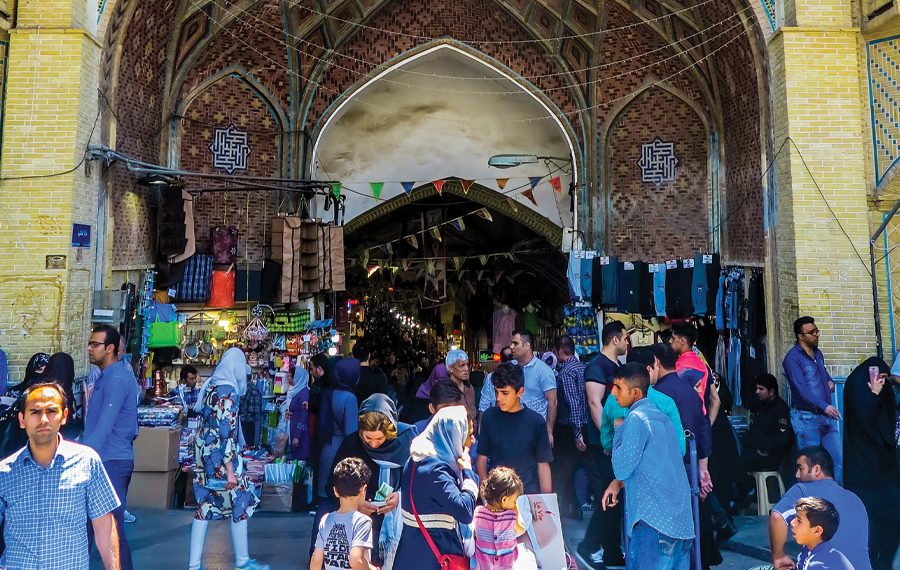 The entrance to the Tehran Grand Bazaar / Photo from depositphotos.com
In such instances, I truly miss having been raised by my grandmothers and aunts in Iran, who would have come up to my mother and said, “You know we love you, but for God’s sake, put some fenugreek and cold cream on your child’s bottom before she turns as red as the beets.” I long to hear such feedback from a know-it-all aunt who could visit me several times a week, rather than from “Debbie” in a Facebook mothers’ group.
The fact that many young women who stay home with their children usually are alone during the day also means they now have extraordinarily greater loads on their plates than ever before. “Tabby,” my mother observed last month as she watched me standing slightly crookedly in front of our kitchen counter, “you stand on your feet too much. When I was your age, I didn’t know what [body] pain was.”
She was right. For nearly a decade, she raised her two daughters with the help of my maternal grandmother, who cooked many of our meals; my paternal grandmother, who lovingly played with us for hours on end; and our many aunts, who slipped us a big bowls of pasta behind our mother’s back when she told us not to ruin our appetites with anything other than meat.
These days, my mother would like to help me but she knows mostly recipes for Persian food, which, however sumptuous, our toddler rejects because he’s discovered chicken nuggets. She struggles to read to him from our multitude of English-language books, and although she cannot pronounce Seussian words such as “wocket” and “nizzards,” she appreciates the books’ magical whimsy.
I understand all of those wonderful women who helped raise me in Iran were able to do so because they could afford to stay home, or because traditional Iranian society did not expect them to work. In the United States, a working woman is the norm. It would be unrealistic to demand I or anyone else be surrounded at home by a support network of people who have nothing better to do than to give us advice on how to persuade our children to eat right.
This is America; we all work and we all hustle. If we need creative ways to feed our children, that’s what Pinterest is for. But for some reason, arguing over chicken fat versus raw eggs and chocolate with my phone instead of a human being always falls flat.
Having a job may be stimulating and rewarding, but it doesn’t mean we still won’t feel alone. Individualism — that wonderful benchmark of the American spirit — can be just a stone’s throw away from solitude and isolation.
I am blessed to have several aunts within proximity to our home in Los Angeles, but I see them only a few times a year because of two of the greatest blessings-turned-curses in this wonderful country: Everyone here is perpetually, maddeningly busy, whether she is 5 or 65, and the indisputable reality of living in a country where everyone respects boundaries and no one wants to “intrude upon your time.”
I am raising my own children in America — in the company of seemingly no one.
The American emphasis on the individual and individual space not only is a foreign value in Iran, but all over the Middle East, including Israel, where a small family dinner at home often turns into a block party with neighbors, and friends arrive at one’s apartment uninvited but certain they’ll never be turned away because “it’s not the right time.”
Personal space is overrated, especially in this city, where one could spend an entire day driving and not talk to another soul. I love America, and I love being an American, but if I have any more personal space, I’m going to suffocate.
The first lesson I learned about the U.S. came in the form of a Chicken McNugget. Immediately after landing at Los Angeles International Airport, our family experienced its first, true moment of American life: We found a McDonald’s, but because we’re Iranian, we became frustrated and overwhelmed at the sheer number of ways someone could make a sandwich. The same paradox of choice soon showed us that in America, there was more than one way to be Jewish, and that included deciding not to be Jewish.
We had never heard of distinctions such as Reform, Conservative, Orthodox or anything else when we were in Iran. If you were Jewish, you either were known to be more practicing or less practicing. That was pretty much it. No one quibbled over who was a “good Jew” because it was hard enough to ensure you were being a “good Iranian,” especially after the revolution, when the first Jewish casualty of the brutal, new theocracy was a generous philanthropist named Habib Elghanian, who was murdered for “being friends with the enemies of God,” a reference to the various charitable causes he supported in Israel.
In Iran, Jews lived as a minority without the option of disassociating from their Jewish identity and joining the majority, unless they wanted to convert to Islam. Even if they were less-observant Jews, as far as many in the greater Shiite population was concerned, they still were Jews — and Jews only.
America simply doesn’t work like that. Here, we’re still a minority, but the only people who never let us forget that at our core, we’re Jewish — whether we’re Reconstructionists, Chabadniks or completely unaffiliated — are anti-Semites. Otherwise, it can become easy even for us to forget we’re Jewish.
Despite an alarming uptick in anti-Semitic incidents during the past few years, I believe the majority of non-Jewish Americans wouldn’t conduct business with a colleague or admit someone to an institution of higher education before thinking to themselves, “I wonder if he is a Jew?”
That wasn’t the case in Iran. For reasons ranging from last names that sounded Jewish to good old-fashioned gossip, everyone knew who was Jewish and who wasn’t. This meant Jews had no choice but to stay within their community simply because Iranian society was less apt to let them break out of it.
Until the turn of the 20th century, this separation was a physical one, as most Jews in Iran were forced to live in Jewish quarters, commonly referred to as the “mahaleh,” because they were believed to be so “najes,” or ritually impure, that they could contaminate the general Muslim population. Jews were banned from leaving their homes during the rain or snow lest their impurities get washed onto a Muslim.
Eventually, the walls of those ghettos wore away, and in the two decades leading up to the 1979 Islamic revolution, the Jews of Iran assimilated more into the greater population in that many embraced secular lifestyles and counted Muslim Iranians as close friends and co-workers. Yet the unspoken boundaries between Jews and the greater population still were alive and palpable.
In Iran, Muslims define Jews; in the United States, Jews define themselves, and often this means they negate themselves because they reject any semblance of Jewish identity. It would only be a matter of time before some Iranian American Jews began to do the same.
Individualism — that wonderful benchmark of the American spirit — can be just a stone’s throw away from solitude and isolation.
“Daniel” believes he is “religiously homeless” but describes his situation with the kind of apathy most people normally reserve for choosing laundry detergent. He won’t set foot inside an Orthodox, Persian synagogue because it reminds him of everything he came to hate about it as a child. According to Daniel, this includes rabbis who try to “scare” congregants into observing halachah, or Jewish law, rather than inspiring them, and Hebrew prayers he cannot understand because he never had any formal Jewish education.
Yet, he cannot attend services at a Reform congregation because everything — from the melodies to the nerve-wracking silence of people praying rather than chatting — are too foreign to him. He’s also anxious that at any moment, a rabbi, informed by gossip, will pull him aside and try to convince him to end his two-year relationship with a young woman of Mexican descent who is not Jewish. He’s stopped attending inspirational talks on Jewish issues aimed at students and young professionals because none of these lectures has come close to the kind of passion and joy his girlfriend exudes when she talks to him about the amazing kindness of Christianity.

Would Daniel have faced such isolation and struggle had he been in Iran? Of course not. He would be living under an oppressive regime and scraping together enough money to buy his family some meat (the rate of inflation in the country currently is 51%) while cursing himself for not having tried to leave Iran sooner. He would have been miserable, but according to his mother, at least he would have made it to a few Shabbat services every now and then.
In America, we each received a second life, but the real question is: What are we doing with that life?
There’s a lot to be said for community, in all its forms: the elderly baker who made fresh loaves of barbari bread so elegantly that the dough almost seemed like an extension of his hands, and who always slipped you a little extra piece and gave you a blessing that your mother should have more healthy children; the kosher butcher who knew exactly what kind of meat you needed the day before Shabbat; the neighbor who heard your bitter screams and invited you to her home for a cup of a tea and a plea for you to be more compassionate to your emotionally detached husband. They were all there — in a land of blessing and curse — where you seldom locked your front door and always lived as a Jew, because society rarely allowed you the chance to identify as anyone else.
There’s a reason why most people — including Persians — prefer peacocks over pigeons. While pigeons annoy, peacocks display, and they display brilliantly. They often hide their true beauty until just the right moment, then whip it out in a fantastic show of lavish opulence. They remind me of a young Persian man who dresses humbly, then drives off in his shiny new Maserati, or every family who takes out a second mortgage on its modest home to fund a $700,000 wedding.
Were we like this back in Iran? A few of us were, but I believe we all had the potential to flaunt what we had — that is, once we were able to get our hands on something. That’s where America came in.
Twenty-five years before Facebook, Iranian American Jews were living in a way that elicited awe, respect and, yes, envy, which is exactly what many wanted. Then social media came along and made what used to be a glamorous wedding attended by 400 into an enviable wedding “trailer” film, shot overhead with a drone and viewable by 2,000 people who didn’t attend the wedding.
In the 1970s, my father asked if he could marry my mother. Technically, he didn’t even ask her; he stood before her and her family, in witness of his own family, praised my mother’s virtues and asked my grandfather for the privilege to marry her. In a way, it sounds backward and unromantic, and qualifies as the very definition of the collective as opposed to the individual.
Today in the United States, or at least in Beverly Hills, a wedding proposal is a very private moment, shared only by the loving couple — and a few photographers, videographers and perhaps a florist. After the happy news is announced via social media, there’s a flurry of congratulatory messages — hundreds of them — all delivered virtually.
In one instant, that private moment becomes publicly visible and with it, self-questioning begins. Parents see those images on Facebook and might wonder why their daughters still are single; wives click on a photo and are envious of the engagement ring in that picture; older folks feel happy for the bride and groom but might wonder why they were fated to endure such a miserable marriage. We all compare.
In Iran, Muslims define Jews; in the United States, Jews define themselves, and often this means they negate themselves because they reject any semblance of Jewish identity.
In Iran, especially after the revolution, miserable societal conditions overshadowed personal misery, whether in the form of an unhappy marriage or unfulfilled career goals. We had bigger fish to fry than feeling inadequate over the size of engagement rings.
In this country, we not only have the freedom and means to fry the fish, but we sit alone and chew on every single piece, often with a side of bitterness and ingratitude.
Ironically, we now have the opportunity to know more about others’ lives than ever before, but most of what we know — such as someone’s latest glamorous vacation — matters little, and we hardly see one another.
In America, we each received a second life, but the real question is: What are we doing with that life?
Are we working harder, driven by an obsession to give more tzedakah this year than we did last year, or by an obsession to have better devices this year than we did last year?
Are we desperate to be married so we can love and be loved and also ensure Jewish continuity and transmit 3,000-year-old values, or so we can have perfect photo ops and congratulatory messages from 800 of our closest friends?
Are we taking full advantage of America’s religious freedoms by choosing to actively live as Jews, or not holding ourselves accountable for whatever assimilation we believe inevitably will knock on our doors?
America is amazing in that it redeems and saves us but also allows us the opportunity to wholly lose ourselves. But do I ever wish I still lived in Iran? Never.
I have bigger fish to fry.
Tabby Refael – is a Los Angeles-based writer, speaker and co-founder of 30 Years After, which promotes civic action, leadership and participation in Jewish life among Iranian American Jews.
Zawartość publikowanych artykułów i materiałów nie reprezentuje poglądów ani opinii Reunion’68,
ani też webmastera Blogu Reunion’68, chyba ze jest to wyraźnie zaznaczone.
Twoje uwagi, linki, własne artykuły lub wiadomości prześlij na adres:
webmaster@reunion68.com






 Zakharii TV