Archives

What is Purim? An introduction to the Jewish holiday

What is Purim? An introduction to the Jewish holiday

  BimBam


rom the parties to the reading of the Megillah to the piles and piles of Hamentashen, Purim is easily the most fun holiday in the Jewish calendar. This video talks about all of the great traditions!

This video was made possible with a generous grant from the Koret Foundation as part of its initiative on Jewish Peoplehood.


Zawartość publikowanych artykułów i materiałów nie reprezentuje poglądów ani opinii Reunion’68,
ani też webmastera Blogu Reunion’68, chyba ze jest to wyraźnie zaznaczone.
Twoje uwagi, linki, własne artykuły lub wiadomości prześlij na adres:
webmaster@reunion68.com


Haley slams Human Rights Council

Haley slams Human Rights Council for inviting Iran rights abuser to speak at UN

ERIC CORTELLESSA


With Iranian Justice Minister Alireza Avaie set to address world body this week, US envoy says United Nations needs reforms to be ‘a good investment of our time and money’

photo, United Nations Ambassador for the US Nikki Haley address UN Security Council meeting on Myanmar’s Rohingya crisis, at UN headquarters in Washington. (AP Photo/Bebeto Matthews, File)

WASHINGTON — US Ambassador to the United Nations Nikki Haley lashed out at the Human Rights Council on Sunday, saying it should be “ashamed” for inviting an Iranian minister notorious for his human rights abuses to address the body’s annual meeting in Geneva this week.

Iran Justice Minister Alireza Avaie’s slated remarks along with some 100 government ministers and other dignitaries from around the world have already elicited outrage from Iranian and international activists.

Haley said his appearance bolsters the Trump administration’s criticisms of the UN and threats to cut US aid to the orginization.

“The Human Rights Council should be ashamed to allow Mr. Avaei to address its membership,” the South Carolina native said in a statement.

“Yet again the Council discredits itself by allowing serial human rights abusers to hijack its work and make a mockery of its mandate to promote universal human rights. This does nothing but reinforce the United States’ call for much needed reforms at the Council for it to be viewed as a good investment of our time and money,” she said.

Alireza Avaie (Alireza.gharibdoust / Wikipedia)

The European Union imposed sanctions on Avaei and other Iranian officials in October 2011 because, as Tehran’s former top prosecutor said, he was “responsible for human rights violations, arbitrary arrests, denials of prisoners’ rights, and an increase in executions.”

Exiled members of the Iranian opposition also said Avaei played a key role in a 1988 massacre of political prisoners. Amnesty International has said that during that episode, nearly 5,000 prisoners were executed in a matter of months; Iranian opposition groups, for their part, put the figure closer to 30,000.

“Allowing Avaie to address the Human Rights Council is disgraceful and would make a mockery of the United Nations and its human rights mechanisms,” Shahin Gobadi, a member of the National Council of Resistance of Iran, told AFP earlier this week. “This must not happen.”


Zawartość publikowanych artykułów i materiałów nie reprezentuje poglądów ani opinii Reunion’68,
ani też webmastera Blogu Reunion’68, chyba ze jest to wyraźnie zaznaczone.
Twoje uwagi, linki, własne artykuły lub wiadomości prześlij na adres:
webmaster@reunion68.com


Trial of Palestinian Ahed Tamimi

Trial of Palestinian teen who slapped IDF soldiers begins behind closed doors

TOI STAFF


Judge at Ofer military court orders outsiders kept out of the proceedings for the benefit of Ahed Tamimi, who is being tried as a minor

Seventeen-year-old Palestinian Ahed Tamimi, right, arrives for the beginning of her trial in the Israeli military court at Ofer military prison in the West Bank village of Betunia, February 13, 2018. (THOMAS COEX/AFP)

The military trial of a Palestinian teenager, who was arrested after a video posted online showed her hitting two IDF soldiers in the West Bank, began Tuesday behind closed doors.

The judge in the trial at the Ofer military court ordered journalists removed from the courtroom, ruling that open proceedings would not be in the interest of 17-year-old Ahed Tamimi, who is being tried as a minor.

Only family members were allowed to remain in the courtroom, and diplomats present to observe were also asked to leave.

She has been charged with 12 counts including assault and could face a lengthy prison term if convicted.

The charges relate to events in the video and five other incidents. They include stone-throwing, incitement and making threats.

A large crowd of journalists had shown up to cover the legal proceedings against Tamimi, whose case has gained international attention.

Tamimi, who has been incarcerated for nearly two months, was seen whispering across the courtroom to her family.

Her father, Bassem Tamimi, shouted, “Stay strong!”

Bassem Tamimi center, the father of seventeen-year-old Palestinian Ahed Tamimi, waves as she arrives for the beginning of her trial in the Israeli military court at Ofer military prison in the West Bank village of Betunia on February 13, 2018. (THOMAS COEX/AFP)

He told The Associated Press as he headed into the court that he came “with no good expectations, because this a military court, and it’s part of the Israeli military occupation.”

Trials of minors in military court are typically closed, but Tamimi’s lawyer said previous hearings for the teenager had been open and she argued for it to remain that way.

“They understand that people outside Ofer military court are interested in Ahed’s case, they understand that her rights are being infringed on and her trial is something that shouldn’t be happening,” lawyer Gaby Lasky told journalists after having unsuccessfully objected to the judge’s decision to close the trial.

“So the way to keep it out of everybody’s eyes is to close doors and not allow people inside the court for her hearing,” she said.

Tamimi celebrated her 17th birthday in prison at the end of January after a military judge ordered her remanded until the end of proceedings against her.


Ahed Tamimi’s mother, Nariman Tamimi, who also appeared in the widely shared footage, was also remanded until the end of proceedings. Ahed’s cousin Nour Tamimi was released after being charged for her participation in the December 15 incident.

Ahed Tamimi has said that the same soldiers featured in the video had shot her cousin in the head with a rubber bullet an hour before the filmed encounter.

The three Tamimis are facing aggravated assault charges. Ahed’s 12-count indictment refers to a statement she gave to her mother — who was filming the incident and streaming it on Facebook — in which she called for more violence. Immediately following the squabble, Nariman asked her daughter what kind of message she wanted to convey to viewers.

“I hope that everyone will take part in the demonstrations as this is the only means to achieve the result,” Tamimi said. “Our strength is in our stones. Whether it is stabbings or suicide bombings or throwing stones, everyone must do their part and we must unite in order for our message to be heard that we want to liberate Palestine.”

Nour Tamimi, second left, and her aunt Nariman Tamimi, second right, attend a hearing at the Ofer military court in the West Bank on January 1, 2018. (AFP Photo/Ahmad Gharabli)

Earlier this month attorney Lasky told The Times of Israel that the trial, which had been slated to begin on January 31, has been twice delayed because the military prosecution had failed to hand over evidence.

Since her arrest Tamimi has become a cause célèbre for Palestinian supporters, and rallies have been held in several locations calling for her release. Many Palestinians see her as bravely standing up to military control over the West Bank, while Israelis accuse her family of using her as a pawn.

Jacob Magid contributed to this report.


Zawartość publikowanych artykułów i materiałów nie reprezentuje poglądów ani opinii Reunion’68,
ani też webmastera Blogu Reunion’68, chyba ze jest to wyraźnie zaznaczone.
Twoje uwagi, linki, własne artykuły lub wiadomości prześlij na adres:
webmaster@reunion68.com


3 Israeli startups vying to be the Waze of indoor spaces

Israel21c3 Israeli startups vying to be the Waze of indoor spaces

Abigail Klein Leichman


Oriient, Navin and Indoorgo want to help you navigate malls, museums, hospitals and airports without any need for installed hardware in the venue.

Image via Shutterstock.com

The Israeli navigation app Waze will steer you to your destination along the fastest route. But it can’t help you find your way inside a mall, museum, school, hospital, airport or other large building because GPS doesn’t work indoors.

This problem has caught the attention of tech companies large and small, including Google and Apple, yet today’s indoor maps haven’t mastered live navigation functionality.

Three Israeli companies are meeting this challenge with sophisticated indoor orientation apps independent of beacons or any other hardware installations in the venue. Each approach is slightly different, as we explain below.

Oriient

Oriient, founded in February 2016 in Tel Aviv, is building a plug-in for app developers on a monthly licensing model. The technology pinpoints indoor position within three feet using information from the Earth’s magnetic field and from sensors inside every smartphone.

Many malls, for example, already offer visitors free dedicated apps that enable them to do a store or product search. Adding Oriient to that app will provide an accurate indoor positioning service to guide the shopper directly to the store and even the shelf. The same could be done in any large building.

“Retailers and facility managers expect the service to just work without installing or maintaining anything. It’s low-cost and no hassle, and that’s what drives us,” CEO Mickey Balter tells ISRAEL21c.

Oriient was incubated in the 8200 EISP accelerator in Tel Aviv from January to June last year, and then from June to September in Techstars/Metro Accelerator for Retail in Berlin, a new cooperation between a German retail chain and an American accelerator.

“Through that platform we gained significant customers in the European retail space and are working with them on deployment,” says Balter.

“Next would be extension to the US and to non-retail verticals like smart buildings and robotics. We are seeing a lot of opportunities in the ‘future of the workspace’ as a lot of office buildings are introducing indoor positioning. We don’t necessarily have to track smartphones; we can also track robots.”

Oriient has five employees and is hiring more, having received more than $2 million in seed funding.

Navin

Navin took off nearly five years ago, guided by cofounders including Shai Ronen, a former F-16 combat navigator and Technion computer science graduate who worked in mapping and navigation technology at Elbit, Visionmap and Compugen.

Like Waze, the Navin app is powered by crowdsourcing. Its patented P2P Crowd Mapping technology turns smartphones into anonymous indoor mapping devices that passively capture millions of data movement points using aviation-grade stabilization, noise-canceling and drift-correction algorithms. The app generates maps from these data points.
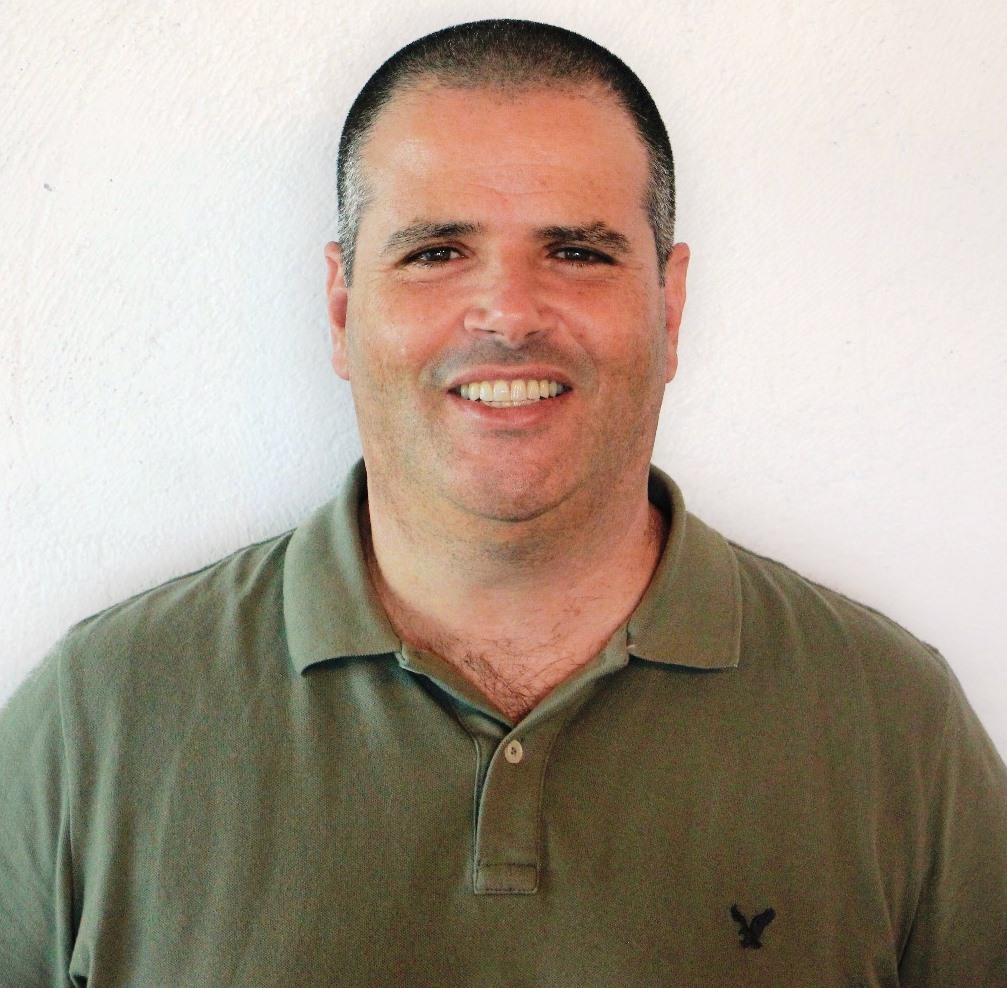
Shai Ronen of Navin. Photo: courtesy

“We have the novel ability to create detailed maps of any building anywhere in the world remotely on our servers, without us ever being in that building,” Ronen tells ISRAEL21c.

Because a critical mass of data is needed to create each map — about 20 to 40 users using virtually any device at any time — Navin will recruit regional “ambassadors” to do the mapping prior to a beta launch early this year in one city at a time. Currently, Navin is being tested in large Israeli hospitals.

Navin was incubated in 8200 EISP and then in the Microsoft Ventures accelerator. Three years ago, serial entrepreneur Gidi Barak came aboard as founder and active chairman.

The Tel Aviv startup has 12 employees and has raised nearly $2 million from investors and the Israel Innovation Authority. Recently, Navin opened an office in Hong Kong because “Asia is a great place to start and there is a lot of interest in Hong Kong and Singapore, which are gateways to other countries,” says Ronen.

The revenue model probably will be based on in-app advertising from businesses in the buildings mapped, targeted to individual users’ movement patterns.

Indoorgo

Indoorgo Navigation Systems is developing an app that makes use of smartphone sensors and existing infrastructure in a building, such as Wi-Fi and Bluetooth, as well as the fixed position of the building’s overhead lights.

“This also allows us uniquely to give navigation in places such as parking garages,” says Larry Loev, CEO of Ariel Scientific Innovations, the technology commercialization arm of Ariel University.

The core technology was developed nearly five years ago in the university’s Kinematics and Computational Geometry Laboratory by professors Boaz Ben-Moshe and Nir Shvalb. Ben-Moshe and Ariel Scientific Innovations are the primary shareholders of Indoorgo, which has been exclusively funded till now by Ariel University.

To add any building to the app’s central database, it must be mapped once by one person – it could be an employee of the building, with no special training – in the course of about two hours. Data from subsequent Indoorgo users improves the positioning accuracy, explains Ben-Moshe. “Accuracy of up to 3 meters is achieved for the first visitor, gradually improving to less than 1 meter.”

Loev says this resolution is significant. “Google Maps can throw you off by 10 to 15 meters, while ours will be a product you can reliably use.”

Indoorgo is in the demo stage and has been tested in Israeli shopping malls. “The company is now ready for investment or sale,” says Loev.

Targeted in-app advertising is the most likely revenue model.


Zawartość publikowanych artykułów i materiałów nie reprezentuje poglądów ani opinii Reunion’68,
ani też webmastera Blogu Reunion’68, chyba ze jest to wyraźnie zaznaczone.
Twoje uwagi, linki, własne artykuły lub wiadomości prześlij na adres:
webmaster@reunion68.com


NO LEGISLATION CAN REWRITE HISTORY

NO LEGISLATION CAN REWRITE HISTORY

DANIEL SCHATZ


“One cannot fake history, one cannot rewrite it, one cannot hide the truth.”

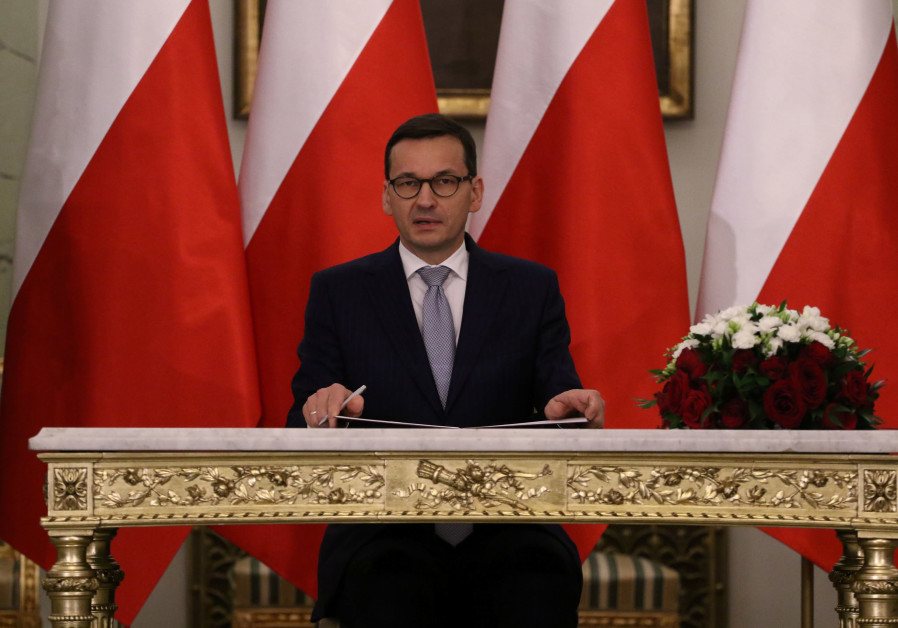
Newly appointed Polish Prime Minister Mateusz Morawiecki reacts after receiving his nomination from President Andrzej Duda during a government swearing-in ceremony in Warsaw, Poland, December 11, 2017. (photo credit: AGENCJA GAZETA/SLAWOMIR KAMINSKI VIA REUTERS)

My childhood was full of magical, well-known tales of love and joy and everyday life in the shtetls of Poland, told with warmth and wit by my grandparents. Some of these characters became my childhood heroes.

As a little boy yet unaware of Auschwitz, I wondered about my grandmother’s sadness: even when telling funny stories, she seemed to laugh with one eye and cry with the other. I don’t remember when I found out that all the characters, so alive in these vivid stories, were murdered in the Holocaust.

In recent years I have had several opportunities to visit former Polish shtetls, including the town of Zamosc, where my grandmother’s family lived before the Second World War. These villages are places where memory has been turned into history.

On a one-lane street leading to a small house on Ulica Gesia in Zamosc, I found the house where the Zalcman family once lived. It was from here that my relatives were sent to the death camp of Belzec in July 1942.

My grandmother saved herself by fleeing to the Soviet Union with her parents. While taking refuge in the towns and villages of the Polish countryside throughout the daring escape, they lived in constant fear of being denounced by their Polish neighbors.

On another street in Katowice, I found the house where my grandparents found refuge after miraculously surviving the war. From here, they were expelled in 1968 following the Polish communist government’s antisemitic campaign resulting in the forced exodus of nearly all of the country’s remaining 20,000 Jews, a mere 25 years after Nazi Germany had carried out the Holocaust on Polish soil.

Although World War II ended in 1945, the past is never dead. It’s not even past, as the author William Faulkner put it. Last week Poland’s President Andrzej Duda signed into law a bill approved by the country’s senate, imposing prison terms of up to three years for anyone who acknowledges Polish complicity in the Holocaust.

In addition to the risk of infringing upon freedom of speech and academic scholarship, the legislation – spearheaded by Warsaw’s ruling right-wing populist Law and Justice Party (PiS) – may distort historical records about the complicity of segments of the country’s population in the persecution of their compatriots.

The narrative of Poles as the main victims of Nazi Germany is deeply rooted in Polish national memory. Six million of its citizens were murdered by the Germans. Of the six million Jewish Holocaust victims, half were Polish Jews, accounting for 90% of the Jewish population in the country. Poles constitute the largest national group within the Righteous Among the Nations recognized by Yad Vashem, the World Holocaust Remembrance Center in Jerusalem.

The idea of Polish national innocence is nonetheless – as pointed out by the American historian Timothy Snyder – far from innocent itself. A growing number of scholars – as the Polish-Canadian historian Jan Grabowski – have argued that Poles took simultaneous roles as victims, perpetrators and bystanders. He documents their involvement in betraying and murdering their compatriots in The Hunt for the Jews: Betrayal and Murder in German-Occupied Poland (2013), while highlighting the heroism of individual Poles who risked their lives in efforts to save Jews.

The publication of Neighbors (2001) by the Polish-American historian Jan Tomasz Gross had already spurred Polish society into collective soul-searching and official state apologies. Gross details how, on July 10, 1941, under the eyes of the German occupiers, Polish Catholics murdered hundreds of their Jewish neighbors by burning them alive in the town of Jedwabne. Poland’s Institute of National Remembrance revealed, following a two-year investigation, that mass murders initiated by locals had taken place in several other villages.

Illustrative of the prevailing political sentiments in Warsaw, Poland’s Education Minister Anna Zalewska insinuated during an interview on the public broadcaster TVN in 2016 that the Jedwabne massacre was a matter of opinion. The same year, Gross was summoned to appear before Polish police for stating that Poles killed more Jews than they did Germans during the Holocaust. Gross was suspected of insulting the honor of the Polish nation.

Rather than seeking to use history to serve the imperatives of the present, those who see themselves as defenders of Poland’s good name should draw inspiration from its former president Aleksander Kwasniewski, who stressed to the Knesset in 2000 that “one cannot fake history, one cannot rewrite it, one cannot hide the truth.”

No government can rewrite historical facts and no law can erase history. Each society ought to examine historical developments and offenses, irrespective of the nationality of the perpetrators, to eradicate the ghosts of the past and safeguard a future founded upon respect for human rights, democracy and the rule of law. This remains our obligation to the dead and the living.


Daniel Schatz  – The author is a political scientist and Visiting Scholar at Columbia University’s European Institute. He has served as a Visiting Fellow at Harvard, Stanford and Georgetown University.


Zawartość publikowanych artykułów i materiałów nie reprezentuje poglądów ani opinii Reunion’68,
ani też webmastera Blogu Reunion’68, chyba ze jest to wyraźnie zaznaczone.
Twoje uwagi, linki, własne artykuły lub wiadomości prześlij na adres:
webmaster@reunion68.com