Archives

US Sanctions Six People, Seven Firms Under Rules Targeting Hezbollah

US Sanctions Six People,
Seven Firms Under Rules Targeting Hezbollah

by Reuters and Algemeiner Staff


The entwined flags of Hezbollah and Iran. Photo: File.

The Trump administration attacked Hezbollah’s financial network on Friday by imposing sanctions on six people and seven entities in an effort to turn back Iran’s influence in the Middle East and beyond.

“The administration is determined to expose and disrupt Hezbollah’s networks, including those across the Middle East and West Africa, used to fund their illicit operations,” Treasury Secretary Steven Mnuchin said in announcing the penalties under financial regulations targeting the Lebanon-based Hezbollah terrorist group.

The six sanctioned individuals included five Lebanese and one Iraqi, most of them linked to Al-Inmaa Engineering and Contracting, the Treasury Department said. The seven entities were firms based in Sierra Leone, Liberia, Lebanon and Ghana, the statement said.

Senior Trump administration officials said the sanctions were part of an aggressive move against Hezbollah to try to limit the influence of Iran, which gives the group about $700 million a year to help finance its activities.

The officials, briefing reporters at the White House on condition of anonymity, said the Trump administration was working to reverse what it considers a more lackadaisical approach toward Hezbollah by Democratic President Barack Obama after the 2015 Iran nuclear deal went into effect.

More such targeted sanctions are expected in the months ahead, they said.

The officials said Hezbollah was already under financial strain as it continued to pay for costly operations in Syria and Yemen. The goal was to get European allies to join the United States in increasing pressure on the group, they said.

As a result of the Treasury designations, all their assets subject to US jurisdiction are blocked and Americans are prohibited from engaging in transactions with them.

The six individuals were targeted because they are linked to financier Adham Tabaja and his company, Al-Inmaa Engineering and Contracting. The officials described Tabaja as among the top five Hezbollah financiers at the moment.


Zawartość publikowanych artykułów i materiałów nie reprezentuje poglądów ani opinii Reunion’68,
ani też webmastera Blogu Reunion’68, chyba ze jest to wyraźnie zaznaczone.
Twoje uwagi, linki, własne artykuły lub wiadomości prześlij na adres:
webmaster@reunion68.com


Remembering a warrior poet who embodied the Israeli experience


Remembering a warrior poet who embodied the Israeli experience

JOSHUA DAVIDOVICH


Haim Gouri is eulogized as the last of a generation, a fighter and writer who was able to speak to the nation but was also tarnished by his right-wing politics
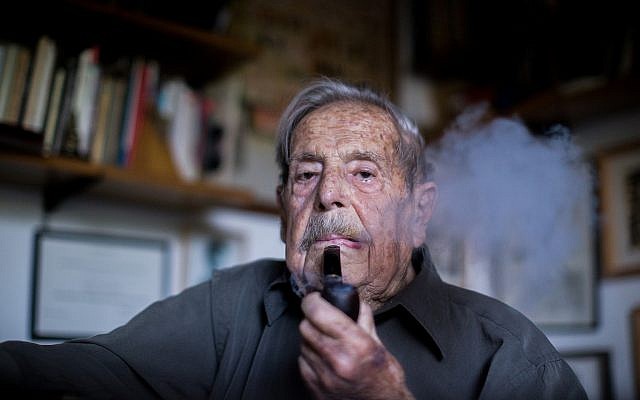
Veteran Israeli poet, novelist, journalist, and documentary filmmaker Haim Gouri at his home in Jerusalem, July 6, 2015. (Yonatan Sindel/Flash90)

Haim Gouri was perhaps Israel’s best example of its unique brand of warrior-poets, birthed of a search for meaning through the fires of the Jewish people’s traumas and the country’s early wars.

It’s impossible to sum up the life of Gouri, a man of letters who in many ways embodied the competing personalities of Israel — fighters yearning for land but also peace — into a handful of pages, but a day after his death Wednesday, papers try their hand at remembering who he was and what he meant and encapsulating it into the format of a daily.

The tabloids Israel Hayom and Yedioth Ahronoth devote a combined dozen pages to Gouri, and through all the remembrances and eulogies there is also a profound sense of loss for a mythological Israel of yore he personified, as if he were the last living breath of those who built the country, especially those of the pre-state Palmach militia. Yedioth Ahronoth, which includes a caricature of him joining other poetic Palmach alums on a cloud, calls him “The last national poet” and Israel Hayom says he was “The last of the giants.”

Haaretz’s straight-up obituary of Gouri notes that “Gouri’s poems were the poems of the Israeli national ethos, and many of his poems became inalienable assets of Israeli culture.”

“Gouri was many things,” writes Nahum Barnea in Yedioth Ahronoth. “He was a gifted poet and artist, one of the most talented people of the ’48 generation; he was the flesh and blood of the state, loving and pained; he was an excellent journalist, curious, empathetic, who knew how to describe a scene or tell a story; he was a courageous fighter, moral, who knew who to act with humanity and charity toward a conquered population; he was a simple, humble and honest man of conscience.”

In Israel Hayom, Amnon Lord, who knew Gouri personally, adds a bit more color to his humble life, especially the mostly overlooked last chapters.

“Until his last month he would continue to climb the three stories to his modest apartment in the Jerusalem neighborhood of Talbieh. A home without an elevator. Alika, as he called his wife Aliza, would take care of him. Make sure he didn’t drink, or at least not too much, and didn’t get annoyed and come to blows with some annoying passerby who started to harass him for his political views,” he writes.

Israelis mourn near the coffin carrying Israeli poet, novelist, journalist and filmmaker Haim Gouri, outside the Jerusalem theater on February 1, 2018. Gouri passed away yesterday. (Yonatan Sindel/Flash90)

In Yedioth, writer Amos Oz writes that Gouri’s right-wing politics indeed came between them “but we remained close friends.”

Yet those politics also lead to a rare bit of criticism of Gouri in Haaretz’s lead editorial.

“Gouri’s tragedy, like those of many of his generation, was the effort to straddle the fence, to shoot while crying, to be both moral and an occupier. Gouri called it ‘the third way.’ He belatedly realized that the settlers and right-wing governments were leading the state into moral disaster and undermining the democracy the founders established. But he didn’t succeed, or didn’t dare, to offer an alternative and to fight for it. The 1948 generation left that mission to its heirs,” the paper writes.

In Israel Hayom, writer A.B. Yehoshua also writes about Gouri’s politics, how he became a believer in the two-state solution after “he understood that keeping greater Israel meant apartheid for Arabs,” but he zeros in on Gouri’s work as a journalist able to put ideology to the side.

“His journalist’s instinct — to go into a place and bring the voice of people — gave great strength to his writing and his humanity,” he writes. “He could cross generational boundaries in a wonderful way, and was able to speak with those younger than him and older than him.”

In Yedioth, Eitan Haber focuses on Gouri’s fighter past, writing that his name should be inscribed on every military memorial in the country, as someone who was always with the IDF.

“Gouri was a national poet, who wrote his poetry with an iron pen. In a country whose years are rich with security operations, he was a symbol to those who followed after him in wars,” he writes.

There’s some actual news in the papers as well and Haaretz’s lead story previews what may be the next war, with a headline quoting Defense Minister Avigdor Liberman saying the next battle in the north “will need ground troops or will never end.”
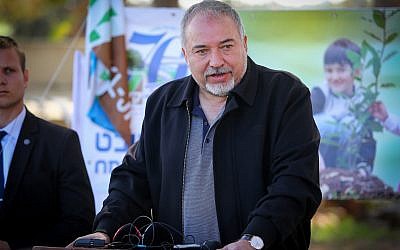
Defense Minister Avigdor Liberman during a ceremony for the Jewish holiday of Tu Bishvat in Kibbutz Kfar Aza, in southern Israel, January 31, 2018. (Flash90)

“No one is looking for adventures, but if we have no choice the goal is to end [the fighting] as quickly and as unequivocally as possible,” Liberman is quoted saying. “Regrettably, what we have in all the conflicts in the Middle East is that without soldiers on the ground it does not come to an end.”

Israel Hayom meanwhile looks at the country’s enemies in the south, after Hamas leader Ismail Haniyeh was placed on the US terror blacklist.

Columnist Eyal Zisser praises the move to the super moons and sees it as a sign of US President Donald Trump’s commitment to Israel.

“The message from Washington is clear: Haniyeh and Hamas are part of the problem and not the solution, and the Trump administration has no intention of ‘embracing’ Hamas to bring it into dialogue in the false hope that it will soften and give in,” he writes. “It’s also a message to Palestinian Authority President Mahmoud Abbas, who thought he could play with the Trump administration like he did with his predecessor in the White House, and who has tried to deal with Hamas via an intra-Palestinian reconciliation process instead of fighting them.”


Zawartość publikowanych artykułów i materiałów nie reprezentuje poglądów ani opinii Reunion’68,
ani też webmastera Blogu Reunion’68, chyba ze jest to wyraźnie zaznaczone.
Twoje uwagi, linki, własne artykuły lub wiadomości prześlij na adres:
webmaster@reunion68.com


Don’t Go To Israel

Don’t Go To Israel

Noy Leyb


We’ve all heard the rumours. Danger. Warzone. Scary.
Israel is not a safe place to travel to, and this video explains why.
A video by Noy Leyb and Maya Gilady

Footage: Creative commons
Footage Credit: http://bit.ly/2sT0q2l
Music: Living water by Generdyn (license)


Zawartość publikowanych artykułów i materiałów nie reprezentuje poglądów ani opinii Reunion’68,
ani też webmastera Blogu Reunion’68, chyba ze jest to wyraźnie zaznaczone.
Twoje uwagi, linki, własne artykuły lub wiadomości prześlij na adres:
webmaster@reunion68.com


College students from 13 countries learn coding in TLV

Israel21cCollege students from 13 countries learn coding in TLV

ISRAEL21c   Staff


TAVtech, a 4.5-week fellowship, ends with a three-day social impact hackathon.

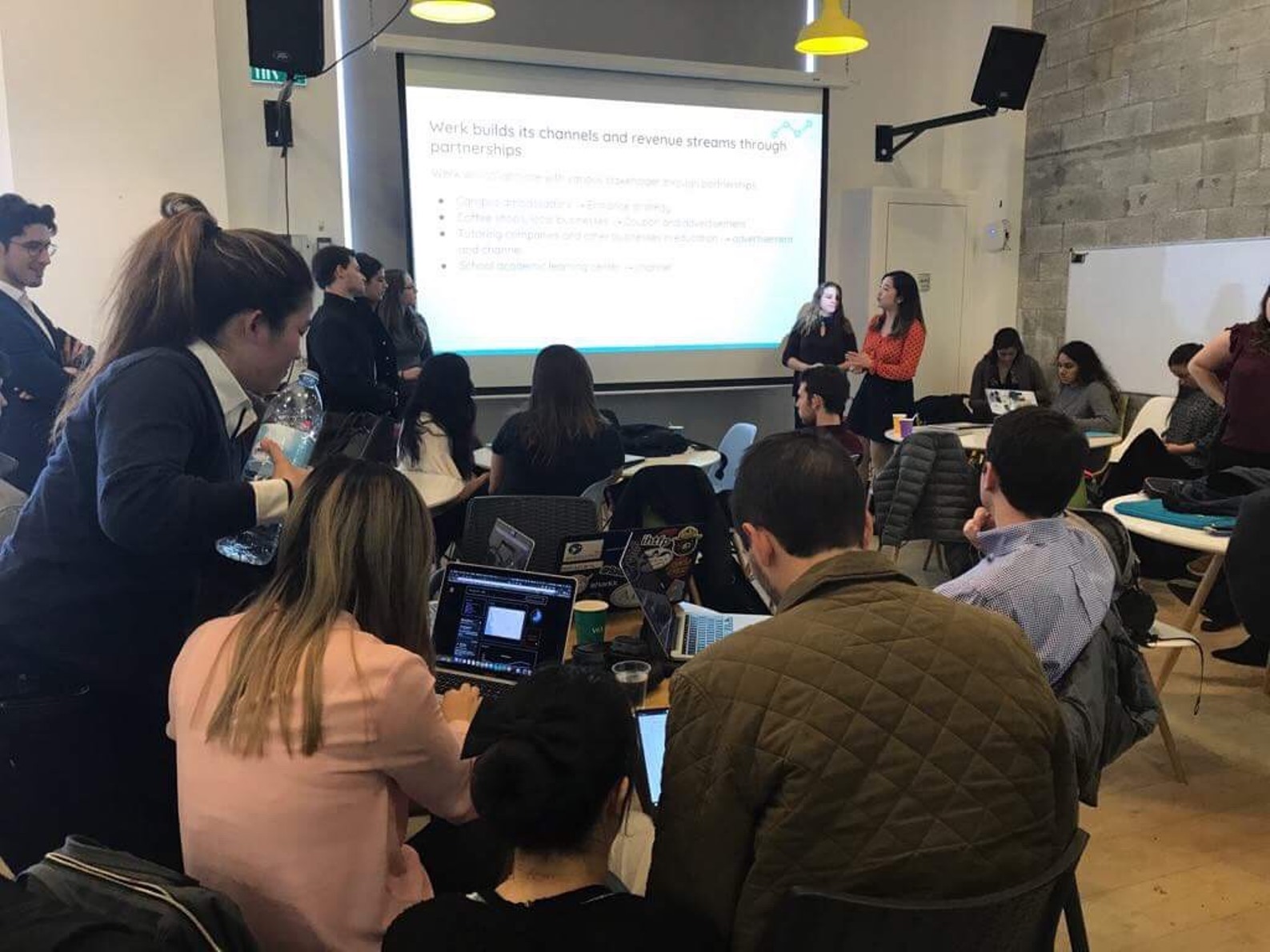
Masaki Kagesawa presents his team’s project on bitcoin mining for charities to the judges. Photo by Eytan Rubinstein

Eighty college students from Argentina, Canada, China, India, Israel, Italy, Japan, Kenya, Russia, Singapore, South Africa, Turkey and the United States came together in Tel Aviv during January session break for another edition of TAVtech Ventures, a 4.5-week coding and entrepreneurship fellowship.

The students learn high-demand coding skills in hot areas such as artificial intelligence, big data, cybersecurity and data science, while interacting with leading players in Israel’s startup ecosystem including Israel Innovation Authority CEO Aharon Aharon and Israel Cleantech Ventures Partner Jack Levy.

The nonprofit fellowship program (motto: “Code for the Planet”), founded two years ago by students from NYU and Harvard, places an emphasis on social impact. It concludes with TAVhacks, a three-day hackathon where the students team up and combine the technical skills and information acquired over the previous four weeks to create projects (and possibly startups) with a meaningful social impact.

This year, 17 teams of young technologists competed in the first round of the hackathon. Five advanced to the final round to compete for three awards — The Changemaker, Tech Savvy and Audience Favorite – determined by judges including Jimmy Levy (Al Bawader Capital and Galil Software), Rina Shainski (Duality Technologies), Nir Kouris (NK- Innovation Strategy Marketing), Daniel Ben Yehuda (Fintech Venture Builder) and Eyal Toledano (Zebra Medical Vision).

Participants in the 2018 TAVhacks social-impact hackathon for foreign college students in Tel Aviv. Photo by Shreya Raghunandan

The Changemaker award went to a team that proposed a website and browser extension where users create profiles indicating their favorite brands and charitable causes, to facilitate the donation of a portion of sales profits at checkout.

The Tech Savvy award went to a team proposing a “‘next-generation identity solution” giving marginalized or displaced children under five access to a digital identity infrastructure.

The Audience Favorite award was won by FaceReality, a web application that uses image-to-image translation with conditional adversarial networks to transform police sketches of suspect’s faces to photos.


Zawartość publikowanych artykułów i materiałów nie reprezentuje poglądów ani opinii Reunion’68,
ani też webmastera Blogu Reunion’68, chyba ze jest to wyraźnie zaznaczone.
Twoje uwagi, linki, własne artykuły lub wiadomości prześlij na adres:
webmaster@reunion68.com


PAYPAL CLOSES ACCOUNT OF FRENCH BDS ORGANIZATION

PAYPAL CLOSES ACCOUNT OF FRENCH BDS ORGANIZATION

BENJAMIN WEINTHAL


France has one of the most robust anti-BDS laws in Europe

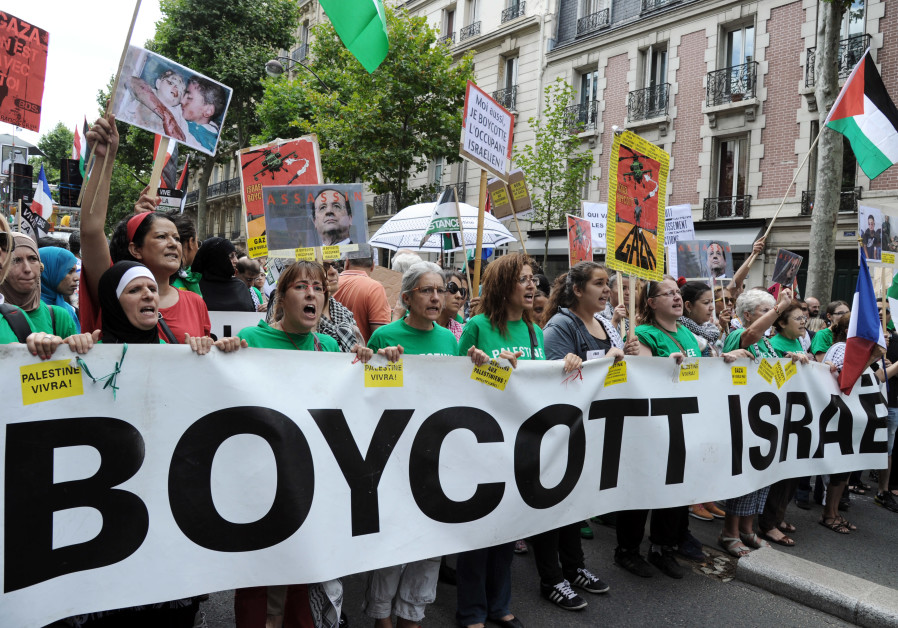
Protesters hold abanner that reads “Boycott Israel” during a pro-Palestinian demonstration in Paris. (photo credit: AFP PHOTO / DOMINIQUE FAGET)

The US online payment company PayPal closed the account of one of France’s most powerful boycott Israel organizations – the France-Palestine Solidarity Association – The Jerusalem Post learned on Friday.

As part of an investigative series into funding streams for Boycott, Divestment, Sanctions organizations targeting Israel, the Post had asked PayPal on Tuesday: Is the association’s account with PayPal in violation of France’s anti-discrimination law? Is the account in violation of PayPal’s anti-hate policy? France has one of the most robust anti-BDS laws in Europe, the Lellouche Law, which bans discrimination based on national origin.

Paul Furia, a spokesman for the French Foreign Ministry, told the Post that “I can’t comment specifically on the AFPS [the France-Palestine Solidarity Association] PayPal account, nor speak on behalf of the company to tell you whether or not the account should be canceled.

“However, I want to point out that calling to boycott of Israel is indeed illegal in France. Several decisions of the highest criminal court [the Cour de Cassation] confirmed that calling to boycott breaks the law and constitutes an ‘incitation to discrimination or hate based on national origin or religion.’” A PayPal representative told the Post on Friday: “Due to customer confidentiality, we cannot comment on the details of any specific PayPal account. However, we would like to stress that PayPal has zero tolerance for the use of our secure payments platform to facilitate illegal activities. We make every effort to comply with laws and regulations around the world. Compliance with these laws is something we take very seriously. We carefully review questionable activities reported to us, and discontinue our relationship with account holders found to violate our policies.”

After a Post 2016 exposé of another BDS organization – Campagne BDS France – PayPal and banking giant Credit Mutuel closed the group’s accounts amid escalating criticism over its illegal practices.

The Israeli government published in early January a list of 20 BDS organizations, which included Campagne BDS France and the France-Palestine Solidarity Association, that are banned from entering the Jewish state. Strategic Affairs Minister Gilad Erdan said at the time: “The boycott organizations need to know that the State of Israel will act against them and not allow them entry to harm our citizens,” adding, “No nation would have permitted entry to critics coming to harm the country.”

The France-Palestine Solidarity Association said, “The members of France-Palestine Solidarity Association are attached to the right of peoples to self-determination and to the defense of the individual. Their purpose is to develop solidarity with the Palestinian people and to support them particularly in their fight for the fulfillment of their national rights.”

According to a January 2017 report by the Jerusalem-based NGO Monitor, the France-Palestine Solidarity Association “does not publish financial information, reflecting a lack of transparency and accountability,” and the association “receives government funding from the French government through different governmental bodies.”

The French Development Agency gave the association €320,000 for 2017-2019, NGO Monitor wrote.

NGO Monitor documented the France-Palestine Solidarity Association’s anti-Israel and allegedly antisemitic language, including calling the Gaza Strip an “extermination camp” due to the “criminal Israeli government – and all those who support it… the small ‘angels of death’ who are sheltered there to continue their experiments and envision the ‘final solution.’” THE ASSOCIATION accuses Israel of ethnic cleansing and apartheid, and calls for it to “Stop hunting Palestinian children!” wrote NGO Monitor. The NGO Monitor research document provides links to the association’s website in connection with its anti-Israel rhetoric.

The France-Palestine Solidarity Association terms Israel’s West Bank security barrier an “apartheid” wall.

According to the association, Israeli policies “institutionalize a military and colonial domination over the Palestinian people in order to exploit them and make them disappear as a people, by decomposing it, transferring its population and/or forcing it to exile. This matches the notion of ‘sociocide.’” NGO Monitor wrote that the association legitimizes the use of armed struggle as a means for Palestinian liberation and states that Israel “deploys a state terrorism in the name of preventive war.”

French MP Meyer Habib told the Post on Thursday: “According to Article 225-2 of French Criminal Code, French law prohibits all forms of call for economic boycott ‘on the basis of race, religion or national origin.’” He added that “the jurisprudence of the French Court of Cassation of October 20, 2015, is perfectly clear in this matter as well. This rule applies to all economic players, including banks. In the light of the above, Credit Mutuel closed BDS France’s account in May 2016.

“Truly, AFPS [the France-Palestine Solidarity Association] is part of the BDS movement and promotes discrimination against Israelis because of their national origin. Under the cover of charitable activities for the Palestinian people, they try to circumvent national anti-discrimination regulation in order to promote boycott and hatred of Israel,” he said.

Habib continued, “As a French MP, representing the 150,000 French nationals residing in Israel, I fight fiercely against all forms of hatred toward Israel.

“Generally speaking, I am absolutely certain that anti-Zionism is the new face of antisemitism. I believe that AFPS’s real activity must be unmasked, and that its bank accounts should be closed in accordance with the law.”

Marc A. Greendorfer, the head of the US-based Zachor Legal Institute, which combats BDS activity, filed a complaint with PayPal on Tuesday for providing accounts to the France-Palestine Solidarity Association and the German neo-Nazi organization The Third Way.

“On behalf of Zachor Legal Institute, a civil rights legal foundation, we would like to report two violations of your acceptable use policy,” Greendorfer wrote.

“The accounts for the entities listed below violate the AUP, as they promote hate and racial intolerance. Each of these accounts promotes antisemitism and national origin discrimination through their promotion of the so-called ‘Boycott, Sanction, Divestment’ movement that targets Israel and those of Israeli origin. Please advise us of your position on this report,” he wrote.

The France-Palestine Solidarity Association did not immediately respond to Post queries.


Zawartość publikowanych artykułów i materiałów nie reprezentuje poglądów ani opinii Reunion’68,
ani też webmastera Blogu Reunion’68, chyba ze jest to wyraźnie zaznaczone.
Twoje uwagi, linki, własne artykuły lub wiadomości prześlij na adres:
webmaster@reunion68.com