Archives

WHAT IS THAT TATTOO ON YOUR ARM?

WHAT IS THAT TATTOO ON YOUR ARM?

AMY SPIRO


The Number on Great-Grandpa’s Arm will air on HBO in the US on Saturday, January 27 and will be available in Israel on February 3.
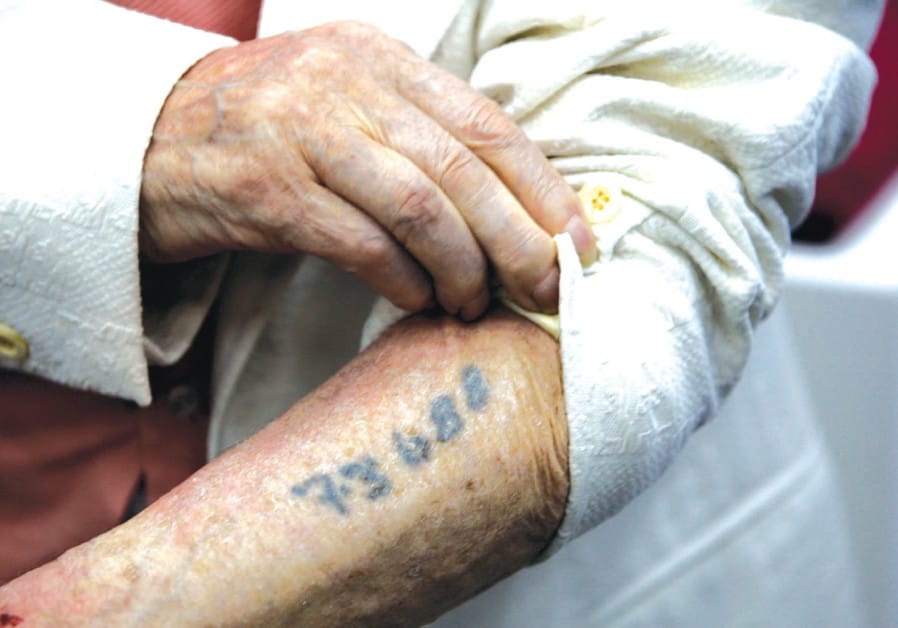
A Holocaust survivor shows his tattoo. (photo credit: BAZ RATNER/REUTERS)

Elliot has a lot of questions for his great-grandfather. What did you do for fun as a kid? Did you go to school? What did your father do for a living? Why do you have a number tattooed on your arm?

10-year-old Elliot loves spending time with his 90-year-old great-grandpa Jack. The sweet relationship between the two is the focus of a new HBO documentary that will air later this month, called The Number on Great-Grandpa’s Arm.

The film is a joint effort of HBO and the Museum of Jewish Heritage, directed by Amy Schatz and featuring hand-painted watercolor animation from artist Jeff Scher, and is set to air on International Holocaust Remembrance Day.

The moving 20-minute documentary is narrated by Elliot, who loves spending time with his great-grandfather but is aware of his painful past. The young boy asks pointed, direct questions about Jack’s wartime experience, and also narrates a basic overview of the events of the Holocaust.

“Concentration camp was a place where they kept them behind a bunch of electric fences so they wouldn’t escape,” Elliot explains.
Sure, at times it’s clear that the young boy is reading out scripted lines, but the film’s overall effect is poignant and compelling.

And there’s no denying the unvarnished, irrefutable love between the old man and the little boy.

Interspersed with footage of Elliot and Jack talking, and the photos of Jack’s life both before and during the war, are a full eight minutes of hand-painted watercolor images by Scher recreating wartime scenes.

The animation shows the roundup in the Sosnowiec Ghetto, the life in Auschwitz and the death march that began as the war neared its end.

Jack patiently tells Elliot about his life before the war, his father’s hat shop and his love of soccer. He then explains when they had to begin wearing yellow stars, and leave their home and move to the ghetto. He was later deported to a string of concentration camps before ending up in Auschwitz. He never saw his mother or father ever again, and always wondered what happened to them, he tells Elliot.

Jack rebuilt his life in Rochester, New York, and opened a fish restaurant there.

One of the most moving scenes in the film features him in the store with a customer.

“This is his number right here,” the customer says, gesturing to Jack’s arm. “And he knows exactly what it means to be hungry. So if there’s anybody hungry, he’s gonna feed ‘em. If you got money or not.”

Elliot’s matter-of-fact narration and unspoiled curiosity have created a short, sweet film that is appropriate for adults and also for older children. The horrors of World War II are not easy fare for any age, but they are also a necessity for everyone to learn.

“You need to know it to understand, to stop it from happening in future generations,” Elliot says. “They say in like a year or two, there’s going to be no survivors left.

And so we’re trying to get all their stories and information before they pass away.”

The Number on Great-Grandpa’s Arm will air on HBO in the US on Saturday, January 27. It will become available via HOT VOD and Yes VOD in Israel on January 28 and air on TV on February 3.


twoje uwagi, linki, wlasne artykuly, lub wiadomosci przeslij do: webmaster@reunion68.com


27 January – International Holocaust Remembrance Day

27 January – International Holocaust Remembrance Day

Yad Vashem


“The Holocaust, which established the standard for absolute evil, is the universal heritage of all civilized people”

UN Declaration Holocaust remembrance

Download the PDF file .

Visit Yad Vashem

The Righteous


twoje uwagi, linki, wlasne artykuly, lub wiadomosci przeslij do: webmaster@reunion68.com


Top 10 Most Influential Israelis In International Business, Science, and Culture in 2017

Top 10 Most Influential Israelis In International Business,
Science, and Culture in 2017

Simona Shemer


Israelis are recognized leaders in any number of fields including technology, medical research, innovation and humanitarian aid.

As the year comes to a close, NoCamels has put together a list of this year’s most influential Israelis in the spheres of literature, science, tech, sports and the arts — people who have made their mark not only in their own country but on the world.

Here are 10 Israelis that fit that description for 2017:

The Actress: Gal Gadot

Israeli model and actress Gal Gadot was Israel’s hottest commodity in 2017. This year, exploding on to the scene as Wonder Woman, she became the sixth most searched person on Google, according to a Google Trends report, nestled between actor Kevin Spacey and US First Lady Melania Trump. Gadot was also a top grossing female star of 2017, according to Mashable. She was on every notable talk show and on numerous magazine covers. GQ named her their 2017 Wonder Woman of the Year. Many Israelis know Gadot as a former Miss Israel, a model, and a spokesperson for Israeli clothing brand Castro. But what really makes Gadot special, as she becomes a household name, is that she doesn’t appear to have lost her Israeli authenticity. She continues to be super nice and super Israeli — in a good way. Remember when she sampled Israeli chocolate on the Jimmy Fallon show? Or when she joked on an American morning talk show that having a second baby as Wonder Woman was harder than being in the Israeli military? Gadot is not afraid to talk about her upbringing and it’s utterly refreshing.

Gadot, too, has become a role model for young girls and women, perhaps by default, but she relishes the role and it shows in her appearances. She is not afraid to have the “sexism” conversation and has gone as far as to refuse to work on the Wonder Woman sequel, if Brett Ratner, the film’s producer who was accused of sexual misconduct, stays involved. He has since left the project.

Gal Gadot as Wonder Woman

The Author: David Grossman

Jerusalem-born author David Grossman has written at least seven books that have been translated into more than 30 languages. In his works, he’s addressed the Israeli-Palestinian conflict, young adult romance, and loneliness in childhood, writing a children’s book about a mother-son relationship, and even doing some poetry. He has been a bestselling Israeli writer for years and a celebrated one at that — his works have won global awards that include French Chevalier de l’Ordre des Arts et des Lettres, Germany’s Buxtehuder Bulle, Rome’s Premio per la pace e l’azione umanitaria, the Frankfurt peace prize, and Israel’s Emet prize.

Israeli Author David Grossman. Photo by the Emet Prize website via Wikimedia

This year, he won the Man Booker Prize for his book A Horse Walks Into a Bar in 2017, a prestigious international literary award from the UK given out to a deserving title in English translation, annually, with a £50,000 ($67,272) prize. Grossman’s book, a tale of a comedian suffering a breakdown in an Israeli comedy club, was selected from 126 titles from writers in Denmark, Argentina, France, and Israel. Critically acclaimed Israeli author Amos Oz was one of the finalists.

Grossman isn’t just recognized for being an Israeli writing about an Israeli character. He is recognized for being a “master storyteller,” the Man Booker Prize judges said.

The Entrepreneur: Adam Neumann

Miguel McKelvey and Adam Neumann, founders of WeWork

Adam Neumann, the Israeli-born co-founder of WeWork, the international co-working space company, is the founder of one of the most talked-about startups in the world right now. In September, Business Insider called it the “most valuable startup in New York City” after the company raised $4.4 billion in three months. With a $20 billion valuation, WeWork is actually considered the sixth most valuable startup in the world, according to the CBInsights, a venture capital database. So how did its New York-based founder build this company from the ground up? Neumann credits his Israeli character with helping him reach his goals, even though he doesn’t live in the country right now. At the WeWork Creator Awards in Tel Aviv in October, Neumann told the packed crowd that “Israeli is special” and filled with “an energy” that has helped it earn its “Startup Nation” title. “People here do things from the heart,” he said, “I always felt part of a community and that community is called Israel. We are so lucky to have this.”

Taking from Israel’s “community” concept could sound completely cliche if it wasn’t for the fact that Neumann is running one of the biggest “community”- related firms in the world. Founded in 2010 with Miguel McKelvey, WeWork now has 178 locations in 18 countries around the world and shows no signs of slowing down. The company, with its coworking space concepts and its offshoot projects that include shared apartments, and yes, even a private children’s school, is certainly making an impact. Adam Neumann is a big reason for that.


The Chef: Michael Solomonov

Chef Michael Solomonov in the kitchen. Photo via YouTube.

read more: Top 10 Most Influential…


twoje uwagi, linki, wlasne artykuly, lub wiadomosci przeslij do: webmaster@reunion68.com


THE PROSPECTS FOR ISRAEL-SAUDI RELATIONS

THE PROSPECTS FOR ISRAEL-SAUDI RELATIONS

ARI HEISTEIN


Saudi Arabia has already shown a profound interest in making US President Donald Trump happy, and Trump has shown a deep affinity for Israel.

SAUDI ARABIA’S Crown Prince Mohammed Bin Salman attends the Annual Horse Race ceremony in Riyadh, Saudi Arabia, in December. (Bandar Algaloud/Saudi Royal Court). (photo credit: BANDAR ALGALOUD/COURTESY OF SAUDI ROYAL COURT/REUTERS)

Why should the Saudis buy the cows if they get the milk for free?” is what many experts concluded after examining the prospects for Riyadh establishing formal relations with Jerusalem in exchange for military assistance. Noting the numerous domestic and external challenges that Saudi Crown Prince Mohammed bin Salman (MBS) is already facing, others wondered why would he add another destabilizing factor into the mix by recognizing Israel. While these arguments have some merit, they do not necessarily translate into a correct conclusion.

Conventional wisdom holds that because what is bad for Iran is good for Israel in this zero-sum game, Israel is providing the Saudis with all the support that they request in their battle against Tehran. Therefore, Riyadh has little to gain and much to lose from going public as a friend of Israel.

But this logic ignores several possibilities. First, Saudi Arabia has already shown a profound interest in making US President Donald Trump happy, and Trump has shown a deep affinity for Israel – even if Israel cannot offer Saudi Arabia much more than it is currently providing, it is possible that Saudi interests elsewhere could be advanced by establishing diplomatic relations with Israel.

Second, if Israel does consider formal ties with Saudi Arabia a significant priority then perhaps it is withholding some aid, to be released on the condition it is granted formal recognition. Third, the Saudis may be limited in the scope and visibility of the aid they can accept without formally recognizing Israel.

Finally, as the Israeli-Palestinian conflict is now fairly low on the agenda of a Middle East in turmoil, the cost of recognizing Israel may not be very high despite possible Iranian or Qatari efforts to capitalize on the issue for their propaganda war against Riyadh.
It is also worth noting that MBS’s perception of his interests may not be in line with how experts see them. He has already taken on a military campaign in Yemen, blockaded Qatar, forced the resignation of the prime minister of Lebanon – and none of these appear to have turned out well. The question is whether these were a string of mistakes due to inexperience or if there is some method to the madness.

Considering that he does not seem eager to reverse any of those decisions and climb down the escalation ladder, it is far from certain whether MBS himself sees his aggressive policies as missteps, despite the large volume of political commentary deriding them. Mistakes or not, it is possible or even likely that in the future he will employ policies that are counterintuitive to the community of foreign policy experts.

And there are signs that change may be afoot in the Israeli-Saudi relationship.

First, the Kingdom of Bahrain, which takes its foreign policy cues from Saudi Arabia, recently sent a delegation to Israel to promote religious tolerance. It seems possible that sending this group of Bahraini nationals was a litmus test regarding the potential backlash in the Arab for increasing the visibility of ties with Israel (in the week after Trump’s declaration recognizing Jerusalem, no less).

Second, the construction of the Saudi “smart city” nicknamed “Neom” may broaden both the convergence of Saudi and Israeli economic interests as well as the venue for cooperation to achieve them. It is reported that Israeli firms are in talks with the royal court about investing and developing MBS’s latest project, which seeks to diversify the Saudi economy and turn the desert kingdom into a trade hub.

But with these minor steps forward, there are also clear instances in which Riyadh resists changing its long-standing policies that make relations with Israel contingent on a peace agreement with the Palestinians. For example, the kingdom recently blocked Israel’s participation in the World Chess Championships in Riyadh.

All that being said, it is certainly possible that an unpredictable actor like MBS could decide to circumvent the Palestinian issue and build open relations with Israel either gradually or in a single bold move. True, it may mean taking on another challenge at a time when the crown prince already has his hands full, but similar arguments do not appear to have influenced his decision-making calculus in the past.

The author is the special assistant to the director of the Institute for National Security Studies.


twoje uwagi, linki, wlasne artykuly, lub wiadomosci przeslij do: webmaster@reunion68.com


The Jewish mind found the solution to Hamas terror tunnels

The Jewish mind found the solution to Hamas terror tunnels

Arutz Sheva Staff


Coordinator of Activities in the Territories: “Two million people in Gaza are under occupation, but the occupation is by Hamas, not Israel.”

Maj. Gen. Yoav MordechaiIDF Spokesperson

The Coordinator of Government Activities in the Territories (COGAT), Major General Yoav Mordechai, spoke out Sunday on the destruction of the terror tunnel which was discovered in the Gaza Strip under the Kerem Shalom crossing in an interview with Arabic television station Al-Hurairah Sunday.

“Israeli genius and the Jewish brain have found a solution for all the terrorist tunnels,” Maj. Gen. Mordechai said. “Just as Iron Dome has in the air, there is a technological dome of steel under the ground.”

He asked to send a message to all those involved in the digging of the tunnels into Israeli territory. ” “As you saw in the past two months, there is only death in these tunnels.”

“I am also surprised that in these days of reconciliation [between Hamas and Fatah], that this tunnel was dug in the direction of Israel and fro there to Egypt. What an important message that sends to Egypt

“The question is how we can help two million Palestinians in Gaza, who are under occupation. But the occupation [in Gaza[ is not Israel’s. Hamas is the occupier of the Palestinian people,” emphasized the general.


twoje uwagi, linki, wlasne artykuly, lub wiadomosci przeslij do: webmaster@reunion68.com