Archives

Israel has stopped hijacked planes

Netanyahu hints Israel has stopped hijacked planes crashing into European cities

RAPHAEL AHREN


PM tells NATO ambassadors that Israeli intel has thwarted ‘several dozen major terrorist attacks,’ some involving civil aviation
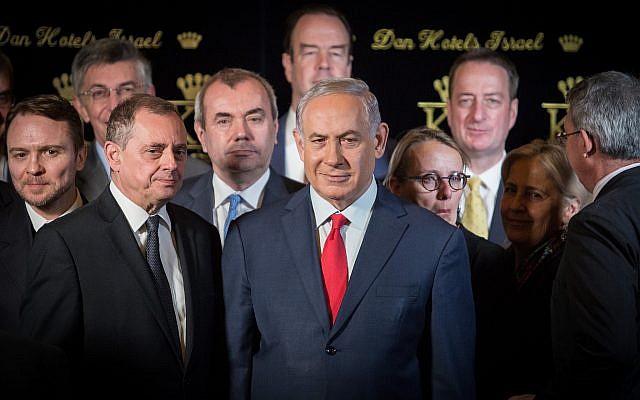
Prime minister Benjamin Netanyahu hold a joint press conference with NATO ambassadors to Israel at the King David Hotel in Jerusalem, January 9, 2018 (Hadas Parushl/Flash90)

Prime Minister Benjamin Netanyahu on Tuesday indicated that Israel has prevented hijacked airplanes from crashing into European cities.

“We have, through our intelligence services, provided information that has stopped several dozen major terrorist attacks, many of them in European countries,” he told foreign diplomats in Jerusalem.

“Some of these could have been mass attacks, of the worst kind that you have experienced on the soil of Europe and even worse, because they involve civil aviation. Israel has prevented that, and thereby helped save many European lives,” Netanyahu said, apparently referring to plane hijackings.

He did not provide specific details about the attacks Israel helped prevent. The Prime Minister’s Office declined to elaborate.

At a meeting of Israel-based ambassadors to the North Atlantic Treaty Organization (NATO), Netanyahu said Jerusalem contributes to the security of every single member of the Western defense alliance, in that it fights both Sunni and Shiite strands of radical Islam.
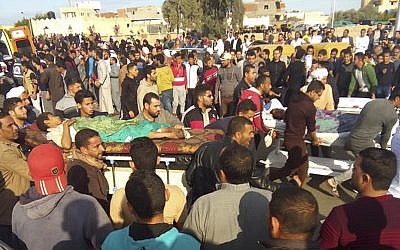
Injured people are evacuated from the scene of a terrorist attack on a mosque in Bir al-Abd in the northern Sinai Peninsula of Egypt on November 24, 2017. (AP Photo)

Besides fighting Islamic State terrorism aimed at European cities, Israel is also preventing the group from creating a second stronghold in Egypt, he said.

“ISIS is being destroyed in Iraq and Syria, but it is trying to establish an alternative territorial base in the Sinai. Israel is contributing to preventing that in myriad ways,” Netanyahu said. “In general, I would say that Israel is the most powerful indigenous force in the Middle East that fights radical Islam.”

Israel further helps NATO by fighting Iran, the dominant Shiite power, the prime minister went on. The Jewish state does not only seek to prevent the Islamic Republic from acquiring nuclear weapons, it is also “absolutely committed to preventing Iran from establishing a military base in Syria. And we back our words with action,” he added, likely hinting at various airstrikes on weapon convoys and factories allegedly carried out by Israel.

Furthermore, Iran plans to import 100,000 Shiite fighters to Syria as part of its quest to dominate and eventually “conquer” the Middle East, he charged.
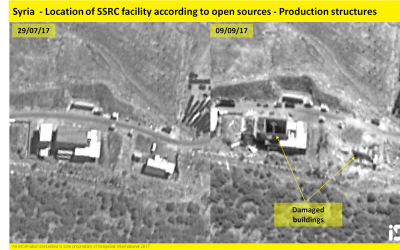
Israeli satellite images show results of an airstrike attributed to the IDF on a Syrian military weapons development base on September 7, 2017. (ImageSat International)

If Tehran were successful in its efforts, radical Sunni and Shiite forces would clash in Syria, sending millions of refugees to European shores, the prime minister warned.

“Where will the spillover [of a Sunni-Shiite clash in Syria] happen? In Europe. Where will the human flow go? To Europe. Who’s preventing that right now? Israel? Right now, Israel alone. But I maintain that it’s a common interest that we have,” he told the NATO ambassadors during the public part of the event.

Israel and NATO have cooperated on security matters for decades but recently upgraded their ties significantly. Last year, Israel opened its first office at NATO headquarters in Brussels.

Israeli officials have repeatedly said that the Jewish state opposes the presence of Iran and its proxies, notably Hezbollah, in southern Syria and Lebanon.

Israel has been negotiating with the United States and Russia, the main brokers in Syria, to keep Iran-backed Shiite militias and the Hezbollah terrorist group away from the border.

Netanyahu, Defense Minister Avigdor Liberman and others have all said that Israel’s policy is to target shipments of advanced weaponry, including accurate long-range missiles, that are heading to or in the possession of Hezbollah.

In late December, Assad’s troops, accompanied by Iranian-backed fighters, recaptured the Syrian Golan from rebels, allowing President Bashar Assad to reassert control over a small portion of the area adjacent to the Israeli border. Still, much of the area along the border, around the city of Quneitra, remains under rebel control.

Last week, IDF Chief of Staff Gadi Eisenkot said the most serious immediate threat to Israel was posed by Hezbollah, followed by other jihadist groups supported by Tehran positioned on the Syrian border.

Describing Iran as a “multidimensional threat,” the army chief said the most worrying aspect is the Islamic Republic’s desire to obtain nuclear capabilities, followed by its efforts to achieve hegemony in the region.


twoje uwagi, linki, wlasne artykuly, lub wiadomosci przeslij do: webmaster@reunion68.com



Co naprawdę dzieje się w Hebronie?

Co naprawdę dzieje się w Hebronie?

    Malgorzata Koraszewska


Hebron, miasto mające około 200 tysięcy mieszkańców. Ma większość arabską i długą żydowską historię. O sytuacji w tym mieście opowiada jego mieszkanka.


twoje uwagi, linki, wlasne artykuly, lub wiadomosci przeslij do: webmaster@reunion68.com


Guatemala not ‘moving,’ but ‘returning’ to Jerusalem

Guatemala not ‘moving,’ but ‘returning’ to Jerusalem, says Foreign Minister Jovel

Batya Jerenberg


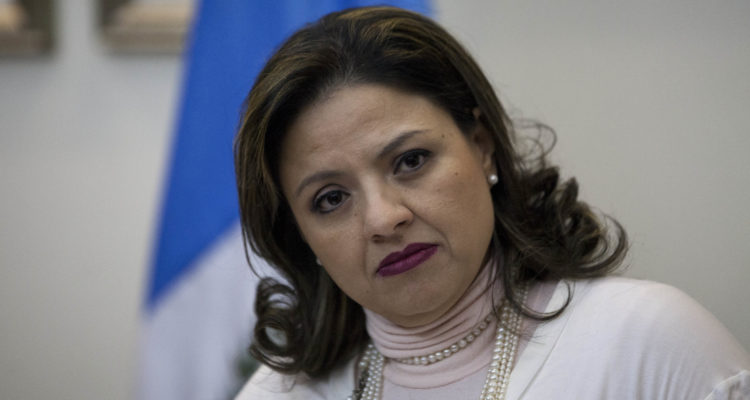
Guatemala FM Sandra Jovel takes questions from press on moving embassy to Jerusalem, Dec. 26, 2017. (AP/Moises Castillo)

Guatemala’s foreign minister forcefully denies speculation that her country was pressured in any way to follow Trump’s lead on Jerusalem.

Three weeks after President Donald Trump declared that the United States recognizes Jerusalem as Israel’s capital and that the US would start the process of moving its embassy there from Tel Aviv, Guatemalan President Jimmy Morales announced his own embassy’s move in a Facebook post on Sunday evening.

On Wednesday, his foreign minister, Sandra Jovel, held a press conference in Guatemala City to deny that any pressure was brought to bear on Guatemala to do so. “There wasn’t any pressure. There wasn’t any overture from the United States to make this happen,” she said. “This was a decision by the government, the state and the foreign policy of Guatemala.”

Jovel was adamant that there was no quid pro quo involved in the decision. “We are friends and historical allies with Israel … We have asked nothing of Israel or the United States.”

She also made a point of stating that Guatemala was not “moving” to Jerusalem, but rather “returning.” The Central American state was one of only 16 countries to establish its embassy in Jerusalem after being one of the first countries to recognize Israel de facto after the state was declared.

It left in 1980, in a period of more strained relations, when the Knesset passed the Basic Law on Jerusalem, which stated that the city would remain the “complete and united capital of Israel.” At the time, in a move reminiscent of last week’s General Assembly vote rejecting Trump’s declaration on Jerusalem, the UN Security Council condemned that Basic Law as being a violation of international law and passed Resolution 478, calling upon member states to remove their diplomatic missions from the city, which Guatemala then did.

In last week’s vote, Guatemala was one of only seven nations to join the US and Israel in rejecting the UN’s condemnation. Historically, the country has had close relations with Israel, especially in the field of security. Morales has now brought the two countries even closer. Israel was the first Western country he visited after gaining office, when he signed bilateral agreements in agriculture, science and development.

Prime Minister Benjamin Netanyahu warmly thanked Morales for his declaration of recognition, saying that this was “just the start” and “there will be others.” Deputy Foreign Minister Tzipi Hotovely said that her ministry was in touch with 10 other countries that were thinking of following in the footsteps of the US, although she would not name them while discussions were ongoing.


twoje uwagi, linki, wlasne artykuly, lub wiadomosci przeslij do: webmaster@reunion68.com


German Jewish Life Only with Police Protection

Jewish Official: German Jewish Life Only with Police Protection

JNi.Media


Charlotte Knobloch

Charlotte Knobloch, the former president of Central Council of Jews in Germany, on Friday told the newspaper Heilbronner Stimme that Jewish life in Germany is possible only under police protection (Jüdisches Leben nur unter Polizeischutz möglich).

“In Berlin as well as here in Munich, the big Hanukkah candlesticks were under guard around the clock,” Knobloch told the Heilbronner Stimme, warning that “Jewish life can only take place in public under police protection and the strictest security precautions – or it must be completely canceled for security reasons, like the public Hanukkah celebration in Mülheim.”

Knobloch called for the German federal government to create a new authority to monitor and defend against the new wave of anti-Semitism: “Anti-Semitism has grown on the right and the left, in the Muslim community and also in the heart of German society,” said Knobloch, now serves as president of the Jewish Community of Munich and Upper Bavaria. She argued that an efficient approach to fighting public and covert anti-Semitism is long overdue.

In April, the Bundestag received an expert report showing that Jews in Germany are facing increased anti-Semitism in their everyday lives, and fear for their safety.

Recently, German Jews were shocked at the appearance of a video documenting a 60-year-old German man outside a Jewish restaurant in Berlin, berating the owner and predicting that “within five years you’ll all be back in the gas chambers.”

Commenting on the video, Charlotte Knobloch said, “The hostility and threats that can be seen in the video are disgusting but not unusual. Many overt and covert forms of anti-Semitism are on the rise in every area of society.”

In her view, this video did not represent an isolated incident but the “everyday experience of Jewish people. Anti-Semitism is widespread online and on social media but also in the analog world. Jewish students, for instance, suffer greatly from this phenomenon—’Jew’ has once again become an insult in German schoolyards.”

Last July, Josef Schuster, the current president of the Central Council of Jews in Germany, told Deutsche Welle that his group is “delighted that our communities have grown as they have. In addition, many Israelis are drawn to Berlin, which we also warmly welcome, of course. But the fact is, Jewish institutions still need police protection. There is a potential threat. My biggest wish would be that this police protection would someday no longer be necessary.”


twoje uwagi, linki, wlasne artykuly, lub wiadomosci przeslij do: webmaster@reunion68.com


IDF opens criminal investigation into Palestinian double amputee’s death

IDF opens criminal investigation into Palestinian double amputee’s death

JUDAH ARI GROSS and AGENCIES


Move comes after Southern Command probe failed to determine how Ibrahim Abu Thurayeh died during a riot on the Gaza border last month

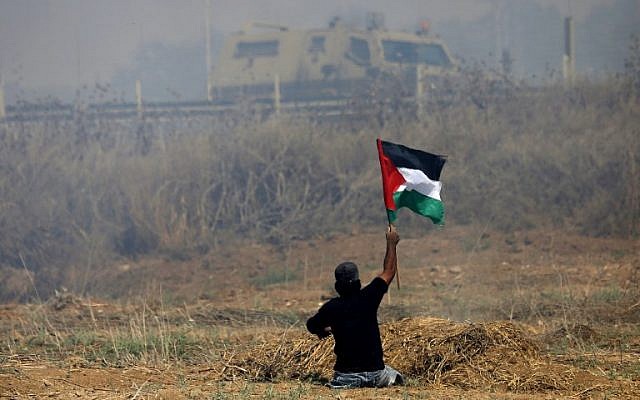
This photo taken on May 19, 2017, shows handicapped Palestinian demonstrator Ibrahim Abu Thurayeh waving a Palestinian flag during clashes with Israeli soldiers following a protest against the blockade on Gaza, near the border fence east of Gaza City. (MOHAMMED ABED / AFP)

The army on Thursday morning announced that the Military Police was launching a criminal investigation into the death of a disabled Palestinian man during a riot along the Gaza security fence on December 15, after an earlier IDF probe failed to determine how he had died.

Since Ibrahim Abu Thurayeh’s death, Palestinian officials have been insisting that the man, a wheelchair-bound double amputee, was killed by Israeli sniper fire during a protest against US President Donald Trump’s recognition of Jerusalem as Israel’s capital.

The death of Abu Thurayeh sparked angry denunciations by Palestinians and others, who said he could not have presented a serious threat during the protest. His image emerged as an international symbol of resistance to Trump’s December 6 Jerusalem declaration, which the Palestinians see as siding with Israel.

The Israel Defense Forces’ Southern Command launched an investigation into the allegation that Abu Thurayeh was killed by Israeli sniper fire, and found that no live round had been explicitly aimed at him, but failed to determine the exact cause of death.

“No live fire was aimed at Abu Thurayeh. It is impossible to determine whether Abu Thurayeh was injured as a result of riot dispersal means or what caused his death,” the army said at the end of the investigation on December 18.

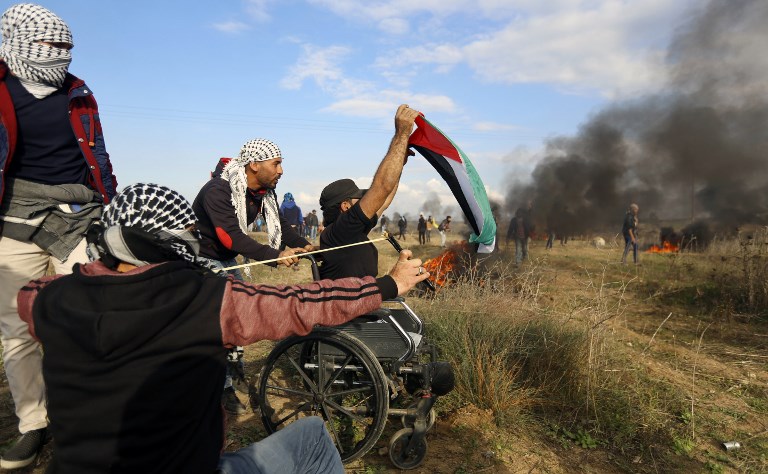
Wheelchair-bound Palestinian demonstrator Ibrahim Abu Thurayeh waving a Palestinian flag during a protest along the Gaza-Israel border on December 15, 2017, as clashes with Israeli security forces against Washington’s recognition of Jerusalem as Israel’s capital intensified. (MOHAMMED ABED / AFP)

The military said it was hindered in its investigation by the fact that Palestinian authorities did not share the details of Abu Thurayeh’s injuries from the demonstration.

“Despite numerous IDF requests for information, no precise details or conclusions regarding Abu Toriya’s (sic) injuries were received. If additional details will be received, they will be examined and studied,” an army spokesperson said at the time.

Despite failing to identify Abu Thurayeh’s cause of death, the army asserted that its investigation had uncovered “no moral or professional failures.”

On Thursday morning, the IDF said it was handing the case to the Military Police for renewed scrutiny after obtaining previously unavailable information about the incident from groups inside Gaza.

“In order to further examine the case, including information received from organizations operating in the Gaza Strip, it was decided that the circumstances of Abu Thuraye’s death will also be examined by a Military Police investigation,” the army said.

On December 28, the Associated Press reported it had received Palestinian medical records showing that Abu Thurayeh was killed by a bullet that struck him in the head.

The medical records, which include a hospital report and a death certificate, said that Abu Thurayeh, 29, was struck by a bullet above his left eye and died from bleeding in the brain. The same findings were detailed in a report by the Palestinian Red Crescent ambulance service reviewed by the AP.

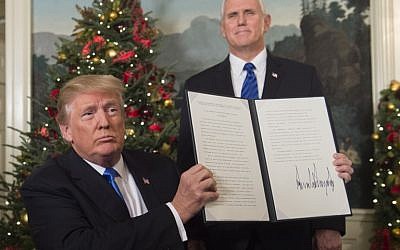
US President Donald Trump holds up a signed memorandum after he delivered a statement on Jerusalem from the Diplomatic Reception Room of the White House in Washington, DC on December 6, 2017 as US Vice President Mike Pence looks on. (Saul Loeb/AFP)

The reports did not specify who fired the bullet or what caliber it was.

The AP showed the report from Gaza’s Shifa hospital and the death certificate to the army. In a statement, the military noted the report had come from the media and said it “will be studied and examined during the following days.”

The military has maintained that the demonstration on December 15 “was extremely violent and included thousands of rioters,” who threw rocks and rolled burning tires at the security fence itself and the soldiers on the other side of it.

The army said that troops mostly used crowd dispersal weapons — tear gas and rubber bullets — against the protesters, but that in some cases live fire was used. Though such riot dispersal munitions are less lethal than standard rounds, there have been numerous cases of people being killed by rubber bullets and tear gas canisters, as well as from complications connected to inhaling tear gas.

“Few controlled shootings were carried out toward main instigators. Troops received approval prior to shooting each round by a senior commander in the field,” the army said at the time.

While the clash turned violent, with protesters hurling stones, firebombs and burning tires at the border fence, witnesses have said there was no gunfire from the Palestinian side.

The protest came amid a wave of violence that erupted in the Palestinian territories after Trump’s Jerusalem declaration, and in which 12 people died, almost all of them in Gaza. Hamas, the terror group that controls the coastal enclave, urged Palestinians to confront soldiers and settlers, and allowed thousands of Gazans to clash with Israeli troops at the border fence. Its leader, Ismail Haniyeh, praised the “blessed intifada,” urged the liberation of Jerusalem, and made plain the group was seeking to intensify the violence against Israel.

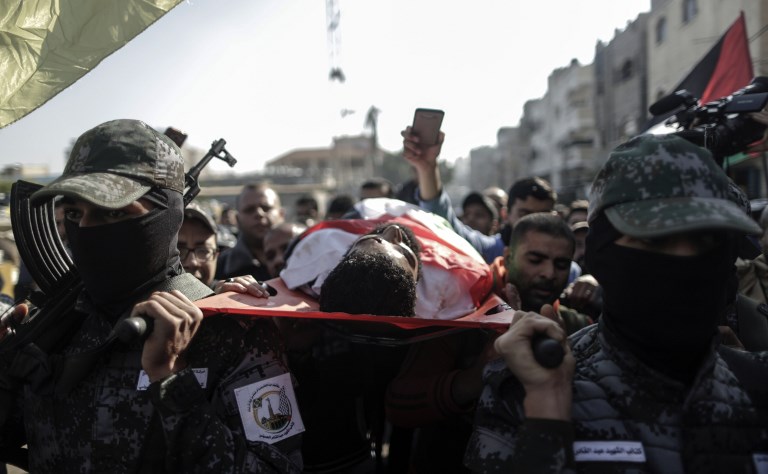
Palestinians carry the body of 29-year-old Ibrahim Abu Thurayeh during his funeral in Gaza City, on December 16, 2017, after he was killed during clashes between Israeli soldiers and Palestinian protesters along the Gaza security fence the day before. (Mahmud Hams/AFP)

Abu Thurayeh’s story drew international news coverage, and thousands attended his funeral in Gaza. Addressing the funeral, Hamas chief Ismail Haniyeh praised him as a hero and a martyr, and vowed never to relinquish Jerusalem. “And I don’t mean East Jerusalem, but unified Jerusalem,” Haniyeh said, in footage screened by Israel’s Channel 10. “Not East Jerusalem and not West Jerusalem. Muslim. Muslim.”

Last month, UN High Commissioner for Human Rights Zeid Ra’ad Al Hussein decried Abu Thurayeh’s death as “incomprehensible — a truly shocking and wanton act.” Despite the Israeli army’s own internal probe into the events at the time, Zeid urged “an independent and impartial investigation” to ensure perpetrators were held accountable.

Abu Thurayeh was a regular presence at protests at the border.

While relatives have claimed he lost his legs in an Israeli airstrike while trying to rescue people, AP records showed that he was wounded on April 11, 2008, in a clash between Israeli forces and Palestinian operatives in the Bureij refugee camp in central Gaza. AP television footage from that day shows Abu Thurayeh identifying himself as he is taken away on the back of a pickup truck.

Both gunmen and civilians were wounded and killed that day, and it is not clear whether Abu Thurayeh had participated in the violence. Since losing his legs, he often rolled around Gaza City, earning a living by washing cars. He also was a frequent participant in protests along the border.

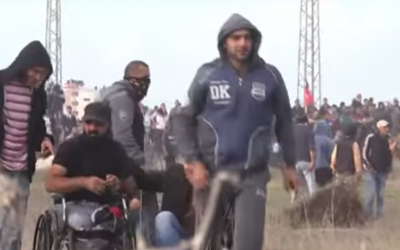
Ibrahim Abu Thurayeh at the Gaza border on December 15, 2017. (YouTube screenshot)

According to the IDF, some 3,500 Palestinians protested along the Gaza security fence on December 15 over Trump’s controversial decision to recognize Jerusalem as Israel’s capital and ultimately move the American embassy to the holy city.

Palestinians consider East Jerusalem, captured by Israel from Jordan — which had been occupying it since 1948 — in the 1967 Six Day War, as the capital of their future state. Trump said his declaration did not prejudge a final status agreement as part of a future peace deal, but Palestinians were infuriated by the decision.

The Guardian quoted eyewitnesses who said Abu Thurayeh’s wheelchair had been pushed up to the fence, whereupon he climbed out of it and tried to crawl forward toward it, before being hit.

In video footage recorded at the protest, Abu Thurayeh could be seen carrying the Palestinian flag and waving the victory sign at Israeli soldiers across the border.

“I want to go there,” he said, referring to the other side of the border, as a number of young men surrounding him waved Palestinian flags and others threw stones toward the troops.

“This land is our land,” he said, in another video posted on social media. “We will not give up. America has to withdraw its decision.”


twoje uwagi, linki, wlasne artykuly, lub wiadomosci przeslij do: webmaster@reunion68.com