Archive | June 2019

Syria accuses Israel of firing missiles at a border town in its south

Syria accuses Israel of firing missiles at a border town in its south

TOI STAFF


State media says some incoming projectiles intercepted; no reports of injuries and no comment from IDF; reported strike comes days after rockets fired at Israel

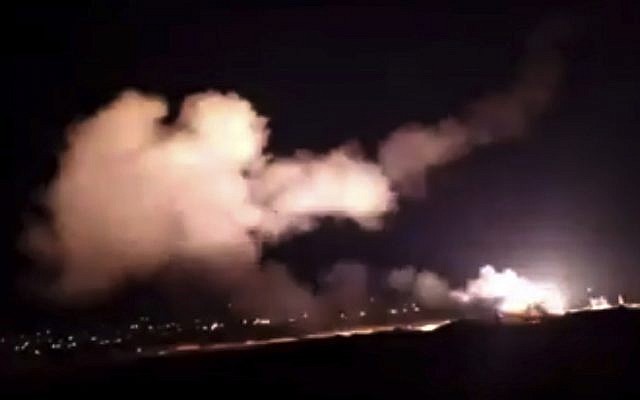
Illustrative: This frame grab from a video provided by the Syrian official news agency SANA shows missiles flying into the sky near Damascus, Syria, Tuesday, December 25, 2018. (SANA via AP)

Syrian state media reported early Wednesday that Israel had fired several missiles toward the town of al-Harra just across the Golan Heights border and claimed air defenses intercepted several of the projectiles.

There were no immediate reports of injuries and no Israeli response to the claims.

The report also claimed that Israel was jamming Syrian air defense radars in the area.

While Israel has carried out hundreds of strikes in Syria, they have usually targeted bases linked with Iran. In the rare occasions that Israel has targeted villages and towns along the Golan Heights border, it has been after identifying Iranian and Hezbollah attempts to set up cells in the area.

On Saturday, two rockets were fired from Syria toward Israel’s Mount Hermon in the Golan Heights. There were no reports of injuries or damage

An Israeli military position, right, is seen on the top of Mount Hermon in the Golan Heights, where the borders between Israel, Syria and Lebanon meet. April 9, 2019. (AP Photo/Hussein Malla)

The launches came less than a week after a limited clash between Israel and Syria.

Toward the start of the Syrian civil war, the Israeli military established a number of “red lines” that if violated would result in a retaliatory strike, including any attacks — intentional or otherwise — against Israel.

They also included Iranian efforts to establish a permanent military presence in Syria and attempts to transfer advanced munitions to the Lebanon-based Hezbollah terrorist group.

In recent years, Israel has acknowledged conducting hundreds of airstrikes in Syria in response to these “red line” violations.


Zawartość publikowanych artykułów i materiałów nie reprezentuje poglądów ani opinii Reunion’68,
ani też webmastera Blogu Reunion’68, chyba ze jest to wyraźnie zaznaczone.
Twoje uwagi, linki, własne artykuły lub wiadomości prześlij na adres:
webmaster@reunion68.com


Australian Muslim Doctor Subjected to Hate Campaign by Islamists

Australian Muslim Doctor Subjected to Hate Campaign by Islamists Over Charity Work With Jews

Algemeiner Staff


Project Rozana says its aim is build bridges between Israelis and Palestinians through medicine. Photo: Project Rozana.

A Muslim doctor in Sydney, Australia, has become the target of an antisemitic, anti-Zionist hate campaign because of his work helping sick Palestinian children obtain treatment in Israeli hospitals.

Dr. Jamal Rifi’s support for Project Rozana has led to him being branded an “enemy” by pro-Iranian and pro-Hezbollah activists in his local community because the charity has Jewish members, Australian news outlets reported on Friday.

Project Rozana was originally set up six years ago by the Jewish women’s group Hadassah Australia, which has strong links with Jerusalem’s Hadassah Hospital. The group’s goal as stated on its website is to “build better understanding between Israelis and Palestinians through health.”

The charity was named after Rozana Salawhi, a Palestinian girl who was saved by doctors at Hadassah after falling from an apartment block in the Palestinian city of Ramallah in the West Bank.

Rifi is a prominent figure in Sydney’s Lebanese Muslim community and has been recognized for his work to prevent the radicalization of young people by Islamic State (IS).

The doctor said that he feared that he had been referred to Lebanon’s Military Court for possible prosecution — which means he cannot visit his ailing mother in the country for fear of being arrested.

Rifi also turned to NSW Police to investigate threats against him and his family.

“While the investigation remains with local police, appropriate referrals have been made to the Engagement and Intervention Unit and Bias Crime Unit within the Counter Terrorism and Special Tactics Command,” a police spokesman told journalists on Friday.


Zawartość publikowanych artykułów i materiałów nie reprezentuje poglądów ani opinii Reunion’68,
ani też webmastera Blogu Reunion’68, chyba ze jest to wyraźnie zaznaczone.
Twoje uwagi, linki, własne artykuły lub wiadomości prześlij na adres:
webmaster@reunion68.com


ROCZNICA URODZIN HENRYKI ŁAZOWERTÓWNY

ROCZNICA URODZIN HENRYKI ŁAZOWERTÓWNY

Anna Majchrowska


Henryka Łazowertówna urodziła się 19 czerwca 1909 r. w Warszawie. Podczas II wojny światowej należała do grupy Oneg Szabat. Pisała przede wszystkim o uchodźcach, wyłuskując ze statystki samopomocowych raportów losy poszczególnych żydowskich rodzin i ukazując ich walkę o przetrwanie w getcie.

Henryka Łazowertówna

Była pisarką, poetką i tłumaczką, studiowała filologię polską i romańską na Uniwersytecie Warszawskim i w Grenoble we Francji. Wydała przed wojną dwa bardzo dobrze przyjęte tomiki wierszy: Zamknięty pokój i Imiona świata, a w 1938 r. opowiadanie Wrogowie. Od 1935 r. należała do warszawskiego oddziału Związku Zawodowego Literatów Polskich.

Przed 1939 r. mieszkała z matką przy ul. Siennej w Warszawie, po utworzeniu getta znalazło się na terenie tzw. małego getta.

Po wybuchu wojny Łazowertówna zaangażowała się w pracę społeczną, m.in. w działalność organizacji charytatywnej CENTOS, która opiekowała się bezdomnymi i osieroconymi dziećmi. Emanuel Ringelblum, który zaproponował jej przygotowywanie materiałów propagandowych w Żydowskiej Samopomocy Społecznej, pisał: jej materiały propagandowe, plakaty, odezwy, listy itp. cechowała serdeczność, lekkość i prostota styluOddziaływały swoją prostotą i szczerością. [Emanuel Ringelblum, Kronika getta warszawskiego]

Ringelblum wciągnął też Łazowertównę do prac Archiwum. Pisała przede wszystkim o uchodźcach, wyłuskując ze statystki samopomocowych raportów losy poszczególnych żydowskich rodzin i ukazując ich walkę o przetrwanie w getcie. Jest m.in. autorką relacji „Dziewięć miesięcy na Pawiaku” spisanej w 1941 r.

Henryka Łazowertówna, “Dziewięć miesięcy na Pawiaku”, pierwsza strona

W konkursie rozpisanym przez Oneg Szabat wśród wąskiego kręgu przyjaciół i współpracowników, jej monografia o losie rodzinie z Bydgoszczy po przesiedleniu do Warszawy zdobyła jedną z pierwszych nagród. [Emanuel Ringelblum, Kronika getta warszawskiego]

Piosenkę z tekstem najbardziej znanego wiersza Łazowertówny, Mały szmugler w gettowych restauracjach i teatrach wykonywała słynna pieśniarka Diana Blumenfeld.

Przez mury, przez dziury, przez warty
Przez druty, przez gruzy, przez płot
Zgłodniały, zuchwały, uparty
Przemykam, przebiegam jak kot.
W południe, po nocy, o świcie
W zawieje, szarugę i skwar
Po stokroć narażam swe życie
Nadstawiam dziecinny swój kark.

Łazowertównie nie udało się schronić po „stronie aryjskiej”. Jak pisał Emanuel Ringelblum, Łazowertówna chorowała na płuca, lecz bez większej gotówki, bez jakichś dziesięciu tysięcy złotych, nie było co marzyć o stronie aryjskiej. Łazowertówna miała wielu przyjaciół Polaków (…), mimo to nie znalazł się nikt, kto by ją uratował. W czasie pierwszej akcji likwidacyjnej zginęła w Treblince razem ze swą matką. (…) Na Umschlagplatzu starano się uchronić ją przed pójściem do wagonu, ale nie chciano czy nie potrafiono zwolnić jej matki. Henryka Łazowertówna dobrze wiedziała, iż wysiedlenie oznacza śmierć, mimo to poszła za matką.

Wiersz „Mały Szmugler” na pomniku Pamięci Dzieci — Ofiar Holokaustu na cmentarzu żydowskim w Warszawie
Źródło: Wikipedia


Zawartość publikowanych artykułów i materiałów nie reprezentuje poglądów ani opinii Reunion’68,
ani też webmastera Blogu Reunion’68, chyba ze jest to wyraźnie zaznaczone.
Twoje uwagi, linki, własne artykuły lub wiadomości prześlij na adres:
webmaster@reunion68.com


Can an electronic patch reduce the pain of migraines?

Can an electronic patch reduce the pain of migraines?

Brian Blum


Theranica’s Neriva Migra patch delivers a small electrical jolt to mitigate headaches and other acute pains through ‘conditioned pain modulation.’

In clinical trials, two-thirds of patients got significant pain relief with Theranica’s Neriva Migra patch. Photo: courtesy

It looks like a high-tech version of a nicotine patch, but Theranica Bio-Electronics’ wearable device has a different purpose: to knock out migraines… at least temporarily.

Inside Theranica’s Neriva Migra patch are tiny electrodes that deliver a small electrical jolt to your body to mitigate headaches and other acute pains through what’s known as CPM (conditioned pain modulation).

CPM is a counterintuitive approach to pain management. The idea is that by introducing a secondary noxious stimulus (the electrical zaps from the patch), perception of the primary noxious stimulus — in Theranica’s case, migraines — can be reduced.

Similar to a nicotine patch, you place the Neriva Migra device on your arm above the elbow. The device communicates wirelessly via Bluetooth with your smartphone, which regulates the electrical pulses and sets a timer. A 45-minute treatment can bring relief for pain within two hours.

In Theranica’s clinical trials involving 252 patients across 12 sites in the US and Israel, “around two-thirds of patients got significant pain relief,” Theranica cofounder and chief operating officer Ronen Jashek tells ISRAEL21c. “More than 30 percent were pain free.”

There’s one unavoidable hitch: The pain does come back eventually because this is not a cure, rather a treatment to deal with headaches at their worst.

Theranica’s Neriva Migra device isn’t on the market yet – it’s currently being evaluated by the FDA and clearance is expected in a couple of months. Nor is the business model set, other than it will need a prescription. The cost is hoped to be equivalent to, or less than, common prescription drugs.

Neriva Migra, which began development in 2016, will first be available in the United States, followed by Europe in 2020, according to the company’s plan.

Good for 12 sessions

Each device can be used for only 12 sessions because, Jashek explains, “The electrodes in any kind of device like this need to be replaced after a number of treatments.” The tiny battery inside the device also runs out of juice.

Jashek suggests users either recycle the patch or send it back to Theranica. “It’s an electronic device, so you recycle it like you do any electronic equipment,” he says.

Theranica’s Neriva Migra patch lasts for 12 sessions. Photo: courtesy

The 17-person Netanya-based Theranica has raised nearly $42 million. The latest round of $35 million closed in March.

Neurolief, an Israeli company developing a head-mounted neuro-modulation device for migraine relief, has raised only $5 million.

Why the difference in fundraising success? Blame it on the Eckhouse effect.

Eckhouse is a highly successful serial entrepreneur focused on medical technology startups. Among the companies he’s backed or founded: ESC Medical (renamed Lumenis), Syneron Medical, RealView Imaging and Alon MedTech Ventures. He invented Intense Pulsed Light, a non-invasive technology for various dermatological and ophthalmology treatments. Along with Jashek, Alon Ironi and Slava Barabash, he is a cofounder (and now active chairman) of Theranica.

Headaches are, unfortunately, big business. The Migraine Research Foundation estimates that migraines are the third most prevalent illness in the world. In the US, migraines impact 12 percent of the population (18% women, 6% men).

Several American med-tech companies are in this crowded field. Thirty Madison raised $15 million in 2018 for a tool that tracks migraine incidents and offers virtual consultations with doctors; Healint’s Migraine Buddy tracker is being tested by pharma giant Novartis to see whether chronic migraines induce anxiety and depression; Gammacore makes an FDA-approved device that electrically stimulates the vagus nerve to block migraine pain signals; and Cefaly has an FDA-approved device that delivers micro-impulses to the trigeminal nerve. The latter two are more cumbersome than Theranica’s device.

One of the most promising – and potentially permanent – treatments for migraine suffers is occipital nerve stimulation, where a small pulse generator is surgically implanted at the base of the skull to send pain-relieving electrical impulses to the brain. But the technique is invasive and can cost tens of thousands of dollars.

Theranica’s device will be significantly less expensive and can be applied at home. No major side effects have shown up during clinical tests, Jashek adds.

Could CPM could be used for other types of pain beyond migraines, since CPM doesn’t require direct stimulation to the part of the body where the pain is?

Absolutely, Jashek says, as long as the pain is of a similar acute nature. “We won’t be able to address general chronic issues like back or muscle pains,” he tells ISRAEL21c.

Find more information on Theranica’s Neriva Migra device here.


Zawartość publikowanych artykułów i materiałów nie reprezentuje poglądów ani opinii Reunion’68,
ani też webmastera Blogu Reunion’68, chyba ze jest to wyraźnie zaznaczone.
Twoje uwagi, linki, własne artykuły lub wiadomości prześlij na adres:
webmaster@reunion68.com


Jak wychowuje się morderców

Jak wychowuje się morderców

  Malgorzata Koraszewska


Mały jordański chłopiec mówi matce, że idzie pomścić Omara (terrorystę, który zabił dwóch Izraelczyków). Idzie wyzwalać i umrzeć za Jerozolimę. Dobrze nauczył się swojej roli, zapewne nie tylko do tego filmu. Dzieci stają się pierwszymi ofiarami religijnego fanatyzmu.


Zawartość publikowanych artykułów i materiałów nie reprezentuje poglądów ani opinii Reunion’68,
ani też webmastera Blogu Reunion’68, chyba ze jest to wyraźnie zaznaczone.
Twoje uwagi, linki, własne artykuły lub wiadomości prześlij na adres:
webmaster@reunion68.com