
Archive | February 2024

Directly beneath UNRWA’s Gaza headquarters, IDF uncovers top secret Hamas data center

Directly beneath UNRWA’s Gaza headquarters, IDF uncovers top secret Hamas data center

EMANUEL FABIAN

.
Subterranean facility for terror group’s intelligence needs, beneath UN complex in upscale Rimal neighborhood, discovered after interrogations of Palestinian prisoners

GAZA CITY, Gaza Strip — Beneath the Gaza Strip headquarters of the controversial United Nations agency for Palestinian refugees, known commonly as UNRWA, the Hamas terror group hid one of its most significant assets, the Israeli military has revealed.

The subterranean data center — complete with an electrical room, industrial battery power banks and living quarters for Hamas terrorists operating the computer servers — was built precisely under the location where Israel would not consider looking initially, let alone target in an airstrike.

The revelation of the server farm comes amid other accusations of UNRWA collusion with the Gaza-ruling terror group and the entanglement of the UN body that provides welfare and humanitarian services for Palestinian refugees from the 1948 and 1967 wars and their descendants.

Israel last month accused 12 staff with the UN Palestinian refugee agency of taking part in the October 7 massacre by Hamas-led terrorists, who killed 1,200 people and took 253 hostages in the murderous rampage.

Since the allegations became public late last month, UNRWA has seen many of its top donor countries announce funding freezes, leading to concerns that the agency could stop operating in Gaza and elsewhere in the Middle East within weeks.

But the IDF’s recent discovery of the Hamas data center while UNRWA is under increased scrutiny appears to be merely a coincidence.
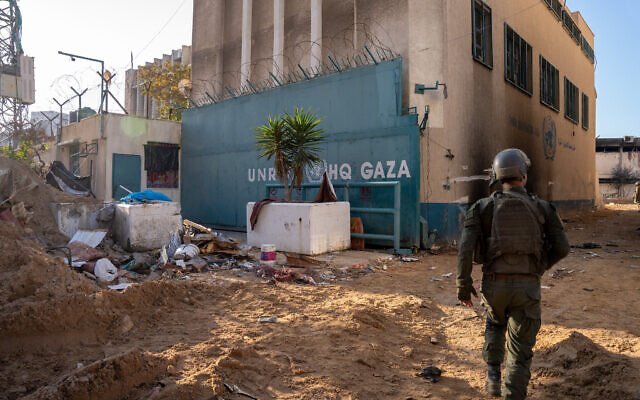
Col. Benny Aharon walks into UNRWA’s headquarters in Gaza City, February 8, 2024. (Emanuel Fabian/Times of Israel)

UNRWA’s Gaza headquarters is located in Gaza City’s upscale Rimal neighborhood, an area that the IDF had previously operated in, dismantled the local Hamas battalion and withdrawn its troops from.

At the time of the initial ground offensive in Gaza City, the military had not found or known much about the Hamas data center. But new intelligence, primarily emerging from the Shin Bet interrogations of captured terrorists, helped pinpoint where to dig.

“The IDF was here previously, the first time was to destroy the enemy, but when we were here the last time we collected a lot of intelligence documents and findings, a lot of prisoners, and thanks to this we reached here. Now we carried out a targeted operation to take this capability away,” said the commander of the 401st Armored Brigade, Col. Benny Aharon, while giving a media tour of the tunnel and UN complex on Thursday.

“We had a basis of information, but not enough to be able to dig down 20 meters and find it, we needed a bit more. There’s information we get from prisoners we capture, from computers we find, from documents, maps,” he said.

The IDF in recent weeks has returned to carry out smaller operations in the northern Gaza Strip, after largely destroying Hamas’s fighting capabilities during the early stages of the ground offensive.
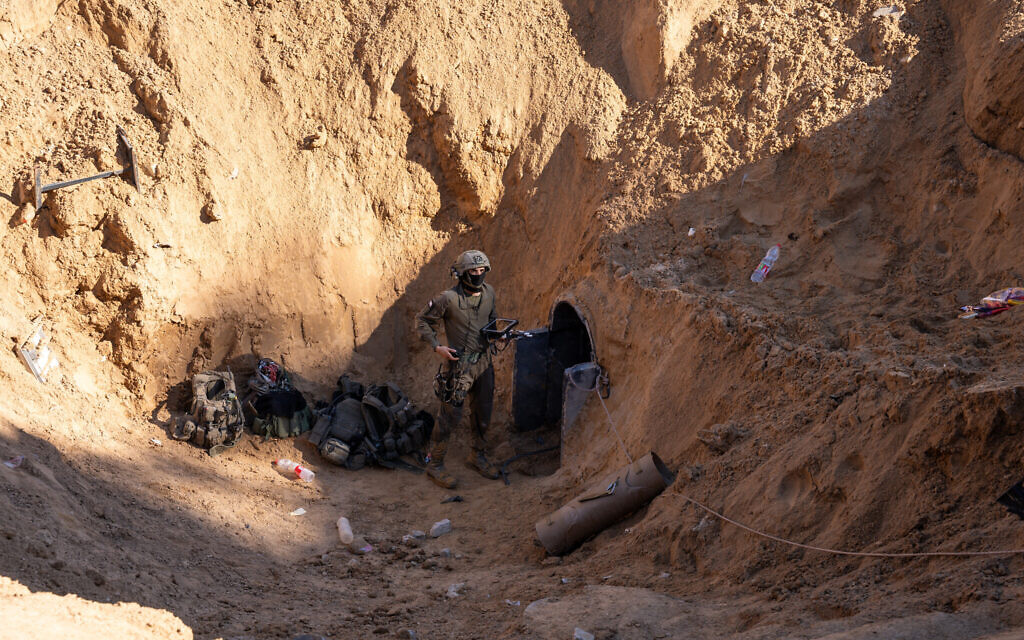
A soldier of the Yahalom unit stands outside a tunnel leading to a Hamas data center, uncovered by the IDF in Gaza City, February 8, 2024. (Emanuel Fabian/Times of Israel)

Col. Nissim Hazan, a senior officer in the 401st Brigade, said the IDF can now carry out raids with much smaller numbers of forces, for operations “that require much more research and much more time, and a lot more patience.”

There is still a risk to these raids, with Aharon noting that two soldiers under his command had been killed during their operation to reach the Hamas data center — Maj. (res.) Yitzhar Hofman, a commander in the Israeli Air Force’s elite Shaldag unit and Maj. David Shakuri, the deputy commander of the Combat Engineering Corps’ 601st Battalion — both by sniper fire.

Hazan, who is tasked with coordinating the brigade’s underground operations, said the main entrance to the tunnel was located under a UNRWA school in the area. However, it had been blocked off by Hamas by the time troops arrived. Instead, combat engineers dug down around eight meters to find the shallowest part of the underground passage.

A muddy and humid labyrinth to the data center

Journalists, accompanied by troops of the elite Yahalom combat engineering unit, the Shaldag unit and Hazan, entered the tunnel passage that had been uncovered. Due to the humidity, with all of Hamas’s air filtration systems disabled, we were advised to remove our bulletproof vests before embarking on the journey to the data center. 
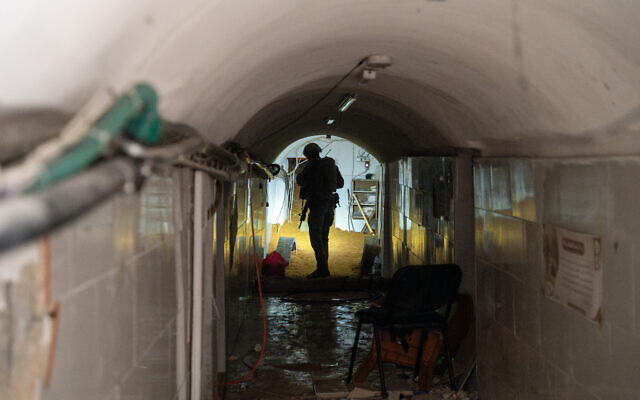
A soldier stands in a Hamas tunnel underneath a UNRWA school in Gaza City, February 8, 2024. (Emanuel Fabian/Times of Israel)

The first stretch of the 700-meter-long tunnel, a few dozen meters with Hamas’s hallmark concrete arches and a floor of sand, was relatively unremarkable, similar to hundreds of kilometers of underground passages the terror group has built across the Gaza Strip.

The passage had several other branching paths, but to keep the reporters on track and not get lost, soldiers had placed neon glowsticks on the floors.

The route we followed led to a small hole, which after climbing through, revealed a large hallway with flooring, wall tiles, air conditioning and lighting fixtures.

The hallway was plastered with posters bearing the logo of Hamas’s military wing, the Al-Qassam Brigades, some with operational security instructions for the terrorists managing the data center.

In this part of the tunnel, according to Hazan, Hamas IT and intelligence staff would supervise and manage the data center. 
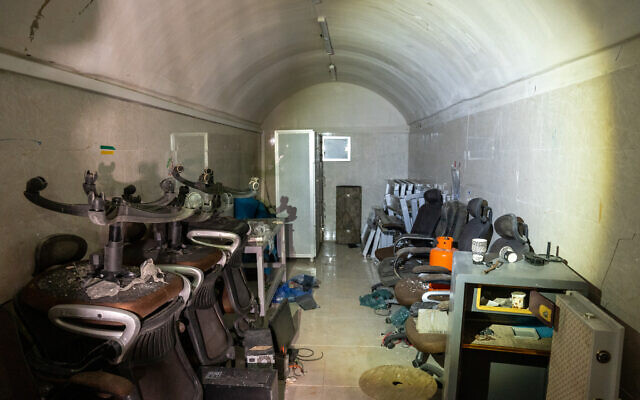
Office chairs are stored in a room in a Hamas tunnel, underneath a UNRWA school in Gaza City, February 8, 2024. (Emanuel Fabian/Times of Israel)

Along the hallway, there were several rooms, including a kitchenette, a meeting room with office chairs, two bathrooms and living quarters with several mattresses.

Also in the hallway, troops found several small mobility scooters, thought to have been used by Hamas to traverse through the tunnel’s facilities with ease.

“Above us is a UNRWA kids’ school,” Hazan said, as we explored the rooms in the main hallway. “This is years of work, with a lot of determination and resources.”

From the main hallway, a 300-meter passage led to the data center and nearby electrical room.

“We are now crossing a main road in Rimal, below several high-rise towers,” Hazan said. 
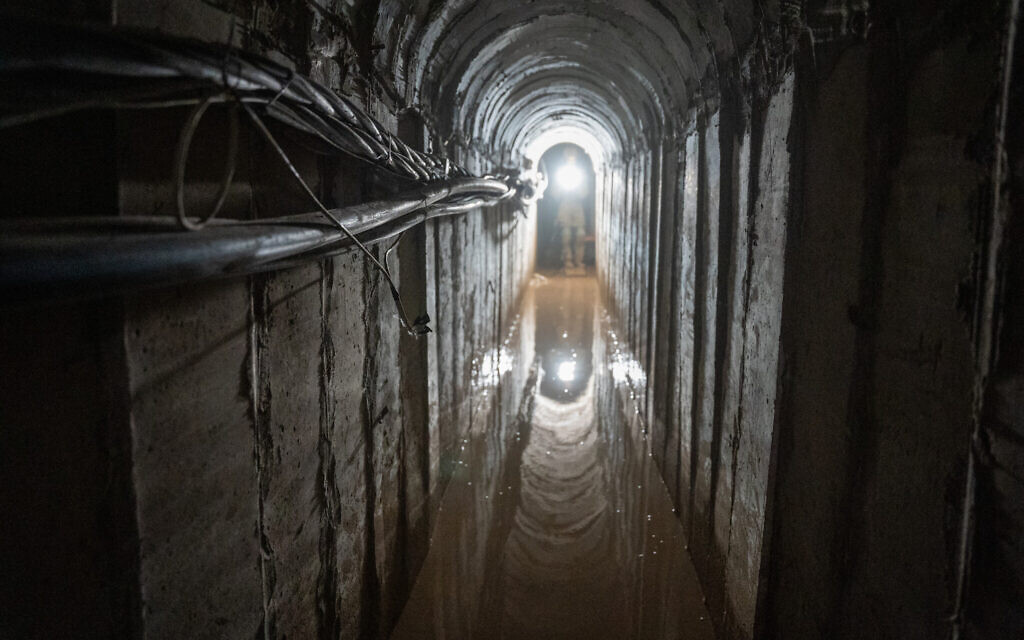
A flooded tunnel leading to a Hamas data center, uncovered by the IDF in Gaza City, February 8, 2024. (Emanuel Fabian/Times of Israel)

Parts of the tunnel, due to the combat engineers’ operations, did not have the usual concrete ceiling, exposing the fragile sand.

“Keep your head down and don’t touch the ceiling,” a Shaldag officer told us, as we crawled through the section, making sure not to cause the tunnel to collapse on our heads.

Also as a result of the combat engineers digging to reach the tunnel, rainwater had flooded in, causing knee-deep puddles in some areas, which we waded through to reach the data center.

After the flooded sections of the tunnel, a slippery incline led to the first main facility in the tunnel, the electrical room.  
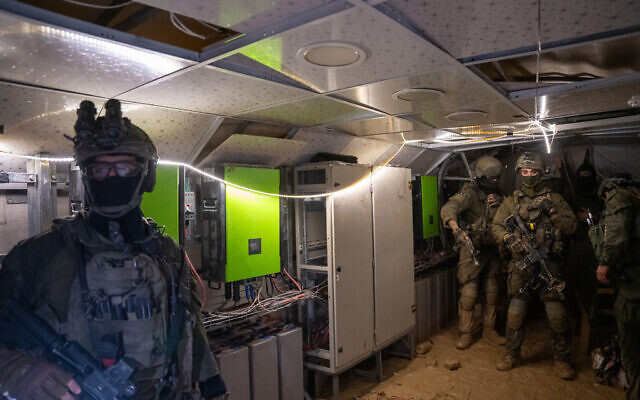
An electrical room serving an underground Hamas data center, beneath the UNRWA headquarters, uncovered by the IDF in Gaza City, February 8, 2024. (Emanuel Fabian/Times of Israel)

The room, with several electrical closets, power inverters and dozens of off-grid industrial batteries, was now covered in a thick layer of mud.

Part of the room’s dropped ceiling was falling apart, where the combat engineers had dug down 20 meters from the courtyard of the UNRWA complex, adjacent to one of the main buildings.

A few more dozen meters of tunnel from the electrical room led to the heart of the facility, Hamas’s data center.

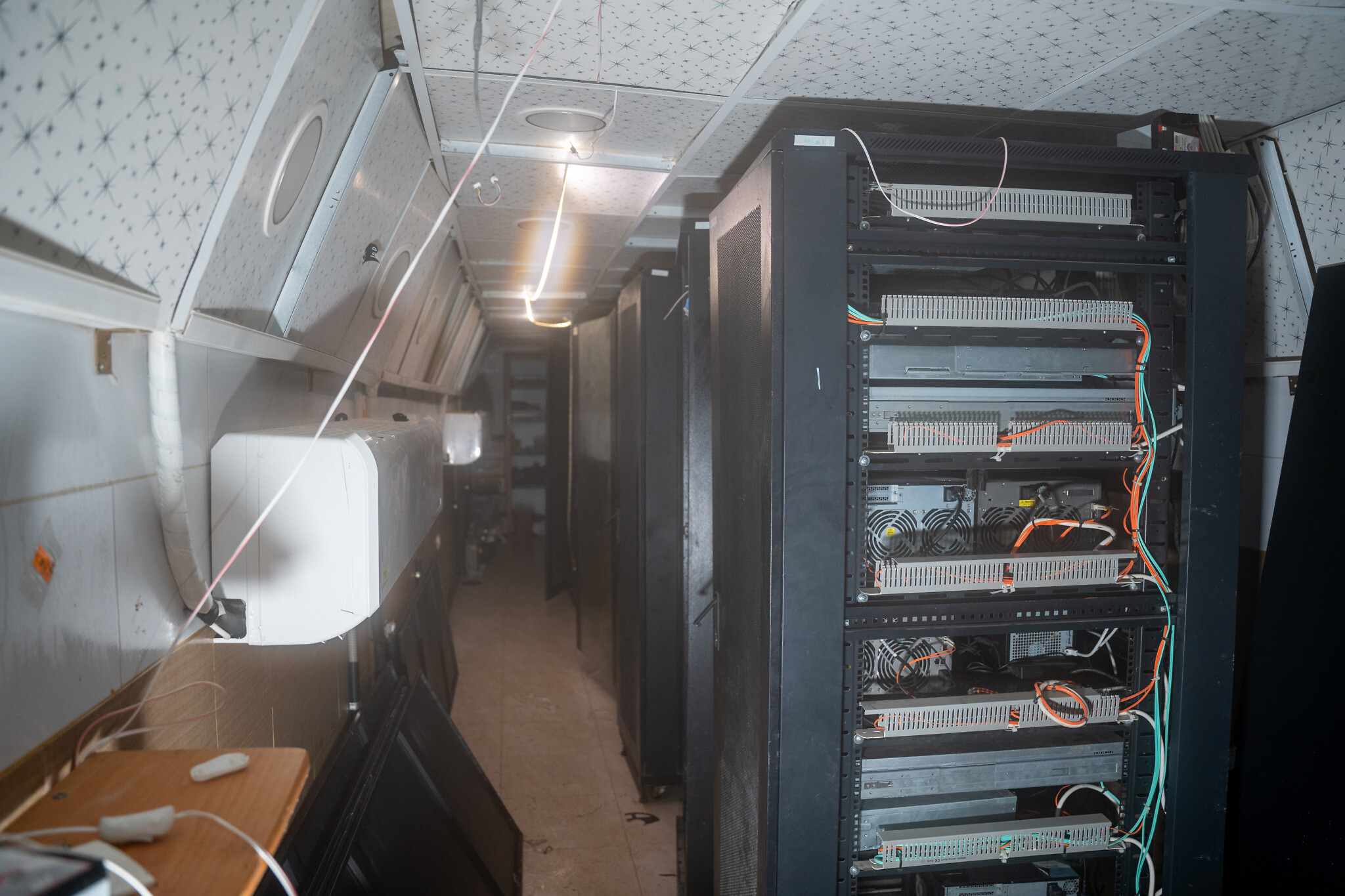
There were about half a dozen rows of server cabinets, each with racks of computers for Hamas’s operations.  
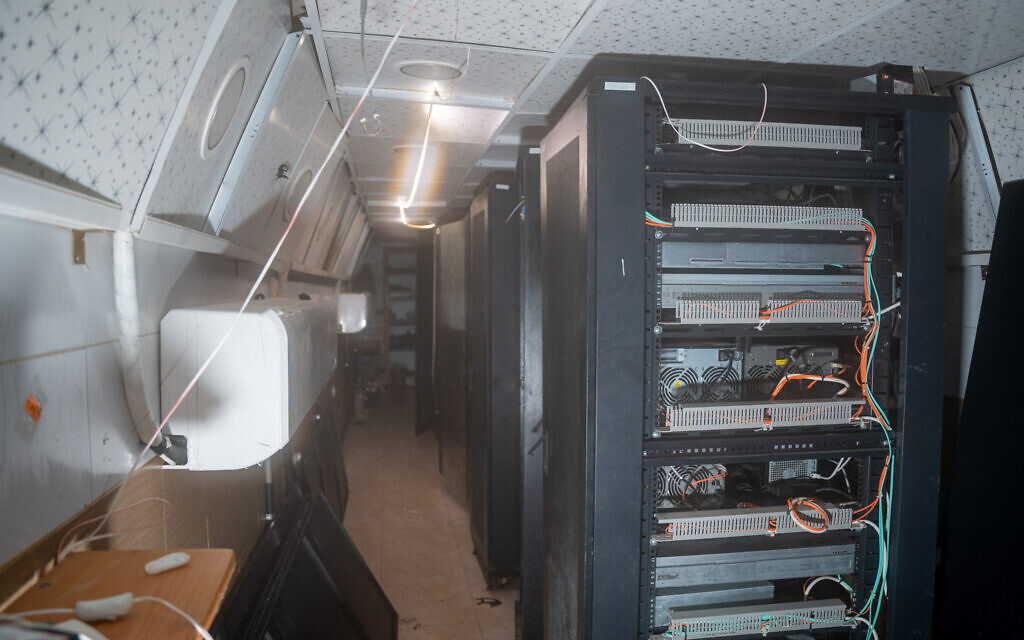
A subterranean Hamas data center underneath UNRWA’s headquarters in Gaza City, February 8, 2024. (Emanuel Fabian/Times of Israel)

“We are now at the heart of the secret… under the main UNRWA building. Here is where Hamas kept its intelligence servers,” Hazan said. He said that “to destroy it, totally, so that Hamas cannot use this intelligence supremacy again, you need boots on the ground.”

IDF officials believe Hamas used the server farm for intelligence gathering, data processing and communications. Hard drives and some of the computers were taken to Israel to be investigated by intelligence authorities before the tunnel system was demolished in a large explosion.

Hazan said the IDF knows of several more “strategic” Hamas tunnels in Gaza, that they will reach in time.

“We have time, months ahead of us in the war, and one by one we will dismantle them and take away what the enemy is trying to hide, and it hides it in a very sophisticated and cynical way,” he said.  
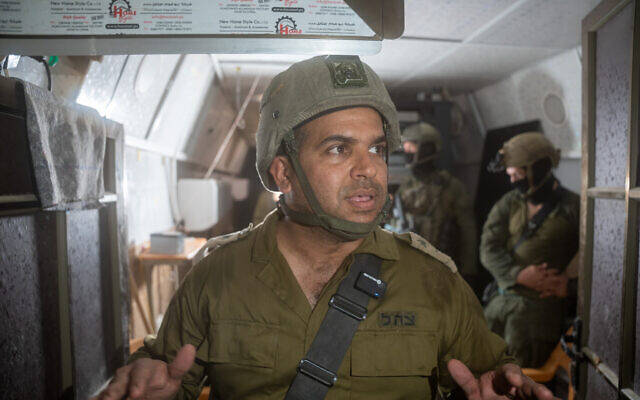
Col. Nissim Hazan speaks to reporters from a Hamas data center, beneath the UNRWA headquarters, uncovered by the IDF in Gaza City, February 8, 2024. (Emanuel Fabian/Times of Israel)
.

UNRWA’s Gaza headquarters

After leaving the tunnel back through the way we entered, we boarded an armored personnel carrier to take us to the UNRWA headquarters, as walking there aboveground was too exposed to potential Hamas snipers.

The headquarters appeared to be largely intact, unlike many of the surrounding buildings that had been pummeled by Israeli strikes.

Passing through the main gate, reading UNRWA HQ GAZA, and a nearby building with similar text in English and Arabic and bearing the UN logo, we reached the courtyard from which the combat engineers dug down into the electrical room.  
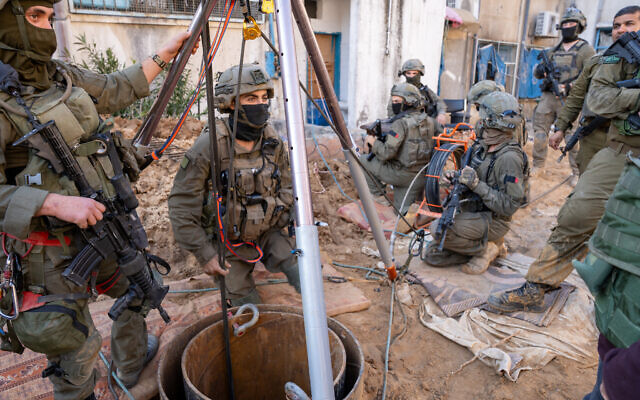
Troops of the Yahalom combat engineering unit lower a camera into a tunnel shaft they dug in the courtyard of UNRWA’s Gaza headquarters, to reach a Hamas underground electrical room, February 8, 2024. (Emanuel Fabian/Times of Israel)

At the UNRWA headquarters, Aharon said his forces found several caches of weapons belonging to Hamas when they raided and battled Hamas gunmen for the complex, although it was after the UN staff had evacuated.

“Grenades, rockets, launchers, explosives, a large amount of weapons that would put any Hamas company to shame,” he said.

The IDF also said that in some of the offices of UNRWA officials, troops found equipment and documents that indicated “that the same offices were also used by Hamas terrorists.”

“There is no doubt that UNRWA staff knew that [Hamas] was digging a massive tunnel beneath them,” Aharon said. “There’s a perimeter wall, a gate, cameras, at the gate they log who comes in and out. Whoever worked at UNRWA knew very well who was coming in, and who they were covering for.”  
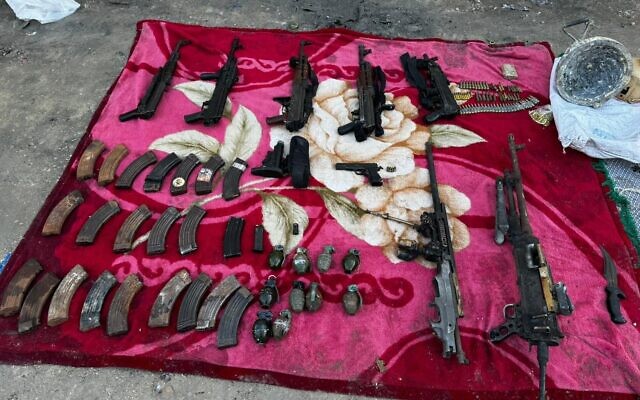
Weapons recovered by IDF troops in the UNRWA headquarters, in a photo published by the IDF on February 10, 2024. (Israel Defense Forces)

“UNRWA provides cover for Hamas, UNRWA knows exactly what is happening underground, and UNRWA uses its budget to fund some of Hamas’s military capabilities, this is for certain,” he said.

At the main building in the UN complex, Aharon led the reporters to UNRWA’s server room, which he said sits directly above the underground Hamas data center, where the reporters had been a short while earlier.

“Some of the cables connect down,” he said, showing a line of cables running down to and into the floor, as we stood above the Hamas data center.

The IDF said the electrical cables leading from the UN building to the tunnel were providing power to the Hamas infrastructure belowground.  
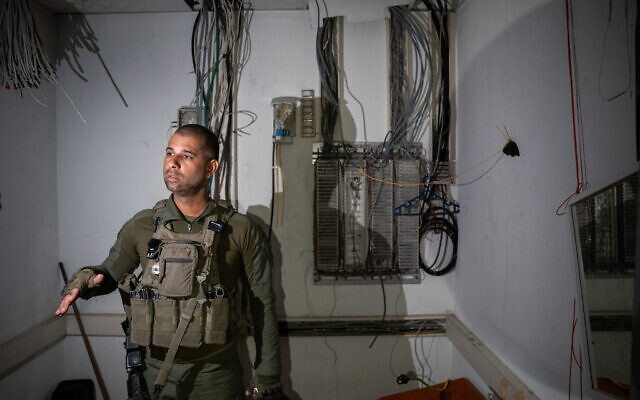
Col. Benny Aharon shows reporters UNRWA’s server room at its headquarters in Gaza City, February 8, 2024. (Emanuel Fabian/Times of Israel)

The UNRWA server room, unlike the Hamas one, appeared to be mostly empty. One server cabinet was placed outside the room, but it had been stripped of all the computers.

“They cleared out all the computers, all the DVRs (digital video recorder for surveillance cameras), cut [most of] the cables, this is the behavior of someone who has something to hide,” Aharon said.

“Someone who works at UNRWA, who is supposed to care for human rights, to care for the welfare of the population in Gaza, shouldn’t rush to disconnect all the DVRs, the cameras, cut all the wires and take all the computers. These are the actions of someone who knew the army was coming and wanted to hide the evidence,” he said.  
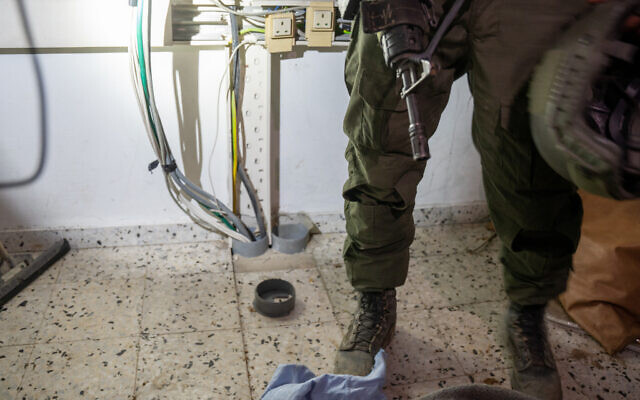
Cables running from a UNRWA server room to a Hamas data center underground in Gaza City, February 8, 2024. (Emanuel Fabian/Times of Israel)

Hazan said that Hamas “didn’t randomly select this area. It knows that during peacetime and in previous wars [Israel] didn’t have the legitimacy to strike a UNRWA building and collapse it on the tunnel.”

In addition to the allegations of its collusion with Hamas, Israel has also long accused UNRWA of perpetuating the Israeli-Palestinian conflict by extending refugee status to millions of descendants of Palestinians who fled or were forced out of homes in today’s Israel at the time of the establishment of the Jewish state in 1948, rather than limiting such status only to the original refugees, as is the norm with most refugee populations worldwide. 
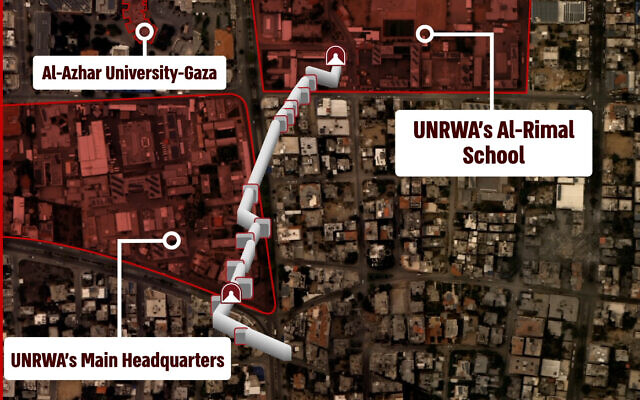
An IDF infographic released February 10, 2024, showing the route of the Hamas tunnel found under UNRWA’s Gaza headquarters. (Israel Defense Forces)

“We were shocked to the depths of our souls, that an organization that is meant to be caring for human rights, is cooperating in such a clear and brutal way, without any fears, with a terror group like Hamas,” Aharon said.

UNRWA did not immediately respond to requests for comment. In a tweet following the publication, the agency’s head Philippe Lazzarini denied any knowledge of the Hamas data center.


Zawartość publikowanych artykułów i materiałów nie reprezentuje poglądów ani opinii Reunion’68,
ani też webmastera Blogu Reunion’68, chyba ze jest to wyraźnie zaznaczone.
Twoje uwagi, linki, własne artykuły lub wiadomości prześlij na adres:
webmaster@reunion68.com


Numerous Weapons Discovered in UNRWA Premises in Gaza

Numerous Weapons Discovered in UNRWA Premises in Gaza

i24 News


View of the United Nations Relief and Works Agency (UNRWA) building in Rafah in the southern Gaza Strip. Photo: Abed Rahim Khatib / Flash90.

The IDF revealed that it had discovered, in the areas of Shati and Tel al-Hawa in northern Gaza, twenty terrorist infrastructure sites including a tunnel entrance near an UNRWA school. The tunnel, an “important part of Hamas’ military intelligence services,” passed under the building which serves as the main headquarters of UNRWA in the Gaza Strip.

Large quantities of weapons were found in rooms of the building, including rifles, ammunition, grenades and explosives. Intelligence and documents discovered in the offices of UNRWA officials confirmed that these offices had also been used by Hamas terrorists, the military claims.


Zawartość publikowanych artykułów i materiałów nie reprezentuje poglądów ani opinii Reunion’68,
ani też webmastera Blogu Reunion’68, chyba ze jest to wyraźnie zaznaczone.
Twoje uwagi, linki, własne artykuły lub wiadomości prześlij na adres:
webmaster@reunion68.com


Arabscy obywatele Izraela wiedzą, że wygrali

„Izraelscy Arabowie i Żydzi są jak sól i pieprz: jedno i drugie potrzebne jest na stole, a kiedy dodajemy je do potrawy, przestajemy je odróżniać. — prof. Mouna Maroun (na zdjęciu), wiceprezes i dziekan ds. badań na Uniwersytecie w Hajfie. (Zdjęcie: Mouna Maroun. Credit: Rami Shllush


Arabscy obywatele Izraela wiedzą, że wygrali

Bassam Tawil
Tłumaczenie: Andrzej K0raszewski


Sierżant pierwszej klasy (rezerwa) Ahmed Abu Latif, lat 26, mąż i ojciec rocznego dziecka, zginął 22 stycznia podczas walk pomiędzy Izraelem a Hamasem w Strefie Gazy. Abu Latif, muzułmański obywatel Izraela, ucieleśniał izraelskiego ducha jedności i patriotyzmu po masakrze Izraelczyków dokonanej 7 października przez Hamas. Był także wspaniałym przykładem współistnienia i niezachwianej miłości do Izraela.

wiadomości na Facebooku na początku wojny Abu Latif, który pracował jako ochroniarz na Uniwersytecie Ben-Guriona w Negewie, napisał:

„Jako Beduin-Izraelczyk, uważam, że służba w IDF Beduin Gadsar (Batalion Zwiadu Pustyni) była zaszczytem, który ujawnił moje mocne strony i pozwolił mi poznać przyjaciół na całe życie. Uwielbiam kontaktować się z ludźmi i łączyć kultury, niezależnie od tego, czy jest to goszczenie przyjaciół na posiłku, czy odwiedzanie z przyjaciółmi kibucu Szovel, graniem na gitarze i śpiewanie piosenek Jehudi Ravitza.

9 października o godz. 20.00 w towarzystwie szwagra wyruszyłem na misję rozdawania żywności żołnierzom. Po drodze naszą uwagę zwrócił radiowóz policyjny, jednocześnie otrzymaliśmy niepokojące wiadomości, że terroryści infiltrują obszar Miszmar Hanegev w pobliżu Rahat. Jako uzbrojeni i profesjonalni ochroniarze natychmiast dołączyliśmy do policji, pomagając w poszukiwaniu terrorystów. Naładowana adrenaliną misja była zarówno intensywna, jak i satysfakcjonująca, podkreślając znaczenie ochrony naszego domu. Na szczęście terroryści zostali szybko zlokalizowani i policja rozprawiła się z nimi.

W tle toczącej się wojny często słyszymy o zaangażowaniu obywateli arabskich. Odczuwamy ból z powodu poległych bohaterów, wśród których są również Beduini i Druzowie, muzułmanie i chrześcijanie, którzy odważnie bronili naszego kraju. Społeczność Beduinów opłakuje wszystkie cywilne ofiary, niezależnie od ich pochodzenia – Żydów, chrześcijan czy muzułmanów. To prowadzi mnie do kluczowego punktu: wszyscy dzielimy ten sam los, a nasza siła leży w jedności. Niestety są tacy, którzy starają się podważyć współpracę między różnymi sektorami, siejąc nasiona nieufności. Wzywam was, abyście nie dali się zwieść takim próbom i abyście mocno trwali w naszym wspólnym zaangażowaniu na rzecz jedności.”

Abu Latif nakręcił także film zachęcający do zaciągnięcia się do Jednostki Zwiadu Pustyni IDF. Nie był jedynym członkiem izraelskiej, przeważnie arabskiej mniejszości, który zginął podczas wojny, i nie jest jedynym Arabem, który służył w IDF i w izraelskiej policji. Tysiące arabskich muzułmanów, chrześcijan i członków społeczności druzyjskiej od dawna służy lub jest wolontariuszami w różnych oddziałach izraelskich sił bezpieczeństwa.

Major Jamal Abbas (23 l.), dowódca kompanii 101. Batalionu Brygady Spadochroniarzy, zginął w walce w południowej Strefie Gazy 18 listopada 2023 r. Abbas urodził się w rodzinie, w której było wielu wysokich rangą oficerów z wioski druzyjskiej w Peki’in w północnym Izraelu. Jego dziadek, emerytowany pułkownik Gideon Abbas, był jednym z pierwszych żołnierzy druzyjskich, którzy osiągnęli stopień dowódcy brygady w IDF. Ojciec Jamala, pułkownik Anan Abbas, poszedł w jego ślady.

Inny druzyjski oficer, podpułkownik Salman Habaka, lat 35, również zginął podczas walk z Hamasem w listopadzie ubiegłego roku. Habaka jest najstarszym rangą oficerem, który zginął od początku wojny. 7 października, kiedy Hamas najechał Izrael, był jednym z pierwszych żołnierzy IDF, którzy wkroczyli do kibucu Be’eri, gdzie zabarykadowały się dziesiątki terrorystów. Był odpowiedzialny za zneutralizowanie wielu terrorystów i uratował wielu mieszkańców ukrywających się w swoich domach i schronach. „Sytuacja w Be’eri była bardzo zła” – powiedział później. „Ale wiedzieliśmy, że mamy jedną główną misję: uratować pozostałych mieszkańców i zabić jak najwięcej terrorystów. Chodziliśmy od domu do domu i usuwaliśmy [terrorystów]”.

Nisreen Jousef, Druzyjka, która przez ostatnie 15 lat mieszkała z mężem Ijadem i czwórką dzieci we wsi Jated w pobliżu Strefy Gazy, jest uznawana za bohaterką, która uratowała 7 października życie dziesiątkom swoich żydowskich sąsiadów. Tego dnia jej mąż był jedną z pierwszych osób, które zostawiając żony i dzieci w domu, pospieszyły z cywilnym oddziałem bezpieczeństwa Jated i stawiły czoła terrorystom Hamasu, którzy wdarli się do ich społeczności. On i drugi (żydowski) strażnik schwytali dwóch terrorystów. Wtedy właśnie Nisreen zdecydowała się wkroczyć do akcji i przesłuchała terrorystów, aby uzyskać od nich informacje na temat inwazji. „Złapałam jednego z nich za kark i zapytałam po arabsku, kto go przysłał” – wspomina.

„Powiedziałem mu, żeby spojrzał mi w oczy, żeby wiedział się go nie boję. Zapytałem, ilu jest tam jeszcze terrorystów i gdzie się znajdują. Powiedział mi, że jest ich o wiele więcej na polu, 100 metrów od naszego domu.”

Dzięki informacjom, które uzyskała od terrorystów, izraelskie siły bezpieczeństwa zostały wysłane na miejsce, gdzie wzięto do niewoli 20 terrorystów. Zapytani, czy myślą, że nigdy nie wrócą do swojego domu, Nisreen i jej mąż odpowiedzieli:

„Tak. To było przerażające, ale to jest nasz kraj, to jest nasz dom. Nie możemy pokazywać im [terrorystom], że jesteśmy słabi. Nie możemy dawać im poczucia, że wygrali pomimo strachu, bólu i katastrofy, której doświadczyliśmy.”

Historie izraelskich muzułmanów i Druzów są dobrym przykładem tego, jak Żydzi i nie-Żydzi od dawna żyją w pokoju i harmonii w Izraelu. Są także oznaką tego, że coraz większa liczba społeczności muzułmańskich, chrześcijańskich i druzyjskich pozostaje lojalna wobec Izraela. Okrucieństwa Hamasu z 7 października nie rozróżniały Żydów i Arabów, starych i młodych, mężczyzn i kobiet, czarnych i białych. Co najmniej 20 arabskich obywateli Izraela zostało zamordowanych przez terrorystów Hamasu podczas ataku tego dnia lub w wyniku ataków rakietowych Hamasu w następnych dniach. Większość ofiar stanowili mieszkańcy beduińskich wiosek mieszkający na południu Izraela. Co więcej, Hamas uprowadził kilku Beduinów, mężczyzn i kobiet.

Nic więc dziwnego, że przeważająca większość izraelsko-arabskiego społeczeństwa sprzeciwiła się atakowi Hamasu. Badanie przeprowadzone przez Nimroda Nira z Instytutu Adama i Mohammeda Chalaily’ego wśród arabskiej społeczności wykazało, że większość izraelskich Arabów popiera prawo Izraela do samoobrony, a nawet wyraziła chęć zgłoszenia się na ochotnika do pomocy cywilom, którzy ucierpieli podczas ataku Hamasu. Badanie wykazało, że prawie 80% izraelskich Arabów sprzeciwiało się atakowi Hamasu, a 85% sprzeciwiało się porwaniom ludności cywilnej.

Dwa dni po masakrze izraelski bloger Nuseir Yassin, popularnie znany jako „Nas Daily”, zamieścił na X (dawniej Twitterze):

„Przez długi czas zmagałem się ze swoją tożsamością. Palestyńskie dziecko urodzone w Izraelu. Wielu moich znajomych do dziś nie chce wymówić słowa „Izrael” i nazywa siebie wyłącznie „Palestyńczykami”. Miałem 12 lat, to nie miało dla mnie sensu. Więc zdecydowałem się połączyć te dwie rzeczy i zostać „Palestyńczykiem-Izraelczykiem”. Myślałem, że to określenie odzwierciedla to, kim jestem. Najpierw Palestyńczyk, potem Izraelczyk. Ale po ostatnich wydarzeniach zacząłem myśleć. I myśleć. I myśleć. I wtedy moje myśli zamieniły się w gniew. Zdałem sobie sprawę, że jeśli Izrael miałby zostać „najechany” znowu w ten sposób nie bylibyśmy bezpieczni. Dla terrorysty najeżdżającego Izrael celem są wszyscy obywatele… A ja nie chcę żyć pod rządem palestyńskim. Co oznacza, że mam tylko jeden dom, nawet jeśli nie jestem Żydem: Izrael…”

Inne badanie przeprowadzone przez Izraelski Instytut Demokracji wykazało, że większość arabskich obywateli Izraela czuje silną więź z państwem w następstwie rzezi z 7 października. Około 74% respondentów stwierdziło, że ma dobre stosunki z Żydami, a 56% stwierdziło, że masakra dokonana przez Hamas nie reprezentuje społeczeństwa arabskiego, Palestyńczyków ani społeczności islamskiej. Badanie wykazało, że 70% Arabów w Izraelu identyfikuje się z państwem.

Komentując wyniki ankiety, prof. Mouna Maroun, wiceprezes i dziekan ds. badań na Uniwersytecie w Hajfie oraz była kierowniczka Katedry Neurobiologii w Sagol, pierwsza Arabka zajmująca wyższe stanowisko na wydziale nauk przyrodniczych, powiedziała:

„Jestem izraelską Arabką… jest mi wstyd. A Hamas jest winien…

W imię ludzkości błagam społeczność arabską, aby poszła naprzód i mądrze i odpowiedzialnie zrozumiała narrację żydowską, tak jak prosimy ich o zrozumienie naszej narracji od 75 lat. Po raz pierwszy jako mniejszość arabska jesteśmy proszeni o okazanie empatii i zrozumienie narracji większości…

W mieście Hajfa są mieszane dzielnice i budynki, w których Żydzi i Arabowie  mieszkają razem. Na uniwersytecie Żydzi i Arabowie uczą się i dorastają razem. To jest paradygmat, który Izrael musi powielić, aby przejść dalej po tragedii z 7 października.

To [Arabowie identyfikujący się z Izraelem] pokazuje, że społeczność arabska w Izraelu aspiruje do dalszej integracji ze społeczeństwem i dystansowania się od podmiotów działających w złej wierze, takich jak Hamas…

Izraelscy Arabowie i Żydzi są jak sól i pieprz: jedno i drugie potrzebne jest na stole, a kiedy dodajemy je do potrawy, przestajemy je odróżniać. Musimy przyjąć i pielęgnować nasz wspólny los, współpracując ze sobą, angażując się w poważnym dialogu i zrozumieniu, że jeśli chodzi o współistnienie i wspólne życie, nie ma się czego obawiać.”

Maroun należy do grupy arabskich kobiet zajmujących wysokie stanowiska na izraelskich uniwersytetach. W 2021 roku Rada Gubernatorów Uniwersytetu Hebrajskiego w Jerozolimie ogłosiła, że prof. Mona Khoury-Kassabri została wybrana na wiceprezesa ds. strategii i różnorodności na uniwersytecie. Był to pierwszy raz, kiedy ktoś ze społeczności arabskiej został mianowany na stanowisko wiceprezydenta uniwersytetu. „Jestem głęboko zaszczycona możliwością bycia pierwszą Arabką pełniącą funkcję wiceprezesa Uniwersytetu Hebrajskiego” – powiedziała Khoury-Kassabri .

„Mam pewność, że moje doświadczenie zarówno w sali wykładowej, jak i na pełnionym stanowisku będzie mi dobrze służyć w promowaniu celów strategicznych i wartości integracyjnych tej wspaniałej instytucji”.

Oprócz edukacji, izraelska medycyna zawsze służyła jako model żydowsko-arabskiej równości i współistnienia. Pacjenci żydowscy i arabscy dzielą te same sale w izraelskich szpitalach, gdzie pracują razem żydowscy i arabscy lekarze i pielęgniarki.

Odsetek arabskich lekarzy w Izraelu rośnie. Pod koniec 2021 r. lekarze arabscy stanowili 24% izraelskich lekarzy. W tym samym roku 43% nowych licencji dla lekarzy przyznano lekarzom arabskim i druzyjskim. Udział obywateli arabskich w innych zawodach związanych z opieką zdrowotną jest również znaczny.

„Szpitale, miejsca, w których tak wiele osób doświadcza bólu i chorób, są także miejscami współpracy lekarzy żydowskich i arabskich” – zauważyła Fahima Abbas, badaczka w Adva Center, izraelskim zespole doradców monitorującym rozwój społeczny i gospodarczy. „Naszym obowiązkiem jest o tym pamiętać i wzmacniać tę współpracę zarówno w czasach zwyczajnych, jak i w sytuacjach nadzwyczajnych. To ważny element demokratycznego państwa”.

W 2022 r. sędzia Chaled Kabub został pierwszym muzułmaninem powołanym do Sądu Najwyższego Izraela. Wszyscy poprzedni arabsko-izraelscy sędziowie zasiadający w 15-osobowym sądzie byli chrześcijanami, co jest kolejnym przykładem tego, jak arabscy obywatele Izraela mają normalny dostęp do wyższych stanowisk w sektorze publicznym.

W 2019 r. Samer Hadż Jehia został pierwszym arabskim szefem dużego banku w Izraelu, kiedy został mianowany prezesem zarządu Bank Leumi.

Od 1948 r. ponad 80 obywateli arabskich zostało wybranych na członków izraelskiego parlamentu, Knesetu. W 2020 roku w Knesecie zasiadało 17 arabskich posłów w liczącym 120 członków parlamencie.

Hamas niewątpliwie miał nadzieję, że masakra popełniona przez jego członków 7 października zniszczy wszelkie kontakty nie tylko między Izraelem a Palestyńczykami, ale także między Żydami i Arabami w samym Izraelu. Na szczęście jednak Hamasowi nie udało się skłócić izraelskich Żydów i izraelskich Arabów. Pomimo wojny Izrael-Hamas zdecydowana większość Żydów i Arabów w Izraelu nadal współpracuje i żyje w pokoju i bezpieczeństwie obok siebie, często w tych samych dzielnicach i w tych samych budynkach.

Palestyńczycy żyjący pod rządami skorumpowanej Autonomii Palestyńskiej na Zachodnim Brzegu i pod rządami grupy terrorystycznej Hamasu w Strefie Gazy mogą jedynie pozazdrościć obywatelom arabskim obywatelom życia w Izraelu, gdzie cieszą się demokracją, wolnością słowa, dostępem do doskonałej opieki zdrowotnej, do instytucji edukacyjnych, możliwościami karier zawodowych i życiem w dobrze prosperującej gospodarce.


Bassam Tawil – jest muzułmańskim badaczem i publicystą mieszkającym na Bliskim Wschodzie.


Zawartość publikowanych artykułów i materiałów nie reprezentuje poglądów ani opinii Reunion’68,
ani też webmastera Blogu Reunion’68, chyba ze jest to wyraźnie zaznaczone.
Twoje uwagi, linki, własne artykuły lub wiadomości prześlij na adres:
webmaster@reunion68.com


War, Antisemitism and Free Speech: A Critical Dilemma

War, Antisemitism and Free Speech: A Critical Dilemma

Ben Cohen / JNS.org


The Constitution of the United States. Photo: Wikicommons.

 – Should governments and public institutions take punitive measures against groups or individuals who promote antisemitism through such measures as cutting funding, criminalizing aspects of their speech or even proscribing them outright?

Here in the United States, such a discussion is purely theoretical because the First Amendment protects all forms of speech, including Holocaust denial, and racist and antisemitic barbs. Because freedom of speech is a natural right, the American tradition promotes debate, fostering the optimistic, if often misplaced, notion among some that better arguments and clearly presented facts will invariably overwhelm lies and conspiracy theories. But in Europe, there is no right of absolute free speech, and in most countries, antisemitic and racist speech, as well as declared sympathies for terrorism or violence, can run you afoul of the law.

The current European dilemma is whether to tighten and strengthen these measures in a bid to bring a greater sense of security to Jewish communities facing a wave of antisemitism unprecedented in its intensity for nearly a century. The proximate cause was, of course, the Oct. 7 Hamas pogrom in Israel, but the themes incorporated in this discourse are much older, even ancient. In part because of their frustration at the sheer stubbornness of these toxins, politicians who sympathize with the plight of their Jewish constituents are examining legal means to stem the flow of antisemitic tropes.

Two weeks ago, Berlin’s State Senator for Culture and Social Cohesion, Joe Chialo, attempted to introduce a new measure that would deny funding to artists who promote antisemitism, including antisemitic depictions of Zionism and Israel. In order to determine what is and isn’t antisemitic, Chialo urged the adoption of the International Holocaust Remembrance Alliance’s (IHRA) working definition of antisemitism, which includes several examples of when anti-Zionism crosses the line into antisemitism.

Last week, Chialo was forced to withdraw his proposal. “I must take the legal and critical voices that saw this clause as a restriction on the freedom of art seriously,” he said in a statement. “Let there be no doubt: I will continue to fight for a Berlin cultural scene that is free of discrimination.” To be clear, the problem here was not the substantive argument of the IHRA definition that anti-Zionism and antisemitism are frequently the same. Rather, it centered on the issue of whether measures in Germany taken to combat Holocaust denial are—in terms of jurisprudence—appropriate when it comes to denial of Israel’s right to exist. “The denial of the Holocaust is about denying a fact, while Israel’s right to exist is about denying a right,” Professor Stefan Conen of the German Lawyers’ Association told the German parliament’s legal affairs committee last week. Another witness, Professor Michael Kubiciel, forecasted a series of procedural headaches should the proposal advance, which could only be resolved, he said, through the adoption of a “more open wording … for example by also recording the right to exist of states to which the Federal Republic has made a particular commitment, such as the E.U. member states.”

None of these objections invalidate the underlying claim of a symbiosis between antisemitism and anti-Zionism, and nor should we conclude that Chialo will abandon his efforts to banish antisemitism from the German arts scene because of one setback. However, the uncertainty around his proposal has bolstered the argument that the IHRA definition is not so much a means of understanding antisemitism as a tool for censoring Israel’s adversaries.

Last Monday, the Berliner Zeitung news outlet interviewed one of the co-authors of the IHRA definition in the context of Chialo’s stalled initiative. “The definition has often been misused as a blunt instrument to label someone as antisemitic for a variety of reasons, including criticism of Israel,” said Ken Stern, the director of the Center for the Study of Hate at Bard College and a former American Jewish Committee (AJC) in-house expert on antisemitism.

Elaborating, Stern said that this “misuse” of the definition was more pronounced “not so much for disqualifying criticism of Israel as antisemitic, but rather, for pro-Palestinian attitudes. I may not agree with some of these attitudes or statements, but calling them antisemitic is wrong, even harmful.” Later in the interview, Stern clarified that while he opposed the “boycott, divestment and sanctions” campaign targeting Israel, he vehemently objected to calling anyone who supports it “antisemitic.”

“Do I think that supporting BDS makes you an antisemite? No, I don’t think so,” he said, before adding: “Although, of course, you can be an antisemite who supports BDS.” In other words, while the campaign may attract antisemites because of its obsession with the Jewish state, it is not inherently antisemitic.

I should say, at this point, that I knew Stern professionally some years ago when I worked with him on antisemitism issues at the AJC. My assessment, which hasn’t changed, is that his overarching goal was to persuade progressives to take antisemitism seriously, and he was willing to cut them all sorts of slack in order to achieve that. What he was unwilling to acknowledge is that making these allowances undermine the very definition he helped to write! Because while the definition doesn’t explicitly say that BDS is antisemitic, it does say that “[D]enying the Jewish people their right to self-determination, e.g., by claiming that the existence of a State of Israel is a racist endeavor” is. That pretty much sums up the core philosophy of the BDS movement, which regards the boycott as an instrument to secure the eventual elimination of Israel as a sovereign state and makes no secret of this aim.

The most disturbing aspect of the interview was the sense that in his desire to mollycoddle progressive students and activists who regard as Israel as a colonial interloper, Stern has lost empathy with the actual victims of antisemitism. The atrocities and bestialities of the Hamas pogrom were straight out of the Cossack playbook of previous centuries, executed with the purpose of humiliating the enemy and denying their basic humanity because fundamentally, antisemites regard Jews as adjacent to, rather than belonging to, the rest of the human species. Yet all Stern could bring himself to say was that the conflation of anti-Zionism and antisemitism within the IHRA definition was a product of the tensions around the U.N.’s 2001 Durban anti-racism conference. “I’m not saying that every form of anti-Zionism is antisemitic, but that was the climate at the time,” he remarked—the bizarre implication being that the climate in the 2020s, in the wake of the worst outburst of antisemitic violence since the Holocaust, is, in fact, more benign.

What makes the present situation different is that antisemitism is surging against the background of a war in the Middle East that could easily intensify and expand, and whose most vulnerable front consists of Jewish communities around the Diaspora who cannot be protected by Israel’s military might.

In such an environment, when there is an unmistakable correlation between antisemitic memes spread on social media, anti-Jewish invective at pro-Hamas demonstrations and actual violence—I am thinking of the brutal assault last Saturday night on three Israelis walking through London’s West End by a mob of thugs yelling “Free Palestine”—tougher measures, including censorship, are warranted in those cases where such tools are legally available.

While we didn’t choose this outcome (as the Russian revolutionary Leon Trotsky said, “You don’t choose war; war chooses you”), we have no choice but to deal with it, as decisively as we can.


Zawartość publikowanych artykułów i materiałów nie reprezentuje poglądów ani opinii Reunion’68,
ani też webmastera Blogu Reunion’68, chyba ze jest to wyraźnie zaznaczone.
Twoje uwagi, linki, własne artykuły lub wiadomości prześlij na adres:
webmaster@reunion68.com


Antisemitic Vandals Strike Hillel Building at University of Leeds in UK

Antisemitic Vandals Strike Hillel Building at University of Leeds in UK

Dion J. Pierre


Antisemitic message graffitied on Hillel House of University of Leeds. Photo: Union of Jewish Students/X

The Hillel House of University of Leeds was vandalized on Thursday night, raising further concerns about a hateful campus climate and rising antisemitism across the United Kingdom, particularly since Hamas’ October 7 attacks.

The vandals, according to pictures shared online, graffitied “FREE PALESTINE” on the building and additional scribble on two window panes.

“We are heartbroken and angry that after an uplifting and inspiring Challah Bake, our JSoc Hillel House was defaced with antisemitic graffiti,” Leeds JSoc, which uses the building for club meetings, said in a statement also signed by the Union of Jewish Students, an advocacy group. “It is shocking and outrageous that those who hate us would stoop to this level.”

The groups noted that a University of Leeds professor may be responsible for leading anti-Zionist to the building, alleging that he shared its address “for the sole purpose of intimidating Jewish students on campus.”

“We are working with CST and the police to ensure that those who committed this crime get the consequences they deserve,” the group added.

Anti-Zionists extremists struck elsewhere on Thursday, storming University of Birmingham with socialists and other far-left groups while holding signs that said, “Zionists off our campus” and “75 years of illegal occupation!” Many concealed their faces, covering them with keffiyeh.

“Jewish students are feeling less and less safe at university because of these vile antisemitic acts,” National Jewish Assembly (NJA), a Jewish civil rights nonprofit, said in a statement about the incidents. “It’s time we say enough. Jewish students deserve and must feel safe on campus.”

Thursday’s incidents followed a set-back for the academic Jewish community. Earlier this week, it was announced that a UK government agency which arbitrates disputes over employment law ruled that University of Bristol lacked standing to fire sociologist David Miller, an extreme anti-Zionist who was accused of harassing Jewish students and promoting antisemitic tropes, and said his “anti-Zionist beliefs qualified as a philosophical belief and as a protected characteristic.”

Pervasive antisemitism and anti-Zionism at UK universities is forcing members of the Jewish academic community to conceal their identities on campus, according to a June 2023 report issued by the Parliamentary Task Force on Antisemitism in Higher Education, a committee of lawmakers and established by former Prime Minister Boris Johnson in 2022 in response to complaints of anti-Jewish racism and discrimination.

“We were told it was commonplace for Jewish students to choose not to wear certain clothing or jewelry around campus because it would make them visibly identifiable as Jewish,” the Task Force wrote in the report, titled Understanding Jewish Experience in Higher Education, noting that academic staff “also raised important comparable concerns about negativity surrounding their Jewish identity.”

The Task Force recommended that all universities adopt the International Holocaust Remembrance Alliance (IHRA) definition of antisemitism, which, it said, has not, contrary to the claims of its many opponents, diminished free speech and academic freedom.


Zawartość publikowanych artykułów i materiałów nie reprezentuje poglądów ani opinii Reunion’68,
ani też webmastera Blogu Reunion’68, chyba ze jest to wyraźnie zaznaczone.
Twoje uwagi, linki, własne artykuły lub wiadomości prześlij na adres:
webmaster@reunion68.com