Archives

The Media Continues Its Iran Deal Myth-Making

The Media Continues Its Iran Deal Myth-Making

Sean Durns
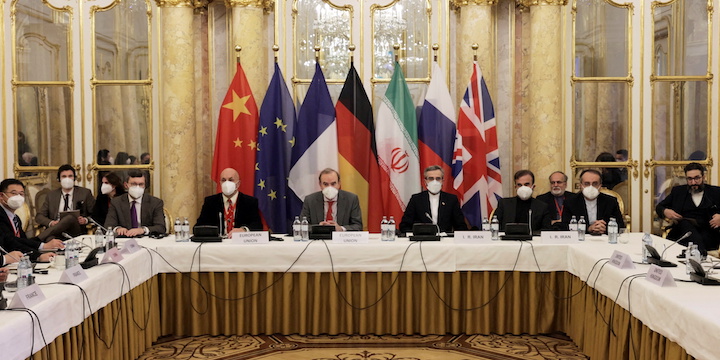

Deputy Secretary General of the European External Action Service (EEAS) Enrique Mora and Iran’s chief nuclear negotiator Ali Bagheri Kani and delegations wait for the start of a meeting of the JCPOA Joint Commission in Vienna, Austria December 17, 2021. EU Delegation in Vienna/EEAS. Photo: Handout via REUTERS

“The great enemy of the truth,” John F. Kennedy once observed, “is very often not the lie — deliberate, contrived and dishonest — but the myth — persistent, persuasive, and unrealistic.” Both myths and lies surround the Joint Comprehensive Plan of Action (JCPOA), the 2015 accord reached between the United States and the Islamic Republic of Iran over the latter’s nuclear weapons program.

And few myths have been as enduring as the myth that Israel’s security establishment supported the so-called Iran nuclear deal.

Gilead Ini, a senior research analyst for the Committee for Accuracy in Middle East Reporting and Analysis (CAMERA), punctured the falsehood when it was first introduced in 2015. At the time, the pitch to sell the Iran Deal was in full swing.

In September of that year, The New York Times published a graphic that highlighted Congressional opposition to the Obama administration-brokered deal.

Initially, the graphic included a column headed “Jewish?” to highlight whether the Democratic lawmaker casting votes on the JCPOA was Jewish or not. Not content with regurgitating the antisemitic dual loyalty canard, the newspaper falsely asserted that the debate over the deal “divided Jewish constituents between those who saw the deal as a threat to Israel and those who backed it as a way to avert conflict between Iran and the United States.”

That most Americans, Jewish and otherwise, were skeptical of the deal on its merits was a fact to be ignored or obfuscated. Instead, many JCPOA boosters propagated the line that it was “this deal or war.”

This lack of nuance was extended in additional media reports, which claimed that Israel’s security establishment supported the Iran nuclear deal.

In fact, many of the experts cited by press outlets as “supportive” were deeply critical of the JCPOA.

Former Israeli Prime Minister Ehud Barak, for example, referred to it as a “bad deal.” Forward journalist J.J. Goldberg implied that Amos Yadlin, the former head of Israel’s military intelligence, favored the agreement when, in fact, he was lukewarm at best. As CAMERA noted at the time, Yadlin had called the JCPOA “problematic,” even adding: “this is not a good deal … you also could call it a bad deal.”

Indeed, other Israeli security experts who were often cited as supporters, such as Efraim Halevy and Israel Ziv, were less than enthusiastic in their expressions of the deal’s merits. Ziv, while believing that the deal “is not particularly bad,” argued that “there is no one in Israel who thinks the nuclear agreement is a good agreement.”

Yet, more than half a decade later, the media is continuing to publish reports on both the JCPOA, and Iran’s nuclear program, that are missing essential context.

Take, for example, The Washington Post.

On December 9, 2021, the newspaper published a report entitled “Israel opposed the Iran nuclear deal, but former Israeli officials increasingly say U.S. pullout was a mistake.” The publication of the dispatch coincided with ongoing negotiations in Vienna between the United States and Iran.

Israeli officials, Post reporter Shira Rubin asserted, have “warned that economic sanctions on Iran are not deterring it from dangerously advancing its nuclear program.” She adds: “while Israel had applauded President Donald Trump’s withdrawal from the accord in 2018,” former Israeli officials have “concluded that his ‘maximum pressure’ policy built primarily on sanctions has failed to prevent Iran from increasing the quantity and quality of its enriched uranium.”

To bolster the argument, Rubin quoted Yoel Guzansky, the former head of the Iran desk on Israel’s National Security Council. Guzansky said that “the nuclear deal was flawed, but at least it put a lid on Iran’s advancement, which we don’t have now.” Another official, Raz Zimmt, said that the pullout “may actually have accelerated Iranian nuclear progress.”

The Post’s report claimed that former Israeli officials said that the JCPOA “subjected Iran to restrictions and to international inspections that held in check crucial elements of the nuclear program,” whereas sanctions have achieved far less.

Yet, there is no real way to measure Iran’s nuclear progress. The JCPOA itself did not require Iran to disclose its nuclear history. Additionally, it isn’t accurate to imply that Iran was subjected to a stringent inspection regime under the deal, because the deal’s terms prohibited the inspection of military sites and didn’t allow immediate access. The yardstick, from the very beginning, was broken.

Put simply: it is impossible to know the full extent of Iran’s nuclear progress — a fact that the deal didn’t solve, and arguably made worse. But what is known is that Iran was, in fact, cheating and lying about its nuclear program — a fact that makes the JCPOA’s loose inspection terms even more troubling.

An October 2018 report by the Institute for Science and International Security, a Washington, DC-based think tank, analyzed documentation that Israel had seized from Tehran in a daring intelligence operation. This “nuclear archive” consisted of thousands of documents, later authenticated by the US, which showed that Iran had not only lied about its nuclear program, but was hiding it during negotiations with the United States and others. As CAMERA noted in a November 2018 Daily Caller op-ed, the revelations from the “nuclear archive” were widely ignored by media outlets.

Furthermore, the Post’s report also fails to mention a key fact: the JCPOA’s terms included sunset provisions. The deal did not, by its very terms, prevent Iran from acquiring nuclear weapons. The agreement’s biggest booster even admitted as much.

In an April 7, 2015, interview with NPR, then-President Barack Obama acknowledged that in “13,14, 15 years” Iran, thanks to advanced centrifuges, will be able to “enrich uranium fairly rapidly, and at that point, the breakout times would have shrunk to almost zero.” The Post also failed to inform readers that the JCPOA did not address the R&D aspects of Iran’s program, and even allowed for the use of advanced centrifuges.

Regrettably, more omissions followed.

The Post noted that Israeli operatives had assassinated Mohsen Fakhrizadeh in November 2020, describing him as “the country’s top nuclear scientist.” But Fahrizadeh was more than a mere scientist — he was also a top commander in the Islamic Revolutionary Guard Corps (IRGC), which has been designated by the US for its role in supporting and training terrorist groups and for targeting Americans.

The Post also quoted Israeli officials who “said that Western isolation from Iran also contributed to the weakening of pragmatic Iranian Hassan Rouhani.”

Rouhani may have been pragmatic, but he was no moderate. As CAMERA frequently highlighted, Rouhani has claimed that United Flight 93, which crashed during the September 11, 2001, Al-Qaeda terrorist attack was “shot down by the United States Air Force.” Rouhani has also supported the use of illegal chemical warfare and, when he was the first secretary of Iran’s National Security Council, supported operations to target and murder dissidents living abroad.

Iran is the world’s leading state sponsor of terrorism, and has targeted and murdered Americans. The regime calls for the destruction of the world’s sole Jewish state and has devoted considerable resources to attacking Israel. Tehran’s attempts to acquire nuclear weapons warrant both concern and careful press coverage. Yet too often, both have been lacking.


The writer is a Senior Research Analyst for CAMERA, the 65,000-member, Boston-based Committee for Accuracy in Middle East Reporting and Analysis 


Zawartość publikowanych artykułów i materiałów nie reprezentuje poglądów ani opinii Reunion’68,
ani też webmastera Blogu Reunion’68, chyba ze jest to wyraźnie zaznaczone.
Twoje uwagi, linki, własne artykuły lub wiadomości prześlij na adres:
webmaster@reunion68.com


News From Israel- February 13, 2022

News From Israel- February 13, 2022

ILTV Israel News


Israeli authorities officially sounding the alarms of war – and calling on all citizens to evacuate Ukraine

Major clashes erupting again, in the flashpoint Jerusalem neighborhood of Sheikh Jarrah

Two steps forwards but one step back in relations with the UAE. Israeli El-Al airlines drastically cutting its number of flights to Dubai; citing “unmet security concerns…”


Zawartość publikowanych artykułów i materiałów nie reprezentuje poglądów ani opinii Reunion’68,
ani też webmastera Blogu Reunion’68, chyba ze jest to wyraźnie zaznaczone.
Twoje uwagi, linki, własne artykuły lub wiadomości prześlij na adres:
webmaster@reunion68.com


Could Ukraine crisis lead to new world order that impacts Israel? – analysis

Could Ukraine crisis lead to new world order that impacts Israel? – analysis

SETH J. FRANTZMAN


While Russia may receive some tough words and even sanctions, world nations are getting out of Ukraine as fast as possible.

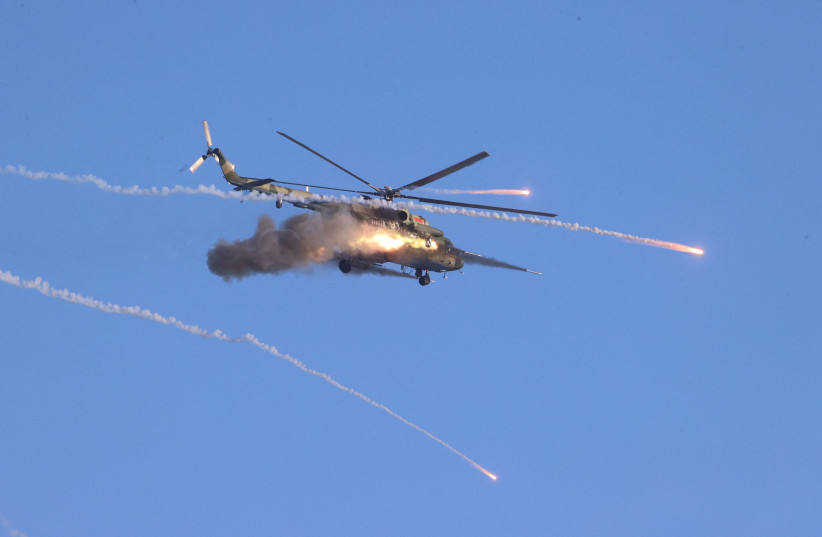
A helicopter fires during military exercises held by the armed forces of Russia and Belarus at the Gozhsky training ground in the Grodno region, Belarus, February 12, 2022. / (photo credit: LEONID SCHEGLOV/BELTA/HANDOUT VIA REUTERS)

The unfolding Ukraine crisis illustrates how major Western governments are dealing with the chances for a conflict between a near-peer rival of the United States and another large country. In this sense, it paints a picture of how future conflicts may unfold.

How the Ukraine crisis is resolved is only one aspect of this. If Russia does invade Ukraine, and if the West does then back Ukraine, it could lead to an escalating conflict. The outcome of that conflict matters. But it also matters if Russia gets a swift victory or if nothing happens.

This matters to the Middle East. The outcome of the Ukraine crisis could signal to Iran that it can encourage more proxy attacks in the region. A sense of global impunity to invasions and attacks, and a perception the US-led world order has fractured, could help enemies of Israel.

Why this matters is because even before any shots have been fired, major countries such as China have shown how they will react. In short, China doesn’t seem concerned. Turkey, which sells drones to Ukraine but works with Russia in Syria, doesn’t seem concerned. Iran doesn’t seem concerned.

The China-Russia-Iran-Turkey authoritarian alliance that often works together to challenge the US and Western interests is part of an emerging new world order. This order emerged largely to challenge US global hegemony of the 1990s. It is symbolized by meetings in various forums, such as Astana process on the Syrian civil war and the Shanghai Cooperation Organization.

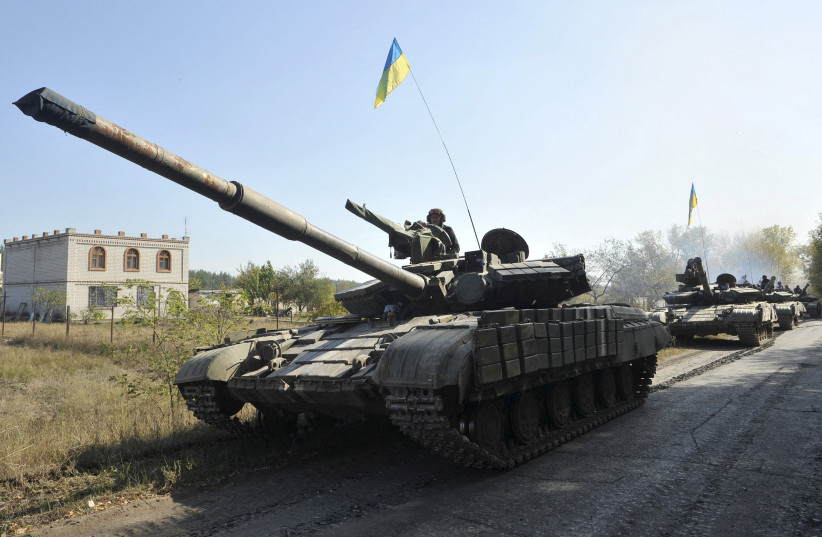
Tanks of the Ukrainian armed forces are parked on the roadside during a withdrawal near the village of Nyzhnje in Luhansk region, Ukraine, October 5, 2015. (credit: STRINGER/ REUTERS)

The West’s response to the Ukraine crisis has largely been one of putting out statements, sending some weapons and then removing embassy staff. The messaging is clear: While Russia may receive some tough words and even sanctions, the US and others are rapidly folding up their diplomatic posts in Kyiv and moving personnel to Poland or elsewhere.

This appears to give a kind of green light to a further crisis. It doesn’t exactly instill confidence to see all the foreign diplomatic staff fleeing for the exits. In a sense, it acknowledges a fait accompli, as if the invasion has already happened.

Has Russia won without actually having to do anything?

There is compelling evidence that Moscow has been able to outmaneuver the US and NATO already. 

Russia has shown that pressure in the form of a troop buildup can cause panic in Western chanceries and prompt Western leaders to either phone Moscow or run around in circles discussing what to do next.

While the US and UK have appeared quite strong on the need to defend Ukraine, their NATO allies haven’t done much. Countries that were formerly in the Soviet orbit or close to the Russian border, such as Poland and the Baltics, are standing strong on these issues, but it’s not clear what countries such as Spain or Italy will do.

This lets us get a glimpse of what comes next. It’s increasingly clear that the “rules-based international order,” the one that made up the so-called “new world order” of the post-Gulf War status, is largely in tatters.

US president George H.W. Bush believed that at the end of the Cold War the US could anchor this order. However, incidents such as the Black Hawk Down incident in Somalia and the fiascoes that took place after the Iraq invasion, and then the collapse of Afghanistan, largely showed that the US can’t really enforce a world order, let alone win a war on terrorism. This means the US moved from humanitarian intervention and “global policeman” in the 1990s to narrowly focused counterterrorism operations.

Along the way, many countries leapt at the opportunity to take advantage of US bungling in places such as Afghanistan and the American public’s penchant for wanting to end “endless wars.” These countries, including Russia and China, have become more powerful.

Russia has already shown it can enforce its rules in the Caucasus and also has sent forces to Syria. It has meddled in Libya and Africa, and it is increasingly selling its weapons across the Middle East and Africa.

Meanwhile, the US is largely beset by domestic squabbles, and polling on backing Ukraine in the US shows that Americans are divided. They don’t really want involvement in another foreign war. Russia can read the polls too.

This means the Ukraine crisis could serve as a turning point, at least symbolically, of how the world order is changing. However, it could also serve to show that Russian threats and even an invasion won’t go as Moscow planned.

If Russia fumbles, then this could fuel the US desire to move to near-peer rivalry, and it could fuel massive defense spending for new systems and platforms to confront Moscow. That could lead to the US seemingly awakening from a slumber of domestic chaos and pandemic-induced malaise.

This matters for the Middle East. The US is a key partner of countries in the region and an ally of Israel and others. The US, however, has wanted to withdraw from the region and reduce its footprint. Whenever the US signals withdrawal, this unleashes chaos and also invites Iran and others into the region.

These are usually outcomes that can harm Israel because Iran leads proxies that are anti-Israel. Iranian proxies also target Israel’s new peace partners in the Gulf. Thus, the Ukraine crisis could have ramifications that affect Israel.

Russia is not necessarily the major problem, and it generally gets along with Israel. China has also had trade with Israel. But there are major questions about how it might fuel Iranian aggression in the region. If Russia is seen to have gotten a green light for an invasion, then Iran may think it can increase its attacks.


Zawartość publikowanych artykułów i materiałów nie reprezentuje poglądów ani opinii Reunion’68,
ani też webmastera Blogu Reunion’68, chyba ze jest to wyraźnie zaznaczone.
Twoje uwagi, linki, własne artykuły lub wiadomości prześlij na adres:
webmaster@reunion68.com


U.K Jewish group rebukes “racist & hateful” Knesset member – Michael Wegier

U.K Jewish group rebukes “racist & hateful” Knesset member – Michael Wegier

ILTV Israel News


British Jewish community leaders issuing a scathing reprimand of ultra-conservative Israeli MK, Bezalel Smotrich. The rare rebuke calling on Smotrich to leave the country over his “hateful ideology”, as Smotrich tours the UK to gather support against the new Israeli religious conversion law.

Michael Wegier | CEO, UK Board of Deputies of British Jews


Zawartość publikowanych artykułów i materiałów nie reprezentuje poglądów ani opinii Reunion’68,
ani też webmastera Blogu Reunion’68, chyba ze jest to wyraźnie zaznaczone.
Twoje uwagi, linki, własne artykuły lub wiadomości prześlij na adres:
webmaster@reunion68.com


Israeli authorities vow to redress police-Pegasus scandal

Israeli authorities vow to redress police-Pegasus scandal

ILTV Israel News


Public security Minister Omer Barlev officially setting up a state commission of inquiry, into allegations that police illegally surveilling citizens for years – including public officials, journalists, and their family members.


Israelis from left and right banding together, rallying against the abuse of NSO’s spyware on the public

The controversial citizenship law passing thru its first reading in Knesset

A groundbreaking study that could be the solution to spinal injuries – and the reversal of long-term paralysis


Zawartość publikowanych artykułów i materiałów nie reprezentuje poglądów ani opinii Reunion’68,
ani też webmastera Blogu Reunion’68, chyba ze jest to wyraźnie zaznaczone.
Twoje uwagi, linki, własne artykuły lub wiadomości prześlij na adres:
webmaster@reunion68.com