Archives

Meet the new creepy, crawly search-and-rescue robot

Israel21cMeet the new creepy, crawly search-and-rescue robot

ISRAEL21c Staff


RSTAR, developed by researchers at Ben-Gurion University, can navigate large obstacles and carry payloads necessary for search-and-rescue operations.
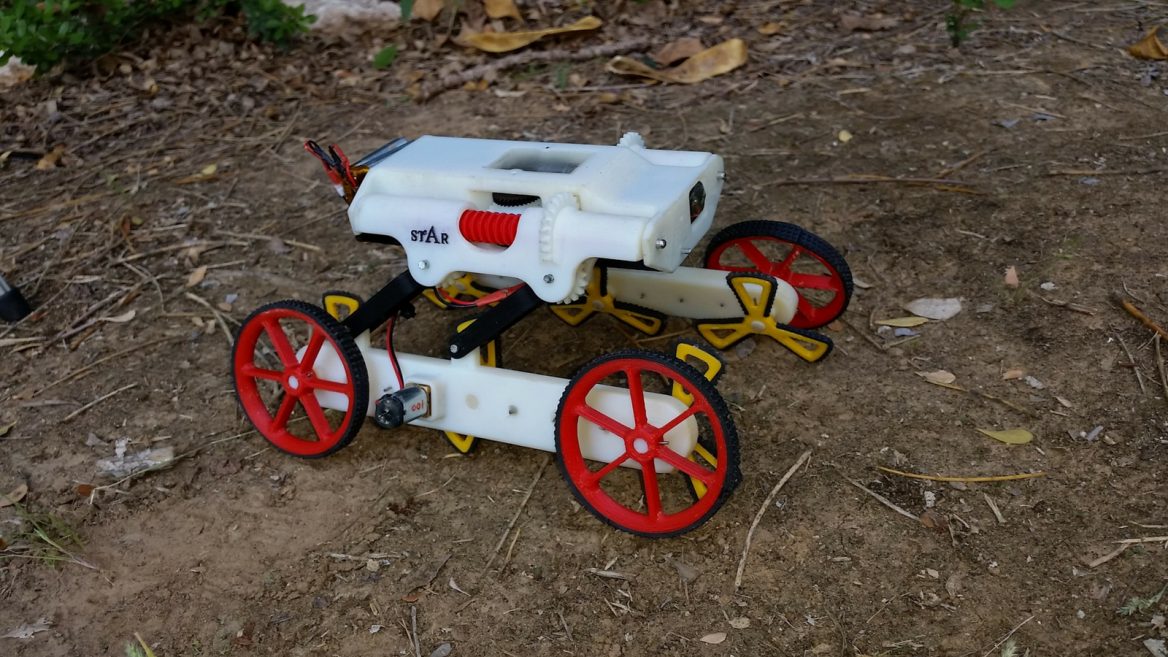
Ben-Gurion University researchers designed the Rising Sprawl-Tuned Autonomous Robot (RSTAR) to function simply and reliably without external mechanical intervention. Photo: courtesy

The newest member of the robot family at Ben-Gurion University of the Negev (BGU) is RSTAR, a highly maneuverable search-and-rescue robot that can creep, crawl and climb over rough terrain and through tight spaces.
Developed by BGU researchers, RSTAR – which stands for Rising Sprawl-Tuned Autonomous Robot – utilizes adjustable sprawling wheel legs attached to a body that can move independently and reposition itself to run on flat surfaces, climb over large obstacles and up closely-spaced walls, and crawl through a tunnel, pipe or narrow gaps.

The innovative new robot was introduced in May at the International Conference on Robotics and Automation (ICRA 2018) in Brisbane, Australia.

“The RSTAR is ideal for search-and-rescue operations in unstructured environments, such as collapsed buildings or flooded areas, where it must adapt and overcome a variety of successive obstacles to reach its target,” says Bio-Inspired and Medical Robotics Lab Director David Zarrouk, a lecturer in BGU’s department of mechanical engineering.

Previous robots developed by Zarrouk and the BGU team include 1STAR, a steerable robot that uses only one motor, and MASR (Minimally Actuated Serial Robot), a snake-like robot that travels along a rotatable structure using just two motors, making it unusually lightweight, small and inexpensive.

Zarrouk worked together with BGU student and robotics lab worker Liran Yehezkel to create RSTAR, designing it to function simply and reliably, change shape and overcome common obstacles without any external mechanical intervention.

3 feet per second

Its speed and relatively low energy consumption make the robot ideal for a broad range of applications that may require longer work time, BGU said in a statement.

Using its round wheels, the robot is able to travel more than three feet per second on hard flat surfaces. It can also switch to spoke wheels to avoid getting stuck in extremely soft or granular surfaces, like thick mud or sand.

RSTAR can climb vertically and crawl horizontally by pressing its wheels to walls without touching the floor.
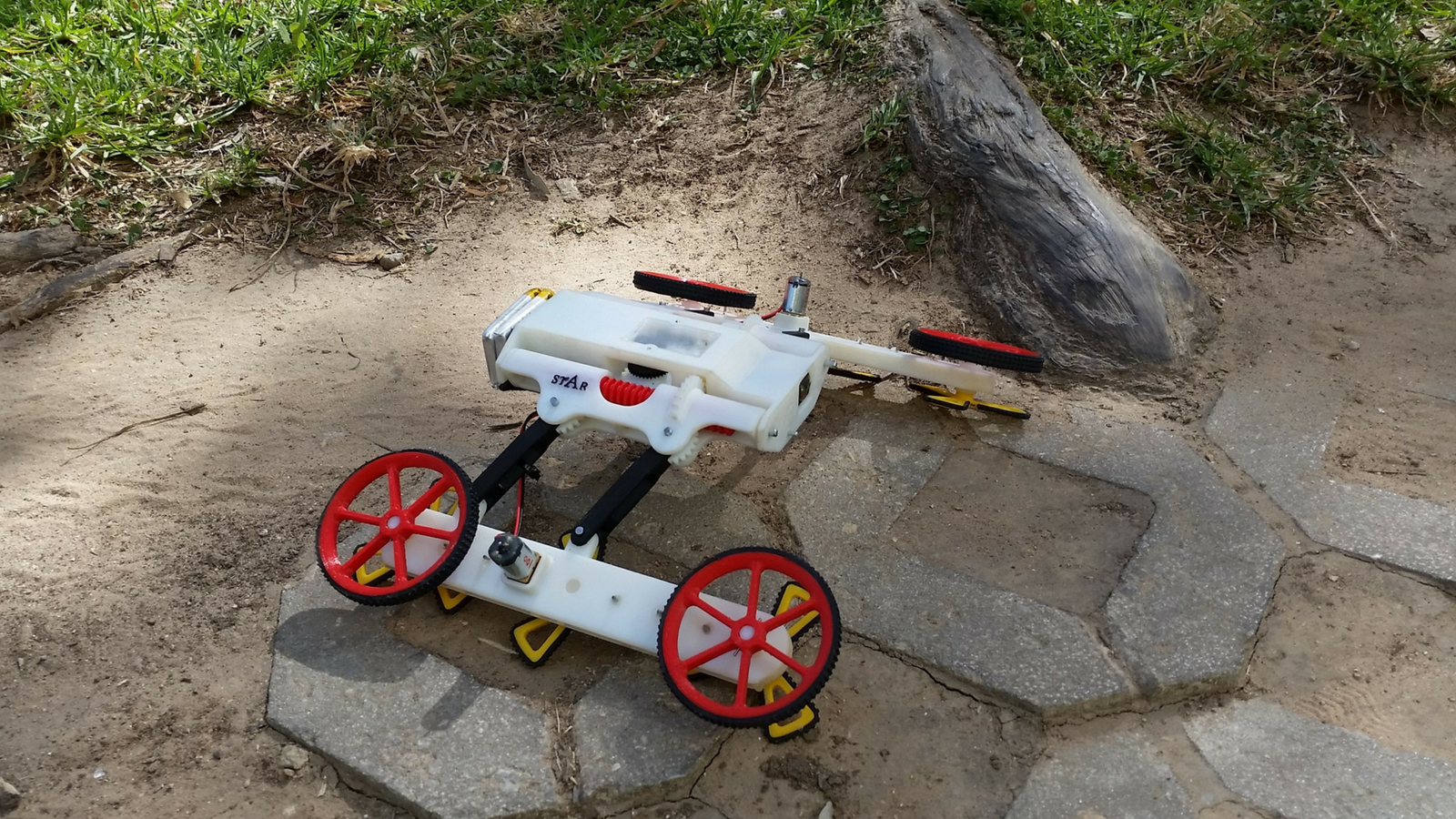
RSTAR uses adjustable sprawling legs angled downward and outward from its body to navigate a variety of obstacles and surfaces. Photo: courtesy

BGU said the creation of a larger version of the STAR robot is already underway. This one will be able to climb over larger obstacles, including stairs, and carry more than four pounds of sensors and supplies

A smaller STAR or RSTAR will piggyback on the larger robot for use in hard-to-reach areas and between narrow cracks and passages.

Israeli rescue robots

The RSTAR joins a growing list of rescue robots that have been developed in Israel in the last several years.

The Rooster, developed by Israeli startup RoboTiCan, can help reach injured victims of natural disasters where it’s not safe to send a human rescue worker. Its unique ability to walk, hover and fly over obstacles sets it apart from other search-and-rescue robots that can either walk or fly, but not both.

In 2016, Tel Aviv University and ORT Braude College collaborated on the development of a five-inch-long featherweight robot dubbed “TAUB” in tribute to both academic institutions.

Inspired by the common locust, the tiny high-jumping TAUB robot could be used for sending lifesaving reconnaissance data to human rescue teams in disaster situations, or for cleaning up oil spills or for gathering intelligence – and many other difficult missions unsuited to large robots and humans.

The robotic octopus arm, created in 2011 by an international group of scientists including Hebrew University Prof. Binyamin Hochner, was modeled after a real octopus that lives in the Mediterranean Sea. The robotic arm can wrap around objects or people and then stiffen to grasp them, making retrieval possible in difficult underwater environments.


Zawartość publikowanych artykułów i materiałów nie reprezentuje poglądów ani opinii Reunion’68,
ani też webmastera Blogu Reunion’68, chyba ze jest to wyraźnie zaznaczone.
Twoje uwagi, linki, własne artykuły lub wiadomości prześlij na adres:
webmaster@reunion68.com



Jerusalem Israel Song – Shira Chadasha Boys Choir Music Video

Jerusalem Israel Song – Shira Chadasha Boys Choir Music Video

   ShiraChadasha2


The Shira Chadasha Boys Choir are about to release their second album The name of the album is Arayvim zeh l’zeh. Composed and conducted by Nachman Seltzer, arranged mostly by Jeff Horvitch with one song by Leib Yaacov Rigler. The album has twelve new songs and old songs from Dvekus composed by Abie Rotenberg. The thirteenth song is entitled Yizkarem and was composed by Nachman Seltzer in the memory of the boys from Mercaz Harav, on the day after the attack. With star soloists Yaacov Leebhoff, Moishe Bell and Simcha Levinstein this album is sure to be a hit.


Zawartość publikowanych artykułów i materiałów nie reprezentuje poglądów ani opinii Reunion’68,
ani też webmastera Blogu Reunion’68, chyba ze jest to wyraźnie zaznaczone.
Twoje uwagi, linki, własne artykuły lub wiadomości prześlij na adres:
webmaster@reunion68.com


Israel to launch rocket to the moon in December

Israel21cIsrael to launch rocket to the moon in December

Abigail Klein Leichman


SpaceIL’s lunar module will blast off on a SpaceX Falcon 9 rocket and land on the moon two months later.

Determined to continue its race to the moon despite the expiration of the $20 million Google Lunar XPRIZE competition last March, Israel’s nonprofit SpaceIL announced plans to launch its unmanned module on a SpaceX Falcon 9 rocket from Cape Canaveral in Florida in mid-December.

If the module reaches the moon as expected on February 13, 2019, it will make history as the smallest and first privately funded unmanned spacecraft to land on the moon.

“Our mission was never about winning the prize money – although $20 million would have been nice,” said SpaceIL CEO Ido Anteby. “It’s about showing the next generation that anything is possible – that even our small country can push the limits of imagination.”

On July 10, SpaceIL gave the press its first look inside the Israel Aerospace Industries (IAI) MABAT Space facility in Yehud near Israel’s airport, where the nonprofit organization has been collaborating with IAI for eight years to build the 1,322-pound (600-kilogram) spacecraft.

Until now, only three world superpowers — the United States, Russia, and China — have achieved controlled lunar landings.

Lacking the resources of those superpowers, SpaceIL turned to private donors to fund the project. SpaceIL was the first of 16 Google Lunar XPRIZE competitors to sign a launch contract and one of only five teams to reach the finals.

Approximately $88 million was invested in the spacecraft’s development and construction. SpaceIL President Morris Kahn has donated about $27 million to the effort and decided to proceed even after the contest deadline passed and effectively ended without any finalists achieving the goal.

“After eight challenging years, I am filled with pride that the first Israeli spacecraft, which is in its final construction and testing phases, will soon be making its way to the moon,” said Kahn. “I have experienced numerous challenges in my life, but this was the greatest challenge of all.”

Kahn said the lunar launch “will fill Israel, in its 70th year, with pride. It is a national accomplishment that will put us on the world’s space map.”

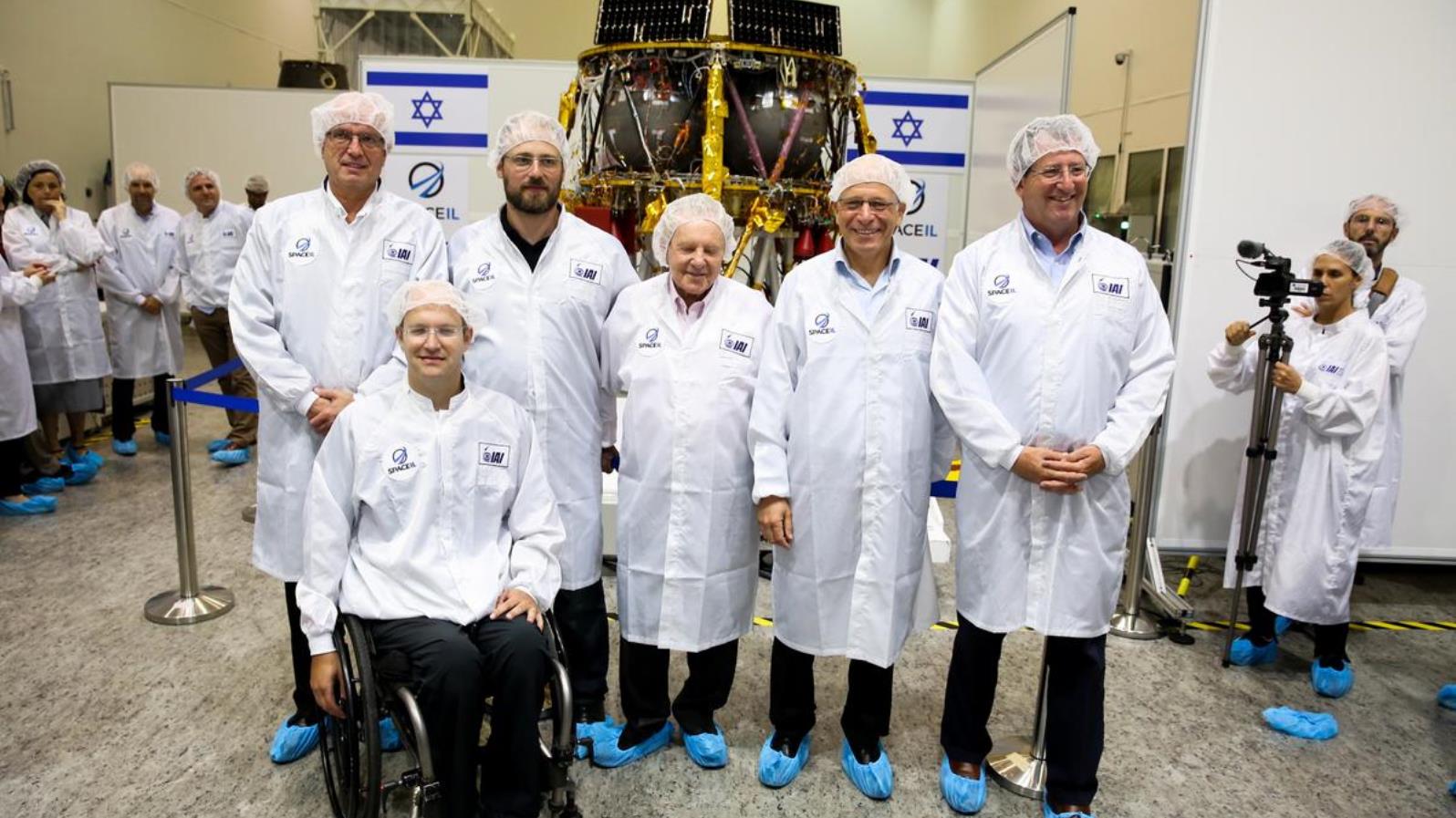
From left, Aviad Shmaryahu of the Israel Space Agency; SpaceIL founders Yariv Bash and Kfir Damari; philanthropist Morris Kahn, SpaceIL CEO Ido Anteby; and head of IAI’s space division Ofer Doron. Photo courtesy of Space IL

The craft and the journey

The spacecraft’s design and development process began in 2013, two years after Yariv Bash, Kfir Damari and Yonatan Winetraub founded SpaceIL and registered for the Google Lunar XPRIZE competition. Construction began at the IAI MABAT Plant last year.

In the coming months, the Israeli spacecraft will undergo intensive checks and tests at IAI to prove that it can withstand the launch, flight and landing conditions, said Anteby.
The dimensions of the spacecraft are 1.5 meters (4.9 feet) high and 2 meters (6.5 feet) in diameter. The fuel it will carry will comprise some 75 percent of its total 600kg weight. Its maximum speed will reach more than 10 kilometers per second (36,000 kilometers, or nearly 22,370 miles, per hour).

Anteby said the SpaceIL craft – bearing an Israeli flag — will disengage from the launch rocket at an altitude of 60,000 kilometers (37,282 miles) and will begin orbiting Earth in elliptical orbits. Upon receipt of a command from the control room, the spacecraft will enter a higher-altitude elliptical orbit around Earth, which will reach a point near the moon.

At this point, it will ignite its engines and reduce its speed to allow the moon’s gravity to capture it. It will then begin orbiting the moon, until the appropriate time to begin the landing process. This process will be executed autonomously by the spacecraft’s navigation control system.

The entire journey, from launch to landing, will last approximately two months.

SpaceIL’s module is to take photos and video of the landing site and measure the moon’s magnetic field as part of a scientific experiment designed by Weizmann Institute researchers. The data will be transmitted to the IAI control room during the two days following the landing.

The program has always had STEM education as a secondary goal, aiming to encourage Israeli children to choose to study science, technology, engineering and mathematics. With the help of a broad network of volunteers, SpaceIL has already made presentations to about 900,000 children nationwide.

For children from any country, SpaceIL introduced its Moon Kids website in English, chock full of fun interactive content about the moon and outer space.

IAI has been a full partner in the project from its inception. Over the years, additional partners from the private sector, government companies and academia have joined, including Weizmann Institute of Science; Israel Space Agency; the Ministry of Science, Technology and Space; Bezeq and others.

IAI CEO Josef Weiss said he regards the launch of the first Israeli spacecraft to the moon as an example of the amazing capabilities once can reach in civilian space activity.

“The State of Israel, which is already firmly planted in the realm of space in its military activity, must harness resources for the benefit of civilian space, which is an engine of innovation, technology, education and groundbreaking around the world,” said Weiss.


For more information about SpaceIL, click here.


Zawartość publikowanych artykułów i materiałów nie reprezentuje poglądów ani opinii Reunion’68,
ani też webmastera Blogu Reunion’68, chyba ze jest to wyraźnie zaznaczone.
Twoje uwagi, linki, własne artykuły lub wiadomości prześlij na adres:
webmaster@reunion68.com


‘Am Yisrael Chai’: Ugandan Jews Enter Israel With Song and Dance

‘Am Yisrael Chai’: Ugandan Jews Enter Israel With Song and Dance

Algemeiner Staff


Members of the Ugandan Abayudaya community visit the Western Wall in Jerusalem during their Taglit-Birthright trip. Photo: MAROM.

Some 40 Ugandan youths landed in Israel this past Tuesday, as part of the first-ever Taglit-Birthright group from the Jewish Abayudaya community.

The group entered the arrivals hall at Ben-Gurion International Airport near Tel Aviv while dancing and singing in Hebrew, “David, the king of Israel, lives and endures,” and, “Am Yisrael Chai!”

Others in the hall soon joined the celebration, which was accentuated by drum beats and occasional blows of the shofar. They later recited the “Shehecheyanu,” a Jewish prayer of gratitude for new or special occasions.

The group spent the first two days of its trip in northern Israel, before arriving in Jerusalem to celebrate the Jewish Sabbath.

Our #MaromUganda Taglit-Birthright Israel group arrived in Israel!! #AbayudayaInIsrael ברוכים הבאים לישראל תגלית מרום אוגנדה משבט אבאיודאיה! #IsraelExperience #Birthright #MasortiMovement

Publicerat av MAROM Tisdag 21 augusti 2018


While Birthright, which offers eligible young Jews from across the world free 10-day tours of Israel, is partially funded by the Israeli government, the Abayudaya community’s religious status is not officially recognized by Jerusalem.

In June, a member of the community was denied a request to obtain Israeli citizenship under the Law of Return pertaining to the Jewish Diaspora, in a decision the Interior Ministry said extended to all Abayudayas.

That stance has been rejected by leaders of Conservative Judaism, whose rabbis converted a majority of the 2,000-member Ugandan community starting in 2002, as well as by the Jewish Agency, a quasi-governmental body that oversees Jewish immigration to Israel and officially recognized the Abayudayas as Jewish since 2009.

Now led by Rabbi Gershom Sizomu, the group traces its roots to African chieftain Semei Kakungulu, who began observing some Jewish religious practices in the early 20th century. It has since adopted more formal Jewish observances and withstood persecution, including under the dictatorial rule of Idi Amin, who outlawed Judaism and destroyed synagogues after assuming power in 1971.


Zawartość publikowanych artykułów i materiałów nie reprezentuje poglądów ani opinii Reunion’68,
ani też webmastera Blogu Reunion’68, chyba ze jest to wyraźnie zaznaczone.
Twoje uwagi, linki, własne artykuły lub wiadomości prześlij na adres:
webmaster@reunion68.com


DEMOCRATS, REPUBLICANS AND THE JEWISH COMMUNITY

DEMOCRATS, REPUBLICANS AND THE JEWISH COMMUNITY

MATT BROOKS


It’s an undeniable fact that extremist, anti-Israel Democrats have won their party’s nomination for Congress.

American Jews partcipate in the annual Israel Day Parade 370. (photo credit: REUTERS)

In a recent op-ed carried in the Jewish media, Halie Soifer, the newly-appointed executive director of the Jewish Democratic Council of America (JDCA), preaches the same talking points we hear from Jewish Democratic leaders every election year: Republicans should give up on the Jewish vote. 

Her arguments are not convincing. First she asserts that American Jewish values are Democratic values. Then she claims that Democrats are more pro-Israel than Republicans. Both of those statements are simply false.

The Jewish community may still tilt Democrat, but Soifer conveniently forgets to mention that Republicans have received increasing shares of the Jewish vote over the last 25 years. She also ignores the strong support for Republican policies and candidates among the growing population of Orthodox voters in America. Clearly, Jewish values are not identical with the Democratic Party platform if a significant majority of observant Jews vote Republican.

Jewish voters, like all Americans, want economic policies that promote job growth and unleash the economic power of America. They want national security policies that protect our citizens from terrorism, secure our national borders and stop threats from our enemies abroad. 

All of us saw the results of eight years of Democratic values in action under the Obama administration: more regulations, more taxes and higher unemployment at home, along with weakness, concessions and alienated allies abroad. Today, Republican leaders and Republican policies are bringing us back to prosperity, strength and security.

The most distressing part of Soifer’s essay was her attempt to use the Democratic Party’s historic support for Israel as cover for the many anti-Israel Democratic candidates who are rising to prominence in their party. 

It’s an undeniable fact that extremist, anti-Israel Democrats have won their party’s nomination for Congress. They include: Alexandria Ocasio-Cortez (NY), Leslie Cockburn (VA), Ilhan Omar (MI), Rashida Tlaib (MI) and Scott Wallace (PA). That’s not to mention Rep. Keith Ellison, the Democratic nominee for Minnesota attorney-general. According to Democratic Party leaders, being anti-Israel is acceptable. Democratic Party co-chairman Tom Perez said Ocasio-Cortez represents the “future the Democratic Party.” She and the others mentioned here have the full support of the Democratic Party and, with the exception of Tlaib, the endorsement of Jewish Democratic groups like JDCA and J Street. We have yet to hear Soifer or her organization, the JDCA, oppose the rest of these troubling candidates. 

In contrast, when anti-Israel, white supremacist candidates run for office as Republicans, the Republican Jewish Coalition and the Republican Party are quick to speak out. The Republican Party and the RJC have denounced them and denied them any support. Their ideology is evil and such people have no place in the party of Lincoln. 

Unfortunately, Soifer has to contend with the fact that Republicans are overwhelmingly more supportive of Israel than Democrats at the grassroots as well. Polls show that Republican support for Israel is near 80%, while Democratic support is less than 30%. We have seen Democrats shifting away from Israel for years, and the partisan gap in support for Israel is now the widest it has ever been. 

The RJC will continue to educate and energize the growing Jewish Republican movement in this country. Jewish voters deserve to have a voice in the party that is pro-Israel, supports economic growth and national security, and reflects their values. And that party is the GOP.


The writer is the executive director of the Republican Jewish Coalition.


Zawartość publikowanych artykułów i materiałów nie reprezentuje poglądów ani opinii Reunion’68,
ani też webmastera Blogu Reunion’68, chyba ze jest to wyraźnie zaznaczone.
Twoje uwagi, linki, własne artykuły lub wiadomości prześlij na adres:
webmaster@reunion68.com