Archives

Shared love of soccer draws Jews and Arabs to Jaffa Gate

Israel21cShared love of soccer draws Jews and Arabs to Jaffa Gate

  21see


The historic gate of Jerusalem’s Old City was transformed into a soccer pitch to bring teenagers together in fellowship and sport.


Zawartość publikowanych artykułów i materiałów nie reprezentuje poglądów ani opinii Reunion’68,
ani też webmastera Blogu Reunion’68, chyba ze jest to wyraźnie zaznaczone.
Twoje uwagi, linki, własne artykuły lub wiadomości prześlij na adres:
webmaster@reunion68.com


New sweet protein holds out hope for diabetics

Israel21cNew sweet protein holds out hope for diabetics

Brian Blum


An Israeli company has developed a sweet protein that can replace sugar in food and won’t raise your blood sugar or insulin levels.
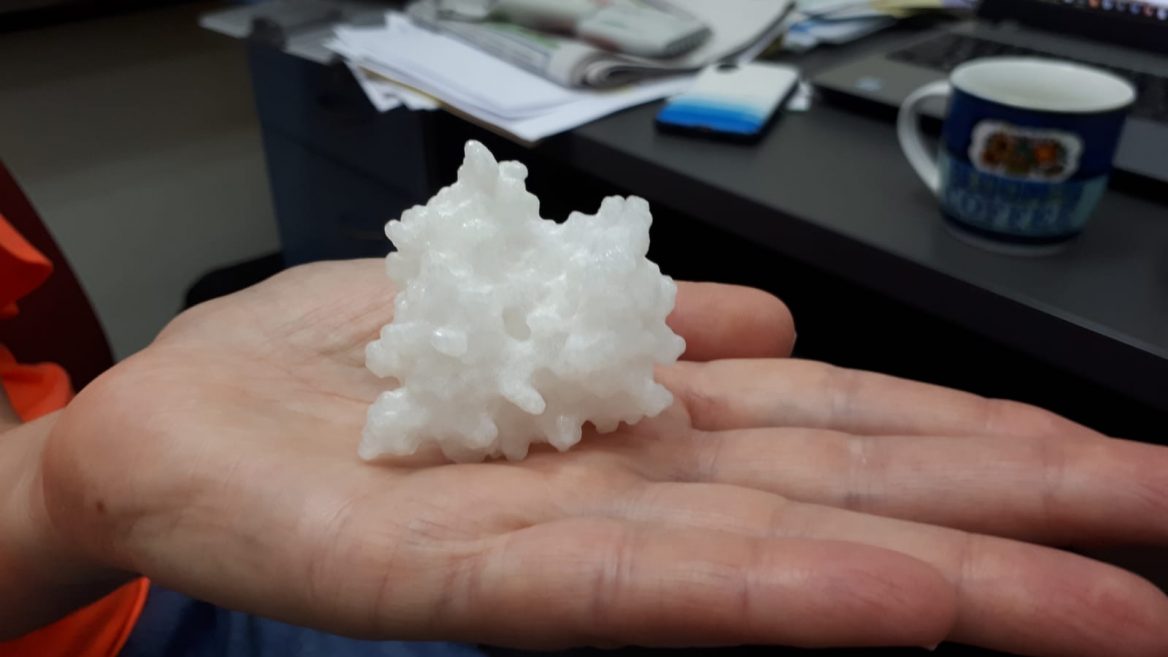
Thaumatin, found in the katemfe plant, is a sweet protein that can be used to replace sugar. Photo courtesy Amai Proteins

Ninety-nine percent of all fruits in the world derive their sweetness from sugar. But there are a dozen or so fruits that grow along the equatorial belt that contain a sweet protein, rather than a sugar.

What if that protein could be turned into a commercial product? Proteins used as a sweetener would have significant advantage over added sugar: they’re digested by the body just like any other protein in the GI tract, they don’t raise your blood sugar or insulin levels, they steer clear of your liver, don’t burden your kidneys, nor do they affect the microbiome in the same way as sugar.

That means a protein-sweetened candy bar would not contribute to diabetes or obesity as would its sugary cousin.

That’s what Ilan Samish was thinking when he first learned about thaumatin, the sweet protein in katemfe, a plant which grows primarily in Nigeria.

“The world is spending huge amounts of money to cure disease,” he tells ISRAEL21c, pointing to how obesity has been classified by the World Health Organization as a global epidemic. “But we’re not focusing on curing the food that’s causing the disease. We need to cure the food rather than cure the disease.”

Telling people to cut down on their sweets doesn’t work, Samish says. “Sweetness makes people happy. So we need to find a way to allow people to enjoy themselves, but in a healthy way. Now we have a way to do just that.”

Samish wasn’t the first entrepreneur to think about harvesting sweet protein-containing fruits, but other companies have run into obstacles: the costs of picking and shipping the fruits to a lab (from Africa to somewhere in the west, as is usually the case) and then extracting and processing the protein into a powder can be prohibitive.

The team at Amai Proteins. Photo courtesy Amai Proteins

Enter computational protein design (or CPD). Samish is a CPD expert. He studied with William DeGrado, considered the “father” of CPD, at the University of Pennsylvania. Samish even published a book on the subject.

CPD utilizes massive computer processing to map and model the structure and energetics of proteins. “Proteins are like a necklace of beads,” Samish explains. “The beads are the amino acids that make up a protein.” Samish uses CPD to mix and match beads on the necklace until the resulting protein has just the right composition to successfully work as a sweet protein fit for the mass food market.

Samish’s company, Amai Proteins, bases its design on several sweet proteins including the thaumatin found in the katemfe plant, but doesn’t actually use any of the plant itself. “I’ve never even seen the katemfe fruit,” Samish admits. “I’ve never been to Nigeria.”

As a result, his laboratory-produced sugar substitute is “a 100 percent designer protein” that’s even better than the original. “It’s more soluble and binds less to the tongue,” Samish says. That gives it an advantage over Stevia, another sugar-alternative (derived from the leaves of the Stevia plant). Stevia adheres to the tongue and causes a long-lasting and unpleasant aftertaste.

CPD is resource intensive. Samish says he is grateful to Amazon and Google, which together donated $120,000 worth of cloud computing time on their systems to power Amai’s protein designs.

The next step in the process for Amai is to actually generate the designer protein at scale. For this, Samish turned to a less technological solution than Amazon for inspiration.

Brewing beer?

“We take the DNA we’ve designed and put it in yeast where it grows,” Samish explains. “It’s like brewing beer, but instead of making alcohol, our yeast makes a sweet protein.”

The resulting powder is a pure protein. That means Amai’s sweet proteins are not genetically-modified organisms, which some consumers shy away from consuming. For a food to be considered a GMO, you’d have to be eating a modified version of the plant or the yeast itself. “Our final product contains no remnants of the host organism’s DNA,” Samish says. “It’s protein powder only, brewed at the fermentation facilities located at our labs in the Weizmann Science Park in Rehovot.”

Sweet protein powder is several thousand times sweeter than sugar, Samish adds. “So instead of adding, say, 4 grams of sugar into a product, we need less than 2 milligrams of protein sweetener.” That will help keep the costs down, but winds up creating a different challenge.

“If we replace the sugar in chocolate with our protein sweetener, the chocolate will weigh only half as much,” he says. “So the chocolate maker will need to add nutritional fibers.” That may, in turn, change the cost as well as the taste and experience of eating the chocolate.

So far, this is all theoretical: no actual Amai protein-sweetened products are on the market yet. But Samish and his team have been doing extensive tests. At the recent FoodTechIL exposition in Tel Aviv, Amai gave samples of a protein-sweetened lemon soda to some 1,000 attendees. “The feedback was excellent,” Samish says.

For its current tests, a 50/50 mix of protein sweetener and another sweetener (sugar or Stevia) was used. The aim, however, is to get to 100 percent sugar reduction. Amai also demonstrated some other products at FoodTech, including a strawberry-flavored drink, a whipped cream concoction and a yogurt.

Amai has received NIS 3 million ($825,000) in investment to date from the Israeli-run Strauss food conglomerate. The investment was made through Strauss’s Tel Aviv-based food incubator, The Kitchen Hub, where Amai is a portfolio company.

Amai Proteins is one of a growing number of Israeli startups addressing the world’s sugar addiction. The sugar substitute market is huge – worth around $9 billion a year, Samish says. By comparison, that’s only a tenth of the market for sugar itself. Samish believes companies like Amai can change that. “Current substitutes are not as tasty as sugar and are either unhealthy or perceived as such,” he says.

Among the other Israeli companies to keep an eye on, there’s  (“matok” is Hebrew for “sweet”) which adds an “inert” mineral carrier to sugar so that a food or beverage can contain less sweetener while delivering the same sensation. (It works because it’s just the surface of the sugar that the body “enjoys,” so why not substitute sugar with something less harmful.)  DouxMatok has raised $8 million.

Unavoo’s Heylo product takes a similar additive approach as DouxMatok, but for Stevia not sugar. Heylo adds a dietary fiber so you get less Stevia (and less aftertaste) while experiencing the same sweetness.

A1C uses regular sugar in its chocolates and ice creams but adds a special formulation that the company says lowers the glycemic index of its products. The company was founded by Ran Hirsch, whose daughter was diagnosed with diabetes, in collaboration with Mariela Glandt, the endocrinologist who treated her.

Then there are companies like Spirugar that swap out the sugars and carbohydrates typical in cakes and cookies with flours made of nuts, almonds and seeds plus fruit and vegetable-based sweeteners (all 100 percent vegan).

Amai is already working on two other sweet proteins. Ultimately, the company aims to expand into other areas where CPD can be beneficial in food design. That includes so-called “functional foods” (cereal or breads that are fortified with vitamins, herbs and nutraceuticals, for example) and “medical foods” (foods that are formulated for management of disease that cannot be met by normal diet alone).

“We’ve already received requests and we definitely plan to do it,” Samish says. After all, he adds, “we are a platform company for food applications.” For now, though, the company’s sweet spot is thaumatin and other lab-grown proteins.

If he plays his fruit right, perhaps Samish will even get to see a katemfe plant in person someday.


Zawartość publikowanych artykułów i materiałów nie reprezentuje poglądów ani opinii Reunion’68,
ani też webmastera Blogu Reunion’68, chyba ze jest to wyraźnie zaznaczone.
Twoje uwagi, linki, własne artykuły lub wiadomości prześlij na adres:
webmaster@reunion68.com


Origins of the Word Palestine

Origins of the Word Palestine

   StandWithUs


We often hear claims that Palestinians are “native” or indigenous to the land of Israel, but does history back this up? It’s worth taking a look.


Zawartość publikowanych artykułów i materiałów nie reprezentuje poglądów ani opinii Reunion’68,
ani też webmastera Blogu Reunion’68, chyba ze jest to wyraźnie zaznaczone.
Twoje uwagi, linki, własne artykuły lub wiadomości prześlij na adres:
webmaster@reunion68.com


13 million declared anti-Semites in Germany

13 million declared anti-Semites in Germany

Noah Klieger


Op-ed: Sixteen percent of German population declared in a recent survey that they don’t like Jews, but president of Central Council of Jews in Germany—who advised Jews to avoid wearing a skullcap in big cities—wants us to take comfort in the fact that ’80 percent are not prejudiced against Jews.’

Let’s talk a bit about today’s Germany. Nearly 83 million residents, one of Europe’s biggest countries. Between 100,000 to 200,000 Jews, most of whom arrived from Russia several decades ago after the German authorities invited them and helped with their absorption.

“Germany needs a Jewish population,” the authorities announced at the time. By the way, some of the “invitees” weren’t even Jews or weren’t Jewish according to Halacha. In Russia, after all, there was no problem purchasing certificates and permits of all kinds. I remember cases in which the husband received financial support from the Jewish community, which included some 28,000 people at the time, and his wife received aid from the Catholic Caritas organization.

Skullcap march against anti-Semitism held in Berlin in April (Photo: EPA)

And now to anti-Semitism. In a recent survey, 16 percent of the population—about 13 million people—declared they didn’t like Jews, to say the least. About 70 percent of the respondents further stated that they were strongly against the oppression of Palestinians by Israel.

There’s no surprise here, if we know, for example, that two Muslim rappers—Kollegah and Farid Bang—recently won the Echo award, a sort of “Oscar” for the country’s most popular artists. The two, who always perform in front of sold-out crowds, often ridicule Holocaust survivors and their songs are littered with anti-Semitic expressions. After their win stirred a public row, the prize was cancelled, but the committee that delivers the award found no fault in their selection.

And if a leading newspaper like Süddeutsche Zeitung publishes a cartoon of Prime Minister Benjamin Netanyahu with all the “characteristics” that Joseph Goebbels gave the Jews (a long, crooked nose and big ears), and the paper’s editors decide to bid farewell to the cartoonist only after an uproar from Jewish circles, that says enough too.

And now to Dr. Josef Schuster, president of the Central Council of Jews in Germany, who recently advised observant Jews not to wear a skullcap in big cities to protect themselves. I’m having trouble accepting the arguments presented by “the No. 1 Jew in Germany” to Itay Mashiach, Yedioth Ahronoth correspondent in Berlin. His explanations prove that he fails to understand the situation or doesn’t want to understand it.

Anti-Semitic German rapper duo Kollegah and Farid Bang (Photo: AFP)

On the one hand, Schuster says Germany’s Jews are in no danger and have no reason to consider leaving. On the other hand, when he is asked whether the fact that anti-Semitism is still present in Germany in 2018—despite politicians’ efforts—isn’t evidence of the failure of Jewish life in Germany, Schuster replies: “Definitely not a failure. There has always been hostility towards Jews among 20 percent of the population, even when the community was much smaller. But we must also remember the opposite conclusion, that 80 percent are not prejudiced against Jews.”

That’s an argument I have yet to hear. It’s like saying that in a certain country “only 20 percent are criminals.”

Addressing the immigration of Jews from Germany, Schuster said: “Thank God, there is no such danger.” Thank God?

Schuster also argued that anti-Semitic manifestations were more common in big cities like Berlin, Cologne and Munich, but that the situation was different in the small cities. As someone who has visited hundreds of school classrooms and addressed thousands of students, mainly in Germany’s small cities, I would like to reveal to Dr. Schuster that he is wrong and that the truth is actually the opposite. Berlin and Cologne don’t represent Germany. The small cities do, and anti-Semitism is much more common there.


Zawartość publikowanych artykułów i materiałów nie reprezentuje poglądów ani opinii Reunion’68,
ani też webmastera Blogu Reunion’68, chyba ze jest to wyraźnie zaznaczone.
Twoje uwagi, linki, własne artykuły lub wiadomości prześlij na adres:
webmaster@reunion68.com


UK Paper Promotes Noam Chomsky’s Charge on ‘Israeli Intervention in US Elections’

UK Paper Promotes Noam Chomsky’s Charge on ‘Israeli Intervention in US Elections’

Adam Levick


Noam Chomsky. Photo: Wiki Commons.

The Independent legitimized the warped political views of linguist Noam Chomsky this week in a column by their US editor Andrew Buncombe.

The article, titled “Israeli intervention in US elections ‘vastly overwhelms’ anything Russia has done, claims Noam Chomsky,” highlighted a charge made by the American academic in an interview with the fringe radical left talk show Democracy Now.

Here’s the Chomsky quote that was highlighted by the Independent journalist:

Israeli intervention in US elections vastly overwhelms anything the Russians may have done, I mean, even to the point where the prime minister of Israel, Netanyahu, goes directly to Congress, without even informing the president, and speaks to Congress, with overwhelming applause, to try to undermine the president’s policies — what happened with Obama and Netanyahu in 2015.

Buncombe then contextualizes Chomsky’s views by uncritically citing the (widely discredited) views of John Mearsheimer and Stephen Walt:

The power of the pro-Israel lobby has long been one of the contentious, and disputed, issues in Washington. In 2007, John Mearsheimer and Stephen Walt published The Israel Lobby and US Foreign Policy, which described the lobby as “loose coalition of individuals and organisations who actively work to steer US foreign policy in a pro-Israel direction.”

The ADL and others concluded that the book evoked historically toxic narratives alleging Jewish control of US foreign policy.

Despite the authors’ denial that their book was antisemitic, Mearsheimer later endorsed a book by Gilad Atzmon characterized by the Community Security Trust as “quite probably the most antisemitic book published in [the UK] in recent years.”

Moreover, Chomsky’s claim that Netanyahu’s address to Congress was worse than Russia’s meddling in the US election is absurd. The Israeli prime minister was trying to use his bully pulpit to convince Congress to vote against the Iran Deal. Russia’s government reportedly engaged in a systematic campaign designed to literally swing a US election, an attempt to undermine America’s democracy that evokes the actions of the KGB in the 1930s.

Leaving Chomsky’s convoluted argument aside, the decision by the Independent editor to promote the academic’s charge on Israel’s putative influence on the US political system — without informing readers of Chomsky’s record of unhinged commentary on a host of other international issues — is extremely troubling.

Chomsky, for starters, has argued that the US is “the world’s greatest terrorist state,” praised the Vietcong, defended the genocidal Khmer Rouge, and expressed support for the terror group Hezbollah.

Here are other quotes from the esteemed radical professor on Jews, Zionism, and Israel.

On American Jews:

Jews in the US are the most privileged and influential part of the population. … Privileged people want to make sure they have total control, not just 98% control. That’s why antisemitism is becoming an issue.

On Zionism:

Hitler’s conceptions have struck a responsive chord in current Zionist commentary.

On Judaism:

In the Jewish community, the Orthodox rabbinate imposes its interpretation of religious law. … Were similar principles to apply to Jews elsewhere, we would not hesitate to condemn this revival of the Nuremberg laws.

Chomsky may be prolific as a linguist, but politically he’s an ideological extremist whose views need not be legitimized and promoted by respectable media outlets.


Adam Levick covers the British media for CAMERA, the 65,000-member, Boston-based Committee for Accuracy in Middle East Reporting in America.


Zawartość publikowanych artykułów i materiałów nie reprezentuje poglądów ani opinii Reunion’68,
ani też webmastera Blogu Reunion’68, chyba ze jest to wyraźnie zaznaczone.
Twoje uwagi, linki, własne artykuły lub wiadomości prześlij na adres:
webmaster@reunion68.com