Archives

In a Bomb Shelter in Southern Israel

In a Bomb Shelter in Southern Israel

Mark Werner


What it’s like to be awakened by a ‘Code Red’ siren alerting you to the incoming Palestinian missile.

Most Americans have never had the experience of being wakened in the middle of the night by a Tzeva Adom (“Code Red”) siren, rushing to the closest bomb shelter, and hiding in the shelter while listening for the explosion of a Palestinian missile. I recently had this experience and am writing to share it with non-Israelis.

Together with nine other Sar-el volunteers, for three weeks this summer, I was stationed on an IDF base in fairly close proximity to the Gaza Strip. Immediately after flag raising on our second day on the base, the soldier (Danielle) in charge of our team of volunteers called us together: “Now there’s no reason to be nervous, but you should know that this morning Hamas fired 28 missiles from Gaza into Israel. Iron Dome shot down most of them but five landed in Israel. Three fell in unpopulated areas, but two did not. One of the latter fell in the playground of a kindergarten, and luckily no one was hurt. Since we are not too far from Gaza, you shouldn’t worry, but I will show you now the closest bomb shelter.”

The site where a projectile from the Gaza Strip hit a house in the Eshkol region of southern Israel, injuring two people, on August 9, 2018. (Eshkol Security)

We were far enough away from the Gaza border that the Hamas missiles that morning had not triggered the Tzeva Adom sirens in our area. The news about the nearby missile attack did not alarm us, and most of us forgot about it by the time we went to work. We worked side-by-side with the soldiers engaged in manual labor and we were on our feet all day. So by the end of the day, we were tired and went to bed uncharacteristically early – lights out by 9:00.

At 10:30, the Tzeva Adom sirens jolted us awake. Danielle ran down our corridor, banging on our doors: “Code Red Alert! Missile attack! Get to the bomb shelter fast!” We could tell by the urgency of her tone that this was not a drill. And so we all jumped out of our beds and ran to the bomb shelter.

What did I think about when hiding in a bomb shelter? As long as my family was not with me, I need not worry about them. But what about my volunteer colleagues? Were they all out of their bunks and safe in the bomb shelter? Yes. Phew!

Standing in the bomb shelter were volunteers and female soldiers. The volunteers (like me) were older but the soldiers were 18 – 20 year old young women. A couple of the young women were crying. Others hugged to comfort each other. I could see the fear in their eyes as they stood, staring at the floor. In uniform and carrying weapons during the day, these women looked tough. But in the bomb shelter, they looked like scared 12-year-old girls.

What did I think about in the bomb shelter while we waited to hear whether a missile would explode nearby? My first thought was a feeling of anger, directed at the Palestinians who were firing missiles at us. I knew that, if we were in a bomb shelter, so were tens of thousands of Israeli civilians who lived between our base and the Gaza Strip. I was angry that mothers and fathers had to scoop up their terrified children and hide in bomb shelters because the Palestinians seek to terrorize the Israeli population.

As I stood in the bomb shelter feeling helpless, my anger morphed into a second thought. None of this proportionate response stuff! For every missile fired into Israel, I wanted Israel to retaliate with 100 missiles. I knew that Israel’s response, unlike the Palestinians who target Israeli civilians, would be directed towards military targets and would strive to minimize civilian casualties. Certainly, if North Korea fired missiles at the US, the US response would be massive, not proportionate. And no one would expect less.

There’s an old adage that there are no atheists in a foxhole. Let me add a corollary to that adage – there are no pacifists in a bomb shelter. The urge to strike back at your attacker is instinctive.

That night, the Tzeva Adom sirens jolted us awake at 10:30, 1:30, and 3:00. Returning to our bunks from the bomb shelters the third time, Danielle joked: “See – we’re giving you guys the full treatment of how it feels to live like an Israeli. No charge.” Danielle’s joke evoked no laughs. We were sleep-deprived, exhausted, and consequently lacking a sense of humor.

Luckily, no missiles landed on our base for the three weeks we were there. Leaving the bomb shelter, each time I thanked God that no missiles had landed nearby and no one was hurt. The experience put me in a better position to empathize with those Israelis who live in southern Israel and have to endure those Code Red sirens and missile attacks on an almost daily basis. No one should have to live like that. And so peace can only be possible once the Palestinians cease their violence towards Israel. No one should expect more of a people forced to live in bomb shelters.


Zawartość publikowanych artykułów i materiałów nie reprezentuje poglądów ani opinii Reunion’68,
ani też webmastera Blogu Reunion’68, chyba ze jest to wyraźnie zaznaczone.
Twoje uwagi, linki, własne artykuły lub wiadomości prześlij na adres:
webmaster@reunion68.com



Live: Arab Israelis rally in Tel Aviv against Jewish nation-state law

Live: Arab Israelis rally in Tel Aviv against Jewish nation-state law

   Ruptly


Arab Israelis gather in Tel Aviv’s Rabin Square on Saturday, August 11, to demonstrate against the new Jewish nation-state law.

The law declares Israel as the nation-state of the Jewish people and permits the establishment of Jewish communities, allowing segregation by religion or nationality. The bill also instates Hebrew as Israel’s official language, while sidelining Arabic to a ‘unique status’ and legally binding the Hebrew calendar as the official calendar.


Zawartość publikowanych artykułów i materiałów nie reprezentuje poglądów ani opinii Reunion’68,
ani też webmastera Blogu Reunion’68, chyba ze jest to wyraźnie zaznaczone.
Twoje uwagi, linki, własne artykuły lub wiadomości prześlij na adres:
webmaster@reunion68.com


SWEDEN’S PROPHET

SWEDEN’S PROPHET

HILLEL NEUER


Per_Ahlmark.jpgPer Ahlmark

What you each have in common,” said Per Ahlmark to a hall filled with several dozen of his friends from the Swedish Liberal Party, intelligentsia and media, invited to a January 2009 Stockholm conference celebrating his 70th birthday, “is that you are all defenders of democracy and freedom, enemies of totalitarianism and tyranny, and supporters of Israel. Of course, you also happen to be the only public figures in Sweden who think like this.”

When my friend Per passed away in June, at the age of 79, the free world lost an eminent writer, poet and pro-democracy activist, who served Sweden in the 1970s as deputy prime minister and head of its Liberal Party. The organization that I direct, United Nations Watch, lost its European co-chair; and Israel and the Jewish people lost one of their most devoted defenders.

“The best lack all conviction,” wrote Yeats, “while the worst are full of passionate intensity.” With Per Ahlmark, however, it was the exact opposite. Per stood out brilliantly for the passion of his convictions, and for his extraordinary courage. In a country that, in his words, “did next to nothing to contribute to the defeat of Nazism and Communism,” Per swam against the tide. In his charismatic presence, one immediately felt his sense of purpose and the force of his moral commitments; he was part Churchill, part prophet Jeremiah.

Over five decades, Per Ahlmark was a singular voice of moral clarity against not only tyrants and totalitarians who threatened life, liberty, and democracy, but also against their fellow travelers in Sweden and throughout the West.

This “treason of intellectuals,” he argued, was committed not just by lesser-known writers or thinkers, but by leading personalities such as prime ministers and other cabinet ministers, ambassadors, newspaper editors-in-chief and high-profile scholars.

Seduced by radical politics, they turned into apologists for Communist repression – for Mao’s China, Castro’s Cuba, even Pol Pot’s Cambodia. In Sweden alone, Per showed, these fellow travelers published thousands of articles and hundreds of books and pamphlets to “explain” third world dictators or even terrorism against the West and Jews.

These intellectuals accepted dictatorship in faraway lands out of an inverted racism: oppression that they would never tolerate in Sweden was somehow acceptable for others. “The totalitarian temptation,” he wrote, “is one of the saddest human follies of the last century.”

For Per, history revealed three empirical rules that proved why liberal democracy was vital for all of humanity. First, “no democracy has ever gone to war against another democracy.” Second, democracies rarely commit genocide or mass murder against others or their own. Third, “famine has never occurred in a democracy.” Why not? “The crucial factor is freedom,” wrote Per. “Where there is an active opposition and a free press, governments cannot neglect tens of thousands of people starving to death.”

As a believer in freedom and democracy, Per became one of the early leaders of UN Watch, the first non-governmental organization dedicated to monitoring the world body. In contrast to his compatriots like Hans Blix, Carl Bildt and Jan Eliasson, he refused to be silent when the UN betrayed its own values. “Why is it,” he wrote in a 2005 op-ed, “that tyrannies like Cuba, China, Saudi Arabia, Sudan, and Zimbabwe are members of the UN’s Human Rights Commission?”

As an enemy of fascism, he was an early opponent of Iraq’s Ba’athist dictator Saddam Hussein. After France built a nuclear reactor for the mass murderer, Per was one of the few in Europe who, in his words, “openly, repeatedly and wholeheartedly” defended Israel’s 1981 destruction of that death machine. Only a decade later, when the US, Britain, France and 25 other countries sent 670,000 troops into the 1991 Gulf War with Saddam, did the free world understand why.

Per was equally prescient on Iran.

“What sort of world is imaginable,” he asked the UN Watch board in October 1995, “if the mullahs get hold of the most devastating weapons?” He spoke of an intuition – that “this might be the most acute danger to humankind that we have faced since the Cold War.”

What made Per exceptional, perhaps above all else, was that he was one of the few non-Jewish members of his generation who devoted much of his life to fighting antisemitism.

In the early 1970s, he raised international awareness of Soviet repression of Jews and Jewish life.

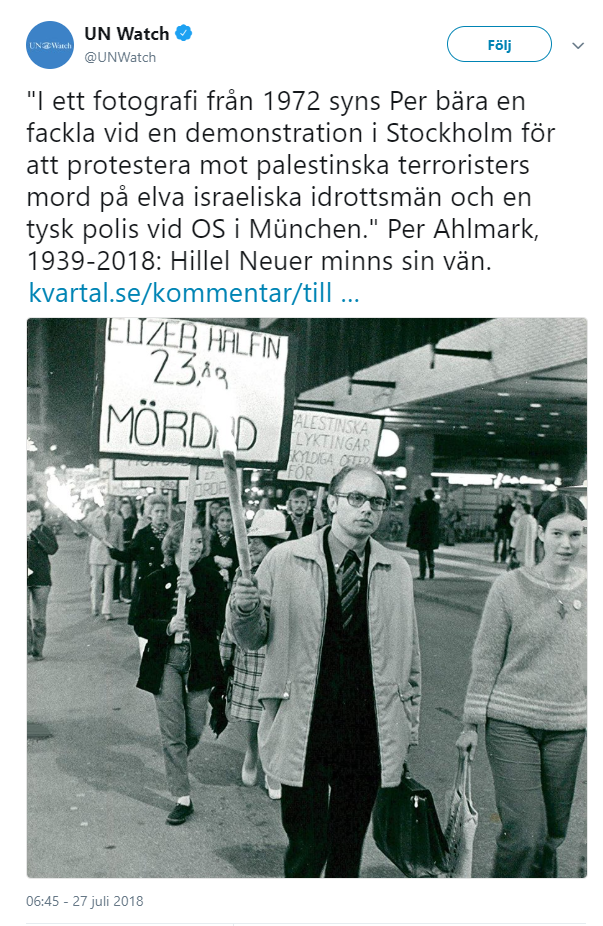
In a 1972 photo, Per is seen carrying a torch at a Stockholm rally to protest the murder by Palestinian terrorists of 11 Israeli athletes at the Munich Olympics.

“Na zdjęciu z 1972 roku Per nosi pochodnię na demonstracji w Sztokholmie, by zaprotestować przeciwko palestyńskim terrorystom, zabijając jedenaście izraelskich sportowców i niemiecką policję w OS w Monachium”. Per Ahlmark, 1939-2018: Hillel Neuer pamięta swojego przyjaciela.”

in 1983, he founded the Swedish Committee Against Anti-Semitism, whose work was instrumental in ensuring the closure of one of the world’s most virulently antisemitic radio stations, broadcasting from Sweden. Per would go on to play a vital role in convincing the Swedish government to convene the Stockholm International Forum on the Holocaust in 2000.

“The astonishing thing with antisemitism is its flexibility,” wrote Per. “It cannot change its goal of attacking the Jews. But it can change its face, its strategy and part of its vocabulary.” In a 2002 address to Yad Vashem, Israel’s Holocaust museum, Per noted that as Israel has become “the center of identity and source of pride and protection for most Jews, it is Zionism which has become the target and object of slander as a racist ideology.”

Per saw how “the old-new antisemitism has again become a plague.” Its “breakthrough” was the 1982 Israeli invasion of Lebanon. “That war did not create antisemitism,” Per told a McGill University conference in 1992, “but it did release it. It gave the Jew-haters a feeling that now they could go public again, or launch their terror.” In Europe, he noted, “bombs have been thrown at synagogues, Jewish schools and institutions. Jews and Jewish shops and restaurants have been attacked by extremists of different political colors. Again, Jewish cemeteries are being desecrated. This has happened in many European cities. Jews are killed or frightened just because they are Jews.”

Sadly, since Per wrote those words 25 years ago, attacks on Jews across Europe have only increased.

recommended by:
Eva Rozenbaum Yerushalmi's Profile Photo Eva Rozenbaum Yerushalmi

Per’s values were not found only on paper. They were set by his personal example, which radiated warm friendship, modesty and kindness. I had the privilege to know him after I joined UN Watch as director in 2004. I was only a few years out of law school, but Per always treated me with great respect. He was enormously supportive of our work, and would often write, call and visit us in Geneva to encourage usWhen we would invite him to speak at the United Nations, Per would always caution me that his remarks would be candid and sharp. I would smile and say that we expect nothing less.

If only the UN and its member nations heard more of Per Ahlmark’s righteous words – and listened – the world would be a much better place. 


The writer is executive director of UN Watch. A Swedish version of this article appeared in the magazine Kvartal.


Zawartość publikowanych artykułów i materiałów nie reprezentuje poglądów ani opinii Reunion’68,
ani też webmastera Blogu Reunion’68, chyba ze jest to wyraźnie zaznaczone.
Twoje uwagi, linki, własne artykuły lub wiadomości prześlij na adres:
webmaster@reunion68.com


HAS EUROPE BECOME AN IRANIAN TOOL TO CIRCUMVENT U.S. SANCTIONS?

HAS EUROPE BECOME AN IRANIAN TOOL TO CIRCUMVENT U.S. SANCTIONS?

CHARLES BYBELEZER/THE MEDIA LINE


Comment: Europe loses its moral compass… again

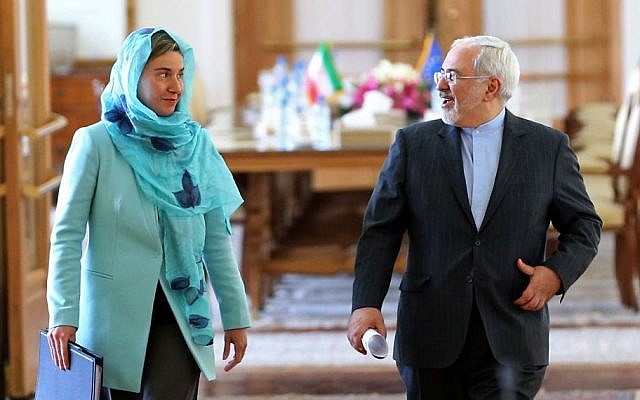
Iranian Foreign Minister Mohammad Javad Zarif, right, and European Union foreign policy chief Federica Mogherini after their meeting, in Tehran, Iran, April 16, 2016. (AP /Ebrahim Noroozi)

One could not be faulted for assuming that the leaders of a self-defined progressive continent, on which the worst genocide in modern history was perpetrated only decades ago, would be more predisposed to siding with the United States, the world’s foremost purveyor and guarantor of freedom, than with Iran, the world’s foremost state sponsor of terrorism which repeatedly has vowed to finish off Hitler’s work by eradicating the lone Jewish state.

But one would nevertheless be wrong.

On Monday, European Union foreign policy chief Federica Mogherini, in conjunction with the top diplomats of Britain, France and, for that matter, Germany, released a joint statement expressing “deep regret” over the re-imposition of American sanctions on the Islamic Republic.

“We are determined to protect European economic operators engaged in legitimate business with Iran,” the politicians wrote. “This is why the European Union’s updated Blocking Statute enters into force on 7 August to protect EU companies…from the impact of US extra-territorial sanctions.”

The “blocking statute”—a law enacted in one jurisdiction to obstruct the application of a law enacted in another jurisdiction—essentially prohibits EU firms from complying with US sanctions and provides mechanisms that allow businesses to recover any resulting damages while negating potential foreign court rulings against them.

For good measure, the EU committed to the “preservation and maintenance of effective financial channels with Iran, and the continuation of Iran’s export of oil and gas.”

The EU transformed itself into an Iranian tool after the Trump administration rejected its calls to receive exemptions from the new financial penalties; which, in turn, followed months of EU groveling to Tehran in the form of a “negotiating process” aimed at devising a sufficiently large bribe to entice the Islamic Republic to remain in the Joint Comprehensive Plan of Action, more commonly known as the Iran nuclear deal.


All of this was precipitated when President Donald Trump in May defied the international community by withdrawing Washington from the atomic pact and vowed to reimpose sanctions on the Iranian regime. The first batch was set to come into effect at midnight Eastern Standard Time, barring Iran’s purchase of American dollars as well as its trade in gold and precious metals, among other things. A second installment targeting Tehran’s crucial energy and shipping sectors will take effect in November.Since President Trump nixed the nuclear accord, Iran’s currency, the rial, has lost half of its value, a major reason for growing civil unrest in the country.

Moreover, despite Brussels’ capitulation, European businesses have left the Iranian market en masse, placing tremendous stress on an already fragile economy.And things are about to get worse for the regime, which continues to sow death and destruction via its proxies in Syria—where the Revolutionary Guard Corps has directed Bashar Assad’s annihilation of his own people—as well as in Iraq and Yemen. Iran is already the effective sovereign in what is known as Lebanon, projecting its rule through its Hezbollah underling that controls the government and armed forces.

While Iran has been on the march since agreeing to the 2015 nuclear accord—for which it received a windfall of about $100 billion—its situation has become increasingly precarious since President Trump assumed office. Now, with protests erupting nationwide and as its economy teeters on the verge of collapse, Tehran reportedly has been conducting back-channel negotiations with the White House through intermediaries in Oman.On Sunday, Israeli media reported that President Trump may even meet his Iranian counterpart Hassan Rouhani next month on the sidelines of the United Nations General Assembly.

In other words, Iran’s back is up against the wall—precisely where it was before the Obama administration and the Europeans threw the mullahs a lifeline in the form of a grossly inadequate agreement that completely ignored Tehran’s past atomic activities and failed to rein in its regional expansionism and illicit ballistic missile program.

And just when the rogue nation is starting to feel the pain again, Europe is once more doing its utmost to bypass the U.S. and prop up the Mullahs.

Essentially, the EU has taken the side of Russia, China and North Korea, and for what?

Iran obviously is a big marketplace and the EU has destroyed its own financial clout through the implementation of socialist policies; but there is no question that the bloc can weather the storm, as was the case when sanctions previously were leveled against the Islamic Republic.

Perhaps, then, the EU fears that turning a blind eye for thirty years to the activities of Hezbollah on its soil may come back to haunt it. Indeed, it became evident last month that Iran’s malignancy has spread across the bloc, when an Iranian diplomat based in Austria was arrested for plotting a terror attack in France.

An equally persuasive argument, though, is that the EU is simply acting out of spite, out of great disdain for President Trump. There is no love-lost between Brussels and Washington, and the American leader has not held back from criticizing traditional U.S. allies.
But acting out of malice when the fate of millions of lives are at stake is the very definition of reckless.

Whereas Europe clearly has not learned the lessons of its past, at least today the U.S.’ moral compass seems intact. For its part, the Jewish people is again at the intersection of the boundaries of good and evil.

This time, it may be Israel that reminds Europe where the line is drawn.


Zawartość publikowanych artykułów i materiałów nie reprezentuje poglądów ani opinii Reunion’68,
ani też webmastera Blogu Reunion’68, chyba ze jest to wyraźnie zaznaczone.
Twoje uwagi, linki, własne artykuły lub wiadomości prześlij na adres:
webmaster@reunion68.com


Israeli-Druze Security Chief Recalls Adam Terror Attack: ‘It Hurts Me’

Israeli-Druze Security Chief Recalls Adam Terror Attack: ‘It Hurts Me’

Benjamin Kerstein


Israeli security forces at the entrance to Adam, July 26, 2018. Photo: Hadas Parush / Flash90.

The Israeli-Druze security chief of the settlement of Adam in the West Bank recounted his pain over the murder of Yotam Ovadia, who was killed last Thursday by a Palestinian terrorist who had jumped the community’s fence.

Asked by Makor Rishon for his thoughts about the incident, Ali Hussein, who has served as Adam’s head of security since 2005, touched his stomach and said, “It hurts me here.”

“People here know me,” he continued. “I live with them. They know I run toward everything, every event. And suddenly it happened. It isn’t easy to lose a resident. Someone who you know his family, children, his father. My entire team feels this way, not good.”

Hussein’s family lives in the north of Israel and he says, “I have two families — the people of Adam and my family in the north.”

He originally came to Adam while working with a private security firm in 2002. “I looked at the community and I connected to it quickly,” he stated.

“We were afraid something like this would happen,” he said of the terror attack. “We train for this scenario. We aren’t afraid, but we are vigilant.”

Hussein described the incident, saying, “The guard at the gate called me, and I heard him yell that three Bedouins who lived outside the gate said they saw someone jump the fence and enter the settlement. I rushed there and talked to the Bedouins. … They pointed out the direction the terrorist went. I informed headquarters that there was a suspicion of an infiltration.”

“When I got in the car,” he recounted, “a resident caught me on the telephone and said, ‘There’s a terrorist here.’ I arrived at the street and saw that the terrorist had already been neutralized by the residents. I asked how many wounded there were, I saw Yotam and ran to him. I gave him first aid and called Magen David Adom to come quickly.”

Asked what he thought about the terrorist, a 17-year-old Palestinian boy, Hussein said, “In my eyes, this is someone who bit the hand that fed him, because they give a living to hundreds of Palestinian workers in this community. The relations with them are very good, and in the end there’s a Palestinian attack. I don’t understand their minds.”

“The relations here are so good,” he stated, “that there were arguments between me and Arab workers, and the residents took the side of the workers. A few years ago, there was a major accident outside the community and some Palestinian children were killed. The chairman of the community printed out a mourning sign and hung it out for everyone to see. I don’t get it, why do they do this? The Jews and the Druze, we’re in the same boat against them.”

Asked whether he would like to live in Adam, Hussein replied, “Yes. Of course. My children were with me two weeks ago for a few days. But my wife works in Carmiel and my mother lives in the north, so it won’t happen. There are several Druze residents here. Two of my nephews live here.”


Zawartość publikowanych artykułów i materiałów nie reprezentuje poglądów ani opinii Reunion’68,
ani też webmastera Blogu Reunion’68, chyba ze jest to wyraźnie zaznaczone.
Twoje uwagi, linki, własne artykuły lub wiadomości prześlij na adres:
webmaster@reunion68.com