Archives

The Middle East Problem

The Middle East Problem

PragerU


The Middle East conflict is framed as one of the most complex problems in the world. But, in reality, it’s very simple. Israelis want to live in peace and are willing to accept a neighboring Palestinian state. And most Palestinians do not want Israel to exist. As Dennis Prager explains, this is really all you need to know. In 5 minutes, understand how Israel was founded, and how, since that auspicious day in 1948, its neighbors have tried to destroy it, again and again.
Donate today to PragerU! http://l.prageru.com/2ylo1Yt


Zawartość publikowanych artykułów i materiałów nie reprezentuje poglądów ani opinii Reunion’68,
ani też webmastera Blogu Reunion’68, chyba ze jest to wyraźnie zaznaczone.
Twoje uwagi, linki, własne artykuły lub wiadomości prześlij na adres:
webmaster@reunion68.com


Celebrating the ‘Haley Effect’

Celebrating the ‘Haley Effect’

Shari Dollinger / JNS.org


US Ambassador to the UN Nikki Haley speaks in favor of an amendment condemning Hamas during a General Assembly debate. Photo: Reuters / Mike Segar.

JNS.org – In many Jewish households on Friday nights, parents bless their daughters in the names of our matriarchs: Sarah, Rebecca, Rachel, and Leah. We do so to hold out our highest role models to our girls. Lately though, I’ve had the creeping inclination to consider another name to this list of women: US Ambassador to the United Nations Nikki Haley.

Haley represents our country with bold, honorable, and principled leadership. In no forum are these traits more lacking than the United Nations. In no place are they more sorely required. And on no issue does this present itself more clearly than her proud and consistent stand in defense of Israel.

Just this week, Haley announced that the US delegation would withdraw from the UN Human Right Council — in large part because of its history of unfairly targeting and condemning Israel, while turning a blind eye toward human-rights violators like Syria, Iran, and North Korea.

Earlier this year, when mothers and fathers in southern Israel were forced to wake their children and run to bomb shelters as rockets rained down from Gaza, Haley reassured these parents that their fears would be heard. Not only did she condemn these attacks, but she also called for a UN Security Council emergency meeting on Gaza-based terror.

This may seem like a logical response to such violence, but it was the first time that the United States had called for such a meeting to address the issue, despite the fact that more than 10,000 rockets have been fired at Israel from Gaza during the last 17 years.

Unsurprisingly, the emergency meeting to examine the true injustice in the region — Palestinian terrorism — hasn’t been scheduled. But the move flipped UN standard operating procedure to condemn Israel for defending itself against terror — be it rockets, riots, or stabbings. And it’s not the first time that Haley has grabbed headlines for her leadership.

Recently, she vetoed an anti-Israel resolution sponsored by Kuwait that made no mention of Hamas, yet condemned Israel for the “excessive, disproportionate and indiscriminate” use of force “against Palestinian civilians.” Then she forced the UN Security Council to consider a measure condemning Hamas as a terrorist organization. And just this week, she gathered enough votes to pass an amendment to a Palestinian-backed resolution that would have condemned Hamas. When her amendment was sidelined by a procedural maneuver, she called the effort to obstruct the vote “shameful.”

She has stopped the United Nations from appointing a Palestinian diplomat to a UN mission in Libya. She has stopped the UN High Commissioner for Human Rights, Zeid Ra’ad al-Hussein, from publishing a blacklist of companies that do business with Israel in the West Bank, eastern Jerusalem, and the Golan Heights. And she has stopped a UN Security Council draft resolution that would have called for the reversal of recognizing Jerusalem as the capital of Israel.

These moves have made her one of the most popular politicians in America. A recent Quinnipiac University poll found that 63 percent of American voters approve of Haley’s decision-making skills. Her approval spans party lines: 75 percent of Republicans, 63 percent of Independents, and 55 percent of Democrats say that they approve of how she’s handling her job.

I’ve seen the widespread admiration for her leadership play out in public. She has been lauded in the press, feted at pro-Israel conferences, and will be the keynote speaker at the annual Christians United for Israel (CUFI) Washington Summit on July 23.

When she speaks, the pro-Israel community listens.

Last month, I was privileged to attend the opening of the US Embassy in Jerusalem, where I experienced this “Haley effect” myself. The mere mention of her name elicited spontaneous and prolonged applause from the crowd in attendance. She has the respect of her fellow diplomats, the admiration of Americans of all political stripes, and the appreciation of the Israelis.

How could I not consider her to be a role model for my own daughters?

Nikki Haley is not a Jewish matriarch, but she is a heroine for Israel nonetheless, who is well on her way to being the world’s next great diplomat.


Shari Dollinger is the co-executive director of Christians United for Israel.


Zawartość publikowanych artykułów i materiałów nie reprezentuje poglądów ani opinii Reunion’68,
ani też webmastera Blogu Reunion’68, chyba ze jest to wyraźnie zaznaczone.
Twoje uwagi, linki, własne artykuły lub wiadomości prześlij na adres:
webmaster@reunion68.com


New Colombian president open to moving embassy to Jerusalem

New Colombian president open to moving embassy to Jerusalem

JOSHUA DAVIDOVICH, RAPHAEL AHREN and AGENCIES


Ivan Duque, who said he wanted to have the best possible ties with Israel, defeats leftist challenger, though some see seeds of political shift for conservative country
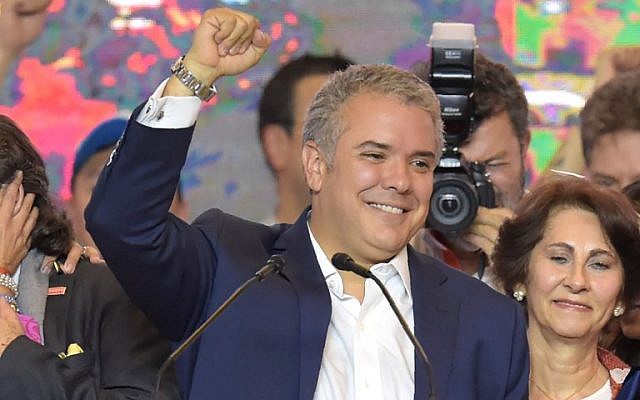
Newly elected Colombian president Ivan Duque celebrates with supporters in Bogota, after winning the presidential runoff election on June 17, 2018. (AFP/ Raul Arboleda)

The newly elected Colombian president said recently he would be open to moving the country’s embassy to Jerusalem, potentially becoming the fourth country, and third from Latin America, to do so.

Conservative Ivan Duque won just over 54 percent of the vote, beating out leftist rival Gustavo Petro’s, who took 41.7% with nearly all the votes counted, electoral authority figures showed Sunday.

On May 16, Duque said at a campaign event that if elected he would not rule out “the possibility of placing the diplomatic seat in Jerusalem.”

The comment, made at an event with local churches, garnered cheers and applause at the time.


Duque also said he wanted to “maintain the best possible relations with the state of Israel.”

The statement came on the same day Guatemala became the second country to move its embassy to Jerusalem, two days after the US. A week later, Paraguay became the third country to do so.

The comments from Duque garnered a harsh backlash from his opponents on the campaign trail, with most other candidates rejecting the position, according to Colombian news site El Nuevo Siglo.

Questioned about his statement days later, Duque clarified to local radio station Caracol that he supported a two-state solution and wanted his eventual government to contribute to peace efforts.

“Colombia cannot stir up hatred in the Middle East,” he said.

Duque’s opponent Gustavo Petro had been a vocal opponent of the US decision to recognize Jerusalem as Israel’s capital, and accused the IDF of carrying out a “massacre” against Gazans during border protests against the embassy transfer on May 14.

Presidential candidate Gustavo Petro speaks after his defeat by conservative rival Ivan Duque in Colombia’s presidential runoff election, in Bogota, Colombia on June 17, 2018. (AFP / LUIS ROBAYO)

Duque, 41, a former economist and first-term senator, is seen as a security hawk in the mold of his mentor, former president Alvaro Uribe.

In 2010 and 2011, Duque’s served as an assistant to Uribe in a UN probe of the 2010 Mavi Marmara flotilla incident, in which Israeli solders scuffled with Turkish protesters trying to break the Gaza blockade.

The panel ultimately found that Israel’s blockade on Gaza was legal, but the raid, in which 10 Turkish activists were killed, was excessive.

Throughout his campaign, Duque was dogged with accusations that he would be little more than a puppet for Uribe, who is constitutionally barred from seeking a third term

Duque is the son of a former governor and energy minister who friends say has harbored presidential aspirations since he was a child. The father of three ago entered public service almost two decades ago as an adviser to then Finance Minister Juan Manuel Santos, whom he will succeed as president.

Duque later moved to Washington, where he spent more than a decade at the Inter-American Development Bank, first as an adviser for three Andean countries and later as chief of the cultural division.

When Duque takes office, he will inherit a country with existing favorable ties toward Israel.

Under outgoing President Juan Manuel Santos Colombia has become one of Israel’s best friends in Latin America. Prime Minister Benjamin Netanyahu visited the country during a swing through Latin America in 2017.

In October 2012, Santos said that the world should recognize Israel as the state of the Jewish people.

“There have been strong relations between the two countries. Colombia is among the few Latin American countries that did not vote in favor of upgrading ‘Palestine’ as a non-member state at the UN a few years ago,” Hebrew University’s Arie M. Kacowicz, an expert on Latin America, said last year.

Colombia, which fought an insurgency by FARC rebels for decades until a peace treaty signed in 2016, regularly purchases Israeli arms.

Leah Soibel, the founder and of Fuente Latina, an organization promoting stronger ties between Israel and Latin America, said last year that relations between the country were ripe for expanding.

“Colombia has traditionally been Israel’s strongest partner in the region regarding military and security ties,” she said.

During Netanyahu’s visit, Foreign Ministry director Yuval Rotem expressed hopes that Israel could transition its trade relationship with Bogota into infrastructure projects following the peace deal.

“There are many projects that the ministry of post-conflict is trying to promote and we believe that, in a modest way, we can be also a part in this journey,” he said at the time.

However, with Duque’s election, the historic peace with FARC and efforts to integrate the former rebels into society has now been thrown into doubt.

Colombia’s peace process to end a conflict that left more than 250,000 people dead is considered largely irreversible. Most of the more than 7,000 rebels who have surrendered their weapons have started new lives as farmers, community leaders and journalists. Last year the rebels launched a new political party and will soon occupy 10 seats in congress.

But the accord remains contentious and Duque pledged throughout his campaign to make changes that would deliver “peace with justice.” Through constitutional reform or by decree, he could proceed with proposals such as not allowing ex-combatants behind grave human rights abuses to take political office until they have confessed their war crimes and compensated victims.

“The peace we all dream of demands corrections,” Duque told hundreds of jubilant supporters late Sunday. “So that victims are the true center of the process and so that there is justice, reparations and no repetition.”

The current agreement allows most rebels to avoid jail, a sore point for many.

“The rebels are going to get 10 seats in congress without having made reparations to victims or turned over information on drug trafficking routes,” said Felipe Ramirez, 29, a veterinarian who voted for Duque. “That’s a bad precedent because other criminal groups will want the same.”
Duque’s detractors warn that his victory could throw an already delicate peace process into disarray.

“I think it will set up a big constitutional battle,” said Cynthia Arnson, director of the Latin America program at the Woodrow Wilson International Center for Scholars.

Analysts also saw the possible seeds of a shift left for the conservative country with the success of Petro, the first left-wing candidate to make a run-off in decades.

Petro energized young voters and drew millions to public plazas with his fiery speeches vowing to improve the lives of poor, disenfranchised Colombians.

And though he failed to catch Duque, his more than 8 million votes marked the biggest ballot box success for a leftist presidential contender yet in a country where leftist politicos have long been stigmatized over fears of potential ties to guerrilla causes.

“Perhaps as time passes people will be less scared about voting for left-wing politicians,” said Jorge Gallego, a professor at Colombia’s Rosario University. “Although with this result, it’s proven that Colombia is still a right-wing country.”


Zawartość publikowanych artykułów i materiałów nie reprezentuje poglądów ani opinii Reunion’68,
ani też webmastera Blogu Reunion’68, chyba ze jest to wyraźnie zaznaczone.
Twoje uwagi, linki, własne artykuły lub wiadomości prześlij na adres:
webmaster@reunion68.com


JEWS ARE NOT SWEDES, POPULIST RIGHT-WING LAWMAKER SAYS

JEWS ARE NOT SWEDES, POPULIST RIGHT-WING LAWMAKER SAYS

JTA


Bjorn Soder, who represents the Sweden Democrats party at the Riksdag, the Swedish parliament, claims he only meant that people have a right to have their own identity.

Björn Söder. (photo credit: TWITTER)

Alawmaker for a populist right-wing party in Sweden has been accused of racism after writing on Facebook that Jews and members of the Sami minority are not Swedes.

Bjorn Soder, who represents the Sweden Democrats party at the Riksdag, the Swedish parliament, maintains that in his post Sunday he never questioned minorities’ rights as Swedish citizens but merely stood up for their rights to preserve their distinct ethnic identities.

Soder on Facebook criticized Annie Loof, a Cabinet minister for the liberal Centre Party, who wrote on Twitter that her “Jewish friends are simply my Swedish friends: As a citizen of Sweden, you are Swedish, even whether you belong to one of our national minorities or not.”

Soder responded that Loof was “undermining” the status of those five minorities by downplaying their distinctive identities, as he described it.

“These groups have minority positions in Sweden precisely because they are not Swedes. Shame on you, Annie Loof, for your racist attitude,” he wrote.

Soder made similar statements in a 2014 interview with Dagens Nyheter. Lena Posner Korosi, who was then the president of the Jewish Council in Sweden, said that Soder’s reasoning was “reminiscent of 1930s Germany.”

Paulus Kuoljok, the president of the Sami Parliament Plenary Assembly — a publicly elected parliament and a state agency addressing the rights of that indigenous minority – called Soder’s Facebook post “provocative” and designed to win votes.

“They have shown their hostile stance for quite some time, so I’m not surprised,” he told Sveriges Television.

Sweden Democrats has several Jews in its ranks, including lawmakers. It has nonetheless been accused of espousing anti-Semitic views, which the party denies.

In October, a party lawmaker called for action against what she labeled the “control of media by any family or ethnic group,” citing a prominent publisher with Jewish roots.

Senior lawmaker Carina Herrstedt was widely criticized in the media for writing a racist joke in an email that was deemed offensive to gays, blacks, nuns, Roma and Jews. Finance spokesman Oscar Sjostedt was heard in a recording jokingly comparing Jews to sheep being killed in German abattoirs.


Zawartość publikowanych artykułów i materiałów nie reprezentuje poglądów ani opinii Reunion’68,
ani też webmastera Blogu Reunion’68, chyba ze jest to wyraźnie zaznaczone.
Twoje uwagi, linki, własne artykuły lub wiadomości prześlij na adres:
webmaster@reunion68.com


Three Wounded in Suspected Car-Ramming Attack Near Jerusalem

Three Wounded in Suspected Car-Ramming Attack Near Jerusalem

Benjamin Kerstein


The scene of a car-ramming attack near Jerusalem, July 23, 2018. Photo: United Hazalah.

Three Israeli soldiers were wounded on Saturday in a suspected car-ramming terror attack near Jerusalem.

According to Israel Hayom, the incident took place in the area of Gush Etzion, a group of West Bank settlements in close proximity to Jerusalem. The site of the attack is near the Arab village of Kfar Husan, to which the attacking car apparently escaped. The attacker has not been apprehended.

The three victims are reported to be conscious and in good to moderate condition, suffering from injuries to their lower bodies.

Israel Hayom quotes the Israeli ambulance service Magen David Adom saying, “At 8:56pm a report was received at MADA Center 101 in the Jerusalem area about three young pedestrians injured by a vehicle near Kfar Husan. An IDF medical team is giving medical aid to three people who were lightly wounded.”

Car-ramming has been a common tactic used by Palestinian terrorists for well over a decade.


Zawartość publikowanych artykułów i materiałów nie reprezentuje poglądów ani opinii Reunion’68,
ani też webmastera Blogu Reunion’68, chyba ze jest to wyraźnie zaznaczone.
Twoje uwagi, linki, własne artykuły lub wiadomości prześlij na adres:
webmaster@reunion68.com