Archives

Abbas Deliberately Chose to Be Photographed With Antisemitic Cartoon

Abbas Deliberately Chose to Be Photographed With Antisemitic Cartoon

Benjamin Kerstein


Palestinian Authority President Mahmoud Abbas reads a newspaper inside a hospital in Ramallah, May 21, 2018. Photo: Palestinian President Office (PPO) / Handout via Reuters.

Palestinian Authority President Mahmoud Abbas deliberately chose to be photographed reading a newspaper with an antisemitic cartoon facing the camera, a Middle East scholar has revealed.

The photograph, taken in Abbas’ hospital room, where he was being treated for an ear infection and pneumonia, shows him reading a PA newspaper. Clearly visible is a cartoon showing an Israeli soldier poisoning a Palestinian baby.

Edy Cohen, chairman of the Kedem Forum for Middle East Studies, told The Algemeiner, “I just spoke with several people very close to Mahmoud Abbas, and it was explicitly told to me that Abbas picked the only [newspaper] where that cartoon was large. … So I understand that he chose it deliberately, because we’re talking about the biggest cartoon there was, so it would be seen. It’s a subliminal message.”

The photo, Cohen said, was “a message to his people. Abbas is not a child. He’s old. He’s going to meet his maker. But he wants to go out as a hero. And the message he’s sending is ‘Even if I’m in the hospital, I’m against the Jews. I’m against Israel.’”

Cohen sees the move as a symptom of a deeper problem with Abbas’ attitude toward Jews. Citing Abbas’ book The Other Face, which denies the Holocaust, Cohen stated, “You cannot be a Holocaust denier without being antisemitic. It goes together.”

In recent weeks, Abbas has made several statements considered openly antisemitic, including that the Jews brought the Holocaust upon themselves and that there was no Jewish connection to the Land of Israel.

“Abbas from the beginning to today was against the Jews,” Cohen said, “and he always hid it. After Oslo, of course he hid it. But now, when there is no political process, he has no problem with it.”

Rabbi Abraham Cooper — associate dean of the Simon Wiesenthal Center — agreed that the photograph was a deliberate choice on Abbas’ part. Asked by The Algemeiner whether he thought the picture was staged, Cooper replied, “Of course. No question about it.”

Cooper believed the photo was part of an ongoing ideological campaign against Jews and the State of Israel. It showed, he said, “how deep is the cancer of hatred the Palestinian Authority president harbors for the Jewish state, her people and values.”

“The validation of that cartoon by him exposes how little difference there is between the PA and Hamas,” Cooper continued. “Both continue to brainwash a new generation of children that Israelis are interlopers and latter-day Nazis. The big lie tactics employed in the so-called ‘marches of return’ gained the Palestinians nothing of practical value, with the exception that the man in the street in Turkey and elsewhere in the Middle East is convinced that Jews are baby killers, cold-blooded murderers who deserve whatever terrorist or other bombing attacks are inflicted on Jews, inside Israel and/or around the world.”

Particularly disturbing, said Cooper, was the use of a visual image to further this campaign. Recounting a study undertaken in the 1980s on antisemitic Soviet cartoons, he stated, “We saw that the impact, the emotional impact of a powerful cartoon, good or bad, was in under two seconds. And much more long-lasting than any op-ed or article that may have accompanied it. … At the end of the day, by posing with that image, the message, the emotional message to the Palestinian people is just reinforcing the idea that Israelis are interlopers, inhuman, baby killers. … It is pornographic, really.”

The result, he added, was “the brainwashing of another generation.”

“If that’s the legacy of a sick old man that maybe is on his last breath as the leader of the Palestinian people, it just speaks volumes,” Cooper lamented. “This is a man who’s led his people right into the abyss.”


Zawartość publikowanych artykułów i materiałów nie reprezentuje poglądów ani opinii Reunion’68,
ani też webmastera Blogu Reunion’68, chyba ze jest to wyraźnie zaznaczone.
Twoje uwagi, linki, własne artykuły lub wiadomości prześlij na adres:
webmaster@reunion68.com




Maya Sickle, 8½, talks about growing up Israeli

Israel21cMaya Sickle, 8½, talks about growing up Israeli

ISRAEL21c


In the last of our Independence Day video series, Maya describes how this Independence Day she’ll be making blue-and-white cupcakes.


Maya Sickle lives in Tel Aviv and loves living near the beach. Her role models are Anne Frank, Yitzhak Rabin and Gal Gadot. And someday, when she reaches the age of 70 just like the state of Israel is celebrating this year, she wants to play with her kids.


Executive Producer – Jonathan Baruch
Producer / Director – Haim Silberstein
DP – Eyal Sela
Editing – Shahar Beeri
Color Grading – Ari Amit
Sound – Oren Sharon


Zawartość publikowanych artykułów i materiałów nie reprezentuje poglądów ani opinii Reunion’68,
ani też webmastera Blogu Reunion’68, chyba ze jest to wyraźnie zaznaczone.
Twoje uwagi, linki, własne artykuły lub wiadomości prześlij na adres:
webmaster@reunion68.com


ISRAEL AND THE EU

ISRAEL AND THE EU

JPOST EDITORIAL


Israeli politicians would be wise to avoid the recently popular brand of “megaphone diplomacy” and focus on a more subdued tactic.

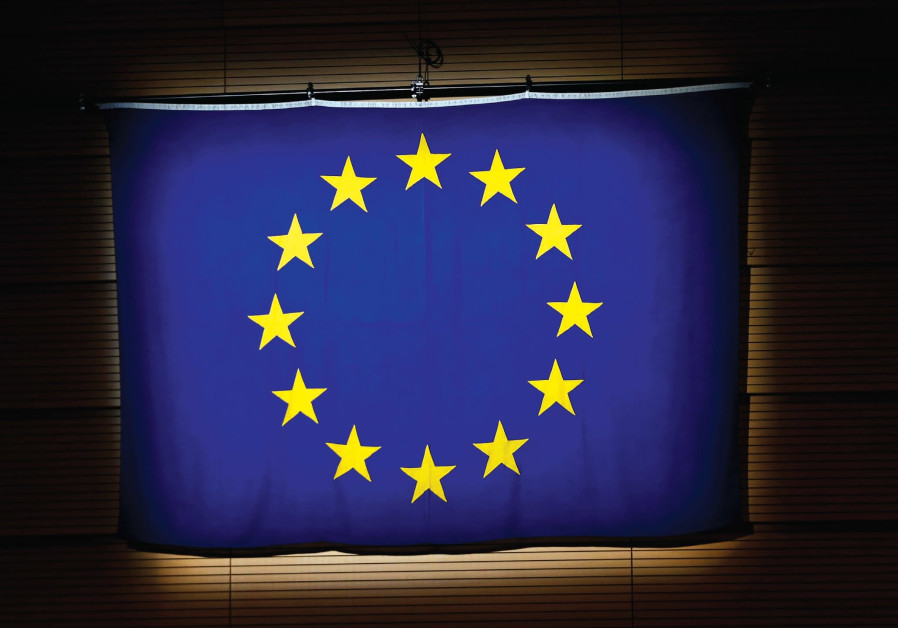
A European Union (EU) flag is pictured during a ceremony in Lausanne.. (photo credit: REUTERS)

It’s fair to say that friends shouldn’t tell friends to “go to hell” or “go to a thousand hells,” as Energy Minister Yuval Steinitz said so untactfully about the European Union in an interview this week. But are the EU and Israel truly friends?

Steinitz’s comment to Ayala Hasson on Radio 103 FM on Wednesday was in response to criticism from Brussels over Israel’s handling of a human rights issues, particularly its desire to kick the local director of Human Rights Watch out of the country and the police arrest and alleged beating of Mossawa director Jafar Farah during a protest last weekend. One could imagine that if it was only about those incidents the response from Jerusalem wouldn’t be so blunt.

Telling off Europe and accusing it of “cynicism and chutzpah” plays well in many Israeli circles. The Likud base, which Steinitz was likely speaking to, loves to see Israel stand up for itself. And it makes little difference to them whether the subject of abuse is Iran, Turkey, the EU or even leftists here in Israel.

Many here share the sentiment that Israel is unfairly singled out and that Brussels calling out the Jewish state just shows “how vile it is,” as Steinitz said.

It often seems as though the EU institutions, as opposed to the members states where there is a much wider range of attitudes, is obsessed with Israel, and not in a good way. The EU is often the first to condemn Israel for alleged rights violations.

It regularly blasts Israel for construction in the West Bank, opposes Israel (and the US) when it comes to the Iran nuclear deal and supports civil society groups here that are some of the government’s biggest critics.

That said, the EU is also a major ally of Israel. It is a primary trade partner (number one by some counts), it cooperates closely on counter-terrorism, it offers support for Israel’s academia and it is a member of the Mideast Quartet on the Middle East.

What it comes down to is values. The EU was founded on the ideal of breaking down borders and barriers between states and societies. The values of nationalism and exceptionalism are anathema to its very DNA.

Again it is important to note that this is true for the EU establishment, not the individual member states, where we have witnessed a swing to the Right in several central countries.

It just so happens that those are also the values that have been on the rise in Israel over the last few years. As recent elections have shown and demographics suggest, Israeli society is growing more nationalistic and is expected to continue that trend in the coming years, or at the very least in the next elections, whenever they are held.

As in everything that has to do with politics and international relations these days, there is also the “Trump factor” to take into account. Israeli politicians see that the US president and his administration are firmly in Israel’s corner. They may feel that gives them license to speak more boldly than in the past. If under the Obama administration, the US and EU were firmly on the same page on most issues, today the cracks are beginning to show.

Does that mean the two bodies are on a collision course, that they are destined to turn from friends into enemies? Not necessarily.

The good thing about friendships is, if they’re strong enough, they allow us to tell our friends what we dislike about them without it ruining the relationship. There is an understanding that even if we call out our friends, we still have their best interests at heart. A lot depends on the delivery.

Prime Minister Benjamin Netanyahu has been known to criticize the EU too, but when he does it, he focuses on a certain issue or statement and not a broadside, general assault. He understands that while Israel and Europe might not see eye-to-eye today, they still need each other for trade, security cooperation and other diplomatic affairs.

Israeli politicians would be wise to avoid the recently popular brand of “megaphone diplomacy” and focus on a more subdued tactic.

There are smarter ways to tell friends to go to hell.


Zawartość publikowanych artykułów i materiałów nie reprezentuje poglądów ani opinii Reunion’68,
ani też webmastera Blogu Reunion’68, chyba ze jest to wyraźnie zaznaczone.
Twoje uwagi, linki, własne artykuły lub wiadomości prześlij na adres:
webmaster@reunion68.com



I was at the Gaza border, we did all we could to avoid killing

I was at the Gaza border, we did all we could to avoid killing

Kinley Tur-Paz


I’m writing this for my good friends, my moral humane friends, and for all those who are concerned and angry over the Palestinians killed and injured on the border with Gaza.

In the biblical Exodus from Egypt, when the Egyptian army drowned in the Red Sea just before overtaking the Israelites, our sages say that God prevented the angels from singing and rejoicing, scolding them with the words “my creations are drowning in the sea and you are singing?!”

I write these words with great caution, and from a sense of mission. I can understand and identify with all of those good and moral Zionists who fear that the many Palestinian victims may be our fault, the result of mistakes made by our side. I’m writing because I am one of the few who was there, in uniform, in the reserves, but I was there. Yes, right there on the fence where the demonstrations are happening. It was last Friday, but I saw it with my own eyes; I was on our side of the fence but I could see and hear and understand everything. I want to testify from my firsthand knowledge, not a theoretical point of view. Because I was there.

I want to testify that what I saw and heard was a tremendous, supreme effort from our side to prevent, in every possible way, Palestinian deaths and injuries.

Of course, the primary mission was to prevent hundreds of thousands of Gazans from infiltrating into our territory. That kind of invasion would be perilous, mortally dangerous, to the nearby communities; would permit terrorists disguised as civilians to enter our kibbutz and moshav communities, and would leave us with no choice but to target every single infiltrator. That’s why our soldiers were directed to prevent infiltration, in a variety of ways, using live ammunition only as a last resort.

The IDF employs many creative means of reducing friction with Gazans and uses numerous methods, most of which are not made public, to prevent them from reaching the fence. In addition, over the past few weeks there have been serious efforts to save the lives of children and civilians who have been pushed to the front lines by the Hamas, who are trying to hide behind them in order to infiltrate and attack Israel.

When there is no alternative, and live ammunition must be used to stop those who storm the fence, the soldiers make heroic and sometimes dangerous efforts not to kill and to only injure those on the other side. The IDF stations senior commanders at every confrontation point to ensure that every shot is approved and backed up by a responsible figure with proper authority. Every staging area has an especially large number of troops in order to make sure that soldiers are not put into life-threatening situations where they will have no choice but to fire indiscriminately.

A situation where thousands of people rush you is frightening, even terrifying. It is extremely difficult to show restraint, and it requires calm, mature professionalism. Sixty-two dead is an enormous number. But I can testify from my first-hand experience, that every bullet and every hit is carefully reported, documented and investigated, in Excel spreadsheets. Literally. I was there and I saw it with my own eyes.

This isn’t the time or place to discuss the situation in general and the desperate plight of the residents of Gaza. I’m not interested in starting a political discussion here, although I do have a clear position. What I’m trying to do is present, for everyone who really wants to listen, the extent of the IDF’s enormous effort to protect Israel’s borders while minimizing injuries and loss of life on the other side.

And despite all this – the situation on the border with Gaza is deteriorating. I hope that we won’t be called up again soon for reserve duty to protect our country. But if we are, we will go with the knowledge that we are serving a morally just cause. We do not rejoice when we must go to war, but we also don’t go like sheep to the slaughter. Not anymore.


Kinley (Moshe) Tur-Paz is founder and CEO of the Kibbutz HaDati Educational network.


Zawartość publikowanych artykułów i materiałów nie reprezentuje poglądów ani opinii Reunion’68,
ani też webmastera Blogu Reunion’68, chyba ze jest to wyraźnie zaznaczone.
Twoje uwagi, linki, własne artykuły lub wiadomości prześlij na adres:
webmaster@reunion68.com


BEHIND THE SMOKESCREEN PART II – EXCLUSIVE FOOTAGE FROM GAZA

BEHIND THE SMOKESCREEN PART II – EXCLUSIVE FOOTAGE FROM GAZA

Jerusalem Post


“I shot the video because I observed many times first hand how Palestinians build their propaganda and I strongly believe that no peace will be possible as long as international media believe their narrative instead of seeing the facts,” the French filmmaker told The Jerusalem Post with the release of the first part of the footage.


Zawartość publikowanych artykułów i materiałów nie reprezentuje poglądów ani opinii Reunion’68,
ani też webmastera Blogu Reunion’68, chyba ze jest to wyraźnie zaznaczone.
Twoje uwagi, linki, własne artykuły lub wiadomości prześlij na adres:
webmaster@reunion68.com