Archives

Israel breaks its solar power production record

Israel21cIsrael breaks its solar power production record

Rebecca Stadlen Amir


On a perfectly cloudless Saturday afternoon in Israel, solar energy was producing 13.4 percent of the country’s total electricity consumption.

Aerial view of solar panels in the Southern Israeli city of Eilat. Photo by Moshe Shai/FLASH90

On Saturday afternoon March 17, with not a cloud in the sky, Israel set a new record in solar power. At precisely 12:07pm, solar energy was producing 13.4 percent of the total electricity being consumed in the country, the Israel Electric Corporation said.

Though new technologies and massive solar projects have helped put Israel closer to its renewable energy goals, officials said the record broken on Saturday was caused by a specific combination of events – high solar production and low overall consumption.

“The high percentage level comes because it was a Saturday and the weather was perfect for renewable energy. This proves we can do it,” said Oren Hellman of the corporation.

“The sun is the biggest source of energy in Israel and we can achieve much greater solar energy production,” he said.

Jonathan Aikhenbaum, a campaign manager at Greenpeace Israel, praised the event.

“This proves that when you want, when obstacles are removed, the solar revolution is gaining strength,” he told Ynet News. “A combination of sun and innovation is finally putting Israel on the map. The day is not far off where we will reach 100% from solar energy, like Denmark achieved from wind energy last year.”

Despite Israel’s abundance of sunshine and solar energy technologies, currently only 2.6% of Israel’s electricity is generated from renewable sources. Much of the solar energy produced is exported, plus discoveries of natural gas reserves have interfered with the adoption of solar energy in recent years.

However, new energy projects in the Negev and Arava are aiming to increase the country’s renewable energy percentage. The Ashalim Thermo-Solar complex, currently being constructed in the Negev, is expected to provide approximately 300 megawatts of electricity daily to the Israel Electric Company’s national grid, contributing 2.5% toward the government’s goal of 10% renewable energy by 2020.

Scheduled to be up and running by summer 2018, the amount of energy produced by the complex will be enough for about 5% of Israel’s population when it is completed.


Zawartość publikowanych artykułów i materiałów nie reprezentuje poglądów ani opinii Reunion’68,
ani też webmastera Blogu Reunion’68, chyba ze jest to wyraźnie zaznaczone.
Twoje uwagi, linki, własne artykuły lub wiadomości prześlij na adres:
webmaster@reunion68.com



New algorithm identifies fake users on social networks

Israel21cNew algorithm identifies fake users on social networks

Abigail Klein Leichman


Israeli and American researchers develop generic method to detect fake accounts on most types of social networks, including Facebook and Twitter.

Illustration by NiroWorld/Shutterstock.com

Fraudulent user profiles – bots – are a serious and growing concern on social media. By some estimates, as many as 48 million Twitter accounts and 270 million Facebook accounts are phony, designed for nefarious purposes from ruining reputations to influencing shoppers and voters.

Now, researchers from Israel’s Ben-Gurion University (BGU) of the Negev and from the University of Washington in Seattle say they have developed a generic method to detect fake accounts on most types of social networks, including Facebook and Twitter.

According to their study published in the journal Social Network Analysis and Mining, the new method is based on the assumption that fake accounts tend to establish improbable links to other users in the networks.

“With recent disturbing news about failures to safeguard user privacy, and targeted use of social media by Russia to influence elections, rooting out fake users has never been of greater importance,” said Dima Kagan, lead researcher and a PhD student in BGU’s department of software and information systems engineering.

The algorithm consists of two main iterations based on machine-learning algorithms. The first constructs a link prediction classifier that can estimate, with high accuracy, the probability of a link existing between two users. The second iteration generates a new set of meta-features based on the features created by the link prediction classifier.

These meta-features are used to construct a generic classifier that can detect fake profiles in a variety of online social networks.

“We tested our algorithm on simulated and real-world data sets on 10 different social networks and it performed well on both,” Kagan reported.


“Overall, the results demonstrated that in a real-life friendship scenario we can detect people who have the strongest friendship ties as well as malicious users, even on Twitter. Our method outperforms other anomaly detection methods and we believe that it has considerable potential for a wide range of applications particularly in the cybersecurity arena,” the study authors said.

The algorithm can also be used to reveal the influential people in social networks.

The Israeli researchers involved in this project previously developed the Social Privacy Protector (SPP) to help users evaluate their friends list in seconds to identify which have few or no mutual links and might therefore be phony profiles.

Other researchers who contributed to the present study are former BGU doctoral student) Michael Fire of the University of Washington and Prof. Yuval Elovici, director of the Telekom Innovation Labs@BGU, director of Cyber@BGU and a faculty member of BGU’s department of software and information systems engineering.

The study was supported by the Washington Research Foundation Fund for Innovation in Data-Intensive Discovery and the Moore/Sloan Data Science Environment Project at the University of Washington.


Zawartość publikowanych artykułów i materiałów nie reprezentuje poglądów ani opinii Reunion’68,
ani też webmastera Blogu Reunion’68, chyba ze jest to wyraźnie zaznaczone.
Twoje uwagi, linki, własne artykuły lub wiadomości prześlij na adres:
webmaster@reunion68.com


U.S. EMBASSY WILL OPEN HERE ❗

U.S. EMBASSY WILL OPEN HERE ❗

    Hananya Naftali


This is where U.S. embassy will be opened VERY SOON.

From Jerusalem, Israel’s eternal capital, I call world leaders to move their embassies to Jerusalem as well.

Help me to educate the world about Israel- http://fnd.us/HananyaNaftali


Zawartość publikowanych artykułów i materiałów nie reprezentuje poglądów ani opinii Reunion’68,
ani też webmastera Blogu Reunion’68, chyba ze jest to wyraźnie zaznaczone.
Twoje uwagi, linki, własne artykuły lub wiadomości prześlij na adres:
webmaster@reunion68.com


HELLO, JEREMY CORBYN; GOODBYE, JEREMY CORBYN

THE POSTMAN KNOCKS TWICE: HELLO, JEREMY CORBYN; GOODBYE, JEREMY CORBYN

AVRAHAM AVI-HAI


BRITISH LABOUR Party leader Jeremy Corbyn arrives to vote in local government elections in London on May 3. (photo credit: REUTERS)

Hello Jeremy,

I want to tell you that I am very grateful for, and fully agree with your policy of “recognizing Israel’s right to exist within the 1948 borders.” This is such a good policy that it should be adopted by every country. After all, the effort to create and build Israel, the lives lost and the need to win battles have nothing to do with our existence. So, thanks Jeremy, for recognizing my “right” to exist.

To repeat: recognition of a people’s right to exist in its own land is such a good policy it should be made universal. Without delay, Israel should recognize England’s right to exist within the borders of 1603, before Scotland was joined to England because a king of Scotland was made king of England.

The same applies to Ireland, which was invaded constantly over hundreds of years by England and forced into a unilateral Act of Union in 1800. The English government was obviously guilty of war crimes: replacing populations, starving millions of people and forcing emigration of more millions. It took many an Irish rebel and much spilled blood to get the English out of Southern Ireland by 1922. 

Now look at Northern Ireland. Is it not true that England implanted English and Scottish Protestants in Ireland to keep the Catholic Irish in line? These settlements should have been evacuated. They were an impediment to peace for hundreds of years. Only when the two sides understood they were there to stay was an uneasy peace achieved.

In addition, Jerry (may I call you Jerry, just by coincidence the nickname the English gave the Germans in both World Wars), England, having returned to its original borders, might consider whether Wales has been fairly treated. On this Welsh question, I lack sufficient information, so I’ll leave it.

Once all this is achieved, that is full English withdrawal to its original borders, and England is no longer an occupier, you can deal with indemnifying the United Irish Republic and the Republic of Scotland. For this purpose, I propose hiring a good accounting firm along with a team of historians and economists, even if the companies or experts involved are Jewish. Jews have their use don’t they, if only not too often. Right?

In addition, Jer, you are a socialist. Therefore the lands belonging to the royal House of Windsor and to the “titled aristocracy” descendants of strong-arm medieval land-grabbers should be returned to national ownership in England and in each of the countries, now free and independent, which once constituted the United Kingdom. Parliament must beg forgiveness from all of the former lands of the British Empire as well as Ireland and Scotland for the massacres, exploitation and outrages committed in the name of the Crown. The British Left, and you as their leader, must apologize to Israel for singling it out while your country executed Irishmen extra-legally, and while millions starved or were made refugees in Africa, and while over half a million Muslims, Christians and Kurds were killed in Syria – with nary a word from your pure-hearted Left.

In truth, J., I don’t believe you will accept these terms of reciprocal policies. So why, Corbyn, should you “recognize” Israel’s right to exist? You are, sir, as ignorant of history as you are absent of common decency. Now since you passed only two A-level school-leaving examinations with the grade of E (the lowest), why don’t we help you learn more about the very name you bear? True not every “leader” was well-educated, But Winston Churchill, who had been a poor student, wrote great histories, meaning he had to study and research first.

First things first, Corbyn, Jeremiah is a Hebrew name. It may mean “hold God on high” – or maybe “God will raise you.” Corbyn means a little crow or raven. (I will not let indulge myself by telling you what the word means in Ashkenazi pronounced Hebrew.) 

And Jeremy Corbyn, as the raven in Edgar Allen Poe’s poem quotes, “Nevermore!” In modern English, “Enough is enough!” 

Finally, Mr. Corbyn, I will not shake hands with you as we say good-bye. Maybe now you know why, Anyway, I have a much better Jeremy to listen to. Hear this, as translated under the aegis of that same James who shlepped Scotland into union with England: 

He who scattered Israel will gather him,
And keep him as a shepherd does his flock.’
For the Lord has redeemed Jacob,
And ransomed him from the hand of one stronger than he.
Therefore they shall come and sing in the height of Zion.
(Jeremiah 31:10-12) 

And as we all know, crows cannot sing; they can only caw! Goodbye! 


The writer was born in Toronto when being a Canadian citizen meant also being a British subject. He is a social democratic liberal who once respected the British party system. As such, he neglected to reckon with British socialist antisemitism going back to the 1930s and the drawing room sneers of the so-called upper classes.


Zawartość publikowanych artykułów i materiałów nie reprezentuje poglądów ani opinii Reunion’68,
ani też webmastera Blogu Reunion’68, chyba ze jest to wyraźnie zaznaczone.
Twoje uwagi, linki, własne artykuły lub wiadomości prześlij na adres:
webmaster@reunion68.com


Webhose takes aim at the Dark Web

Israel21cWebhose takes aim at the Dark Web

Brian Blum


Mr. Robot, watch out: An Israeli startup is serving notice that the hidden is now visible and even your bitcoins won’t save you from the law.

Image by Alexander Geiger/Shutterstock.com

Fans of the popular TV show “Mr. Robot,” which dives deep into the world of shady hackers and the Dark Web that lurks beyond its better-known counterpart, take note: An Israeli startup is serving notice that the hidden is now visible and even your bitcoins won’t shield you from the long arm of the law.

Just as Google crawls the World Wide Web to index the sites we want to find, Bnei Brak-based Webhose has developed a technology that can scour the anonymous part of the Internet accessed through a special browser called Tor. Webhose can even bypass the Captcha systems meant to keep out creepy crawlers.

Law-enforcement agencies, cybersecurity companies and large financial institutions have all expressed interest, Webhose CEO Ran Geva tells ISRAEL21c. That’s not surprising: The Dark Web has long been a sanctuary for those dealing in all things illegal: drugs, weapons, money laundering, pornography and more.

It’s an area ripe for innovation and Webhose has taken the lead.

“There is no Google for the Dark Web,” Geva says. “No one is doing search engine optimization there because the sites on the Dark Web don’t necessarily want to be found!”

Webhose has employed what Geva calls “ethical hackers” – experts hired by companies to find vulnerabilities in their sites — to help get behind the Dark Web’s Captcha protection.

Ran Geva, CEO of Webhose. Photo: courtesy

Geva has a warning for criminals using cryptocurrencies: You cannot really hide. Bitcoin, the most popular cryptocurrency, is actually “less secure than a bank,” he points out.

“All transactions are recorded on a ledger that’s shared openly across the network. It’s anonymous, but if you put your Bitcoin wallet address on the visible web – perhaps for a completely different, even legitimate reason – or if you share some identifying detail like your ICQ, Twitter or Facebook handle, we can see what you did with your money. Law enforcement can then ask for the IP of the user that posted and make the connection.”

Webhose is not just a science project. The company is earning more than $250,000 a month with a profit margin of close to 50 percent. Webhose clients include, for instance, a fintech startup in France and Luxembourg, a US startup that detects fake news and a cryptocurrency compliance watchdog.

The nicest company that crawls the Web

Most of the company’s revenue is not from the Dark Web. That tool was unveiled only last year. Webhose spends most of its resources searching the “visible” Internet. “We are the nicest company that crawls the Web,” says Geva.” We comply with everything; everyone can see what we’re doing. On the Dark Web, though, it’s a very different story.”

Webhose doesn’t do anything with the data it finds. “We focus on content collection,” Geva explains. “We let our clients analyze the content.”

That partly explains the company’s odd name. Twitter calls the stream of tweets that come from its platform the “firehose.” Webhose applies that same concept to data it collects from the Internet, creating what Geva dubs a “firehose for the web.”

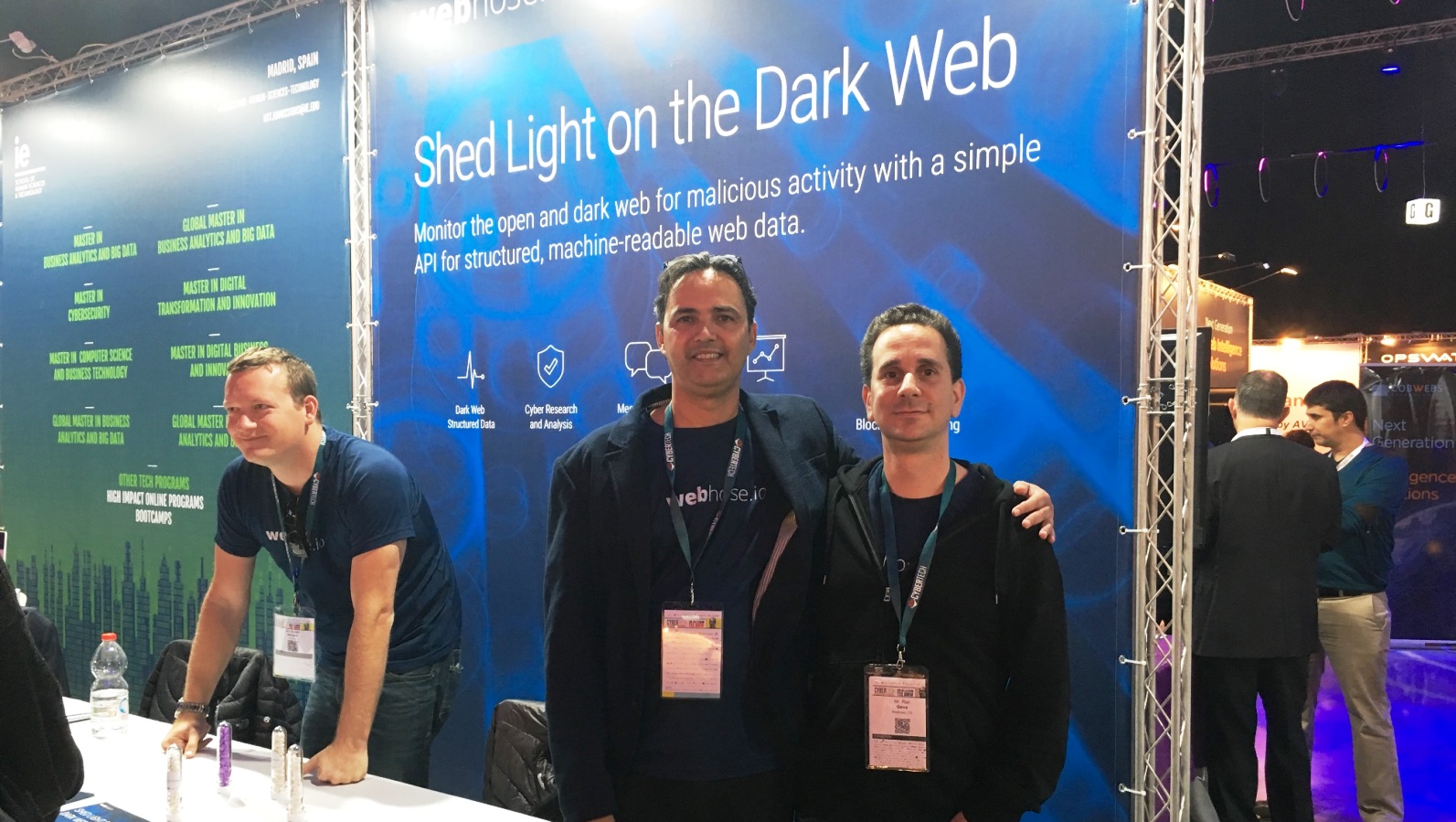
Webhose’s Guy Mor, left, and Ran Geva at a trade show. Photo: courtesy

Geva’s previous company, Omgili (Oh My God I Love It) was a search engine for message boards, an area where Google wasn’t so successful back in 2007 when Geva, now 41, started Omgili. As the initial crawler technology evolved, Geva imagined using it to track publicity campaigns on the Internet. He even built an app to do so, but it wasn’t reliable enough.

Geva kept plugging away until the technology worked. This is what enables Webhose to deliver highly structured data to its clients, “much more than the title, snippet and summary Google provides.”

Webhose organizes message-board posts, blogs, news, reviews, ratings and stock data, plus it has historical pricing information on some 20 million products, making it an ideal tool for e-commerce businesses and banks looking for patterns to ferret out fraud.

Webhose stores everything it’s collected in machine-readable format on its own databases. Customers tap into that database by creating an XML or JSON feed. Webhose has a nearly four-year archive of millions of websites, although the company only keeps 30 days’ worth of data live on its system, in order to keep searches snappy.

Webhose is not the only company structuring data around the web. Silicon-Valley-based Import.io uses machine learning to return relevant results to customers. DeepCrawl, which has its headquarters in London, is popular with SEO providers.

Webhose sells the data it collects on a freemium basis. A student, for example, can make “up to 1,000 API calls a month, which can return up to 100 results each,” Geva explains. “So in theory you could get access to up to 100,000 articles or message-board posts for free. After that pricing starts at $50 per month. We have tens of thousands of free users.”

The one area where Webhose is not free: searching the Dark Web. So, can Webhose keep a real-world Mr. Robot from hacking the world’s banks and ushering in financial ruin?

“We love that show,” says Geva. “But it’s much crazier than what we’re doing. Still, it feels good to be useful on that front.”


Zawartość publikowanych artykułów i materiałów nie reprezentuje poglądów ani opinii Reunion’68,
ani też webmastera Blogu Reunion’68, chyba ze jest to wyraźnie zaznaczone.
Twoje uwagi, linki, własne artykuły lub wiadomości prześlij na adres:
webmaster@reunion68.com