Archives

Kristallnacht and Larry David: Too soon?

Kristallnacht and Larry David: Too soon?

Joshua Hammerman
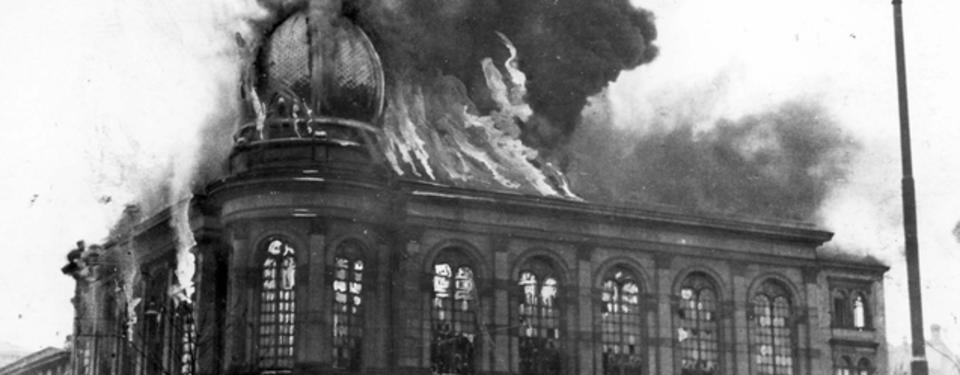


Today is Kristallnacht plus 79 years, the end of the seventh decade since the Holocaust unofficially began with the Night of Broken Glass. With the completion of seven decades, has a threshold been passed where the Holocaust is no longer to be seen as “recent” and must now be considered exclusively to be in the past tense?

According to the Urban Dictionary, “too soon” is “a phrase used to respond to someone making a comment that was intended to be funny, but touches on subject matter that shouldn’t be joked about, usually because it was a recent event (being in the last decade or so).

When a joke is no longer considered “too soon,” we know that a threshold has been passed. That might be the best indicator that we’ve reached a different moment in the perception of an event.

It might always be “too soon” to joke about certain elements of the Holocaust. But the same thing might have been thought regarding the Lincoln assassination, until someone uttered, at some point in the 1950s, “But how did you like the show, Mrs. Lincoln?” Some say the joke came from a New Yorker cartoon, others say it was from a comedian like Tom Lehrer or Bob Newhart. Either way, we’re talking about nearly a century before it was not “too soon.”

With the Holocaust, that moment might have come last weekend, when Larry David went on Saturday Night Live and talked about the absurdity of coming up with good pickup lines at a concentration camp. The monologue was met with considerable shock from the Jewish community, even though it hardly is the first time the Holocaust had been a source of humor by Jews – but most of the prior jokes had been told at the expense of the perpetrators rather than the victims.

When I heard David’s quip, I recoiled at its insensitivity, instinctively saying to myself, “too soon.” But then I reflected for a moment about the shock I was feeling that this joke was “too soon.” Was it because survivors are still among us and that it actually is still “too soon?” Or did I gulp so hard at the realization that the “too soon” moment had just passed before my eyes. It is no longer “too soon” to usher the Holocaust into the realm of normalcy, to treat it as history, to begin to remold it, rethink it, and even play with it, and in doing so, to re-imagine the Judaism that the victims bequeathed to us.

In fact, Larry David’s monologue was just the most visible eruption of something that has been slowly boiling beneath the surface as a new generation of writers and artists has come of age. In Shalom Auslander’s angry, narcissistic, yet shockingly brilliant memoir “Foreskin’s Lament,” published a decade ago, in 2007, he describes the horrible way his parents inflicted guilt as “going Holocaust” on him, as in “Do you know how many Jews died at the hands of the Nazis so you can keep kosher?” The Holocaust itself becomes a character in the narrative: “Mr. Holocaust,” he calls it, the bearer of eternal Jewish trauma. Auslander is numbed by the naked bodies in the newsreel footage he watches at school assemblies. He struggles with the horror even as he trivializes it, out-Rothing even Philip Roth in his cynical detachment.

Similarly, in the documentary “Kike Like Me,” also released in 2007, Jamie Kastner takes us on a sophomoric, self-indulgent road trip through the Jewish world, culminating with a visit to Auschwitz. It is an infuriating yet revealing window into the YouTube generation at its most cynical and most shallow. Borat meets Buchenwald. Kastner, like Auslander, is simply one lost young Jew trying to figure out how this big Holocaust piece fits into the rest of the puzzle known as Jewish identity. It’s a big piece, but it’s just another piece. Even Larry David might have recoiled to read this bit of “humor” from David Deutch’s, as quoted in Heeb Magazine: “So I guess you don’t think the Holocaust is funny. But I gotta tell you, it killed them back in Poland.”

That’s shocking, but no less so than Mel Brooks’ “The Producers” was in 1967, when, for many, “Springtime for Hitler” came much “too soon.”

In the Torah, at the end of the seventh day, God rested. With the Holocaust, at the end of the seventh decade, the dead have rested. A bad joke was told by a Jewish comic and the world kept on spinning.

The Holocaust has receded far enough into history to begin its assimilation into the larger Jewish story. This process is inevitable and for the most part beneficial. When we lose a loved one, the grief eventually gives way to “normalcy” — but not normalcy as it was before the person died. Instead, a new equilibrium forms, an altered worldview, in which the story of that departed relative’s story becomes one with our own, imbuing our lives with added meaning.

The year 1648 was a dark one for Eastern European Jewry, as a Cossack revolt killed upwards of 100,000 Jews in Poland. Almost exactly 70 years later, the Baal Shem Tov introduced the Hasidism to Polish Jewry. In early Hasidic literature, his followers specifically drew a line from the ordeals of 1648 to their teacher’s career, asserting that this charismatic leader “awakened the people Israel from their long coma and brought them renewed joy in the nearness of God.” Seven decades was precisely when it was no longer “too soon.”

The folklore of the early Hasidic masters demonstrates that that the Cossack massacres were still very real to them, well over a century after they occurred. Those tales are filled with the pathos of illness and poverty and loss – but they took that sadness and transformed it into song. They could not succeed in doing that until a full generation had come and gone and few if any actual witnesses were left. Otherwise, to sing and dance, as they did all the time, would have been to sing and dance on someone’s fresh grave.

So, based on historical precedent, it makes perfect sense that after seven decades, the rabbinic equivalent of a lifetime, we can begin to envision new possibilities and remove ourselves, ever so slightly, from the traumas of the past, even if it’s done in bad taste.

Perhaps the realization that the Holocaust might be transitioning to becoming purely historical is what shocked us most of all about Larry David’s monologue. Perhaps then, for a new generation, such humor is no longer “too soon.”

What do you think, Mrs. Lincoln?


Joshua Hammerman Rockower Award-winning journalist, father, husband, son, friend, poodle-owner, Red Sox fan and rabbi of Temple Beth El in Stamford, CT


twoje uwagi, linki, wlasne artykuly, lub wiadomosci przeslij do: webmaster@reunion68.com



2018 ‘JEWISH NOBEL’ GOES TO NATALIE PORTMAN

2018 ‘JEWISH NOBEL’ GOES TO NATALIE PORTMAN

TAMARA ZIEVE


Natalie Portman said she was “deeply touched and humbled” by the honor.

Genesis Prize Laureate Natalie Portman. (photo credit:GENESIS PRIZE FOUNDATION)

Jewish actress, director and social activist Natalie Portman is the winner of the 2018 Genesis Prize, the Genesis Prize Foundation announced Tuesday. The annual $1 million award honors extraordinary individuals who serve as an inspiration to the next generation of Jews through their outstanding professional achievement, commitment to Jewish values and to the Jewish people.

The prize selection committee, headed by Jewish Agency Chairman Natan Sharansky, acknowledged Portman as a globally-acclaimed actress and director. She began her acting career at the age of 12 and has since achieved recognition and praise from audiences around across the world. She is a winner of multiple prestigious awards, including an Academy Award (Oscar), two Golden Globe Awards, the British Academy of Film and Television Award as well as other industry honors.

Portman is also noted for her social activism in such areas as gender equality, combating poverty, micro-finance and animal rights.

Stan Polovets, co-founder and chairman of the Genesis Prize Foundation said that, “Natalie’s charismatic on-screen presence has touched the hearts of millions. Her talent, her commitment to social causes and her deep connection to her Jewish and Israeli roots are greatly admired. She exemplifies the core traits of the Jewish character and values of the Jewish people – persistence and hard work, pursuit of excellence, intellectual curiosity and a heartfelt desire to contribute to making the world a better place. Without a doubt, she is a role model for millions of young Jews around the world.”

“It gives me great pleasure to welcome Natalie Portman to the distinguished family of Genesis Prize Laureates – outstanding Jews of our time,” Sharansky said. “An example of excellence and dedication to Jewish values, she is an exemplary Genesis Prize Laureate. I express my strong support for her chosen philanthropic cause and wish the new Laureate further success in advancing the mission of the Genesis Prize that is so relevant to all of us today.”

Portman said she was “deeply touched and humbled” by the honor.

“It exemplifies the Jewish value of Tikkun Olam, or ‘mending the world,’” she said. “I am proud of my Israeli roots and my Jewish heritage; they are crucial parts of who I am. It is such a privilege to be counted among the outstanding Laureates whom I admire so much. I express my heartfelt gratitude to the Genesis Prize Foundation, and look forward to using the global platform it provides to make a difference in the lives of women in Israel and beyond.”

“I am particularly inspired by the opportunity to make an impact on women’s issues in Israel,” added Portman. “Israel has already achieved much in terms of social and economic development, education and science, and we can all be rightfully proud of it as Jews. And yet, there is much that can be done to advance equal opportunity for women in this society. Increasing women’s participation makes a country stronger and I look forward to fostering more positive change in this area.”

In keeping with the tradition established by the previous Genesis Prize Laureates, $1 million in award money will be granted to philanthropic programs in honor of Natalie Portman. The programs will focus on advancing women’s equality in all aspects of human endeavor. In particular, funds will be used for grants to organizations involved in promoting women’s educational opportunities, economic advancement, health and safety and full participation in policy formulation and political activity. A significant portion of the funds will be channeled to programs advancing women’s equality in Israel.

This year’s laureate was Sir Anish Kapoor, a prominent British sculptor and a champion of Syrian refugee rights.

Natalie Portman becomes the fifth winner of the annual $1 million Genesis Prize. Other previous laureates of the award, dubbed “the Jewish Nobel” by Time Magazine, are former New York City Mayor Michael Bloomberg (2014), actor and peace activist Michael Douglas (2015), virtuoso violinist and advocate for people with disabilities Itzhak Perlman (2016).


twoje uwagi, linki, wlasne artykuly, lub wiadomosci przeslij do: webmaster@reunion68.com

 

WHY ARE ZIONISTS CELEBRATING UNFULFILLED PROMISES?

WHY ARE ZIONISTS CELEBRATING UNFULFILLED PROMISES?

RAFAEL MEDOFF


Balfour Declaration – Wikipedia

Instead of “facilitating” Jewish statehood as Balfour had pledged, the British were now blocking it. If a Jewish state were to come into being, it would be despite British obstruction of the Balfour

As Arab armies mobilized and the Arab League’s secretary-general vowed to carry out ‘a war of extermination and momentous massacre’ of the Jews, the UN stood idly by. (photo credit:REUTERS)

In the coming weeks, numerous Jewish organizations and institutions will celebrate the 100th anniversary of the Balfour Declaration and the 50th anniversary of the United Nations partition plan for Palestine.

Remarkably, however, the proposals that will be celebrated were just that – proposals. Neither of them actually was implemented, at least not in the way their authors intended.

The Balfour Declaration, issued in the form of a letter from the British foreign minister on November 2, 1917, endorsed “the establishment in Palestine of a national home for the Jewish people” and pledged to “use [Great Britain’s] best endeavors to facilitate the achievement of this object.”
Zionist leader Chaim Weizmann said he “heard the steps of the Messiah” in Balfour’s proclamation.

For a short time, the British Mandate authorities opened Palestine’s doors to Jewish immigration and permitted Jews to purchase land without restrictions. But when Palestinian Arabs began to riot, British policy began to change.

Each new wave of Arab terrorism in the 1920s and 1930s resulted in new limits on the development of the Jewish national home. The 1939 White Paper reduced Jewish immigration to a trickle, and the 1940 Land Transfer Regulations allowed unrestricted Jewish land purchases in just 5% of the country. At protest rallies throughout the country, the new regulations were compared to laws in Nazi Germany that likewise prohibited Jews from owning land.
Instead of “facilitating” Jewish statehood as Balfour had pledged, the British were now blocking it. If a Jewish state were to come into being, it would be despite British obstruction of the Balfour Declaration.

The plan adopted in 1947 by the United Nations likewise was never implemented. The UN proposed to create separate Jewish and Arab states in western Palestine. (The eastern 78% of the country already had been severed by the British many years earlier, and renamed Transjordan.) The Zionist leadership accepted the UN proposal, but both the Palestinian Arabs and neighboring Arab regimes rejected it.

As Arab armies mobilized and the Arab League’s secretary-general vowed to carry out “a war of extermination and momentous massacre” of the Jews, the UN stood idly by. Its member-states were not willing to send soldiers to enforce partition.

So why all the celebrating next month? Mostly because the two documents conveyed a certain legitimacy. The Balfour Declaration represented the endorsement of Jewish statehood by the world’s greatest power. The adoption of the partition plan by the UN General Assembly meant the idea of a Jewish state was supported by the majority of the international community.

For a people who had been persecuted and relegated to national homelessness for close to 2,000 years, these developments offered the psychological comfort that Jewish isolation might soon be coming to an end.

But when it came to the Jewish people’s most urgent practical need – a state of their own – the failure of both the British and the United Nations to implement what they promised illustrated the gap between rhetoric and reality.

In the end, the Jews would have to fight for what was theirs. They did fight, and they won. Next year’s 70th anniversary of the establishment of Israel will provide an opportunity to celebrate what was achieved, rather than merely what was promised.


The writer is the author or editor of 17 books about Jewish history and Zionism, including ‘The Historical Dictionary of Zionism’ [coauthored with Chaim I. Waxman].


twoje uwagi, linki, wlasne artykuly, lub wiadomosci przeslij do: webmaster@reunion68.com


All the foods you can imagine at the bustling Machane Yehuda

Israel21cAll the foods you can imagine at the bustling Machane Yehuda

Lin Arison & Diana C. Stoll
The Desert
and the Cities Sing


The Machane Yehuda market in Jerusalem. Photo by Shutterstock

Much of the food scene in Jerusalem revolves around one of the world’s greatest food markets, Machane Yehuda, which bustles with some 250 stalls selling fruits and vegetables, baked goods, fish, meat, cheeses, nuts and spices, wines and liquors, clothing and housewares.

Vendors entice, cajole, and sometimes browbeat potential customers in a gamut of languages; and buyers in turn elbow one another in an effort to gain access to the ripest pomegranate, the plumpest chicken, the nicest bit of halvah – quickly filling up bags and wheeled carts to be dragged squeakingly home.

Just about anything food-related can be obtained here. Two small dining places that have been embedded in the market for decades are Azura and Rachmo, both of which serve delicious Sephardic foods – hummus, kibbeh, stuffed vegetables, and much more – all exquisitely prepared.

The busy Teller Bakery offers crusty European-style loaves and sweet, soft challah, and everything in between.

Basher Fromagerie brings in the finest cheeses from every corner of the world.

The gray-bearded Yemenite Uzi-Eli Hezi makes juices from any fruit you can think of (including the etrog, the citron that plays a central role in the Jewish festival of Sukkot).

Cylindrical mountains of chalky white sweetness await at Mamlechet haHalvah, the appropriately dubbed “Halva Kingdom.”

Any taste can be satisfied at this thriving market.

  • Machane Yehuda market
  • Machneyuda
  • Basher’s Fromagerie
  • Uzi-Eli Hezi
  • Azura 4
    HaEshkol Street, Jerusalem
  • Rachmo
    5 HaEshkol Street, Jerusalem
  • Teller Bakery
    74 Agripas Street, Jerusalem
  • Mamlechet HaHalvah (Halva Kingdom)
    12 Etz HaChaim Street, Jerusalem

Lin Arison & Diana C. Stoll are the creators of The Desert and the Cities Sing: Discovering Today’s Israel, a treasure box that highlights Israel’s creative achievement and innovation.


twoje uwagi, linki, wlasne artykuly, lub wiadomosci przeslij do: webmaster@reunion68.com


Palestinians Again Fail to Oust Israel from International Sports Competition

Palestinians Again Fail to Oust Israel from International Sports Competition

United with Israel Staff


Soccer’s international governing body has turned down another Palestinian demand to jettison Israel from its ranks.

The world’s governing body for soccer, or “football” as the sport is known in most parts of the world, Fédération Internationale de Football Association (FIFA), has turned down another Palestinian demand to remove the Israeli Football Association (IFA) from its ranks.

FIFA ruled against a motion submitted by the Palestinian Football Association (PFA) requesting official recognition of the PFA’s rights under FIFA bylaws on the grounds that the Israel-Palestinian conflict is a complex political dispute unrelated to football.

Such a move would have Israeli teams based in Judea and Samaria declared teams originating from “occupied territory” and would require the IFA to expel them or face a penalty itself.

FIFA President Gianni Infantino tried to resolve the issue through talks, but finally stated that “we see there where our limits unfortunately are,” noting, perhaps hyperbolically, that disputes in the region date back “10,000 years.”

“Football is not going to solve them either, I am afraid,” Infantino said.

Council members decided that “interference by FIFA in the (soccer) status quo in these territories … could have an aggravating effect on the current circumstances.”

The World Jewish Congress (WJC) on Friday welcomed the decision.

The WJC’s says its efforts on the matter spanned several diplomatic spheres.

WJC President Ronald Lauder met with the chairman of the FIFA Israel-Palestine Monitoring Committee, Tokyo Sexwale, to pressure him to drop the Palestinian bid, and the two spoke a number of times subsequently in follow-up.

Lauder and Sexwale agreed that FIFA should serve as an instrument for bringing nations together. Sexwale also expressed last week at the WJC National Community Directors Forum in Cape Town his wishes of a peaceful solution to the Palestinian-Israeli conflict.

WJC CEO and Executive Vice President Robert Singer called FIFA’s ruling “a significant precedent which sends a strong message that international organizations should be used to build bridges, not to create divides. There is no place in sports for cynical political campaigns or unwarranted bias.”

“We hope that this puts an end to the PFA’s misguided actions, and that other international organizations will follow FIFA’s lead,” Singer said.

The WJC also reiterated its support for organizing a friendly football match between Israel and the Palestinians, under FIFA’s auspices, to encourage dialogue and cooperation, in accordance with the fundamental values of the association.

This is not the first time Arab entities have tried and failed to undermine Israel through FIFA.

The Palestinians have utilized FIFA several times over the past year as a platform for undermining Israel.

The PFA is headed by Jibril Rajoub, who served time in an Israeli prison for terrorism.

“Any activity of normalization in sports with the Zionist enemy is a crime against humanity,” Rajoub stated in 2014.

In 2012, slamming the idea of organized sports activities with Israelis, Rajoub stated on PA TV that he would bring Arabs by helicopter to events instead of crossing through Israel, “so they will see no Jews, no Satans, no Zionist sons of bitches.”


twoje uwagi, linki, wlasne artykuly, lub wiadomosci przeslij do: webmaster@reunion68.com