Archives

How a 15th-century Hebrew Bible survived the Inquisition unscathed

How a 15th-century Hebrew Bible survived the Inquisition unscathed

CNAAN LIPHSHIZ
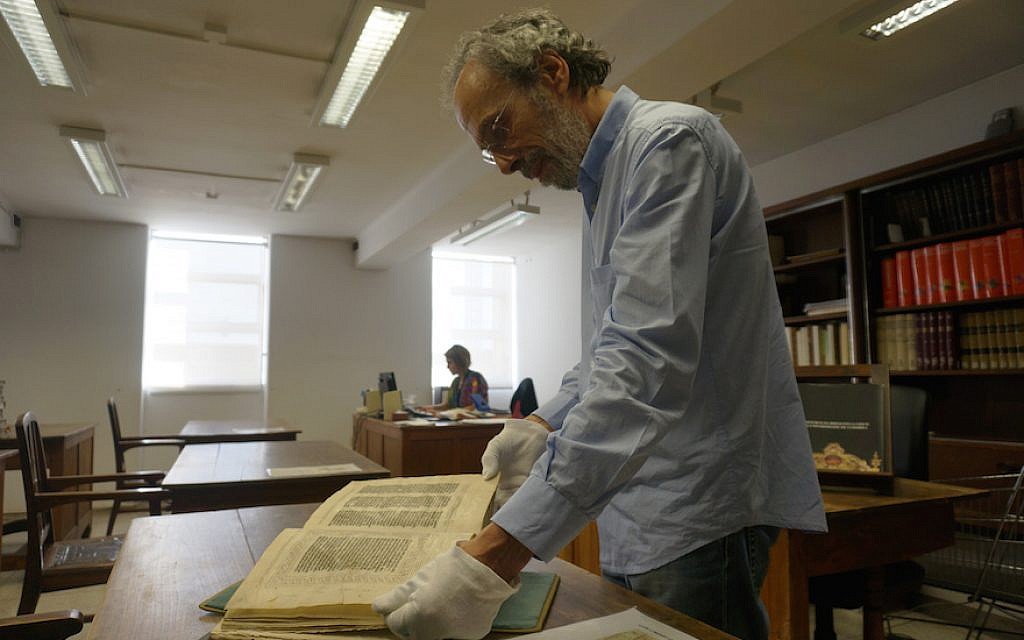

António Eugénio Maia do Amaral presenting the 15th-century Abravanel Hebrew Bible at Portugal’s Coimbra University in 2016. (Cnaan Liphshiz)

COIMBRA, Portugal (JTA) — From its mountaintop perch, the University of Coimbra towers majestically over the downtown square that used to be the regional headquarters of the Portuguese Inquisition.

It’s a fitting location for the 737-year-old university, the seventh oldest in the world, which outsmarted and outlived the campaign of persecution against Jews and freethinkers unleashed by the Catholic Church and Portugal’s rulers in 1536.

“This place was almost literally an ivory tower of knowledge during those dark times,” António Eugénio Maia do Amaral, assistant director of the university’s 500-year-old library, recently told JTA.

Thanks to the university’s undocumented policy of subterfuge against the Inquisition — Amaral said its librarians essentially hid many books that censors would likely have wanted to destroy, reintroducing them to the indexes only after the Inquisition was abolished in 1821 — Coimbra was in possession of a collection of rare, pristine Jewish manuscripts found nowhere else.

One such manuscript is the Abravanel Hebrew Bible.

Ranked by the university in a 2012 statement as its rarest artifact, the handwritten Bible from the 15th century is perfectly preserved. The book is filled with drawings on parchment that are so vibrant, they seem to have been recently created.

The 15th-century Abravanel Hebrew Bible at Coimbra University. (Cnaan Liphshiz)

The Abravanels — a distinguished, wealthy Sephardic family with branches in Spain and Portugal that fled to Amsterdam and the Balkans during the Inquisition — commissioned 20 such Bibles. The volume in Coimbra is among the best preserved of the handful whose whereabouts are known today.

The book is worth north of $3 million, according to the university’s Joanine Library, which in 2013 was recognized as a UNESCO World Heritage Site. That’s where the Bible is kept — along with hundreds of other precious manuscripts — inside a huge vault with special climate control and aerial disinfection facilities.

The vault is typically only opened to scholars. Yet last year, Amaral took JTA inside to see the Bible. There was a brief moment of confusion when the employee asked to locate the book said she could not find it in the index system. But Amaral, who has worked at the library for more than 20 years, shrugged and said calmly that he would have to “let the fingers do the looking” once inside the vault.

Amaral may have been laid back, but he was anything but cavalier. He expertly navigated the labyrinthine vault — two cards with digital keys are required for access — while donning librarian gloves. He took care not to breathe directly on the books he handled, so as not to introduce moisture.

Alongside its technological solutions, the library employs a uniquely time-tested and green method for pest control: For centuries, it has been home to a colony of nocturnal, insect-eating bats. In the evenings, when the library is closed, the tables beneath their flight paths are covered with furs in order to protect them from the bats’ excrement.

The University of Coimbra has little information on how exactly it came to possess the Abravanel Hebrew Bible, possibly because it was hidden or scrubbed from the library’s indexes to hide it from Inquisition agents.

What makes the Abravanel Bible so rare, however, isn’t just its age — it’s the pristine condition. Across the Iberian Peninsula, numerous books remain that Jews smuggled out during centuries of Inquisition, at risk to their own lives, but they are damaged. One such specimen: An 1282 copy of the Mishneh Torah, the code of Jewish religious law authored by Rabbi Moshe ben Maimon, or Maimonides. The book has whole passages that an Inquisition censor singed away, making them lost forever. It’s kept at the 400-year-old library at the Portuguese Synagogue in Amsterdam, which was founded by refugees from the Inquisition.

The second-rarest specimen at Coimbra’s library is another Bible dating to the 15th century. The Latin-language volume was one of the world’s first printed books, prepared by partners of Johannes Gutenberg, the inventor of the print machine. Printed in 1462 — just 12 years after the original 42-line Gutenberg Bible which is on display in Mainz, Germany — the one in Coimbra is the only surviving copy of an edition of four 48-line Bibles printed by two of his partners.

Language differences aside, the printed book looks similar to the handwritten one. Both have illustrations and hand-drawn margins that writers used to keep their text straight before the invention of print.

That’s no accident, Amaral said.

“The margins and drawings were added to the printed copy to make it seem as though it was handwritten,” he said.

This retrograding was partly done for aesthetic reasons — readers were used to seeing them — and partly as a “precaution,” Amaral said, because some Christian fanatics considered print machines “the works of the devil.”

The Inquisition Patio in Coimbra. (Cnaan Liphshiz)

Thousands were murdered during a series of Portuguese Inquisitions that followed the Spanish Inquisition of 1492. At least 200,000 Jews fled the Iberian Peninsula for the Netherlands, South America and the Middle East during the period, which lasted nearly three centuries. Thousands more stayed and practiced Judaism in secret for generations.

The library’s archives also contain rare, chilling records that reveal the bureaucracy behind the Inquisition’s barbarity. For example, the minutes of a 1729 trial against Manuel Benosh, a Portuguese Jew, indicated that he was “released” by the Inquisition to civil authorities with an instruction that he be “punished in flesh” — a euphemism for a death sentence by burning.

Outside of Lisbon, Coimbra University is the largest owner of Portuguese Inquisition verdicts.

“It was a mission that made this place not only a victim and opponent of the horrors of the Inquisition, but also a witness to them,” Amaral said.

True to its tradition of defiance, the library was also one of the few institutions to openly refuse to comply with the censorship policies of the regime of António de Oliveira Salazar, Portugal’s pro-fascist dictator of 34 years, until 1968.

“Again there were the same tricks as during the Inquisition,” Amaral said. “In the end, we now see who has prevailed.”


twoje uwagi, linki, wlasne artykuly, lub wiadomosci przeslij do: webmaster@reunion68.com



Antisemitisms of the Left and Right (with Mark G. Yudof)

Antisemitisms of the Left and Right (with Mark G. Yudof)

Kenneth Waltzer


Jewish intellectuals and rabbis, a disputatious lot, have struggled for more than two millennia to define Jewish identity. Is it genetic, religious, cultural, traditional, communal? Perhaps it is more than one of these. Antisemites of the Left and Right, however, have less difficulty. They make facile choices constructing Jewish identity, ignoring historical complexity to serve their own ends.



Seventy years or so after the liberation of Auschwitz, hatred of Jews is again on the rise in Europe and the Middle East. It is also evident to a lesser degree in the United States, particularly on campuses. Jews once again are called out, made to answer for the antisemite’s conception of the Jew. Confident faith in an exceptional America where tolerance reigns is shaken. What is to be done?

I.

Today, Jewish students are called to account for their support of Israel, which on many campuses is presented as an evil pariah state. They are pronounced guilty due to white privilege and they are charged with supposed control of the media. At San Francisco State university, Jewish students faced open calls in late spring that Jews supporting Israel should get off the campus. A law suit against the university claims “Jewish students who are open about their Jewish identities…feel vulnerable, intimidated, and threatened on their own campus.” Bloodied Israeli flags appear at anti-Trump demonstrations in the Northeast, Midwest, and West, falsely linking civil rights and concerns about immigrant rights with the ongoing Israeli-Palestinian conflict. At the University of Illinois, Students for Justice in Palestine recently equated fascism, white supremacy, and Zionism. Simultaneously, an army of white nationalists marched in late summer at the University of Virginia with swastikas and weapons charging “Jews will not replace us. “Jews will not replace us.” These pernicious developments and others presage rising frictions in the coming months.

Charlottesville was a wake-up call for Jews as well as for African Americans, immigrants and other targets of hate. Hundreds of neo-Nazis, white nationalists, and white supremacists mobilized from around the country, descending on the town and campus armed with weapons. They marched with lit torches intimidating students, and they grew increasingly more violent in a poorly policed, escalating clash, which led to a homicide. Followers of Richard Spencer and others marched under the banner of a whites-only republic. In their outlook, the threat of racial decline in the United States is engineered by the Jews, whom racial nationalists picture as non-white and as choreographing the rest — globalization, immigration, illegal immigration, judicial checks on executive power, equality before the law, and multiculturalism.

Before these events, observers spoke expectantly of higher levels of antisemitism on campuses but did not fully anticipate the role white nationalists would play. Instead, they worried primarily about a growing Far Left antisemitism different from Far Right antisemitism. The antisemitism of the Far Left is the hatred of self-proclaimed anti-racists who nonetheless believe in a rigidly dogmatic anti-Israelism. It is about the intersection of anti-Zionism and antisemitism, and especially about distaste in the global Left for the Jewish state. The antisemitism of the Far Right is more like the older racial anti-Semitism.

These forms of hatred share a distinctive eagerness to put the Jew at the center of what is wrong with the world in the present. Yet they differ significantly and demand responses attuned to the differences.

The antisemitism of the Far Left is often called the newest anti-Semitism. It takes its bearings from its growth during a post-Holocaust age, with roots in Soviet bloc anti-Zionism and antisemitism during the decades after World War II. Its origins are also traceable to the collapse of socialist politics late during the 20th century, which have been replaced by a kind of campist, binary international politics, pitting Western imperialism and anti-imperialism against one another. In this view, the Jewish state is a key part of the Western imperialist bloc and most Jews are allies of Israel. What the Jew was to racial anti-Semites historically, an ally of the devil, the Jewish state now becomes as a Western ally in the global Left power perspective. The Jews were once hated because they were thought of individually as alien and other; they are now hated for being linked with and supportive of a sovereign Jewish state.

The antisemitism of the Far Right also reflects new elements but also harkens back to modern racial antisemitism, the hatred that culminated in the Nazi Holocaust. Antisemites assume Jews are evil in their seed. They carry their essence in their biology, It is also shaped by 21st century identity politics, including multiculturalism and novel assumptions about cultural identity. In this alternative view, the Jews, evil in their nature, are an extraordinarily malevolent force shaping domestic fortunes. They drive globalism, affect economies, stir migration, and push multiculturalism. “White Man, are you Sick and Tired of the Jews Destroying Your Country through Immigration and Degeneracy? states flyers distributed at the U. of Minnesota and many other campuses. Poster depicting the international Jew and Jewish menage were up at the University of Houston where the Students for Justice in Palestine will host their national conference in late October.

In the racial theory of the white nationalists, Jews are among the many other minorities which allegedly threaten the foundations of an imagined white republic. Jews are sub-humans just like Blacks and Latinos but they are significantly more powerful and influential. It is claimed they have their own powerful lobby, dominate important institutions, help fund the major parties, and operate from unseen places to selfishly shape the prospects of others. Jews are racial enemies bent on extending the rule of the Jews.

The antisemites on the hard left oppose a Jewish state, even stand against the idea of Israel as a raft nation or a refuge for Jews. Â Jews need no such consideration, they seem to say: no compensatory affirmation arises from a white nationalist review of Jewish history. These bigots see Jewish history as a selective history of power and privilege, not of catastrophe and calamity. No Israel must exist in Arab lands anywhere. Leaders in the Boycott Divestment and Sanctions movement (BDS) acknowledge that a single Palestinian state is their true goal. The idea of a two state solution lacks justice, most think, because it involves having to accept a Jewish state. Left antisemitism also excuses attacks on European and American Jews and their institutions because Jews everywhere are supporters of Israel. They are inductees in Israel’ cause.

II.

As we move further into the new academic year, Left antisemites are a presence on many campuses. Some are part of the BDS movement, with academic positions in departments and programs. They are endorsers of the U.S. Committee for the Academic and Cultural Boycott of Israel (USACBI) or members of Students for Justice in Palestine (SJP). Not all are antisemitic, to be sure, but there are many in the ranks who view it as appropriate to raise questions about Jewish students standing for campus office or to circulate cartoons about Israel where classic Jewish figures appear with hooked noses and grasping hands. They think it desirable to bar Jewish groups in institutions from progressive alliances or to characterize campus Hillels as white supremacist organizations. At universities in California, they are among the students who disrupt Jewish meetings during anti-apartheid weeks. n the views rationalized by the idea of intersectionality, Jews are erased.They are ‘whites” and have no identity. Such people do not see the links between their antisemitism and their racism more broadly. They think they are not racists at all,

The Far Right antisemites, in contrast, are a threat reaching into campuses from outside. Generally these people are not enrolled at the universities but seek access, desiring to leaflet, march, mobilize, gain publicity, and win support. Groups like the Vanguard, Identity Europa, and Traditionalist Workers Party launch surprise forays onto campuses, pasting up flyers without permission, defacing walls, and chalking doors and sidewalks. The more prominent forces like the group Richard Spencer leads seek permits to march or rent venues, trying to turn towns and campuses into public fora for white identity. Â They sue when they are denied entry, as they have recently at Auburn and most recently at Michigan State University and Ohio State University. At Florida, they pushed their way in and appeared, as great expense.

The challenge we face dealing with the Far Left antisemites on campus is to openly identify and point out their hateful tendencies when they cross the line from anti-Zionism to anti-Semitism. Supporters of Jewish students must aggressively name and call out this form of hate when it appears, tagging any misbehavior, and pressing campus administrators to follow up and enforce existing codes of faculty and student conduct. Hate directed at Jewish students deserves no less response than hate directed at other minority students. We must be actively vocal in demanding that haters be held to forms of expression that meet the rules and standards of conduct respecting academic freedom and freedom of expression. We must especially press university administrators to enforce the rules equally when such people shut down speakers or engage in physical confrontations to block free speech. University leaders must be held to treating antisemitism against Jews as they would treat actions of racism against African-Americans or misogyny against women. Equal treatment for all is the demand to be emphasized as a shared goal. .

Crafting appropriate responses to antisemites of the Far Right also poses a challenge, since freedom of speech on campus in America includes the right to engage in hate speech. Under the First Amendment, it is difficult for universities to deny requests for permits as the courts demand content-neutrality in policing access to public fora. After the Virginia violence, several campuses turned down Richard Spencer’s petitions to speak, citing fears of violence; but courts in time will assess university actions more in keeping with the case llaw. Concern with the Far Right should look to create partnerships with agencies that monitor and collect intelligence on these groups, like he Anti-Defamation League, get to know this form of hate better, and mount noisy protests when the Right appears near or on campus.

III.

Coping with the antisemitisms of the Far Left and the Far Right poses challenging problems. We must simultaneously maintain a watchful responsiveness, aggressively calling them out, labeling, and countering their views with our own speech, while also affirming the free speech traditions and boundaries that have defined our academic institutions. These are not easy tasks. Equally important, Jewish leaders and people should never accept the historical revisionism of our enemies, permitting them to define and say who and what we are or what we stand for without speaking up forcefully ourselves.


Kenneth Waltzer is former director of Jewish Studies at Michigan State University and a progressive opponent of the Boycott, Divestment, and Sanctions movement. He a historian of the Holocaust completing a book on the rescue of children and youths at Buchenwald. He currently directs the Academic Engagement Network.


twoje uwagi, linki, wlasne artykuly, lub wiadomosci przeslij do: webmaster@reunion68.com


Israeli jets bomb Syrian weapons facility.


Report: Israeli jets bomb Syrian weapons facility, ‘violent explosions’ reported

Aryeh Savir


An IAF F-15 (IAF)

Did Israel attack targets in Syria again? Arab news sources are reporting that the IAF carried out strikes against a weapons depot inside the country.

The Israeli Air Force (IAF) attacked and destroyed a weapons storage facility in the Syrian city of Homs on Wednesday night, Arab media reported.

The Syria Observatory for Human Rights (SOHR) reported that “violent explosions shook” the city, and that the strikes were executed against “a military establishment.”

The London-based SOHR quotes sources that say that the facility was a rocket depot. It is not known whether these rockets belonged to the Lebanese Hezbollah terror group or the Assad regime.

Lebanon’s National News Agency (NNA) reported “strong blasts” were heard inside Lebanon, “caused by Israeli airstrikes” in Syria.

“The Syrian army fired several missiles at the raiding warplanes,” NNA said.

“The Syrian army responded with a surface-to-air missile that it fired towards the raiding Israeli fighter jets,” Lebanon’s al-Mayadeen.

Israel has conducted strikes against Syrian targets from Lebanese airspace in the past, thus avoiding the Russian air defense system deployed in Syria.

There is currently no information on casualties.

Neither Israeli nor Syrian or Hezbollah officials have confirmed the reports.

Similar reports of IAF strikes inside Syria have emerged in the past.

Hezbollah has been working hard to arm itself with advanced weapons. Israel has stated repeatedly that it will not allow the terror organization to acquire advanced weaponry, which would threaten the country and compromise the IDF’s capability to maneuver in Lebanon in the event of another war.

Prime Minister Benjamin Netanyahu has confirmed in the past that Israel carried out several attacks against Hezbollah to prevent the group from obtaining advanced weapons.

Israeli leaders have warned that Hezbollah, backed by Iran, could drag the region into another round of hostilities.

The IDF has stated that its Home Front Command was preparing for a scenario of hundreds of civilian casualties and 1,000 to 1,500 rockets raining daily on Israeli population centers in an eventual conflict with the Hezbollah terror organization.


twoje uwagi, linki, wlasne artykuly, lub wiadomosci przeslij do: webmaster@reunion68.com


Fatah continues campaign against Balfour Declaration

Fatah continues campaign against Balfour Declaration

Dalit Halevi


Abbas’s movement calls on Britain to apologize for the 1917 Balfour Declaration.

Mahmoud AbbasSTR/Flash 90

The Fatah movement headed by Mahmoud Abbas, who also serves as Palestinian Authority (PA) chairman, on Wednesday condemned British Prime Minister Theresa May, who announced her intention to officially mark the 100th anniversary of the Balfour Declaration.

Munib al-Jar’ub, the Fatah official in charge of public diplomacy, said that May’s remarks express a bias toward the “racist occupation state”, a reference to Israel, and represent a danger of legitimizing an “occupation” that targets Palestinian land and man.

Jar’ub called on the British government to assume its historical, legal, political, financial and moral responsibility for the implications of the Balfour Declaration, and to apologize to the Palestinians for the disasters and injustices they had suffered, as well as to rectify the “historic catastrophe” by recognizing an independent Palestinian state with eastern Jerusalem as its capital.

Fatah also called on Britain to retract the statements that legitimized the “occupation” and to force Israel to implement the decisions of the international institutions and to bring it to justice for the crimes it had committed against the Palestinians.

Palestinian Arab organizations have for months been waging a campaign aimed at forcing Britain to apologize for the 1917 declaration, in which Britain pledged to establish a national home for the Jewish people.

The November 2, 1917, Balfour Declaration was sent by then-British Foreign Secretary Arthur Balfour and proclaimed Britain’s support for the establishment of a Jewish national home in then-Palestine.

The British government in April rejected the demand to apologize for the Declaration, saying, “The Balfour Declaration is an historic statement for which HMG (Her Majesty’s Government) does not intend to apologize. We are proud of our role in creating the State of Israel. The task now is to encourage moves towards peace.”


twoje uwagi, linki, wlasne artykuly, lub wiadomosci przeslij do: webmaster@reunion68.com


Congress to Vote on Resolution Supporting Balfour Declaration

Congress to Vote on Resolution Supporting Balfour Declaration

Amir Tibon


‘Israel is one of our closest friends and allies, and it is important that we stand with her and honor this important milestone,’ resolution proponent Senator Lankford said.
From left to right: British General Edmund Allenby, former British Prime Minister Arthur Balfour, First High Commissioner of Palestine Herbert Samuel in Jerusalem, 1925. HANDOUT/AFP

The American Congress is expected to vote on a resolution in the coming weeks expressing its support for the Balfour Declaration, on the 100-year anniversary of the British document lauded as one of the Zionist movement’s greatest international achievements.

A text of the resolution, which has been obtained by Haaretz, states that Congress “commemorates the centenary of the Balfour Declaration; affirms its commitment to maintaining the strongest of bilateral ties with the state of Israel; and recognizes the importance of the establishment of the modern State of Israel as a secure and democratic homeland for the Jewish people.”

The resolution states as its basis the fact that “the Jewish people have had a homeland in modern- day Israel for more than 3,000 years”, and also mentions that “the Balfour Declaration clearly recognized and sought to uphold the ‘‘civil and religious rights of the existing non-Jewish communities in Palestine,’’ as well as the ‘‘rights and political status enjoyed by Jews in any other country.”

The resolution is proposed by Senator James Lankford (R-OK) together with Senator Joe Manchin (D-WV). Senator Lankford told Haaretz that “it is entirely appropriate for the United States Congress to commemorate the 100th anniversary of the Balfour Declaration, a statement that ultimately led to the reestablishment of the State of Israel in 1948,” said Lankford. “Israel is one of our closest friends and allies, and it is important that we stand with her and honor this important milestone.”

In recent weeks, the Palestinian Authority began an international campaign against the 100-year-old declaration, claiming that the part of it which promised to respect the rights of the non-Jewish population in historic Palestine has not been fulfilled or respected. The PA has also asked the British government to apologize for issuing the declaration and to use the centennial mark in order to increase its support for Palestinian independence and an end to Israel’s occupation of the West Bank.


twoje uwagi, linki, wlasne artykuly, lub wiadomosci przeslij do: webmaster@reunion68.com