Archives

MY WORD: IDENTIFYING WITH GAL GADOT

MY WORD: IDENTIFYING WITH GAL GADOT

LIAT COLLINS


Judaism was the groundbreaking religion when it comes to values of social justice, solidarity and liberation.

Gal Gadot. (photo credit:REUTERS)

Woody Allen has a lot to answer for. Gal Gadot provides a lot of the answers.
It has been impossible this summer to ignore the superstar status of former Miss Israel Gadot as she wooed and wowed the world in the lead role of Wonder Woman.

Gadot is everything that Allen is not.

Allen’s screen persona is the archetypal nebech. It’s hard to think of Allen without relying on Yiddish words and humor. His characters are weak and make you pity them. They are also full of self-pity and doubts. Allen recreated cinematic comedies in the 1970s by turning nervous and nervy nerds into heroes. Gadot, on the other hand, is the embodiment of powerful woman (and it’s quite a body at that). In the movie she literally saves the world. She’s not the victim, she’s the savior. She’s a super-hero and super human at the same time.

Not coincidentally, Allen is as stereotypical a New York Jew as they come – arguably he created the stereotype – while Gadot is a Hebrew-speaking native Israeli and proud of it. She’s not scared to let people know she was a combat trainer in the IDF. In fact, she’s not scared. Period.

Last week I was discussing with a friend from England the problems that even proud Jews have there in the current atmosphere. Over breakfast at a Jerusalem street cafe, surrounded by people talking – loudly and without fear – in Hebrew, she noted that it was often uncomfortable to be openly Jewish in London.

The solution, I told her, was not to shy away from it but to meet the antisemitism, and more frequently expressions of anti-Israeli attitudes, head on, or at least with head held high. Acting like a victim does nothing to end abuse.

Some of my recent thoughts and discussions on the subject stem from an essay by David Hazony in the June-July issue of The Tower, titled “Israeli Identity and the Future of American Jewry. After decades of ominous demographic statistics, the American Jewish community faces a stark choice about its future. Can Israeli culture offer a way out?”

The article is long but worth reading. Hazony discusses the two great problems that face American Jewry today: “assimilation” or “continuity” or “identity” and what “may be called the ‘Israel problem.’”

Hazony notes: “These two factors – assimilation and Israel-angst – are the real sources of crisis. These and not others, like antisemitism or terrorism, because they are problems of the spirit: a collective Jewish spirit that is no longer sure of its future or even its present, an insecurity that both expresses and exacerbates the problem. These issues have, simply, made ‘being Jewish’ into something problematic for the next generation of non-Orthodox Jews.”

Like Hazony, I believe that Israel should be part of the solution, not the problem.

In a community that seeks a cause and longs to help, activism could be channeled toward finding the inner Israel. This is the Israel that is not foreign. It’s the recognition of the fact that this is where the Jewish people was born, whose landscape, climate and surroundings lie at the very foundation of the religion.

And while I don’t belittle the importance of Yiddish (my Bubbe would turn in her grave), it’s important to recognize that being Jewish doesn’t even start with Yiddishisms, let alone end there. Israelis speak Hebrew. And Allen’s angst-filled mannerisms seem pathetic and out of place under Mediterranean skies.

You can’t understand Israelis without understanding Hebrew. Allen doesn’t represent Israeli Jewish youth, be they Ashkenazi, Sephardi or any other identity. (And keep in mind that when Israelis talk about “marrying out,” it is more likely that they are referring to marrying someone from a different Jewish community than marrying a non-Jew.)

There are American Jews who make their support for Israel contingent on the country, or at least its leaders, behaving in a certain way. Imagine Irish-Americans making their Irish identity conditional on the politics of the Republic of Ireland or Italian-Americans determining their cultural affiliation by whichever of the ever-changing governments happens to be in power in Rome.

Jewish identity and support for Israel should not be a matter of Right and Left.

As Hazony puts it: “Have you ever noticed that evangelical support for Israel does not seem to buckle into existential crisis just because Israel – the manifestation of God’s will – is one of the least religious countries on Earth, in which gays thrive and abortions are legal and the government sponsors actual Shari’a courts? For evangelicals, the contradictions are not a cause for crisis for the simple reason that their own identity is not dependent on the policies of the Israeli government. Their support flows from identity but does not define it, much the same way that [Abraham Joshua] Heschel’s involvement in the Civil Rights movement flowed from his deep Jewish identity rather than defined it.”

Israelis hear threats by American Jewish liberals to disengage if the country doesn’t do what they want and shrug. We’re not scared of losing them. If their love is conditional, we’ve already lost them. They’ve cut themselves off from the family.

I was not surprised to read recently that the pro-Palestinian advocacy group which goes under the misleading name Jewish Voice for Peace had begun a campaign urging American students not to participate in Birthright Israel trips, the all-expenses- paid short tours of Israel that have revolutionized the way participants relate to the country. JVP’s voice is getting shriller. What does it have to fear? That young Jews will see firsthand that Israel is not the evil state that JVP likes to demonize?

The JVP Facebook page says: “Our Judaism is grounded in values of solidarity and liberation, not occupation and apartheid.”

Judaism was, indeed, the groundbreaking religion when it comes to values of social justice, solidarity and liberation. And for all its faults (no country is perfect), Israel remains a standard bearer in these values. But we aren’t a cowering, Allen-like Diaspora figure. When we’re hit by rockets and terrorists, we fight back. And it turns out that our experience in tackling terrorism is helping save the world from global jihad.

We refuse to be the victim. We cannot forgive or forget the Holocaust, but making its commemoration the central point of our identity is to belittle who we are and have always been. Similarly, universalizing the Holocaust reduces it to the point when everyone is a victim. That’s not a good place to be.

Meanwhile, it is not only Gadot who is showing the beautiful face of Israel.

In the tikkun olam category, Israelis are “mending the world” through medicine, technology and agricultural developments. They are treating in Israeli hospitals Syrians injured in the civil war. And they are helping hurricane and earthquake victims. Israeli movies and TV shows have a growing international fan club – Fauda followers are eagerly waiting for the second series of the TV thriller just as Wonder Woman’s fans are excited about plans for a sequel.

And here’s food for thought. Last week Time Out London put Barbary, a “modern Israeli” (but unfortunately nonkosher) restaurant, at the top of the 100 best restaurants in London list. Several other Israeli restaurants were on the list, as was Monty’s Deli, boasting “Jewish soul food, made with love.” Israel is fighting back, one bite at a time.


twoje uwagi, linki, wlasne artykuly, lub wiadomosci przeslij do: webmaster@reunion68.com



RADIOACTIVE OBJECT FOUND NEAR NAZI-ERA NUCLEAR RESEARCH SITE

RADIOACTIVE OBJECT FOUND NEAR NAZI-ERA NUCLEAR RESEARCH SITE

BECKY BROTHMAN


A German man’s metal detecting hobby makes history

A picture taken in September 1937, in Munich, shows German Chancellor Adolf Hitler (R) riding in a car with Italian dictator Benito Mussolini while the crowd gives the fascist salute.. (photo credit:SNEP / AFP)

German police are investigating a 64-year-old man who found a radioactive metal object in Oranienburg, Germany. The discovery has potentially huge implications for the study of Nazi nuclear history.

Bernd Thälmann uncovered the object when he was searching for treasure with a metal detector. The odd lump appeared to be metal and was picked up by the detector, but did not react when placed near a magnet, confounding its discoverer.

The man took the object back to his home, but became nervous and called the police a few days after the discovery.

The police tested the object and determined that it was radioactive. According to the German newspaper Berliner Kurier, Thälmann was placed under investigation for possessing “an unauthorized radioactive substance.”

After the object’s radioactivity was confirmed, police evacuated 15 residents near Thälmann’s house and specialists swept the premises for more radioactive substances.

Oranienburg, a town in Brandenburg in northeastern Germany, was the site of secret Nazi-era research center. The center was part of Hitler’s nuclear weapons project, nicknamed the Uranverein (Uranium Club), which sought to obtain nuclear capabilities for the Third Reich.

The facility was headed by German scientists Nikolaus Riehl and Günter Wirths, who later worked for the Soviet atomic bomb project after the fall of Hitler’s Germany.

The Oranienburg facility’s purpose was to enrich uranium oxide taken from South America and transform it into plutonium. The Oranienburg facility was known to the Allies by 1944.

In November 1944, the Alsos Mission — a team of US military and scientific personnel who were tasked with unearthing Germany’s scientific developments — confirmed the Oranienburg center’s uranium program.

Leslie Groves, commander of the Manhattan Project — the Allied nuclear program which ultimately created the first nuclear bomb — recommended that the Oranienburg facility be destroyed by air assault before the Red Army could get to the area and take the facility’s equipment for themselves.

The facility was heavily bombed by the US Air Force in March 1945. Due to the uranium center and multiple other armament and chemical plants in the area, Oranienburg has more unexploded bombs than any other town in Germany, according to Deutsche Welle.

While the Manhattan Project successfully created nuclear weapons, the German nuclear program floundered. Much of this can be attributed to the purging of Jewish scientists and other political enemies of the Nazis when Hitler came to power.

Thousands of Jewish scientists, including Nobel laureates and dozens of theoretical physicists emigrated from Germany to the US and Britain. The most notable Jewish scientist to leave Germany and influence the Manhattan Project was Albert Einstein.

Thälmann’s new discovery could shed more light on the facility and its remnants.

According to German police, Thälmann wanted to retrace his steps and find more evidence of the Nazi-era site, but he has not been cooperating with authorities and “refuses to provide information on the exact location.”

The criminal investigation is ongoing.


twoje uwagi, linki, wlasne artykuly, lub wiadomosci przeslij do: webmaster@reunion68.com



Arrested by the KGB in Russia

Arrested by the KGB in Russia

Howard Kaplan


Howard Kaplan is the author of the The Damascus Cover and Bullets of Palestine and has just completed a new Middle East thriller.

In Casablanca, in February 2015, I watched Jonathan Rhys Meyers and Sir John Hurt film scenes for the adaptation of my spy novel, The Damascus Cover. I thought back to how, 44 years earlier, the KGB threatened what they would do to me if I ever wrote about my arrest in the Soviet Union — which launched me on my career as a writer.

When I was 22, I walked along a memorized route from the Hotel Metropole, where I was staying, through nearby Red Square and soon, on a narrow street adjacent to the square, approached an apartment door. Suddenly, from behind, two men grabbed my arms from both sides; they said nothing. I was scared, did not know who they were or where I was being taken. I stayed silent thinking that on a quiet street in the USSR, I had no good alternatives and, whether I fought or complied, they could do with me what they wanted. They led me to the back of the building, inside a rear entrance, and down some dark steps. I let myself be taken into an artist’s studio. Around a table, the first thing I saw was that several of the men sitting there had silver Stars of David on their lapels. I was with the leaders of both the Democratic and Jewish dissident movements. A translator explained I had purposely been given the wrong address and watched to see if the KGB were following me.

The next day, after showing my passport to the KGB guard outside the Dutch Embassy, I entered the building and handed the Ambassador a manuscript. All unpublished manuscripts were considered property of the Communist state, so emigrants were required to leave all writings behind. We wrote notes and before I left, he burned them. His last missive said: “Be careful, this is not James Bond.” I was on a 14-day independent tour to a number of cities; a different Intourist guide met my plane at each stop and then drove me to the airport for my next internal flight which I boarded without accompaniment. On the tenth day, I met with Hebrew teachers in a Kharkov apartment in the Ukraine. That evening, about 11 p.m., one Hebrew teacher walked me to the trolley that would take me back to my hotel. As we turned the corner, a wall of men leaped from the shadows. Quickly, a uniformed officer grabbed my arm, twisted it behind my back, and rammed me against the building. My companion was pummeled.

Separated from him at KGB headquarters, I was forcibly seated at the end of a long table. Two plainclothesmen entered. The older — middle-aged, barrel-chested, with white thinning hair — was the interrogator. His lean, blond companion was 20 years his junior. I guessed they held the ranks of colonel and captain, respectively, in the KGB. They sat across from me. Within seconds, four uniformed men accompanied the manager of my hotel into the room to translate.

The sparring began. I was brash, naively fearless, felt that my passport protected me, and it soon became clear they knew nothing about the manuscript transfer. How did I meet these men? What did they tell me? Who sent me? I rebutted: “Is it illegal to talk to Soviet citizens?” The colonel: “No, but it is illegal to consort with hooligans.” Nervous, I asked to use the bathroom. It was after 1:00 a.m. The colonel said I could use the bathroom in my hotel room and we would resume tomorrow in the hotel manager’s office.

We continued for two days; they made me write out each answer in longhand. I could use facilities when I wanted and food was brought. More than anything, they wanted to know who had sent me. I gave them a name and described my father who I could easily describe again, even if exhausted days later, when they inevitably again demanded his description. I explained that my handler had approached me outside a travel agency and I had no way of contacting him, though he would be meeting my scheduled flight from Moscow to Heathrow in two days. My sense was that if the KGB wanted to level an espionage charge, consorting with hooligans and anything else they felt like piling on would be sufficient. I was unimportant and counted on their greater desire to identify who had sent me.

I was flown to Moscow, escorts on both sides of me on the commercial flight, and met at the airport by another team, one of whom spoke perfect British and the other, similar American. They said they were Intourist travel guides.

For another two days, I was interrogated outside the airport in a small hotel without a restaurant and marched for each meal through Passport Control and into the departure lounge, then back again, the message clear. The morning of my scheduled flight, a prosecutor arrived in my hotel room. In a small ceremony, I was officially expelled from the USSR.

In the departure lounge this final time, one of my interrogators took me aside. “Everybody has been very polite to you here, no? Nobody has harmed or struck you.” I agreed. “Good,” he said sternly. “Then I will not expect to see any newspaper articles or stories written about your experiences in the Soviet Union. If I do, the KGB can find you anywhere in the world and next time we will not be so humanistic. Do you understand?”

I nodded, defiance hot inside me.

And as I cleared customs at London Airport, I saw two men following me. They were later found naked, tied to trees in Epping Forest.


twoje uwagi, linki, wlasne artykuly, lub wiadomosci przeslij do: webmaster@reunion68.com



COLUMN ONE: ISRAEL AND THE AMERICAN JEWISH CRISIS

COLUMN ONE: ISRAEL AND THE AMERICAN JEWISH CRISIS

CAROLINE B. GLICK


The key to strengthening and supporting the community is to bypass its failed leadership and speak and interact directly with American Jews.

Jews cleaning out notes from the Western Wall ahead of Rosh Hashanah. (photo credit:MARC ISRAEL SELLEM)

As the New Year 5778 begins, 88% of Israeli Jews say that they are happy and satisfied with their lives. This makes sense. Israel’s relative security, its prosperity, freedom and spiritual blossoming make Israeli Jews the most successful Jewish community in 3,500 years of Jewish history.

The same cannot be said for the Jews of the Diaspora. In Western Europe, Jewish communities that just a generation ago were considered safe and prosperous are now besieged. Synagogues and Jewish schools look like army barracks. And the severe security cordons Jews need to pass through to pray and study are entirely justified. For where they are absent, as they were at the Hyper Cacher Jewish supermarket in Paris in 2015, assailants strike.

Western European Jewry’s crisis is exogenous to the Jewish communities. It isn’t the Jews who caused the crisis, which may in time cause the wholesale exodus of the Jews from Europe. The crisis is a function of growing levels of popular antisemitism spurred by mass immigration from the Islamic world and the resurgence of indigenous European Jew-hatred, particularly on the far Left.

The same cannot be said of the American Jewish community, which at the dawn of 5778 also finds itself steeped in an ever deepening crisis. And while antisemitism is a growing problem in America, particularly on university campuses, unlike their European counterparts, American Jews could mount and win a battle against the growing anti-Jewish forces. But in large part, they have chosen not to. And they have chosen not to fight the antisemites because they are in the midst of a self-induced identity crisis.

First, there is the problem of demographic collapse.

According to the Pew Research Center’s 2013 study of American Jewry, nearly 60% of American Jews intermarry. Based on the Pew data, the Jewish People Policy Institute published a report in June that noted that not only are 60% of American Jews who get married marrying non-Jews, only half of American Jews are getting married at all. And among those who are getting married, less than a third are raising their children as Jewish in some way.

Earlier this month, a study of American Jews was published by the Public Religion Research Institute. It found that not only hasn’t the situation improved since the Pew survey was published, the trend toward assimilation and loss of Jewish identity among American Jews has accelerated.

In 2013, 32% of American Jews under 30 said that they were not Jews by religion. Today the proportion of Jews under 30 who say they have no relation to the Jewish faith has ballooned to 47%.

Not surprisingly, the wholesale abandonment of Jewish faith by nearly half of young American Jews has taken a toll on the two liberal streams of American Judaism. According to the study, the percentage of American Jews who identify as Reform or Conservative Jews is in free fall.

Whereas in 2013, 35% of American Jews identified as Reform, today, a mere four years later, only 28% identify as Reform. The situation among Conservatives is even worse. In 2013, 18% of American Jews identified as Conservatives. Today, only 14% do. Among Jews under 30 the situation is even starker. Only 20% of American Jews under 30 identify as Reform. Only 8% identify as Conservative.

To be sure, the trend toward secularism and assimilation among US Jewry is not new. And over the years, Reform and Conservative leaders have adopted varying strategies to deal with it.

In 1999 the Reform movement tried to deal with the problem by strengthening the movement’s religious practices. Although the effort failed, the impulse that drove the strategy was rational. American Jews who seek spiritual and religious meaning likely want more than a sermon about tikkun olam.

The problem is that they also want more than a rabbi donning a kippa and a synagogue choosing to keep kosher.

This is why, as the number of Reform and Conservative Jews is contracting, the number of American Jews who associate with the Orthodox movement is growing. Between 2013 and 2017, the proportion of young American Jews who identify as Orthodox grew from 10% to 15%.

Moreover, more and more American Jews are finding their spiritual home with Chabad. Today there are more Chabad houses in the US than Reform synagogues.

Unable to compete for Jews seeking religious fulfillment, the Reform and Conservative movements have struck out for new means of rallying their bases and attracting members. Over the past year, two new strategies are dominating the public actions of both movements.

First, there is a selective fight against antisemitism. While antisemitism is experiencing a growth spurt in the US progressive movement, and antisemitism is becoming increasingly overt in US Muslim communities, neither the Reform nor Conservative movements has taken significant institutional steps to fight them.

Instead, both movements, and a large swath of the Jewish institutional world, led in large part by Reform and Conservative Jews, have either turned a blind eye to this antisemitism or supported it.

Take for instance the case of Davis, California, imam Amman Shahin.

On July 21 Shahin gave a sermon calling for the Jewish people to be annihilated. His Jewish neighbors in the progressive Jewish communities of Davis and Sacramento didn’t call the police and demand that he be investigated for terrorist ties. They didn’t demand that his mosque fire him.

Instead, led by the Oakland Jewish Federation, local rabbi Seth Castleman and the JCRC, they embraced Shahin. They appeared with him at a public “apology” ceremony, where he failed to apologize for calling for his Jewish colleagues, and every other Jew, to be murdered.

All Shahin did was express regret that his call for genocide caused offense.

On the other hand, the same leaders stand as one against allegations of antisemitic violence stemming from the political Right. In the face of an utter lack of evidence, when Jewish institutions were subjected to a rash of bomb threats last winter, Reform and Conservative leaders led the charge insisting that far-right antisemites were behind them and insinuated that the perpetrators supported President Donald Trump. When it worked out that all of the threats were carried out by a mentally ill Israeli Jew, they never issued an apology.

So, too, the Reform and Conservative movements, like the rest of the American Jewish community, treated the Charlottesville riot last month like a new Reichstag fire. They entirely ignored the violence of the far-left, antisemitic Antifa protesters and behaved as though tomorrow neo-Nazis would take control of the federal government. They jumped on the bandwagon insisting that Trump’s initial condemnation of both groups was proof that he has a soft spot for neo-Nazis.

The problem with the strategy of selective outrage over antisemitism is that it isn’t at all clear who the target audience is. Survey data shows that the more active Jews are in the synagogue, the less politically radical they are and the more devoted to Jewish causes they are. So it is hard to see how turning a blind eye to leftist and Muslim antisemitism will rally their current membership more than they already have been rallied. Moreover, the more radicalized Jews become politically, the more outlets they have for their political activism both as Jews and as leftists. No matter how anti-Trump Conservative and Reform leaders become, they can never rival the progressive forces in the Democratic Party.

Prospects for success of the second strategy are arguably even lower. The second strategy involves cultivating animosity toward Israel over the issue of egalitarian prayer at the Kotel.

Last June, the government overturned an earlier decision to build a passageway connecting the Western Wall Plaza with Robinson’s Arch, along the Southern Wall, where egalitarian prayer services are held. The government also rescinded a previous decision to have representatives of the Conservative and Reform movements receive membership in the committee that manages the Western Wall Plaza.

The government’s first decision was non-political. The Antiquities Authority nixed the construction of the passage due to the adverse impact construction would have on the antiquities below the surface.

As to the second decision, it is far from a matter of life and death. The committee has no power to influence egalitarian prayers for better or for worse.

And yet, rather than acknowledge that the decision was a setback but it didn’t harm the status of egalitarian prayer at the Wall, the Reform and Conservative movements declared war against the government and dragged much of the organized Jewish establishment behind them.

The Reform leadership canceled a scheduled meeting with Prime Minister Binyamin Netanyahu, and the Jewish Agency Board followed suit.

Six hundred Conservative rabbis signed a letter to Netanyahu accusing him of betraying Diaspora Jewry and announcing they would be forced to reconsider their support for Israel.

Ambassador David Friedman, who had just taken residence in Israel a month before the explosion, used his first public remarks as ambassador to call his fellow American Jews to order.

Friedman said, “Yesterday, I heard something that I thought I’d never hear before. And I understand the source of the frustration and the source of the anger. But I heard a major Jewish organization say that they needed to rethink their support for the State of Israel.

“That’s something unthinkable in my lifetime, up until yesterday. We have to do better. We must do better,” he said.

But in the intervening months, the Conservative and Reform movements have not relented in their attacks. They have ratcheted them up.

The thinking appears to be that if they can make this problem look like a life or death struggle between Israel and progressive Jewry, they can both keep their dwindling bases engaged and attract members of the increasingly anti-Israel Jewish far Left.

The problem with this is that just as they cannot outdo the Democratic Party in their hostility toward Trump, so the Conservative and Reform movements cannot be more anti-Israel than Jewish Voices for Peace and other anti-Israel Jewish groups.

The question for Israelis is what this failure of the mainstream American Jewish leadership means for the future of Israel’s relationship with American Jewry. Jewish survival and continuity through the ages has been predicated and dependent on our ability as Jews to uphold the commandment of the sages that all Jews are responsible for one another. As the most successful Jewish community in history, Israel has a special responsibility for our brethren in the Diaspora.

The first step toward fulfilling our duty is to recognize the basic fact that while it is true that the American Jewish community is in crisis, the leaders of that community are in an even deeper crisis. And the key to strengthening and supporting the community is to bypass its failed leadership and speak and interact directly with American Jews.

www.CarolineGlick.com


twoje uwagi, linki, wlasne artykuly, lub wiadomosci przeslij do: webmaster@reunion68.com


Israel sends aid to Mexico after devastating earthquake

Israel21cIsrael sends aid to Mexico after devastating earthquake

Nicky Blackburn


The Israel Defense Forces and Israeli aid agencies send emergency response teams to Mexico following 7.1 magnitude earthquake

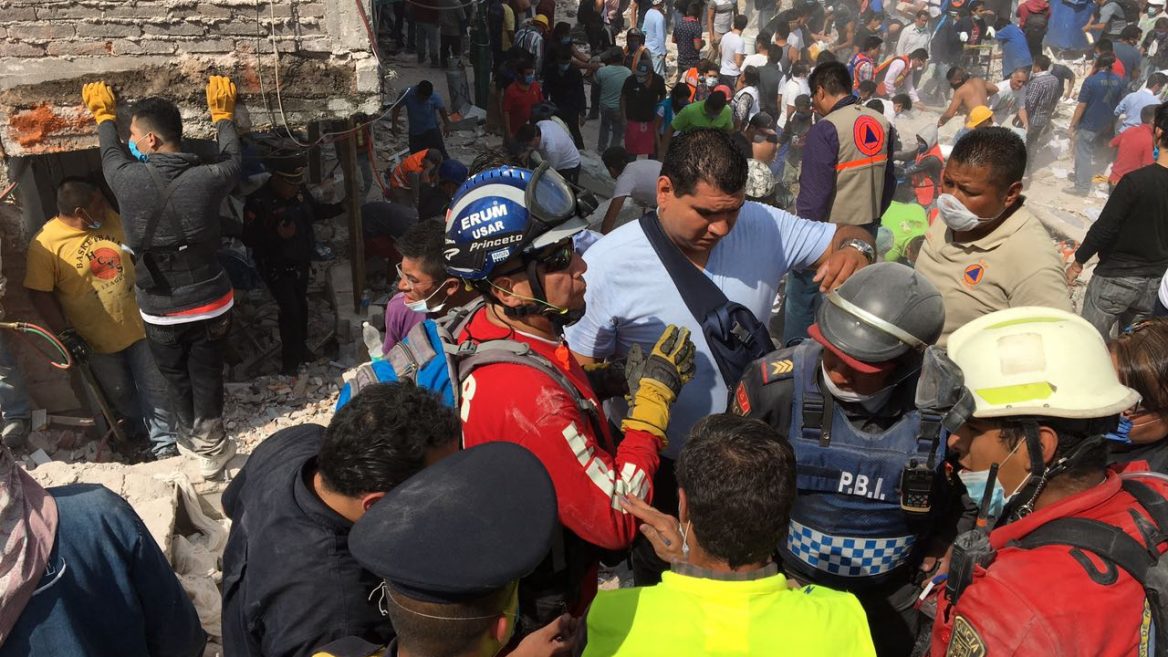
Israeli search and rescue teams search for survivors in Mexico. Photo courtesy ZAKA

The Israel Defense Forces Search and Rescue Unit and two other Israeli aid agencies have sent emergency response teams to Mexico in the wake of a deadly 7.1 magnitude earthquake that has killed more than 200, flattened buildings, and extensively damaged infrastructure.

The earthquake, which struck 140 kilometers southeast of Mexico City, caused substantial damage. It comes just two weeks after another deadly earthquake hit the country, the most powerful to strike Mexico since 1985.

Israel received a request for assistance from Mexico following the severe earthquake on Tuesday night, and in response a 50-member team of the IDF Search and Rescue Unit departed earlier this afternoon with a planeload of equipment.

Israeli nonprofit aid organization IsraAID will also send an emergency response team to Mexico, with psychosocial, water, sanitation and hygiene specialists.

Volunteers from ZAKA Mexico, which was established recently with the advice of Israel’s ZAKA International Rescue Unit, were also rushed the area to offer search, rescue and recovery assistance.

“The tremor was extremely significant and close to Mexico City, so many people have been affected, “ said Voni Glick, co-CEO of IsraAID.

“Earthquakes are terrifying for anyone in the vicinity, and with shelters filling up, we are sending a team to provide psychosocial post-trauma support and help more remote communities with water, hygiene and sanitation solutions.”

He said team members will provide mental-health support to vulnerable individuals and communities affected by the earthquake, particularly those evacuated to shelters for an indeterminate time.

In addition, he said, IsraAID’s team will put immediate water, sanitation and hygiene measures in place.

“The Mexican people are still reeling from the impact of the last earthquake, and this newest disaster further compounds the crisis,” said Glick.

“It is impossible to describe the scope of the disaster. Millions of people are without power; there is great confusion and distress,” said ZAKA Mexico commander Marcus Cain.


twoje uwagi, linki, wlasne artykuly, lub wiadomosci przeslij do: webmaster@reunion68.com