Archives

Construction of New, Technologically-Advanced Barrier on Gaza Border

Residents of Southern Israel Welcome Construction of New, Technologically-Advanced Barrier on Gaza Border

Barney Breen-Portnoy


The Israel-Gaza Strip border. Photo: Mary Madigan via Wikimedia Commons.

Israelis who live near the Gaza Strip are welcoming the construction of a new technologically-advanced border wall, the Hebrew news site Ynet reported on Thursday.

The barrier — which will include sensors to detect underground activities — will be completed within two years.

During its last war with Israel in the summer of 2014, the Gaza-ruling Hamas terrorist group used an extensive cross-border tunnel network to attack IDF troops.

On Wednesday, an IDF official warned Hamas to not try to thwart the wall project, saying, according to the Times of Israel, “Israel will defend this barrier in every way possible. This barrier will be built. Period. At any price.”

Sderot Mayor Alon Davidi told Ynet that the wall would “significantly increase the sense of security” of border area residents.

Alon Shuster — the head of the Sha’ar HaNegev Regional Council — expressed a similar sentiment and added that the building of the barrier would bolster an ongoing population boom the Gaza border area has been experiencing during the relative quiet of the past three years since Operation Protective Edge ended.

Yifat Ben Shushan, who lives in Netiv HaAsara, said, “I was pleased to learn the project is advancing steadily and will indeed provide us with protection against the most worrying threat — the tunnels. This certainly improves my sense of security as both a resident and a mother of children.”

However, Ben Shushan pointed out, the barrier was only an “operational solution.”

In Gaza, she said, “there are close to two million people living under Hamas rule and in a difficult humanitarian situation.”

“The problem with Gaza will continue after the barrier is built,” she cautioned.

Meanwhile, the IDF on Thursday published several graphics showing how Hamas hides tunnel entrances in civilian areas in Gaza.


twoje uwagi, linki, wlasne artykuly, lub wiadomosci przeslij do: webmaster@reunion68.com


The Jewish History of Krakow


The Jewish History of Krakow

The Weiss-Livnat International MA Program
in Holocaust Studies at the University of Haifa Blog


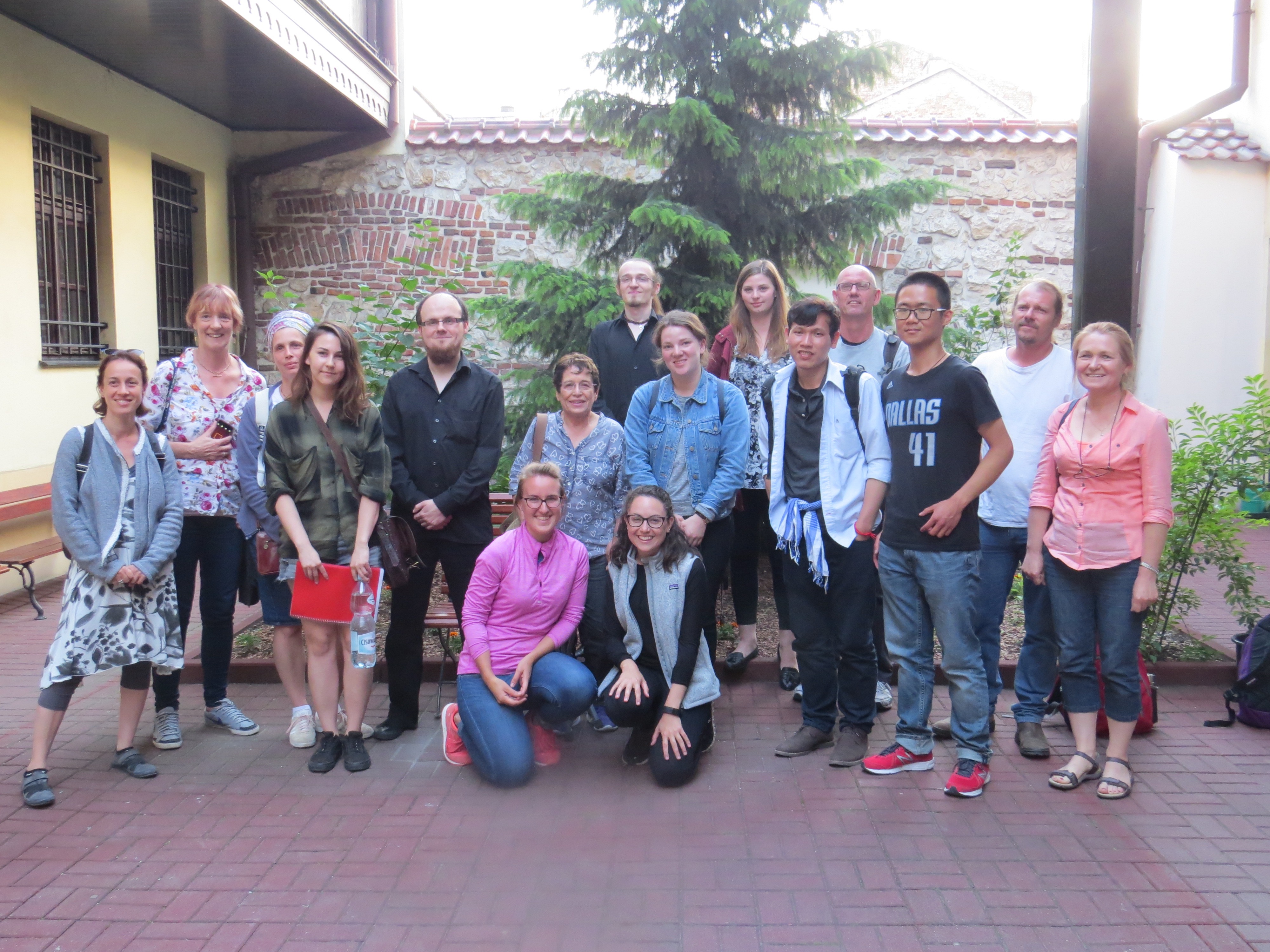
Our students meeting with students from the Jagiellonian

While in Krakow, we visited the Jewish Studies students of Jagiellonian University. At the Jewish Studies Center, in the heart of the vibrant Jewish Quarter in Krakow, the students study Yiddish, Jewish History specifically in Poland, and the Holocaust. We divided into small groups and met with a selection of students. We talked about different research projects and research ideas, they exchanged resources and angles for their studies. It was a pleasure to meet with these scholars and learn a Polish perspective on the Holocaust.

Our students with students from Jagiellonian University

After our meeting with these students we explored the lively Jewish Quarter in Krakow. In the streets you can find markets, which have been preserved since pre-Holocaust Poland. You can also find bookshops selling books in Yiddish and Hebrew.

Our group in the Remah Synagogue

Many of the synagogues in the area have been converted to museums and are no longer active, but they still tell the long story of Jews in Poland. Many of the buildings there have murals of Jewish life with Yiddish text. Though there aren’t many Jews left in Krakow, their lack of presence is noted, it is not ignored. The people of Krakow keep the memory of the Jews that used to live amongst them alive.

The next day we took a tour through Krakow. First we stopped at the Remah Synagogue and the accompanying cemetery. The synagogue was named after Rabbi Moses Isserles, whose name abbreviated is Ramah. Rabbi Moses Isserles was an eminent Polish Ashkenazi Rabbi, and talmudist.

Our group at the grave of Rabbi Yom-Tov Lipmann Heller.

Another important rabbi, Rabbi Yom-Tov Lipmann Heller, was buried here in the back of the cemetery in a lowly and otherwise forgotten part next to Yossele the Holy Miser. The Rabbi asked to be buried next to him as a great honor. Yossele the Holy Miser is something of a Jewish legend from the medieval ages. According to the lore, Yossele the Holy Miser was the richest Jew in Krakow, but he refused to give tzedakah (charity) to the synagogue or those less fortunate, or so they thought. After Yossele the Holy Miser died the community buried him in the back of the cemetery, thinking he was a stingy and greedy man. Much to their surprise he had been providing for less fortunate families all over the city. Many families came to the Rabbi and said they had been given mysterious weekly allowances on their front porches. It became apparent to the Rabbi that Yossele the Holy Miser had been anonymously giving to them over many years. Many consider this form of tzedakah, anonymous giving, as the highest form of charity. According to the story, the rabbi of this story was Rabbi Yom-Tov Lipmann Heller, and this is why he asked to be buried in the back of the cemetery, next to Yossele the Holy Miser.


Interested in applying for our MA in Holocaust Studies Program? You can find the application and more information at our website


twoje uwagi, linki, wlasne artykuly, lub wiadomosci przeslij do: webmaster@reunion68.com


Researcher gives seal of approval to 53 biblical characters’ existence

Researcher gives seal of approval to 53 biblical characters’ existence

RICH TENORIO


Lawrence Mykytiuk looks for ancient personalities who have made an impression — be it on a signet ring or a monument

Biblical characters that Lawrence Mykytiuk claims to have verified. Clockwise, from left: Sargon II; Cuneiform prism describing the restoration of Babylon by Esarhaddon; a relief of King Sennacherib from his palace in Nineveh; Tiglath-pileser III from the palace at Nimrud. (Public domain)

Thanks to a researcher’s unique system, 53 individuals in the Hebrew Bible have been proven as genuine historical characters through material evidence of their existence. The system’s creator, Lawrence Mykytiuk, an associate professor of library science at Purdue University, calls it “a way to develop historicity.”

It sounds like an unlikely project: a professor in the Midwest verifying ancient names from the Mideast. Yet Mykytiuk’s training as a librarian and interest in the Bible help him do what he says on-the-scene archaeologists are too busy to — pore through journals and books, scrutinize inscriptions discovered on digs and attempt to match names in the historical record with names in the Bible.

Mykytiuk’s system relies on three criteria: A biblical name must match the name on an authentic inscription, with no possibility of a forgery (thus ruling out items from the antiquities market, he said). The names — in the Bible and on the inscription — must match in terms of setting and time period. And, in perhaps the most exacting category, Mykytiuk looks for matches of at least three specific details identifying an individual, such as name, father’s name and title.

Lawrence Mykytiuk identifies ancient Biblical characters through their personal seals. (Courtesy)

“If it matches the same three mentions in Scripture, it’s a virtual certainty,” Mykytiuk said. “There might be a few people with the same name, father’s name,” he added, “but same title? That’s stretching it. I consider it a virtual certainty, either a dead ringer or virtual certainty.”

He does note in a PowerPoint presentation, however, that verifications of biblical names do not guarantee verifications of biblical events involving these individuals.

Developed over 25 years, Mykytiuk’s system is arguably successful. Studying 94 inscriptions, he has verified kings, pharaohs, high priests and scribes, among others.

All of the names are male, although he said he is “hoping to identify a woman from an inscription. Not yet.”

Verified characters include eight kings of the Northern Kingdom of Israel and six from the Southern Kingdom of Judah. One is King Ahab of the Northern Kingdom of Israel, who fought in the Battle of Qarqar in 853 BCE — an event that eagle-eyed Mykytiuk noted in both the Book of Kings and on an image of the Kurkh Monolith.

“There was only one Israelite king at a time who could have fought [in the battle],” Mykytiuk said. “Bingo. There was a match between the inscription and the Bible.”

Mykytiuk’s oldest verification is another sovereign — King David himself, from 1000 BCE. He found a match between the protagonist of Samuel I and the “House of David” wall inscription at the Tel Dan excavations in northern Israel.

“‘King of Israel’ was in one line,” Mykytiuk said. “The next line read ‘Melech Beit David.’ It was in Aramaic, by the enemies, the Arameans, who conquered Tel Dan and indicated a victory monument, a stele, a big sign in stone. The Israelites reconquered it, and smashed [the stele] to pieces that they used to make a wall.”

read more: Researcher gives seal…


twoje uwagi, linki, wlasne artykuly, lub wiadomosci przeslij do: webmaster@reunion68.com


Israeli forces arrest 5 Palestinians said on way to terror attack

Israeli forces arrest 5 Palestinians said on way to terror attack

JUDAH ARI GROSS


Suspects nabbed in West Bank town near Jerusalem, reportedly left behind suicide notes; Shin Bet mum on details

Illustrative. Israeli security forces arrest a Palestinian rioter in Wadi Joz, near the Old City of Jerusalem, July 21, 2017. (Judah Ari Gross/Times of Israel)

Israeli forces arrested five Palestinians “suspected of being involved in terrorism” in the West Bank village of Eizariya, outside Jerusalem, on Thursday, the Shin Bet security service The agency said it could not detail of what they are suspected at this time. However, Channel 10 news reported the five men were armed and were believed to be en route to committing a major attack in Jerusalem.

According to the news outlet, the suspects had all left behind suicide notes.

The Shin Bet said it could not confirm the report and provided no further details.

The five Palestinians are all residents of the Hebron area in the West Bank, the Shin Bet said.

The arrest operation was conducted by the Shin Bet, the IDF and Israel Police.

They were taken into custody where they will be interrogated, the police said.


twoje uwagi, linki, wlasne artykuly, lub wiadomosci przeslij do: webmaster@reunion68.com


MORE THAN 150 FOREIGN VOLUNTEERS ARRIVE TO JOIN IDF

MORE THAN 150 FOREIGN VOLUNTEERS ARRIVE TO JOIN IDF

ANNA AHRONHEIM


A total of 379 recruits are enlisting as lone soldiers.

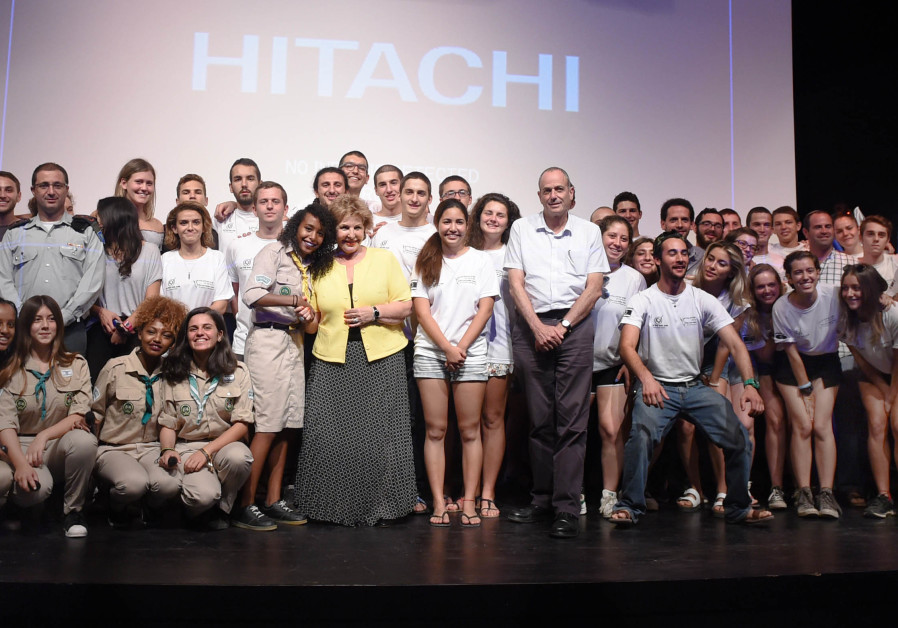
Minister of Aliyah and Integration MK Sofa Landver (Yisrael Beiteynu) poses with new IDF volunteers.. (photo credit:DEFENSE MINISTRY)

Some 153 youth from 12 countries arrived in Israel over the summer to volunteer to serve in the IDF.
The new recruits, composed of 122 male and 31 female volunteers, will begin their service in the July-August drafting period.

According to a statement released by the Defense Ministry’s Social Defense Branch on Sunday, for the first time there is a volunteer from Honduras and one from Thailand. Nearly half (45%) of the volunteers are from the US, another 38% came from France, and others from South Africa, Belgium, Mexico, Australia, Canada and Austria.

Immigration and Absorption Minister Sofa Landver (Yisrael Beytenu) congratulated the new recruits, wishing them “a pleasant and challenging service. I am sure you will [serve] with the same motivation that motivated you to come here. We’ve prepared you for your military service, we will guide you through it, and we will also be there with you to prepare you for civilian life.

“We are making great efforts to encourage the mobilization of Diaspora Jewry and prepare them for a meaningful and vital service. We are happy to see that each year there is a 5% increase in the number of volunteers from abroad and immigrants,” Landver added.

The volunteers will have a preparatory program ahead of their recruitment, where they will undergo physical and mental preparation for their induction into the IDF, which includes field trips throughout the country, including to heritage sites and museums, meetings with IDF officers and Hebrew classes.

According to the ministry’s statement, it was decided three years ago by the IDF and the Defense Ministry’s Social Defense Branch to establish preparatory programs for new immigrants and foreign volunteers. “These programs were found to be of critical value for integrating them into the service and were even defined as a condition for the recruitment of foreign volunteers,” it said.

The annual summer draft for all IDF units began on July 9 and will end on August 17, and IDF figures for this year’s summer draft show that over 10% of the new recruits were born outside Israel, the majority from France.

A total of 379 recruits are enlisting in the July-August draft as lone soldiers, which means that they have no immediate family in Israel and are entitled to special benefits.

During their service, lone soldiers are entitled to additional assistance from the state, including monthly living stipends, discounts on electricity bills, exemption from municipal taxes, rental assistance or lodging provided by the Association for the Well-being of Israel’s Soldiers, and extra financial support for combat soldiers.

Once they complete their military service, lone soldiers receive a onetime lump sum of NIS 6,000, the option to live for three months in a Beit Hahayal (soldiers’ hostel), and preparation and financial help to complete their matriculation and psychometric exams.

According to a 2016 report by the Knesset’s Research and Information Center, half of lone soldiers left Israel immediately after completing their military service. And of the half that stayed, one-third left shortly after.


twoje uwagi, linki, wlasne artykuly, lub wiadomosci przeslij do: webmaster@reunion68.com