Archives

Nikki Haley to Visit Israel for First Time Next Week

Nikki Haley to Visit Israel for First Time Next Week

JNI Media


“For the day of Hashem is near upon all the nations; as thou hast done it shall be done unto thee; thy dealing shall return upon thine own head.” Obadiah 1:15 (The Israel Bible™)

US ambassador to the UN Nikki Haley speaking at the AIPAC conference on March 27, 2017. (Screenshot)

US envoy to the UN Nikki Haley on Friday wrote in a Washington Post op-ed the UN Human Rights Council (UNHRC) is singling out Israel for relentless condemnations, while truly heinous regimes such as Venezuela and Cuba go scot-free because they are members of the Council.

“When the council passes more than 70 resolutions against Israel, a country with a strong human rights record, and just seven resolutions against Iran, a country with an abysmal human rights record, you know something is seriously wrong,” the ambassador wrote.

In fact, Haley reminded her readers, “In 2014, Russia invaded Ukraine and took over Crimea. This illegal occupation resulted in thousands of civilian deaths and injuries, as well as arbitrary detentions. No special meeting of the Human Rights Council was called, and the abuses continue to mount.”
Haley will visit Israel for the first time as UN ambassador next week, presumably to help celebrate the 50th anniversary of the Six Day War. But on her way over she will stop in Geneva, Switzerland, to address the UNHRC. It’s a crucial visit for the vehemently anti-Israeli world body, because President Trump has threatened to leave. In fact, Haley has stated that she plans to make her recommendations to the President on staying in or quitting the UNHRC based on her discussions in Geneva.

Incidentally, Haley’s successor, Obama appointee Samantha Power, was similarly critical of the way the UNHRC treated Israel.

Haley detailed her plans for next week’s Geneva visit: “I will outline changes that must be made. Among other things, membership on the council must be determined through competitive voting to keep the worst human rights abusers from obtaining seats.”

She envisions changes in the method of picking new members: “As it stands, regional blocs nominate candidates that are uncontested. Competition would force a candidate’s human rights record to be considered before votes were cast.”


twoje uwagi, linki, wlasne artykuly, lub wiadomosci przeslij do: webmaster@reunion68.com


US ambassador to Israel, not welcome in Ramallah


US ambassador to Israel, not welcome in Ramallah, joins peace talks against Palestinians’ wishes

World Israel News Staff


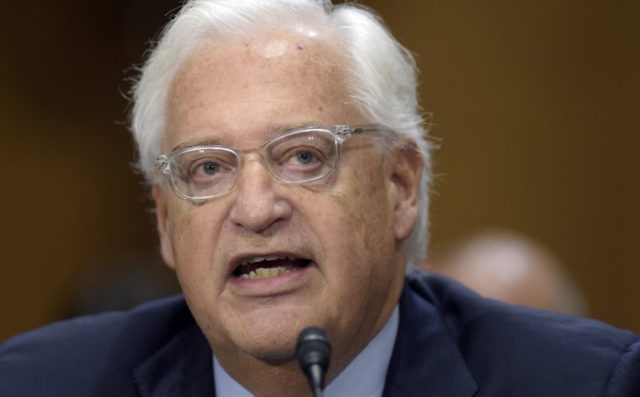
US Ambassador to Israel David Friedman (AP)

A meeting between Trump’s negotiating team and Palestinian officials took place in Jerusalem instead of Ramallah because of the PA’s refusal to host the US ambassador to Israel.

In an unusual occurrence, United States Ambassador to Israel David Friedman attended a meeting with Palestinian Authority (PA) officials alongside President Donald Trump’s Special Representative for International Negotiations, Jason Greenblatt, at Jerusalem’s King David Hotel on Tuesday.

Explaining the unexpected inclusion of Friedman, a senior White House official was quoted by the Jerusalem Post and Times of Israel as saying, “The administration believes that in order to give everyone the best chance to reach an ultimate deal, it is critical to have negotiators that are close with the president.”

While Friedman had served as Trump’s personal lawyer, Greenblatt previously had the role of executive vice president and chief legal officer at the Trump Organization. Trump’s son-in-law, Jared Kushner, is also a close adviser to the US president on Israel and the peace process.

Fatah Central Committee Member Azzam al-Ahmad said on official PA television, “We do not want one of the members of the [American] delegation to come to us. Why? Because he is the ambassador of America in Israel and the purview of his work is in Israel.”

Greenblatt and Friedman were joined by the US consul general in Jerusalem, David Blome. The PA officials reportedly included chief negotiator Saeb Erekat, PA General Intelligence Chief Majid Faraj and PA President Mahmoud Abbas’s economic adviser, Muhammed Mustafa.

On Monday, Israeli Defense Minister Avigdor Liberman urged the Trump administration to abandon a bilateral peace process with the PA and instead adopt a regional approach.


twoje uwagi, linki, wlasne artykuly, lub wiadomosci przeslij do: webmaster@reunion68.com


IDF major general questioned in submarine fraud probe

IDF major general questioned in submarine fraud probe

Raoul Wootliff


Police detain suspect at Lahav 433 serious crime unit, a day after six others were hauled in to face investigators

An IDF submariner peers through his vessel’s periscope during a surprise exercise in May 2017. (IDF Spokesperson’s Unit)

Police on Tuesday detained for questioning a former major general in the IDF in connection with suspected corruption in the multi-million dollar purchase of naval vessels from Germany.

The suspect was questioned under caution at the Lahav 433 serious crimes unit in Lod, police said, offering no further details on the identity of the suspect and the the crimes he’s suspected of.
The development came a day after six suspects were brought in for questioning as part of an ongoing investigation into so-called “Case 3000,” or the “submarine affair.” They are suspected of attempting to sway the deals in favor of the German shipbuilder ThyssenKryupp.

Police initially withheld the names of the suspects. However, later in the day, it was revealed that two of the suspects are former deputy head of the National Security Council Avriel Bar-Yosef and ThyssenKryupp’s Israeli agent, Miki Ganor. Prime Minister Benjamin Netanyahu’s personal lawyer David Shimron was also grilled.

The names of the others still cannot be reported.

The suspects were questioned under caution for more than 12 hours over suspicions of fraud, bribery, tax evasion and money laundering, the Israel Police and the Tax Authority said in a joint statement. “At the time of the events under question, some of the suspects were public servants and some worked in the private sector,” the statement said.

Following the interrogations, three of the suspects were brought to the Rishon Lezion Magistrate’s court, where Chief Justice Einat Ron agreed with the police request to hold Bar-Yosef and Ganor for a further four days, and relegate Shimron to three days of house arrest.

Netanyahu is not a suspect in the case. However, police are planning to summon him to testify on what he knows about the issue and specifically as to whether he knew of the corruption allegations against Bar-Yosef when he sought to appoint him head of the National Security Council in 2016, Channel 2 news reported.

Bar-Yosef’s candidacy was later withdrawn when it emerged that he was suspected of accepting bribes in exchange for promoting the interests of German businessmen involved in the development of Israel’s offshore gas fields.

David Shimron, Prime Minister Benjamin Netanyahu’s personal lawyer, at a Likud press conference in Tel Aviv, February 1, 2015. (Flash90)

Attorney General Avichai Mandelblit ordered the Israel Police to formally look into the submarine affair in November 2016, after accusations surfaced that Netanyahu may have been swayed to purchase vessels by business ties Shimron had with ThyssenKrupp. The deals for patrol boats and submarines came under intense scrutiny late last year, after it was revealed by Channel 10 news that Shimron also served in an advisory capacity for ThyssenKrupp, which was awarded the contracts for building Israel’s submarines and naval attack boats.

In December, officers from the Lahav 433 unit entered the office of legal adviser Ahaz Ben-Ari at the Defense Ministry building in Tel Aviv and removed information from computers there. The data concerned the cancellation of an international tender to build four new warships to protect Israel’s offshore natural gas rigs in the Mediterranean Sea.

The contract was awarded instead to ThyssenKrupp. Under the 2015 deal, worth €430 million ($480 million), ThyssenKrupp is to supply Israel with four “Sa’ar 6 corvette” ships over a period of five years.

The purchase was opposed by parts of the defense establishment, including then-defense minister Moshe Ya’alon, who has since threatened to “tell all” on Netanyahu’s involvement, if the prime minister is not indicted as part of the probe.


twoje uwagi, linki, wlasne artykuly, lub wiadomosci przeslij do: webmaster@reunion68.com


Netanyahu reads from Bible to prove Hebron’s Tomb of Patriarchs is Jewish


Netanyahu reads from Bible to prove Hebron’s Tomb of Patriarchs is Jewish

Aryeh Savir


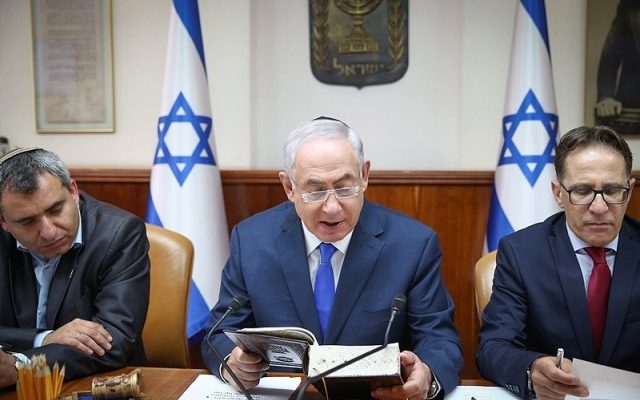
PM Netanyahu reads from the Bible during the Cabinet meeting. (Ohad Zweigenberg/POOL)

Netanyahu read from the Bible to demonstrate that UNESCO’s resolution on Hebron negated religion, history and the facts.

Prime Minister Benjamin Netanyahu read passages from the Bible during Sunday’s weekly Cabinet meeting as a refutation of Friday’s resolution passed by the United Nations Educational, Scientific and Cultural Organization (UNESCO) World Heritage Committee designating the Tomb of the Patriarchs and Hebron a Palestinian heritage site.

“I would like to read from Genesis 23:16-19: ‘And Abraham hearkened unto Ephron; and Abraham weighed to Ephron the silver, which he had named in the hearing of the children of Heth, four hundred shekels of silver, current money with the merchant…And after this, Abraham buried Sarah his wife in the cave of the field of Machpelah before Mamre–the same is Hebron–in the land of Canaan. And the field, and the cave that is therein, were made sure unto Abraham for a possession of a burying-place by the children of Heth,’” Netanyahu read.

“The connection between the Jewish People and Hebron and the Tomb of the Patriarchs is one of purchase and of history which may be without parallel in the history of peoples,” Netanyahu declared.

“Of course this did not prevent the UNESCO World Heritage Committee last Friday from passing yet another delusional resolution which determined that the Tomb of the Patriarchs, the same Cave of Machpelah, is a Palestinian heritage site,” the Israeli premier derided the resolution.

Netanyahu explained that in wake of this resolution, he has decided to cut an additional $1 million from Israel’s UN membership dues and transfer the funds to the establishment of “The Museum of the Heritage of the Jewish People in Kiryat Arba and Hebron.” The money will also serve additional heritage initiatives related to Hebron.

He tasked Minister of Jerusalem Affairs and Heritage Ze’ev Elkin with submitting a proper proposal on this matter.

“Against UNESCO’s denial, Israel will present to the world the historical truth and the Jewish People’s deep connection – of thousands of years – to Hebron just as we did with UNESCO’s other delusional decision regarding the absence of a connection to Jerusalem,” Netanyahu vowed.

After UNESCO previously passed Muslim-sponsored resolutions denying the Jewish connection to Jerusalem and the Old City, Israel reduced its UN dues.

“Therefore today I have instructed that procedures be completed for the construction of the Kedem Center for displaying the historical and archaeological findings for the City of David,” Netanyahu said of the new museum on the Jewish people’s ancient history in Jerusalem. “This will be an impressive structure with extensive displays. The entire world will see the truth and the first visitors whom I will invite there will be UNESCO and UN delegations.”

The UNESCO resolution characterized the site as facing danger, which directly contradicts facts on the ground.

This designation attempts to eliminate the Jewish people’s millennia-long connection to the sites, at which the founders of the Jewish religion are buried.


twoje uwagi, linki, wlasne artykuly, lub wiadomosci przeslij do: webmaster@reunion68.com


Israel and self-defense: Dealing militarily with Syria ‘spillovers’

Israel and self-defense: Dealing militarily with Syria ‘spillovers’
Prof. Louis René Beres

Special to Israel National News

Again, for conspicuous reasons of national self-defense, Israel has been forced to fire upon Syrian military positions. The immediate cause of this latest reaction was another “spillover” to the northern Golan Heights from Syria’s civil war. In these engagements, typical target sets for Israel have been pro-terrorist convoys inside Syria, often transporting anti-aircraft ordnance or other advanced weapons to Hezbollah operatives in Lebanon.

Such worrisome weapons have included SA-17anti-aircraft missiles, Russian-arms that could sometime enable Hezbollah to shoot down Israel’s civilian aircraft, its military jets and helicopters, and even its drones.

Geo-strategic context matters a great deal. Hezbollah operates within a starkly anarchic Syria, seeking, among other things, to open up viable new insurgent fronts against Israel. Together with readily recognizable sponsors from Iran’s Islamic Revolutionary Guard Corps (IRGC), these seemingly faith-driven Shiite insurgents are increasingly able to fire upon Israel from an operations headquarters in southern Syria. On occasion, the Israel Air Force has targeted both Hezbollah terrorists and IRGC fighters near Quneitra, close along the Israeli border.

Significantly, there are some meaningful ironies here. Most problematic, perhaps, obligatory expressions of Israeli national self-defense could simultaneously enlarge the power of ISIS and certain other Sunni militias. For Israel, to be sure, difficult strategic and tactical choices will continue to present themselves.

Thus far, Israel’s actions have remained consistent with pertinent international law. In specifically legal terms, Israel’s carefully measured and discriminate use of force against Hezbollah terrorists and related assets in Syria has strictly conformed to all applicable rules concerning distinction, proportionality, and military necessity. Although Tehran and Damascus continue to identify Israel’s defensive actions as “aggression,” such reactions are indispensable, and are also plainly supported, inter alia, at Article 51 of the United Nations Charter.

International law is never a suicide pact. In essence, under all peremptory or immutably basic law, Israel has a primary and incontestable prerogative to survive. Indeed, jurisprudentially at least, nothing could conceivably be less controversial.

The critical legal issues are not complicated. By allowing its territory to be used as a source of Hezbollah terrorist weapons against Israel, and as a formidable new base for anti-Israeli terrorist operations, Syria has ipso facto placed itself in violation of the U.N. Charter, and of far wider norms of international law. And because these norms must ultimately be protected and preserved by individual affected states (the state of nations is still in the “state of nature”), Israel has every right to respond unilaterally to Syrian-inflicted harms.

Because Damascus, at its own insistence, continues in a formal condition of belligerency with Israel ( that is, in a legal “state of war”), any charge of “Israeli aggression” by Syria or Iran would make no legal sense.

There is something else. Syria has become an unambiguously failed state. But as Israeli Prime Minister Benjamin Netanyahu correctly points out, Bashar al Assad remains personally and legally responsible for any “spillover violence.”

In law, being transformed into a failed state in no way constitutes a permissible excuse for failing to maintain normal and full intra-national control.

In other words, no such retrograde metamorphosis can ever be exculpatory.

For Israel, the expressly legal issues are easy to ascertain and to reaffirm. The relevant codifications are unhidden. To begin, authoritative prohibitions of pro-terrorist behavior by a state can be found at Article 3(f) and 3(g) of the 1974 General Assembly Definition of Aggression. These prohibitions also form a part of longstanding customary international law, and of what are identified at Article 38 of the Statute of the International Court of Justice as “the general principles of law recognized by civilized nations.”

Following the 1977 Protocols to the Geneva Conventions of 1949, all insurgent organizations, like all states, are fully obliged to comply with humanitarian international law.

Under all binding international law, every use of force by states must be judged twice: once with regard to the justness of the cause, and once with regard to the justness of the means. This second standard expressly concerns the law of armed conflict. Even when it can be determined that a state has a basic right to use force against another, or against another state’s proxies, this does not imply, ipso facto, that such use would be in proper agreement with the law of war.

From the start, in defending itself against Hezbollah, Israel’s actions have been consistent with the law of war. Unlike the Shiite terrorist militias in Lebanon, now repositioning, in part, to southern Syria, and unlike the Syrian-supported Hamas and Islamic Jihad Sunni forces, who very intentionally target noncombatants, Israel has always been meticulous about striking exclusively hard targets in both Syria and Lebanon.

Unlike Damascus, which even in its currently gravely attenuated form opposes any peaceful settlement with Israel, Jerusalem resorts to defensive force only as a distinctly last resort. As for perplexing Syrian allegations that Israel’s actions have somehow raised the risk of further escalation, this particular risk could disappear entirely if Damascus and Tehran would effectively cease their lawless support for Hezbollah and other related criminal organizations. In this connection, terrorism, it must never be forgotten, is more than wanton violence. Always, it also represents an expressly codified crime under international law.

Ultimately, the lawfulness of Israel’s use of force against Hezbollah terrorists, and against Hezbollah-bound weapons in Syria, is supported by the “inherent right” of “anticipatory self-defense.” Enlarging the specifically post-attack right of self-defense found at Article 51 of the UN Charter, this customary international law doctrine entitles any existentially endangered state to use appropriately measured force preemptively; that is, whenever the danger posed is “imminent in point of time.” Facing a potentially endless stream of terrorist rocket attacks upon its vulnerable civilian populations, Israel maintains not only the right, but also the incontestable obligation, to protect its citizens.

Always, Israel must do whatever it can to best safeguard its land and its populations, including, at least in principle, certain longer-term military actions against a still-nuclearizing Iran. Today, however, the operational situation is growing more complicated, and any once-rational decision to invoke anticipatory self-defense in this particular case is plausibly gone. Inevitably, therefore, Jerusalem will have to deal much more routinely with a variety of Iranian/Syrian terrorist proxies, especially Hezbollah, and to do so without constraint by any legal or jurisprudential inhibitions.

International law, Israel must continue to remind the world, is not a suicide pact.


Louis René Beres (Ph.D., Princeton, 1971), is the author of many books and articles dealing with Israel and international law. His twelfth book, Surviving Amid Chaos: Israel’s Nuclear Strategy, was published in 2016 by Rowman & Littlefield. http://www.israeldefense.co.il/en/content/surviving-amid-chaos-israels-nuclear-strategy In December 2016, Professor Beres co-authored a major monograph at Tel Aviv University with General (USA/ret.) Barry R. McCaffrey, Israel’s Nuclear Strategy and America’s National Security https://sectech.tau.ac.il/sites/sectech.tau.ac.il/files/PalmBeachBook.pdf

Louis René Beres was born in Zürich, Switzerland, at the end of World War II.


twoje uwagi, linki, wlasne artykuly, lub wiadomosci przeslij do: webmaster@reunion68.com