Archive | May 2020

Actor Hugh Jackman Teaches Jimmy Fallon How to Braid and Bake Challah

Actor Hugh Jackman Teaches Jimmy Fallon How to Braid and Bake Challah

Shiryn Ghermezian


Hugh Jackman showing off the challah he baked at home, during his appearance on ‘The Tonight Show Starring Jimmy Fallon.’ Photo: Screenshot

Australian actor Hugh Jackman taught US late-night show host Jimmy Fallon how to bake challah as they both stood in their own kitchens during a virtual interview last week.

Jackman, who said his children loved challah, prepped his dough earlier using a bread machine, while Fallon said he got pre-made dough from a local store.

The “Wolverine” star, who is not Jewish, then talked Fallon though the steps of making the braided bread, from rolling out the dough to braiding it, giving it an egg wash and then baking it.

Afterward, Fallon said, “This is the best thing I have ever made in my whole house. I want everyone to see this. This is awesome.”

The video below includes some tap-dancing moves from Fallon and a short performance by Jackman of his upcoming role in the Broadway revival of “The Music Man,” slated to open this fall:


Zawartość publikowanych artykułów i materiałów nie reprezentuje poglądów ani opinii Reunion’68,
ani też webmastera Blogu Reunion’68, chyba ze jest to wyraźnie zaznaczone.
Twoje uwagi, linki, własne artykuły lub wiadomości prześlij na adres:
webmaster@reunion68.com


Palestyńskie kłamstwa nigdy nie umierają; Wikipedia i Google trzymają je przy życiu

Palestyńskie kłamstwa nigdy nie umierają; Wikipedia i Google trzymają je przy życiu


Phyllis Chesler
Tłumaczenie: Małgorzata Koraszewska


Okupacja jest słowem, które dominuje większość dyskusji o Izraelu, ale prawdą jest, że propalestyńscy propagandziści okupują Google i Wikipedię, by podtrzymać przy życiu dawno obalone narracje.

Zobaczyłam to wyraźnie, kiedy brałam udział w webinarium z lekarką, który pracowała w tajnej jednostce Izraela, “Dudevan”, pierwowzorem dla popularnej serii Fauda. Mówiła o swojej pracy w Gazie i na Zachodnim Brzegu podczas Operacji Ochronny Brzeg.

“Sądziłam, że nic mnie już nie zdziwi. Ale wiele rzeczy dziwiło” – powiedziała. Lekarka opowiedziała historię próby uratowania życia 2,5 letniego chłopca z Zachodniego Brzegu, którego niechcący przejechał samochodem jego ojciec. Błyskawicznie zabrali chłopca do izraelskiego szpitala, po drodze starając się utrzymać go przy życiu.

“Mimo wszystkich naszych starań – opowiadała – chłopiec umarł. Kiedy spytała ojca, czy ofiarowałby narządy chłopca innemu dziecku, odpowiedział: ‘Tylko dziecku palestyńskiemu, nie dziecku izraelskiemu, Żydowi’”.

To był ojciec, który właśnie widział niesamowity wysiłek izraelskich Żydów, by uratować życie jego syna; to był bardzo dramatyczny i emocjonalny moment. Stare uprzedzenia mogły ustąpić, przynajmniej na chwilę. Jednak wyuczona nienawiść tego człowieka do Żydów i Izraela włączyła się natychmiast. Lekarka osłupiała wobec nagłego pojawienia się takich właśnie ”politycznych realiów”.

To jest rodzaj psychologicznego wroga, jakiego Izrael ma przeciwko sobie. A dalej są palestyńscy przywódcy terrorystyczni, którzy indoktrynują własną ludność i używają jej do podejmowania ataków terrorystycznych przeciwko izraelskim cywilom. Zachodnie media i globalni liderzy minimalizują ten fakt.

Przy diabolicznych podwójnych standardach świata izraelscy żołnierze są oskarżani o potworności, których nigdy nie popełnili, podczas gdy palestyńscy terroryści – Hamas, Palestyński Islamski Dżihad, Organizacja Wyzwolenia Palestyny, Fatah, Ludowy Front Wyzwolenia Palestyny – którzy torturują, porywają ludzi i samoloty, używają ludzkich tarcz, włącznie z dziećmi, są nadal postrzegani jako niewinne ofiary.

Wbrew panującej opinii, Izraelska Armia Obronna (IDF) jest wyjątkowo etyczna, co potwierdzają wojskowi dowódcy z innych krajów. Dla izraelskich żołnierzy dramatem jest każda przypadkowa śmierć cywila, ale i śmierć własnych towarzyszy. Inaczej niż przywódcy palestyńskich terrorystów, nie gloryfikują śmierci i opłakują każdą stratę życia w nieustannej bitwie o przetrwanie. Trzeba to powtarzać raz za razem, by przeciwdziałać koszmarnej propagandzie przeciwko Izraelowi.

Zatruta antyizraelska propaganda ciągle zalewa wszystkie platformy medialne. Pamiętacie na przykład rzekomą masakrę dokonaną w 2002 roku przez Izrael na cywilach z Dżanin (Jenin)? Opisywano ją na czołówkach gazet na całym świecie.

Ta „masakra” nigdy się jednak nie zdarzyła.

Przez niemal dwa lata arabscy terroryści nieustannie atakowali izraelskich cywilów. Było bardzo dużo ofiar śmiertelnych i rannych. W marcu 2002 roku terroryści zamordowali 100 Izraelczyków. 27 marca zamachowiec-samobójca wysadził się w powietrze w hotelu Park w Netanji właśnie, kiedy Żydzi siadali do Sederu w Pesach. Trzydzieści osób zginęło, w większości ludzi starszych wiekiem. Kolejnych 140 odniosło rany.

To była ostatnia kropla. Wielu zamachowców-samobójców pochodziło z Dżanin

IDF wysłała żołnierzy do Dżanin. Szli od jednego domu zamienionego w bombową pułapkę do drugiego, cały czas pod ogniem, tylko po to, by nie oskarżono Izraela o bombardowanie z powietrza lub o popełnienie masakry.

Raporty palestyńskiej strony opisywały niczym nieusprawiedliwiony izraelski festiwal mordów, z setkami zabitych, niewinnych ludzi. Niektórzy mówili o tysiącach zabitych. Jak twierdzono, całe miasto zostało zniszczone.

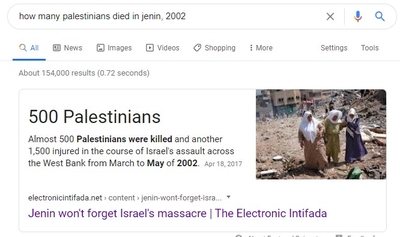
W rzeczywistości zginęło 56 Palestyńczyków, z których większość była uzbrojona. Izrael stracił 23 żołnierzy. Mimo tego, jeśli ktoś chce się dowiedzieć, co się tam stało i zacznie szukać w Google pod hasłem “Jenin“, oto, co znajdzie.

Na pierwszych pięciu stronach o “Jenin” jest 27 antyizraelskich artykułów, promujących fałszywą historię i tylko siedem, które mówią prawdę o tym, co zdarzyło się naprawdę.

Szukaj w Google “How many Palestinians died in Jenin, 2002” [Ilu Palestyńczyków zginęło w Dżanin, 2002] a to jest pierwsza rzecz, jaka zobaczysz dzisiaj:

To było kłamstwem wtedy. To jest kłamstwem dzisiaj.

Wiadomości prasowe i telewizyjne, dwa znakomite filmy – Pierre Rehova The Road to Jenin i Gila Mezumena Jenin Diary: The Inside Story – i bardzo poruszająca książka Bretta Goldberga A Psalm in Jenin, z łatwością obalają zakłamaną „historię przekazywaną przez algorytmy” z Google i przypominają, co się naprawdę zdarzyło.

Naprawdę ważne jest to, że propaganda o rzekomej masakrze w Dżanin nie ogranicza się do lat 2002-2003. Kłamstwa trwają przez cały XXI wiek.

W latach 2017-2018 islamistyczni propagandziści, Yvonne Ridley i Ilan Pappe, kontynuowali powtarzanie tego krwawego oszczerstwa.

Jeszcze w zeszłym tygodniu Yvonne Ridley mówiła o tej masakrze, której nie było, jako jednej z „największych zbrodni wojennych tego stulecia”.

Ponad pół miliona martwych Syryjczyków mogłoby temu przeczyć.

Taka propaganda, jaką szerzy Yvonne Ridley, w sposób nieunikniony jednak prowadzi do prawdziwych masakr i linczów – Żydów i Izraelczyków.

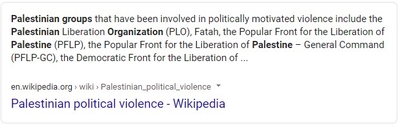
Częścią problemu jest powiązana z Google Wikipedia, która jest pełna antyizraelskich kłamstw i propalestyńskiego stanowiska. Na przykład, spójrzcie, co wyskakuje dzisiaj, kiedy szukacie hasła “Palestinian terrorist groups” [palestyńskie grupy terrorystyczne]:

Pierwszą rzeczą, jaką jednak zobaczycie, jest podsumowanie Wikipedii “palestyńskiej politycznej przemocy”.

“Palestyńska przemoc polityczna oznacza czyny przemocy lub terroru motywowane przez palestyński nacjonalizm. Te polityczne cele obejmują samostanowienie i suwerenność w Palestynie, ‘wyzwolenie Palestyny’ albo w miejsce zarówno Izraela, jak i palestyńskich terytoriów, albo wyłącznie palestyńskich terytoriów. Czasami skierowane na bardziej ograniczone cele, takie jak uwolnienie palestyńskich więźniów w Izraelu, innym kluczowym celem jest przybliżenie realizacji palestyńskiego prawa powrotu”.

Podobnie jak tak zwana „masakra” w Dżanin, sprawa Al-Dury dotyczy rzekomego zamordowania z zimną krwią w 2000 roku 12-letniego palestyńskiego chłopca przez izraelskich żołnierzy na skrzyżowaniu Netzarim. Jaserr Arafat raz jeszcze odrzucił pokój i rozpoczął długo planowaną intifadę przeciwko Izraelowi. Świat muzułmański uznał Al-Durę za męczennika i pokazywał jego zdjęcie raz za razem w mediach, na koszulkach, kubkach, plakatach itd. Nadal to robi.

Dziennikarka Nidra Poller określa sprawę Al-Dury jako „balistyczny mit dalekiego zasięgu”. Przez wiele lat cały świat wierzył, że izraelscy żołnierze umyślnie zamordowali dziecko. Także IDF szybko wystosowała przeproszenie, które po zbadaniu sprawy wycofała – dzięki heroicznej i upartej pracy dokonanej przez Nidrę Poller i przez Richarda Landesa, Esther Schapira, Philippe Karsenty’ego i izraelskiego fizyka, Nahuma Shahafa.

Z czasem stało się jasne, że jeśli nawet Al-Dura w ogóle został zastrzelony, nie mogli zrobić tego Izraelczycy.

Chociaż Google nadal automatycznie podaje link do Wikipedii, w końcu dołączono pod hasłem „Al Dura” fakt, że kontrowersja wokół tego, co się zdarzyło, rzeczywiście istnieje. Jednak dział opisujący tę kontrowersję pojawia się na samym końcu tego hasła w Wikipedii, najpierw jest fałszywa narracja podawana jako prawda.

Protesty w Gazie w 2019 roku przy granicy z Izraelem dostarczają najnowszego przykładu sytuacji, kiedy Palestyńczycy dokonują przemocy, a propaganda rażąco przekłamuje izraelską reakcję.

Antyizraelska grupa, Jewish Voice for Peace, dołączyła do chóru głosów twierdzących, że Izrael zabija pokojowo protestujących Palestyńczyków. Twierdzono między innymi, że „Izraelscy snajperzy” umyślnie obierają za cel “dzieci i osoby niepełnosprawne”.

Okazało się, że przeważająca większość ofiar śmiertelnych to byli członkowie lub stowarzyszeni z organizacjami terrorystycznymi. Ponad połowa zabitych składała się z członków i osób stowarzyszonych z Hamasem.

Dowiedzieliśmy się tego od funkcjonariuszy Hamasu.

Poszukaj jednak “Gaza border protests”, a nigdzie nie zobaczysz tych faktów.

Jest jasne, że ta śmiercionośna kampania dezinformacji nigdy się nie skończy, ale ci, którzy zarządzają platformami w Internecie, nie powinni pomagać w tym przestępczym procederze.


Phyllis Chesler – Emerytowana profesor psychologii City University of New York, współzałożycielka Association for Women in Psychology oraz National Women’s Health Network.


Zawartość publikowanych artykułów i materiałów nie reprezentuje poglądów ani opinii Reunion’68,
ani też webmastera Blogu Reunion’68, chyba ze jest to wyraźnie zaznaczone.
Twoje uwagi, linki, własne artykuły lub wiadomości prześlij na adres:
webmaster@reunion68.com


My Grade School Teacher Was a Nazi Mass Murderer With a Secret Identity

My Grade School Teacher Was a Nazi Mass Murderer With a Secret Identity

Itay Mashiach


Artur Wilke, top left, with his class at the school in Stederdorf, in 1959. The child Jürgen Gückel is in the striped sweater, in the bottom row, center.

SS officer Artur Wilke returned to his village after the war and became a grade school teacher. How could an entire community shut its eyes, and what happens when one boy, now 67, decides to talk?

The ear-splitting din in the schoolyard ceased abruptly; the children hurried to their classrooms. The silence that descended on the small yard threw into bold relief the full provincialism of the streets in the village of Stederdorf, in northwestern Germany: dormant stone houses; small, well-tended gardens; a gentle dripping of winter’s waning days.

Jürgen Gückel entered an empty classroom and looked around. Sixty years ago he was a pupil in this school. He has a vivid recollection of his first teacher, Walter Wilke. He also remembers how one day, in the middle of a class, Wilke left in the company of two policemen, and never taught there again.

In his interrogation Walter Wilke admitted that his real name was Artur and that for 16 years he had been using the identity of his brother, who was killed in World War II. He was one of a group of defendants in one of the most significant judicial proceedings that took place in West Germany, accused of murdering 6,600 people.

As an SS officer based in Minsk, in occupied Soviet Byelorussia (today, Belarus), Wilke was the commander of mass executions by firing squads, killed with his own hands those who survived gassing attempts in trucks, and was responsible for the liquidation of the Minsk ghetto. He also oversaw the deportation of the Jews of the Slutsk ghetto in 1943, where he personally shot people who fled – looking like living torches – as the ghetto burned. “A fanatic, passionate nationalist,” the judges ruled, and sentenced him to 10 years in prison.

None of these facts were known to the children of Stederdorf – neither before nor after his arrest; nothing of his deeds could tarnish the image of the teacher and intellectual who educated the village’s young children for about a dozen years. Gückel and his classmates had no idea why their teacher was incarcerated. Wilke served only half his term: He was released after five years mainly because of poor health, returned to Stederdorf and lived there until his death, in 1989.

A few years ago, shortly before his retirement, Gückel, a journalist who lives today in the nearby town of Peine, encountered Wilke’s name in a theological article about remorse among Nazi criminals. “I knew him when he was still calling himself Walter Wilke,” Gückel says today.

Astonished by the information, he started to investigate. Last December, he published a book, “Class Photo with Mass Murderer” (in German), the fruit of more than three years of research in numerous archives. On the book’s cover is a photograph of 6-year-old Gückel with his classmates and their teacher.

For decades, Wilke’s true identity was shrouded in silence. That silence made it possible for the murderer to live and work in the village under an assumed identity, and also to return to it after serving half of what was, to begin with, an unconscionably short prison term – and then to be completely forgotten after dying at a ripe old age.

Blanket silence: on the part of his extensive family, his many acquaintances in the village, his colleagues and the authorities. It was a silence so all-encompassing that it was as though a secret order to maintain it had been issued in 1945 and obeyed for almost three-quarters of a century, until December 2019, when Gückel published his book. How is it possible for a whole community to shut its eyes, and what happens when one boy, now 67, decides to talk?

Gückel. He didn’t just shatter the silence – he shattered the lack of interest. / Credit: David Bachar

Aiming for the neck

Artur Wilke was a promising young man: Born in the Prussian province of Posen, he was a devout Christian, highly educated, an expert in ancient languages, and a graduate of theological and archaeological studies. He joined the Nazi Party in 1931, and seven years later, at the advice of a professor, became a member of the SD, the intelligence agency of the SS. “They need learned people there,” the professor told his students. Wilke was 28, ablaze with ambition, blond with prominent cheekbones and a high forehead, “racially desirable for procreation,” according to the SS reports.

In 1942, he was stationed at SD regional headquarters in Minsk, the capital of Soviet Byelorussia. The unit was engaged in thwarting enemy activities, ranging from underground meetings of the Komsomol, the Communist Party’s youth wing, to those of secret partisan networks. Proper judicial proceedings were rare at the time: Suspects were interrogated in the cellars of Minsk’s prisons and afterward disappeared. As SS chief Heinrich Himmler had made it clear that “in principle, every Jew is a partisan,” the unit also dealt with the Jews.

The murder sprees in the eastern regions of occupied Europe were raw and ferocious. The local extermination camp in the Minsk area, Maly Trostinets, encompassed several forested areas, each containing a number of pits – about 50 meters long, five meters wide and two meters deep – allowing for the shooting of a few hundred people in each round. The shooters were told to aim for the neck. Wilke sometimes shot and sometimes guarded. Eventually he was put in charge of the shooting and when needed, finished off gassing victims who had survived that experience.

Between executions, he read poems by the German Romantic poet Friedrich Hölderlin, which he had brought from home. He also kept a personal diary, which he kept in a closet and was later found by the Red Army.

“Monday, Feb. 8, 1943… 05.00 Starting in the ghetto, a very good start, 1,300 Jews removed… Afterward the sector commander Karl decides to burn (about 300-400 Jews come out of their bunkers)… March 9, 1943. The sun is shining. At night I had that terrible itching of the skin again.”

It is impossible to determine exactly which murders Wilke took part in, but the documents and his diary confirm his presence on certain occasions. It can be proved, for example, that he was the commander of the executions on the first day of one the last Aktions in the Minsk ghetto (about 2,000 victims) and of the liquidation of the Slutsk ghetto (1,600 victims). According to this rigorous calculation, which apparently reflects only some of the massacres that went on, the court of law in Koblenz attributed the deaths of 6,600 victims to Wilke.

Wilke married during the war and fathered three children. At the end of the war, however, he abandoned his family, moved to Stederdorf, the village east of Hanover where his brother Walter, who had been killed in the war, had lived, and assumed his identity. He married another woman and had two children with her. A few years later, his first wife died, and Wilke adopted his first three children: To them he was their uncle Walter. They had no idea he was their father, Artur, who had disappeared in the war.

No politics

“Part of it is also guilt feelings, because until now I did not devote enough thought to how the Holocaust still affects us,” says Gückel, explaining why he undertook his research, when we met in the village recently. “I wanted to understand that now. And also, when I asked people in the village what they knew about Wilke, I would sometimes get hostile replies, even though those people had absolutely no idea what Wilke actually did. That only served to motivate me.”

We leave the school and head for the small lake in the heart of the village. We are joined by Gustav Kamps, another former pupil of Wilke’s; his family has lived here for six generations and he himself served as the local mayor for 23 years. On the edge of the lake he and Gückel exchange banal reminiscences about the village – about someone who fell into the river, about the kiosk that closed down.

The school where Artur Wilke taught, in Stederdorf, Germany. Then and now. / Credit: The school’s archive

“In the village they talked about the war, but never about mass murders or anything like that,” Kamps recalls. “That, they did not see, or did not want to see. There was [tacit] agreement that we don’t talk about things like that – that’s how I understood it. ‘Let those old things rest quietly’ – that was always the comment.”

They didn’t talk, but did they know? In the years after the war, West Germany was flooded by impostors, people who assumed false identities who popped up out of nowhere and reinvented their pasts. But Wilke was brazen enough to return to the village his brother Walter had lived in before the war and to assume his identity.

Kamps estimates that the population of Stederdorf at the time was slightly more than 2,000. From the whole period of his childhood he remembers only one incidental remark. “My father said once that Wilke went to the war a handball player and returned a soccer player, and that there was something odd there.”

The same story repeated itself almost without exception in dozens of interviews Gückel conducted with veteran residents: Before Wilke’s arrest they didn’t know, after the trial they didn’t ask, to this day he is never mentioned. For example, a boy named Eckhardt, who was the best friend of Wilke’s son, never exchange a word about it with him. When it came to the father, he testified, a “deathly silence” reigned between the two boys.

“I still can’t imagine how it was possible,” he told Gückel. “But we were brought up to be silent about the past and that is how we accepted it.”

Wilke’s second wife, who was the local doctor, also knew and said nothing. And his relatives, the 30 members of the Wilke family who lived in Stederdorf at the time, also knew and kept silent. How did he blend into the life of the village so smoothly?

“That is a question I asked myself over and over,” Gückel says. “How did they let him loose on the children in a place where so many people must have known that he was not who he said he was? It was a time when many people looked the other way… And as the village teacher and the husband of the village doctor, he quickly became part of the community.”

Even after Wilke was sentenced and the explosive material from the trial became accessible, his past remained completely obscured. Many of his neighbors and pupils – Gückel among them – never learned his real name. The school archive documents every detail of the community’s day-to-day life: a new teacher has arrived, someone drowned in the lake, a school fire drill. But about the fact that a veteran teacher was arrested, and later convicted, on a charge of mass murder – not a word.

Gückel: “The father of a girl from my class was the school principal for 10 years. For 10 years he had a colleague who was a murderer! That man did not say a word at home about how he was tricked by Artur Wilke. It was simply not talked about.”

Did his friends know that he had murdered thousands of people? “No, we did not give that any thought,” one of those friends told Gückel. “It did not interest me. Back then, after he was released, people did not talk about politics.”

Artur Wilke’s SS document. / Credit: German Federal Archives

Mum on the Holocaust

“The Holocaust played an astonishingly marginal role in the consciousness of most Germans after the war,” Harald Jähner wrote in his book “Time of the Wolf” (in German) about Germany in the first decade following the war. Few people spoke about the Holocaust publicly.

The repression of knowledge of the extermination camps and the disinclination to talk about them continued after the war, despite attempts by the Allies to compel the German people to confront the Nazis’ crimes by means of films, for example. While the world was reeling with shock at the Nazis’ industrialized murder, the Germans occupied themselves with the surge in winter crimes: the theft of coal and potatoes.

“Apart from a couple of total and touchingly puppet-like villains, I still have not encountered any Nazis here,” the philosopher Theodor Adorno wrote to Thomas Mann in 1949, and continued, “not simply in the ironic sense that people will not admit to having been Nazis, but in the far more disturbing sense that they believe they never were Nazis, that they have utterly and entirely repressed this.”

Repressing the past did not necessarily mean being silent about it, but when it was discussed, the assumption was consistent: The Germans perceived themselves as the victims. Visiting Germany in 1949, Hannah Arendt, who had fled her native country in 1930, was taken aback by the endless verbiage and the stories about hunger, the bombing raids and the suffering the Germans had endured in the war, which she heard time and again from people she met. Of the fate of the Jews, not a word was spoken; about her own fate she was asked nothing.

A “cloud of melancholy” covers Europe, but not Germany, Arendt wrote in 1950. There, “a lack of response is evident everywhere,” and “busyness has become their [the Germans’] chief defense against reality.”

Was the silence crucial to rebuilding a functioning society from the ruins? In his book, Gückel cites a marginal episode from late in the war. In 1933, he writes, the Nazis arrested the head of the Social Democratic Party in Stederdorf, Anton Görgner, and the leader of the local branch of the Nazi Party, Heinrich Santelmann, came to his defense. In 1945, when the situation was reversed, a group of vengeance-bent Poles arrived at Santelmann’s house, and he called on Görgner for help.

“I threw them out with shouts,” Görgner wrote in his memoirs. “This is a decent man and I can vouch for him, I told them. When they laughed contemptuously, I presented the certificate proving I was an inmate in a concentration camp. It worked and they backed off. To Santelmann I said: Now we’re quits.”

For his part, Gückel comments that “people had to begin anew, and get along with one another.”

The Allies were amazed to see that when the fighting ended, no Germans took to the streets to settle accounts with the Nazis. Some historians today view this erasure of the past, including the silence about Nazi crimes, as a development that made it possible to integrate millions of avowed Nazis into (West) German society. This entailed a series of infuriating general amnesties and statutes of limitation. 

Gustav Kamps, another former pupil of Wilke’s.

When West Germany’s first chancellor, Konrad Adenauer, appointed Hans Globke, a lawyer who had helped write the Nazis’ race laws, as chief of his chancellery, he remarked, “You don’t throw out the dirty water if you don’t have any that’s clean.”

The 1968 generation

I accompany Gückel as he travels to Braunschweig (Brunswick), some 30 kilometers west of Stederdorf, for a meeting with high-school students. He belongs to the generation that came to maturity around 1968 – the generation of the students’ revolt and the shattering of conventions, of those who were not silent and confronted their parents about what they had done in the war. Was the silence broken then?

“The 1968 generation grasped much of all this only in a mediated version,” Gückel explains. “That generation studied politics in the university and drew its information from thick books about fascism, but they didn’t connect it to people, to those around them. Everything was always very theoretical.” In the case of Stederdorf, that would mean that no connection was drawn between what was taught at school, and someone who once taught there.

The young students listen as Gückel reads long excepts from his book about villages in Belarus and events in the 1940s that sound as distant as the moon and as remote as ancient Greece. Nevertheless, they display considerable interest. German high-schoolers are used to engaging with the Holocaust.

“What surprised you most in your research?” one student asks. Gückel replies that “there is so much information and so little of it is well known,” and adds that one of his goals was to give the murderer a face.

In a break after the meeting, Helen and Nikita, 17-year-olds, confirm that they “can talk about the subject without any problem.” Just recently they took part in a seminar about the Holocaust in school, tey say, while at home “we talk about it openly.”

So, is the silence history? Has Germany processed that dark chapter successfully? Samuel Salzborn, a German professor of political science and author of the book “Collective Non-Guilt,” is skeptical.

“The confrontation [in Germany] with Nazism and with the Holocaust is often described as a success story,” he says in a phone conversation. “But what applies to a small part of the society, educated and left-liberal, doesn’t apply to the majority of the public. Accordingly, I view [this success story] as a lie, possibly one of Germany’s greatest postwar lies.”

Stederdorf, Germany.

Interrogations and torture

Wilke grounded his false identity in documents, such as a membership card in the Social Democratic party (bearing a date that preceded the party’s reestablishment in the village). But more important, for the British army, which controlled the region, he was apparently an important personage and they did not expose him.

He testified in his trial that the British recommended that he keep his true identity secret; indeed, he said that in 1948 they even sent him to a secret service course in Southampton. The reason was not Wilke’s lengthy experience in the killing pits, but the new career he had started to develop at the end of 1942: as an expert on anti-partisan combat. Partisan activity in the Soviet Union was expanding at the time, and the SS responded by establishing a special division for dealing with it.

A secret cable was sent to intelligence officers on the front: “By order of the chief of combat against the partisans… The decision as to whether villages will be burned and the residents liquidated or evacuated, is delegated absolutely and exclusively to the commander of the SD force.” That was Wilke’s new assignment.

Torching villages was not an exceptional operation as part of “combat against the partisans.” In many cases, women, children and the elderly in a village were herded into a barn or a house that was then set ablaze.

The 257 residents of the village of Dory, in Belarus, were forced into the church. “They shouted all the time, ‘To the church! To the church!’” related Rudovic Ivan Petrovic, who was 12 at the time. “Then they shot the people in the church… Maybe wounded people were also burned – who knows?” The scene repeated itself in hundreds of villages across Belarus.

The cinematic version of these horrors, in the feature film “Come and See” (USSR, 1985), is unforgettable. Even if Wilke was not present in every village – there were a total of 5,295 in Belarus – he alone possessed the command authority over the atrocities.

One of the units that executed these orders was that of the sadist Oskar Dirlewanger, and named for him; it was made up of released prison inmates, and known as one of the most brutal in the SS. When Wilke was at the front he often joined the unit. Between operations he returned to Minsk and directed the interrogations in the torture cellars, events accompanied by a lot of drinking, electric shocks and benzine injections – which almost always ended in the killing pit.

“Artur Wilke belongs to the type of mass murderers who were present in the field and are responsible for victims on a scale of tens of thousands,” says historian Peter Klein, of Touro College Berlin.

“He did not have a broad perspective, like the more senior SS and police commanders, who drew up large-scale plans. But in western Belarus, he bears chief responsibility for the mass murders of 1942-1943, both of Jews and of the civilian population.” He was, however, never brought to trial for that anti-partisan episode in his career.

Gückel presented his findings to the Stederdorf villagers in stages, with the sensitivity of a group therapist.

Artur Wilke’s daughter Sigrid. When she was 20, the man she called “uncle” was arrested. He was an intelligent man, but very rigid and violent. / Credit: David Bachar

“The first meeting was attended by 140 neighbors,” he says. “I presented the story, and a long silence fell on the audience. The people were completely dumbfounded, because they of course did not know beforehand what Artur Wilke really did.” Over a period of three months, the local paper serialized the entire book. Now, Wilke’s name was on everyone’s lips; the hostile responses to Gückel disappeared completely.

The story’s effect on German audiences in general is palpable. At the end of an open evening I attend in Berlin, after Gückel reads from his book to a gray-haired audience, copies are snatched up and a crowd mills around him. One person tells him that in his family they discovered that an uncle had served in the Gestapo. “It happens at every event,” Gückel says afterward. “There are always people who say, ‘and in our family,’ or ‘in our school,’ something similar happened. ‘And we all kept silent.’ It’s not an isolated case, it’s a phenomenon.”

The connection that had been silenced between distant Holocaust events and neighbors and relatives, between the theoretical and the personal, was finally established.

Over the years, Gustav Kamps, the former mayor, took part in the activity of the local YMCA branch. By a harrowing coincidence, that activity also included the visits of delegations of youth to Belarus, and specifically to locales that were destroyed by his former teacher Wilke – although Kamps was completely unaware of this. Young people from Stederdorf even took part in rebuilding the church in Dory in which 257 people were burned to death in 1943, without knowing that their parents’ teacher had been in charge of the massacre.

Gückel discovered these links for the first time while working on the book.

Kamps: “He told me, ‘Did it ever occur to you that Wilke was there committing murder? That he perpetrated multiple crimes there? … A person switches off, doesn’t think about it. He needs some sort of stimulus. And then the interest came too. I have to say in all honesty, then the matter came up. And then we spoke about it significantly more.”

Perhaps this is the key to the silence: lack of interest. The questions about who knew and why no one cried out lose their meaning, because no one took an interest. Gückel didn’t shatter the silence – he shattered the lack of interest.

Brother’s screams

The silence assumed its most grotesque proportions in the home of Artur Wilke. “We always called him ‘uncle,’” says Sigrid, 79, Artur Wilke’s eldest child, in the dining room of her house, in Nienburg, a journey of an hour and a half from Stederdorf. They didn’t know a thing, she reiterates. They had not an iota of suspicion. “After all, I did not know my father at all.” The “uncle” was an intelligent person but very rigid and violent. He beat her brother so badly that once he needed stitches in his head.

“We lived in a small apartment,” she says. “The neighbors downstairs always heard when there were blows and shouting and everything. My brother’s screams were awful. I can hear them to this day. It never leaves your head.”

With five children in the house it was very crowded, so Sigrid and her sister moved to a vacant room in the school. Afterward, Wilke decided to send his three “adopted” children for another adoption in the United States. Two of them remained there, but Sigrid returned to Germany within months. “My brother was grateful for the move to America and he didn’t want to hear anything more about Germany. Nothing. I didn’t hear from him for the next 60 years.”

Sigrid was 20 when the man she called “Uncle” was arrested in the school. “A phone call came. Walter has been arrested, my stepmother said. I was shocked.”

Did you ask why?

“You don’t ask. There are no questions. That was completely taboo.”

How did you come to understand that one doesn’t ask? Children always ask.

“True, but somehow there was fear. We entered a family we didn’t know at all. You also have to remember that we were still in shock from our mother’s death.”

The initial rumors heard by both villagers and the family, was that the reason for the arrest was bigamy. A partial truth. Sigrid didn’t know about the war-crimes indictment. She and her siblings didn’t even ask what Wilke was accused of. “With us there were no questions. In this story there were no questions. There were questions if something happened in school, you were allowed to ask about that, no problem. But other than that? About personal matters? No. That was the most terrible of all, yes? I didn’t know where my father was born. I didn’t know anything.”

Her siblings learned about the arrest one day when they at school in the United States.

Sigrid: “The teacher came into their classroom and said, ‘Another pig has been arrested in Germany.’ In front of the whole class! An educator has to have a little understanding! He could have approached them at recess and told them that it was their father. Horrible.”

Wilke wrote from prison frequently. Many poems. Sometimes the children wrote back. Then, one day he was released and returned home. “I think he tried to apologize for having been in the war, for the arrest, for not having had time for us. That was my feeling,” Sigrid says. Even after he returned, she never called him Father; or Uncle; or Artur. “I just refrained.” A few years later, her half-brother, Wolfdietrich, committed suicide on his 27th birthday.

All the questions about what she knew, what she thought and what she asked elicit the same answer: nothing. It’s difficult today to understand the world in which she grew up – the orphanhood, the small village apartment, the violent uncle, the war generation that erased its past. It was a world of silence. A crack appeared in that world two years ago, when Gückel shared his plans with Sigrid, although there wasn’t much she could tell him. “I tried to forget everything until now, when it all surfaced again. It is very hard, yes. Not easy. To discover all this. There is a burden.”

Is the burden heavier now?

“Yes, certainly. After all, we didn’t know a thing, and now we are starting to understand what really happened; or actually not to understand.”


The book’s publication led to a renewal of the connection with the brother in America, after 60 years. However, ties with her younger sister, who lives in Stederdorf, have been cut since the book’s release. “You have to let all these old things rest quietly,” it’s said. But Sigrid is not sorry. “I wanted to know the truth,” she says.


Zawartość publikowanych artykułów i materiałów nie reprezentuje poglądów ani opinii Reunion’68,
ani też webmastera Blogu Reunion’68, chyba ze jest to wyraźnie zaznaczone.
Twoje uwagi, linki, własne artykuły lub wiadomości prześlij na adres:
webmaster@reunion68.com


News From Israel – May. 3, 2020

News From Israel – May. 3, 2020

  ILTV Israel News


Israel sees the lowest rate in new #coronavirus infections since march.
A new Israeli filtration device can kill up to 99% of viruses in the air.
Meet an amazing teen that has dropped out of high school to produce one of the most-watched films of the year.


Zawartość publikowanych artykułów i materiałów nie reprezentuje poglądów ani opinii Reunion’68,
ani też webmastera Blogu Reunion’68, chyba ze jest to wyraźnie zaznaczone.
Twoje uwagi, linki, własne artykuły lub wiadomości prześlij na adres:
webmaster@reunion68.com


DYBUK Z CELULOIDU. PRZEDWOJENNE KINO ŻYDOWSKIE W POLSCE

DYBUK Z CELULOIDU. PRZEDWOJENNE KINO ŻYDOWSKIE W POLSCE

Agnieszka Kajczyk


„Dybuk”. Kadr z filmu Michała Waszyńskiego z 1937 r. / Filmoteka Narodowa – Instytut Audiowizualny

autor: AGNIESZKA KAJCZYK
W przedwojennej Polsce społeczność żydowska, stanowiąca 10% populacji całego kraju, prowadziła intensywne życie umysłowe oraz kulturalne. Żydzi polscy stanowili – w zakresie potencjału politycznego, kulturalnego oraz wyznaniowego – najważniejszą po Żydach amerykańskich część diaspory, natomiast Polska była największym ośrodkiem kultury jidysz na świecie.

Film żydowski[1] czerpał pełnymi garściami z jidyszowej twórczości dramaturgicznej. Teatr żydowski często podejmował problematykę obyczajową i społeczną, wzbogaconą o elementy religijne oraz folklor. Wśród elit żydowskiej akulturowanej inteligencji dominował pogląd, że filmy jidysz, oparte nierzadko na tzw. literaturze szundowej (tj. tandetnej, kiczowatej), są produkcjami niskich lotów i nie mają żadnej wartości artystycznej, za to schlebiają gustom najmniej wybrednej publiczności.

Za grzechy”, zapowiedź w „Kinie i Rewji dla Wszystkich“ 1936, nr 3 (20 lutego) / Polona

W czasach kina niemego najczęściej przenoszono na ekran popularne sztuki Jakuba Gordina, Zalmena Libina, Heimana Meisela. Wczesne filmy jidysz, takie jak Okrutny ojciec (jid. Der wilder foter, 1911), Sierota Chasia (jid. Chasie di jesojme, 1912), czy Córka kantora (jid. Dem chazns tochter, 1913), przedstawiały żydowskie życie rodzinne, związane z nim konflikty oraz dylematy. W tym okresie podjęto też pierwsze próby połączenia filmowej opowieści z żydowską duchowością, a na ekran przeniesiono sztukę Jakuba Gordina Bóg, człowiek i szatan (jid. Got, mensz un tajwl, 1912) oraz niemą wersję Ślubowania (jid. Tkijes kaf, 1924). Tendencja ta znalazła jednak swe pełne rozwinięcie dopiero w kinie dźwiękowym lat późniejszych.

Wybuch I wojny światowej przerwał na kilka lat produkcję filmów żydowskich. Nie udało się jej wznowić aż do drugiej połowy lat trzydziestych. Jednym z głównych powodów był niewątpliwie kryzys gospodarczy lat 1929–1935. Nie bez znaczenia były również problemy organizacyjno-techniczne, związane z przechodzeniem z filmu niemego na film dźwiękowy. W roku 1936 r. obniżono opodatkowanie krajowych filmów, co spowodowało, że kryzys został przełamany, a na rynku polskim zaczęły pojawiać się filmy dźwiękowe w języku jidysz.

Pierwszym żydowskim filmem dźwiękowym był melodramat Za grzechy (jid. Al chet, 1936) w reżyserii Aleksandra Martena. Obraz ten miał swoją premierę w warszawskim kinie „Fama”, które mogło pomieścić 500 osób. Producent Saul Goskind, założyciel wytwórni „Kinor”, długo musiał przekonywać właściciela kina, że wyświetlenie jego filmu będzie opłacalną inwestycją. Podczas premiery doszło do zamieszek. Spowodowane były tym, że sprzedano dwa razy więcej biletów na pokaz filmu niż było miejsc w sali kinowej. Film stał się sensacją i wielkim sukcesem, dzięki czemu rok później wytwórnia Goskinda zrealizowała kolejny obraz, tym razem komedię pt. Weseli biedacy (jid. Frajleche kabcunim, 1937), zaś dźwięk stał się obowiązkowym elementem produkcji filmowych. Od 1936 roku, wraz z nastaniem filmów udźwiękowionych, do wybuchu II wojny światowej trwała złota era kina jidysz.

MOTYWY PRZEDWOJENNEGO KINA JIDYSZ

Głównym, podstawowym wyróżnikiem kina jidysz był język. Innymi ważnymi elementami były typowe motywy oraz schematy fabularne. Należał do nich motyw wędrówki. Postać wędrowca czy posłańca, także przychodzącego z zaświatów, występuje w wielu filmach. Spotkamy go między innymi w dramatach: Dybuk (jid. Der Dibuk, 1937), Błazen purymowy (jid. Purimszpiler, 1937), w melodramatach: List do matki (jid. A briwele der mamen, 1938), Bezdomni (jid. On a hejm, 1939), a także w komedii Judeł gra na skrzypcach (jid. Jidl mitn fidł, 1936).

Motyw tułaczki miał również swój drugi wariant, oparty na podróży za ocean, który łączył się z marzeniami bohaterów o awansie społecznym i wielkiej karierze na emigracji. Tendencje emigracyjne wśród społeczności żydowskiej były w owym czasie bardzo silne ze względu na narastający w latach 30. antysemityzm. Ameryka w filmach jidysz przestawiana była jako golden medina, kraj wielkich możliwości, w którym osiągnięcie sukcesu jest niemal na wyciągnięcie ręki. Mit Ameryki, w której panuje dobrobyt, można wieść dostatnie i szczęśliwe życie był bardzo mocno zakorzeniony w tradycji żydowskiej. Motyw ten pojawia się m.in. w filmach Za grzechy oraz Judeł gra na skrzypcach.

Ponadto temat migracji, wiązano także „z przeciwstawieniem systemu wartości tradycyjnych żydowskich miasteczek – sztetli, i cywilizacji wielkomiejskiej, żądającej wyrzeczenia się tożsamości i więzi z bliskimi, prowadzącej niekiedy do moralnego upadku”[2], tak jak ma to miejsce w filmie np. List do matki w reż. Leona Trystana oraz w obrazie Bezdomni w reż. Aleksandra Martena. Filmy te odwoływały się do konwencji rodzinno-obyczajowej sagi, melodramatu rodzinnego, służące podtrzymywaniu wartości tradycyjnej wspólnoty żydowskiej. Familijna opowieść miała też swoją wersję komediową, choćby w postaci filmu Mateczka (jid. Mamele, 1938 r) w reżyserii Józefa Greena i Konrada Toma, zrealizowanego przede wszystkim z myślą o publiczności żydowskiej w USA.

Co istotne, filmy podejmujące wątek emigracji, a także te, które osadzone były wyłącznie w żydowskim miasteczku, sztetlu, bardzo często nie pozwalały zorientować się widzowi, gdzie dokładnie toczy się akcja. W filmach takich jak Za grzechy, Bezdomni czy Dybuk akcja rozgrywała się w bliżej nieokreślonej czasoprzestrzeni, mniej więcej w okresie I wojny światowej.

W drugiej połowie lat 30., kiedy nakręcono w Polsce kilkanaście pełnometrażowych filmów jidysz, żaden z nich nie poruszał ważnych problemów społecznych, np. antysemityzmu. Prawdopodobnie brak aktualnych tematów w produkcjach krajowych spowodowany był w dużej mierze tym, że producenci i właściciele kin nie chcieli podejmować ryzyka, angażując się w aktualne konflikty. Jednym z poważniejszych powodów był strach, że tego typu produkcje nie znajdą zainteresowania wśród masowej publiczności, dla której kino stanowiło rozrywkę i okazję do oderwania się od rzeczywistości. Zdawano też sobie sprawę, że tego rodzaju filmy – gdy już trafią na ekrany kin – mogłyby stanowić dla środowisk narodowych pretekst do wywołania zamieszek. Istniała też uzasadniona obawa, że cenzura państwowa nie dopuści do rozpowszechniania obrazów, jeśli uzna, że godzą w dobre imię kraju. Niezależnie zatem, czy film zostałby źle przyjęty przez publiczność, narodowców, czy zablokowany przez cenzurę, w każdym z tych przypadków producent poniósłby olbrzymie straty. Filmy poruszające sprawy społeczne były w opinii producentów nierentowne.

Filmowe opowieści przede wszystkim przedstawiały zatem tradycyjny żydowski świat wraz z jego folklorem. Żydowska religijność oraz obyczajowość były bardzo ważnymi elementami, dzięki którym kino jidysz cieszyło się dużym zainteresowaniem i było przedsięwzięciem opłacalnym finansowo. Józef Green – najbardziej aktywny przedwojenny producent filmów żydowskich w Polsce – postulował: „Temat filmu powinien być żydowski, ale zarazem uniwersalny. Należy, jak tylko można wystrzegać się żydowskich stereotypów: Żyda galutowego i kapoty, ale pozostawić tyle tradycji, elementów folklor i etnografii, ile to jest potrzebne dla przydania filmowi żydowskiego kolorytu (…)”. Wyjaśnia to, dlaczego w filmach tak chętnie pokazywano obyczaje oraz święta żydowskie. Na przykład przedstawienia purymowe można zobaczyć w obrazie Błazen purymowy, tradycje weselne w Dybuku oraz w Judeł gra na skrzypcach, święta Rosz ha Szana i Jom Kipur obecne są w filmie Za grzechy, święto sukot przedstawiono w filmie Mateczka i Dybuk, natomiast Pesach i wieczerzę sederową pokazano w Liście do matki. Z kolei żydowski mistycyzm oraz bogaty folklor żydowski obecny jest w filmach Dybuk i Ślubowanie.

Kino jidysz było przede wszystkim przeznaczone na eksport, krąg jego potencjalnych odbiorców obejmował zarówno publiczność żydowską w kraju, jak i mówiącą w jidysz diasporę za oceanem. II wojna światowa brutalnie przerwała rozwój żydowskiej kinematografii, która już nigdy później nie odrodziła się w takiej formie i na taką skalę, jak miało to miejsce w złotej erze kina jidysz.

SUBIEKTYWNY PRZEGLĄD PRZEDWOJENNYCH FILMÓW JIDYSZ

Film dokumentalny Droga młodych (Mir kumen on, 1936)

“Droga młodych”, kadr z filmu

Film powstał na zamówienie sanatorium im. Medema w Miedzeszynie. Jego reżyserem był Aleksander Ford, wówczas wschodząca gwiazda polskiej awangardy filmowej.

Przed wojną Ford był współzałożycielem lewicowego Stowarzyszenia Miłośników Filmu Artystyczngo START. Zaliczał się do twórców, którzy uważali, iż film powinien być społecznie użyteczny, a jednocześnie spełniać wymogi artystyczne. Młody reżyser, do którego zwrócono się z prośbą o realizację filmu promującego działalność sanatorium Medema (jednej z najnowocześniejszych świeckich instytucji żydowskiej przedwojennej Polski), miał już na swym koncie kilka niszowych, ale cenionych produkcji, takich jak Legion ulicy czy Sabra.

Droga młodych (jid. Mir kumen on), zrealizowana w konwencji filmu fabularno-dokumentalnego, opowiada o dzieciach z biednych robotniczych rodzin, cierpiących często na różne choroby, w tym gruźlicę. Bohaterowie trafiają do sanatorium, pod troskliwą opiekę lekarską, gdzie stosuje się twórcze i nowoczesne metody wychowawcze. W nowych warunkach dzieci nie tylko wracają do zdrowia fizycznego, lecz również nabierają życiowego optymizmu, poznają, co to radość, porządek, praca i solidarność.

Film Forda uznano za dzieło o dużej wartości artystycznej, został jednak zakwestionowany przez cenzurę, którą zaniepokoiła scena przyjęcia przez dzieci żydowskie dzieci strajkujących polskich górników. Jego wyświetlanie w kraju uzależniono od usunięcia szeregu scen, na co Ford nie wyraził zgody. Nieugięta postawa reżysera spowodowała, że film został objęty zakazem wyświetlania zaraz po zakończeniu produkcji w 1936 r. Uznano bowiem, że obraz w obecnym kształcie propaguje tendencje komunistyczne. W prasie można było m.in. przeczytać, że „film «Droga młodych» pod pozorem humanitaryzmu i współczesnych metod wychowawczych zawiera sceny będące żerowaniem na nędzy mas oraz propagandę światopoglądu komunistycznego. Wskutek tego wyświetlanie powyższego filmu mogłoby zagrażać żywotnym interesom Rzeczypospolitej”.

Film został zatem odłożony na półkę i nigdy nie trafił do masowej dystrybucji w Polsce. Natomiast we Francji w klubach filmowych pokazywany był pt. Nous arrivons, prezentowano go również za oceanem.

Komedia muzyczna Judeł gra na skrzypcach (Jidl mitn fidl, 1936)

“Judeł gra na skrzypcach”, kadr z filmu
Filmoteka Narodowa – Instytut Audiowizualny

Judeł gra na skrzypcach został zrealizowany przez Józefa Greena, właściciela wytwórni „Green Film”. Do współpracy nad swoim pierwszym filmem producent zaprosił utalentowanego polskiego reżysera Jana Nowinę-Przybylskiego, o którym później krytycy pisali, że „udało mu się w filmie wydobyć specyficzną atmosferę żydowskiego miasteczka”. Za scenariusz do filmu odpowiadał Konrad Tom, który posłużył się dość typowym dla ówczesnej kinematografii schematem postaci ubogiej dziewczyny, która dzięki pomyślnemu zbiegowi okoliczności robi karierę, zyskuje sławę i miłość. Bohaterką jest Itke, córka basisty Ariego, jednego z miejscowych klezmerów. Po utracie dachu nad głową Itke przebiera się za chłopca i przyjmuje imię Judeł, by wraz z ojcem wyruszyć w świat, gdzie próbuje zarobić pieniądze grając na podwórkach. Para spotyka konkurencyjny duet muzyków, zabawnego Icyka i przystojnego Froima, a ich spotkanie ostatecznie prowadzi do powstania kwartetu. Itke nie zdradza nowym wspólnikom, że jest dziewczyną, co więcej – zakochuje się w Froimie. Oczywiście ten stan rzeczy prowadzi do wielu zabawnych perypetii, ostatecznie jednak Froim odkrywa tożsamość Itke, która dzięki zbiegowi okoliczności robi karierę jako diva teatralna. Choć zakochani zostają rozdzieleni, na statku płynącym do Ameryki, ponownie za sprawą szczęśliwego trafu, Itke znów spotyka Froima.

Green podszedł do realizacji debiutu bardzo starannie i profesjonalnie. Zdawał sobie sprawę, że aby film odpowiadał szerokim warstwom publiczności, musi być w nim obecna zarówno tradycja żydowska, jak i folklor. Ważnym elementem filmu była również muzyka, którą napisał amerykański kompozytor Abraham Ellstein.

Zapowiedź premiery “Judeł gra na skrzypcach”, Wiadomości Filmowe nr 15 (1 sierpnia 1936) / Polona

W nadziei na zwiększenie atrakcyjności filmu na amerykańskim rynku i na przyciągnięcie tamtejszej publiczności do kin, Green zdecydował się ściągnąć do Polski z USA wielką gwiazdę teatru i kina jidysz, Molly Picon, która zagrała w nim główną rolę. Judeł gra na skrzypcach stał się najbardziej znanym filmem Picon, a piosenki z tego filmu na stałe weszły do repertuaru aktorki. Film zdobył niesłychane powodzenie i okazał się finansowym sukcesem. Był pokazywany w Polsce, w Stanach Zjednoczonych i innych krajach. Komedia muzyczna Judeł gra na skrzypcach odniosła jeden z największych sukcesów komercyjnych w dziejach kina jidysz.

Dramat Dybuk (Der Dibuk, 1937)

„Dybuk”, afisz / Polona

Film Dybuk w reżyserii jednego z najpopularniejszych reżyserów dwudziestolecia międzywojennego Michała Waszyńskiego został szybko uznany za największe osiągnięcie artystyczne w produkcji filmów w języku jidysz, realizowanych przez polską kinematografię przed II wojną światową.

Dramatyczna legenda zawarta w sztuce scenicznej Szymona An-skiego Na pograniczu dwóch światów stała się wdzięcznym materiałem filmowym, m.in. za sprawą bogatej symboliki, nawiązującej do żydowskiego mistycyzmu, legend chasydzkich, kabalistycznych oraz wierzeń ludowych. Sztuka An-skiego odwołuje się do talmudycznej przypowieści o przeznaczeniu kobiety mężowi na 40 dni przed jej narodzeniem oraz na wątku obietnicy zaprzyjaźnionych ojców – połączenia ślubem ich przyszłych dzieci. Natomiast wedle kabalistycznych wierzeń Dybuk to dusza zmarłego, która nie może zaznać spokoju, wnika w ciało żywej osoby. Ten odwieczny motyw sztuki dramatycznej, gdzie żywi i umarli pozostają w stałej więzi, umieszczony został w barwnym i egzotycznym środowisku mistyki chasydzkiej.

Tytułowym Dybukiem w filmie Waszyńskiego jest Chanon, który zawładnął ciałem Lei. Młodzi byli sobie przeznaczeni przez swych ojców, ale ojciec Lei, bogacz Sender, złamał słowo: oddał dziewczynę innemu, więc poniósł karę. Lea umiera. Nie chce bowiem wyrzec się Chanona, choć zostaje zaprowadzona na dwór cadyka z Miropola, który daremnie odprawia nad nią egzorcyzmy. Ostatecznie oboje zakochani spoczną w jednej mogile na opuszczonym cmentarzu. Rozwojem wydarzeń w filmie kieruje wszechmocne przeznaczenie, nad jego wypełnieniem czuwa wysłannik zaświatów – Posłaniec Meszulach.

Reżyser, wielokrotnie był ganiony przez recenzentów (przed wojną zrealizował ponad 40 filmów fabularnych, uważanych za mierne), tym razem został doceniony niemal przez wszystkie polskie czasopisma filmowe. W Dybuku  krytycy filmowi natychmiast zaczęli doszukiwać się inspiracji polskim romantyzmem. Gazety z jednej strony chwaliły precyzyjne odtworzenie zjawisk z dziedziny spirytyzmu i okultyzmu, z drugiej strony – obrazowi zarzucano również zbyt realistyczne i za mało wizyjne potraktowanie tematu. Inni z kolei krytycy uznawali Dybuka za triumf kinematografii krajowej i dowód jej artystycznych możliwości, gdyż „przerasta on o całą klasę znakomitą większość nowych filmów europejskich”. Dzieło Waszyńskiego weszło do kanonu klasyki kina nie tylko żydowskiego, ale i światowego.

Zapisy tytułów filmów w jidysz zostały podane za pracą Natana Grossa Film żydowski w Polsce, Kraków 2002.


Źródła:

Katarzyna Czajka, Kina żydowskie w Warszawie w dwudziestoleciu międzywojennym, „Kwartalnik Historii Żydów” 2013, nr 3.

Judith N. Goldberg Laughter through tears: the Yiddish cinema,  Fairleigh Dickinson University Press, 1983.

Natan Gross, Film żydowski w Polsce, Rabid, Kraków 2002.

Historia Filmu Polskiego, t. I i II, pod red. Jerzego Toeplitza, Wydawnictwo Artystyczne i Filmowe, Warszawa 1988.

Jim Hoberman, Bridge of Light: Yiddish Film Between Two Worlds, Museum of Modern Art – Schocken Books, New York 1991

Władysław Jewsiewicki, Polska kinematografia w okresie filmu dźwiękowego w latach 1930–1939, Łódzkie Towarzystwo Naukowe, Łódź 1967.

Daria Mazur Kino jidysz na ziemiach polskich do wybuchu drugiej wojny światowej – konteksty społeczno-polityczne i kulturowe, „Images” vol. XVII/no.26 Poznań 2015, s. 129–138.

[1] Pojęciem kina jidysz obejmuje się filmy zrealizowane w języku jidysz przez twórców pochodzenia żydowskiego (chociaż od tej reguły bywały odstępstwa), przedstawiające treści oraz tematy związane ze społecznością żydowską.

[2] Daria Mazur, Kino jidysz na ziemiach polskich do wybuchu drugiej wojny światowej – konteksty społeczno-polityczne i kulturowe, „Images” vol. XVII/no. 26.


Zawartość publikowanych artykułów i materiałów nie reprezentuje poglądów ani opinii Reunion’68,
ani też webmastera Blogu Reunion’68, chyba ze jest to wyraźnie zaznaczone.
Twoje uwagi, linki, własne artykuły lub wiadomości prześlij na adres:
webmaster@reunion68.com