Archive | September 2023

Israel Daily News – September 19, 2023

Israel Daily News – September 19, 2023

ILTV Israel News


Netanyahu has arrived to a controversial New York. Saudi Arabia and the European Union have kicked off a new initiative promoting a solution to the israeli-palestinian conflict. And much more.


Zawartość publikowanych artykułów i materiałów nie reprezentuje poglądów ani opinii Reunion’68,
ani też webmastera Blogu Reunion’68, chyba ze jest to wyraźnie zaznaczone.
Twoje uwagi, linki, własne artykuły lub wiadomości prześlij na adres:
webmaster@reunion68.com


Festiwal Żydowskiego Instytutu Historycznego 2023


Festiwal Żydowskiego Instytutu Historycznego 2023

Żydowski Instytut Historyczny


18 września 1946 roku z piwnicy zniszczonego domu przy ulicy Nowolipki 68 wydobyto metalowe skrzynki, które zawierały pierwszą część Podziemnego Archiwum Getta Warszawy, wyjątkowego zbioru świadectw, dokumentów, dzieł sztuki i fotografii z warszawskiej „dzielnicy zamkniętej”, nazywanego na cześć jego inicjatora Archiwum Ringelbluma. W 77. rocznicę tego wydarzenia zapraszamy na Festiwal Żydowskiego Instytutu Historycznego – tydzień pełen bezpłatnych wydarzeń poświęconych Archiwum i grupie Oneg Szabat.
.

Festiwal będzie trwał od 18 do 24 września 2023 r.

Wstęp na wszystkie wydarzenia jest bezpłatny.

Przez cały tydzień wstęp na wystawy jest bezpłatny.
Godziny otwarcia:
  • poniedziałek 9–18
  • wtorek 9–20
  • środa 9–18 
  • czwartek 9–18 
  • piątek 9–16
  • sobota 10–18
  • niedziela 10–18

Program wydarzeń:

Data Temat Goście/Prowadzący Dodatkowe informacje
18 września, poniedziałek, 18:00 Pokaz rysunków Beniamina Rozenfelda Michał Krasicki Zapisy pod adresem: rezerwacja@jhi.pl
19 września, wtorek, 18:00 Festiwal ŻIH | Oprowadzanie po wystawie stałej / Фестиваль JHI | Тур постійною експозицією Justyna Majewska / Юстина Маєвська Oprowadzanie w języku polskim i ukraińskim. Zapisy pod adresem: rezerwacja@jhi.pl

Тур польською та українською мовами. Реєстрація за адресою: rezerwacja@jhi.pl

20 września, środa, 18:00 Dokumentowanie Zagłady i zbrodni wojennych. Między Archiwum Ringelbluma a wojną w Ukrainie | Spotkanie Nikita Grekowicz, Katarzyna Person Na żywo w Żydowskim Instytucie Historycznym
21 września, czwartek 18:00 Otwarty finisaż wystawy „Korzenie powstania. Opór w getcie warszawskim” Miejsce: Skwer Batalionu Harcerskiego AK „Wigry” przy Kinie Muranów
23 września, sobota Wystawy otwarte od 10:00 do 18:00
23 września, sobota, 11:00 Twórczynie Archiwum Ringelbluma – gra miejska Zapisy pod adresem: rezerwacja@jhi.pl
23 września, sobota, 16:00 Spacer śladami Oneg Szabat Szymon Pietrzykowski Zapisy pod adresem: rezerwacja@jhi.pl
24 września, niedziela, 11:00 Ostatnie oprowadzanie po wystawie czasowej „Pomniki oporu. Sztuka wobec powstania w getcie warszawskim (1943-1956)” Michał Krasicki Zapisy pod adresem: rezerwacja@jhi.pl
24 września, niedziela, 15:00 Spacer rowerowy śladami upamiętnień Archiwum Ringelbluma Franciszek Bojańczyk Zapisy pod adresem: rezerwacja@jhi.pl
24 września, niedziela, 17:00 „Napisz mi, moja droga, czy masz listy od szanownego syna” – Czytanie performatywne dokumentów z Archiwum Ringelbluma Aktorzy Teatru Ochoty Zapisy pod adresem: rezerwacja@jhi.pl

Partnerem Festiwalu jest Stowarzyszenie Żydowski Instytut Historyczny w Polsce.

Patroni medialni: Magazyn „Stolica”, Radio Kampus, TVP Kultura

Wydarzenie jest finansowane przez Islandię, Liechtenstein i Norwegię w ramach Funduszu EOG oraz przez budżet krajowy #EEAGrants #Funduszenorweskie #EOG #EEANorwayGrants

ZDK 2022 B PL.png [45.41 KB]


Zawartość publikowanych artykułów i materiałów nie reprezentuje poglądów ani opinii Reunion’68,
ani też webmastera Blogu Reunion’68, chyba ze jest to wyraźnie zaznaczone.
Twoje uwagi, linki, własne artykuły lub wiadomości prześlij na adres:
webmaster@reunion68.com


The Shofar of Dreams

The Shofar of Dreams

STUART HALPERN


How a rabbi made history on Mount Sinai.
.

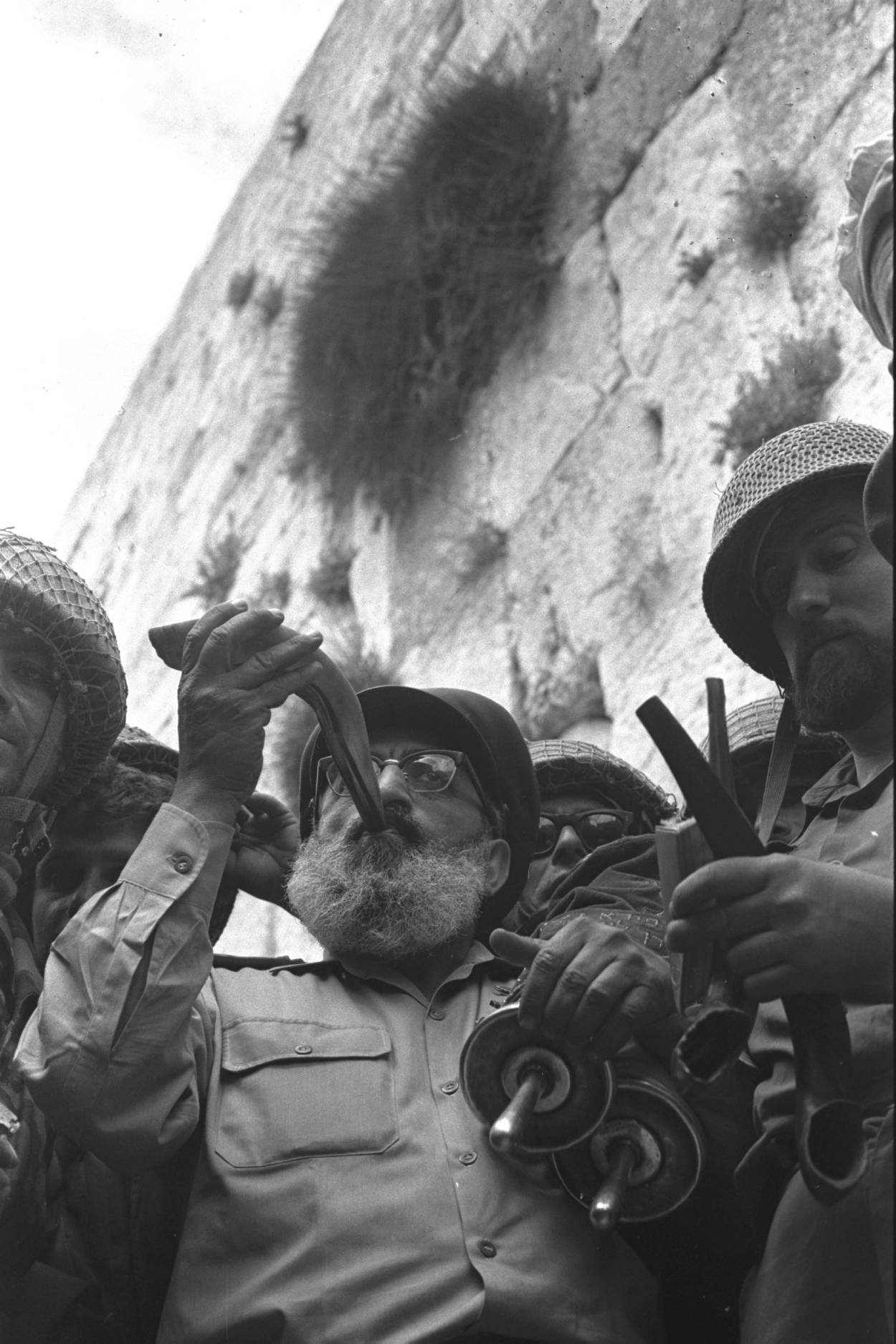
Rabbi Shlomo Goren blows the shofar in front of the Western Wall, 1967
ISRAELI GOVERNMENT PRESS OFFICE

While we usually associate the blowing of the shofar with the High Holidays, sometimes it’s more about where it’s blown than when. So it was in 1956 that Rabbi Shlomo Goren received a knock at his door from a man from Tel Aviv who had recently returned from abroad and held an object wrapped in rags. The man, a shofar maker, had received instructions in a dream. “Go to Turkey,” his dream instructed him. “And buy a large ram’s horn. Make it into a shofar for Rabbi Goren to blow on Mount Sinai.”

Goren was born Shlomo Goronchick in Zambrov, Poland. His parents, Hasidim, had sold their belongings and moved to Israel. Their relatives, who stayed in Europe, were murdered by the Nazis. Upon becoming chief rabbi of the Israeli Defense Forces, Goronchick had been encouraged by David Ben-Gurion to Hebraicize his name. “Take off the ‘chick’ and be ‘Goren,’” the prime minister advised. A last name meaning “threshing floor,” the hard surface on which grain was separated from useless straw during biblical times, turned out to be fitting for a man with unyielding determination and a sense of purpose resembling that of the ancient prophets.

Unwrapping the rags, the shofar maker presented Goren with this Turkish shofar, meant to be blown where Moses received the two tablets.

At that point in time, not even the chief rabbi of the IDF presumed that Israel would take over the Sinai Desert, and the Saint Catherine area containing Jebel Musa, known as “the Mountain of Moses.”

“You must be mistaken,” Rabbi Goren insisted. “Perhaps you misunderstood your dream and the shofar is for blowing on the Temple Mount or at the Kotel.” (Rabbi Goren was confident that the Old City of Jerusalem, home of the Temple Mount and the Kotel, then under Jordanian control, would one day be under Israeli sovereignty.)

The man insisted there had been no misunderstanding.

Six months later, the IDF captured the Sinai Desert.

Before the Sinai was returned to Egypt in negotiations, Rabbi Goren climbed 3,300 steps to fulfill the man’s dream. Ignoring an IDF Personnel Department order not to scale the mountain, he had driven through the night, rested at a local monastery, and before dawn began to ascend, accompanied by three other men.

Writing in his memoir, Rabbi Goren recounts:

I felt a deep and overwhelming sense of history. This was the second time in history that a shofar had been blown on Mt. Sinai. The first time, it was Moses who blew it—“and the voice of the shofar sounded louder and louder; Moses speaks and God answers him by a voice” (Exodus 19:19). Now, after thousands of years, I had merited going up Mt. Sinai and blowing the shofar.

Eleven years later, Rabbi Goren found himself on the cusp of liberating Judaism’s holiest site. Though his responsibilities lay more in the realm of faith than of fighting, Rabbi Goren had headed directly into battle.

“I have to cross the lines with the first company that goes across,” he told the 11th Brigade commander, as Goren recounts in his autobiography. The commander hesitated, responding that he needed clearance from the chief of staff to allow the rabbi to take on the enemy gunmen.

“You don’t need any confirmation,” Goren replied. “I’m going on the first troop carrier that crosses the lines.” So Goren went. Like a shepherd heading into battle with a sling and a prayer against a sword-wielding giant, Goren grabbed a Torah scroll and a shofar.

At 4 p.m., his carrier suffered a direct hit. His shofar was burned. Everyone else besides Goren was injured, including the driver, who had shrapnel lodged in his neck. Goren swiftly took a handkerchief out of his pocket, wrapped it around the wound, and dragged the driver out of harm’s way. An ambulance came to take the wounded to the hospital. Goren stayed in the field. He borrowed a helmet from a wounded combat engineer. In his haste heading to the front, Goren had neglected to take protective gear with him, and his hat had been burned by the shell, along with the shofar.

As he recounted later:

I was no longer in the carrier and was alone in the field with the sefer Torah. One side of the field was a swath of ripe grain and the other side was a field of thorns. The Egyptians fired at us incessantly and fires broke out in the field. I was afraid for the sefer Torah and for my life. I dug a deep impression in the ground so that I could protect my head and a deeper impression under my chest, so that I could hold onto the sefer Torah and lean on it. I was sure I would not get out of there alive, and I thought that if I reached the next world, I would be coming with a sefer Torah in my arms.

Somehow, Goren survived an onslaught of heavy fire overhead, and when the sun set, he made his way back to the IDF camp. The driver, who had survived, couldn’t believe Goren had somehow made it out alive.

Goren then realized he needed a new hat. Paying 10 liras for an officer’s cap at command headquarters, he anxiously awaited the next opportunity to head back into battle. When brigade commander Motta Gur was given the order to take the Old City, Goren sprinted straight toward the Lions’ Gate. Paratroopers were spread out along both sides of the road, with heavy artillery raining down incessantly. At the gate, a bus was on fire, and a tank had stalled.

“Rabbi Goren, you’ll get yourself killed,” a battalion commander shouted. “Come with us and stick close to the wall.”

“I’m the highest-ranking officer here,” the chief rabbi, also a lieutenant colonel, replied. “You can’t make me do anything.”

This was the second time in history that a shofar had been blown on Mount Sinai.

Feeling like he was “flying,” Goren headed to the Old City home of his father-in-law, Rabbi David Cohen, a saintly figure known as the Nazir due to his asceticism and piety. Cohen had a small synagogue attached to his apartment. It was 4:30 in the morning.

“I need your shofar,” Goren told his startled father-in-law. “We are going to liberate the Kotel!”

Goren had in mind the biblical practice of blowing a horn in battle. In the book of Numbers, God instructs the Israelites: “and if you go to war in your land, against the enemy that oppresses you, then you shall blow an alarm with the trumpets; and you shall be remembered before the Lord your God and you shall be saved from your enemies.”

Drawing closer to the Lions’ Gate, Goren began blowing the shofar. The Israeli troops reached the tank that had been stuck, blocking the entrance to the Temple Mount. So Goren climbed it and slid down the other side. Making his way to the site of the Temple, in between blasting the shofar, he prayed-shouted to the soldiers, “In the name of God, take action and succeed. In the name of God, liberate Jerusalem, go up and be successful.”

The Old City was recaptured by the IDF. Jerusalem was reunified.

When the dust had settled, Goren headed from the Temple Mount down to the Kotel. A minyan was gathered. There the rabbi recited Kaddish for the soldiers who had fallen in battle. Someone made an audio recording. Paratroopers can be heard crying as the prayer ends. Goren then blew the shofar.

After having nearly ascended to heaven with a Torah scroll in his arms, Goren returned to Mount Sinai. He began writing a sefer Torah there. Completed two years later at the same spot, the Torah now sits in the ark in the Komemiut Avraham synagogue in Tel Aviv.

In a halachic essay examining the nature of Rosh Hashanah, Rabbi Goren mentions a millennia-old debate regarding the nature of the holiday, in which the shofar blasts are the central ritual. Perhaps, as some rabbis have suggested, one’s emotional register on the holiday should be crying, even mourning. After all, as Rabbi Alan Lew’s now-classic reflection on the High Holidays put it, picturing ourselves being inscribed in the Book of Life—or the alternative—makes the prospect of death real. And for this, we are often completely unprepared. We might not luck out when we forget to wear a helmet. As Lew puts it, there “are the times when the solid ground we thought we stood on disappears beneath our feet, leaving us reeling and heartbroken.” The siren call of the shofar becomes the wailing Kaddish for the fallen.

The second rabbinic perspective is the exact opposite. Rosh Hashanah, seen from this angle, is a celebratory renewal, meant to be accompanied by festive food and drink. A clarion call to covenant, the shofar harks back to Sinai’s revelation, immortally inscribed in the sefer Torah. The Torah, as an ancient rabbinic teaching has it, was God’s blueprint for the world. And the world’s birthday is Rosh Hashanah. We are meant to rejoice in the shofar’s celebratory sound.

Perhaps somewhere in the ditch, clutching the scroll with bullets overhead, or between ankle-aching steps up the mountain where Moses once moved, Rabbi Goren pondered this debate. Likely, had an authority figure, be it military or rabbinic, offered an attempt to settle the matter, Rabbi Goren would have plowed ahead with his own opposing view. But maybe that’s the point. Both heartbreaking and heavenly, symbolizing sacrifice and spiritual success, the shofar’s sound calls, ever still.


Rabbi Dr. Stuart Halpern is Senior Adviser to the Provost of Yeshiva University and Deputy Director of Y.U.’s Straus Center for Torah and Western Thought. His edited books include the recently released Esther in America, the first full-length treatment of the Megillah’s interpretation in and impact on the United States, as well as Gleanings: Reflections on Ruth and Proclaim Liberty Throughout the Land: The Hebrew Bible in the United States.


Zawartość publikowanych artykułów i materiałów nie reprezentuje poglądów ani opinii Reunion’68,
ani też webmastera Blogu Reunion’68, chyba ze jest to wyraźnie zaznaczone.
Twoje uwagi, linki, własne artykuły lub wiadomości prześlij na adres:
webmaster@reunion68.com


Levin to ‘60 Minutes’: Most Israelis feel judicial system is against them

Levin to ‘60 Minutes’: Most Israelis feel judicial system is against them

September 18, 2023 / JNS


MInister of Justice Yariv Levin appears on CBS’s “60 Minutes,” Sept. 18, 2023. Screenshot

Israeli Justice Minister Yariv Levin told “60 Minutes” in an interview that aired on Sunday that “more than half of Israelis” feel that the country’s judicial system is against them.

The CBS News show’s report was based on a visit by “60 Minutes” anchor Leslie Stahl to Israel in August to investigate Israel’s judicial reform and the ongoing protests that have swirled around it for the past nine months.

“Of course, I respect the opinions of those who see my reform as something that could do any harm,” said Levin, who has led the government’s reform effort. “But I can assure you that the fears are completely baseless.”

.

.
“The current situation in Israel is [that] the judicial system is completely controlled by a group, an elite group—more than half of the Israeli population finds itself as if the judicial system is something that is almost against them,” he said.

Stahl opened the segment by referring to the government’s reform push as a “judicial overhaul,” stating, “This legislation would weaken the Supreme Court’s power, eliminating checks and balances put upon the government’s authority.”

Stahl focused the segment on Achim L’Neshek, or “Brothers in Arms,” a group of IDF reservists who oppose the reform.

“Members of the group brought their skills, common military backgrounds and extreme dedication to the cause,” she reported.

Ahead of his departure to the United States on Sunday, Israeli Prime Minister Benjamin Netanyahu lashed out against anti-reform protesters, saying they are “joining forces with the PLO and Iran” in harming the Jewish state.

“The protesters have made blocking roads a normal event, refusal [to serve in the military] normal, and they are defaming Israel before the world,” said Netanyahu. “I was the head of the opposition and I did not slander Israel before the world,” he added.

His comments, and the airing of the “60 Minutes” segment, come on the heels of last week’s contentious Supreme Court hearing on petitions asking to strike down an amendment to Basic Law: The Judiciary the Knesset passed on July 24. The amended law bars justices from using “reasonableness” as a justification for reversing decisions made by the cabinet, ministers and “other elected officials as set by law.”


Zawartość publikowanych artykułów i materiałów nie reprezentuje poglądów ani opinii Reunion’68,
ani też webmastera Blogu Reunion’68, chyba ze jest to wyraźnie zaznaczone.
Twoje uwagi, linki, własne artykuły lub wiadomości prześlij na adres:
webmaster@reunion68.com


Migranci uciekają z Tunezji na Lampedusę. Meloni krytykuje UE, Salvini grozi użyciem wojska

Migranci na Lampedusie, 15 września 2023 r. / Fot. Valeria Ferraro / AP Photo

Migranci uciekają z Tunezji na Lampedusę. Meloni krytykuje UE, Salvini grozi użyciem wojska

Bartosz Hlebowicz


Od środy na włoską wyspę Lampedusa leżącą między Maltą a Tunezją przypłynęło ok. 10 tys. migrantów. Włoskie władze próbują relokować część z nich do ośrodków na Półwyspie Apenińskim. Premier Giorgia Meloni krytykuję Unię Europejską za brak reakcji.

Sytuacja na wyspie Lampedusa jest skomplikowana. „Corriere della Sera” pokazuje nagrania stłoczonych w ośrodku dla imigrantów ludzi, którzy przez mur przekrzykują się z grupką karabinierów stojących po drugiej stronie. Niektórzy czarnoskórzy migranci, przybyli w tym tygodniu z Tunezji, z łatwością przeskakują przez płot za plecami stróżów prawa i idą do miasta w poszukiwaniu jedzenia.

Mieszkańcy wyspy próbują pomagać przybyszom. „Il Giornale” publikuje zdjęcie miejscowej rodziny podejmującej kolacją czarnoskórych migrantów, opowiada też o policjancie, który, poruszony widokiem spragnionych, wygłodniałych, bosych migrantów, organizuje z kolegami z komisariatu szybką pomoc: ubrania, buty, zabawki dla dzieci. „La Repubblica” pokazuje kolejkę przed kościołem San Gerlando, gdzie wolontariusze rozdają paczki z jedzeniem.

Trwa relokowanie migrantów z Lampedusy do ośrodków w innych regionach. Niestety, w nocy doszło do tragedii: autobus wiozący migrantów z Sycylii do ośrodka w Piemoncie zderzył się pod Rzymem z ciężarówką. Zginęli dwaj młodzi (32 i 35 lat) kierowcy autokaru, 25 osób jest rannych, w tym kilka ciężko.

Nienawistna kampania prezydenta Tunezji

Migranci przypłynęli na Lampedusę z Tunezji. W lipcu Unia Europejska, na skutek zabiegów włoskiego rządu, zawarła z Tunezją układ, na mocy którego kraj ten miał – w zamian za europejskie pieniądze – powstrzymywać migrantów. „Modelowe” (wedle określenia prawicowej premier Włoch Giorgii Meloni) porozumienie okazuje się jak dotąd całkowitym fiaskiem.

Podejmowany w lipcu w Rzymie prezydent Tunezji Kais Saied nie tylko zlekceważył umowę z włoskim rządem i UE, ale właśnie podsycana przez niego nienawiść do cudzoziemców stała się przyczyną masowego exodusu z tego kraju. „Polowanie na czarnych” nasiliło się w Tunezji od 25 lutego, kiedy to Saied wezwał naród do obrony przed „podmianą etniczną”.

We wtorek i w środę okręty włoskiej straży przybrzeżnej przybijały do portu na wyspie bez przerwy, obładowane kolejnymi migrantami podjętymi na morzu. Opuszczają oni Tunezję w niewielkich, chybotliwych blaszanych łodziach. Wielu z nich tonie.

Spór Włoch z Francją i Niemcami 

Premier Włoch Giorgia Meloni (Bracia Włoscy) oceniła, że nie widzi żadnej reakcji ze strony Unii Europejskiej na problemy Włoch z imigrantami. Jednak to włoski rząd nie dotrzymał warunków porozumienia w sprawie migrantów z Francją i Niemcami, których teraz oskarża o odwracanie się plecami.

Sprawę tłumaczy dziennik „Domani”: w czerwcu 2022 r. kilka krajów, w tym Włochy, Francja i Niemcy, podpisało umowę o „dobrowolnym mechanizmie solidarności” przewidującym, że inne państwa będą przejmowały od Włoch część migrantów po tym, jak we Włoszech ukończona zostanie procedura rozpatrywania ich prośby o ochronę międzynarodową. Jednak w listopadzie zeszłego roku, niedługo po tym, jak władzę objął prawicowy rząd Meloni, Francja zawiesiła tę współpracę. Powodem była awantura o statek NGO „Ocean Viking” z rozbitkami, którego Włochy, niezgodnie z umową, nie wpuściły do sycylijskiego portu i musiał on płynąć do Francji. Wicepremier Salvini przedstawił to jako sukces Włoch. 

Kilka dni temu także Niemcy zamroziły współpracę z Włochami. W zeszłym roku aż 21 tys. migrantów wymknęło się włoskiej biurokracji i przedostało się bez odpowiednich pozwoleń do innych krajów. A od grudnia włoski rząd, tłumacząc się „kwestiami technicznymi”, przestał przyjmować ich z powrotem, mimo że zobowiązuje ich do tego traktat dubliński. Francja i Niemcy uznały, że będą przyjmowały dodatkowych migrantów, skoro Włosi wypuszczają do nich osoby, które nie przeszły na ich terytorium pełnej procedury i nie zgadzają się na ich odsyłanie.

Meloni w Budapeszcie brata się z Orbánem

Sama Meloni pojechała do Budapesztu, by wziąć udział w „forum wzrostu demograficznego”, gdzie została serdecznie powitana przez premiera Viktora Orbána i prezydent Katalin Novak. Meloni pochwaliła Węgry za “wzorową politykę demograficzną” („Musimy bronić rodziny, tak jak tego pragnie papież Franciszek i tak jak robi się to na Węgrzech”) i wspomniała o konieczności „wielkiej bitwy w obronie rodzin, tożsamości, Boga i wszystkich rzeczy, który utworzyły naszą cywilizację”.

Włoskie media spekulują, że spotkanie Meloni z Orbánem jest zapowiedzią przystąpienia Fideszu do Europejskich Konserwatystów i Reformatorów, do których należy także Prawo i Sprawiedliwość.

Za wyjazd w newralgicznym momencie skrytykowała Meloni włoska opozycja. Szef opozycyjnego Ruchu 5 Gwiazd Giuseppe Conte skomentował: „Podczas gdy Włochy pogrążone są w kryzysie, m.in. z powodu podwojenia liczby migrantów, Meloni udaje się na Węgry, by uściskać się z Orbánem, który zatrzasnął Włochom drzwi przed nosem w sprawie redystrybucji migrantów”.

Braciom Włoskim trudno odpierać te zarzuty. W tym roku do 13 września przybyło do Włoch 126 tys. migrantów, podczas gdy w tym samym okresie w 2022 r. – 66 tys. Orbán zaś w czerwcu tego roku sprzeciwił się przystąpieniu jego kraju do paktu o relokacji (tak samo jak premier Polski Mateusz Morawiecki).

Salvini: Nie wykluczamy użycia marynarki wojennej

Meloni krytykuje też, choć niebezpośrednio, współrządząca z nią i zarazem rywalizującą o prawicowy elektorat Ligę. Andrea Crippa, wicesekretarz Ligi, ocenił na portalu Affaritaliani.it: „Umowa z Tunezją nie działa. Droga dyplomatyczna do niczego nie doprowadziła. Rząd Tunezji ewidentnie wypowiedział wojnę Włochom. Nie do pomyślenia, aby kraj taki jak Włochy był szantażowany przez państwa Afryki Północnej”.

Matteo Salvini, szef partii i zarazem wicepremier rządu, który wcześniej mówił o spisku przeciwko Włochom, w czwartek, w telewizyjnym programie „Stasera Italia”, zadeklarował: „Europa jest daleko, nie ma jej. Jest współwinna. Musimy przyjąć do wiadomości, że Bruksela, Berlin i Paryż odwracają się do nas plecami i sami musimy bronić naszych kobiet, mężczyzn i granic wszelkimi środkami, jakimi dysponuje demokracja. Włochy sięgną po wszelkie niezbędne środki na morzu i lądzie. Nie wykluczam użycia marynarki wojennej”. Po czym dodał: „Są instytucje niemieckie, które dają miliony euro NGO-som za zwożenie migrantów do Włoch. Takie są fakty”.

Salvini na doroczne święto partii w miejscowości Pontida zaprosił liderkę francuskiej skrajnej prawicy Marine LePen. Tymczasem na Lampedusę przyleciała Marion Maréchal-Le Pen, prawa ręka ksenofobicznego polityka i publicysty Érica Zemmoura, żeby wyrazić poparcie dla włoskiego rządu i skrytykować politykę Europy wobec, jak to określiła, „nielegalnych”. 


Zawartość publikowanych artykułów i materiałów nie reprezentuje poglądów ani opinii Reunion’68,
ani też webmastera Blogu Reunion’68, chyba ze jest to wyraźnie zaznaczone.
Twoje uwagi, linki, własne artykuły lub wiadomości prześlij na adres:
webmaster@reunion68.com