Archives

UN vote on Palestinian independence: NGOs tell Canada to choose Israel

UN vote on Palestinian independence: NGOs tell Canada to choose Israel

OVAH LAZAROFF


“CIJA expects that Canada will adopt meaningful and tangible ways to reaffirm its unqualified support for and friendship with Israel.”

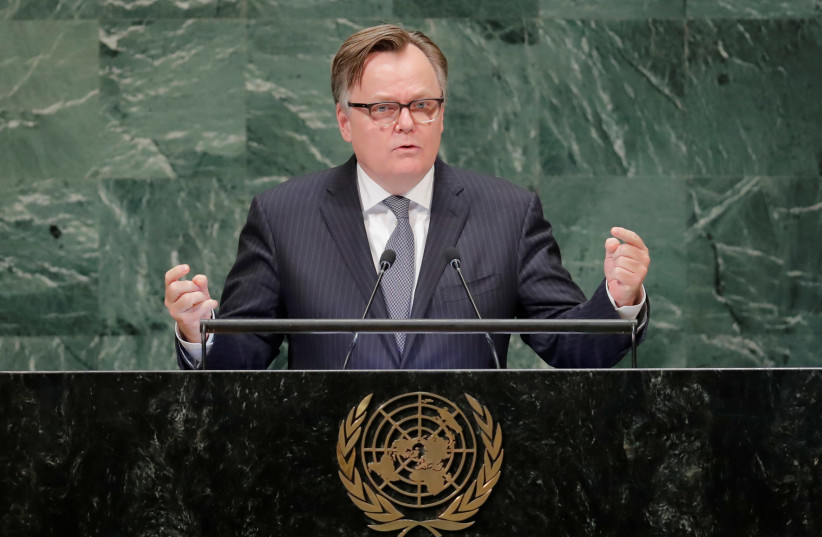
Chair of the Delegation of Canada Marc-Andre Blanchard addresses the 73rd session of the United Nations General Assembly at U.N. headquarters in New York, U.S., October 1, 2018 / 
(photo credit: REUTERS/BRENDAN MCDERMID)

Several nonprofits have urged Canada to stand with Israel at the United Nations on Wednesday when the General Assembly votes on a resolution in favor of Palestinian self-determination.

The vote is one of at least 18 pro-Palestinian and/or anti-Israeli texts that the UNGA is scheduled to approve this month.

Canada is traditionally one of the countries that stands with Israel by either rejecting or abstaining from such resolutions.

But last month, during a preliminary vote at the Third Committee, Canada reversed one of its traditional voting patterns by voting “yes” instead of “no” after the United States clarified that it no longer views West Bank settlements as illegal.

Canada’s Centre for Israel and Jewish Affairs (CIJA) has since pressured the Canadian government to reverse that decision, including by meeting with Canadian Prime Minister Justin Trudeau earlier this month.

“Trudeau said that Canada’s vote on this resolution will not change back because Canada seeks to underscore its commitment to a two-state solution,” CIJA CEO Shimon K. Fogel said.

He noted that Trudeau committed not to change any other Canadian votes related to Israel at the UN.

“CIJA expects that Canada will adopt meaningful and tangible ways to reaffirm its unqualified support for and friendship with Israel,” Fogel said.

However, the Geneva-based UN Watch has collected 37,000 signatures for an on-line petition calling on Trudeau to reverse Canada’s vote.

“The resolution condemns Israel’s anti-terrorism barrier yet omits to mention that it was built in response to the Second Intifada, which killed or wounded 8,341 Israelis by Palestinian suicide bombings, shootings, stoning, stabbing, lynchings, rockets and other methods of attack,” said UN Watch executive director Hillel C. Neuer. “The resolution was presented last month mere days after PIJ fired hundreds of rockets at Israelis, yet the text fails to say a word about this either.”

The UNGA is also expected to vote in support of a resolution combating the “glorification of Nazism, neo-Nazism and other practices that contribute to fueling contemporary forms of racism, racial discrimination, xenophobia and related intolerance.”


Zawartość publikowanych artykułów i materiałów nie reprezentuje poglądów ani opinii Reunion’68,
ani też webmastera Blogu Reunion’68, chyba ze jest to wyraźnie zaznaczone.
Twoje uwagi, linki, własne artykuły lub wiadomości prześlij na adres:
webmaster@reunion68.com


IDF Chief warns of growing challenges to Israel’s security – 17.12.19

IDF Chief warns of growing challenges to Israel’s security – 17.12.19

   TV7 Israel News


1) Israel’s military chief warns that the numerous threats Jerusalem is facing have recently expanded, and that “the number of enemies Israel is facing is greater than the number of fronts” it is forced to operate in.

2) The United States has called upon the Iraqi central government to “take action” to protect U.S. interests in the country, after a mounting number of attacks were recorded over the course of recent weeks – hostilities that according to intelligence officials “have been orchestrated by Iran and carried out by its local (Shi’ite) proxies.”

3) Turkish naval forces intercepted an Israeli research-ship in Cypriot waters and reportedly escorted it away, amid increased regional tensions over natural resource exploration.
#IsraelNews #tv7israelnews #newsupdates


Zawartość publikowanych artykułów i materiałów nie reprezentuje poglądów ani opinii Reunion’68,
ani też webmastera Blogu Reunion’68, chyba ze jest to wyraźnie zaznaczone.
Twoje uwagi, linki, własne artykuły lub wiadomości prześlij na adres:
webmaster@reunion68.com


Trump and nuclear Iran: What has the president gotten right or wrong

Trump and nuclear Iran: What has the president gotten right or wrong

YONAH JEREMY BOB


Only 18 months after he pulled the US out of the 2015 Iran deal, we have a pretty good idea of what Trump has gotten right and wrong on the Iran nuclear standoff.
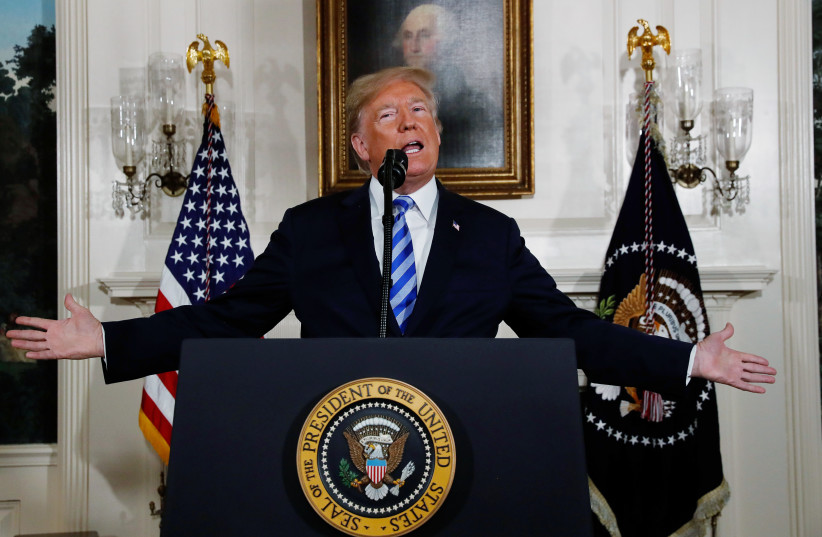
US President Donald Trump announces his intention to withdraw from the JCPOA Iran nuclear agreement during a statement in the Diplomatic Room at the White House in Washington, US, May 8, 2018
(photo credit: REUTERS/JONATHAN ERNST)

Three years into the Trump presidency, 18 months after he pulled the US out of the 2015 Iran nuclear deal and six months after he ended sanctions waivers, we have a pretty good idea of what Trump has gotten right and wrong on the Iran nuclear standoff.

In one line, Trump has succeeded in winning many tactical battles, but appears to be consistently failing at stopping Iran’s slow but steady march toward a nuclear weapon.

On one hand, Trump gets accolades from much of the Israeli defense establishment for his maximum pressure campaign on Iran, including some like former IDF chief Gadi Eisenkot on Monday, who might not be natural supporters.

They say that once Trump snapped sanctions back on Iran, the Islamic Revolutionary Guard Corps, Hezbollah and some Iranian allies in Iraq started to feel the economic squeeze.

Many attribute the protests against Supreme leader Ayatollah Ali Khamenei, against Hezbollah and in Iraq to the success of the Trump pressure campaign in reducing the legitimacy of the Islamic republic’s radical adventurism in the region as well as that of its proxies.

Supporters of Trump’s Iran policy also note that the EU has finally regained some backbone as France, England and Germany have called on the UN to condemn Tehran next week for its ballistic missile program.

Though after the 2015 nuclear deal, the EU – and the US under the Obama administration – largely turned a blind eye to Iran’s ballistic missile program, now there is finally some pressure to crack down on it.

The ballistic missile program is a hot-button issue as it was technically exempted from the 2015 deal’s punitive provisions based on Iran’s manufactured fiction that the missiles are only for defense.

Israel, the Trump administration and now finally the EU, have pointed out that the ballistic missiles can be dual-use for nuclear warheads so that testing those missiles moves Iran close to being able to deliver a nuclear weapon. They also note that the program violates broader UN resolutions, though technically there are no specific punitive provisions for these violations at present.

Finally, the US-Israel confrontational approach, including a Mossad operation in 2018 revealing new nuclear sites, has moved the IAEA slightly into confronting Iran about its Turquzabad nuclear facility and undisclosed nuclear material which the IAEA found traces of there.

So Trump has gotten many things right about Iran.
But on the most crucial point, actually stopping the Islamic republic from getting nuclear weapons, he may be failing.

Iran’s regime is under pressure, but nowhere near falling. Its proxies are under pressure, but still making trouble.

The Islamic republic has used US actions as an excuse to violate the nuclear deal four times since May and is expected to violate the deal again in the coming weeks.

These violations include enriching more uranium, to higher levels, activating more advanced centrifuges, some reduced cooperation with the IAEA and other issues.

Collectively, Institute for Science and International Security President David Albright told the Jerusalem Post that this has brought Iran multiple months closer to a bomb than it was in May (and Albright was not a fan of the JCPOA.)

He warned that if Iran restarts a significant number of its IR-2m centrifuges (more advanced than the standard IR-1s), the time to developing enough enriched nuclear material for a bomb could quickly drop to six months.

Bottom-line: Iran is closer to a nuclear bomb now than it was in May, and may be closer than it would have been had Trump not pulled out of the deal.
In the midst of this deterioration, most also believe that Trump’s deterrence of Iran has suffered after he failed to respond with even a targeted use of force to the Islamic republic’ shooting down of an expensive US drone and Tehran’s striking Saudi oil fields.

These more aggressive activities by Iran were also likely brought on by the Trump pressure campaign – though in fairness to Trump, Iran was getting away with arresting US sailors under the Obama administration without much consequence.
There are also warnings that Trump may seek to cut a new weak deal to save face and get a good photo-op for his reelection campaign.
How did it come to this? What went wrong for Trump on Iran despite some notable tactical successes?

The Obama administration sealed the 2015 nuclear deal, making a number of bets. Its bet that Iran would start behaving better to rejoin the world as a more normal actor was wrong, and part of what Trump’s change in policy was designed to address.

But another bet the Obama administration made seems to have been correct: that they could only retain Chinese and Russian support for pressuring Iran up to a certain point.

Some in the Obama administration revealed quite frankly in the years after the deal that they might have liked to have pushed for a better deal in some areas, but that they believed they would have lost Chinese and Russian support. They said that without that support, Iran would no longer be pressured.

When Trump pulled out of the deal and when he ended sanctions waivers, he made an opposite gamble: that he could force China and Russia to toe the line longer than Obama had to force Iran into cutting a better deal.
It now seems clear that Trump’s gamble on this issue was wrong.
China has periodically cut back business with Iran for months at a time, but has always counter-rallied to continue importing oil from Iran at some later date.

Likewise, China has rescinded some very important public deals with Iran, but has worked a variety of off the books or untraceable economic deals with Iran to keep it afloat despite US pressure.
For example, at one point China reduced its purchasing of Iranian oil to close to zero, only to jump it later back to 800,000 barrels per day in April 2019.

China then briefly dialed down its purchasing of Iranian oil again after the US ended sanctions waivers in May, but has steadily increased back to 186,000 barrels per day and is expected to continue to increase.
There are also reportedly around 20 million barrels of Iranian oil in bonded storage off the Chinese coast and Beijing and Tehran are using goods to effectuate trade that do not leave footprints the way currency transfers do.

Earlier this week, Iran announced that Russia would be extending it a $5 billion loan.

Russia also continues to be involved in a variety of aspects of directly supporting Iran’s nuclear program, and Albright warned that Moscow may even be giving Iranian scientists additional know-how that it is prohibited from giving.

As long as China and Russia have Khamenei’s back, it is very likely that Iran can ride-out the Trump pressure campaign just as it was now for 18 months.
If Iran no longer believes that Trump is willing to use military force against it, then there is also no reason for it not continue to creep closer to the nuclear threshold.

This would leave Israel as the only party that could possibly block Iran with a military strike on the Islamic republic’s nuclear facilities.
All of this could come to a head in 2020, whereas if the nuclear deal had continued, it might not have come to a head until 2023, 2025 or even a bit later.

Some will argue that it was better to confront Iran earlier so that it could not “walk-out” to a nuclear weapon at the end of the 2015 nuclear deal because the deal’s sunset provisions put no real limits on Tehran once it expired.

Whether this is true, the fact is that Trump’s notable tactical successes on Iran do not cover the strategic failure, and absent a major new development, the day when Israel will need to make its own fateful decision continues to creep closer.


Zawartość publikowanych artykułów i materiałów nie reprezentuje poglądów ani opinii Reunion’68,
ani też webmastera Blogu Reunion’68, chyba ze jest to wyraźnie zaznaczone.
Twoje uwagi, linki, własne artykuły lub wiadomości prześlij na adres:
webmaster@reunion68.com


Guatemalan president-elect says reviewing country’s policy on settlements

Guatemalan president-elect says reviewing country’s policy on settlements

MAAYAN JAFFE-HOFFMAN


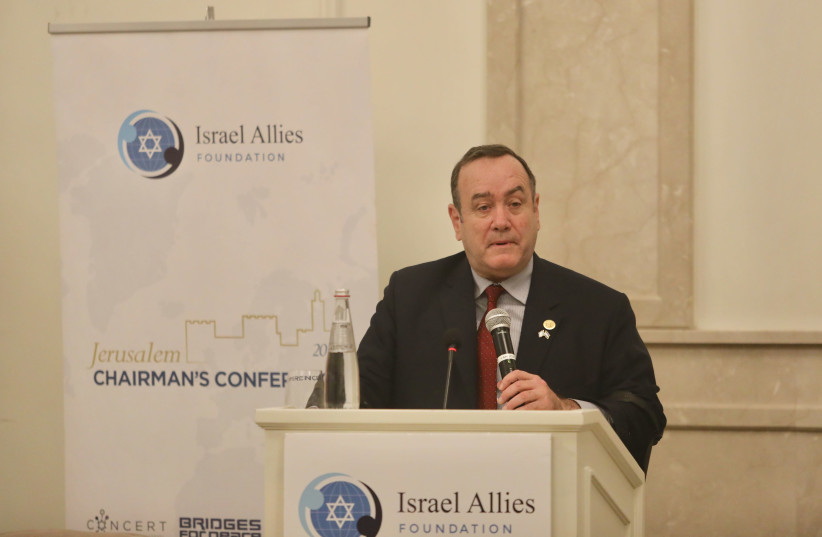
In a talk before a small crowd, hosted by the Israel Allies Foundation, Giammattei noted that his dream is to make Israel and Guatemala even closer than before.
Guatemala’s president-elect, Alejandro Giammattei, speaks an Israel Allies Foundation conference, December 9 2019 / (photo credit: MARC ISRAEL SELLEM/THE JERUSALEM POST)

The president-elect of Guatemala, Alejandro Giammattei, said Monday that when he takes office next month he will reexamine the country’s policy on Jewish settlements in Judea and Samaria with a goal of aligning Guatemala’s policy with that of the United States.

Last month, US Secretary of State Mike Pompeo designated Israel’s settlements to be “not inconsistent with international law.”
The president, speaking in an exclusive interview with The Jerusalem Post also reiterated a statement he made Sunday in the presence of President Reuven Rivlin that he would designate Hezbollah a terrorist organization upon taking office.

“They are attacking Israel,” the president said of Hezbollah.
In a talk before a small crowd, hosted by the Israel Allies Foundation, Giammattei noted that his dream is to make Israel and Guatemala even closer than before.

Guatemala was the second country in the world to recognize the State of Israel in 1948 – only after the US – and the second country to move its embassy to Jerusalem.

Giammattei said that he supports Israel out of faith: “Those who bless Israel will be blessed,” he told the group, quoting a passage from Genesis.
The president-elect said he has no plans to move the Guatemalan embassy from Jerusalem and he will use his role as the country’s leader to encourage other countries to move their embassies to the capital, as well.


Zawartość publikowanych artykułów i materiałów nie reprezentuje poglądów ani opinii Reunion’68,
ani też webmastera Blogu Reunion’68, chyba ze jest to wyraźnie zaznaczone.
Twoje uwagi, linki, własne artykuły lub wiadomości prześlij na adres:
webmaster@reunion68.com


Nine percent of world’s best inventions this year are made in Israel

Nine percent of world’s best inventions this year are made in Israel

Batya Jerenberg,
World Israel News


(TPS)

Time Magazine published its 100 Best Inventions of 2019 Thursday, and Israeli companies have created nine of them.

The list was culled from nominations from editors and writers in nearly 20 categories such as Accessibility, Health, Transportation and Social Good, as well as from applications from companies themselves. The criteria, TIME said, included “originality, creativity, influence, ambition and effectiveness.”

Israel’s contribution to making products “that are changing the way we live, work, play and think about what’s possible” is a hefty one, considering that it ranks only 101st in world population.

In the Social Good category, WaterGen’s water cooler-sized machine can save lives in areas that have no access to the vital liquid by creating it — out of air. Its GENNY appliance “pulls moisture from ambient air to create drinkable water through a patented filtration process,” TIME said, allowing the device to produce up to seven safe-to-drink gallons a day. It also only requires a minimum amount of electricity or solar power to make it work.

The company has already sent truck-sized units to disaster zones around the world that contain their own generators, but the product featured by the magazine is a home unit that can compete commercially with bottled water, making it an environmentally friendly device as well.

In the Accessibility category, TIME reports that OrCam’s MyEye 2 is a “game changer” for those with visual impairments. Weighing less than an ounce, the unobtrusive device can be attached to any pair of glasses. Using artificial intelligence, it can then quietly read out any printed text to its wearer, whether on paper, products, street signs or on screen. It can also instantly identify faces, store items, colors and currency.

For the millions of people around the world who suffer from migraines, Theranica’s Nerivio in the Health Care category could do the trick. Strapped around the upper arm, the $99 wireless device can be turned on as soon as a person feels the headache or migraine begin, and it “electrically stimulates the body’s own neural pathway for tamping down pain signals.” The company said that it will only become available in its home country in April 2020.

Tyto Care’s TytoHome is another Health Care winner. It is a handheld device that can do many routine exams that doctors do for patients in their office – but you don’t have to leave the house. It measures vital signs, and has adapters that can check your ears, throat, skin and even lungs. To get instant feedback on this information, it then video-conferences with a doctor in real time.

The Israeli-made Temi made it to the top of the Home category. It is a voice-operated, autonomous personal assistant robot that can navigate around the house on its own and respond to questions and voice commands such as “Call Mom.” It has a touch screen computer “head” and even a small shelf so that someone in the kitchen can send a loved one a cup of coffee in another room.

A product that will only begin testing next year was chosen in the Sustainability category, in the hope that it will work as its inventors hope. Eviation’s Alice is a nine-seat plane that runs completely on electricity and so far has a range of 650 miles. If its lightweight design proves itself, larger commercial aircraft may significantly reduce the aviation industry’s carbon footprint in the not-too-distant future.

ECOncrete was picked for the Design category, for its unique “biomimicry” building technique that “replace[s] intrusive concrete infrastructure, from sea walls to seafloor mats, with products that blend in with their surroundings.”

Lastly, two Israeli items made the Special Mentions group. A robot called ElliQ is a social companion for the elderly, and online insurer Lemonade will pay out any leftover money from an insurance claim to charities that its customers want to support.


Zawartość publikowanych artykułów i materiałów nie reprezentuje poglądów ani opinii Reunion’68,
ani też webmastera Blogu Reunion’68, chyba ze jest to wyraźnie zaznaczone.
Twoje uwagi, linki, własne artykuły lub wiadomości prześlij na adres:
webmaster@reunion68.com