Archives

Shame on Europe

Shame on Europe

JPOST EDITORIAL


There is no denying that the European Union is engaging in a double standard toward Israel.
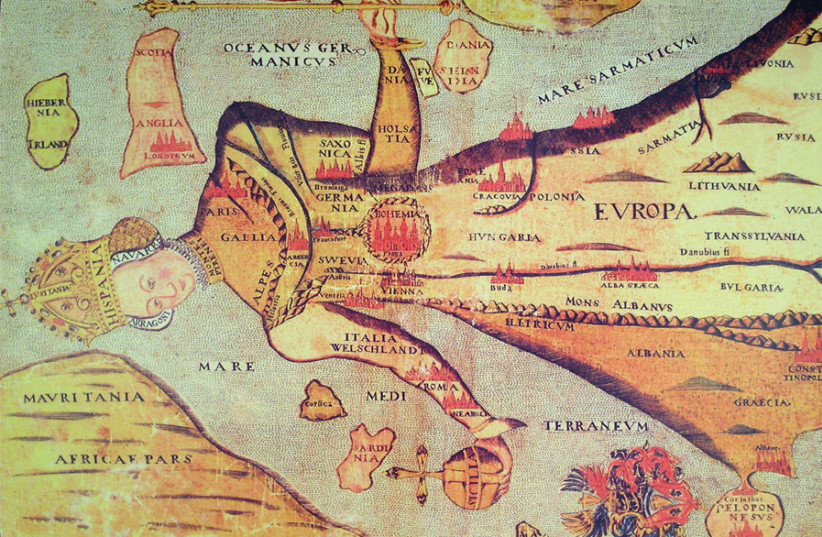
AN OLD map presents Europe in the shape of a queen holding scepter and orb, with Portugal as her crown, Spain as her face, France as her belowthe- neck area, lower Germany and Denmark as her left arm, Italy as her right arm (with Sicily as orb), and the rest of central and eastern Europe as the dres /  (photo credit: Wikimedia Commons)

The European Union’s Court of Justice decided this week that products made in Judea and Samaria cannot be labeled “made in Israel,” mandating that labels be changed in all 28 EU member states.

Before the ruling, the EU had only advised such labeling, but now it will be a requirement, and the union can launch legal proceedings against any state that does not comply.The mandatory labeling also applies to products of east Jerusalem and the Golan Heights, even though those areas are under Israeli sovereignty.
This decision is an outrage for a number of reasons.

First, it came while half of Israel was shut down due to the threat of rockets launched by terrorists into civilian populations. A modicum of consideration would have been appreciated at this time.

The court could have easily waited, but it did not.

The decision would have been controversial at any time, but for it to come when children from Tel Aviv to Beersheba and beyond had to stay home from school and run for shelter when rocket sirens went off, was an insult to Israelis.
This singling out of Israel is exactly what former Jewish Agency chairman Natan Sharansky meant when he wrote in 2004 of the “three Ds” distinguishing antisemitism from legitimate criticism of Israel: delegitimization of Israel, demonization of Israel and subjecting Israel to double standards
There is no denying that the European Union is engaging in a double standard toward Israel as opposed to other territories.

There is no similar labeling mandate for other areas under territorial conflict, like Tibet, Northern Cyprus or Western Sahara, as former justice minister Ayelet Shaked pointed out. In fact, rather than singling out their products, the EU even has an agreement with Morocco allowing European boats to fish in territorial waters off Western Sahara.

Beyond the formal definition of antisemitism, Europeans have a long history of telling Jews where they can – and more often, can’t – live, and with whom they can do business, going back centuries.

Labeling products from Judea and Samaria will encourage boycotts, something Jews were subjected to in the darkest period of Europe’s history.
And by declaring Jewish businesses – the implication being Jewish life – in Judea and Samaria as illegitimate, the EU is acceding to the Palestinian-driven idea that certain spots on the map need to be “Judenrein,” free of Jews.

After all, Palestinian Authority President Mahmoud Abbas has said that, for him to reach an accord with Israel, the West Bank will have to be “free of settlers,” meaning Israeli Jews.
Europe allows free passage and even residence of citizens of one state into another, but its courts think that Jew-free areas are an acceptable concept in other parts of the world.

The decision also applies to Israeli products made in the Golan Heights, an area that falls under Israeli sovereignty, which is recognized by the United States. Requiring labeling of Israeli products made in the Golan makes no sense. Let’s say Israel would want to give the Golan to somebody: who would the EU recommend?

The brutal Syrian leader Bashar Assad, who has murdered more than half a million of his people in this long civil war? Or would Europe prefer ISIS, Iran or maybe Russia? Israel’s control over the Golan helps keep Israel secure and prevents a larger conflict that could erupt and engulf the Middle East.

The failure to recognize this simple fact is not just ignorance. It is a lie.
And then there is east Jerusalem. Basically, what the EU is saying is that if a menorah is made in the Old City and then exported for sale to Paris, it would need to be labeled. The capital of the Jewish people for three thousand years and its connection to the Jewish people is put into question.
This is ridiculous.

What Europe seems to fail to understand is that the days when the continent could tell Jews where they can live or where they can do business are over. Those days ended in 1948.

For the European Union’s top court to make a decision reeking of prejudice on a day when Israelis were most vulnerable is inexcusable.

Europe should be ashamed.


Zawartość publikowanych artykułów i materiałów nie reprezentuje poglądów ani opinii Reunion’68,
ani też webmastera Blogu Reunion’68, chyba ze jest to wyraźnie zaznaczone.
Twoje uwagi, linki, własne artykuły lub wiadomości prześlij na adres:
webmaster@reunion68.com



Inside the Hebron Lions’ Den

Inside the Hebron Lions’ Den

Jerold Auerbach


Nearly 800 participants from 80 communities around the world came to Israel, making a stop in Hebron at the Cave of the Patriarchs, with Chabad’s Rohr Jewish Learning Institute. Photo: Bentzi Sasson.

The Lions’ Den, a fascinating collection of essays by journalist Susie Linfield, focuses on Zionism and the political left from Hannah Arendt to Noam Chomsky. She makes it clear from her opening page that she identifies herself as a left-wing intellectual who is also a Zionist. “I believe in a state for the Jewish people,” she explained to a group of startled left-wing intellectuals at a dinner party, adding “along with a Palestinian one.”

Linfield appropriately chastises political leftists who are not only repelled by the “brutal Israeli occupation” and “oppression of the Palestinians.” Indeed, they are repulsed “by the existence of Israel itself.” She pointedly cites their “double standard” that enables them “to support regimes far more repressive and violent, and far less egalitarian and politically open” than Israel — “even the Israel of the Occupation.” Only for Israel, she understands, is “a nation’s right to exist” challenged.

Clearly Linfield is not among them. But her own embrace of Zionism, she quickly reveals, is conditional and restricted. In 2012 she visited Hebron with Partners for Progressive Israel, aligned with the left-wing Meretz party, which “works against the Occupation and the Likud.” In Hebron, she writes, “a Palestinian city of about 200,000 inhabitants … a few hundred ultra-nationalist Israeli settlers have established themselves.” Claiming to represent Zionist values, they “have recreated the despised, endangered, and ghettoized position of the Jews that Zionism was designed to eradicate.”

By contrast, as a quick Google search would inform her, Palestinian Hebron is the commercial hub of the West Bank, with high-rise apartment buildings, shopping malls, and universities. She might have wondered why she and her progressive partners — because they are Jews — are forbidden from entering that flourishing city. Instead, surrounded and protected by Israeli soldiers (she does not consider why such protection is necessary), they walk along “a designated Israeli street.” She is clearly upset that Palestinian boys nearby “are prevented from crossing over to our side of the street from theirs.” It is, she writes, “bizarre, ludicrous, mortifying.” She added, “I am ashamed to be a Jew.”

Linfield seems oblivious to the history of Jews in Hebron, which Partners for Progressive Israel and her own commendable research talents conveniently ignore. That history began with the biblical narrative of Abraham’s purchase of a cave from Ephron the Hittite as the burial site for Sarah. In time Abraham, Isaac and Rebekah, Jacob and Leah were also buried there. But Hebron became far more than the burial site of the patriarchs and matriarchs. It was where King David ruled before relocating his throne to Jerusalem. Millennia before the emergence of Islam, Hebron was deeply embedded in the biblical narrative and Jewish history. At the beginning of the Common Era, King Herod built the massive stone enclosure surrounding the burial site, known as Me’arat ha’Machpelah, which still looms over the city.

In time, although Jews were prohibited by Moslems from entering their sacred enclosure, Hebron Jews became a unique community of Jewish memory. But during the 1929 Arab riots, the Hebron Jewish community was chosen for slaughter. Marauding Arabs murdered sixty-seven Jews, traumatized survivors were evacuated, and Hebron became Judenrein. Following the Six Day War, for the first time since the 13th century, Jews prayed inside Machpelah at the tombs of their ancestors. It was not long before a group of religious Zionists, led by Rabbi Moshe Levinger, came to Hebron to celebrate Passover and begin to restore the ancient Jewish community. They succeeded, although within stringent limits imposed ever since by the Israeli government.

Susie Linfield is not impressed, and it is unlikely that the Partners for Progressive Israel who guided her visit revealed the millennia-old history of Hebron Jews. To be sure, as I know from repeated visits to research their history, there is far more to Hebron than the shabby Jewish Quarter where successive Israeli governments have stifled new construction and growth. To celebrate Shabbat Chaye Sarah in Machpelah, when the Torah passage recounting Abraham’s purchase is read, is an unrivaled experience. Then and there Jews return to their most ancient holy site and embrace the Biblical narrative. There the Jewish past in the Land of Israel began — and, despite a history of sorrow inflicted upon it, endures.

It is regrettable that Susie Linfield permitted her embrace of “progressive” Israel, and her evident writing talent, to distort and defame the biblical city of Hebron and its devoted and determined Jewish residents. There, under different guidance, she might have understood that even a “progressive” Jew can embrace Jewish history in the biblical homeland of the Jewish people. Instead, obsessed with Israel as an “occupier,” she neglects to mention that Hebron Jews, and 400,000 other settlers, “occupy” Judea and Samaria, which is that biblical homeland.


Jerold S. Auerbach is the author of Hebron Jews: Memory and Conflict in the Land of Israel (2009).


Zawartość publikowanych artykułów i materiałów nie reprezentuje poglądów ani opinii Reunion’68,
ani też webmastera Blogu Reunion’68, chyba ze jest to wyraźnie zaznaczone.
Twoje uwagi, linki, własne artykuły lub wiadomości prześlij na adres:
webmaster@reunion68.com


Israel under heavy rocket fire from Gaza – TV7 Israel News 12.11.19

Israel under heavy rocket fire from Gaza – TV7 Israel News 12.11.19

  TV7 Israel News


1) Palestinian Islamists are firing barrages of rockets and mortar-shells from the Gaza Strip toward Israel’s central and southern communities – in retaliation for Israel’s targeted assassination of the Iranian-backed Islamic Jihad commander in the Hamas-controlled territory, Baha Abu Al-Ata.
2) Israel reportedly conducted a separate targeted bombardment of the leader of the Palestinian Islamic Jihad Akram al-Ajouri, in the Mezza district of the Syrian capital Damascus.
3) Europe is contemplating its reaction to the latest Iranian breaches of the 2015 nuclear agreement.


Zawartość publikowanych artykułów i materiałów nie reprezentuje poglądów ani opinii Reunion’68,
ani też webmastera Blogu Reunion’68, chyba ze jest to wyraźnie zaznaczone.
Twoje uwagi, linki, własne artykuły lub wiadomości prześlij na adres:
webmaster@reunion68.com


HIGH COURT APPROVES ALEXEI BURKOV’S EXTRADITION TO U.S

HIGH COURT APPROVES ALEXEI BURKOV’S EXTRADITION TO U.S

YONAH JEREMY BOB


Last week, the Russian hacker and Naama Issachar had both requested the High Court to block the hackers’ extradition to the US.

Supreme Court President Esther Hayut. (photo credit: MARC ISRAEL SELLEM)

The High Court of Justice approved on Sunday the extradition of a Russian hacker to the US, rejecting his request to be extradited or to serve his potential jail sentence in Russia.

Last week, the Russian hacker and an Israeli woman in a Russian prison for cannabis possession had both requested the High Court to block the hackers’ extradition to the US.

The family of Naama Issachar, serving a seven-and-a-half-year sentence in Russia, had filed their petition two weeks ago, while the hacker, Alexei Burkov, filed last week. Later last week, Issachar’s family had already withdrawn their petition.

These moves follow Acting Justice Minister Amir Ohana’s signing off on extraditing Burkov to the US for perpetrating cyber fraud and earlier rulings by the Jerusalem District Court and the Supreme Court to extradite him.

Generally, the petitioners oppose any extradition, but given the state of legal play, they were pushing for extradition to Russia in place of the US, and as part of a deal for Russia to return Issachar to Israel.

Israelis generally view Issachar as having violated the law, but that the violation was minor and that the heavy Russian jail sentence was a political move to try to press Israel to return Burkov to Moscow.

In a bizarre legal twist unique to the extradition process, though the Supreme Court already ordered Burkov’s extradition, he had a chance to try a redo after the justice minister signed the extradition order by addressing his petition to the same body, but in its capacity as the High Court of Justice.

Essentially the idea is that extradition has both a criminal and constitutional component and that the initial Supreme Court ruling addresses the criminal obstacles, while the later High Court ruling addresses any constitutional obstacles.

In theory, the High Court could have overturned the earlier Supreme Court ruling, and in fact, the High Court had frozen the extradition until it could issue a decision.

In practice, cases where the High Court vetoes an extradition that its – in their capacity as the Supreme Court – already approved, are extraordinarily rare.

The two main arguments that Burkov seemed to be basing the latest petition to the High Court on were: that earlier court decisions were to extradite him, but not necessarily to extradite him to the US over Russia, and that Burkov was not physically in the US.

In a classic extradition case, one person commits an individual crime in his home country and flees to a foreign country to escape the law.

Usually the criminal is in it for personal gain, and none of the governments involve particularly care what happens to the criminal.

If there is an extradition treaty between the country of origin and the country where the criminal fled, he is usually extradited back home, and if not, often not.

And then there is when diplomatic considerations break into the fold.

Here, Burkov has been on “extradition row” since 2015 when the US filed a serious and well-grounded evidentiary request for extraditing him to the US for perpetrating the cyber fraud scheme.

In the age of globalized crime, physically residing in a country is not required if the main harm of your criminal actions were felt in that country.

So normally his extradition to the US would be a done deal.

Russia’s harsh sentence of Issachar sparked speculation that Burkov has value to Moscow and might have been involved in cyber intelligence activities. Otherwise, it would be unclear why Russia would care if one citizen gets sent to jail for fraud.

There are many political reasons why Prime Minister Benjamin Netanyahu would want to please Russian President Vladimir Putin even if there might be few legal ones.

But ultimately the extradition was always expected to go through due to these legal arguments and because Israel would be even more concerned about upsetting the US by failing to extradite Burkov than it would be concerned about alienating Russia.

The High Court said that arguments to extradite Burkov to Russia or to have him serve his potential jail sentence there had no real legal basis.


Zawartość publikowanych artykułów i materiałów nie reprezentuje poglądów ani opinii Reunion’68,
ani też webmastera Blogu Reunion’68, chyba ze jest to wyraźnie zaznaczone.
Twoje uwagi, linki, własne artykuły lub wiadomości prześlij na adres:
webmaster@reunion68.com


Israel exposes Iran’s lies about its nuclear ambitions – TV7 Israel News 08.11.19

Israel exposes Iran’s lies about its nuclear ambitions – TV7 Israel News 08.11.19

   TV7 Israel News


1) The Islamic Republic of Iran refuses to cooperate with the International Atomic Energy Agency, IAEA, vis-à-vis a warehouse that is situated on the outskirts of Tehran, which according to Israeli allegations, stored nuclear materials related to the Mullah’s aspiration to develop nuclear weapons.
2) Senior Israeli officials reinforced a statement made by U.S. Secretary of State Mike Pompeo, and warned that Iran would be able to reach a nuclear bomb within less than a year if it decided to take swift action in this direction.
3) Germany Chancellor Angela Merkel reiterated her countries concerns over the latest nuclear-related developments in Iran, yet noted that Berlin has not made its final decision about how to confront Tehran’s latest activities.


Zawartość publikowanych artykułów i materiałów nie reprezentuje poglądów ani opinii Reunion’68,
ani też webmastera Blogu Reunion’68, chyba ze jest to wyraźnie zaznaczone.
Twoje uwagi, linki, własne artykuły lub wiadomości prześlij na adres:
webmaster@reunion68.com