Archives

Netanyahu Congratulates Trump on Killing of Islamic State Leader: ‘An Important Milestone’

Netanyahu Congratulates Trump on Killing of Islamic State Leader: ‘An Important Milestone’

Benjamin Kerstein


Israeli Prime Minister Benjamin Netanyahu speaks at the Likud party headquarters following the announcement of exit polls during Israel’s parliamentary election in Tel Aviv, Israel, September 18, 2019. Photo: REUTERS/Ammar Awad.

Israeli Prime Minister Benjamin Netanyahu congratulated Donald Trump on Sunday after the US president announced the death of Islamic State leader Abu Bakr al-Baghdadi in a US special forces raid.

“I want to congratulate President Trump on the impressive achievement, an operation that led to the death of the [IS] leader al-Baghdadi,” Netanyahu said in a statement.

“This reflects the united resolve of the free countries led by the United States to fight the forces of terror, the terror organizations, and the terrorist states,” the prime minister added.

Netanyahu concluded, “This is an important milestone, but it’s part of a longer battle which we must win.”

Trump announced Baghdadi’s death at a White House press conference, saying, “The thug who tried so hard to intimidate others spent his last moments in utter fear, panic, and dread, terrified of the American forces coming down on him.”

The IS leader, said Trump, blew himself up while attempting to escape US soldiers through a tunnel.

“He reached the end of the tunnel as our dogs chased him down. He ignited his vest, killing himself and his three children,” Trump said. “His body was mutilated by the blasts. The tunnel had caved on him.”


Zawartość publikowanych artykułów i materiałów nie reprezentuje poglądów ani opinii Reunion’68,
ani też webmastera Blogu Reunion’68, chyba ze jest to wyraźnie zaznaczone.
Twoje uwagi, linki, własne artykuły lub wiadomości prześlij na adres:
webmaster@reunion68.com


THREE SUKKOT SNAPSHOTS

THREE SUKKOT SNAPSHOTS

EZRA WEINBERG


Three different events on Sukkot show how special this festival is.

A BOY looks out through a window of a sukkah in Ashdod. (photo credit: AMIR COHEN/REUTERS)

Everyone should have a claim to fame associated with a Jewish holiday. Mine came when I was 10 years old and I was living in Jerusalem for the year. My mother was in her third year of rabbinical school and studying at the Hebrew University of Jerusalem.

My sister and I went to local public schools in Kiryat Shmuel. Somehow my school was chosen from all the schools in Jerusalem to decorate the sukkah of Chaim Herzog, then the president of Israel! And of all the classes in my school, my class was chosen to decorate an entire wall of that sukkah.

My teacher took a few volunteers. Somehow my hand shot up. She handed some of us large pieces of poster board. I became an artist that day and make a very elaborate full-page poster sign of the hadassim, or myrtle, one of the four species of the holiday. And then a few days into the holiday, we were invited as a class to come see our work. I was invited to the president’s sukkah to be his guest. Although I did not fully comprehend the significance of this moment, I knew this was a special experience and something I would remember for a long time. That was in 1984. Sukkot was going to be the holiday that discovered me.

Fast forward 22 years. It’s 2006 and I’m in my fourth year of rabbinical school myself! I hear about a brand-new Sukkot retreat for people in their 20s and 30s up at Isabella Freedman Jewish Retreat Center in the Berkshires. Just one sukkah, but so many Jews! With all these Jews of different stripes, how will it work? The retreat coordinators decided that we needed three minyanim: an orthodox minyan, a traditional egalitarian minyan, and a Jewish Renewal minyan. But the problem was that these were mostly young people who didn’t wake up early on holidays for prayer.

On the first morning, we barely had the 10 people needed for a minyan in each group. So on the second morning, we decided to combine forces. Rabbis Shai Held and David Ingber ended up collaborating for one meaningful prayer service. Shai lead Shacharit (morning prayers) while David lead the Torah service. Dara and I lead the recital of Hallel psalms together.

WAS IT easy and comfortable? Not at first. Many Jews in that room were not used to singing songs during prayer like this one: “We are opening up in sweet surrender to the luminous love light of the one.” A few curious Orthodox Jewish women came into the service. One of them even received an aliyah, that is, was called up to the Torah. Jewish pluralism was alive and not conforming to any pre-set conditions. “All Streams – One Source” was born.

It is 2016. Year 10 of Sukkahfest, which has now expanded from a two-day holiday to a multi-pronged nine-day festival of joy. All of the old regulars now come for last days. More and more sukkot are built around the premises of Isabella Freedman. “Sukkat Shalom” has been solidified as the sukkah we all eat in together, while “Sukkat Chalom” is where we sing and share stories and dream big dreams. It is no longer a retreat for folks in their 20s and 30s, but people are now coming with their siblings, parents and children.

Couples who have met at Sukkahfest are celebrating anniversaries. “All Streams moments” happen on purpose and spontaneously. New songs are composed. Old notions of Jewish identity are composted. Our Kohenet community weave together and lead us in new/ancient rituals of water celebration as described in the Talmud as Simhat Beit Hashoeva. We pray, we eat, we bless and we sing – joyously. We channel our ancestors and invite them as guests into the sukkah. We remember friends who are no longer with us and bring their spirits into our sukkah. We CELELBRATE the Earth, led by our friends from Teva and Adamah.

And everything builds to Simhat Torah. We dance with the Torah scrolls. We share Torah – literally and figuratively. We celebrate in our separate minyanim, and then we come together for the seventh and final hakafa-dance – the ALL STREAMS hakafa. We have no idea what is going to happen. We live in the uncertainty guided by the living metaphor of these temporary huts that bring us inside and shelter us. Fully immersed and fully satisfied, for just a moment in time. This is the annual pilgrimage


Rabbi Ezra Weinberg is a longtime Hazon ambassador as an alum of the New York Ride, the Israel Ride and Sukkahfest. He lives and works in Washington Heights with his wife and two children, and is currently a fellow at the UJA’s Ruskay Leadership Institute.


Zawartość publikowanych artykułów i materiałów nie reprezentuje poglądów ani opinii Reunion’68,
ani też webmastera Blogu Reunion’68, chyba ze jest to wyraźnie zaznaczone.
Twoje uwagi, linki, własne artykuły lub wiadomości prześlij na adres:
webmaster@reunion68.com


Netanyahu, Gantz to meet today

Netanyahu, Gantz to meet today

Arutz Sheva Staf


Blue and White, Likud leaders to meet for first time since Gantz received the mandate to form the government from President Reuven Rivlin.

Rivlin, Gantz, and Netanyahu / Amos Ben Gershom/GPO

Blue White Chairman, MK Benny Gantz and Prime Minister Binyamin Netanyahu will meet at the Kirya in Tel Aviv Sunday afternoon to examine the possibility of promoting a unity government led by Blue and White. The meeting will be the first between the leaders since Gantz received the mandate to form the government form President Reuven Rivlin.

The two face many obstacles in forming a unity government, including the question of who will be prime minister first in a rotation. Gantz believes that he should be prime minister first since Blue and White is the larger party, while Netanyahu believes he should be prime minister first due to his experience in the position.

Another obstacle is Blue and White’s insistence that Likud abandon the larger right-wing and haredi bloc while Likud insists that the bloc be included in the unity government.

According to sources in the Blue and White party, Gantz is prepared to waive one demand but not the other. The parties will then discuss the common principles of a unity government as the basis for the joining, if they so wish, of additional parties.

Immediately after the meeting with Netanyahu and the Likud team, representatives of the other parties will be invited to meet with a Blue and White team led by Adv. Yoram Turbovich.


Zawartość publikowanych artykułów i materiałów nie reprezentuje poglądów ani opinii Reunion’68,
ani też webmastera Blogu Reunion’68, chyba ze jest to wyraźnie zaznaczone.
Twoje uwagi, linki, własne artykuły lub wiadomości prześlij na adres:
webmaster@reunion68.com


Hezbollah chief warns of civil war, says Israel exploiting Lebanon protests

Hezbollah chief warns of civil war, says Israel exploiting Lebanon protests

TOI STAFF and AGENCIES


Terror chief says though the demonstrations began spontaneously they are now being manipulated by domestic and regional rivals; Hezbollah supporters clash with demonstrators
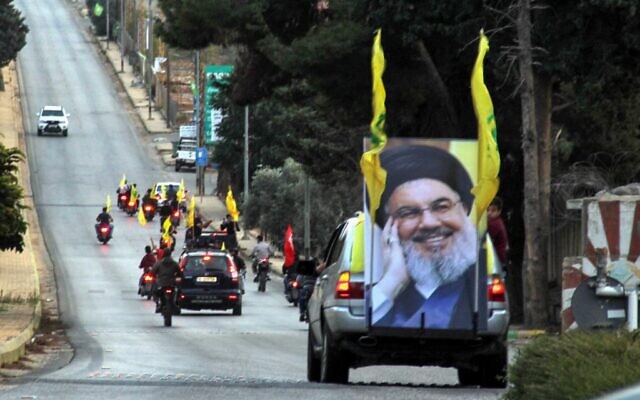
Supporters of the Hezbollah terror group drive in a convoy in support of its leader Hassan Nasrallah’s speech, in the area of Fatima’s Gate in Kfar Kila on the Lebanese border with Israel, October 25, 2019. (Ali Dia/AFP)

Hezbollah leader Hassan Nasrallah on Friday warned that ongoing massive anti-government protests in Lebanon could plunge the country into civil war, and accused Israel and other countries of working to take advantage of the demonstrations to fuel unrest.

The head of the Iran-backed terror organization spoke as the protests, which initially were triggered by new proposed taxes that followed public spending cuts, dragged on into a ninth day.
Nasrallah said though the protests began as a popular expression of anger against corruption and deepening economic crisis, they were now being exploited by political rivals and international and regional powers who oppose Hezbollah.

“What does it mean that the Israelis get Lebanese among those who are in the Zionist entity to the border to show solidarity with the protests,” he was quoted saying by Hezbollah’s Al-Manar television network. It was not immediately clear what he was referring to. An Iranian-armed proxy, Hezbollah seeks to destroy Israel.
In an unusual move, Nasrallah spoke with a Lebanese flag behind him instead of the Hezbollah banner.

Nasrallah warned Lebanon could descend into civil war, conjuring fear of the country’s war that lasted 15 years and ended in 1990.

“I’m not threatening anyone, I’m describing the situation,” he said. “We are not afraid for the resistance [Hezbollah], we are afraid for the country.”


  Almanarnews English@AlmanarEnglish

SG Sayyed Hasan threatens those behind schemes to exploit ‘s protests:
Resistance is the most powerful party in the country.
It’s not a problem if you get scared

Embedded video


He did, however, praise the protesters for pressuring the government to back away from tax hikes, but reiterated his opposition to the resignation of the cabinet.

“In view of the difficult financial, economic and living situation in the country, in view of security and political tensions that are prevailing in the region … a vacuum will lead to chaos, to collapse,” he said, according to the Reuters news agency.

Hezbollah is a major political player in Lebanon and with its allies holds the majority in the cabinet. It is the only movement not to have disarmed after Lebanon’s 15-year civil war.

Nasrallah also called on his supporters to leave the streets after clashes broke out in Beirut between them and anti-graft protesters.

Unprecedented protests have erupted in some Hezbollah strongholds, but some of its supporters have also taken offense to slogans against their leader.

In the capital’s main square, protesters fell silent to listen to Nasrallah’s speech broadcast on loudspeakers.

As it neared its end, the police moved in to separate Hezbollah supporters from the rest of the demonstrators, an AFP correspondent said.
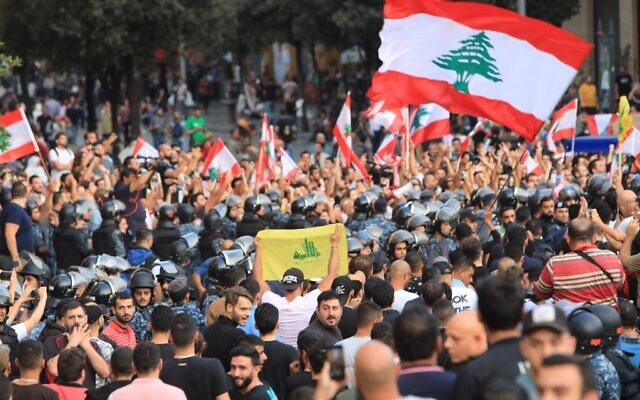
Lebanese security forces stand between Hezbollah (foreground) and anti-government protesters (background) at Riad al-Solh square in the capital Beirut on October 25, 2019. (AFP)

Before they retreated, Hezbollah backers threw rocks, plastics bottles and branches at the other demonstrators, who responded in kind chanting “Revolution.”

Scuffles also broke out in central Beirut before the speech, when Hezbollah supporters entered the area to reject chants against Nasrallah, who was named by the protest movement as one among the political elite who must leave.

“Nasrallah is more honorable than all of them,” the pro-Hezbollah protesters chanted. They clashed with the protesters who were previously in the square until riot police tried to break up the fight. The incidents came shortly before Nasrallah was due to speak.

Anger has been building among Hezbollah supporters because the protesters named him, along with other corrupt politicians. At least two protesters were injured. The riot police encircled the pro-Hezbollah protesters, who carried batons, separating them from the other protesters.

But tension returned when the protesters moved down the main road, lobbing stones and at one point attacking a TV crew from a station aligned with a Hezbollah rival. Some protesters chanted for calm.
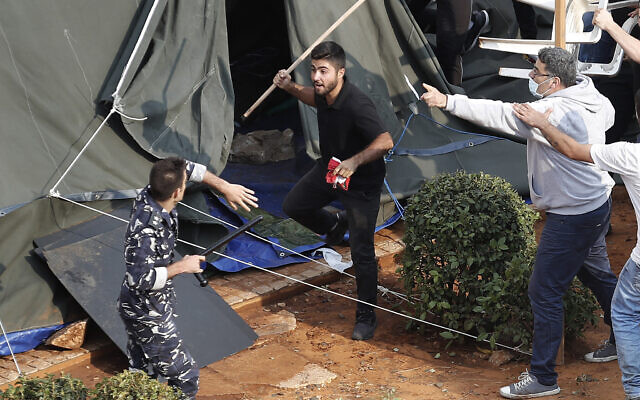
A Hezbollah supporter, right, fights with a Lebanese riot policeman, left, after a clashes erupted between Hezbollah and anti-government protesters near the government palace, in downtown Beirut, Lebanon, October 25, 2019. (AP Photo/Hussein Malla)

Banks, universities and schools remained closed Friday, the ninth day of nationwide protests, which initially were triggered by new proposed taxes that followed public spending cuts.

The demonstrators — who have thronged towns and cities across Lebanon — have been demanding the removal of the entire political class, accusing many across different parties of systematic corruption.

Numbers have declined since Sunday, when hundreds of thousands took over Beirut and other cities in the largest demonstrations in years, but could grow again over the weekend.

Lebanon’s largely sectarian political parties have been wrong-footed by the cross-communal nature of the protests.

Drawing in Christians and Muslims, Shiite, Sunni and Druze, the street movement has largely been peaceful — evolving into celebrations after nightfall.

Waving Lebanese national flags rather than the partisan colors normally paraded at demonstrations, protesters have been demanding the resignation of all of Lebanon’s political leaders.

“All of them means all,” has been a popular slogan.
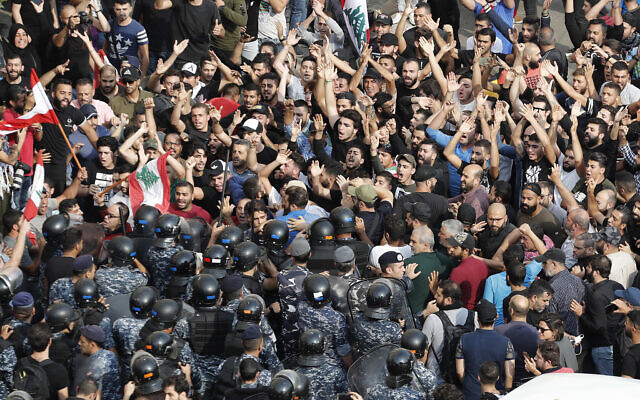
Hezbollah supporters stand in front of Lebanese riot policemen, as they shout slogans praising the terror groups leader Hassan Nassrallah, during a protest near the government palace, in downtown Beirut, Lebanon, October 25, 2019. (AP Photo/Hussein Malla)

In attempts to calm the anger, Prime Minister Saad Hariri has pushed through a package of economic reforms, while President Michel Aoun offered Thursday to meet with representatives of the demonstrators to discuss their demands.

But those measures have been given short shrift by demonstrators, many of whom want the government to resign to pave the way for new elections.

The unprecedented mass protests come amid a deepening economic crisis in Lebanon. The country is one of the world’s most indebted nations, with public debt over 150 percent of the gross domestic product. The protesters accuse the politicians of amassing wealth even as the country gets poorer.


Zawartość publikowanych artykułów i materiałów nie reprezentuje poglądów ani opinii Reunion’68,
ani też webmastera Blogu Reunion’68, chyba ze jest to wyraźnie zaznaczone.
Twoje uwagi, linki, własne artykuły lub wiadomości prześlij na adres:
webmaster@reunion68.com


ENCOUNTERING PEACE

ENCOUNTERING PEACE: THE UNLIKELY POSSIBLE SCENARIO

GERSHON BASKIN


As long as Netanyahu is not cleared of all charges, from the clear moral point of view, he should not be allowed to rule Israel.

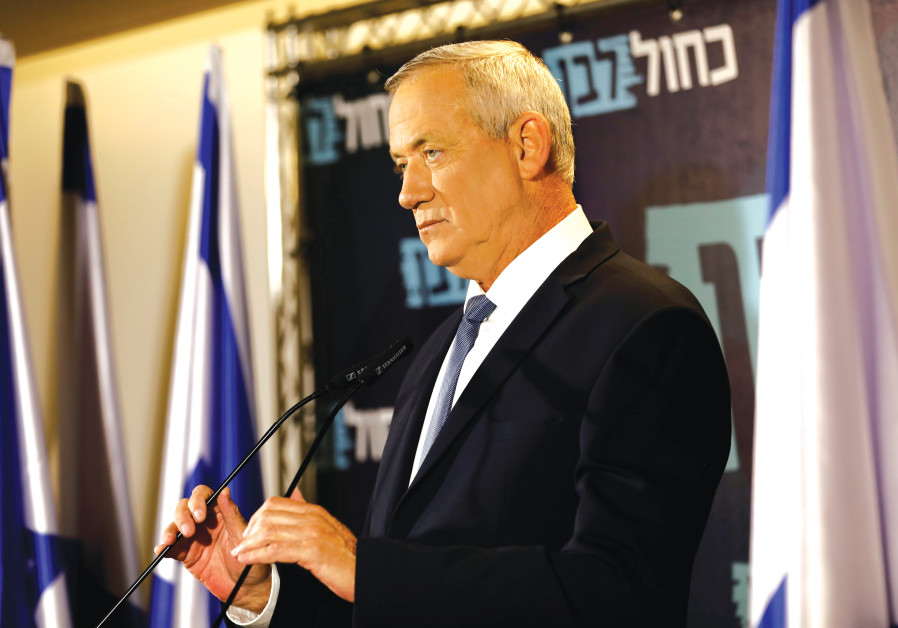
BENNY GANTZ : His government would only have to last until Netanyahu is indicted. (photo credit: REUTERS)

It should be no surprise to the readers of this column that as unlikely as it is, I hope that there will be a new center-left government led by Benny Gantz.

Even if that government is a minority government which is supported from the outside by the Joint List, and Liberman’s Yisrael Beytenu abstains, in a matter of a few months that new government could set Israel on a new and must desired course. It would be the beginning of a correction course resetting Israel’s path toward peace within the country, especially regarding Jewish-Arab relations. It would be a course correction in once again presenting an outstretched hand to our Palestinian neighbors. And it would be a correction course in setting parameters for equality and equal opportunities for the entire Israeli society, without incitement against any part of the society.

What’s in it for Liberman? If he and his party colleagues are serious about their stated agenda, a new center-left government could deliver on all of his secular demands: public transportation on Shabbat, the reform mandatory IDF military service draft law that was the stated reason for bringing down the last two Knessets, core curricula for all schools, keeping grocery and convenience stores in secular areas open on Shabbat, and almost anything else Liberman would want.

The Joint List would support the government because Gantz’s first phone call would be to Palestinian Authority President Mahmoud Abbas to renew the belief that peace on the basis of two states for two peoples is once again possible. Then Gantz would call Egyptian President Abdel Fattah al-Sisi and Jordanian King Abdullah to call for a regional summit together with Abbas to renew negotiations and peaceful relations. Furthermore, the new government would either amend the Nation-State Law or abolish it and pass a Citizens Equality Law based on the Declaration of the Establishment of the State of Israel.

The ultra-Orthodox parties would without doubt have the greatest fears about these possibilities, but the new government could provide reassurances by including in the new state budget aboveboard funding with benchmarks for parity and equality for all schools – including haredi schools from all streams, Arab schools and periphery schools – with an emphasis on providing additional equalization funds for those schools in all communities that have been left behind in recent years. Immediate plans for dealing with the housing crisis, especially for young couples, including young haredi couples, could be addressed in the new budget.

A settlement building freeze, perhaps with the exception of Betar Illit and Modi’in Illit, could be set, enabling resources that today are spent beyond the security barrier to be spent inside of Israel in the communities with the greatest needs.

A social network could begin to be rebuilt, including investment for public housing and an immediate infusion of resources into the health system.

All of this could be done by resetting priorities and making the necessary budgetary adjustments.

BUT EVEN if such a government were established, it would not last long. A minority government can stay in power as long as 61 members of Knesset don’t support a vote of no confidence. A military flare-up from the north or from Gaza could easily bring down the government. Gantz and Blue White would not feel very comfortable remaining in such a government, and from the point of view of the so-called democratic will of the people, the government should have a majority of support from the elected Knesset.

From the point of view of the centralist camp led by Blue and White, the government has to last only until Benjamin Netanyahu is indicted, as is expected. At that point, public opinion would force Netanyahu to stand down, at least until he could clear himself of all charges of corruption. Once Netanyahu is out of the picture, Gantz and his team would probably invite the Likud to join the government and to replace Labor and the Democratic Union with a so-called national-unity government. It may seem far-fetched, but in fact it may be the only way that Gantz can form a government and become prime minister.

As long as Netanyahu is not cleared of all charges, from the clear moral point of view, he should not be allowed to rule Israel. In fact, any suspected public servant with charges of corruption against him should be forced out of office. Moreover, the suspected public servant should not have to be forced out; he should resign on his own. In a self-respecting democracy a public servant who was convicted of a crime against the public should not be allowed to serve as a public servant, for the rest of his life – not only for a period of seven years. Netanyahu must not return as leader of this country, as long as he has not proven his complete innocence. There are many other reasons Netanyahu should not continue to lead Israel, but those are matters of political beliefs, values and performance, and can be legitimately debated and argued within a democracy. The issues concerning the alleged criminal behavior of the prime minister should be beyond debate.

The single most significant reason that has prevented the creation of the so-called national-unity government is the refusal of Netanyahu to stand down until clearing the suspicions. The attorney-general will probably not issue the indictments against Netanyahu within the next 28 days allotted to Gantz to form a government. In that case, our best option is to move forward with the scenario described above. It is possible, it is legitimate and, from my point of view, it is the best possible outcome from the recent elections.


The writer is a political and social entrepreneur who has dedicated his life to the State of Israel and to peace between Israel and her neighbors. His latest book, In Pursuit of Peace in Israel and Palestine, was published by Vanderbilt University Press.


Zawartość publikowanych artykułów i materiałów nie reprezentuje poglądów ani opinii Reunion’68,
ani też webmastera Blogu Reunion’68, chyba ze jest to wyraźnie zaznaczone.
Twoje uwagi, linki, własne artykuły lub wiadomości prześlij na adres:
webmaster@reunion68.com