Archives

Modern-Day Immigrants, and How Eleanor Roosevelt Saved Jewish Refugees

Modern-Day Immigrants, and How Eleanor Roosevelt Saved Jewish Refugees from the Holocaust

Eliana Rudee / JNS.org


Eleanor Roosevelt speaks to a war-time audience, while Rose Pesotta and others listen. Photo: Flickr.

JNS.org – In 1940, a passenger cargo ship called the SS Quanza left the port of Lisbon carrying several hundred Jewish refugees to freedom. But no country would take them in, and so the passengers became trapped on the ship.

Nobody Wants Us tells the gripping true story of how Eleanor Roosevelt, along with two other integral figures, stepped in to save the passengers on board, because of her moral conviction that they were not “undesirables,” as the US State Department labeled them, but rather “future patriotic Americans.” She sympathized with the refugees, as her family too were once immigrants to the United States.

The 35-minute film by Laura Seltzer-Duny, which premiered in New York City on August 11 (coinciding with Tisha B’Av, a day of mourning on which numerous tragedies befell the Jewish people) by the Sousa Medes Foundation and the American Sefardi Federation, intends not only to restore the history of the Quanza after 79 years, but to illustrate the power of individuals to change history and save lives.

“It brought me to tears to hear what my parents risked to bring me here,” Lucienne Geldzahler, an audience member at the film’s premiere, said. Her family from Antwerp arrived on American shores from Lisbon on a similar ship, she said.

As the experiences of political refugees continue to top headlines in the United States, Stephen Morewitz — a leading expert on the Quanza and the grandson of attorney Jacob L. Morewitz, who helped save the passengers — said “this is an episode in American history that everyone needs to know.”

At the beginning of World War II, Portuguese diplomat Sousa Mendes defied the orders of his regime, and issued visas and passports to 40,000 refugees fleeing Nazi Germany, such as the artist Salvador Dali; Margret Rey and H. A. Rey, the authors of the Curious George books; and tens of thousands of other Holocaust refugees, including many aboard the SS Quanza.

“If so many Jews are suffering because of one man, Hitler, surely I can suffer for so many Jews,” said Mendes, who was later recognized by Israel as a Righteous Among the Nations.

On August 9, 1940, the SS Quanza left Lisbon — one of the few ports from which Jews could flee Europe — carrying hundreds of Jewish refugees from dozens of European countries who had received such visas.

However, the journey turned out to be more than a month long. The Jews aboard were transported from port to port for a month, refused entry in the United States and then Mexico.

Breckinridge Long, supervising the US State Department’s Visa Division under President Franklin D. Roosevelt, turned the immigrants away, wanting to shut down immigration (infamously writing in his diary that “Hitler’s Mein Kampf is eloquent in opposition to Jewry”) and seeing the immigrants as “undesirables.” He voiced concern that allowing the immigrants into America would compromise national security, as there could be “potential Nazis” on the ship, as well as “Jewish communists.”

Just as the vessel returned to Virginia to buy fuel for the way back to Europe, first lady Eleanor Roosevelt spoke to maritime lawyer Jacob L. Morewitz, who successfully delayed the departure of the ship to buy time to litigate the case and allow the passengers to enter the United States.

As the group was finally able to disembark, women from a Jewish society brought cars and began to pick up the refugees late at night, hosting them until they found accommodations.

Michael Dobbs, author of The Unwanted and project director for the Simon-Skjodt Center for the Prevention of Genocide at the United States Holocaust Memorial Museum, was the first to write about the history of the SS Quanza in 1990, maintaining that it was forgotten over time as Eleanor Roosevelt saw the event as a defeat, since Long was given total power following the SS Quanza episode.

Dobbs noted at the premier, “The Quanza incident is a timely reminder that individuals make a difference. Without visas supplied by the Portuguese diplomat Aristides de Sousa Mendes, many of the Jewish passengers on board might well have been stranded in Nazi-occupied Europe.”

“Without the legal brilliance of a maritime lawyer named Jacob Morewitz, the ship would have been obliged to sail back to Europe. Without the intervention of … Eleanor Roosevelt, the passengers would not have been permitted to land,” he continued. “It took three people, from entirely different backgrounds, to save … lives that might otherwise have been lost.”

Jason Guberman, executive director of the American Sefardi Federation, said, “With the rise of hate (particularly antisemitism), bigotry, and fanaticism globally, and as the Iranian regime disingenuously denies the Holocaust while enthusiastically endorsing a new genocide against the Jewish people, it is imperative to learn from and emulate the righteous of the past as we stand against evil.”

In this story, that evil, maintained Blanche Wiesen Cook, a world expert on Eleanor Roosevelt and the author of her three-volume biography, was represented by silence.

“Everything was known by people who could have made a difference, but the silence was resounding,” she said.

While the United States began to bomb Nazi economic infrastructure in 1944, it is suggestive that the railroad to Auschwitz was not bombed. The US Treasury Department’s “Report to the Secretary on the Acquiescence of This Government in the Murder of the Jews” not only found the State Department guilty not only of “gross procrastination and willful failure to act” during the slaughter of the Jewish people in Europe, but stated that there were also “willful attempts to prevent action from being taken to rescue Jews from Hitler.”

“It is clear that Franklin D. Roosevelt could have done so many things, like fire Breckinridge Long,” said Wiesen Cook. “He did not want to let the refugees in and risk the upcoming election.”

“Even the silence of the American Jewish community was beyond unfortunate,” she added. “Eleanor Roosevelt acted as a visionary, saying we will have peace when we all have education, jobs, housing, security, and health care. She made the refugees an interest, opposed fascism, and said that everybody on the SS Quanza could be her guest.”

In addition to airing a longer version of the film on PBS in 2020, Seltzer-Duny and New Day Films are distributing the film to public high schools and junior high schools, along with educational material to accompany it. “We need to reach the community at large, who get a little bit of Holocaust education but not enough,” she told JNS. “By taking this film and deconstructing it, teachers can create more empathy for the refugee plight then and now by understanding America’s response with volunteers on the ground, who took a chance and helped.”

“It’s up to us not to stay silent when we see refugees struggling now because it happened to us — we were refugees, too — and we need to stand up for [them] and educate about what happened so that it doesn’t happen again,” she said.



Zawartość publikowanych artykułów i materiałów nie reprezentuje poglądów ani opinii Reunion’68,
ani też webmastera Blogu Reunion’68, chyba ze jest to wyraźnie zaznaczone.
Twoje uwagi, linki, własne artykuły lub wiadomości prześlij na adres:
webmaster@reunion68.com


Group of Israelis Said Brutally Attacked in Warsaw by Arab Men Shouting ‘Free Gaza’

Group of Israelis Said Brutally Attacked in Warsaw by Arab Men Shouting ‘Free Gaza’

Benjamin Kerstein


Israeli Yotam Kashpizky after being beaten by a group of Arabs in Warsaw, Poland, September 8, 2019. Photo: Facebook screenshot.

A group of Israelis were accosted and one severely beaten in Warsaw, Poland by a group of Arab men, who attacked them because of their national origin, the brother of one of the victims alleged on Sunday.

Yotam Kashpizky was left with facial and ocular fractures by the assault, which his brother Barak described in a Facebook post together with photographs of his brother’s injuries.

Barak stated that Yotam was assaulted in the early hours of Sunday morning by “a group of Arabs” who attacked him without provocation.

“The Arabs began beating him and his friends only because they were Jewish,” Barak said. The group of Israelis were returning to their hotel from a nightclub, he added.

“A group of Arabic-speakers approached them and asked if they were from Israel,” Barak recounted. “When they replied in the affirmative, they were mercilessly attacked, accompanied by shouts of ‘f**k Israel.’” He later told an Israeli news station that they also chanted “free Gaza” during the attack.

Yotam, he added, was in a taxi at the time, and ran toward his friends in an effort to stop the attack.

“An Arab man, who was apparently wearing brass knuckles, punched him and Yotam lost consciousness,” said Barak. “Afterwards, another friend came out of another taxi in order to help.”

At that point, some girls in the Israeli group began to scream and the attackers fled.

Barak spoke bitterly of the bystanders at the scene, saying none of the Poles did anything to help.

“Even the security guards at the club who were called to help didn’t lift a finger,” he said.

“Yes, 2019, Warsaw, Poland, and the reality is returning,” Barak asserted. “Poles stand by and watch, while people ‘not of their people’ beat Jews to the point that they lose consciousness. Today it’s my brother, tomorrow it will be one of your relatives.”


Zawartość publikowanych artykułów i materiałów nie reprezentuje poglądów ani opinii Reunion’68,
ani też webmastera Blogu Reunion’68, chyba ze jest to wyraźnie zaznaczone.
Twoje uwagi, linki, własne artykuły lub wiadomości prześlij na adres:
webmaster@reunion68.com


Five Rockets Fired at Southern Israel

Five Rockets Fired at Southern Israel as Border Riots Continue

Reuters and Algemeiner Staff


An Iron Dome battery fires an interceptor missile as rockets are launched from Gaza toward Israel near the southern city of Sderot, Aug. 9, 2018. Photo: Reuters / Amir Cohen.

Five projectiles were launched from the Gaza Strip toward Israel late Friday night, the Israeli military confirmed after rocket warning sirens sounded in the Israeli border town of Sderot and two nearby villages shortly before midnight.

One rocket fell in an open field but there were no injuries, Israeli media reports said.

Israel responded with tank and air strikes on a number of Hamas military targets in the northern Gaza Strip, an Israeli military spokesman said. Palestinian officials said no one was injured.

At the same time, the weekly riots on the Gaza-Israel border continued, with two rioters shot by IDF forces.

An Israeli military spokesman said troops guarding the border on Friday were faced with more than 6,000 demonstrators at several points along the fence, some hurling explosive devices and firebombs.

He said that some briefly managed to cross the fence before returning to Gaza, and that Israeli forces responded with riot dispersal measures.

Egypt, Qatar, and United Nations officials have been working to keep the border calm in recent months.

Around 210 Palestinians have been killed since the riots began in March 2018, Gaza medical officials say.

In that period, an Israeli soldier was shot dead by a Palestinian sniper along the frontier, and another was killed during an Israeli undercover raid into Gaza.


Zawartość publikowanych artykułów i materiałów nie reprezentuje poglądów ani opinii Reunion’68,
ani też webmastera Blogu Reunion’68, chyba ze jest to wyraźnie zaznaczone.
Twoje uwagi, linki, własne artykuły lub wiadomości prześlij na adres:
webmaster@reunion68.com


OUR MISSION IS TO SAVE LIVES

UNITED HATZALAH: OUR MISSION IS TO SAVE LIVES

ELI BEER


“At an early age, I realized what I wanted to do was to save lives. I wanted to be a doctor, but instead life took me in the direction of creating a volunteer EMS organization.”

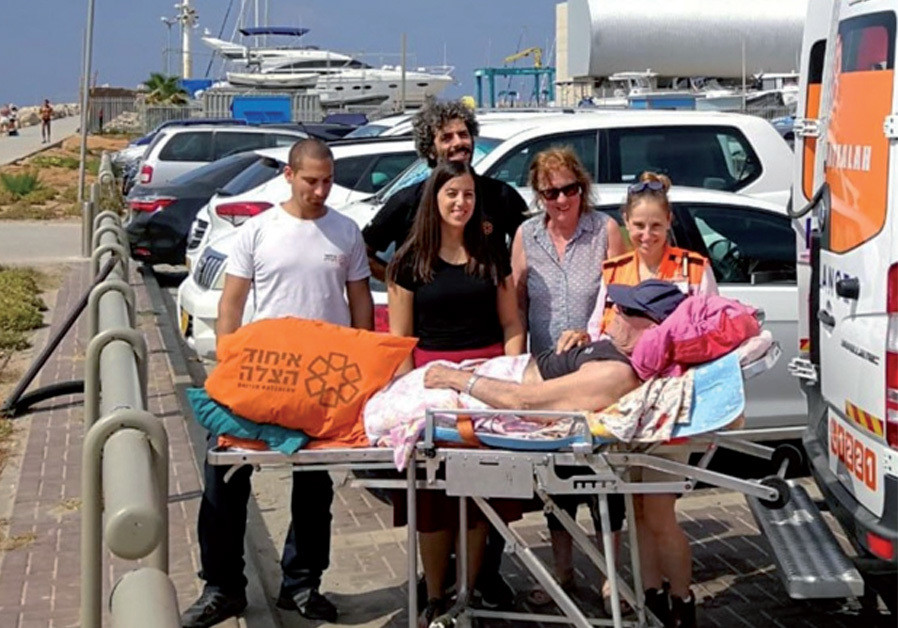
Yehuda and the United Hatzalah team. (photo credit: Courtesy)

I have been working in emergency medical services for 30 years and began volunteering when I was 16 in the back of an ambulance.

The first time that I responded on my own and managed to save a life, I realized that I needed to create a first response organization comprised of volunteers who would be willing to drop everything, run out on their family and friends at a moment’s notice, and wake up in the middle of the night to help strangers whom they never had met.

Basically, I needed a bunch of like-minded people to save many lives. But people called me meshugga.

Some years later, I had a dream of achieving a three-minute response time for first responders across all of Israel. People thought that this, too, was meshugga.

Later, my dream grew to take the model of what became known as United Hatzalah and expand it to other countries around the globe. This, too, people thought was meshugga.

But I achieved those goals because people saw that I was meshugga for a good reason and they joined me.

I’ve often believed that everyone is a little crazy in their lives, and that the question we all face in life is: what do we do with it?

At an early age, I realized what I wanted to do was to save lives. I wanted to be a doctor, but instead life took me in the direction of creating a volunteer EMS organization.

I am blessed to have nearly 6,000 people join me in that mission and make my dream become a reality. These people are passionate and dedicated to helping others whom they’ve never met just because help is needed. The result is that we manage to save people who would otherwise not be saved.

When my own father collapsed with a heart attack, the first person at the scene was a Muslim volunteer from east Jerusalem who shares my meshuggas. The feeling I had at that moment was one that I will never forget.

It is the feeling of self-worth that comes with saving another person, not because you get paid to do it, not because anyone is there with fanfare, but simply the knowledge that the effort one puts in, the self-sacrifice involved in responding, can save the life of another.

This is what gives the impetus to a whole network of people all over the country to give of themselves to save others. It has created communities of people and crosses social, religious and cultural boundaries to unify them under a single banner. It is the reason that 20,000 children dress up as United Hatzalah EMTs every year for Purim – because they want to be part of this meshuggas when they get older. It is why we have 1,000 new trainees every year who want to join this meshuggas, so that they, too, can be a part of a national revolution of helping people, no matter who they may be.

I DIDN’T truly understand this until one of my own children started to volunteer. One of my daughters became an EMT while she was a young teenager, and the reason she did this is that she saw the look on my face when I came home after I had successfully saved a life.

The sense of fulfillment after saving a life is beyond anything else I have ever felt. When I succeed at a business deal, it never makes me as happy as when I help someone else.

My children grew up watching this. Today, four of my five kids and my son-in-law are United Hatzalah volunteers and save lives. It shows me that the thing that drives most people is the desire to be a part of something bigger, something that not only helps other people but can make a meaningful impact on another person’s life, while at the same time uniting them with like-minded people across an entire country.

The more meshuggeners we have in this country who use their meshuggas to help others, the better off we will all be.


The writer is a social entrepreneur and president and founder of United Hatzalah of Israel, an independent, nonprofit, fully volunteer EMS organization that provides fast and free emergency first response throughout Israel.


Zawartość publikowanych artykułów i materiałów nie reprezentuje poglądów ani opinii Reunion’68,
ani też webmastera Blogu Reunion’68, chyba ze jest to wyraźnie zaznaczone.
Twoje uwagi, linki, własne artykuły lub wiadomości prześlij na adres:
webmaster@reunion68.com


Postcard from Israel: Beersheva

Postcard from Israel: Beersheva

  21see


Postcard from Israel: Beersheva
Once a financially plagued metropolis, Beersheva is today a center of modernity, culture, academia and high-tech. The city’s development is seen in its urban design elements, playgrounds and parks, and newly erected university buildings and office towers.

Video by Asi Aivas for ISRAEL21c

Produced by Viva Sarah Press for ISRAEL21c


Zawartość publikowanych artykułów i materiałów nie reprezentuje poglądów ani opinii Reunion’68,
ani też webmastera Blogu Reunion’68, chyba ze jest to wyraźnie zaznaczone.
Twoje uwagi, linki, własne artykuły lub wiadomości prześlij na adres:
webmaster@reunion68.com