
Archives

GUNS OR NO GUNS AT SYNAGOGUE?

GUNS OR NO GUNS AT SYNAGOGUE?

MICHAEL MASTERS


Recently, the US antisemitism envoy, Elan Carr, stated that guards should be posted at every synagogue and Jewish community center in the US. The question was asked: Should the guards be armed?
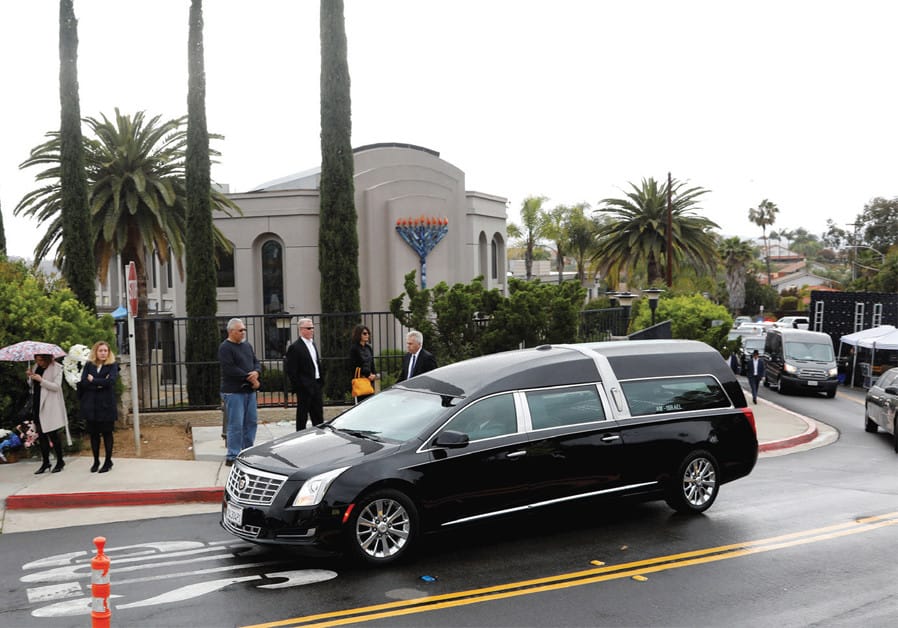
A HEARSE carrying the body of Lori Gilbert- Kaye, the sole fatality of the April 27 synagogue shooting that also left three injured, leaves the Chabad of Poway in San Diego, California, on April 29. Nineteen-yearold white supremacist John T. Earnest shot up the Chabad in a copycat attack inspired by. (photo credit: JOHN GASTALDO/REUTERS)

There were 27 mass attacks in public spaces in 2018, according to the United States Secret Service.

One of those occurred on October 27 at the Tree of Life Synagogue in Pittsburgh, Pennsylvania, where 11 people were murdered. Exactly six months later, an individual walked into another synagogue in Poway, California, and opened fire with an assault rifle. His attack was interrupted and he fled. The reality of these attacks has forced a debate in houses of worship and within the Jewish community specifically. What is the role of guards and firearms in houses of worship?

Recently, the US antisemitism envoy, Elan Carr, stated that guards should be posted at every synagogue and Jewish community center in the US. The question was asked: Should the guards be armed?

Ask anyone in the Jewish community if they want people with guns at their houses of worship and you’ll get deeply divided opinions. From “guns are not the answer” to “the best way to stop a bad guy with a gun is a good guy with a gun,” Jewish worshipers are at odds.

In the wake of the killings at synagogues in Pittsburgh and Poway, protecting Jews in their houses of worship is no idle matter.

Regardless of what someone thinks on the issue of armed guards, action must be taken to make our synagogues safer. More importantly, guards – if a facility does have them – are only one part of a comprehensive security strategy.

Every synagogue should have a well-developed, well-practiced security plan. These plans must ensure that the Jewish community is prepared, empowered and resilient through best practices, standardized efforts that while unique to each community, are consistent in their approach. My group, the Secure Community Network (SCN), the official security organization of the Jewish community, works throughout the country to ensure exactly this.

Communities must also have access to security professionals who are responsible for developing and implementing security plans. Already, more than 40 communities have hired trained, knowledgeable experts to oversee their prevention and response efforts.

Having a close, working relationship with local, state and federal law enforcement is critical. The FBI and the Department of Homeland Security have specialized divisions that work with the faith-based community to share information, provide services and support community resiliency. Giving local police regular access to Jewish facilities allows first responders to be familiar with where to go and what to do.

WHILE SOME entities have the resources to seek complex, expensive security systems, many institutions should know that there are often low to no-cost things that they can do. Locking all doors, except one main entry and exit, is a crucial component of a security plan. Cameras can be effective, but only if they’re actively monitored by people who know what they’re looking for and know what to do if they see it.

Another essential component of a security plan is training. People must be prepared. That is why training in everything from situational awareness and active threat responses to emergency procedures and “Stop the Bleed” training is necessary.

If armed guards are a part of a security plan, then institutions should insist on having individuals who are competent and capable of keeping people safe. On-duty or off-duty law enforcement professionals, or retired law enforcement professionals who continue to meet crucial certifications under federal statute, are often the best option to ensure this.

Make no mistake: unarmed personnel are not security guards. They can be referred to as greeters or safety officers but we have to be honest about their capability. They often cannot be relied upon to perform a security function, so we shouldn’t mislead people with how we refer to them.

If a Jewish facility is relying on armed volunteers or other individuals who lack the highly specialized training to protect people in the face of a deadly threat, it can be a potentially dangerous deficiency.

Volunteers almost always lack the training – and crucial, real-world experience – necessary to know what to do in a worst-case scenario. Armed professionals, on the other hand, must undergo extensive and ongoing training in recognizing and responding to potential and active threats. That’s why they can be more expensive to hire.

All of these issues are why SCN is organizing a meeting this August of security experts to discuss when and how to hire guards, what guards to hire, and to advise communities on best practices. If a Jewish facility is going to include armed security personnel as part of its plan, there is only one way to do that – and that’s to do it carefully and wisely.

We live in a time of danger. We know threats exist. But we also know that preparation is critical to minimizing and eliminating future attacks. It must be comprehensive.


The writer is a former Marine Corps captain and the national director and CEO of the Secure Community Network. A certified police officer, he is trained in special weapons and tactics and has served on numerous task forces for the Department of Homeland Security. He previously served on the executive board of the FBI’s Chicago Joint Terrorism Task Force.


Zawartość publikowanych artykułów i materiałów nie reprezentuje poglądów ani opinii Reunion’68,
ani też webmastera Blogu Reunion’68, chyba ze jest to wyraźnie zaznaczone.
Twoje uwagi, linki, własne artykuły lub wiadomości prześlij na adres:
webmaster@reunion68.com

Boycott of Israel During ‘Academic Freedom’ Lecture in South Africa

Anti-Zionist Former Academic Ditched by US University Urges Boycott of Israel During ‘Academic Freedom’ Lecture in South Africa

Ben Cohen


The main plaza at the University of Cape Town in South Africa. Photo: Reuters / Mike Hutchings.

An American anti-Zionist academic who lost a tenured university position over his graphically-antisemitic outbursts on Twitter surfaced at the University of Cape Town (UCT) in South Africa on Wednesday, where he delivered a fierce attack on the “corporate university” and depicted Israel as the supine tool of an international “ruling class.”

Steven Salaita — whose inflammatory comments on social media during Israel’s Operation Protective Edge in Gaza in 2014 led to the University of Illinois-Urbana Champaign (UIUC) revoking a tenured job offer it had made to him — delivered the 2019 T.B. Davie Memorial Academic Freedom lecture on what he called “the inhumanity of academic freedom.”

Deploying a mixture of simplified Marxist economics with progressive identity politics, Salaita told the audience in Cape Town that academic freedom meant little in an “economy structured around obedience.”

Assailing the concept of “academic freedom” as a ruse that distracted from the cause of genuine social freedom, Salaita insisted that Israel was a major beneficiary of the “structural forces, often unseen, always beneficial to an elite” who “determine what gets heard,” according to a summary of his remarks tweeted by the Palestine Solidarity Forum at UCT.

“Why does Israel, such a small country, enjoy such prominence on campuses?” Salaita asked. “Because Israel humors the ruling class.”

Salaita praised South Africa as the “global moral leader in the Palestinian people’s struggle.” He also expressed strong support for the campaign at UCT for an academic boycott of Israel, arguing creatively that “when the UCT Senate passed a motion against Israeli universities violating human rights, there was a flurry of discontent. Most of them cited academic freedom, and exercised their power to shut down the motion.”

Therefore, opponents of an academic boycott of Israel “themselves, in so doing, violate academic freedom,” Salaita claimed.

By the standards of Salaita’s previous outpourings, Wednesday’s lecture in South Africa was comparatively restrained. In his 2014 tweets — posted when he was a professor of English at Virginia Tech — Salaita displayed a disturbing affinity for terrorist violence, declaring, “You may be too refined to say it, but I’m not: I wish all the f***ing West Bank settlers would go missing,” after Hamas operatives kidnapped three Jewish teenagers from a Gush Etzion hitchhiking post and murdered them.

Other hyperbolic tweets from Salaita included the claim that there was a “sexual…Zionist pleasure w/ #Israel’s aggression,” and that Zionism had transformed antisemitism from “something horrible into something honorable since 1948,” the year of Israel’s creation.

Salaita’s presence in South Africa this week did not pass without criticism. In an article for local website PoliticsWeb published on Monday, South African scholar David Benatar questioned whether the invitation to Salaita would have been extended had his slurs against Jews been aimed at another minority group.

“Consider the case of an American academic whose tweets include the following,” Prof. Benatar wrote. “‘You may be too refined to say it, but I’m not: I wish all the f***ing Mexicans would go missing…’ ‘African nationalists in South Africa: transforming racism from something horrible into something honorable since 1994.’”

Wrote Benatar: “The UCT Academic Freedom Committee; has invited Dr Steven Salaita to deliver the 2019 Academic Freedom lecture named in memory of Dr Thomas Benjamin Davie, former UCT Principal who fought the imposition of Apartheid on UCT in the 1950s…[whatever he says] no matter how vile, he has a right to say it and I would oppose any call for him to be disinvited, heckled, or otherwise silenced.”

Benatar added that he was “not aware of any such calls.” Still, he continued, it did not follow that Salaita “was a fitting invitee to deliver an academic freedom lecture in memory of Dr Davie, or that anybody should go listen to him.”

A separate online petition addressed to UCT urged the university authorities to organize “alternative programming to ensure that opposing views are heard. Salaita’s lecture can be used as a teachable moment to educate the community about the consequences of following his advice.”

The petition, which gathered over 60,000 signatures, noted: “It is particularly critical to do so because Cape Town is presently considering a proposal to support an academic boycott of Israeli universities. It would be unwise and unprofessional to make that decision without a full airing of competing views.”

Written by Prof. Cary Nelson — a former head of the American Association of University Professors (AAUP) — the petition also underlined that Salaita’s anti-Zionism had “led him to cross a particularly dangerous line into anti-Semitism: he urged that Zionists be cast out of progressive organizations and campaigns. The effect on a campus or community would be abhorrent.”

Nelson asserted that there was “more than one painful irony at stake in selecting Salaita as a spokesperson for academic freedom.”

Salaita’s “long term support for an academic boycott of Israeli universities puts him in conflict with the fundamental values that define the academy, foremost among those being the principle that faculty members worldwide be free to communicate their research and analysis with one another without restraint or inhibition,” Nelson wrote.

Jewish organizations in South Africa also leveled criticism at UCT for its invitation to Salaita.

In a statement emailed to The Algemeiner, the head of the South African Zionist Federation charged that UCT’s Academic Freedom Committee — which hosts the annual lecture — had “now simply become a vehicle to steamroll a boycott of Israeli academia at the expense of UCT’s reputation and international standing.”

The committee had “weaponized the concept of academic freedom in order to bash the one and only Jewish State,” the federation’s national chairman, Rowan Polovin, wrote.

“We call on the University of Cape Town to disband the current committee and demonstrate its commitment to academic freedom at the University,” Polovin concluded.

After the University of Illinois-Urbana Champaign (UIUC) rescinded the tenured job offer made to him in 2014, Salaita was subsequently hired by the American University of Beirut in Lebanon. That institution decided not to renew his contract after he taught there for one academic year.


Zawartość publikowanych artykułów i materiałów nie reprezentuje poglądów ani opinii Reunion’68,
ani też webmastera Blogu Reunion’68, chyba ze jest to wyraźnie zaznaczone.
Twoje uwagi, linki, własne artykuły lub wiadomości prześlij na adres:
webmaster@reunion68.com


FIVE HEADLINES SHOW WORLDWIDE ANTI-JEWISH INCIDENTS – ANALYSIS

FIVE HEADLINES SHOW WORLDWIDE ANTI-JEWISH INCIDENTS – ANALYSIS

SETH J. FRANTZMAN


Jews have to consider whether it is safe to wear identifiably Jewish symbols and to consider how and where they pray.

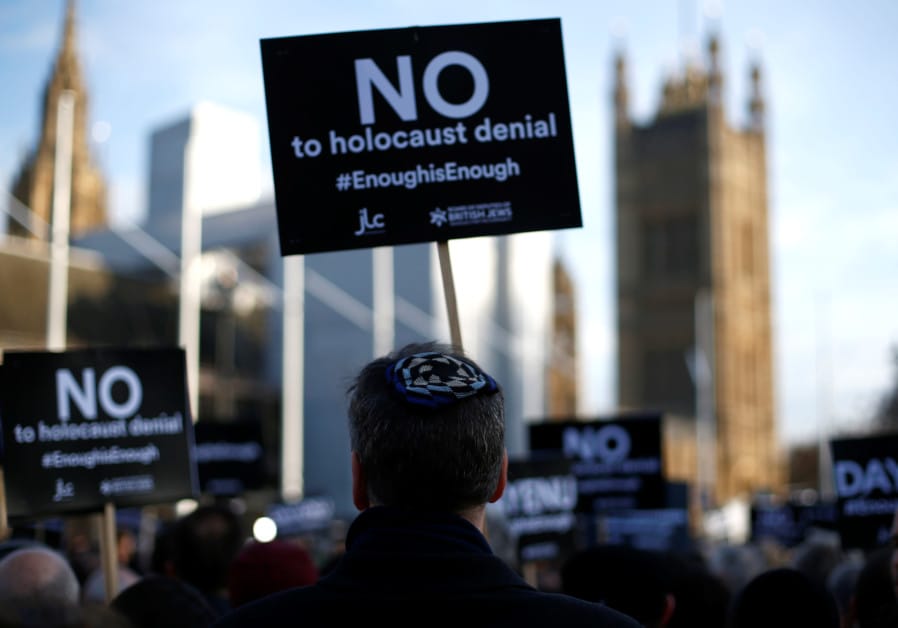
Protesters hold placards and flags during a demonstration, organised by the British Board of Jewish Deputies for those who oppose antisemitism, in Parliament Square in London. (photo credit: HENRY NICHOLLS/REUTERS)

Five headlines from the last forty-eight hours capture increasing antisemitism and anti-Jewish incidents. They show a pattern of hatred and attacks on Jews, Jewish symbols and intolerance towards Jews that is worldwide. These kinds of incidents have happened in the past, but the proximity of them all at the same time paints a disturbing picture of a world in which, in many countries, Jews have to consider whether it is safe to wear identifiably Jewish symbols, and consider how and where they pray.

“Second antisemitic assault in Canada in less than a week,” reads one headline that tells of an incident in Toronto where two Jewish youths with kippahs were assaults in Toronto. In Montreal a taxi driver also cursed a Jewish man. Last year there were more than 2,000 anti-Jewish incidents in Canada, according to the report.

In another incident in Munich reported this week, a rabbi and his sons were “insulted and spat upon” while walking home from synagogue over Shabbat. Antisemitic attacks have almost doubled over the last year while Chancellor Angela Merkel remains in office. According to data the number of attacks increased from 28 in 2017 to 48 in 2018. A separate report in DW says that another Jewish person found graffiti in their apartment building this week.

In Jordan Jewish tourists complained that they were searched for kippahs and banned from praying at Aaron’s tomb. This controversy allegedly began after video showed Jews had prayed at the tomb and it was then closed by the religious authorities because of the “illegal” prayer. But the more controversial aspect of the story is that Jews reported being searched for prayer shawls and kippahs.

 In Turkey a summer camp showed young women shouting “death to the Jews.” The camp, allegedly run by a far-right Islamic group, shows younger girls and teenage women, some clad in all-black, shouting “death” when the word “Jew” is used. The video which circulated on Twitter has caused some controversy in Turkey where more left-leaning voices have asked for it to be investigated. The group that encouraged the young women to call for the murder of Jews also calls for Palestine to be “cleansed” of Jews, according to The Jewish Chronicle, linking hatred of Jews to hatred of Israel.  

Lithuanian Jews shut their community center due to threats. The JTA reports that the only functioning synagogue has been shut down after receiving threatening phone calls. The community closed the Choral Synagogue in Vilnius, a city that once had a large Jewish population and was called the “Jerusalem of the north.”

The headlines paint a disturbing picture. Hatred of Jews is common in countries where there are few Jews. From summer camps where children are told to chant “death to the Jews,” to countries that fear even seeing a Jewish prayer, to once thriving Jewish communities forced to shut their doors, the stories paint a picture of a worldwide assault on Jewish rights to live normally like other people. No other minority group in the world is subjected to such a large number systematic attacks and harassment, in some countries antisemitic attacks against relatively small Jewish minorities are almost equal to all the other hate crimes or religious-motivated hate crimes combined.

There is always an excuse for the hatred. In one country they will say it is about “Palestinians” and in another such as Lithuania they will say the harassing phone calls are about a “historic controversy” over the role of some Lithuanians in supporting the Nazis, but the real story is much deeper. The real story is that unlike any other group, whether it is Sikhs or Bahai or Catholics or Shi’ites, Jews alone are systematically singled out in almost every country in the Middle East and the West for hatred and harassment. This means that wearing a kippah is potentially cause for concern, and Jews have been warned against just wearing their religious symbols. Stars of David are banned from some events in the US with claims that the ancient Jewish symbol is “offensive” because it might remind the intersectional participants of the flag of Israel. Of course crosses and Islamic crescents are not banned, even though they appear on numerous flags. Only one symbol is “controversial” and it just happens to be the one used by Jews. Just one type of headcovering is more controversial to wear in public in most European countries, not the turban or the kippah that Muslims and Catholic cardinals wear, only the kippah that Jews wear can result in them being spat at.

Canada, a country that brags about its tolerance, is plagued by antisemitism. This includes incidents of Islamist preachers calling for Jews to be murdered. In Edmonton an imam claimed Jews were behind ISIS and the New Zealand terror attack. In Montreal another imam said Jews should be “destroyed on judgement day.” Canadian authorities have done nothing to charge these speakers with hate speech or to prevent such incitement from continuing. B’nai Brith’s annual audit of antisemitism found that the number of attacks on Jews increased from 1,752 to 2,041 in 2018. Jews are as likely, if not more, to be victims of attacks in the ostensibly most liberal and wealth western countries, as in other places, despite these countries supposedly being tolerant.

We are supposed to be inured to these kinds of reports. 1,000 attacks here, 2,000 there, vandalism, spitting, harassment, threatening phone calls, graves defaced, rabbis attacked, children punched coming home from synagogue, women’s headscarves pulled off by security, kippahs banned, synagogues shut, authorities dismissing charges by claiming perpetrators are crazy, juveniles or just “politically motivated.” In France a man who murdered a Jewish woman while shouting religious hatred was found not to be criminally liable because he was under the influence of marijuana, as if taking drugs or getting drunk is now a free pass to murder Jews in the country. In Germany the firebombing of a synagogue was ruled to be not antisemitic because the court claimed the bombing of the Wuppertal shul was directed at Israel. In Norway a rapper who cursed Jews was found to not be antisemitic, but only anti-Israel, in a case this year. Across Europe countries and local courts have sought to re-define antisemitism as “political” so as to not charge hate crimes, vandalism and attacks on Jews.

In Finland the Israeli embassy has been subjected to fifteen neo-Nazi attacks, according to another recent report. No other embassies in Finland are routinely attacked by Nazis. Only Israel, only Jews.

The reports raise disturbing questions about a pattern in some countries in which hatred of Jews is not only growing, but is being whitewashed by authorities and made to seem acceptable to people’s ears, in a way racism and hatred against other groups is not. Even as western countries ostensibly struggle to have more stringent hate speech and hate crimes legislation, for some reason the largest target of such crimes, members of the Jewish minority, are sometimes least protected because of a tendency to portray anti-Jewish views as anti-Israel. 


Zawartość publikowanych artykułów i materiałów nie reprezentuje poglądów ani opinii Reunion’68,
ani też webmastera Blogu Reunion’68, chyba ze jest to wyraźnie zaznaczone.
Twoje uwagi, linki, własne artykuły lub wiadomości prześlij na adres:
webmaster@reunion68.com


Israel’s Amos-17 Satellite En Route to Target Orbit After SpaceX Launch

Israel’s Amos-17 Satellite En Route to Target Orbit After SpaceX Launch

Reuters and Algemeiner Staff


A SpaceX Falcon 9 rocket, carrying the Israeli-owned Amos-17 commercial communications satellite, lifts off from the Cape Canaveral Air Force Station in Florida, Aug. 6, 2019. Photo: Reuters / Joe Skipper.

Space Communication said on Wednesday its Amos-17 communications satellite was launched into space and was en route to its orbital position after separating from its SpaceX rocket.

The Israeli satellite operator is counting on Amos-17, which was manufactured by Boeing and will provide communication services to Africa, to help it rebound from some major setbacks, including the loss of a satellite in 2016 when a SpaceX rocket exploded.

“Following a sequence of in-orbit tests that are expected to take approximately three months, Amos-17 is scheduled to begin commercial operations at the 17°E orbital position later in 2019,” the company said.

The launch took place at Cape Canaveral in Florida at 2:23 a.m. Israel time (2323 GMT) and marked the third flight for the Falcon 9 booster, according to SpaceX.

The satellite had a total budget including manufacturing, insurance and launch of about $250 million, and will join three others Spacecom operates.


Zawartość publikowanych artykułów i materiałów nie reprezentuje poglądów ani opinii Reunion’68,
ani też webmastera Blogu Reunion’68, chyba ze jest to wyraźnie zaznaczone.
Twoje uwagi, linki, własne artykuły lub wiadomości prześlij na adres:
webmaster@reunion68.com


French Intelligence Chief Have Made Secret Pact With Palestinian Terrorists

Former French Intelligence Chief Alleged to Have Made Secret Pact With Palestinian Terrorists Behind 1982 Kosher Restaurant Massacre

Ben Cohen


Police and emergency services arriving at the Chez Jo Goldenberg restaurant in Paris following the Aug, 1982 terrorist attack. Photo: Reuters/Frederic Fabre.

As Jews in France and around the world on Friday marked the 37th anniversary of a deadly terrorist attack on a kosher restaurant in Paris, one of the country’s news outlets revealed that the former chief of French intelligence entered into a secret pact with the Palestinian group behind the massacre.

Six people were murdered and 22 wounded on Aug. 9, 1982, when terrorists from the radical Abu Nidal Organization armed with machine guns opened fire on diners at “Chez Jo Goldenberg” on the rue des Rosiers during the restaurant’s busy lunchtime service. After exploding a grenade as they made their escape, the terrorists quickly disappeared into the streets of the Marais, the old Jewish quarter of Paris where the restaurant was located.

On Friday, the newspaper Le Parisien reported that the former head of French intelligence, Yves Bonnet, had admitted to making a secret pact with the terrorists, guaranteeing Abu Nidal operatives free movement within France in exchange for a promise of no further attacks on French soil.

According to Le Parisien, Bonnet made his confession in January this year to the magistrate in charge of investigating the Jo Goldenberg attack, for which no person has yet been convicted.

“We made a kind of verbal deal in which I said, ‘I don’t want any more attacks on French soil and in return I’ll let you come to France and I guarantee nothing will happen to you,’” the paper quoted Bonnet as having said.

The pact was allegedly reached during a clandestine meeting shortly after the attack between Bonnet and representatives of the Abu Nidal group — not the terrorists who executed the massacre, he claimed, but individuals he described as their “stooges.”

According to Bonnet, the pact “worked,” insofar as there were no attacks on French soil “from late ’83, ’84 and until the end of 1985,” he said. Among the concessions made during that time by the DST, the French intelligence service, was the permission for two Abu Nidal terrorists to visit one of their comrades in a French prison.

Le Parisien added that it had partially confirmed Bonnet’s claim of a pact with Abu Nidal with two former DST officials, Jean-François Clair and Louis Caprioli. The paper said it had been told by Clair that he did “not deny that there were contacts with Abu Nidal, to do so would be lying.”

Also in the loop, the paper said, was Gilles Menage, the chief of staff to the then President of France, François Mitterrand — although the official position was that the Élysée Palace “did not know anything” about the contacts with Abu Nidal, a renegade Palestinian faction that was armed and funded by Iraq at the time of the rue des Rosiers attack. Abu Nidal’s long list of atrocities also included the Sept. 1986 shooting at the Neve Shalom synagogue in Istanbul, Turkey, that killed 22 worshippers, and the December 1985 simultaneous attacks on US and Israeli airport counters in Rome and Vienna, which killed 18 people and injured 111.

Yohann Taïeb, the president of the support committee representing victims’ families, said that, if confirmed, Bonnet’s admission was “shameful”. He called on French President Emmanuel Macron to “declassify documents and take decisions about eventual legal proceedings”.

Avi Bitton, a lawyer for the families, told Le Parisien: “We need a parliamentary inquiry not just on the rue des Rosiers attack but to establish if such secret pacts were sealed with other terrorist organizations.”


CRIF   ✔@Le_CRIF

View image on Twitter

– 37 years ago, on August 9, 1982, terrorists opened fire on customers of the restaurant Jo Goldenberg, located in the rue des Rosiers, in Paris. Let’s never forget the victims of this horrific antisemitic attack. -> https://bit.ly/2GXxewt 

Friday’s revelations about the possible collusion between Abu Nidal and French intelligence came on top of another significant, if frustrating, development in the rue des Rosiers investigation earlier this year. In May, Jordan’s highest court rejected a French appeal for the extradition of one of the suspected terrorists, 57-year-old Nizar Tawfiq Mussa Hamada.

Hamada was not formally identified until 2014, when two anonymous informants associated with Abu Nidal’s group supplied the French authorities with critical information about the terrorists’ identities. In 2015, France’s top magistrate tasked with combating terrorism, Marc Trévidic, issued arrest warrants for several suspects, including Hamada and fellow Jordanian citizen Souhair Mouhamed Hassan Khalid al-Abassi — aka Amjad Atta — reputedly the mastermind behind the attack.


Zawartość publikowanych artykułów i materiałów nie reprezentuje poglądów ani opinii Reunion’68,
ani też webmastera Blogu Reunion’68, chyba ze jest to wyraźnie zaznaczone.
Twoje uwagi, linki, własne artykuły lub wiadomości prześlij na adres:
webmaster@reunion68.com