Archives

Polish soccer team honors Holocaust victim who scored its 1st international goal

Polish soccer team honors Holocaust victim who scored its 1st international goal

CNAAN LIPHSHIZ


Ahead of Israeli-Polish match-up, Warsaw to honor Jozef Klotz, murdered in the city’s ghetto in 1941

Jozef Klotz, left, with a teammate in Krakow in the 1920s. (Courtesy of From the Depths)

JTA — Ahead of a match-up between Israel’s national soccer team and Poland’s, the Polish Football Association honored a Jewish player murdered in the Holocaust.
recommended by: Leon Rozenbaum

The two teams are to face each other Monday night in Warsaw in a qualifying match for the 2020 UEFA European Football Championship. Relations between the two countries have suffered following the eruption of a diplomatic crisis over a Polish law making it illegal to blame Poland for the Holocaust.

The Polish association’s president, Zbigniew Boniek, is scheduled to present a jersey bearing the name and number of Jozef Klotz to his Israeli nephew, Yoav Dekel. In 1922, during a match in Sweden, Klotz scored the first-ever goal for a Polish team in an international match. The current members of the Polish national team all signed the shirt, which will be presented during a ceremony in Warsaw, which is being organized by the From the Depths Holocaust commemoration group.

The ceremony is to be followed by the opening of an exhibition about Klotz and the other Polish Jewish players at the TSKZ Jewish cultural club in Warsaw.

Israel’s will play Latvia Friday night and Poland on Monday.

The match would bring into contact hundreds of soccer fans from Israel and Poland. The tension has recently widened to include restitution issues.

Klotz, who was unusually tall for his era of play, was one of Polish soccer’s earliest stars. He played for Jutrzenka Krakow and Maccabi Warszawa before being murdered by German Nazis in the Warsaw Ghetto in 1941.


Zawartość publikowanych artykułów i materiałów nie reprezentuje poglądów ani opinii Reunion’68,
ani też webmastera Blogu Reunion’68, chyba ze jest to wyraźnie zaznaczone.
Twoje uwagi, linki, własne artykuły lub wiadomości prześlij na adres:
webmaster@reunion68.com


IS THE U.S. FUNDING OF LEBANESE ARMY STRENGTHENING HEZBOLLAH?

IS THE U.S. FUNDING OF LEBANESE ARMY STRENGTHENING HEZBOLLAH?

ILAN ZALAYAT


Today Hezbollah is not just a part of the government, but even its local opponents – headed by Prime Minister Saad Hariri – have accepted its legitimacy as an armed group and political component.
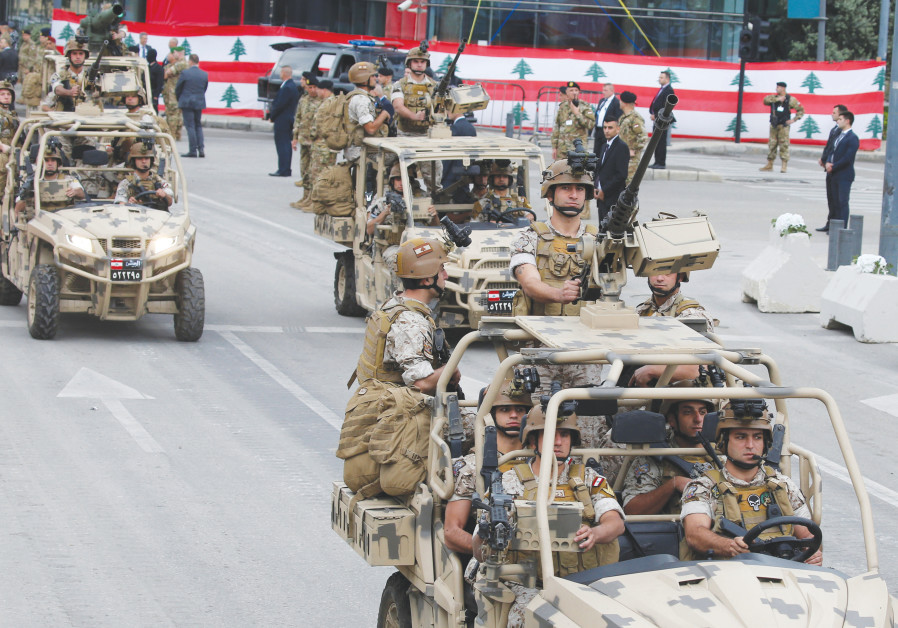
LEBANESE SOLDIERS taking part in a parade. . (photo credit: REUTERS)

The Trump administration is boosting its “maximum pressure” policy against Iran, but the US remains the main benefactor of the Lebanese Armed Forces, despite it having been penetrated and influenced by Hezbollah, the powerful and loyal proxy of Tehran in Lebanon. This paradoxical situation is based on a misconception, and as such it must be stopped.

During the first few months of 2019, the US imposed new sanctions targeting fund-raising sources of Hezbollah, listed by Washington as a terror group in 1997 and responsible for the killing of hundreds of Americans, as well as posing a severe military threat to Israel.

At the very same time, under the radar, shipments of American advanced military equipment have landed in Beirut, suggesting that the current administration is continuing the strategy of its two predecessors to strengthen the military forces of the Middle Eastern country: Since 2005, the US has provided the Lebanese army with aid valued at $2.3 billion – including tanks, light aircraft, and drones – thus becoming the source of about 80% of its equipment, in addition to training more than 30,000 Lebanese soldiers. While no one is deluded that the Lebanese army could confront and disarm Hezbollah, the military support is presumably supposed to turn the army into a strong governmental force that would pose a moderate counterweight to Hezbollah within the Lebanese arena. This is a very simple and logical rationale, but its only flaw is that it belongs in the past.

The hard truth is that Hezbollah and the Lebanese state are, in fact, no longer two different entities. The radical Shi’ite organization, which has both military and civilian branches, has turned to politics over the years, and has gradually become an intrinsic part of the Lebanese political system.

During the 2006 war between Israel and Hezbollah, the Lebanese government had disavowed the organization. Today, however, Hezbollah is not just a part of the government, but even its local opponents – headed by Prime Minister Saad Hariri – have accepted its legitimacy as both an armed group and political component.

In the elections held last year, the political bloc that is dominated by Hezbollah gained decisive power in the parliament and the cabinet, including in nominating the president (a position filled today by Hezbollah’s ally, Michel Aoun). Considering the vast identification and affection Hezbollah currently maintains in Lebanon, particularly among the Shi’ite sect – which encompasses between 30% to 40% of the population, many of whom are employed by, study at or receive social services from Hezbollah’s civil affiliations – the expectation that the local armed forces would remain impartial was somewhat naive.

This illustrates how the lessons from five years ago, when the US-equipped Iraqi army collapsed in the face of ISIS, have yet to be learned, proving that the backing of states’ governmental forces must be carried out in tandem with taking account of the particular social context.

Indeed, Hezbollah has been significantly increasing its sway over the Lebanese army: Last year, Israeli intelligence reports pointed out operational and intelligence collaboration between the army and Hezbollah, such as joint patrols in which Hezbollah members wore army uniforms.

Further, the organization has been able to infiltrate its agents into the ranks of the army as soldiers and officers. For instance, a unit commander in the Israeli border area with a high rank was exposed as a Hezbollah insider. In military parades in 2016, Hezbollah itself showed off US-made armored personnel carriers, presumably taken from the Lebanese military. In general, the army is proving time after time its incompetence – or unwillingness – to prevent Hezbollah’s increasing buildup, which largely consists of Iranian weapons systems smuggled into the country, either under the nose of the army or in its tacit consent.

Although the decision-makers in Washington seem to be aware of these realities, in advocating the armament of the Lebanese military, American officials have stressed that this aid is crucial to prevent external menaces to Lebanon – such as another destructive war between Hezbollah and Israel, or spillover of the war in Syria into Lebanon.

Yet, these arguments still do not hold true. Regarding the tensions with Israel, the Lebanese military is clearly not fulfilling the mission assigned to it in the UN resolution following the 2006 war: to enforce the prohibition on Hezbollah from being in the southern region adjacent to Israel. In December, it was revealed that Hezbollah had dug military tunnels right under the Israeli border.

Sources within the UN peacekeeping force even accused the Lebanese army last year of helping Hezbollah to violate the resolution, by preventing the UN inspectors from reaching the border villages in which the organization hides its weapons. As for the threats looming from Syria, the US-backed Lebanese army was not successful in undertaking the low-scale military challenge of defending northeastern Lebanon, which was faced in the recent years with jihadi infiltration from Syria. Instead, Hezbollah – yes, Hezbollah – was called in to accomplish this national duty.

The temptation to bolster the Lebanese forces to enhance Lebanon’s sovereignty is understandable, but given the discernible clout of Hezbollah over the Lebanese army, the insistence to continue to distinguish between the two is not merely a fruitless investment, but pure malpractice that endangers the security of both Lebanon and Israel.

Halting the military aid to Lebanon could be a last-ditch wake-up call to the local opposition against Hezbollah – and everyone concerned with the country’s sovereignty – clarifying that they must strive to push Hezbollah out of power. Under the current circumstances, the American armament of the Lebanese army is an own goal for the US.


The writer is a Middle East and security analyst.


Zawartość publikowanych artykułów i materiałów nie reprezentuje poglądów ani opinii Reunion’68,
ani też webmastera Blogu Reunion’68, chyba ze jest to wyraźnie zaznaczone.
Twoje uwagi, linki, własne artykuły lub wiadomości prześlij na adres:
webmaster@reunion68.com


Israel holds military drill amid US-Iran tensions

Israel holds military drill amid US-Iran tensions

  VOA News


Israel holds military drill amid US-Iran tensions.
Israel wrapped up its largest military drill in years on Thursday, June 20, with thousands of troops from the army, navy and air force simulating a future war with the militant Lebanese Hezbollah group. (AP)
👉As tensions continue between the U.S. and Iran, Israel backs President Donald Trump but worries that Iran could use its proxy, Hezbollah, to attack Israel.
Israeli Prime Minster Binyamin Netanyahu made it clear who’s side Israel is on in a conflict between the U.S. and Iran.
“In the last 24 hours, Iran has intensified its aggression against the United States and against all of us, and I repeat my call for all peaceloving countries to stand by the United States in its effort to stop Iranian aggression. Israel stands by the United States on this,” Netanyahu said.
https://www.voanews.com/middle-east/i…


Zawartość publikowanych artykułów i materiałów nie reprezentuje poglądów ani opinii Reunion’68,
ani też webmastera Blogu Reunion’68, chyba ze jest to wyraźnie zaznaczone.
Twoje uwagi, linki, własne artykuły lub wiadomości prześlij na adres:
webmaster@reunion68.com

WE MUST BUILD BRIDGES OVER TROUBLED WATER

ISRAEL-DIASPORA RELATIONS: WE MUST BUILD BRIDGES OVER TROUBLED WATER

RABBI MEIR AZARI


“The whole political system in Israel must recognize the importance of this bond and the need for mutual respect and recognition between what we may see as the the modern-day Jerusalem and Babylon.”

Diaspora youngsters enjoy a Birthright Israel trip to the Jewish state.. (photo credit: Courtesy)

As Israel matures, its problems seem to become more numerous and complex. The Israel before us is a divided country that is still in the process of formation and still searching for its way. There are conflicting visions about the path Israeli society should take, and the tension between the different “tribes” within this society is boiling over.

However, most of Israeli society – and certainly most of the Jewish population – understand the importance of the bond and the bridge with the Jews of the Diaspora. Yet at the moment, this bond is weakening.

Some people saw the Jewish connection mainly as a source of economic support for the young nation. Others recognized that the Diaspora holds the last Jewish reserves for the State of Israel. Others still even saw Israel’s relationship with North American Jewry and the strength of this community as a component in the state’s strategic resilience.

At the Conference of Jewish Federations, President Rivlin expanded: “We are not strategic partners – we are family. We do not have shared interests – we have a shared fate, a shared history, and a shared future.”

Yet we have to admit that many on both sides of the ocean would agree that there are many cracks in the relationship. We may be a family, but we’re a troubled one. Here and there some of us are still talking to each other, chatting with the aunt and enjoying the uncle’s cooking. But each community does not understand the other as well as they used to. We know the connection is very important, but apathy and distance have made it a minor component of Israeli reality.

We Israelis find it difficult to explain the importance of a democratic state in the challenging surroundings of the Middle East. Our cousins overseas find it hard to accept the way Israel ignores the unique Jewish character of the North American community. 

A survey of the Jewish community in St. Louis found that 80 percent of the local Jews believe that the bond with Israel would be more meaningful if all the Jewish religious streams were officially recognized by the Israeli government.

In reality, however, many of Israel’s leaders – even those who frequently visit what they may see as the “American Exile” – do not understand the gulf that is emerging between Israelis and those who are still our brothers and sisters today, but may not be so tomorrow.

In thousands of liberal communities affiliated to the non-Orthodox streams – just as in secular and traditional circles in Israel – people are grappling with the need to find Jewish meaning in an era of equality, pluralism, and renewal. 

Belittling the achievements of the North American community, turning a cold shoulder to its leaders, beliefs, and communities, and failing to acknowledge their contribution to Israel will destroy the weak bridge that still stands.

After the rerun of the elections we unfortunately face here in Israel, irresponsible rabbis and politicians will again raise demands that would tear down the bridge between us and the Diaspora. They should stop a moment to consider what this will mean. What will remain of the relationship between Israel and the superpower on which it depends? An evangelist preacher that loves Israel for the moment, while waiting for the Armageddon – what does it mean for Christianity? Ultra-Orthodox Jews from Brooklyn, or the ten percent of American Jews who are Modern Orthodox, and who usually find it difficult to understand and adjust to their Israeli counterparts?

The whole political system in Israel – right, center, and left, too – must recognize the importance of this bond and the vital need for mutual respect and recognition between what we may see as the modern-day Jerusalem and Babylon. 

Firstly, we must reverse a trend that was highlighted in a recent survey by the Israel Institute for National Security Studies, in cooperation with the Ruderman Foundation: “In the present generation, both in Israel and among Jews in the US, we can see growing trends toward detachment and alienation, a weakening of affinities and of the sense of belonging, and a loosening of mutual liability, caring, involvement, and the relations between the two communities.”

Ridiculous solutions such as the plan to strengthen the Chief Rabbinate and give it authority over the Diaspora, or to appoint a “chief rabbi for the Diaspora,” will do nothing to build bridges of respect and recognition over the stormy waters of the ocean. Neither will programs supported by the Ministry for the Diaspora that are based entirely on Orthodox bodies. Rejecting the arrangements regarding the Western Wall and Reform and Conservative conversion are further evidence of the refusal to internalize the diversity of opinions and beliefs in the Jewish world in the early twenty-first century.

A significant proportion of the North American Jewish leadership today – both in the communities and in national bodies such as AIPAC – are not considered Jewish by the Orthodox establishment. This is true of an even larger proportion of their children. So who will be there tomorrow to strengthen us, help us as they have done in the past, and support important activities in every corner of Israel, in every university and development town, in every city, kibbutz, and moshav? How would Jerusalem look without Hadassah, or Tel Aviv-Jaffa without the Charles R. Bronfman Auditorium, or the Tel Aviv Museum with the support and collections donated by Diaspora Jews? Yes, our brothers and sisters across the ocean sometimes ask annoying questions. They appear to us at times to be “over-assimilated”. Sometimes they may upset us or seem to patronize us. But, we can all agree that to have a family and friends is better than being alone in this world. 


Rabbi Meir Azari, Head of the Daniel Center for Reform Judaism and the Bridge over Troubled Waters festival, which will be held in Tel Aviv on June 12-14.


Zawartość publikowanych artykułów i materiałów nie reprezentuje poglądów ani opinii Reunion’68,
ani też webmastera Blogu Reunion’68, chyba ze jest to wyraźnie zaznaczone.
Twoje uwagi, linki, własne artykuły lub wiadomości prześlij na adres:
webmaster@reunion68.com


Spór o modlitwy Żydów na Wzgórzu Świątynnym

Spór o modlitwy Żydów na Wzgórzu Świątynnym

Malgorzata Koraszewska


Dr Mordechai Kedar jest arabistą, znawcą kultury arabskiej i muzułmańskiej. Islam, mówi, miał powstać na gruzach judaizmu i chrześcijaństwa, miał zastąpić te religie. Obecność Żydów w Jerozolimie obraża i niepokoi. Żydowskie modły na Wzgórzu Świątynnym są teologicznym problemem i wyzwaniem. Tak więc, nie jest to konflikt o ziemię, nie jest to konflikt narodowy, mamy do czynienia z konfliktem traktowanym przez muzułmanów jako religijny i z przekonaniem, że samo istnienie Żydów w Jerozolimie podważa fundamenty islamu.


Zawartość publikowanych artykułów i materiałów nie reprezentuje poglądów ani opinii Reunion’68,
ani też webmastera Blogu Reunion’68, chyba ze jest to wyraźnie zaznaczone.
Twoje uwagi, linki, własne artykuły lub wiadomości prześlij na adres:
webmaster@reunion68.com