Archives

LIBERIAN PRESIDENT PLANTS TREE FOR PEACE IN JERUSALEM

LIBERIAN PRESIDENT PLANTS TREE FOR PEACE IN JERUSALEM

KKL-JN


Liberian President George Manneh Weah plants an olive tree in the KKL-JNF Grove of Nations in Jerusalem, becoming the 112th head of state to do so.

President of Liberia George Manneh Weah, gives a speech at the KKL-JNF Grove of Nations in Jerusalem. (photo credit: KKL-JNF)

Liberian  President George Manneh Weah was greeted at the Grove of Nations in Jerusalem by KKL-JNF Director of Protocol Andy Michelson, who noted the symbolic importance in Jewish tradition of planting a tree.

“By planting a tree here today, in this grove, you are leaving a living thing here, which you will be able to come to see again on your next visit and see how it has grown,” he said. “For us, the planting of a tree is very important, and we plant trees for life cycle events such as weddings and Bar Mitzvahs.”The Grove of Nations is especially reserved for visiting heads of state from all over the world, who plant olive trees as symbols of peace. The grove symbolizes the aspiration for peace between the countries of the world and solidarity with the state of Israel and the Jewish people. Weah is the 112th leader to plant a tree there since it was inaugurated in 2005.

Liberia was one of the African countries that voted for the UN Partition Plan for Palestine in the UN General Assembly on the 29th November, 1947, in favor of an independent Jewish state.

“I am honored to be in Israel and today, we have seen so much,” said Weah, who, in addition to his wife, the First Lady Clar Weah, was accompanied by a delegation of seven ministers as well as the chairman of Liberia’s National Investment Commission and the mayor of Liberia’s capital city Monrovia, Mr. Jefferson Koijee. “We are believers and what we have seen today is so amazing. I hope that Israel will have the peace it is yearning for. God bless Israel.”


Zawartość publikowanych artykułów i materiałów nie reprezentuje poglądów ani opinii Reunion’68,
ani też webmastera Blogu Reunion’68, chyba ze jest to wyraźnie zaznaczone.
Twoje uwagi, linki, własne artykuły lub wiadomości prześlij na adres:
webmaster@reunion68.com


Syria accuses Israel of firing missiles at a border town in its south

Syria accuses Israel of firing missiles at a border town in its south

TOI STAFF


State media says some incoming projectiles intercepted; no reports of injuries and no comment from IDF; reported strike comes days after rockets fired at Israel

Illustrative: This frame grab from a video provided by the Syrian official news agency SANA shows missiles flying into the sky near Damascus, Syria, Tuesday, December 25, 2018. (SANA via AP)

Syrian state media reported early Wednesday that Israel had fired several missiles toward the town of al-Harra just across the Golan Heights border and claimed air defenses intercepted several of the projectiles.

There were no immediate reports of injuries and no Israeli response to the claims.

The report also claimed that Israel was jamming Syrian air defense radars in the area.

While Israel has carried out hundreds of strikes in Syria, they have usually targeted bases linked with Iran. In the rare occasions that Israel has targeted villages and towns along the Golan Heights border, it has been after identifying Iranian and Hezbollah attempts to set up cells in the area.

On Saturday, two rockets were fired from Syria toward Israel’s Mount Hermon in the Golan Heights. There were no reports of injuries or damage

An Israeli military position, right, is seen on the top of Mount Hermon in the Golan Heights, where the borders between Israel, Syria and Lebanon meet. April 9, 2019. (AP Photo/Hussein Malla)

The launches came less than a week after a limited clash between Israel and Syria.

Toward the start of the Syrian civil war, the Israeli military established a number of “red lines” that if violated would result in a retaliatory strike, including any attacks — intentional or otherwise — against Israel.

They also included Iranian efforts to establish a permanent military presence in Syria and attempts to transfer advanced munitions to the Lebanon-based Hezbollah terrorist group.

In recent years, Israel has acknowledged conducting hundreds of airstrikes in Syria in response to these “red line” violations.


Zawartość publikowanych artykułów i materiałów nie reprezentuje poglądów ani opinii Reunion’68,
ani też webmastera Blogu Reunion’68, chyba ze jest to wyraźnie zaznaczone.
Twoje uwagi, linki, własne artykuły lub wiadomości prześlij na adres:
webmaster@reunion68.com


Can an electronic patch reduce the pain of migraines?

Can an electronic patch reduce the pain of migraines?

Brian Blum


Theranica’s Neriva Migra patch delivers a small electrical jolt to mitigate headaches and other acute pains through ‘conditioned pain modulation.’

In clinical trials, two-thirds of patients got significant pain relief with Theranica’s Neriva Migra patch. Photo: courtesy

It looks like a high-tech version of a nicotine patch, but Theranica Bio-Electronics’ wearable device has a different purpose: to knock out migraines… at least temporarily.

Inside Theranica’s Neriva Migra patch are tiny electrodes that deliver a small electrical jolt to your body to mitigate headaches and other acute pains through what’s known as CPM (conditioned pain modulation).

CPM is a counterintuitive approach to pain management. The idea is that by introducing a secondary noxious stimulus (the electrical zaps from the patch), perception of the primary noxious stimulus — in Theranica’s case, migraines — can be reduced.

Similar to a nicotine patch, you place the Neriva Migra device on your arm above the elbow. The device communicates wirelessly via Bluetooth with your smartphone, which regulates the electrical pulses and sets a timer. A 45-minute treatment can bring relief for pain within two hours.

In Theranica’s clinical trials involving 252 patients across 12 sites in the US and Israel, “around two-thirds of patients got significant pain relief,” Theranica cofounder and chief operating officer Ronen Jashek tells ISRAEL21c. “More than 30 percent were pain free.”

There’s one unavoidable hitch: The pain does come back eventually because this is not a cure, rather a treatment to deal with headaches at their worst.

Theranica’s Neriva Migra device isn’t on the market yet – it’s currently being evaluated by the FDA and clearance is expected in a couple of months. Nor is the business model set, other than it will need a prescription. The cost is hoped to be equivalent to, or less than, common prescription drugs.

Neriva Migra, which began development in 2016, will first be available in the United States, followed by Europe in 2020, according to the company’s plan.

Good for 12 sessions

Each device can be used for only 12 sessions because, Jashek explains, “The electrodes in any kind of device like this need to be replaced after a number of treatments.” The tiny battery inside the device also runs out of juice.

Jashek suggests users either recycle the patch or send it back to Theranica. “It’s an electronic device, so you recycle it like you do any electronic equipment,” he says.

Theranica’s Neriva Migra patch lasts for 12 sessions. Photo: courtesy

The 17-person Netanya-based Theranica has raised nearly $42 million. The latest round of $35 million closed in March.

Neurolief, an Israeli company developing a head-mounted neuro-modulation device for migraine relief, has raised only $5 million.

Why the difference in fundraising success? Blame it on the Eckhouse effect.

Eckhouse is a highly successful serial entrepreneur focused on medical technology startups. Among the companies he’s backed or founded: ESC Medical (renamed Lumenis), Syneron Medical, RealView Imaging and Alon MedTech Ventures. He invented Intense Pulsed Light, a non-invasive technology for various dermatological and ophthalmology treatments. Along with Jashek, Alon Ironi and Slava Barabash, he is a cofounder (and now active chairman) of Theranica.

Headaches are, unfortunately, big business. The Migraine Research Foundation estimates that migraines are the third most prevalent illness in the world. In the US, migraines impact 12 percent of the population (18% women, 6% men).

Several American med-tech companies are in this crowded field. Thirty Madison raised $15 million in 2018 for a tool that tracks migraine incidents and offers virtual consultations with doctors; Healint’s Migraine Buddy tracker is being tested by pharma giant Novartis to see whether chronic migraines induce anxiety and depression; Gammacore makes an FDA-approved device that electrically stimulates the vagus nerve to block migraine pain signals; and Cefaly has an FDA-approved device that delivers micro-impulses to the trigeminal nerve. The latter two are more cumbersome than Theranica’s device.

One of the most promising – and potentially permanent – treatments for migraine suffers is occipital nerve stimulation, where a small pulse generator is surgically implanted at the base of the skull to send pain-relieving electrical impulses to the brain. But the technique is invasive and can cost tens of thousands of dollars.

Theranica’s device will be significantly less expensive and can be applied at home. No major side effects have shown up during clinical tests, Jashek adds.

Could CPM could be used for other types of pain beyond migraines, since CPM doesn’t require direct stimulation to the part of the body where the pain is?

Absolutely, Jashek says, as long as the pain is of a similar acute nature. “We won’t be able to address general chronic issues like back or muscle pains,” he tells ISRAEL21c.

Find more information on Theranica’s Neriva Migra device here.


Zawartość publikowanych artykułów i materiałów nie reprezentuje poglądów ani opinii Reunion’68,
ani też webmastera Blogu Reunion’68, chyba ze jest to wyraźnie zaznaczone.
Twoje uwagi, linki, własne artykuły lub wiadomości prześlij na adres:
webmaster@reunion68.com


The Israeli device that aims to clean up your air

The Israeli device that aims to clean up your air

Brian Blum


Israeli home device Aura Air checks for dangerous gases and particles, and purifies the air of tiny particles of bacteria, viruses, mold, fungi and pollen.

Eldar and Aviad Shnaiderman of Aura Air. Photo: courtesy

If you suffer from pollen allergies or are concerned about “indoor pollution” from sources such as cleaning materials, furniture glue and mold, you might have considered buying an air purifier from a brand like Dyson, Molekule or Blueair. And if you’re a safety-concerned home owner, you probably already have a few smoke and carbon monoxide alarms installed.

Israeli startup Aura Air asks: Why buy two devices when you could have it all-in-one?

The Tel Aviv-based company launched a crowdfunding campaign earlier this year to build its indoor air-quality detector and air purifier combo. The goal was a modest $15,000, but backers pledged close to $300,000. That’s on top of the $1.5 million the company received from private angel investors when it launched in 2017.

What makes the air from Aura so cool? The story begins 20 years ago, when brothers Eldar and Aviad Shnaiderman would spend summers and vacations helping at their father’s air-conditioning and maintenance company.

“We saw what was happening on the inside of the units,” Aviad tells ISRAEl21c, “and we thought, wow, it’s so dirty. This is what we’re breathing?”

Aviad, 32, now the CEO of Aura Air, had been in the army’s special forces unit for more than a decade, while also pursuing an MBA. Eldar, the older of the two at 37, who now serves as Aura Air’s CTO, is an electrical engineering by training. When both found themselves ready for their next gigs, they remembered what they’d seen in their father’s shop.

“We knew we had to find a solution,” Aviad says.
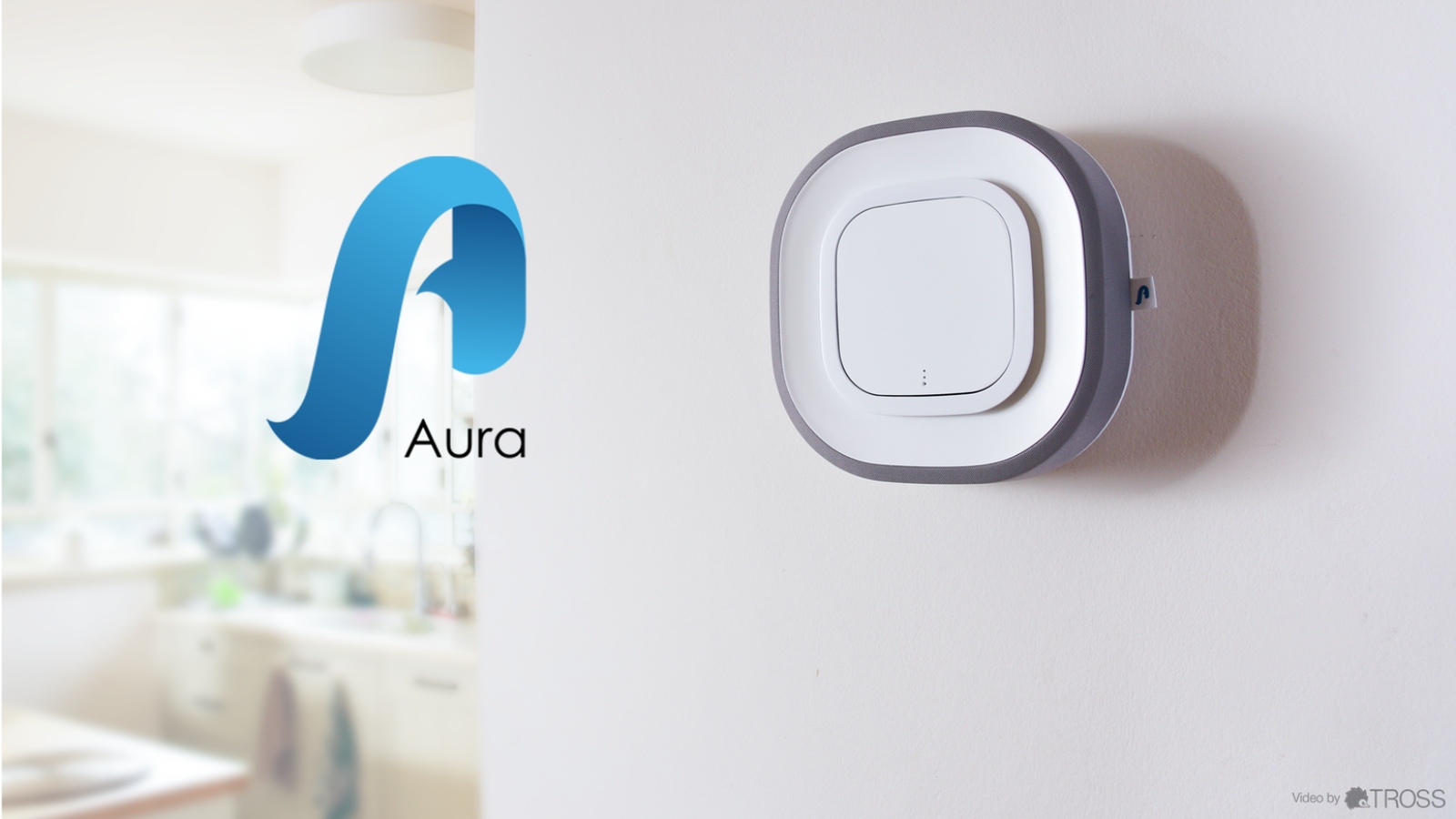
Aura Air is an all-in-one smoke and carbon monoxide detector and air purifier. Photo: courtesy

The result is a device the size and shape of a small robotic floor cleaner but that hangs on your wall.

Aura Air first checks for all kinds of dangerous gases and particles: smoke, carbon monoxide, propane, butane and other flammable gases that can leak, as well as VOCs (volatile organic compounds) such as formaldehyde, paints and acetones, and emissions from office machines (for example, the smell from your photocopying machine).

Aura Air then goes to work to purify the air. It can filter out tiny particles – down to the size of bacteria, viruses and pollen. It cleans the air of mold, fungi and PM2.5, particulate matter just two and a half microns in width that can lodge in the lungs, leading to coughing, sneezing, shortness of breath and, over extended exposure, more serious problems.

Aura Air uses a combination of four filters – a carbon- and copper-infused “Ray” filter, a HEPA (high efficiency particulate air) filter, a pre-filter and ultraviolet UVC LEDs. There’s also a “sterionizer” generating positive and negative ions to freshen indoor air.

“Those can get to places like the carpet and furniture where bacteria and fungi have started to develop but haven’t gone through our product yet,” Aviad explains.

Aura Air is developing packages to cover all the rooms in a home. Photo: courtesy

One Aura Air device can cover 700 square feet, so the average home will need more than one.

“We’re developing packages to cover more than just the living room or bedroom,” Aviad says. “We will have packages for singles, families with newborns, businesses. We want the price to be affordable.”

A single Aura Air will sell for $389 – that compares favorably with competitors retailing at $600 and up. If you pre-order an Aura Air on Indiegogo, you can save 41%. Initial orders are expected to be delivered this summer.

Targeting US market first

Aura Air’s team has been working with the Technion – Israel Institute of Technology and the Hebrew University of Jerusalem to validate its technology. The product is currently in the process of receiving approval from UL (formerly Underwriter’s Laboratory) in the United States.

While you can order an Aura Air on Indiegogo (and eventually through the company’s website) from anywhere in the world, Aura Air is targeting the US market first. The company displayed its product at the CES show in Las Vegas in January of this year.

One place you won’t find Aura Air: your local Best Buy – at least not initially. “We want to understand our audience better before we go for the big retail stores,” Aviad says.

Aura Air wouldn’t have been so successful on Kickstarter without the latest personalization bells and whistles. You control your Aura Air device via your mobile, which displays both indoor and outdoor air quality (the latter through a partnership with fellow Israeli environmental startup BreezoMeter).

When you set up your Aura Air, you’re prompted to answer a series of questions, such as whether anyone in the home suffers from allergies. Your mobile, running the Aura Air app, can then send you push notifications if, for example, there’s a lot of pollen in the air or there’s a higher level of PM2.5 outside.
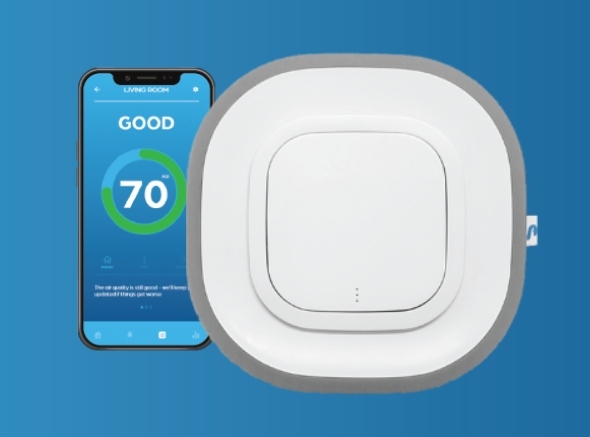
The Aura Air smoke detector and air purifier has an associated app. Photo: courtesy

Your personalization data also affects how the device operates. “If you’re asthmatic, the product will be more sensitive to PM2.5,” Aviad explains. That might mean the fans run faster and longer depending on who’s at home.

Aura Air works in the background. The company’s name comes from the idea that its product protects your breathing environment like a halo – or an “aura.” Once you’ve set it up, you don’t have to monitor it, although you can always talk to your device (via Google Assistant or Amazon’s Alexa) to check air quality and adjust parameters manually.

The Shnaiderman brothers have big plans for their 10-person company. Self-sterilizing sheets and towels “that help kill viruses and bacteria will be coming soon,” Aviad says.


Zawartość publikowanych artykułów i materiałów nie reprezentuje poglądów ani opinii Reunion’68,
ani też webmastera Blogu Reunion’68, chyba ze jest to wyraźnie zaznaczone.
Twoje uwagi, linki, własne artykuły lub wiadomości prześlij na adres:
webmaster@reunion68.com


About 8,000 Ethiopian Jews Waiting to Immigrate to Israel

About 8,000 Ethiopian Jews Waiting to Immigrate to Israel

  VOA News


About 8,000 Ethiopian Jews want to move to Israel and join their families already living there. But they accuse the Israeli government of delaying their immigration for racist reasons, accusations the government denies. Linda Gradstein has more from Jerusalem.
Originally published at – https://www.voanews.com/a/about-8-000…


Zawartość publikowanych artykułów i materiałów nie reprezentuje poglądów ani opinii Reunion’68,
ani też webmastera Blogu Reunion’68, chyba ze jest to wyraźnie zaznaczone.
Twoje uwagi, linki, własne artykuły lub wiadomości prześlij na adres:
webmaster@reunion68.com