
Archives

ON THE WRONG SIDE OF THE J STREET

ON THE WRONG SIDE OF THE J STREET

JONATHAN (YONI) MICHANIE


Hoping to be identified as the “middle-ground,” J Street characterizes itself as the home of the “pro-Israel and pro-peace Americans.” But its inconsistent stances reflect only uncertainty.

A Star of David on a man’s kippa. (photo credit: REUTERS)

Since the 1937 Peel Commission, 16 peace offers have been made to the Palestinian leadership – and all have been rejected, most without a counteroffer. While the conflict itself is not short of historical complexities that have made the discussion of concessions difficult for both parties, those complexities have nonetheless always been objective.

Settlements were never the sole obstacle to peace, Israel was not responsible for the unfortunate creation of Palestinian refugees, and the Palestinian leadership has been a principal oppressor of the Palestinian people. While the suffering on both sides cannot be empirically compared or objectively measured, the history that created such complexities is not up for debate or interpretation.
But a significant problem at the table of negotiations has consistently persisted on behalf of the Palestinian leadership, a lack of clarity and a distorted approach to history which have led to the contemporary realities that predominate the Israeli-Palestinian conflict.

The tactics employed by J Street, which are reliant on spreading uncertainty, represent this very same failed approach. This is not only leading to the further divide within the American Jewish community, but to the harming of productive conversations about the conflict.

Following the indisputably antisemitic remark by US Congressional Rep. Ilhan Omar, where she accused Jews of using their financial influence through AIPAC to safeguard American support for the Israeli government, J Street published a disturbing statement titled “Weaponization and Oversimplification of the Israel Debate Must End.” The content of the statement, which essentially condemned antisemitic remarks by US policy-makers while calling for nuance when discussing the conflict, was not as concerning as the timing of its publication. Using this statement to respond to Ilhan Omar’s notorious antisemitic trope, J Street aimed at creating more chaos and division at a time when the American Jewish community aches for unity.

However, following the organization’s statement after Airbnb’s discriminatory decision to boycott Jewish settlements in the West Bank, should we be surprised? The comments condemned criticism of Airbnb’s decision, claiming the occupation must be protested without truly addressing the Boycott, Divestment and Sanctions movement or its ideology.

While rejecting global BDS (in reference to practice within Israel’s Green Line), J Street failed to condemn Airbnb’s clear double standard by singling out Jews in the West Bank. After all, Russia’s Crimea and Morocco’s Western Sahara were never targeted for the same accusations. Lack of clarity is J Street’s strategic approach to dividing the Jewish community in the US under the guise of progressive attitudes toward peace.

In an interview with foreign policy analyst Joshua Keating, J Street president Jeremy Ben Ami responded to Omar’s comments as follows:

“It’s the entirety of the argument that is overblown. What we’re losing sight of is the actual issues that we should be discussing. We’re debating whether a particular tweet or expression is antisemitic. The issues I would like to see a focus on are the occupation, the settlements and the question of whether we can end this conflict.”

IF THE leadership of the organization itself is unable to call out transparent antisemitism, how are they to be given any sort of legitimacy to address a conflict, which at its core is rooted in the refusal to recognize Israel as the rightful home of the Jewish people? While legitimate and proportional criticism of Israel should exist, J Street’s aim at nuancing antisemitism is unacceptable. Since the signing of the Oslo Accords in 1995, the Palestinian leadership has consistently violated the agreement by refusing to tear down its systematic indoctrination of antisemitism in the disputed territories.

The same lack of clarity, which has perpetuated the conflict and the consequential suffering that followed, serves as the same contributing factor to the rise of antisemitism in the United States. J Street’s audacity to label its national organization as “unequivocally Zionist,” while accepting Airbnb’s decision to boycott Jewish settlements in the West Bank – or by seeming to be incapable of releasing a comment solely dedicated to condemning antisemitic language in the US Congress – is nothing short of the same lack of clarity guiding the Palestinian Authority’s rejectionist policies.

Hoping to be identified as the “middle-ground” between both sides of the conflict, J Street characterizes itself as the home of the “pro-Israel and pro-peace Americans.” But its inconsistent stances reflect only uncertainty.

It is evident that the American Israel Council for Public Affairs (AIPAC) stands for bipartisan support of the American-Israeli relationship – one based not only on Zionist principles but on shared values and interests between both nations. And we know that Students for Justice in Palestine advocates for ethnic cleansing. It is just as transparent that American Muslims for Palestine serves as the megaphone for Hamas’s terrorist network in the US, and that Jewish Voice for Peace seeks to eliminate the Jewish character of Israel by supporting the claim to the full right of return for 5.2 million Palestinians (the large majority of whom have never set foot in Israel).

Whether Zionist or anti-Zionist, these organizations are at least transparent enough to be characterized not for the loss of Israel’s Jewish nature, but occasionally for being incapable of condemning organizations which condone Palestinian terrorism and violence. With several more of these inconsistencies, how exactly does J Street seek to be perceived? This uncertainty is cause for concern.

J Street has not just become a divisive factor for the Jewish community in America, it has also become an obstacle to productive discourse and possible reconciliation among the millions waiting for peace to be made. Distorting facts, revising history and disguising a policy of obscurity as neutrality has not only eliminated the organization’s claim to “seek a peaceful two-state solution,” but has also prolonged the harmful lack of clarity that plagues meaningful talks between prominent sectors of the American Jewish community.


The writer is a former IDF paratrooper, and an Israel advocate, public speaker, Middle East analyst, and campus coordinator for the Committee for Accuracy in Middle East Reporting in America (CAMERA). He has a master’s degree in diplomacy and international security from IDC Herzliya.


Zawartość publikowanych artykułów i materiałów nie reprezentuje poglądów ani opinii Reunion’68,
ani też webmastera Blogu Reunion’68, chyba ze jest to wyraźnie zaznaczone.
Twoje uwagi, linki, własne artykuły lub wiadomości prześlij na adres:
webmaster@reunion68.com



We have liftoff! Israel makes history with Moon launch

Israel21cWe have liftoff! Israel makes history with Moon launch

Abigail Klein Leichman


The Falcon 9 launches into space. Photo courtesy SpaceIL

In an emotional and historic moment for Israel, the Beresheet unmanned spacecraft dreamed up by the nonprofit organization SpaceIL launched flawlessly in a SpaceX Falcon 9 rocket from Cape Canaveral Air Force Station in Florida at 8:45pm February 21 (3:45am February 22 Israel time).

The famed countdown was recited in English in Florida, and in Hebrew at Israel Aerospace Industries’ control center in Yehud. The liftoff of the first nongovernmental mission to the Moon, and the first to use a commercial launch, was watched live by tens of thousands of people on Facebook and YouTube.

https://www.facebook.com/arseno/videos/10161467018690542/

Comments and congratulations poured in from viewers in Mexico, New Zealand, Portugal, Ecuador, South Africa, India and the United States from New York to Montana, among other points on the globe, as Beresheet sped into space and separated from the launcher at 9:20 Florida time.

Six minutes later, right on schedule, the spacecraft was fully deployed and under the management of the IAI control center, beginning a seven-to-eight-week journey toward touchdown on the Moon’s Sea of Tranquility.

Inscribed on the craft are the words “Am Yisrael Chai” (“the nation of Israel lives”) and inside is a time capsule containing digital files including a nano Bible, Israeli national symbols and children’s drawings.

SpaceIL’s Beresheet spacecraft is on its way to the Moon. Photo: courtesy

The craft also carries instruments to measure the magnetic field of the Moon to help determine its origins.

Jubilant SpaceIL founders Yonatan Winetraub and Kfir Damari were on site at Cape Canaveral along with key personnel from SpaceIL and IAI and funders of the $100 million mission. Their cofounder, Yariv Bash, was in Yehud along with dignitaries including Prime Minister Benjamin Netanyahu.

‘Three engineers walk into a bar’

The night before the launch, Winetraub related to reporters how he, Bash and Damari first discussed the idea of a Moon mission over drinks in a pub in the Tel Aviv suburb of Holon.

“Three engineers walk into a bar and come out with the design of a spaceship,” said Winetraub. “Sounds like the beginning of a joke, but this is what happened about eight and a half years ago.”

SpaceIL founders, from left, Yonatan Winetraub, Kfir Damari and Yariv Bash. Photo: courtesy

read more: Israel makes history…


Zawartość publikowanych artykułów i materiałów nie reprezentuje poglądów ani opinii Reunion’68,
ani też webmastera Blogu Reunion’68, chyba ze jest to wyraźnie zaznaczone.
Twoje uwagi, linki, własne artykuły lub wiadomości prześlij na adres:
webmaster@reunion68.com


HATE GROUPS IN AMERICA ON THE RISE – REPORT

HATE GROUPS IN AMERICA ON THE RISE – REPORT

JOSEFIN DOLSTEN/JTA


The Southern Poverty Law Center said that both White pride groups and Black nationalist groups have seen an increase in numbers this year.

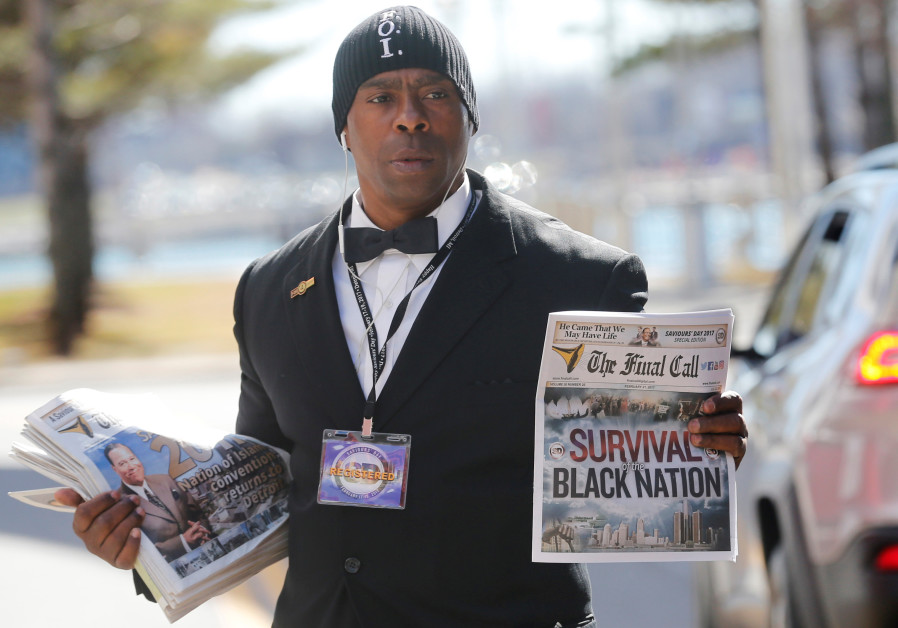
Randall Muhammad sells the ‘Final Call’ newspaper before Religious leader Louis Farrakhan gives the keynote speech at the Nation of Islam Saviours’ Day convention in Detroit, Michigan, U.S. February 19, 2017. (photo credit: REBECCA COOK / REUTERS)

The number of active hate groups in the United States is at a record high — and many are anti-Semitic in nature.

That comes from a report released Wednesday by the Southern Poverty Law Center saying that 1,020 hate groups were active last year, an increase of about 7 percent from 2017. The number exceeds the record of 1,018 groups in 2011; the Montgomery, Alabama-based civil rights organization started counting hate groups in 1990

The SPLC found that the number of both white supremacist and black nationalist groups — such as the Nation of Islam and the Black Hebrew Israelites — has increased. Its intelligence project director, Heidi Beirich, told reporters in a phone call that the majority of groups in both categories are anti-Semitic.

However, the number of some types of organizations, including neo-Nazi and Ku Klux Klan chapters, fell last year

Statements about immigrants and Muslims made by President Donald Trump and commentators on Fox News have helped stoke white nationalist sentiments, the SPLC said.

“The organized hate movement may be showing signs of disappointment with Donald Trump, but the president, aided and abetted by Fox News, continues to push his noxious anti-immigrant and anti-Muslim ideas into the public consciousness — fueling fears of a forthcoming white-minority country,” according to the report

Since Trump’s election the SPLC has faced — and denied — charges that its research and methods have been compromised by a left-leaning cultural agenda and that it paints some legitimate right-wing groups and critics of Muslim extremism as hate groups.

The SPLC report also said that the anti-Semitic black nationalist groups capitalized on comments by the president in recruiting new members. Beirich said groups had responded to Trump’s statements, such as allegedly calling African nations “s—hole countries” in a closed-door meeting, and deriding NFL players on Twitter who refused to stand for the national anthem to show solidarity with marginalized people of color.

“These are all things that black hate groups are using to try to draw people to their ranks,” she said in a response to a question by the Jewish Telegraphic Agency. “There are strains of anti-Semitism in the bulk of these groups.”

The report fears that acts of violence such as the attack on Pittsburgh’s Tree of Life Synagogue in October by a white supremacist gunman, Robert Bowers, will rise.

“[T]here are no signs that the violence, which has been all too common over the past two decades, will let up,” it read. “In fact, if the hate movement abandons politics as a solution to demographic change, as recent denunciations of Trump by prominent white supremacists seem to indicate, more angry lone wolves like Bowers may see violence as a solution.”

A report released by the Anti-Defamation League last month found that the vast majority of extremist-related murders in the country were linked to far-right extremism.


Zawartość publikowanych artykułów i materiałów nie reprezentuje poglądów ani opinii Reunion’68,
ani też webmastera Blogu Reunion’68, chyba ze jest to wyraźnie zaznaczone.
Twoje uwagi, linki, własne artykuły lub wiadomości prześlij na adres:
webmaster@reunion68.com

Alan Dershowitz on Netanyahu’s cases

Alan Dershowitz on Netanyahu’s cases

  litalsun


פרופ’ אלן דרשוביץ בראיון לחדשות 20 מדבר על חקירות נתניהו


Zawartość publikowanych artykułów i materiałów nie reprezentuje poglądów ani opinii Reunion’68,
ani też webmastera Blogu Reunion’68, chyba ze jest to wyraźnie zaznaczone.
Twoje uwagi, linki, własne artykuły lub wiadomości prześlij na adres:
webmaster@reunion68.com


WHO WILL FILL THE VACUUM LEFT BY ISIS?

WHO WILL FILL THE VACUUM LEFT BY ISIS?

ELI BEN MEIR


A very interesting phenomenon has taken place in the Idlib area of Syria: the presence of the Islamic State has almost completely disappeared.
A MEMBER of ISIS waves the group’s flag in Raqqa. (photo credit: REUTERS)

Following extensive international media coverage, the United States recently announced it will be withdrawing its military forces from the Iraq-Syria border and from northern Syria.

This declaration came after US President Donald Trump claimed ISIS had been defeated. He added that the move had been coordinated with Turkish President Recep Tayyip Erdogan, following a months-long Syrian-Russian-Turkish initiative to create a buffer zone in the Idlib region.

Idlib is the last important area still under Syrian rebel control. A few thousand terrorists belonging to Jabhat al-Nusra, a local Salafist group that is the Syrian branch of al-Qaeda, still remain in Idlib. Fighting in the area is still ongoing.

As a result, Syria requires vital military support from Iran and Russia. Turkey is, of course, concerned about renewed Kurdish activity, and the international and internal discourse regarding the Kurdish struggle for independence. In addition, continued violence in Syria could lead to a new wave of Syrian refugees heading for the border with Turkey.

A very interesting phenomenon has taken place in the Idlib area of Syria: the presence of the Islamic State has almost completely disappeared. This radical Salafist group, which suddenly arrived on the scene a few years ago, and whose rule peaked and then sizzled about six months ago, operated as a quasi-governmental entity.

ISIS controlled huge areas of Syria and Iraq, which was home to seven million inhabitants. It ran various state services, including medical, legal, educational and municipal facilities. ISIS also operated large military outposts that housed weapons caches.

Currently, except for in a small number of outposts near the Israel-Syria-Jordan border region, ISIS forces have completely disappeared, leaving everyone wondering what the future holds for them and what we should be worried about.

First of all, the good news is that international military bodies are involved and are coordinating activity that will hopefully bring about a comprehensive change in how to deal with terrorist organizations. With respect to Syria, there is heavy Russian and only minor American involvement.

Moreover, there has been little threat to Israel or Jordan, despite the high potential for damage to the Hashemite kingdom’s police. An interesting question to ask, now that ISIS no longer poses an immediate threat to Israel, is whether the Islamic State – even at the height of its power – posed a serious threat to Israel.

Perhaps Israel should not have allocated so many resources for intelligence and operations to deal with this potential threat – resources that could have been used to counter threats which are more vital.

OTHER IMPORTANT questions deserve our attention. What did ISIS do with all the quality weapons it had at its disposal, including chemical, SAM, and SSM missiles? Where are the terrorist organization’s activists now hiding out? Where else will ISIS attempt to build a Salafist caliphate? Perhaps in the Sinai or Libya?

Above all, however, I think the most important question is: Did ISIS losing most of the territory under its control in Syria and Iraq signify that the organization will cease to exist? What will be the fate of the 14 branches which sprouted up around the world, such as Boko Haram in Nigeria? Should international intelligence organizations continue allocating significant resources to track ISIS and its satellite groups?

In my humble opinion, I think the ISIS branches will not disappear, and the loss of territory has not dampened these groups’ radical Salafist philosophy. ISIS is a terrorist organization that operates globally, and we should expect to see more terrorist attacks in different locations around the world.

Many attacks will continue to take place in Europe, since the terrorist organization already has well-established cells there, and a large number of refugees are already living there.

We should also expect, however, ISIS attacks in Sunni Arab countries – namely Saudi Arabia and other Gulf states, Jordan, Turkey and Egypt. These are countries where many Syrian refugees have found temporary refuge, and where ISIS has already established the infrastructure to carry out hostile terrorist activity.

In addition, it’s reasonable to assume that Israeli and Jewish sites around Europe will come under increased threat. Consequently, we must closely follow all attempts made by ISIS to establish new cells and learn new methods of anti-terrorist warfare, looking out for problematic areas such as the Sinai and Jordan.

The rapid rise and subsequent fall of ISIS over the last decade is a reminder that modern-day warfare has changed significantly since early days of the State of Israel. No longer is training a traditional military enough to defeat paramilitary terrorist organizations. Physically conquering land is also no longer sufficient to prevail in war. In this modern era of social media, we must be also victorious in the world of public opinion and political consciousness.

Perhaps the most important question of all is: Who or what will fill the vacuum left by ISIS? Which organization will succeed in becoming the new world center of hostile terrorist activity? It would be worth our while to invest time and energy in finding answers to these questions before it’s too late. We don’t want to be caught off guard again, as we were when ISIS came into power.


The writer is a former head of the IDF’s research intelligence division.
Translated by Hannah Hochner.


Zawartość publikowanych artykułów i materiałów nie reprezentuje poglądów ani opinii Reunion’68,
ani też webmastera Blogu Reunion’68, chyba ze jest to wyraźnie zaznaczone.
Twoje uwagi, linki, własne artykuły lub wiadomości prześlij na adres:
webmaster@reunion68.com