Archives

HEMINGWAY’S JEWISH BULLFIGHTER

HEMINGWAY’S JEWISH BULLFIGHTER

EROL ARAF


Ernest Hemingway. (photo credit: Wikimedia Commons)

Nostrils flare dripping with venomous anger, the eyes are big, onyx and lifeless; crimson blood pours from its back consecrating the arena; the front hooves beat the ground relentlessly as dust, sweat and rage hang heavy in the afternoon sun; it snorts and roars with contempt; the head, crowned with piercing horns, is lowered; and the pent-up energy is unleashed with a furious charge at the taunting matador who turns on his axis elegantly to enshroud the incensed bull in his blood red cape as man and beast engage in a choreographed macabre dance of death. 

It was at the Pamplona Fiesta in Spain in the 1920s that Hemingway fell in love with the metaphysics of bullfighting, which became a metaphor for his search for meaning and the essence of life and death. The result of this quasi-religious experience was his masterpiece Death in the Afternoon. 

Not surprisingly, Hemingway intensely admired Sidney Franklin, a sublime bullfighter, who was born in Brooklyn, New York to Orthodox Jewish parents. 

Writing in Death in the Afternoon, Ernest Hemingway said, “Franklin is brave with a cold, serene and intelligent valor, but instead of being awkward and ignorant, he is one of the most skillful, graceful and slow manipulators of a cape fighting today. His repertoire with the cape is enormous, but he does not attempt by a varied repertoire to escape from the performance of the veronica as the base of his cape work and his veronicas are classical, very emotional, and beautifully timed and executed. You will find no Spaniard who ever saw him fight who will deny his artistry and excellence with the cape.” Hemingway adds, “He is a better, more scientific, more intelligent, and more finished matador than all but about six of the full matadors in Spain today and the bullfighters know it and have the utmost respect for him.” 

In his book Double-Edged Sword: The Many Lives of Hemingway’s Friend, the American Matador Sidney Franklin, Paul Bart observes that Death in the Afternoon describes Franklin as having the “ability in languages, the cold courage and the ability to command of the typical soldier of fortune.” 

“Yet Franklin wasn’t any kind of soldier,” writes Bart, “resembling instead the womanly Europa in the classical Greek myth where Zeus disguises himself as a bull to rape Europa.” Benjamin Ivry expands on the theme of rape when he writes that Franklin’s bullfighting career was punctuated by genuine violations of his body. In a particularly horrific 1930 episode requiring multiple surgeries, a dying bull’s horn “caught Sidney at the base of his tailbone, plunging into his abdominal cavity through the rectum, piercing the sphincter muscle and large intestine.” Franklin repeatedly risked similar gory disasters long after this 1930 catastrophe. 

One wonders if his courage in looking death in the eyes and never averting his gaze compensated for his deeply felt sense of inadequacy due to his unorthodox sexual preferences; a desire that dare not speak its name had to be sublimated and buried in the sands of the corridas drenched in blood. 

When the Spanish Civil War erupted, Franklin sided with Franco, who was also among his admirers, under whose aegis he continued to perform. Before the result of the war was determined, he tagged along as a paid interpreter while Hemingway and director Joris Ivens filmed the classic documentary of Spain’s doomed war against nationalism, The Spanish Earth. 

He eventually fell out with Hemingway as casting his lot with the Spanish Phalange, after personally witnessing the tragic Republican effort, was simply reprehensible to the author. Hemingway, like George Orwell and Andre Malraux, fought against Franco and wrote about the war. For many, the turning point came when Nazi bombers appeared over the skies of Guernica, transforming the sleepy market town into an everlasting symbol of the atrocity of war in 1937. Immortalized by Picasso’s grey, black and white painting, Guernica was a prelude to Hitler’s and Mussolini’s crimes in the approaching global calamity. 

His friends back in the USA were furious with Franklin after the Spanish Nationalists murdered the poet Federico Garcia Lorca. Other Jews like Milt Wolff, fighting with Spain’s Abraham Lincoln Battalion for the Republicans, were also unforgiving. 

Perhaps Franklin, counter-intuitively seeking death through the excitement of life, as epitomized by bullfighting, was also trying to exorcise his personal demons by cleansing his sins with blood: either the bull’s or his. 

After the war, his days as a matador behind him, Franklin appeared in a few films in the USA and Mexico. Later he presented bullfights on American TV. He wrote an autobiography, Bullfighter from Brooklyn, and he also was a close friend of the American actor and legend James Dean, who was a big fan of the art of Plaza de Toros. 

Hemingway, who had parted company with him, paid him the ultimate tribute in the last chapter of Death in the Afternoon when he concluded: “I can tell you truly, all question of race and nationality aside, that with the cape he is a great and fine artist and no history of bullfighting that is ever written can be complete unless it gives him the space he is entitled to.’ 

The “Matador of the Torah,” as he was known in Spain, died in obscurity in an old age residence in New York in 1976. 

Federico Garcia Lorca’s famous quote, “As I have not worried to be born, I do not worry to die” could have been Franklin’s epitaph. 


Erol Araf is a Montreal-based strategic planning consultant and writer.


Zawartość publikowanych artykułów i materiałów nie reprezentuje poglądów ani opinii Reunion’68,
ani też webmastera Blogu Reunion’68, chyba ze jest to wyraźnie zaznaczone.
Twoje uwagi, linki, własne artykuły lub wiadomości prześlij na adres:
webmaster@reunion68.com



The World Is Playing into Iranian Hands

The World Is Playing into Iranian Hands

Eyal Zisser / Israel Hayom / JNS.org


President Vladimir Putin of Russia, Hassan Rouhani of Iran, and Recep Tayyip Erdogan of Turkey attend a news conference in Tehran, Sept. 7, 2018. Photo: Kirill Kudryavtsev / Pool via Reuters.

JNS.org – The situation along the Gaza border is all about containment. It appears that every time some kind of truce deal is about to be finalized, things abruptly escalate and  both sides suddenly find themselves on the verge of a large confrontation, with Israeli troops entering the Gaza Strip and rockets hitting central Israel.

Israel and Hamas are not the only players bracing for a possible conflagration. Over in Tehran, the ayatollahs know that renewed hostilities would help distract the world’s (and Israel’s) attention from their regional aggression.

Things are not easy for Iran as of late. Renewed US sanctions have crippled the economy and led to unprecedented discontent. The Iranian people want their rulers to use the country’s wealth domestically, rather than to let the Iranian Revolutionary Guards squander it on misadventures in Iraq, Syria, Yemen, and Lebanon. The regime is particularly concerned that Washington could join Israel in attacking its regional assets, particularly in Syria.

Over the past several days, Iranian officials have been upbeat — because of signs that the regional coalition built by Jerusalem and Washington against Tehran may be unraveling.

Just over a year ago, Donald Trump made a historic visit in Saudi Arabia, during which he announced the creation of a pan-Arab Sunni alliance against Iran. Israel was to play a behind-the-scenes role in this coalition, with Riyadh being its linchpin.

But the Sunni Arab pact has fallen apart quickly. Qatar and Saudi Arabia have caused regional turbulence in the Gulf by picking a fight over regional prestige. This has spiraled out of control, and has effectively undone the united front against the Iranians. Turkey, which was to play a role in this alliance, has found itself  trading barbs with Saudi Arabia over the latter’s involvement in the death (likely execution) of journalist Jamal Khashoggi in Istanbul.

Turkish President Recep Tayyip Erdoğan’s anti-Saudi rhetoric cannot be attributed to his commitment to a free press (a concept that has long been discarded under his regime). Rather, it is his way of expressing outrage over having Turkish sovereignty infringed, and could be a way to do some score-settling with Riyadh for being cozy with the Muslim Brotherhood and Hamas, who are not his cup of tea.

Israel, which is an important actor in any anti-Iranian front, has found itself busy with its own crisis vis-à-vis Hamas, and has been dragged into an unwanted conflagration because of intra-Palestinian strife.

No wonder, then, that the Iranians feel giddy now. But they are more than just giddy. Just last week, it was reported that Iran has increased its weapons shipments to Hezbollah, which include guidance components to upgrade the organization’s rockets.

Iran has also taken advantage of the constraints on Israel in the wake of Russia’s decision to bolster Syria’s air defenses. Russia has supplied Syria with advanced S-300 air-defense systems and recently handed over other sophisticated systems. Russian President Vladimir Putin has even said that Iran’s future in Syria was none of his concern. Perhaps Israel’s window of opportunity in Syria is about to close.

The only positive development is that Washington has recently announced a new strategy aimed at driving Iran out of Iraq and Syria. This is a welcome change in US policy, but it appears that the strategy is based on economic warfare, which has a very limited effect with concrete measures on the ground.

The United States must put out the fire that has spread in the region and engulfed its regional allies, it must save Saudi Arabia and its Crown Prince Mohammed bin Salman from himself and make the Khashoggi affair go away, lest the kingdom lose its regional and international stature. On top of that, America must also take action on the ground rather than just talk about Iran’s presence in the region.


Eyal Zisser is a lecturer in the Middle East History Department at Tel Aviv University.


Zawartość publikowanych artykułów i materiałów nie reprezentuje poglądów ani opinii Reunion’68,
ani też webmastera Blogu Reunion’68, chyba ze jest to wyraźnie zaznaczone.
Twoje uwagi, linki, własne artykuły lub wiadomości prześlij na adres:
webmaster@reunion68.com


Holocaust institute stops training guides for Poland over its rhetoric law

Holocaust institute stops training guides for Poland over its rhetoric law

CNAAN LIPHSHIZ


Shem Olam says it aims to reduce tourism to the eastern European country so as to ‘send across a clear message of rejection’

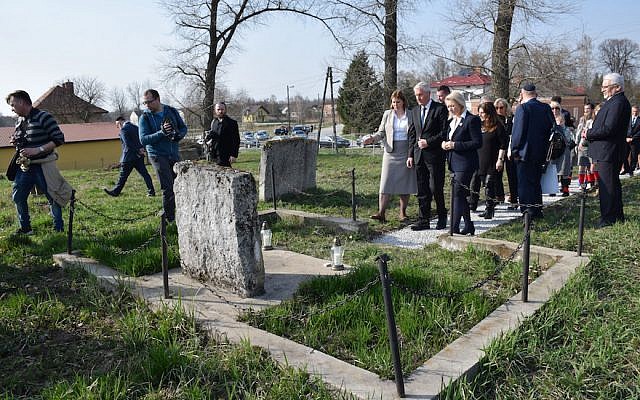
A ceremony at a Jewish cemetery in Frampol, Poland. (ESJF via JTA

JTA — A Holocaust education institute in Israel that trains guides for study trips abroad said it will switch its activities to Ukraine from Poland following the latter country’s law prohibiting some rhetoric about the genocide.

The Shem Olam institute, located in a small village in central Israel that also includes a small museum, focuses on religious life during the Holocaust and has trained some 20 guides for Holocaust study trips in Poland. The institute made the announcement Thursday in a statement to the media.

The goal of the switch is to “reduce the number of delegations to Poland, which constitute a major touristic element, and even hurt the ‘touristic’ inflow of roots trips and thereby send across a clear message of rejection of the state’s interference with the narrative of the Holocaust.”

Earlier this year, Poland’s parliament passed a measure that outlawed rhetoric in which Poland is blamed for Nazi crimes, triggering angry reactions from Israel and Jewish groups that said it amounted to Holocaust revisionism.

“The Polish people [are] trying to deny [their] crimes during the Holocaust but the main problem is the Polish government, which is adhering to a worrisome policy lately of Holocaust denial and anti-Semitism,” said Rabbi Avraham Kriger, Shem Olam’s director, adding, “It is time to stop the river of millions of dollars flowing into Poland each year” through the trips.

Poland has denied that its law is designed to deny the Holocaust, arguing that it serves to prevent attempts to abuse the genocide’s memory. It has also said it is committed to fighting anti-Semitism, whose prevalence in Poland is low relative to Western countries and has recently diminished in scope, according to official figures.

Ukraine, which reportedly has a rising anti-Semitism problem, passed a similar law in 2015, which forbids “insulting the memory” of anti-communist partisans, including those who fought with Adolf Hitler and murdered Jews. It was met with a far fainter reaction than the one triggered by the law in Poland.

Both Ukraine and Poland were occupied by Nazi Germany, and saw widespread collaboration as well as resistance by the local populations. Unlike in Ukraine, the Nazis did not recruit Polish volunteers to fight in their army. Ukrainian authorities have named streets for some Nazi collaborators and in Lviv the municipality hosted a march featuring SS uniforms earlier this year.

In April, 57 US congressmen co-signed a letter condemning the Polish law, but which used far harsher language on how Ukraine “glorifies Nazi collaborators,” as the authors said.


Zawartość publikowanych artykułów i materiałów nie reprezentuje poglądów ani opinii Reunion’68,
ani też webmastera Blogu Reunion’68, chyba ze jest to wyraźnie zaznaczone.
Twoje uwagi, linki, własne artykuły lub wiadomości prześlij na adres:
webmaster@reunion68.com


The Washington Post Soft-Pedals the BDS Movement

The Washington Post Soft-Pedals the BDS Movement

ean Durns / JNS.org


The former Washington Post building. Photo: Wikimedia Commons.

JNS.org – Washington Post coverage of the anti-Israel boycott, divestment, and sanctions (BDS) movement is, with growing frequency, violating the newspaper’s own policies and standards. US-designated terrorist groups support BDS and its supporters openly call for the end of the Jewish state. Yet, these facts cannot be found in The Post’s pages.

Instead, the paper has decided to whitewash BDS.

Take, for example, a recent Washington Post op-ed by Stanford University Professor David Palumbo-Liu, a BDS advocate. Palumbo-Liu defended the decision of a University of Michigan professor and fellow BDS supporter, John Cheney-Lippold, to refuse to write a letter of recommendation for a student’s study-abroad program in Israel.

On October 3, the University of Michigan sent Cheney-Lippold a disciplinary letter, characterizing his actions as falling “far short of the University’s and College’s expectations,” and noting that the professor had “used the student’s request as a platform to express your own personal views.”

“A student’s academic merit should be the primary guide for determining whether to write a letter,” the university explained.

Palumbo-Liu defended Cheney-Lippold, but omitted key components of the university’s decision. In fact, as the university explained in its letter, Cheney-Lippold had previously written letters of recommendation for study in Israel for two other students, admitting that at the time, “I wrote letters for them because I did not have tenure.” Additionally, the professor used “class time for both courses” he teaches to discuss his “views on the BDS movement.”

Worse still, Palumbo-Liu defended BDS as merely seeking “the end of Israeli occupation of Arab territory, the full equality of Palestinian citizens of Israel and the right of Palestinian refugees to return to their homes.” Its supporters, he declared, “include Bishop Desmond Tutu and 2018 Nobel laureate George P. Smith.”

But that is an inaccurate and misleading description of BDS, which seeks to unfairly malign the world’s sole Jewish state, singling it out for opprobrium. And its advocates also include US-designated terrorist groups like Hamas, whose charter calls for the genocide of Jews and Israel’s destruction. Bishop Desmond Tutu, meanwhile, has supported recognizing Hamas as a legitimate political entity and compared its leaders — who target civilians, use human shields, and run a kleptocratic Islamist theocracy in Gaza — to Nelson Mandela, the South African anti-apartheid leader.

BDS activists and leaders are clear on their true objectives, even while The Post and Palumbo-Liu obfuscate. BDS co-founder Omar Barghouti has openly called for the end of the Jewish state of Israel. According to US Congressional testimony by a former US Treasury Department terror analyst named Jonathan Schanzer, some BDS groups have links to terrorist organizations like the Popular Front for the Liberation of Palestine.

No other country in the world faces a systematic campaign to boycott it — only the world’s sole Jewish state. But in Israel, Arabs sit on the Supreme Court, hold elected offices, and enjoy a higher standard of living and greater political freedoms than anywhere else in the Middle East. By contrast, Palestinians living under the rule of Fatah in the West Bank or Hamas in the Gaza Strip do not have free and fair elections, and those who practice religions other than Islam face punishment or death.

Indeed, two days before Palumbo-Liu’s October 13 op-ed in the Post, the Arab-Israeli journalist Khaled Abu Toameh noted that a Palestinian man in Jericho was sentenced by a Fatah-controlled Palestinian Authority (PA) court to “one year in prison for ‘insulting’ the prophets.” BDS supporters, however, were silent — just as they were when the PA’s prime minister, Rami Hamdallah, admitted on March 16, 2016 that torture “happens” in PA-run prisons. Their concern for Palestinians is feigned. But their obsession with and hatred of Israel is very real.

Yet the Post perennially misleads about the nature of BDS. An October 8 report described BDS activities as merely ranging from “discouraging the purchase of goods produced in Israeli settlements to pressuring international companies not to conduct business in Israel and urging celebrities not to visit or perform in the Jewish state.” Two other recent Postarticles, both on the University of Michigan controversy, also omitted key details about BDS.

As the Committee for Accuracy in Middle East Reporting in America (CAMERA) has detailed, one October 9 dispatch falsely claimed that BDS supporters “distinguish” between the Israeli government and Jews. However, a mere five days before that article was published, BDS activists “disrupted the presentation of an Israeli Holocaust film in Berlin,” noted The Jerusalem Post.

CAMERA has, on several occasions, sent Post staff Congressional testimony highlighting the BDS movement’s ties to terrorist-linked entities, as well as statements by BDS activists like Anna Waltzer, who exhorted: “We need to wipe out Israel.”

The Post, it seems, has its narrative. And the paper isn’t going to let facts get in its way.

The Washington Post’s own policies and standards, listed on its website, state that the “first mission of a newspaper is to tell the truth as nearly as the truth may be ascertained.” Further, “the newspaper shall tell ALL the truth so far as it can learn it, concerning the important affairs of America and the world.”

The English philosopher and writer Aldous Huxley purportedly said: “Facts do not cease to exist because they are ignored.” Nor do they cease to exist because The Washington Post, which fancies itself a purveyor of truth, refuses to print them.


Sean Durns is a senior research analyst for CAMERA, the 65,000-member, Boston-based Committee Accuracy in Middle East Reporting in America.


Zawartość publikowanych artykułów i materiałów nie reprezentuje poglądów ani opinii Reunion’68,
ani też webmastera Blogu Reunion’68, chyba ze jest to wyraźnie zaznaczone.
Twoje uwagi, linki, własne artykuły lub wiadomości prześlij na adres:
webmaster@reunion68.com


Can positive emotions shrink cancer tumors?

Israel21cCan positive emotions shrink cancer tumors?

ISRAEL21c Staff


Technion doctoral students Tamar Ben-Shaanan, left, and Maya Schiller. Photo by Rami Shlush, Technion Spokesperson’s office

Artificially activating the “reward system” in the brains of mice with two types of cancer led to a dramatic reduction in the size of their tumors, according to authors of a study conducted at the Technion-Israel Institute of Technology.

“The relationship between a person’s emotional state and cancer has been demonstrated in the past, but mainly in relation to negative feelings such as stress and depression and without a physiological map of the action mechanism,” said Assoc. Prof. Asya Rolls of the Technion Rappaport Faculty of Medicine, who supervised the study.

“Several researchers, for example Prof. David Spiegel of the Stanford University School of Medicine, showed that an improvement in the patient’s emotional state may affect the course of the disease, but it was not clear how this happened. We are now presenting a physiological model that can explain at least part of this effect,” she said.

The results were published in the journal Nature Communications by Rolls along with doctoral students Tamar Ben-Shaanan and Maya Schiller, as well as Hilla Azulay-Debby, Ben Korin, Nadia Boshnak, Tamar Koren, Maria Krot, Jivan Shakya and Michal A. Rahat, and Technion Asst. Prof. Fahed Hakim, medical director of the Scottish EMMS Hospital in Nazareth.

From left, Technion researchers Hilla Azulay-Debby, Prof. Asya Rolls, Prof. Hakim and doctoral student Maya Schiller. Photo by Rami Shlush, Technion Spokesperson’s office

According to Hakim, “Understanding the brain’s influence on the immune system and its ability to fight cancer will enable us to use this mechanism in medical treatments. Different people react differently, and we’ll be able to take advantage of this tremendous potential for healing only if we gain a thorough understanding of the mechanisms.”

The authors emphasized that the study is preclinical and that they tested only two cancer models (melanoma and lung cancer) and only two developmental aspects – tumor volume and weight.

However, this breakthrough may allow doctors to realize the physiological role the patients’ mental state plays in the development of malignant diseases. By artificially activating different parts of the brain, in the future it might be possible to encourage the immune system to block development of cancerous tumors more effectively.

Rolls explained that although the immune system has been proven able to fight cancer effectively if given the right tools, “the immune cells’ involvement in cancerous processes is a double-edged sword, because certain components in these cells support tumor growth. This is done by blocking the immune response and creating an environment that is beneficial to growth.”

Rolls has been studying the brain’s effect on the immune system for several years. In a study she published in 2016 in Nature Medicine, she showed how the immune system can be stimulated to work more effectively by manipulating the brain’s reward system – which operates in positive emotional states and in anticipation of the positive.

The main breakthrough in the present study is the dramatic contraction of cancerous tumors in response to the activation of the brain’s reward system.

Rolls cautioned, however, that the findings are not necessarily applicable to all types of cancer and that the experiments have not been done on humans at this point.

The artificial manipulation that worked on mice “most probably works differently” in humans, she said, “especially because other systems are also involved. For example, stress may counteract these reward system effects.”

Rolls said it’s not as simple as thinking positively to get better. “People are very different in their reactions, and until we fully understand how this works, it merely offers a potential.”

The study was supported by the Adelis Brain Research Award, a $100,000 research grant won by Rolls in June 2017. The prize is intended to encourage excellence in the field of brain research in Israel and to translate the research into global impact for the benefit of all humanity.


Zawartość publikowanych artykułów i materiałów nie reprezentuje poglądów ani opinii Reunion’68,
ani też webmastera Blogu Reunion’68, chyba ze jest to wyraźnie zaznaczone.
Twoje uwagi, linki, własne artykuły lub wiadomości prześlij na adres:
webmaster@reunion68.com