Archives

UNPACKING THE ACTUAL IMPACT OF BDS ON ISRAEL’S ECONOMY

UNPACKING THE ACTUAL IMPACT OF BDS ON ISRAEL’S ECONOMY

ADAM REUTER/GLOBES


One of the goals of the Boycott, Divestment, and Sanctions movement is to hurt the Israeli economy. The movement may not be as effective as many believe it to be.

‘INSTEAD OF fighting the Israeli army on the battlefield or killing civilians through acts of terrorism, the BDS movement seeks to destroy Israel’s image in the eyes of the world.’. (photo credit: REUTERS)

Several years ago, I was invited to meet with executives from the Ministry of Strategic Affairs. One of the ministry’s main goals included “combating the delegitimization of Israel.” The purpose of the meeting was a study we conducted at the Financial Immunities company of the effect of BDS on the Israeli economy. To the best of my knowledge, the study we conducted, which began in 2010, was the only one of its kind. It was meant to determine to what extent the Israeli economy was being affected by the BDS organization. The study included queries to hundreds of senior executives of large companies from every economic sector. It was important to Financial Immunities as a company focusing on helping its clients in risk management at both the macro and micro levels, including an individual company.

The results of the study surprised me. I did not expect such a wide gap between the journalists’ reports over the years about the effect of the BDS monster and its actual effects, which were negligible at the most. The study’s figures are correct as of late 2017.

I obtained a hint about the impotence of the BDS organization at the very beginning of the study. I constructed a false digital identity and applied to the organization as a young Australian interested in boycotting Israel. I asked what I should do. In response, the organization sent me a link to a page with hundreds, if not thousands, of names of international companies having connections with Israel. I was told to boycott them. When I saw the list, I burst out laughing. It included most of the companies selling some kind of products around the world. Boycotting them would have prevented me from buying things ranging from basic items at the supermarket to any kind of mobile telephone whatsoever, a refrigerator, or a car.

The more important step was to question the managers of Israeli companies, the most important question being, “Can you quantify in money how much your company lost as a result of the economic boycott created by BDS?” The proportion of Israeli companies able to state that they had been damaged by the sanctions was around 0.75%. The rate of damage of each of them was less than 10% of their turnover, and even that was mostly during Operation Protective Edge; they experienced no damage in other years.

According to our calculations, based on the information we obtained from the companies, the cumulative proportion of economic damage since 2010 was 0.004%. To put it more colorfully, if the Israeli economy’s yearly income were to average NIS 1 million, the damage from the sanctions would have been NIS 40 – a completely negligible amount.

Paradoxically, there were also Israeli companies that benefited from the boycott. How is that possible? I asked the deputy CEO of a well-known Israeli company that holds a chain of stores in Europe, among other things. It was reported that the company had been damaged by the boycott during Operation Protective Edge when BDS activists stood in front of its store in a European capital and called for boycotting its products. To my surprise, the deputy CEO told me that the company had suffered no damage; on the contrary. How? The activists demonstrating in front of the store in London left after two days when journalistic interest waned. After they left, the number of buyers at the store was four times the number on an ordinary day. These were local non-Jewish residents who liked Israel and came especially to buy at the store in order to demonstrate their sympathy for Israel.

At the same meeting with senior staff at the Ministry of Strategic Affairs, they said that the power of the BDS movement existed mainly in the publications of the Israeli press. This was a different problem – probably a matter of our culture – the emotional and panicked response by Israelis to everything, but that could also be one of the indications of our power.


The author is chairperson of Financial Immunities and coauthor of the book, “Israel – Island of Success.”


Zawartość publikowanych artykułów i materiałów nie reprezentuje poglądów ani opinii Reunion’68,
ani też webmastera Blogu Reunion’68, chyba ze jest to wyraźnie zaznaczone.
Twoje uwagi, linki, własne artykuły lub wiadomości prześlij na adres:
webmaster@reunion68.com




The Jews Have No Historic Right to the Land

Jordanian Archaeologist Mohammad Waheeb Al-Husseini: The Jews Have No Historic Right to the Land

MEMRI


Speaking at a conference held by the Moroccan Organization for Human Rights, Egyptian-German scholar Hamed Abdel-Samad called to stop trying to please the Islamists and said that “whoever wants to embrace the heritage, along with its representatives and theoreticians, and to incorporate them in the enlightenment game is perpetrating a crime.” Abdel-Samad enumerated the principles of enlightenment and said that solutions should not be sought within jurisprudence as these are “nothing but plastic surgery for a lifeless corpse.” It is like an elastic band, he said. “We pull away with our thinking, but then we are pulled back by our fear, of taboos, our fear of prohibitions, and our fear of being punished by the law or by society. There can be no enlightenment where there is fear.” Abdel-Samad posted his speech on his YouTube channel on April 5.


Zawartość publikowanych artykułów i materiałów nie reprezentuje poglądów ani opinii Reunion’68,
ani też webmastera Blogu Reunion’68, chyba ze jest to wyraźnie zaznaczone.
Twoje uwagi, linki, własne artykuły lub wiadomości prześlij na adres:
webmaster@reunion68.com


Gazan was killed at close range after rushing soldier with knife – officer

Gazan was killed at close range after rushing soldier with knife – officer

TOI STAFF and JUDAH ARI GROSS


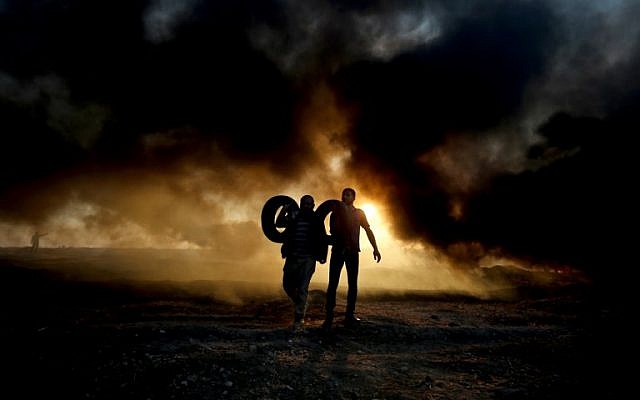
Palestinian protesters carry tires as smoke billows from burning tires at the Israel-Gaza border, east of Gaza city, on October 12, 2018 (Photo by SAID KHATIB / AFP)

One of the Gazan Palestinians who blew a hole in the security fence and crossed the border into Israel on Friday was killed at point-blank after approaching a soldier with a knife, the military said early Sunday.

Seven Palestinians were killed in all and at least 252 were injured in intense clashes with Israeli security forces along the Gaza border on Friday afternoon and evening, the Hamas-run health ministry said.

In the most serious incident, in the south of the Strip, the Israel Defense Forces said several Gazans planted a bomb by the fence. After it exploded and blew a hole in the fence, some 20 Palestinians rushed through and ran toward Israeli soldiers stationed in a snipers’ nest.

Most of the Gazans pulled back and returned through the fence into the Strip after the soldiers fired warning shots into the air. However, several continued to move toward the soldiers, who fired at them, according to Sgt. Omer Kaplan, a field intelligence soldier who monitors the border through surveillance cameras.

The smoke from the explosion obstructed the view of the border and made it hard for Kaplan and the other lookouts to spot the Palestinians after they crossed.

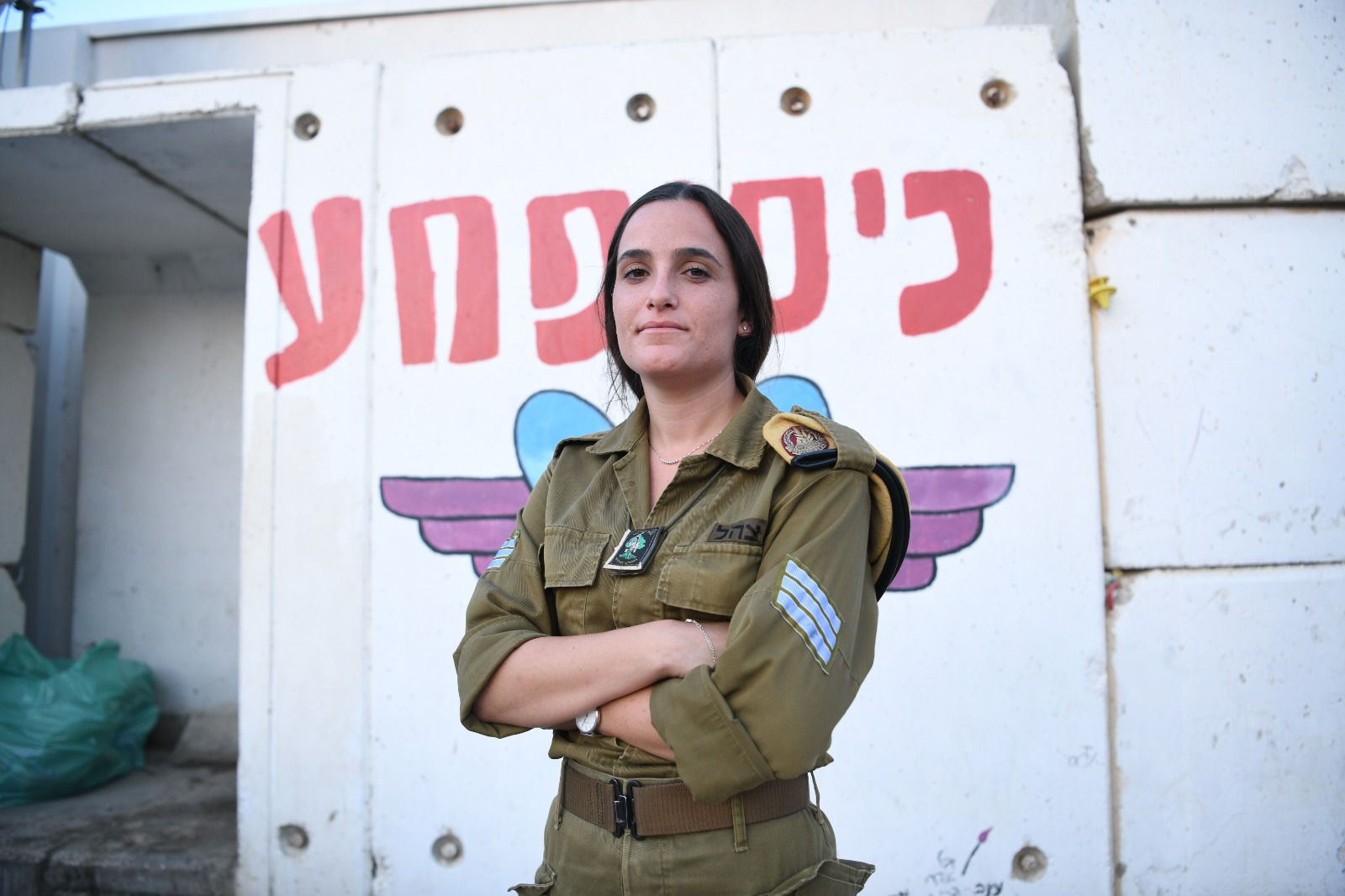
Sgt. Omer Kaplan, a field intelligence soldier who spotted a terrorist approaching a group of soldiers on the Gaza border, on October 12, 2018. (Israel Defense Forces)

“Under the cover of smoke and the violent disturbance, several suspects tried to approach an [Israeli] post, but I recognized them and informed the forces over the communications network and they fired warning shots at them,” she said, in a statement released by the IDF.

“Most of them doubled back, but I noticed that one remained in the area and we lost sight of him,” Kaplan said. “We did a reconstruction… in real time, and I told the forces that there was another terrorist [in the field]. One of the fighters spotted him and neutralized him.”

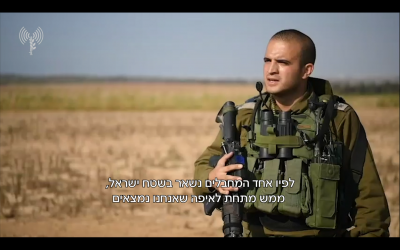
Maj. Ben Hallel, deputy battalion commander from the
Paratroopers Brigade, discusses one of his soldiers finding
and killing a Palestinian armed with a knife, who approached
troops near the Gaza border, on October 12, 2018.
(Israel Defense Forces)

Major Ben Hallel, an officer in the Paratroopers Brigade who commanded the troops during the incident, said the Palestinian was armed with a knife and tried to attack a soldier, who opened fire at close range and killed him.

“We received a reports from the lookouts, saying that one of the terrorists remained in Israeli territory, just under where we were stationed. One of the soldiers, who was near the location, spotted the terrorist, who approached him with a knife,” Hallel said.

The military’s investigation of the incident found that the soldier called on the Palestinian to stop several times before shooting him, the Walla news site reported. The report said the IDF assessed that he intended to grab the soldier’s weapon.

The bodies of three Palestinians were taken back into the Strip by rioters, Hadashot TV news reported.

Palestinians stand by the bodies of Ahmad al-Tawil (L) and Ahmed Abu Naim (R), who were killed the day before during a protest along the Israel-Gaza border fence, during their funeral in Nuseirat camp, in the central Gaza Strip on October 13, 2018 (Photo by SAID KHATIB / AFP)

“This is a blatant terror attempt that was thwarted by IDF troops quickly and professionally which prevented a possible terror attack against civilians and IDF troops,” the IDF said Friday, noting the knife that was found at the scene.

The army said some 15,000 protesters hurled grenades, bombs, firebombs and rocks at Israeli forces at various locations along the border. Hadashot reported that for the first time soldiers were also being shot at with crossbows.

Troops responded with riot dispersal means and live fire, the army said.

In light of the bomb attack on the fence and the heavy rioting, Defense Minister Avigdor Liberman ordered a halt to the transfer of fuel into the Strip.

Riots along the Gaza border have increased in recent weeks, going from a weekly event to near nightly protests since Hamas halted indirect talks with Israel aimed at a ceasefire. The humanitarian crisis in the Strip, meanwhile, has worsened, while reconciliation talks with the Palestinian Authority have broken down.

Hamas, an Islamist terror group that rules the Gaza Strip and actively calls for Israel’s destruction, has created new units tasked with sustaining tensions along the border fence including during nighttime and early morning hours.

Almost every evening, thousands of Gazans have been gathering for violent demonstrations at the Erez crossing and elsewhere, in what is regarded by some as part of Hamas’s attempts to signal to Israel that it wants an economic solution to the Gaza Strip.

At least 140 Palestinians have been killed during protests since late March, according to AP figures. Hamas has acknowledged that dozens of the fatalities were its members.


Zawartość publikowanych artykułów i materiałów nie reprezentuje poglądów ani opinii Reunion’68,
ani też webmastera Blogu Reunion’68, chyba ze jest to wyraźnie zaznaczone.
Twoje uwagi, linki, własne artykuły lub wiadomości prześlij na adres:
webmaster@reunion68.com


Konfederacja jordańsko-palestyńska – dlaczego nie?

Konfederacja jordańsko-palestyńska – dlaczego nie?

Ben-Dror Yemini
Tłumaczenie: Małgorzata Koraszewska


Kiedy Brytyjczycy zdobyli panowanie nad Palestyną jako część mandatu ONZ, obszar ten obejmował obie strony rzeki Jordan i wynosił około 117 tysięcy kilometrów kwadratowych. Jednak w 1921 r. rząd brytyjski przeprowadził podział, odcinając wschodni brzeg rzeki Jordan, który stał się znany jako Emirat Transjordanii lub po prostu Transjordania. Był to, praktycznie rzecz biorąc, twór kolonialny.

Kiedy w 1936 r. wyznaczono Komisję Peela w odpowiedzi na Arabską Rewoltę, zdecydowano o jeszcze jednym podziale. Zaledwie 4,8 tysiąca kilometrów kwadratowych miało przypaść państwu żydowskiemu, podczas gdy 20,6 tysiąca kilometrów kwadratowych miało zostać dodane do państwa arabskiego – Transjordanii – które już rozciągało się na około 90 tysiącach kilometrów kwadratowych.

Nie było rekomendacji założenia „państwa palestyńskiego”, bo w owym czasie nie było narodu palestyńskiego ani jednostki palestyńskiej. Rekomendowano założenie jednego państwa arabskiego po obu stronach rzeki Jordan.

Warto zwrócić uwagę na fakt, że 96% oryginalnej ziemi Palestyny zarezerwowano na to państwo arabskie, a pozostałe 4% miało być oddane Żydom. Opór Arabów wobec tego podziału nie wynikał z ustanowienia arabskiego państwa po obu stronach rzeki Jordan, ale z marnych czterech procentów, które zostały przeznaczone dla Żydów.

W Planie Podziału ONZ z 1947 r. państwu żydowskiemu przyznano 15 tysięcy kilometrów kwadratowych, co stanowiło mniej niż 13% ziemi oryginalnie znanej jako Palestyna. Była to znacząca poprawa w stosunku do 4% przeznaczonych dla Żydów przez Komisję Peela.

Z powodu oporu krajów arabskich wobec tego nowego podziału oraz inwazji otaczających krajów arabskich na Izrael, państwo żydowskie urosło do 21 tysięcy kilometrów kwadratowych.

Jedną rzeczą, co do które wszyscy możemy się zgodzić, jest to, że nigdy nie było żadnej różnicy między tymi Arabami, którzy żyli po zachodniej stronie rzeki Jordan, a tymi, którzy żyli po wschodniej stronie tej rzeki.

Należeli do tej samej rodziny, praktykowali tę samą religię, mówili tym samym językiem i mieli tę samą kulturę. Po wojnie o niepodległość Jordania anektowała Zachodni Brzeg i dała obywatelstwo tym, którzy żyli tam wcześniej pod Mandatem Brytyjskim.

W owych dniach nie bylo Palestyńczyków. Byli Arabami. ONZ nie postanowiła o utworzeniu palestyńskiego państwa. Postanowiła utworzyć arabskie państwo. Połączenie dokonane przez Jordanię był całkowicie naturalne. To nie był związek między cudzoziemcami, ale między braćmi.

Po wojnie sześciodniowej „jordańska opcja” była preferowaną opcją porozumienia pokojowego. W końcu, świat arabski nie stworzył odrębnego państwa przez niemal dwadzieścia lat, kiedy ten teren był wolny od izraelskiej „okupacji”. W 1987 r. dokonano ostatniej próby zrealizowania ”jordańskiej opcji” jako część Porozumienia Londyńskiego między Królem Husseinem a Szimonem Peresem.

Gdyby Bliski Wschód zachowywał się racjonalnie, powiązanie między ludźmi z tego samego narodu byłoby naturalne. W końcu, wszyscy mówią o arabskiej jedności. W rzeczywistości cały szereg Arabskich przedstawicieli, włącznie z Azmim Biszarą (byłym członkiem Knesetu, który uciekł z kraju po oskarżeniu o szpiegostwo), przyznało, że „nie istnieje żaden naród palestyński”.

Łatwo zrozumieć istnienie Egiptu, Iraku i Syrii, z których każde ma do takiego lub innego stopnia historię i dziedzictwo, dające im pewną unikatowość. Ale Jordańczycy i Palestyńczycy? Mają prawo do samostanowienia. Ale podział: po co i dlaczego? Co ich właściwie różni? Nic.

Globalna lewica i palestyńscy aktywiści na Zachodnim Brzegu, jak również niektórzy członkowie izraelskiej prawicy, mówią o „jednym państwie”. Jednak jedno państwo ustanawia się w podobnych i identycznych społecznościach, które praktykują tę samą religię i mają podobną kulturę, nie ustanawia się jednego państwa z dwóch różnych społeczności.

Jordania jest Palestyną, a Palestyna jest Jordanią. Czechosłowacja podzieliła się na dwoje, a Jugosławia podzieliła się na siedem części na bazie religijnego i etnicznego samostanowienia.

To, co było prawdą tam i zostało uznane za słuszne przez większość krajów świata – powinno być również prawdą na Bliskim Wschodzie.

Dlatego, zakładając, że administracja USA, jak powiedział nam w niedzielę prezydent Autonomii Palestyńskiej Mahmoud Abbas, rekomendowała plan pokojowy oparty o konfederację z Jordanią, jest to właściwa i poprawna rekomendacja.

Nie jest jasne, dlaczego Abbas nalega na włączenie Izraela do takiej konfederacji.

Czy Chorwaci zaprosili Słoweńców, by do nich dołączyli? Prawdą jest, że 31 lat po nieudanym Porozumieniu Londyńskim wydaje się, że jordańska opcja nie jest dłużej rozważana, ale logika wymaga, by ponownie położyć ją na stole negocjacyjnym.


Ben-Dror Yemini

(ur. 1954 w Tel Awiwie) jest prawnikiem, historykiem i publicystą wielu izraelskich dzienników (m.in. Maariw, Jediot Achronot), a także wykładowcą, który zajmuje się m.in. wpływem antyizraelskiej propagandy.  Pochodzi z rodziny Żydów wypędzonych z Jemenu. Ben-Dror Yemini jest zwolennikiem pogłębiania dialogu z Palestyńczykami. Od wielu lat opowiada się za niepodległym państwem palestyńskim.


Zawartość publikowanych artykułów i materiałów nie reprezentuje poglądów ani opinii Reunion’68,
ani też webmastera Blogu Reunion’68, chyba ze jest to wyraźnie zaznaczone.
Twoje uwagi, linki, własne artykuły lub wiadomości prześlij na adres:
webmaster@reunion68.com


GERMANY’S BEST-SELLING PAPER CALLS FOR END OF IRAN TRADE TO PROTECT ISRAEL

GERMANY’S BEST-SELLING PAPER CALLS FOR END OF IRAN TRADE TO PROTECT ISRAEL

BENJAMIN WEINTHAL


“It is high time to ask oneself where the money that Iran is earning by this trade is going,” Dr. Schuster said.

A gas flare on an oil production platform in the Soroush oil fields is seen alongside an Iranian flag in the Persian Gulf, Iran, July 25, 2005.. (photo credit: REUTERS)

In an eye-popping commentary on Monday, Germany’s top-selling Bild newspaper urged businesses to stop trade with the Islamic Republic of Iran because of its terrorism and the regime’s goal of obliterating the Jewish state.

Bild’s foreign policy editor Julian Röpcke wrote, “This Iran cannot at this time be an ally, neither in the fight against terrorism, nor as an oil supplier or trade partner.” Röpcke, who reports on the Syrian war, wrote that Iran’s missile launches into Syria were a “message of terror. Because they carry the meter-long inscriptions ‘Death to Israel and ‘Death to the USA’ – and that is deadly serious for the mullahs.”

Röpcke noted that “Iran’s rockets were not fired against the Islamic State, rather against those who stand in the way of the corrupt regime in Tehran; against those who do not want to stand inactively by when Iran’s leader again and again propagates the ‘extermination’ of Israel.” The Bild has a daily circulation of approximately 1,581,000.

Iran’s Islamic Revolutionary Guard Corps said on Monday that it launched six missiles at paramilitary groups located close to the Euphrates River. Iran’s clerical regime claims the missile attack was in response to a terrorist attack on a military parade in the Iranian city of Ahvaz last month. The attack killed 25 people in Ahvaz and injured an additional 60.

The Bild commentary is believed to be first instance in the best-selling paper of a call for the complete end of business deals with the Islamic Republic of Iran. German Chancellor Angela Merkel and her foreign minister, Heiko Maas, support the European Union’s “special purpose vehicle” (SPV) to permit financial transactions with Iran. The SPV is designed to thwart robust US sanctions on Iran’s energy and financial systems. Germany’s federal government provides credit insurance guarantees to companies that want to conduct business with Iran.

On Saturday, the US Embassy in Berlin tweeted a quote from the head of the Central Council of Jews in Germany, Dr. Josef Schuster, who said: “I endorse an immediate stop of any economic relations with Iran. Any trade with Iran means a benefit for radical and terrorist forces, and a hazard and destabilization for the region.”

Merkel and Maas, who said he entered politics “because of Auschwitz,” have ignored Schuster’s plea.

Rabbi Abraham Cooper, the associate dean of the Simon Wiesenthal Center, told The Jerusalem Post, “Courageous honest leadership by Dr. Schuster. Chancellor Merkel continues business with Jew-hating Ayatollah who bankrolls terrorism around the world and threatens six million-plus Jews in Israel.”

Merkel arrives in Israel this week for a joint-cabinet consultation with Israeli leaders. She has defended the Iran nuclear deal that Israel vehemently rejects because it allows Tehran a pathway to a nuclear weapon.

Schuster, who represents nearly 100,000 Jews in Germany, told the Post in August: “The Central Council of Jews in Germany has been criticizing German-Iranian trade relations for a long time. It seems paradoxical that Germany – as a country that is said to have learned from its horrendous past and which has a strong commitment to fight antisemitism – is one of the strongest economic partners of a regime that is blatantly denying the Holocaust and abusing human rights on a daily basis.

“Besides, Germany has included Israel’s security as a part of its raison d’etre. As a matter of course this should exclude doing business with a fanatic dictatorship that is calling for Israel’s destruction, pursuing nuclear weapons and financing terror organizations around the world.


Zawartość publikowanych artykułów i materiałów nie reprezentuje poglądów ani opinii Reunion’68,
ani też webmastera Blogu Reunion’68, chyba ze jest to wyraźnie zaznaczone.
Twoje uwagi, linki, własne artykuły lub wiadomości prześlij na adres:
webmaster@reunion68.com