
Archives

SWEDISH AMBASSADOR, JEWISH LEADERS DISCUSS RISE IN ANTISEMITISM

SWEDISH AMBASSADOR, JEWISH LEADERS DISCUSS RISE IN ANTISEMITISM

SHANNON PRATHER / STAR TRIBUNE


“We’ve seen a rise of antisemitism in the big cities,” Olofsdotter said. “People don’t change when they cross the border. They carry their old values.”
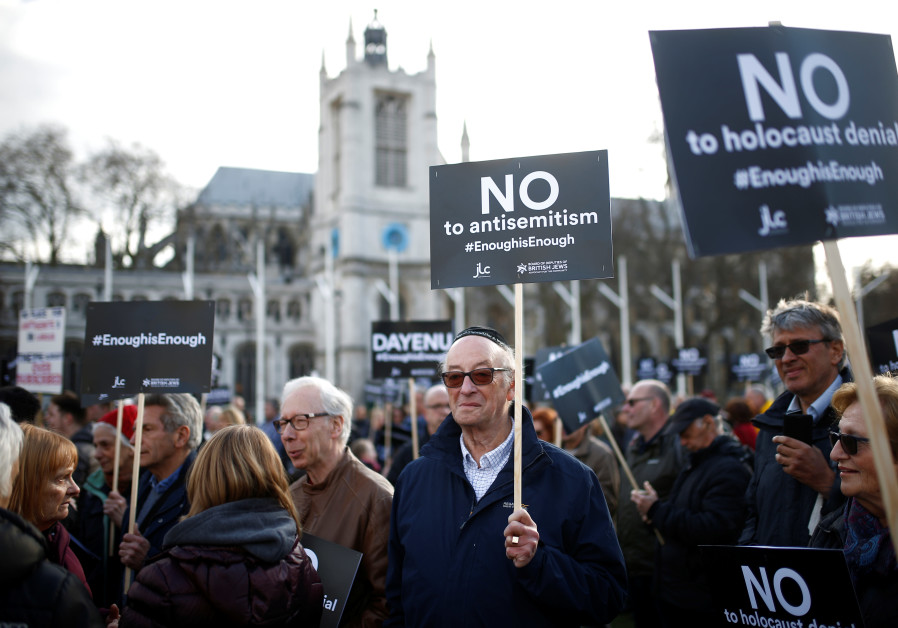
Protesters participate in a demonstration against antisemitism in Parliament Square in London, Britain, March 26, 2018. (photo credit: HENRY NICHOLLS/REUTERS)

Rising antisemitism in Europe and a surge of it here in America brought together the new Swedish ambassador to the United States and leaders of Minnesota’s Jewish community.

(TNS) Ambassador Karin Olofsdotter has sought out meetings with Jewish leaders across the US since taking office a year ago, seeking to address the problem head-on and discuss ways that Sweden is trying to counteract it.

On Tuesday — hours before the start of Judaism’s holiest day, Yom Kippur — Olofsdotter met with Minneapolis Jewish Federation CEO James Cohen and Steve Hunegs, executive director of the Jewish Community Relations Council of Minnesota and the Dakotas.

She said asylum-seekers and refugees from the Middle East who have settled in Sweden sometimes bring anti-Jewish feelings with them.

“We’ve seen a rise of antisemitism in the big cities,” Olofsdotter said. “People don’t change when they cross the border. They carry their old values.”

Sweden’s national plan to stamp out antisemitism includes research, education and coordination that reaches into the classroom, the criminal justice system and even on social media. “That is where a lot of hate flourishes,” she said.

Sweden has also increased security around Jewish institutions after an attack on a synagogue in December. In addition, Sweden is planning a Holocaust remembrance conference in 2020 — similar to one held more than two decades ago, Olofsdotter said.

Olofsdotter’s two-day visit to Minnesota followed the Sept. 9 Swedish national elections in which the far-right, anti-immigrant Sweden Democrats gained ground in the Riksdag, its national legislature, finishing third with 17.6 percent of the vote. The party has its roots in the neo-Nazi movement and has been on the rise in recent years.

Tuesday’s meeting around a conference table at the American Swedish Institute in Minneapolis was amicable with exchanges of gifts and ideas, but Cohen did press the ambassador on Sweden’s pro-Palestinian politics and questioned whether that could be fueling antisemitism. Sweden was one of the first countries to recognize Palestine as a state.

Olofsdotter said the Swedish government’s programs stress that differing political views shouldn’t translate to a dislike of entire groups of people, but she indicated that the government can’t stifle the exchange of ideas.

Olofsdotter then turned the question on her American hosts: “How is antisemitism here?”

After years of decline, reports of antisemitic incidents spiked nearly 60 percent last year to 1,986, according to the Anti-Defamation League’s annual audit. This was the second-highest number reported since the league started tracking it in 1979.Hunegs and Cohen described US educational efforts, including a traveling exhibit called “Transfer of Memory,” which includes portraits and the stories of Holocaust survivors who settled in Minnesota.

One of those survivors, Judy Baron, flanked by her two adult children, met with Olofsdotter.

Baron, a Jew originally from Hungary, was imprisoned at Auschwitz and later at another Nazi concentration camp, Bergen-Belsen. When she was liberated, she was taken in critical condition to an emergency hospital in Sweden. She recovered there and met her husband and fellow survivor, Fred Baron. They eventually settled in Minnesota.

Baron, 90, presented the ambassador with a published book of her watercolor paintings and thanked her for the aid Sweden provided to her and her husband 70 years ago.

Baron’s son, Gary, said it’s meaningful that the ambassador is meeting with Jewish leaders and Holocaust survivors against the backdrop of rising antisemitism in Europe.

He said his mother and his late father always held Sweden in the highest regard.

“They didn’t encounter any antisemitism there. Quite the opposite,” he said.


©2018 the Star Tribune (Minneapolis). Distributed by Tribune Content Agency.


Zawartość publikowanych artykułów i materiałów nie reprezentuje poglądów ani opinii Reunion’68,
ani też webmastera Blogu Reunion’68, chyba ze jest to wyraźnie zaznaczone.
Twoje uwagi, linki, własne artykuły lub wiadomości prześlij na adres:
webmaster@reunion68.com



German Government-Funded Foundation Remains Committed to Joint Research Projects with Iran

Iranian Regime Minister Says German Government-Funded Foundation Remains Committed to Joint Research Projects

Algemeiner Staff


The image used by Iran’s official news agency to highlight cooperation agreements with German Foundation DFG. Image: IRNA.

Iran’s official news agency reported on Friday that a cooperation agreement between a group of Iranian universities and a major German research foundation remains in force, as the Tehran regime prepares for the impact of tough new US economic sanctions.

Interviewed by Iran’s IRNA agency, Deputy Minister for Science Hossein Salar Amoli said that universities in Tehran, Amir Kabir and Isfahan were “cooperating in implementing projects” with higher education institutions from the German cities of Hamburg, Dresden and Berlin, in 24 areas ranging from fossil fuel exploration to the translation of Persian literature.

The same report said that the research was being bankrolled by the Deutsche Forschungsgemeinschaft (DFG — German Research Fund), a state-funded body that awarded 3.2 billion euros of grants in 2017.

While there was no independent confirmation from the DFG of Amoli’s claims on Friday, the organization did reach a Memorandum of Understanding (MoU) with Iran’s National Science Foundation on Jan 21, 2016. The five-year agreement — renewed automatically if neither party objects — was signed by Prof. Nosratollah Zargham for the Iranian side, with Prof. Frank Allgöwer, a leading authority in the field of systems biology, signing on behalf of the Germans.

Nor has the German media reported on the agreements with Iran, since the appearance of a glowing feature about cooperation in water technology between universities in Dresden and Shiraz in the Sächsische Zeitung news outlet last April. This could indicate that the Iranian regime is recycling old news in a propaganda bid to counter US sanctions — although Amoli also claimed, without elaborating, that a group of German academics was currently visiting Iran “to review their capacities to take advantage of research and training projects and increasing cooperation in the future.”

In the four months that have elapsed since US President Donald Trump withdrew from the 2015 nuclear agreement with Iran, the Tehran regime has been anxious to emphasize that renewed sanctions will not impact its “scientific cooperation” with other countries.

On Jun. 1 — three weeks after the US walked away from the nuclear deal — Iranian official Hossein Vatanpour stressed at a press conference that the regime had “scientific exchanges with several countries in the world and sanctions will not affect these relations.”

That message that has been repeated regularly in the face of the comprehensive sanctions on Iran that the US wants locked down by Nov. 4.


Zawartość publikowanych artykułów i materiałów nie reprezentuje poglądów ani opinii Reunion’68,
ani też webmastera Blogu Reunion’68, chyba ze jest to wyraźnie zaznaczone.
Twoje uwagi, linki, własne artykuły lub wiadomości prześlij na adres:
webmaster@reunion68.com


The Yom Kippur Holocaust Protest

The Yom Kippur Holocaust Protest: The Day the Rabbis Marched

Rafael Medoff


The entrance to Auschwitz-Birkenau in Poland. Photo: Wikimedia Commons.

In an era that has seen more than 400,000 people take part in a Women’s March on Washington, it may not sound very impressive that 400 rabbis marched in the nation’s capital in 1943. But numbers alone don’t always tell the whole story.

This week marks the 75th anniversary of the rabbis’ march, which took place three days before Yom Kippur in 1943. The ten days between Rosh Hashana and Yom Kippur are among the most hectic periods for a pulpit rabbi, who has major sermons to prepare and countless logistics to arrange for the most well-attended services of the year.

So there was no small inconvenience involved for the rabbis who answered the call of the political action committee known as the Bergson Group and the Orthodox rescue advocates of the Va’ad ha-Hatzala to come to Washington to plead for the rescue of Europe’s Jews.

And their journey was likely made more than a little jittery by the fact that, just one month earlier, a new high-speed train on its way from New York City to Washington had derailed and killed 79 passengers.
Nevertheless, more than 400 rabbis put down their books, left their communities and congregations, and headed for Washington. Most came from the New York City area, but others traveled from as far away as Chicago, Cleveland, Cincinnati, Pittsburgh, and Worcester, Massachusetts.

As the station master shouted, “Clear the way for those rabbis!” the protesters emerged from Washington Union Station and made their way toward the cluster of buildings known as the Capitol.

It was not only their numbers, but also their stature, that was noteworthy. The marchers were led by Rabbis Eliezer Silver and Yisroel Rosenberg, co-presidents of the Union of Orthodox Rabbis. There were notable Hasidic rebbes, such as the Boyaner Rebbe, Rabbi Shlomo Friedman, and the Melitzer Rebbe, Rabbi Yitzchok Horowitz. And there were a number of younger rabbis who would soon become leaders of their generation, in particular Moshe Feinstein and Joseph B. Soloveitchik.

A columnist for the Yiddish-language newspaper Der Tog (“The Day”) was impressed by the reaction of passersby. As the rabbis in their “long silk and gabardines and round plush hats, moved along Pennsylvania Avenue … there [were] absolutely no snickers, no smirks on the faces of the onlookers,” he wrote. “They did not gape or guffaw as almost any crowd in a Central or East European land most decidedly would have. They watched in wonderment and in respect. The traffic stopped, and here and there a burgher removed his hat. I myself saw many a soldier snap in salute.”

Fear of East European-style antisemitic mockery was actually a large part of the reason that the rabbis’ march was so unusual. It was, in fact, the only march in Washington for the rescue of the Jews during the Holocaust years. Many American Jews, as immigrants or the children of immigrants, were extremely anxious to be seen as fitting in. They worried that noisy Jewish protests might be perceived as un-American.

In fact, one Jewish member of Congress, Representative Sol Bloom (D-New York), reportedly sought to persuade the rabbis to cancel the march on the grounds that “it would be very undignified for a group of such un-American looking people to appear in Washington.” The Jewish communal leader Cyrus Adler once referred to that attitude as “the ghetto crouch” — the phenomenon of Jews walking with their heads bowed so as not draw the attention of non-Jews.

The rabbis were greeted on the steps of the Capitol by Vice President Henry Wallace and members of Congress. After brief remarks, the rabbis proceeded to the Lincoln Memorial to recite prayers and sing the national anthem.

Then they marched to the White House. While most of the rabbis waited across the street in Lafayette Park, their leaders approached the gates of the White House to ask if President Roosevelt could “accord a few minutes of his most precious time.” They wanted to present him with a petition calling for the creation of “a special agency to rescue the remainder of the Jewish nation in Europe.”

A White House staffer informed the rabbis that the president was unavailable “because of the pressure of other business.” Actually, FDR’s schedule was clear that afternoon. But a presidential meeting would have conferred legitimacy on the protesters’ pleas for US action. And Roosevelt’s policy was that there was nothing that could be done to help the Jews, except to win the war. So, in order to avoid seeing the marchers, the president quietly left the White House through a rear exit.

That move backfired. “Rabbis Report ‘Cold Welcome’ at the White House,” declared a Washington Times-Herald headline the next morning. A leading Jewish newspaper columnist angrily asked: “Would a similar delegation of 500 Catholic priests have been thus treated?” The editors of the Jewish daily Forverts (“Forward”) reported signs of a new mood among some American Jews: “In open comment it is voiced that Roosevelt has betrayed the Jews” — a shocking sentiment in a community that repeatedly cast 90% of its ballots for FDR.

The publicity from the march helped galvanize a Congressional resolution urging the creation of a rescue agency. A Roosevelt administration official gave wildly misleading testimony at the hearings on the resolution. The embarrassing publicity that followed, combined with behind-the-scenes pressure from Treasury Secretary Henry Morgenthau, Jr. and his aides, convinced President Roosevelt to establish the War Refugee Board.

Although handicapped by the small size of its staff and the measly level of funding it received from the Roosevelt administration (private Jewish groups supplied 90% of its budget), the War Refugee Board accomplished near-miracles in its brief existence. It provided funds to hide Jewish refugees, bribe Nazi officials, and move tens of thousands of Jews out of the way of the retreating German armies. It also recruited Raoul Wallenberg to go to Nazi-occupied Budapest and financed his rescue missions there. Historians calculate that the Board played a crucial role in saving the lives of some 200,000 Jews in Europe during the final 15 months of the war.

There is no straight line from the rabbis’ march to Raoul Wallenberg pulling Jews off trains bound for Auschwitz. But the march was an important part of the series of events that eventually led to that outcome. Seventy-five years ago this week, the rabbis proved that you don’t always need 400,000 people in the streets of Washington to have an impact — sometimes 400 will do the trick.

Dr. Rafael Medoff is founding director of The David S. Wyman Institute for Holocaust Studies and the author of The Jews Should Keep Quiet: President Franklin D. Roosevelt, Rabbi Stephen S. Wise, and the Holocaust, forthcoming from The Jewish Publication Society in 2019.


Zawartość publikowanych artykułów i materiałów nie reprezentuje poglądów ani opinii Reunion’68,
ani też webmastera Blogu Reunion’68, chyba ze jest to wyraźnie zaznaczone.
Twoje uwagi, linki, własne artykuły lub wiadomości prześlij na adres:
webmaster@reunion68.com


Need to End Iranian Arms Transfers Through Syria

US: Downing of Russian Military Plane Highlights Need to End Iranian Arms Transfers Through Syria

Algemeiner Staff


US Secretary of State Mike Pompeo delivers remarks at the Heritage Foundation in Washington, DC, May 21, 2018. Photo: Reuters / Jonathan Ernst.

US Secretary of State Mike Pompeo on Tuesday said that the downing of a Russian military plane off the coast of Syria in a “friendly fire” incident highlighted “the urgent need…to end Iran’s provocative transit of dangerous weapon systems through Syria, which are a threat to the region.”

In an official statement, Pompeo expressed sorrow “for the death of the aircrew members of the Russian plane that was downed by Syrian regime anti-aircraft fire.”

“Yesterday’s unfortunate incident reminds us of the need to find permanent, peaceful, and political resolutions to the many overlapping conflicts in the region and the danger of tragic miscalculation in Syria’s crowded theater of operations,” Pompeo said.

The secretary of state added: “It underlines the urgent need to resolve the Syrian conflict in accordance with United Nations Security Council Resolution 2254 [of 2015] and to end Iran’s provocative transit of dangerous weapon systems through Syria, which are a threat to the region.”

Russian defense officials initially blamed Israel for the Monday night incident, which followed an IAF air strike on a military target in Syria — the apparent continuation of an ongoing Israeli effort to prevent Iran from cementing its presence in Syria and Lebanon.

But later on Tuesday, Russian President Vladimir Putin said the downing of the plane by a Syrian S-200 battery was the “consequence of a chain of tragic chance events.”


Zawartość publikowanych artykułów i materiałów nie reprezentuje poglądów ani opinii Reunion’68,
ani też webmastera Blogu Reunion’68, chyba ze jest to wyraźnie zaznaczone.
Twoje uwagi, linki, własne artykuły lub wiadomości prześlij na adres:
webmaster@reunion68.com


US State Department Revokes PLO Ambassador Family Visas

US State Department Revokes PLO Ambassador Family Visas

Reuters and Algemeiner Staff


A tattered flag flies over the Palestine Liberation Organization (PLO) office two days after President Donald Trump’s National Security Adviser John Bolton announced that the State Department would close the PLO office in Washington, DC, Sept. 12, 2018. Photo: Reuters / Kevin Lamarque.

The United States revoked visas for the family of the Palestine Liberation Organization ambassador, the envoy said on Sunday, the latest development in the worsening relations between the Trump administration and Palestinian leadership.

Ambassador Husam Zomlot, head of the PLO General Delegation to the United States, said his family, including his two young children, left the United States after being informed their visas would now expire when the diplomatic office is closed next month. The visas were originally set to expire in 2020.

The Trump administration said last Monday the office in Washington would close. The State Department did not respond to a request for comment.

Hanan Ashrawi, a member of the PLO’s executive committee, criticized the Trump administration for being “vindictive.”

“As if the announcement that the US would close our office in Washington, DC, was not enough, this vindictive action by the Trump administration is spiteful,” Ashrawi said in a statement. “The US has taken its attempts to pressure and blackmail the Palestinians to a new level.”

Zomlot said in an interview that two of his embassy employees met last week with State Department staff, who had requested the meeting.

“The State Department informed our colleagues, as part of the discussion on the closure, that the visas of my wife and children are dependent on the PLO delegation and as such will not be valid after the closure of the office and that if they wanted to stay they would have to change their immigration status,” Zomlot said.

He added: “This goes against diplomatic norms. Children, spouses and family have nothing to do with political rows.”

Last month, the United States halted all funding to a UN agency that helps Palestinian refugees.

The Palestinian leadership has angered the White House by boycotting its peace efforts since President Donald Trump recognized Jerusalem as Israel’s capital and moved the embassy there, reversing decades of US policy.

The status of Jerusalem — home to sites holy to the Muslim, Jewish and Christian religions — is one of the biggest obstacles to any peace agreement between Israel and the Palestinians.

Palestinians claim East Jerusalem for the capital of an independent state they seek. Israel says Jerusalem is its eternal and indivisible capital.

Trump’s son-in-law and senior adviser, Jared Kushner, is leading an effort to craft a peace plan meant to launch negotiations between Israel and the Palestinians to end a decades-long conflict. A decision on when the initiative would be rolled out has not yet been made


Zawartość publikowanych artykułów i materiałów nie reprezentuje poglądów ani opinii Reunion’68,
ani też webmastera Blogu Reunion’68, chyba ze jest to wyraźnie zaznaczone.
Twoje uwagi, linki, własne artykuły lub wiadomości prześlij na adres:
webmaster@reunion68.com