Archives

Uproar at Israel Festival opening as culture minister jeered over nudity ban

Uproar at Israel Festival opening as culture minister jeered over nudity ban

JESSICA STEINBERG and AFP


Protester strips down to her bra, audience turn their backs as Miri Regev takes to the stage to make opening remarks for top arts event

A woman, center, strips down to her bra in a show of protest to Culture and Sports Minister Miri Regev during the opening of the Israeli Film Festival in Jerusalem, June 1, 2017. (Jessica Steinberg/Times of Israel)

Culture Minister Miri Regev’s threat to pull funding for the Israel Festival if the annual event continues to invite acts featuring nudity did not go over well with the audience — in fact, it was met with naked opposition on Thursday night.
The controversial minister was subjected to sustained booing, a crowd that turned its back on her and, at least one protester stripping to her underwear, as she tried to give her opening remarks at Israel’s premier annual arts event
“It’s destructive and harmful,” she said over boos from the crowd that continued unabated for some ten minutes. “I never said I’d cancel it, but I won’t finance it. I will not support nude shows.” As Regev appeared on stage, many of the concert goers seated at the Sultan’s Pool in Jerusalem, awaiting a night of live Israeli music, stood and turned their backs on her. Others jeered and whistled.  “That’s your right,” said Regev, “this is a democracy.”

Members of the audience turn their backs in protest to Culture and Sports Minister Miri Regev during the opening of the Israel Festival, Jerusalem, June 1, 2017. (Times of Israel/Jessica Steinberg)

One woman stripped down to her bra in protest at the minister’s anti-nudity stance. Another yelled at Regev that the ballgown she wore to the Cannes Film Festival, featuring iconic images from Jerusalem in honor of the city’s 50th reunification anniversary, was “ugly.” As the crowed continued to boo the minister, she vowed that “I won’t leave this stage until after I’ve finished what I have to say,” and declared that her vocal opponents were delaying their show by booing her speech. Israel Festival director Eyal Sher had asked the crowd ahead of time to tone down its response, reminding everyone “that this is a cultural event; calm down, everyone.” He came out again during Regev’s speech to ask the crowd to settle down. Regev sparked the row when she said earlier this week that her office would not subsidize shows “harmful to the basic values of Israel as a Jewish and democratic state.”


The Israel Festival is the country’s largest and most important interdisciplinary arts festival, featuring performances by domestic and international artists. In a letter Tuesday to Sher, Regev wrote that full nudity — even in the framework of art — offended many people in Israeli society.

While the festival and audiences could make their own choices, “state funding cannot be distributed to activities detrimental to the values of society and its identity,” Regev wrote to Sher. This year two productions — “Pindorama” from Brazil and Spain’s “And what will I do with this sword?” — feature nudity. Sher stressed that both of these shows were only for those who had purchased tickets and were staged in auditoriums, not “in the wider public sphere.”  “We state clearly on all marketing material which performances include nudity, specifically because we are sensitive to those who might not be interested in such shows,” he said on Thursday.
Culture and Sports Minister Miri Regev speaks during a conference in Jerusalem, February 13, 2017. (Yonatan Sindel/Flash90)

Sher said the organizers were not considering changing the program, and noted that the ministry’s funding enabled the festival to “bring the most original, contemporary, innovative, daring materials based purely on artistic considerations.”

The Culture Ministry provides approximately 20 percent of the festival’s budget, which Sher said was under NIS 10 million ($2.82 million, 2.51 million euros).  Regev, formerly the army’s chief spokeswoman and censor, has taken upon herself to rattle Israel’s art establishment, which she considers to be uninclusive and leftist. Cultural figures in Israel accuse Regev of seeking to muzzle them, including trying to advance a bill that would cut subsidies to institutions deemed not “loyal.” That bill was never finalized.


twoje uwagi, linki, wlasne artykuly, lub wiadomosci przeslij do: webmaster@reunion68.com



US envoy to visit Human Rights Council in Geneva and Israel

US envoy to visit Human Rights Council in Geneva and Israel

YnetNews


US Ambassador Nikki Haley is set to travel to Geneva next week to address the UN Human Rights Council, whose funding is under threat by the Trump administration, and then fly to Israel to meet with Israeli and Palestinian leaders.

The US Mission to the United Nations said Tuesday that Haley’s address to the Human Rights Council on June 6 will be the first by a US ambassador. It will be followed by a speech at the Graduate Institute Geneva laying out the US position on future involvement with the council that will address its benefits and failings.

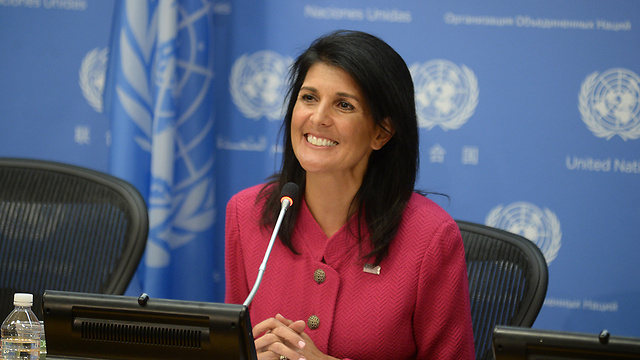
US envoy Nikki Haley (Photo: MCT)

Haley has also complained about anti-Israel bias at the Human Rights Council and said in March that she planned to visit Geneva to talk to members about what the US thinks an effective council should look like.

Speaking with Tuesday, she said, “We’ll be talking with the Human Rights Council about what we think they do well, what we think is not productive, and if there is some reform that could happen out of that.”

Haley said in March that If Washington sees changes it likes, it will remain a member and if not “we’ll put out.”

While in Geneva, the mission said, Haley will also participate in an event highlighting Venezuela’s human rights crisis.

The mission said Haley’s visit to Israel on June 7-9 will also include visits to UN operations in the region.

Haley said she will also be following up in Israel on her visit to the Human Rights Council.


twoje uwagi, linki, wlasne artykuly, lub wiadomosci przeslij do: webmaster@reunion68.com


ISRAELI DEFENSE COMPANY UNVEILS 5TH-GENERATION SPIKE MISSILE

ISRAELI DEFENSE COMPANY UNVEILS 5TH-GENERATION SPIKE MISSILE

ANNA AHRONHEIM


Rafael Advanced Defense Systems says the missile is designed for use against new modern targets with a low signature and time-sensitive characteristics.
Spike LR II system. (photo credit:RAFAEL ADVANCED DEFENSE SYSTEMS)

Rafael Advanced Defense Systems has unveiled its fifth-generation Spike multipurpose missile with a significant increase in range and lethality.

According to a statement released Monday by the company, the Spike LR II “is an advanced multipurpose missile, weighing only 12.7 kg., and can be launched from any Spike launcher.” It has a range of 5.5 km. when fired from ground launchers and up to 10 km. when fired from a helicopter.
The Spike LR II, which can be fired from vehicles, helicopters, ships and ground launchers, has advanced electro-optic seekers which include capabilities of a smart target tracker with artificial intelligence features.

Designed for use against new modern targets with a low signature and time-sensitive characteristics, the missile also includes new third-party target allocation (networked-enabled) enhancement with an embedded inertial measurement unit assembly, which allows the missiles to be fired to grid target coordinates, including advanced armor and protection systems. It is one of the only missiles in the world with this capability.
The Spike LR II also has two advanced warhead configurations for increased lethality, the company said. The Tandem HEAT warhead configuration ups the armor penetration capability of the missile by over 30% and the new multipurpose blast warhead, which includes controlled fusing (by the gunner) for control of the desired effect.

“The development of the Spike LR II is based on Rafael’s vast experience in the development of a wide variety of missiles over the years, and was largely possible due to Rafael’s close cooperation with the users at the IDF and other militaries around the world,” said Moshe Elazar, executive vice president and head of Rafael’s land and naval systems division.

The Spike LR II missile, which Elazar says addresses the complex challenges of the modern battlefield, will be presented for the first time at the Paris Air Show in June.

Rafael has three missiles in the Spike family, Spike NLOS, Spike ER, Spike MR/LR and Spike SR, and has supplied over 27,000 Spike missiles and systems to over 26 countries, including to the Philippines, Lithuania, Australia and India, where they are used by armies on various naval and land system platforms.

In March an Israel Navy unmanned vessel fired a Spike interceptor missile from a Protector unmanned surface vehicle during a test by Rafael systems. According to the company, the model’s missiles can intercept rocket-propelled grenades and other incoming projectiles.

“This new capability allows pinpoint attack of land or naval targets, enabling safe vessel operation, with no risk to the operating force, from a remote command and control room or from aboard other naval platforms,” read a statement by Rafael.


twoje uwagi, linki, wlasne artykuly, lub wiadomosci przeslij do: webmaster@reunion68.com



Entire Israeli security establishment is worried by Trump’s Saudi arms deal

Entire Israeli security establishment is worried by Trump’s Saudi arms deal

RAOUL WOOTLIFF AND RAPHAEL AHREN


Kowtowing to US president, Netanyahu left Israel vulnerable by failing to prevent or even criticize massive, dangerous DC-Riyadh accord, says Yesh Atid leader

Yesh Atid chairman Yair Lapid (Yonatan Sindel/Flash90)

Yesh Atid chairman Yair Lapid said Monday that the entire Israeli security establishment is deeply concerned by US President Donald Trump’s massive arms deal with Saudi Arabia, and that Prime Minister Benjamin Netanyahu failed Israel’s national security because he neither prevented nor tried to minimize the damage of the accord.

The approximately $110 billion weapons deal is the largest in American history and includes advanced air defense systems, ships, helicopters, intelligence-gathering aircraft, tanks, artillery and cybersecurity systems, according to the US State Department.

Speaking to The Times of Israel at our offices in Jerusalem, Lapid said that the way Netanyahu addressed the deal, both before it was announced and after, was “almost reckless” and ignored key Israeli security concerns. Under internal political pressure for Trump’s visit to Israel to appear a flawless success, Lapid said, the prime minster neglected to protect Israel’s interests in the region.

Lapid said Israel did not know about the deal ahead of time — but it would have, had there been a properly functioning Foreign Ministry and a full-time foreign minister.

And he raised specific concerns about some of the materiel that is being supplied to the Saudis. “Saudi Arabia is the most powerful Sunni country. Terrorist groups like Islamic State and Al Qaeda are Sunni, and millions of people in the country support Islamic State and Al Qaeda,” Lapid noted. “So even if the threat doesn’t come from Saudi Arabia itself, these weapons are an inch away from the Sunni terrorists.”

US President Donald Trump (C-L) and Saudi Arabia’s King Salman bin Abdulaziz al-Saud (C-R) arrive for the Arabic Islamic American Summit at the King Abdulaziz Conference Center in Riyadh on May 21, 2017 (AFP PHOTO / MANDEL NGAN)

In particular, Lapid highlighted the strategic partnership agreement, announced as part of the deal, between Raytheon, the contractor representing Israel for sales of the Iron Dome anti-rocket system to the US, and the Saudi government. Under the agreement, Raytheon will build Saudi Arabia a cybersecurity center that Lapid is worried may one day be used to carry out cyberattacks against Israel.

“This worries me because once you give them the cyber ability, you cannot tell them that they can only direct it towards Iran. No, it’s going to be directed towards Israel as well,” he said emphatically.

The offensive cyber capabilities that Saudi Arabia will receive as part of the accord could cause untold havoc in Israel, Lapid warned. “They could shut down the electricity in the room we are sitting in,” he said. “They could penetrate Israel’s Defense Ministry.”

Lapid, a former finance minister who sits on the Knesset Foreign Affairs and Defense Committee’s subcommittee on security and intelligence matters, said he was not alone in his bleak analysis of the deal, and there was deep concern in “the entire security establishment.”

“When the minister of defense is saying the opposite thing from the prime minister, you know that something is wrong. The Israeli military establishment is worried. This is a big deal,” he added.

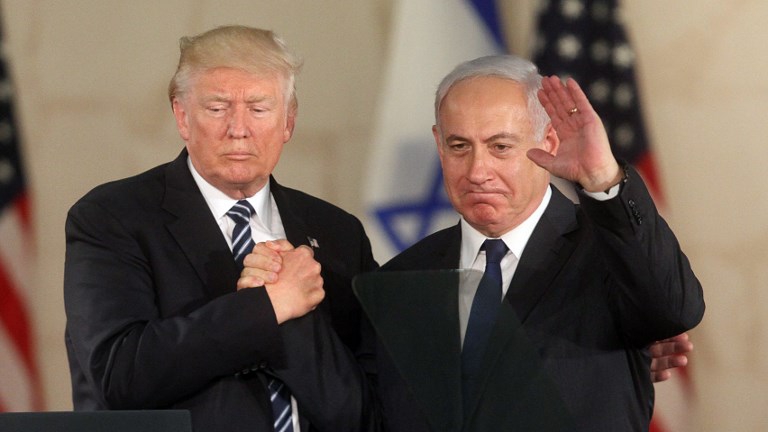
US President Donald Trump (L) and Prime Minister Benjamin Netanyahu wave after delivering a speech at the Israel Museum in Jerusalem on May 23, 2017. (Gil Cohen-Magen/AFP)

One of the most notable aspects of the deal is that the Saudis will receive the Americans’ Terminal High Altitude Area Defense (THAAD) anti-ballistic missile system. This is the same type of battery that the US recently deployed in South Korea to help defend it against an increasingly aggressive Pyongyang. Lapid said the worry is not just in Saudi Arabia owning the system, but in the possibility of it being deployed across the Middle East and therefore limiting Israel’s aerial superiority in the region.

“Netanyahu was under pressure for this visit to be successful for domestic political reasons,” Lapid said. And “there’s nothing wrong with fully embracing the president.

“Yet, I am concerned about the things that weren’t done,” he said. “I understand that everybody wanted to have a perfect visit. And yet, is is part of policy to tell the American president, ‘Listen, we appreciate the friendship, but we are unhappy with the fact that you’re selling arms to the Saudis for $110 billion without even consulting us.’”

By not doing so, Netanyahu “ignored what is essential Israeli security,” according to Lapid, who said that the prime minister was desperate for Trump’s visit to Israel to be a success. “Our defense minister said he is very worried, and the Prime Minister’s Office said there is nothing to worry about. Who should we believe? [Defense Minister Avigdor] Liberman, who represents the entire Israeli defense system, or the Prime Minster’s Office, which was preoccupied with the fact that they don’t want to ruin the visit.”

Following Trump’s visit to Israel last week, Liberman said he was uneasy over the deal announced over the weekend when the US president was in Riyadh and believed it was part of a “crazy” regional arms race. “I’m not at peace with any arms race and the huge Saudi purchase for sure doesn’t add much to our peace of mind,” Liberman said in an interview with Army Radio last Wednesday, adding that he had expressed his concerns in recent talks with US National Security Adviser H.R. McMaster.

Hours later, Netanyahu said the US had agreed to boost the defense aid it gives to Israel and would ensure that the country maintained its qualitative advantage.

But Lapid said that if he were prime minister, he would have worked to prevent the deal from happening in the first place and publicly spoken out against it.

“First of all I would have the kind of functional Foreign Ministry that would make sure we know these things in advance, not finding out during the ceremony in Riyadh. And I would have a foreign minister who is capable of talking to the State Department,” he said. Since the 2015 elections, Netanyahu has resisted appointing a full-time foreign minister, instead holding the position himself.

According to Lapid, had Israel known the extent of the deal beforehand, efforts could have been made via AIPAC and US lawmakers to put pressure on the Trump administration. “There are a bunch of things that could have been done, and none of them were,” he said.

Beyond the general types of weapons and systems that will be sold, many of the specifics about the deal have yet to be released, he noted. But a large influx of advanced military technology into the region should be of the utmost concern to Israel and therefore to the United States, which must continue to preserve the Jewish state’s “qualitative military edge” — its military advantage over surrounding Middle East countries, Lapid said.

A US THAAD interceptor defense system during a test launch (Screen capture: YouTube)

read more: Israeli … are worried by Trump’s Saudi arms deal


twoje uwagi, linki, wlasne artykuly, lub wiadomosci przeslij do: webmaster@reunion68.com


Battle in Jerusalem Between Roman Army and Jewish Rebels Unveiled

2,000-Year-Old Evidence of Final Pre-Second Temple Destruction Battle in Jerusalem Between Roman Army and Jewish Rebels Unveiled

by: JNS.org


Stone ballista balls discovered in the archaeological excavation. Photo: Clara Amit, courtesy of the Israel Antiquities Authority.

JNS.org – Amid this week’s celebrations making the 50th anniversary of Jerusalem’s reunification, the Israel Antiquities Authority (IAA) and the Israel Nature and Parks Authority unveiled evidence of the battle of Jerusalem that took place before the destruction of the Second Temple 2,000 years ago.

Arrowheads and stone ballista balls fired by catapults were uncovered on the main road that ascended from the city’s gates and the Pool of Siloam to the Jewish Temple, the IAA said Thursday.

The artifacts, excavated with the financial support of the City of David Society, tell the story of the final battle between the Roman army and Jewish rebels that ended with the destruction of the Second Temple and the rest of ancient Jerusalem, events that are famously described by historian Flavius Josephus.

“Josephus’s descriptions of the battle in the lower city come face-to-face for the first time with evidence that was revealed in the field in a clear and chilling manner,” said Nahshon Szanton and Moran Hagbi, directors of the IAA excavation, in a joint statement.

“Stone ballista balls fired by catapults, used to bombard Jerusalem during the Roman siege of the city, were discovered in the excavations. Arrowheads, used by the Jewish rebels in the hard-fought battles against the Roman legionnaires, were found exactly as described by Josephus,” the directors added.


twoje uwagi, linki, wlasne artykuly, lub wiadomosci przeslij do: webmaster@reunion68.com