
Archives

NEVER-BEFORE-SEEN DOCUMENT PENNED BY NAZI LEADER HIMMLER UNCOVERED IN ISRAEL

NEVER-BEFORE-SEEN DOCUMENT PENNED BY NAZI LEADER HIMMLER UNCOVERED IN ISRAEL

JOY BERNARD


The National Library has uncovered a telegram written by Heinrich Himmler and sent to Mufti al-Husseini, in which the Nazi leader expressed his support for the Arabs of Palestine.

In this compelling documentary, the life of SS officer Heinrich Himmler unfolds through film footage and the letters he wrote during the war. Photo By: PR

Germany will stand firmly by the Arabs of Palestine in their fight against the “criminal” Balfour Declaration, was the main message conveyed in the telegram that was recently uncovered in the archives of Israel’s National Library. The rare document, which the library assesses dates back to 1943, was written by infamous SS commander Heinrich Himmler and sent to Haj Amin al-Husseini, who served as the Grand Mufti of Jerusalem between 1921 to 1937.

The Nazi commander, who was one of the main masterminds behind the ‘Final Solution’ (the Nazi regime’s term for their plan to exterminate all of Europe’s Jews), wrote to the Muslim leader that “the joint recognition of the enemy, and the joint battle against him are what creates the firm allegiance between Germany and freedom-seeking Muslims all over the world.”

Himmler went on to tell the Mufti, who presided over the Palestinian territories during a particularly tumultuous period for the British Mandate ruling in the area, that his country was closely following the Palestinian resistance against the Balfour Declaration (the historic British document penned by Arthur James Balfour, the UK’s Foreign Secretary at the time, which openly supported “the establishment in Palestine of a national home for the Jewish people.”)

“The National-Socialist movement of the great Germany has made its fight against world Jewry a guiding principle since its very beginning,” Himmler wrote. “For that reason it [the movement] has been closely following the battle of freedom-seeking Arabs- and especially in Palestine- against the Jewish invaders,” the Nazi leader added.

He finished his warm letter to the Mufti by writing: “In this spirit, I am happy to wish you on the first anniversary of the Balfour Declaration, warm wishes for the continuation of your battle until the big victory.”

This newly revealed document sheds more light on the strong connections historians have affirmed before between the Mufti and the top hierarchy of the Nazi regime. In 1937, the British Mandate sought to arrest al-Husseini due to his involvement in the Arab uprising. The Mufti fled to Lebanon and from there to Iraq, where he joined a pro-Nazi group that rebelled against the Iraqi regime and carried out a military coup in April 1941. When the coup failed, al-Husseini escaped to Nazi Germany, arriving in Berlin in November 1941.

Upon witnessing Nazi Germany’s streak of victories at the time, the Mufti decided that he had to gain the close support of Nazi Germany’s leader Adolf Hitler. Al-Huseeini and the Fuhrer’s 90-minutes-long meeting was especially cordial, with the Mufti presenting himself to Hitler not just as leader of the national Palestinian movement but also as the leader of all Arabs and the representative of Muslims worldwide, in an attempt to convince the Nazi leader of the natural allegiance he shared with Germany.

However, historians have stressed in the 72 years that have lapsed since the Holocaust that Mufti al-Husseini’s main objective in pushing for the meeting at the time was to ensure that European Jews would not flee in droves to Palestine as they tried to escape death at the hands of the Nazis.

Despite the firm bond that the Mufti succeeded to forge with the German leadership, many believe that he failed to achieve most of his diplomatic goals. Dr. Esther Webman, an historian from the Tel Aviv University, says that “at the end of the day, the Mufti failed in achieving the majority of his goals: Nazi Germany didn’t declare its support of Arab independence and the Nazi leadership used him to realize its own goals.”

“His attempt to incite Middle Eastern Arabs against the colonial authorities during WWII didn’t succeed either,” Dr. Webman added. “His only significant accomplishment was his success in preventing a number of cases of Jews leaving for Palestine during the war.”

As most of the Nazi leadership was quick to eliminate all evidence of its participation in the horrors executed during World War II, any new documents written by high-ranking officials in the regime serve as a welcome insight into the depths of the dark and atrocious mechanisms of a regime that has left a tragic mark on world history.

As recently as August 2016, more documents written by Himmler were revealed. The Nazi leader’s office diaries, which were believed to have been lost for 71 years, were found at the archives of the Russian military and contained gory descriptions of the Nazi leader’s first-hand experiences during his visits to the extermination camps he oversaw and in which approximately six million Jews had perished.

While Israeli officials have yet to comment on the contents of the telegram that has recently emerged, many are looking forward to hear the reaction of Prime Minister Benjamin Netanyahu, who sparked controversy in October 2015 when he claimed during a speech he made at the 37th World Zionist Congress that Hitler did not intend to exterminate all Jews, but rather to expel them. Netanyahu further claimed that the Fuhrer was inspired to massacre all of Europe’s Jews only after he convened with Mufti al-Husseini, who, as aforementioned, was afraid to face a wave of Jewish immigration to Palestine.

It remains to be seen how this new and significant finding will impact the historic narrative regarding Jewish history and the Palestinian-German diplomatic maneuvers in the years prior to the establishment of the Jewish state.


twoje uwagi, linki, wlasne artykuly, lub wiadomosci przeslij do: webmaster@reunion68.com



Dlaczego antysemici nazywają ludzi “nazistami”?

Dlaczego antysemici nazywają ludzi “nazistami”?

Seth J. Frantzman
Tłumaczenie: Małgorzata Koraszewska


Antysemityzm przechodzi do głównego nurtu, a towarzyszy temu wybielanie i rozwadnianie Holocaustu i zbrodni nazistowskich.
Demonstranci w Rotterdamie wykrzykiwali niedawno hasła o “rakowatych Żydach” podczas wiecu przeciwko rządowi holenderskiemu, który zakazał wygłaszania przemówień tureckim politykom prorządowym. Równocześnie politycy tureccy nazwali Holendrów „niedobitkami nazistowskimi” i oskarżyli ten kraj o „zachowanie nazistowskie”.

Byłoby ciekawe wypytać protestujących, którzy wykrzykują hasła antyżydowskie, a równocześnie niewątpliwie zgodziliby się, że Holandia jest krajem “nazistowskim”. Reprezentują oni narastającą rzeszę tych, którzy określają swoich wrogów mianem „nazistów”, a równocześnie żywią antyżydowskie i nazi-podobne poglądy.

Były premier Malezji Mahathir Mohamad, napisał w zeszłym roku post na blogu, w którym nazwał rywala politycznego, Najiba Razaka, „małym Goebbelsem”, czyli porównał go do ministra propagandy nazistowskiej. Co Mahathir myśli o Żydach? W przemówieniu z 2003 r., do Organizacji Konferencji Islamskiej powiedział: “1,3 miliarda muzułmanów nie może pokonać kilka milionów Żydów… Muzułmanie będą zawsze uciskani i zdominowani przez Europejczyków i Żydów… zdobyli oni teraz kontrolę nad najpotężniejszymi krajami i oni, ta maleńka społeczność, stali się mocarstwem świata. Nie możemy walczyć z nimi tylko siłą”. Według BBC to przemówienie spotkało się ze stojącą owacją.

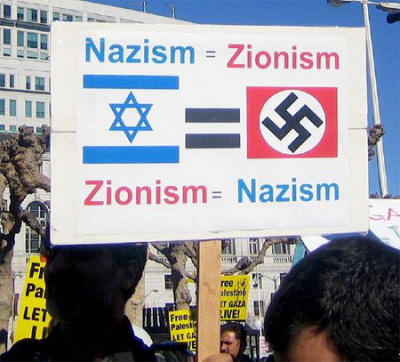
Jest wiele przykładów ludzi, którzy wyrażają antyżydowskie poglądy, często podobne do teorii nazistowskich, a potem oskarżają innych o bycie “nazistami”. Palestyńskie media, politycy, pro palestyńscy działacze i rysownicy często porównują Izrael do nazistów. Na przykład, karykatura Carlosa Latuffa z 2009 r. pokazywała izraelski czołg właśnie miażdżący Gazę, którego cień był swastyką.

Jeśli jednak Palestyńczycy uważają swastykę za taką obrazę i uważają, że Izraelczycy zachowują się “jak naziści”, a syjonizm “kolaborował z nazistami”, jak twierdzi kilku pro-palestyńskich komentatorów, to dlaczego używają swastyki jako graffiti w dzielnicach palestyńskich, żeby szydzić z Żydów? Dlaczego trzeba było kilkakrotnie usuwać flagę ze swastyką z wsi Beit Ummar w 2014 r.? Jak może człowiek oglądać rano rysunek pokazujący żołnierza Izraelskich Sił Obronnych (IDF) ze swastyką, a potem narysować swastykę po południu i wymachiwać nią przed żołnierzami IDF? Albo popierasz nazistów, albo uważasz, że Izrael jest nazistowski. Ale oni chcą to mieć zarówno jako obelgę wroga, jak i własny symbol. Wymaluj swastykę i nazywaj swoich wrogów “Hitler”.

Były przywódca irański, Mahmoud Ahmadineżad był słynny z negowania Holocaustu, twierdząc w 2002 r., że nie było żadnych komór gazowych, że jest to “propaganda syjonistyczna” i “mit”. Twierdził, że jego zaprzeczanie odniosło sukces, łamiąc „tabu tematu, o którym nikomu na Zachodzie nie pozwalano mówić”. Ale Iran był gospodarzem wielu konkursów na karykatury o Holocauście, w których Izraelczycy byli porównywani do nazistów. Jeśli jednak Holocaust nigdy się nie zdarzył, to dlaczego „nazi” jest ostateczną obelgą? Dlaczego ludzie nazywają swoich przeciwników „Goebbels”, a potem wygłaszają przemówienia, które mógłby wygłosić Goebbels o Żydach rządzących światem? Powodem tych sprzeczności jest to, że „nazi” stało się uniwersalnie pejoratywne.

W miarę jak przesłanie Holocaustu stało się uniwersalne, również sprawcy stali się uniwersalni.

Porównuje się prezydenta USA, Donalda Truma, do Hitlera; człowiek podający zupę w show telewizyjnym Seinfeld był “zupowym nazistą”; a nawet w Izraelu ultraortodoksyjni demonstranci często nazywają policję „nazistami”. Dobrze znany profesor izraelski ukuł termin „Judeo-nazi”.

Każdy jest nazywany „faszystą” i „nazistą” jako ostateczna obelga. W tym uogólnieniu słowo traci swoje specyficzne znaczenie.

Następnym krokiem jest, że ludzie, którzy istotnie żywią podobne do nazistów poglądy, szczególnie w kwestii nienawiści do Żydów, przejmują etykietkę nazizmu przeciwko swoim wrogom. Znaczy to, że sprawcy nie widzą sprzeczności między twierdzeniem, że rząd holenderski to „niedobitki nazistów”, a własnymi okrzykami „Żydzi są rakiem”.

Na trzecim etapie sprzeczności znajduje się negacja Holocaustu i twierdzenie, że Izrael jest państwem nazistowskim. Dlatego Mein Kampf sprzedaje się w krajach arabskich tym samym ludziom, którzy patrzą na karykatury Latuffa i mówią: „Izrael jest nazistowski”. Dlatego w Wielkiej Brytanii była seria incydentów, włącznie z wydarzeniem w Izbie Lordów, gdzie „Izrael był porównywany do Państwa Islamskiego i Żydów obwiniano o Holocaust”.

Ludzie coraz rzadziej widzą sprzeczność między nienawidzeniem Żydów a surowym ganieniem innych jako nazistów. Nie widzą sprzeczności między twierdzeniem, że Izrael jest krajem nazistowskim, a równoczesnym zaprzeczaniem Holocaustowi. Zakrywają swoją nienawiść wymówkami i odwracaniem uwagi, twierdząc, że „oczywiście ludzie potępiają antysemityzm, ale…” lub próbując kwestionować określenie „antysemityzm” twierdzeniami, że Arabowie także są Semitami. Twierdzą nawet, że swastyka jest „starożytnym symbolem religijnym”.

Środki masowego przekazu często ignorują niewiarygodnie powszechne uczucia antyżydowskie na Bliskim Wschodzie i wśród imigrantów w Europie.

Nie chcą pytać, dlaczego tłumy skandują slogany antyżydowskie, dlaczego Żydzi są obwiniani za wszystko, oskarżani zarówno o bycie komunistami, jak i o sojusz ze skrajną prawicą. Na przykład Hamas i były premier Malezji oskarżają Żydów o to, że stoją za komunizmem i socjalizmem.

Oskarżanie Żydów o to, że stali za Holocaustem, sprzymierzyli się z nazistami, twierdzenie, że Holocaust nigdy się nie zdarzył, ale powinien zdarzyć się raz jeszcze, jest czymś, do czego zdolnych jest zaskakująco wielu ludzi.

Powodem, dla którego ta nienawiść uchodzi niekwestionowana, jest to, że większość ludzi nie chce przyznać, iż ona w ogóle istnieje. Słyszą antysemickie skandowanie na meczu futbolowym lub na demonstracji i udają, że nie słyszeli. Pojawiły się filmy na wideo imamów, którzy wygłaszają kazania w Kanadzie, mówiąc: „zabij Żydów jednego za drugim”. Władze akceptowały różne wymówki dla tej nienawiści, ale nikt nie chciał zapytać, dlaczego w sali pełnej mężczyzn, którzy słuchali słów „zabij Żydów”, nikt nie powiedział ani słowa sprzeciwu. Z tego samego powodu sala pełna przywódców słuchała bez żadnych protestów malezyjskiego premiera, który głosił antysemickie poglądy, z tego samego powodu nie było protestów przeciwko Ahmadineżadowi.

Antysemityzm przechodzi do głównego nurtu wraz z wybielaniem i rozwadnianiem Holocaustu i zbrodni nazistowskich do punktu, w którym nienawiść do Żydów zostanie zaakceptowana w dobrym towarzystwie, wraz z twierdzeniami, że inni, włącznie z Izraelczykami, są „nazistami”.

Pierwszym krokiem dla zatrzymania tego trendu byłoby, aby władze, które mają materiał zdjęciowy z demonstracji w Rotterdamie, aresztowały za mowę nienawiści tych, którzy krzyczeli “rakowaci Żydzi”, i postawiły ich przed sądem, gdzie można będzie pokazać, kim właściwie są. Zamiast tego w Europie nawet ludzie miejscowi, którzy posłali swoje prace na konkurs karykatur negujących Holocaust, są wychwalani jako nauczyciele i „krytycy”, a ich poglądy nigdy nie są kwestionowane.
Why do antisemites call people “Nazis”

Jerusalem Post, 14 marca 2017


Seth J. Frantzman

Publicysta “Jerusalem Post”. Zajmował się badaniami nad historią ziemi świętej, historią Beduinów i arabskich chrześcijan, historią Jerozolimy, prowadził również wykłady w zakresie kultury amerykańskiej. Urodzony w Stanach Zjednoczonych w rodzinie farmerskiej, studiował w USA i we Włoszech, zajmował się handlem nieruchomościami, doktoryzował się na Hebrew University w Jerozolimie


twoje uwagi, linki, wlasne artykuly, lub wiadomosci przeslij do: webmaster@reunion68.com


Pence at AIPAC: President Trump and I Stand Without Apology for Israel and We Always Will

Pence at AIPAC: President Trump and I Stand Without Apology for Israel and We Always Will

Barney Breen-Portnoy


US Vice President Mike Pence speaks at the AIPAC conference in Washington, DC on Sunday. Photo: Screenshot.

“Under President Donald Trump, if the world knows nothing else, the world will know this — America stands with Israel,” US Vice President Mike Pence declared on Sunday.

In an address at the American Israel Public Affairs Committee’s annual policy conference in Washington, DC, Pence stated, “President Trump and I stand with Israel for the same reason every freedom-loving American stands with Israel — because her cause is our cause, her values are our values and her fight is our fight.”

“I say with confidence, to all gathered here, President Trump and I stand without apology for Israel and we always will,” Pence continued.

Trump, according to Pence, is giving “serious consideration” to moving the US Embassy in Israel from Tel Aviv to Jerusalem.

Furthermore, Pence said, “Under President Trump, the United States will no longer allow the United Nations to be used as a forum for invective against Israel.”

At the same time, the vice president noted, Trump is “invested in finding an equitable and just solution to the Israeli-Palestinian conflict” and “committed to forging a lasting peace in the Middle East.”

“And while there will undoubtedly have to be compromises, I can assure you all — President Trump will never compromise the safety and security of the Jewish State of Israel,” Pence went on to say.

Regarding Iran, Pence vowed the US would “no longer tolerate” the Tehran regime’s “efforts to destabilize the region and jeopardize Israel’s security.”

“Let me clear,” Pence emphasized. “Under President Donald Trump, the United States of America will not allow Iran to develop a nuclear weapon. This is a solemn promise to you, to Israel and to the world.”


twoje uwagi, linki, wlasne artykuly, lub wiadomosci przeslij do: webmaster@reunion68.com



Palestinians get ‘right to return’ — to Jerusalem

Palestinians get ‘right to return’ — to Jerusalem

Daoud Kuttab


Houses are seen in Silwan, a Palestinian neighborhood close to Jerusalem’s Old City, June 29, 2016. (photo by REUTERS/Ammar Awad)

Al-Quds, the leading Palestinian daily, used bright red ink to highlight its March 17 headline. The Palestinian newspaper of record, published in East Jerusalem since 1951, did so to celebrate the March 16 decision by the Israeli High Court of Justice recognizing the “special” status of East Jerusalem Palestinians. “Jerusalemites ‘citizens by birth,’ not immigrants,” blared the headline.

The article that followed included extensive quotes from the court’s unanimous decision requiring the reissuing of permanent residency to Akram Abdel Haqq, a 59-year-old Palestinian from Jerusalem who had left for the US decades prior. Upon returning to his hometown, he was told that he would have the same status as a tourist; that is, he no longer had residency rights.

Abdel Haqq had been 9 years old when Israel captured and occupied East Jerusalem, in 1967. Three years later, in 1970, his family emigrated to the US. Abdel Haqq returned to Jerusalem in 1989 to discover his residency rights revoked.

Adi Lustigman, the Israeli lawyer who defended Abdel Haqq, told Al-Monitor that the case will guide Israeli Interior Ministry officials for years. “It is a precedent that Palestinians who have had their residency revoked or are worried about losing their residency should be very pleased with,” she said.

Lustigman noted, however, that Palestinians wishing to regain their residency will need to resettle in Jerusalem before applying to regain their rights. “But they will not have to live there for a long time,” she said.

Lustigman added that the decision should provide more security to many Palestinians from Jerusalem now living elsewhere on the West Bank. She said, “Israeli Interior officials can no longer easily revoke the residency rights of East Jerusalemites, and this for sure includes Palestinians who are living in the West Bank.” Between 1967 and 2014, Israel revoked the residency permits of more than 14,000 Palestinians from East Jerusalem for not continually living in the city or for living elsewhere for more than seven years, regardless of the reason.

Sani Khoury, a Palestinian lawyer specializing in Jerusalem citizenship issues, told Al-Monitor that the decision is a step forward, but also warned against prematurely celebrating. “We have to wait and see whether this will be followed up by any changes in guidelines or dealings with the problems facing Jerusalemites,” he said.

Khoury shared that he was worried about a note the chief justice of the Supreme Court attached to the ruling. He wrote, “Miriam Naor, the Supreme Court president noted that in the future, similar petitions will be treated on a case-by-case basis, which means that this is not necessarily a major precedent.” Khoury did, however, concede that the ruling is a much stronger commitment than the one made by former Interior Minister Natan Sharansky.

In March 2000, Sharansky submitted an affidavit to the High Court about Israeli policy on residency for Palestinians. The Israeli human rights organization B’tselem reported the gist of it as, “All East Jerusalem Palestinians who return to extend their permits on time and maintain a ‘proper affiliation’ with the State of Israel would retain their status as permanent residents, even those living in Jordan or in other countries.”

One possible reason for Khoury’s cautioning against celebrating could be his knowledge about newly appointed members of the Israeli Supreme Court. Israel’s right-wing justice minister, Ayelet Shaked, announced the appointment of four new justices Feb. 23. One was David Mintz, a Jerusalem District Court judge who lives in an Etzion bloc settlement, south of Bethlehem. The Israeli journalist Amira Hass pointed out in a March 20 column for Haaretz that the ruling in Abdel Haqq’s case reversed a ruling by none other than Mintz, the settler just sworn in as a Supreme Court justice.

Daniel Seidemann, an Israeli lawyer specializing in issues related to Jerusalem and its residents, told Al-Monitor that the residency issue for Palestinians in East Jerusalem has been left vague by a collective Israeli decision-making process. “In 1967, Israel neither offered nor imposed its citizenship on Palestinian East Jerusalemites,” Seidemann explained. “Instead, they were deemed permanent residents under the Entry into Israel Law, as if they were alien residents newly arrived rather than an indigenous population with roots thousands of years old.”

The Israeli lawyer called the high court’s ruling courageous, but of limited impact. “It acknowledges for the first time the absurdity of viewing the Palestinians as ‘newcomers,’ and the devastating impact such a view has,” Seidemann remarked. “It makes the thread by which the residency rights of Palestinians hang somewhat thicker. It will help an indeterminate number of vulnerable individuals. It will make occupation more bearable at times, but it in no way makes Israel less of an occupier.”

While the Palestinians of East Jerusalem have no political rights, they are not without other rights, including rights to property, residency, health care, and so on. Seidemann argued, “These are not the inalienable rights of the citizen, but the ‘alienable’ rights extended by the ‘magnanimity’ of an occupier. These rights always hang by a thread.”

The Israeli High Court decision providing some relief to Palestinians in East Jerusalem deals with a reality that is too little acknowledged in the rest of the world, namely, that East Jerusalem is an occupied city. As such, Palestinians can never be considered immigrants in their own city. Palestinians did not immigrate to Israel. Rather, Israel, with its military occupation, came to the Palestinians in Jerusalem.

While the final status of Jerusalem must be resolved in negotiations, after 50 years of occupation, it is important that basic rights, such as the Palestinians’ right to live in the city of their birth and of their ancestors, not be considered a gift from a “benevolent” occupier but an inalienable right that cannot and should not be taken away.


twoje uwagi, linki, wlasne artykuly, lub wiadomosci przeslij do: webmaster@reunion68.com



Nazi SS commander wished Grand Mufti

Nazi SS commander wished Grand Mufti success in fight ‘against the Jewish invaders’

Ofer Aderet


S.S. head Heinrich Himmler with the Grand Mufti of Jerusalem Haj Amin al-Husseini in 1943.

Nazi SS commander wished Grand Mufti success in fight ‘against the Jewish invaders’
Heinrich Himmler’s message, made public this week by Israel National Library, was sent to mark the ‘wretched’ Balfour Declaration and noted a shared recognition of ‘the enemy,’ world Jewry.

A year and half ago, Prime Minister Benjamin Netanyahu sparked controversy with comments about the ties between the Nazi regime and the Grand Mufti of Jerusalem during World War II. Netanyahu claimed that it was Mufti Haj Amin al-Husseini himself who convinced Nazi leader Adolf Hitler to exterminate Europe’s Jews, before backpedalling on his remarks.

But a new discovery by the National Library of Israel has brought the ties between the mufti and the Nazis back into focus. The archive found a 1943 telegram from Nazi SS leader Heinrich Himmler to Husseini, written in German. The timing of the telegram is significant: It was sent on November 2, 1943 and marked 26 years since the British government issued the Balfour Declaration expressing its support for the establishment of a Jewish homeland in Palestine. (This November will mark the declaration’s 100th anniversary.)

The Himmler telegram reads: “To Grand Mufti Amin al-Husseini: From the outset, the National Socialist [Nazi] movement of Greater Germany has been a standard-bearer in the battle against world Jewry. For this reason, it is closely following the battle of freedom-seeking Arabs, particularly in Palestine, against the Jewish invaders. The shared recognition of the enemy and the joint fight against it are creating the strong base [uniting] Germany and freedom-seeking Arabs around the world. In this spirit, I am pleased to wish you, on the anniversary of the wretched Balfour Declaration, warm wishes on your continued fight until the great victory.”

It was signed by Himmler as SS commander of the entire Third Reich.

The telegram from S.S. head Heinrich Himmler to Mufti Haj Amin al-Husseini, sent to mark the 26th anniversary of the Balfour Declaration in 1943. Israel National Library

The back side of the telegram from S.S. head Heinrich Himmler to Mufti Haj Amin al-Husseini, sent to mark the 26th anniversary of the Balfour Declaration in 1943. Israel National Library

Chen Malul of the National Library’s content department said the telegram took a circuitous route before ending up at the archive in Jerusalem. With the defeat of Nazi Germany, where the mufti had lived during World War II, the document was confiscated by the American army. It then came into the possession of a member of the pre-state Haganah underground army in Palestine, who in turn donated it to the National Library.
Several months ago, as part of ongoing work in the archives, the file was recategorized as pertaining to the Balfour Declaration due to its mention in the telegram.

The file came to the library’s attention after staff was asked to look for materials connected to the 1917 declaration. The telegram was made public this week on Chen’s blog on the National Library’s website.
Ultimately, Himmler’s promise of a “strong base” uniting Nazis and Muslims didn’t stand the test of time. “The mufti failed to achieve most of his goals. Nazi Germany did not declare its support for the idea of Arab independence,” said Dr. Esther Webman, a senior research at Tel Aviv University’s Dayan Center for Middle Eastern and African Studies. She noted that efforts to incite the Arabs of the Middle East against the colonial powers in World War II also failed.
The telegram supplements what historians already knew: At a particular time, an ideological partnership existed between part of the Nazi leadership and the mufti. Nevertheless, it does not serve to confirm Netanyahu’s initial reference to an imaginary conversation between the mufti and Hitler that purportedly took place in November 1941, two years before Himmler sent his telegram.
The Israeli prime minister had initially claimed: “Haj Amin al-Husseini went to Hitler and said to him: ‘If you expel them [the Jews], they will all come here [to Palestine].’” According to Netanyahu’s account, Hitler then asked, “So what am I supposed to do with them?” and the mufti replied: “Burn them.”

When Netanyahu made the remarks in 2015, they sparked major criticism from leading Holocaust historians because the comments implied that Husseini had pushed Hitler to begin the extermination of the Jews. In backtracking, Netanyahu acknowledged that it was the Nazis, and not Husseini, who had decided to exterminate European Jewry. He said that he had never attempted to “absolve Hitler of his responsibility for the Holocaust.”

“All of the facts show that at the meeting between Hitler and the mufti, the Final Solution had long been around and that they had long been killing Jews and had abandoned a solution involving force emigration and expulsion,” said Prof. Dina Porat, the chief historian at the Yad Vashem Holocaust museum and research center. Husseini had asked Hitler to carry out the Final Solution in the Middle East, Porat said, but was certainly not the person to steer the plan itself.


twoje uwagi, linki, wlasne artykuly, lub wiadomosci przeslij do: webmaster@reunion68.com

