Archives

‘Israel is a powerhouse of knowledge’

‘Israel is a powerhouse of knowledge’

Yedidya Ben-O


Ofir AkunisOfir Akunis

US computer chip giant Intel has agreed to buy Israeli car technology firm Mobileye in a deal worth more than $15 billion (14 billion euros), the companies said in a statement on Monday.

Israeli media reported that the deal was the largest ever acquisition for an Israeli tech firm. Intel and Mobileye have been collaborating with German automaker BMW to develop self-driving cars.

The statement said the deal was worth approximately $15.3 billion.

“The combination is expected to accelerate innovation for the automotive industry and position Intel as a leading technology provider in the fast-growing market for highly and fully autonomous vehicles,” it said.

“Intel estimates the vehicle systems, data and services market opportunity to be up to $70 billion by 2030.”

Last year, BMW announced that it was joining forces with Mobileye and Intel on a self-drive project for “highly and fully automated driving” to be commercially available by 2021.

BMW announced in January it would deploy 40 self-driving vehicles for tests in the United States and Europe.

In August, Mobileye and UK-based auto-equipment maker Delphi said they were teaming up to develop an autonomous driving system which would be ready for vehicle-makers in 2019.

Mobileye, which also develops systems for accident avoidance, has concluded an agreement with Volkswagen on road data technology as well.

The Israeli firm was founded in 1999.

Science, Technology and Space Minister Ofir Akunis (Likud) said, “Israel is a powerhouse of knowledge, technology, and innovation.

“The fact that these international giants see potential in Israel and are always looking to buy successful companies in their field, is a source of pride for Israel. This shows how strong Israel’s technology industry is.

“I am sure we will continue to be a pioneering country, which the countries of the world look at and admire,” he said.


twoje uwagi, linki, wlasne artykuly, lub wiadomosci przeslij do: webmaster@reunion68.com


France’s Fillon slams own party for ‘anti-Semitic’ election cartoon

France’s Fillon slams own party for ‘anti-Semitic’ election cartoon

AFP AND TIMES OF ISRAEL STAFF


Tweeted caricature of frontrunner Emmanuel Macron depicted the former banker with a hooked nose and top hat, slicing a cigar with a red sickle

A cartoon published by the center-right French Les Republicains party on March 10, 2017, that seems to employ well-known anti-Semitic tropes in its depiction of rival presidential candidate Emmanuel Macron. (Twitter)A cartoon published by the center-right French Les Republicains party on March 10, 2017, that seems to employ well-known anti-Semitic tropes in its depiction of rival presidential candidate Emmanuel Macron. (Twitter)

France’s center-right presidential candidate Francois Fillon denounced on Saturday an “anti-Semitic” caricature of rival Emmanuel Macron put out by his own Les Républicains party.

The cartoon, quickly taken down after it was posted on the party’s Twitter account on Friday, depicted the centrist Macron, a former banker, with a hooked nose and top hat, carrying a red sickle with which he was cutting a cigar. Associates and supporters from the French left and center were shown around him.

Fillon, a former prime minister, has lagged in polls amid allegations that he had secured fictitious public service jobs for his wife and children.
He was scathing Saturday in his criticism of the cartoon.
“The fight is tough but it must remain dignified,” he said in a statement, vowing not to “tolerate that his own party is broadcasting caricatures containing the codes of anti-Semitic propaganda.”

He urged disciplinary measured be taken against any party officials responsible for the post.

From the Macron camp, the candidate’s spokesman Benjamin Griveaux called it “extremely worrying” that the caricature “draws on the anti-Semitic imagination.”

French presidential candidate for the center-right Les Republicains party Francois Fillon delivers a speech during a public rally in Maisons-Alfort, near Paris, on February 24, 2017. (AFP Photo/Patrick Kovarik)

From the Macron camp, the candidate’s spokesman Benjamin Griveaux called it “extremely worrying” that the caricature “draws on the anti-Semitic imagination.”

French presidential candidate for the “En Marche” movement Emmanuel Macron delivers a speech during a meeting in Saint-Priest-Taurion, France, on February 25, 2017. (AFP Photo/Pascal Lachenaud)

Faced with a public outcry over the cartoon, the Republicains party offered its “apologies” on Friday night and, just six hours after it had gone up, replaced the picture attached to the original tweet with a simple photo of Mr. Macron.

A poll published this weekend saw the centrist Macron in first place ahead of the first round of the French presidential election set for April 23, ahead of second-place far-right candidate Marine Le Pen. Fillon is in third place.


twoje uwagi, linki, wlasne artykuly, lub wiadomosci przeslij do: webmaster@reunion68.com


Israel Defense Forces’s First F-35 Fighter Jets Land in Israel

Israel Defense Forces’s First F-35 Fighter Jets Land in Israel

AiirSource Military AiirSource Military


Two F-35 Lightning II jet fighters, the first for Israel, arrive at the Nevatim Air Force Base in Israel, which will become the new home of Israel Defense Forces’s F-35I “ADIR” fifth-generation fighters. Video includes flyby of the two F-35’s, accompanied by an IAF F-15, and U.S. Secretary of Defense Ashton Carter’s speech at the welcome ceremony. 

AiirSource Military covers events and missions from the United States Armed Forces: Army, Navy, Marine Corps, Air Force, and Coast Guard.

Visit our channel for more military videos:
http://www.youtube.com/AiirSource

Like & share this video to show your support!
Subscribe to stay updated:
http://www.youtube.com/subscription_c…

Facebook: http://www.facebook.com/AiirSource
Google+: http://www.google.com/+AiirSource
Twitter: http://www.twitter.com/AiirSource

Credits: Brigitte N. Brantley, Glenn Slaughter


twoje uwagi, linki, wlasne artykuly, lub wiadomosci przeslij do: webmaster@reunion68.com


From living with an Arab to anti-assimilation activist

From living with an Arab to anti-assimilation activist

Eliran Aharon,


The story of Coral Ben-Shabbat, the innocent girl who fell in love with an Arab and, several years later, joined the Lehava group.

Coral Ben-ShabbatCoral Ben-Shabbat

Coral Ben-Shabbat, coordinator for the anti-assimilation group Lehava, spoke with Arutz Sheva about the long and winding road she passed before joining the ranks of the organization.

“At the age of 13 I met an Arab. At first I didn’t know that he was an Arab, but even after I did know it didn’t bother me. He promised that he would convert,” Ben-Shabbat related. “I promised my parents that I was finished with him, but then I decided to run away to him. His family received me.”

At that stage, Ben-Shabbat’s family came to Arab’s house to rescue Ben-Shabbat, but her Arab boyfriend and his family members started stabbing them with knives.

And you still continued to live with him?

“I continued to live with him for a week-and-a-half. He explained that [Ben-Shabbat’s family] had attacked him first, and I paid a lawyer to bail him out. I covered for him when he was fleeing the police. And then Lehava turned to me and convinced me, and helped me to get out of there.”

How does a Jewish girl end up going out with an Arab?

“We live together with them. Girls don’t see anything bad in it […they] don’t see the severity of going out with an Arab, don’t see what the end of it all will be.”

When Lehava turned to you, how did you decide to go with them instead of your boyfriend?

“The Rabbi of the organization explained to me what would happen, and they opened my eyes to what I didn’t see before.

How did you separate from him?

“I told him that I wanted to leave. I set out and traveled to Eilat. After a year during which he looked for me I returned to Nahariya, and then I joined the organization.

You left your life and turned to the other side, to the Lehava organization?

“In the beginning it was hard for me when I spoke with girls and tried to convince them. I still loved him. I, myself, didn’t believe it because I still loved him, so how could I convince others? But the understanding that it was a mitzvah and I could help others – this is my significance in life.

How is your connection with your family?

“The connection is good, even though I know that they still haven’t forgiven me.”

They talk about Lehava like it’s an “extremist” organization. What would you want people to know about this organization which they don’t know?

We don’t just rescue a girl and a week later tell her to apologize. We accompany her for a year or two, until she gets married. We are not a racist group, we just don’t want Jewish girls to go out with Arabs and live with them in their villages if they can go out with Jews.

Did you ever imagine that you would one day be speaking the way you are now?

No. I was a leftist. I loved Arabs and I saw Lehava as the worst thing there is. Today, I see the organization as the best thing there is.”

What message would you like to give to girls reading this interview?

“In general, girls that I come to take out tell me, ‘My Arab is different.’ In the end, after you marry him, reality will change. He can treat you well, but the minute you are his, everything changes.

You didn’t just join the organization – you are active in it.

I speak with the girls and try to uplift them. I speak to them as a professional and uplift them, I suggest to every girl that is stuck to contact the organization and know that the door is open to everyone.”

Chairman of Lehava Bentzi Gopshtain, noted, “the core of the quiet activity of Lehava is saving and rehabilitating the daughters of Israel. Coral Ben-Shabbat has merited to save dozens of girls who fell into relationships with Arabs […] I call on anyone who knows a girl in danger of assimilation to contact Lehava. We will do whatever we can to help her.”


twoje uwagi, linki, wlasne artykuly, lub wiadomosci przeslij do: webmaster@reunion68.com


FACING HISTORY HALF A CENTURY SINCE EXPULSION OF POLAND’S JEWS

FACING HISTORY HALF A CENTURY SINCE EXPULSION OF POLAND’S JEWS

Daniel Schatz


“My grades were lowered and all my friends had suddenly disappeared. No one dared to talk to me anymore.”
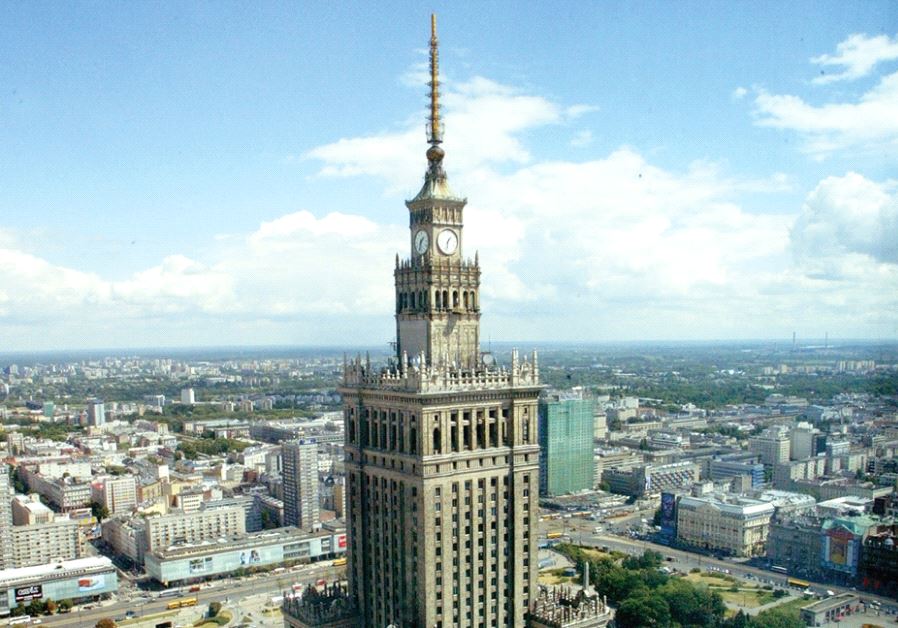
AN AERIAL view of the Palace of Culture in Warsaw that was built in 1955. During the communist era, many Jews were purged and accused of being ‘Zionists.’ Photo By: REUTERS

This month marks the 49th anniversary of the state-sponsored antisemitic campaign of March 1968 in communist Poland. The last remaining survivors of the Holocaust – in a country that, prior to the war, had more than three million Jewish citizens – were declared to be “foreigners,” “Zionists,” “cosmopolitans” and the ultimate enemies of the Polish People’s Republic.

The purge resulted in the forced exodus of 20,000 Jews, a mere 25 years after Nazi Germany had carried out the Holocaust on Polish soil. Thousands of members of the country’s intelligentsia, including outstanding scientists, artists and writers, were expelled from the country.
Many of the émigrés took refuge in Scandinavia, Israel and North America, among other destinations, forced to – once again – build a new life.

The governing United Workers’ Party under the leadership of first secretary Władysław Gomułka and internal affairs minister General Mieczysław Moczar unleashed the campaign of hate in connection with the Six Day War.

“Israel’s aggression in the Arab countries was met with applause in Zionist circles of Jews – Polish citizens,” Gomułka declared during a passionate speech delivered before the Trade Union Congress of June 19, 1967.

The first secretary concluded that “we do not want a fifth column to emerge in our country.” He thereafter called for the expulsion of the country’s last survivors, urging “those who feel that these words are addressed to them” to emigrate. A cheering crowd greeted his words with long and enthusiastic applause.

The speech constituted a signal for those who had long been awaiting the witch-hunt which now was given an official green light. A propaganda campaign followed in the state-owned press combined with the mass mobilization against “the enemies of socialist Poland,” with a wave of rallies across the county.

One of the largest demonstrations, gathering up to 100,000 people, in Katowice, demanded a purge of “Zionist elements” from party ranks, their removal from their positions, and the expulsion of their children from universities, exhibiting such slogans as “Down with Zionism – the Agent of Imperialism!” “Purge the Party of Zionists!” “Zionists to Zion!” and “We’ll Cut Off the Head of the Anti-Polish Hydra!”

The unbearable consequences of the purge included Jews being prosecuted for defaming the Polish state and being subjected to systematic harassment and physical brutality at universities and workplaces. They were ultimately expelled from their jobs and campuses, had their citizenship revoked and were forced to emigrate.
These developments were secondary to the main chapter of the March events, an uprising initiated by students and intellectuals against the Polish communist state, in parallel with the Prague Spring events in neighboring Czechoslovakia. Jews were accused of having instigated the rebellion, which called for democratic reforms, and were detained and beaten, subjected to torture and imprisonment.

Jozef Dajczgewand was arrested by the police on March 12, 1968 and sentenced to two years in solitary confinement where he was subjected to torture, following an antisemitic smear campaign directed against him in the state-owned national press. He concludes that “we lost all of our human dignity and human rights, there was a general feeling on the streets that Jews could, once again, be freely persecuted.”

He recalls the systematic abuse, highlighting that “the police ordered me to take off my pants, screaming ‘fu**ing Jew’ while interrogating me. I closed my eyes wondering for a second if it was Poles who committed these acts, or the same Nazis who had persecuted my parents.” Dajczgewand concludes that no Jews were left in the country when he was released from prison.

“All my friends had left. I was all alone and Poland was cleansed from Jews. I could feel the echoes of history and decided to leave the country.”

Another émigré, Dorotea Bromberg, similarly recalls in a testimony to the Jewish Museum of Stockholm: “We could read in the newspapers and hear on the radio that it was Jews (‘Zionists’) who had stirred up the students.

“On the same day my father was dismissed from his job. Almost all our friends and acquaintances disappeared.

We were forced to leave the apartment that we had lived in for 20 years. We had to move to a small apartment in a building in which the neighbors were openly hostile towards us.”

“Everything changed at school,” she recalls. “My grades were lowered and all my friends had suddenly disappeared. No one dared to talk to me anymore. Only one friend remained, Grazyna. She refused to abandon me and protested to the teachers. She was called up to the school principal and told that she was never to attend school again. And she was forbidden to apply to any other school.”
Bromberg relates how “16-year-old Grazyna went home, wrote a letter about how deeply she was ashamed at what was going on in Poland, and opened the gas tap…. As if it was not enough to lose my best friend I was accused of causing her death. The school reported me to the police and I was forced to confess my ‘crime’ in the assembly hall in front of the entire school.”

She concludes: “Following a virulent media campaign against my father he was threatened with prosecution, accused of taking part in a ‘Zionist conspiracy’ against Poland. He faced 10 years or life in jail. He was refused a lawyer and was cross-examined every day for a whole year. More than 100 witnesses were forced to sign false testimonies against him. Our situation became untenable and we applied for permission to leave the country.”

The victims of the 1968 campaign were made stateless upon leaving Poland while their possessions were confiscated by the Polish state.

In 2000, Aleksander Kwasniewski gave his apology for the campaign of hate “as the president of Poland and as a Pole.” Eight years later, in 2008, Polish president Lech Kaczynski said that he wanted to atone for the 1968 events which he deemed “shameful,” highlighting that “I treat this as my personal contribution to reversing the consequences of those sad, shameful events. Never more.”

The Polish Republic, however, still stands out for its failure to fulfill and recognize its responsibility to the victims. No viable solution has been found to resolve the critical issue of compensation for the exiled and dispossessed, nor have any of its perpetrators been prosecuted.

As we approach the 50th anniversary of the expulsion of Poland’s Jews, this often forgotten dark episode of human history remains etched in our collective memory.

It is high time to confront the remaining ghosts of the past following decades of passivity and inaction.


The author is a political scientist and Visiting Scholar at Columbia University’s European Institute. He has served as a Visiting Fellow at Harvard, Stanford and Georgetown University.


twoje uwagi, linki, wlasne artykuly, lub wiadomosci przeslij do: webmaster@reunion68.com