Archive | May 2020

Remembering Albert Agarunov, the Jewish hero of Azerbaijan

Remembering Albert Agarunov, the Jewish hero of Azerbaijan

ARYE GUT


His life carries spiritual and emotional resonance for all people, but especially for Jews in the Muslim world.
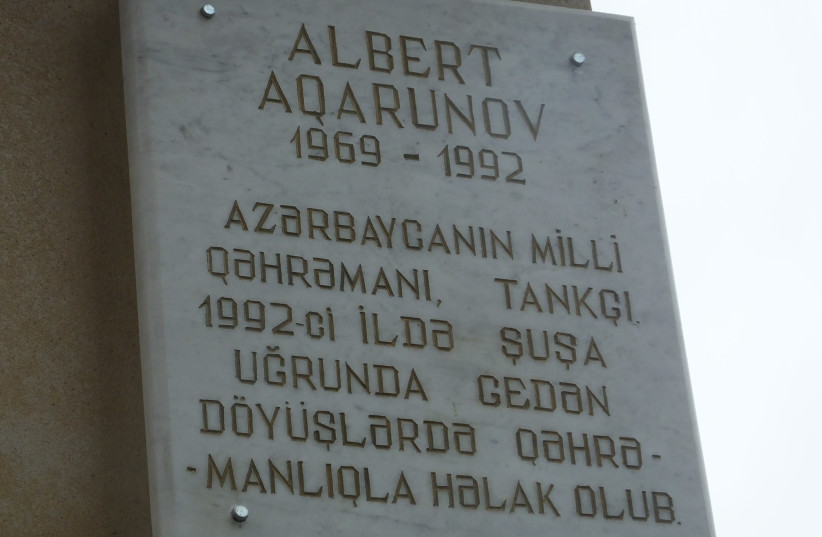
A picture of text written about Albert Agarunov in Qırmızı Qəsəbə / (photo credit: AYKHAN ZAYEDZADEH / WIKIMEDIA COMMONS)

Half a year ago, a monument to the Jewish hero of Azerbaijan was unveiled in the capital of multicultural and tolerant Azerbaijan. The day was a particularly special day for the country’s Jewish community and for Jews worldwide who know the story of decorated war hero Albert Agarunov.

On that day in Baku, an enormous statue of Agarunov was unveiled with military honors before a crowd of government and community leaders and the broader community and foreign guests who had come to celebrate one of the greatest Azerbaijani-Jewish heroes.

Some traveled from afar to attend the ceremony, including Rabbi Abraham Cooper of the Simon Wiesenthal Center; Commissioner for the United States Commission on International Religious Freedom and President of Congress of Christian Leaders Rev. Johnnie Moore; Rabbi Shlomo Amar, former chief Sephardi rabbi; and several other rabbis from Europe, the US and Latin America, as well as state senators from the western US.

Killed at age 23, Agarunov lived a short but glorious and heroic life. He is loved and honored in Azerbaijan. He is a genuine hero and a model of the courage of our people. Azerbaijanis will always honor his memory. A brave tank officer, according to his friends, Agarunov was devoted to his country and was killed pushing his courage and determination to the limit.

He was born into a Mountain Jewish family in the village of Amirjan, near Baku. His family was originally from a famous Jewish village in Azerbaijan – Qirmizi Qasaba (Red Settlement) in Quba and had moved to Amirjan in search of a better life.

Agarunov began his military career in the Soviet army, but soon found himself wanting to give back to the country he loved and knew all his life. I think that most people in the world have never heard the name of this Jewish national hero from Azerbaijan, a secular Muslim country.

This Azerbaijani-Jewish hero went to extraordinary lengths to defend his tank battalion against an onslaught of Armenian tanks. He was a good friend, a renowned sharpshooter and a proud defender of his homeland. The unique story of his life is infused with great pride and respect for his country, a nation ingrained with an unparalleled standard of interfaith engagement, which continues to honor and celebrate Agarunov’s courage and heroism.

Agarunov died fighting on his tank for the city of Shusha. Twenty-eight years have passed since the Armed Forces of Armenia invaded and occupied Azerbaijan’s Shusha region. The fall of Shusha came as the last stage of Armenia’s military occupation of the Nagorno-Karabakh region – part of Azerbaijan’s historical and internationally recognized territory.

On May 8, 1992, with full support by the Russian 336th regiment, the Armenian troops managed to overpower Shusha. As a result of the occupation, Shusha city and 30 villages of the Shusha region were destroyed, 195 innocent civilians were killed, 165 were wounded and 58 persons remain missing. More than 24,000 inhabitants of Shusha were subjected to ethnic cleansing, becoming internally displaced people.

Shusha city was one of the ancient and historical cradles of Azerbaijani culture, with its rich cultural monuments, famous artists and thinkers – Uzeyir Hajibeyov and Rashid Behbudov, Khurshidbanu Natavan and Molla Panah Vagif, Khan Shushinsky and Farhad Badalbeyli, Jabbar Garyagdy and Niazi, Bulbul and Samad bey Mehmandarov. They were born into an impregnable fortress, and, as pure mountain streams flowed through the valleys and expanses of Azerbaijan, built and created beauty. Whether in the fields of music, arts, architecture, literature or others, Shusha was a jewel of Azerbaijan, a source of pride and a cultural center.

In the framework of Armenia’s deliberate policy of destruction, plundering, desecration and embezzlement of cultural and religious heritage of Azerbaijan in the occupied lands – in Shusha alone there were more than 170 buildings with the status of architectural monument – 160 cultural and historical monuments, mosques and rare manuscripts have been destroyed.

THE NIGHT of May 8-9, 1992 was dark and cold. There was no sign of a military attack. It was past midnight when intelligence reported an offensive movement by the Armenians. However, no one was expecting a large-scale offensive. That night many valiant sons of Azerbaijan died. They died defending Shusha, the pearl of Azerbaijan and bastion of national culture. Jewish hero Agarunov, a 23-year-old tank commander, was among those who sacrificed their lives.

Agarunov was one of the Armenian army’s biggest targets. The invaders were so especially offended by his strong military skills, coupled with his identity as a Jew, that they placed a bounty of 5 million rubles on his head. Agarunov fought with all of his heart and might as he and many Jewish soldiers faced the Armenian invasion and subsequent acts of ethnic cleansing and brutality against more than 20% of Azerbaijan.

With the option to repatriate for Israel, Agarunov and his fellow Azerbaijani Jews chose to fight to defend their homeland of Azerbaijan. A truly righteous man, Agarunov lost his life when a sniper bullet caught the seemingly uncatchable hero, because Agarunov had left the security of his tank, exposed to the enemy, instructing the tank driver to avoid driving over the many murdered bodies of his Azerbaijan soldiers on the ground.

Agarunov lost his life because he was busy honoring the lives of his compatriots, unwilling to put even his own safety before the integrity of their memory.

His life carries spiritual and emotional resonance for all people, but especially for Jews in the Muslim world. The meaning and depth of his identity was only realized because he was born and raised in a place where interreligious harmony became an expected component of life. Agarunov fought for his homeland Azerbaijan, because for thousands of years and all the right reasons, his homeland fought for him.

Albert Agarunov was a war hero, an icon of Jewish life and commitment who was not only accepted in a majority-Muslim nation, but also widely cherished by all faiths. When taking in the story of Agarunov’s life, like any historic event, one can easily see that the beginning is as meaningful as the end. Shusha never forgot its own Azerbaijani heritage and the Azerbaijani people will not forget this beautiful and historical city – Shusha!


Zawartość publikowanych artykułów i materiałów nie reprezentuje poglądów ani opinii Reunion’68,
ani też webmastera Blogu Reunion’68, chyba ze jest to wyraźnie zaznaczone.
Twoje uwagi, linki, własne artykuły lub wiadomości prześlij na adres:
webmaster@reunion68.com


Cindy Crawford Prepares ‘Shiksa Brisket’ From Recipe Passed Down by Jewish Husband’s Grandmother

Cindy Crawford Prepares ‘Shiksa Brisket’ From Recipe Passed Down by Jewish Husband’s Grandmother

Shiryn Ghermezian


Cindy Crawford. Photo: Wikimedia Commons.

Supermodel Cindy Crawford prepared on Tuesday for the Passover holiday by making a dish passed down from her husband’s grandmother.

The 54-year-old, whose husband Rande Gerber is Jewish, shared on Instagram a photo of herself at her kitchen island in front of a tray of what she described as her “Shiksa Brisket.”

Crawford and Gerber have been married since 1998 and have two children.


Zawartość publikowanych artykułów i materiałów nie reprezentuje poglądów ani opinii Reunion’68,
ani też webmastera Blogu Reunion’68, chyba ze jest to wyraźnie zaznaczone.
Twoje uwagi, linki, własne artykuły lub wiadomości prześlij na adres:
webmaster@reunion68.com


16 MAJA 1943. ROCZNICA WYSADZENIA WIELKIEJ SYNAGOGI W WARSZAWIE

16 MAJA 1943. ROCZNICA WYSADZENIA WIELKIEJ SYNAGOGI W WARSZAWIE

Żydowski Instytut Historyczny


Wielka Synagoga w Warszawie istniała bardzo krótko, niecałe 65 lat. Jej uroczyste otwarcie miało miejsce 26 września 1878 roku. Wysadzenie w powietrze przez oddziały SS, tłumiące powstanie w getcie, miało symbolizować koniec żydowskiej Warszawy.

Ruiny Wielkiej Synagogi w Warszawie

W 1872 r. Plac Tłomackie został zakupiony przez Komitet Synagogi i powołany przez niego komitet budowy. Projekt i realizację zamówiono u Leandro Marconiego, ówcześnie najlepszego i najdroższego architekta warszawskiego, autora m.in. budynku Banku Handlowego przy ul. Traugutta 7 czy Pałacu Pod Karczochem w Alejach Ujazdowskich, współtwórcy – wraz z ojcem Henrykiem – Hotelu Europejskiego przy Krakowskim Przedmieściu. Po wyburzeniu istniejących budynków z XVIII w. rozpoczęto prace budowlane. Budowa trwała dwa lata, a powstały obiekt mógł pomieścić 2200 osób. W synagodze odbywały się nabożeństwa także z okazji ważnych świąt państwowych, takich jak Święto Konstytucji 3 Maja i Święto Niepodległości 11 listopada. W pomieszczeniu zwolnionym przez służącego utworzono — na początku skromną — Główną Bibliotekę Judaistyczną, która w 1936 r. przeniosła się do nowego Budynku przy Tłomackiem 5.

W styczniu 1940 r. Niemcy zamknęli synagogę. W 1942 r. urządzili w niej – podobnie jak w sąsiednim budynku biblioteki – skład mebli zrabowanych z żydowskich domów. Wysadzenie w powietrze synagogi, po długotrwałych przygotowaniach, miało być symbolicznym zakończeniem żydowskiej obecności w Warszawie. Aktu zniszczenia dokonał osobiście kat warszawskiego getta, SS-Brigadeführer Jürgen Stroop 16 maja 1943 r. Kazimierz Moczarski zapisał w Rozmowach z katem słowa Stroopa, który jeszcze w więzieniu mokotowskim wielokrotnie wspominał to wydarzenie: „Przygotowania trwały 10 dni. Synagoga była gmachem solidnie zbudowanym. Stąd, aby ją za jednym zamachem wysadzić w powietrze, należało przeprowadzić pracochłonne roboty saperskie i elektryczne. Ależ to był piękny widok! Z punktu widzenia malarskiego i teatralnego obraz fantastyczny. Oficer saperów wręczył mi aparat elektryczny, wywołujący detonację ładunków wybuchowych. Przedłużałem chwilę oczekiwania. Wreszcie krzyknąłem: Heil Hitler! – i nacisnąłem guzik. Ognisty wybuch uniósł się do chmur. Przeraźliwy huk. Bajeczna feeria kolorów. Niezapomniana alegoria triumfu nad żydostwem. Getto warszawskie skończyło swój żywot”.

„Odpryski murów i kamienie dolatywały aż na Długą do Arsenału – pisał Henryk Kroszczor, naoczny świadek – a szczątki książek i kawałki papieru aż na sąsiednią ulicę”. „Jedynymi pamiątkami po najznamienitszej warszawskiej budowli żydowskiej są część kolumny i numerek z szatni” – napisał Jan Jagielski.

Po wojnie synagogi nie odbudowano – w latach 60. rozpoczęto budowę Błękitnego Wieżowca, który ukończono w 1991 r.


Źródła:

Jan Jagielski, Trzy synagogi
Henryk Kroszczor, Wielka synagoga na Tłomackiem, w: „Biuletyn Żydowskiego Instytutu Historycznego” nr 3(95)/1975, s. 3–16.Ewa Małkowska, Synagoga na Tłomackiem, Warszawa 1991.
Kazimierz Moczarski, Rozmowy z katem, wstęp Norman Davies, opracował Andrzej Krzysztof Kunert, Kraków 2007.


Model Wielkiej Synagogi, Diaspora Museum, Tel Awiw
Sodabottle, Wikimedia Commons, CC BY-SA 3.0.

Apel poległych przed Wielką Synagogą przy placu Tłomackie 7. Przemawia szef Głównego Urzędu Duszpasterskiego Mojżeszowego rabin Baruch Steinberg, 25 czerwca 1933 r. /  Narodowe Archiwum Cyfrowe


Zawartość publikowanych artykułów i materiałów nie reprezentuje poglądów ani opinii Reunion’68,
ani też webmastera Blogu Reunion’68, chyba ze jest to wyraźnie zaznaczone.
Twoje uwagi, linki, własne artykuły lub wiadomości prześlij na adres:
webmaster@reunion68.com


Is the panic about a rise in American anti-Semitism justified?

Is the panic about a rise in American anti-Semitism justified?

Jonathan Tobin


Attacks on Orthodox Jews in Brooklyn count for the vast majority – perpetrated by African-Americans. (AP/Mark Lennihan)

More to the point, despite efforts to claim the contrary, the numbers don’t justify the effort to claim that anti-Semitism is primarily a product of right-wing extremism linked to Trump.

American Jews are more worried about anti-Semitism than at any time in recent memory. Recent surveys conducted by the Anti-Defamation League and the American Jewish Committee show that they feel less safe with large numbers claiming personal experience of Jew-hatred.

So it was little surprise that the headlines about the publication this week of ADL’s annual audit of anti-Semitism in the United States seemed to validate that growing sense of insecurity felt by what is — notwithstanding all the bad news they’ve been fed about hate — the freest, most prosperous and most powerful Jewish community in the history of the Diaspora.

Many were already panicked by events like the October 2018 Pittsburgh synagogue shooting and the murder of a congregant at Chabad of Poway, Calif., the following April, both by lone gunman right-wing extremists.

The announcement of the audit by ADL CEO and national director Jonathan Greenblatt highlighted the “historic” levels of anti-Semitic incidents and the “record” number of violent assaults that will scare even more people.

That the numbers were released during a global pandemic—when fears about history repeating itself with hatemongers ready to blame Jews for the spread of a new plague in the form of the coronavirus — further exacerbates the anxiety many are feeling while they struggle to cope with life under quarantine lockdowns.

Hardly standing on the precipice

Yet there is a difference between rational concerns and the sort of rhetoric that assumes that Americans are living through the moral equivalent of the last days of the Weimar Republic, in which we stand on the precipice as a new dark age of Jew-hatred beckons.

The HBO dramatization of Phillip Roth’s counter-factual novel “The Plot Against America” about an anti-Semitic government in the 1940s has become an all-purpose metaphor not only for fears about the rise of hate, but also partisan arguments that seek to depict the Trump administration as morally equivalent to the fictional presidency of the Nazi-appeasing Charles Lindbergh in Roth’s book.

The headlines about “the most anti-Semitic incidents in 40 years” seem to justify that kind of thinking, though a sober look at the data should lead observers to the opposite conclusion. Far from depicting a nation in the throws of a massive wave of anti-Semitic agitation, the ADL audit shows a country where attacks on Jews remain rare.

Though even one such attack is one too many, the notion that 61 examples of violence — or even the 2,107 incidents of all kinds, including vandalism or harassment, in a country of approximately 330 million people — hardly justifies the hype.

More to the point, despite efforts to claim the contrary, the numbers don’t justify the effort to claim that anti-Semitism is primarily a product of right-wing extremism linked to Trump.

To the extent that there is real evidence of a surge in attacks, it concerns a very specific group of Jews (the ultra-Orthodox) in a specific region (Greater New York). Yet the surge of anti-Semitic hate against there has nothing to do with the talk about right-wing nutcases inspired by the president.

Over the last century, anti-Semitism has proven to be the sort of virus that easily attaches itself to a variety of ideologies—fascism, Nazism, socialism and Islamism—and is seemingly impervious to efforts to stamp it out. There is ample evidence of a genuine surge of Jew-hatred spreading across the Arab and Muslim worlds, and throughout most of Europe in recent years.

But the notion that Americans are sliding into such a morass of Jew-hatred is unjustified. Social media and the Internet allow tiny groups of extremists a megaphone that makes them seem more numerous than they actually are.

Stumbling across Twitter threads or Facebook comments in which hateful language is employed is upsetting, but it’s not the same thing as Jews being afraid to walk the streets while wearing identifying clothing or jewelry, as is the case in some European capitals.

The only Jews who do face that kind of problem are the Chassidim in Brooklyn, N.Y., where, as the audit documents, more than half of the reported incidents of violence took place, as well as elsewhere in that region. The number of victims of anti-Semitic attacks totaled 95 nationally out of an estimated 5 million to 7 million Jews in the United States.

If you were one of those 95 persons or someone who suffered some form of harassment, or saw your local synagogue defaced by anti-Semitic graffiti, the fact that it is so unusual for Jews to be targeted in this manner is of little comfort. But the numbers undermine efforts to claim that Jews are under siege.

More to the point, despite the consistent efforts to politicize this issue as a right-wing trend enabled by Trump, such as one column published by the Forward claimed, the ADL’s numbers don’t back up the notion that the slight increase in incidents is a function of a resurgent and violent far-right.

Brooklyn attacks make up majority

The vast majority of incidents reported that referenced hostility to Israel or Zionism had nothing to do with right-wingers. Most were either the result of random hatred or the product of left-wing pro-BDS anti-Semitism. Though incidents on college campuses slightly declined in 2019, responsibility for them is still the work of left-wing hate groups.

The perpetrators of the one undeniable surge of anti-Semitic violence in the last year involving attacks on Orthodox Jews in Greater New York were largely African-Americans.

recomended by: Leon Rozenbaum

While local issues may be responsible for some of those attacks, the legitimacy given anti-Jewish and anti-Israel rhetoric by many of that community’s liberal leaders play a part in what has happened.

Nor should it be forgotten that while right-wingers are reviled by mainstream conservatives, some of those on the left who spout hate against Jews, such as like Reps. Ilhan Omar (D-Minn.) and Rashida Tlaib (D-Mich.), are treated as rock stars of the Democratic Party.

All those responsible for anti-Jewish hate deserve condemnation, no matter what their political leanings might be. And even a slight uptick in incidents, as the ADL reported, warrants concern.

Yet American Jews should not succumb to fear or partisan-inspired paranoia. No matter how you spin the ADL’s numbers, the total of incidents still paints a portrait of a country where anti-Semitic attacks of any kind are remarkably rare, and in which violent right-wingers remain few and isolated.

The real plot against America comes from those who would deny the fact that for all of its problems, it is a country where Jews continue to live in freedom and where you are more likely to get hit by lightning than to suffer violent anti-Semitism.


Jonathan S. Tobin is editor in chief of JNS — Jewish News Syndicate. 


Zawartość publikowanych artykułów i materiałów nie reprezentuje poglądów ani opinii Reunion’68,
ani też webmastera Blogu Reunion’68, chyba ze jest to wyraźnie zaznaczone.
Twoje uwagi, linki, własne artykuły lub wiadomości prześlij na adres:
webmaster@reunion68.com


Iran & Hezbollah vow to remain in Syria despite Israeli attacks – TV7 Israel News

Iran & Hezbollah vow to remain in Syria despite Israeli attacks

  TV7 Israel News


1) The Secretary General of the Lebanese Iranian-proxy Hezbollah confirmed Israel’s increased attacks on weapons-manufacturing sites in Syria; all the while denying Iran’s active operational involvement in the war-torn country.

2) Iran’s Islamic Revolutionary Guards have reportedly stepped up efforts to transfer, by means of aerial shipments, numerous advanced precision-guided Fateh-110 missiles to Syria.

3) Air Travel is gradually returning to (what can be called) a new normal, after weeks of bare minimum flights.


Zawartość publikowanych artykułów i materiałów nie reprezentuje poglądów ani opinii Reunion’68,
ani też webmastera Blogu Reunion’68, chyba ze jest to wyraźnie zaznaczone.
Twoje uwagi, linki, własne artykuły lub wiadomości prześlij na adres:
webmaster@reunion68.com