Archive | December 2020

UAE, Bahraini and Israeli envoys light third Hanukkah candles together

UAE, Bahraini and Israeli envoys light third Hanukkah candles together

SARAH CHEMLA


“It was the year of the pandemic, but it was also the year of peace,” said Israel Ambassador to the US Ron Dermer.

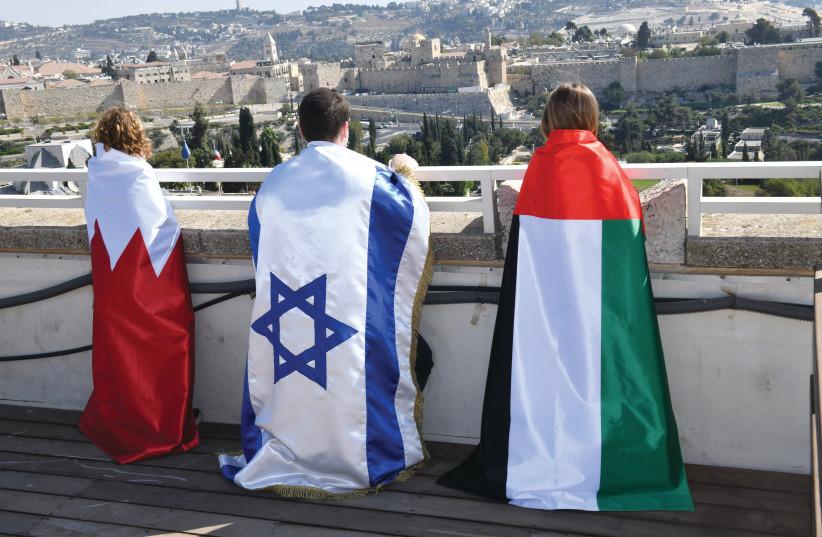
The Gulf-Israel Women’s Forum brings children draped in the flags of Bahrain, Israel and the UAE to Jerusalem’s Old City. / (photo credit: ISRAEL HADARI)

Israeli Ambassador to the US Ron Dermer held a virtual Hanukkah lighting on Saturday with Bahraini Ambassador to the US Abdulla Rashid bin Abdulla Al Khalifa and UAE Ambassador to the US Yousef Al Otaiba, to mark the holiday’s third day by lighting the candles of the hanukkiah (candelabra) together.

The candle lighting was held in the wake of the signing of the Abraham Accords between Israel, the UAE and Bahrain earlier this year.

“It was the year of the pandemic, but it was also the year of peace,” said Dermer as an opening.


“UAE Ambassador to the US Yousef Al Otaiba and Bahraini Ambassador to the US Abdulla Al Khalifa played a critical role” in the signing of the Abraham Accords, continued the Israeli ambassador, “honored” that they have joined him to celebrate the Jewish holiday of light.

“This year, I’m lighting the Hanukkah candles with you at the same time the Jewish community in the UAE are lighting their Hanukkah candles. Now that is peace,” Otaiba said. “Next year, let us hope we can celebrate this holiday together in person.”

He continued, saying “this year, may look and feel a little different, as the Covid pandemic continues to impact our daily lives. But I’m still filled with hope – that 2021 will bring a brand new start for us.”
Khalifa declared that “in a time of hardship for us all, it was that flame of desire – that desire for peace – that prevailed.

“This year, may the hope for peace that exists in each of us burn brightly enough to illuminate the desire in others,” he said. “As on the menorah, let our one candle be surrounded by others, radiating the light of hope on whatever shadows are cast by those wishing to perpetuate darkness and fear.”

Dermer also spoke to the Moroccan Ambassador to the US, Princess Lalla Joumala, agreeing to meet her soon to examine ways to promote relations between Israel and Morocco, following the recent announcement of normalization between the two countries.

Meanwhile, extraordinary scenes in Dubai including Hanukkah celebrations were part of a historic and unprecedented process of the United Arab Emirates embracing tolerance, coexistence and peace. The first weeks of December are a historic turning point on a path that was launched in 2019 as the “Year of Tolerance.”

In this region, messages are important. Publicly displaying government support for different religions and having Hanukkah celebrated in a central space, as it was last week, shows the 200 nationalities in the UAE that Jews are embraced.

In the wake of the signing of the Abraham Accords, achieved with American mediation, these celebrations are strengthening the newly-established links between these countries, and open the path for promising future cooperation.


Tobias Siegal and Seth J. Frantzman contributed to this report.


Zawartość publikowanych artykułów i materiałów nie reprezentuje poglądów ani opinii Reunion’68,
ani też webmastera Blogu Reunion’68, chyba ze jest to wyraźnie zaznaczone.
Twoje uwagi, linki, własne artykuły lub wiadomości prześlij na adres:
webmaster@reunion68.com


Weronika Kostyrko – “Tancerka i zagłada. Historia Poli Nireńskiej”

Pola Nireńska w tańcu "Niechciane dziecko", fot. wydawnictwo Wydawnictwo Czerwone i Czarne.Pola Nireńska w tańcu “Niechciane dziecko”, fot. wydawnictwo Wydawnictwo Czerwone i Czarne.


“Tancerka i zagłada. Historia Poli Nireńskiej”

Marcelina Obarska


To nie jest książka o tańcu. A z pewnością nie tylko o nim – biografia Poli Nireńskiej, tancerki znanej niestety przede wszystkim jako żona Jana Karskiego, zostaje w książce Weroniki Kostyrko ujęta w ramy fascynującej narracji: o rozpaczy, miłości i świecie, którego już nie ma.

Obsesja detektywa

“Tancerka i zagłada” dowodzi, że istotniejszy od samego życiorysu (jako zbioru zdarzeń) jest sposób opowiadania o nim. Jako pierwszy przy obcowaniu z tą obszerną biografią rzuca się w oczy research – bardziej niż imponujący. Kostyrko skrupulatnie wyłuskuje ze zdobytych materiałów i źródeł informacje pozwalające na zbudowanie wielowymiarowego portretu. Sięga głęboko – nie tylko do źródeł stylu Nireńskiej, po której nie pozostały żadne nagrania, lecz także do postaci jej słynnych nauczycielek.

Okładka książki “Tancerka i zagłada. Historia Poli Nireńskiej” Weroniki Kostyrko, fot. wydawnictwo Wydawnictwo Czerwone i Czarne

Dociekliwość autorki przypomina momentami obsesję, w której najdrobniejszy szczegół nie może zostać pominięty (przykładem może być próba zdobycia informacji o pierwszym mężu Nireńskiej, po którym we wspomnieniach artystki i jej przyjaciół nie została nawet wzmianka). Chwilami Kostyrko, niczym Witold Gombrowicz w “Kosmosie”, z fragmentów, przypadkowo odnalezionych “strzałek” i domysłów próbuje tworzyć spójny obraz rzeczywistości – w tym wypadku tą całością jest życie ukształtowane przez traumę i zderzenie z bezwzględnością totalitarnych reżimów.

Głodowała, żeby tańczyć

Pola Nireńska zapisała się na kartach historii jako ikona tańca modern. Żeby tańczyć, szantażowała rodziców, organizując np. “strajki głodowe”. Nie interesował ją jednak sam kunszt czy warsztat – ale emocjonalna ekspresja. Nazywa się ją artystką “tańca wyzwolonego”. Uczyła się w słynnej szkole Mary Wigman w Dreźnie, emigrowała do Londynu, a następnie do Stanów. W Holokauście straciła ponad siedemdziesięciu członków rodziny. Trauma naznaczyła całe jej dorosłe życie, które zakończyła samobójczym skokiem z balkonu swojego mieszkania.

Atutem jest to, że autorka pokazuje nie tylko nieznane szerzej fakty dotyczące Nireńskiej, ale także drogę do nich, odsłaniając swój warsztat reporterki i nie obawiając się emocji. Czytając “Tancerkę i zagładę”, można odnieść wrażenie, że praca nad książką była osobistą przygodą, przeżytą przez autorkę świadomie i z pełnym zaangażowaniem. Kostyrko nie unika prywatnych wtrąceń, nie ukrywa swojego “ja piszącego” – wręcz przeciwnie, niektóre akapity są jak notatki z podróży, jaką – w przenośni, ale i całkiem dosłownie – odbyła podczas tworzenia książki.

Jednocześnie Kostyrko nie sytuuje siebie w pozycji wszechwiedzącej narratorki, ale pozwala sobie na niepewność. W “Tancerce i zagładzie” wiele jest pytań i domysłów. Te momenty niewiedzy czy zawahania mogą być dla czytelnika inspirujące i zachęcać do własnych spekulacji. Taka postawa autorki świadczy o otwarciu na czytelników i czytelniczki, chęci włączenia ich w dialog. “Do którego kina mogła chodzić Pola?”, pyta na przykład, przybierając ton, jak gdyby zapraszająco mówiła “zastanówmy się wspólnie”.

Rozdeptany kanarek, horror na ulicach

Wspomniana skrupulatność może jednak momentami przytłaczać – gęsta od szczegółów narracja rozrzedzona jest wieloma dokładnymi opisami postaci pobocznych, np. sylwetkami przodków drugiego męża Nireńskiej. Gdzie indziej zaś owa szczegółowość ujmująco łagodzi tragiczną przecież historię tancerki – Kostyrko porusza się jak po nanizanych na sznurek koralikach, przyglądając się z pozoru błahym faktom, gdy wspomina np. o rozdeptanym przez babcię Poli kanarku. Niekiedy obszerne dygresje są fascynujące – taki jest opis popularnych w czasach Wielkiego Kryzysu maratonów tanecznych.

Ślub kościelny Jana Karskiego i Poli Nireńskiej, Waszyngton 1965 rok. Obok Karskiego stoi jego świadek, były ambasador RP w Waszyngtonie Jan Ciechanowski, fot. Wydawnictwo Czerwone i Czarne.

Skala mikro opisywanych zdarzeń spotyka się zatem z szerokim kontekstem historycznym, politycznym, kulturowym i społecznym. Książka nie jest zbiorem atrakcyjnych dykteryjek, jak to nierzadko bywa z biografiami, ale próbą rzetelnego naszkicowania obrazu świata, który bezpowrotnie przeminął. Osiemdziesiąt dwa lata życia Nireńskiej opisane zostały przy tym z rysem artystycznym – styl biografii przywodzi na myśl elegancję i wyważenie reportaży Hanny Krall. Kostyrko pisze sugestywnie i plastycznie, przez co “Tancerkę i zagładę” czyta się jak dobrą powieść.

Autorka niczym wytrawna montażystka tworzy angażującą emocjonalnie narrację z dostępnych fragmentów, obszernie przedstawiając tło biografii tancerki. Porażające są np. opisy brutalnych antysemickich aktów przemocy w Warszawie w latach 20. mimo swojej zwięzłości i lapidarności. Przypominają raport, ale – z racji  nagromadzenia – tworzą obraz horroru. Dzięki tym zabiegom “Tancerka i zagłada” nie jest książką jedynie o Poli Nireńskiej, ale też wprowadzeniem w krajobraz XX wieku.

Pola Nireńska na jednym z kilku portretów, które zrobiła jej słynna fotografka Lee Miller (1941), fot. wydawnictwo Wydawnictwo Czerwone i Czarne.

Miłość życia

Z książki wyłania się obraz nie tylko pochłoniętej tańcem artystki, ale i kobiety obdarzonej intensywnym życiem emocjonalnym. Pola Nireńska była biseksualna, a zakochiwała się głównie w kobietach – to w “Tancerce i zagładzie” zostaje powiedziane wprost. Miłość nienormatywna zyskuje w książce widzialność i równouprawnienie. Wątki romansu Poli Nireńskiej z Mary Wigman czy z kompozytorką Priaulx Rainier nie zostają “taktownie pominięte” ani poddane umniejszającym zabiegom. “Myślę, że miłością życia Poli była Priaulx Rainier”, pisze bez zbędnych zawiłości autorka. Tworzy tym samym rodzaj przeciw-historii – opowieści zgoła odmiennej od tej powszechnie funkcjonującej, w której Nireńska sytuowana jest u boku męża, legendarnego kuriera Polskiego Państwa Podziemnego. Karski, jak pisze Kostyrko, o orientacji seksualnej swojej ukochanej wiedział i ją akceptował. Mężowi Poli poświęcony jest w książce cały osobny rozdział.

Biografia jak film

Na uznanie zasługuje gracja, z jaką autorka zdecydowała się zakończyć biografię Nireńskiej. Mimo że lwia część książki przypomina drobiazgowe śledztwo, samobójstwo artystki zostało potraktowane z niezwykłym wyczuciem. To jedyny bodaj moment, w którym autorka rezygnuje z dociekania. Nie drąży tego tematu i – okazując szacunek swojej bohaterce – oddaje głos jej bliskim i rodzinie. O możliwych przyczynach samobójczej śmierci w “Tancerce i zagładzie” wypowiadają się tylko oni, Kostyrko usuwa się w cień. Książka kończy się nagle, z podobną dynamiką, z jaką z życiem pożegnała się Nireńska.

To nie jest książka o tańcu i nie tylko do zainteresowanych tańcem powinna być adresowana. Długi, naznaczony grozą totalitaryzmów życiorys tancerki został przedstawiony w sposób angażujący na tyle, że może jawić się jako świetny materiał na film dokumentalny.

Biografię Nireńskiej autorstwa Weroniki Kostyrko niewątpliwie warto przeczytać – nawet jeśli nie dla samego poznania życia i twórczości artystki – to dla warsztatu biografistki i ujmującego języka. To bowiem także książka erudycyjna, zahaczająca o wiele dziedzin kultury, przez co ma szansę usatysfakcjonować szerokie grono odbiorców.


Zawartość publikowanych artykułów i materiałów nie reprezentuje poglądów ani opinii Reunion’68,
ani też webmastera Blogu Reunion’68, chyba ze jest to wyraźnie zaznaczone.
Twoje uwagi, linki, własne artykuły lub wiadomości prześlij na adres:
webmaster@reunion68.com


Rare menorah engraving dates back to Hasmonean era

Rare menorah engraving dates back to Hasmonean era

HANNAH BROWN


The menorah was discovered in the 1980s in Judea and Samaria.

The faint marks of one of the menorahs can be seen drawn in cistern at al-Alilyat cliffs near Mukhmas / (photo credit: BOAZ LANGFORD)

A rare graffito of a seven-branched menorah found many years ago at the entrance to a tomb on the outskirts of the Arab village of Mukhmas, northeast of Jerusalem, has been highlighted by Dr. Dvir Raviv of Bar-Ilan University’s Martin (Szusz) Department of Land of Israel Studies and Archaeology, in a paper published in the archaeology and history journal In the Highland’s Depth, released just in time for Hanukkah.

The menorah was discovered in the 1980s during a survey initiated by the Staff Office for Archaeology in Judea and Samaria, and was archived more than 30 years ago.

Dr. Raviv reported that the menorah engraving found in Mukhmas dates back to the period between the Hasmonean era and the Bar-Kokhba revolt and is considered an unusual find, because decorative use of the Temple menorah was rare during this period. The most prominent examples found to date include depictions of a menorah on coins of the Hasmonean ruler Mattathias Antigonus, on objects and remnants from Jerusalem, on a stone table in Magdala north of Tiberias and on the Arch of Titus in Rome.

The Mukhmas engraving resembles paintings of two seven-branched menorahs documented in the al-‘Aliliyat caves, a group of caves nearby that served as a hiding place and refuge during the Second Temple period and the days of the Jewish revolts against Rome.

Drawing of the menorah. (Credit: Staff, Office for Archaeology in Judea and Samaria)

The use of a menorah to decorate the façades of Jewish tombs was quite common in ancient times, but this is only the second time that one has been discovered on a Jewish tomb from the period preceding the Bar-Kokhba revolt. A long-known example is Jason’s Tomb in Jerusalem from the Hasmonean period, with small, schematic carvings on the walls of the entrance vestibule, unlike the large, decorated menorah discovered on the façade of the Mukhmas tomb.

Due to the rare use of the menorah as an artistic decoration from the Second Temple period until the Bar-Kokhba revolt, and based on the contexts in which the menorahs of this period were discovered, it has been suggested that the menorah may have been a motif related to the Temple and the priests that served in it during this time.

The depictions of menorahs found on the outskirts of Mukhmas – and the mention of Mikhmas (currently the village of Mukhmas) in the Mishnah as the place from which selected semolina wheat was brought to the Temple (Mishnah Menahot 8:1) – may indicate that a priestly population lived there during the Second Temple period.

Additionally, Mikhmas is mentioned as the dwelling place of Jonathan the Hasmonean, where he began to establish his status in Judea after the death of his brother Judah Maccabee (1 Maccabees 9:73).

“Jonathan’s choice of the town as the base from which to consolidate his control of Judea may have been linked to the location of Mikhmas in a densely-populated area of Jews who supported the Hasmoneans during the years of the revolt,” said Raviv.

“Due to the difficulty in determining the exact date of the menorah’s graffito and the scarcity of explicit references to priests in Mikhmas during the Second Temple period, it is possible that a group reached the site only after the destruction of the Temple and lived there during the period between the revolts,” he said.


Zawartość publikowanych artykułów i materiałów nie reprezentuje poglądów ani opinii Reunion’68,
ani też webmastera Blogu Reunion’68, chyba ze jest to wyraźnie zaznaczone.
Twoje uwagi, linki, własne artykuły lub wiadomości prześlij na adres:
webmaster@reunion68.com


NBC Developing Adaptation of Israeli TV Series.

NBC Developing Adaptation of Israeli TV Series About a Family Being Impacted by Their Son With Autism

Shiryn Ghermezian


The NBC logo. Photo: Wikimedia Commons.

NBC is developing an adaptation of the Israeli series “Yellow Peppers,” a drama about a family’s journey raising a young son who has autism, Deadline reported on Friday.

“Yellow Peppers,” from Keshet Broadcasting and July August Productions, was created by Keren Margalit and aired for two seasons in Israel between 2010-14. Several adaptations of the show have already been made, including the British version, “The A Word,” which aired three seasons on the BBC. Keshet Studios, the LA-based division of the Israeli media firm, and Universal TV, part of Universal Studio Group, first announced efforts to develop a US adaptation of the show last year.

Also called “The A Word,” NBC’s adaptation is written by Arika Mittman, who serves as the project’s executive producer with Keshet Studios’ Peter Traugott, Avi Nir for Keshet Media Group, Alon Shtruzman for Keshet International and Karni Ziv for Keshet Broadcasting. Margalit also serves as an executive producer on the project.

Keshet Media Group CEO Avi Nir told Deadline last year that the US version of the show will be extremely personal. He said, “That series has to be very personal. It’s very emotional. It will be different and not different; the issues families are facing are similar but the characters are local and very different. From 40,000 feet, it might look the same, but if you look closely it’s different.”


Zawartość publikowanych artykułów i materiałów nie reprezentuje poglądów ani opinii Reunion’68,
ani też webmastera Blogu Reunion’68, chyba ze jest to wyraźnie zaznaczone.
Twoje uwagi, linki, własne artykuły lub wiadomości prześlij na adres:
webmaster@reunion68.com


Memories and Expectations of Antony Blinken

Memories and Expectations of Antony Blinken

Martin Peretz


The New Republic staff with a young Antony Blinken. TOP: Left, Chuck Lane; Third from Left, Leon Wieseltier; Fourth from Left, Rick Hertzberg; Fourth from Right, Antony Blinken; Second from Right, Laura Obolensky. BOTTOM: Left, Dorothy Wickenden; Second from left, Mort Kondracke; Third from Left, Marty Peretz; Third from Right, Charles Krauthammer; Second from Right, Mike Kinsley; Right, Ann Hulbert. Photo: courtesy of Martin Peretz.

An extended metaphor from Meir Blinkin, the immigrant Yiddish writer, born in 1879 in Pereyeslav, the Ukraine, dead at 37 in New York where mourning throngs ushered him towards his last address:

Chava was suddenly overwhelmed with the feeling that life was really beautiful, full of promise; life never betrayed those who hoped and believed…

But…

When Chava finally fell asleep she dreamed she had come into possession of a marvelous violin and that all unexpectedly the main string, the one which produces the tenderest, most     heartfelt tones, had snapped.

This was the tale of a curt marriage. But this also was Blinkin’s life — or the lives of his neighbors on the lower east side of New York. The next generation was someone whom I’d met when I was doing “good works” for the Jerusalem Foundation, actually as chairman. He called himself M.H. Blinken (with him came a new spelling of the name) when, as now, two initials as a first name translated into “wealthy man” or “important man.” I recall meeting him in Palm Beach — though I’m not certain — and collecting a hefty five-figure gift for that philanthropy and then having to listen to him criticize Teddy Kollek, an old line Zionist and mayor of Jerusalem, “the city of gold” — or perhaps more aptly “the city of God” — but of a relatively dovish persuasion. Dovish but tough, if you get what I mean, which I don’t quite.

Tony, as I call him (but I haven’t seen him for a handful of years), comes from an intriguing family… at least the part of it I know. That is, I don’t know his father’s side of the family —Donald’s — but I do know his mother’s, Judith. And his sister’s, Leah. This was really a case of the paterfamilias, a family whose character and color somehow descended and was etched by the father, in this case Samuel, who cut the cloth of a large part of the Paris Jewish community, more of the North Africans than the Eastern European and the old-line French, the descendants of the consistoire of Napoleon, the sanhedrin.

I recall visiting the Pisars when Leah was applying to Harvard and happening in on a conversation about Sam asking prime minister Mitterand to write a letter of recommendation for his daughter. I stuck my head into the confab, arguing that Mitterand’s words would not help — how well did he know the young lady? — and might only raise questions like: why does she need the PM to write for her anyway? But Pisar had survived Dachau and Maidanek: his words did carry weight. Even perhaps with his daughter.

I met Antony Blinken when he was at Harvard but got to know him reasonably well only when he came on board The New Republic. One fact I learned quickly was that he was very smart, even brilliant, and if he believed in something and you didn’t, he could argue you down with alacrity and depth. We spoke then only a tiny bit about Israel and the Arabs, Israel and the Palestinians. But once in a lunchtime discussion around the question — at least as I recall it — he mustered the facts of history which in my view settled the argument.

Of course, Blinken worked for both vice president Biden and president Obama. I trust Biden almost as a righteous gentile Zionist… not that he grasps everything that he should; nor do I. So, yes, even Zionists can be wrong, very wrong. Settling the land, especially all of the land that is left, will destroy even the practical possibilities of peace, even the possibilities of calm. But, from my point of view at least, Obama is hostile in principle to even those of us who believe in a two-state solution but recognize that the blame for its failure to materialize has, for 40 years and more, rested squarely with the Palestinian leadership. This is too concrete a view for Obama’s elevated, and incorrect, conception of liberalism as unifying all oppositions, with himself as the unifier. Israel must, somewhere, be to blame, and he and John Kerry found that “somewhere” in the fig leaf of the West Bank settlements.

I am, obviously, not encouraged that John Kerry is part of the Biden Administration — but I am encouraged that his purview is nowhere near the immediate interests of the Jewish state, except that the universe is the concern of every state, of everyone. Under Biden and Blinken, I do not hope for the axiomatic position of Trump and Kushner, a position I believe is probably the fastest way to peace in the long run. Anyway, the new administration is very different from the old and certainly more reflective. So, I do hope, actually expect from it savvy, responsibility, practicality when it comes to the question of Israel and the Palestinians, of Israel and the other Arabs (like the Saudis) — and I believe, especially under the guidance of Blinken, that’s what we will see and experience.

But I don’t hope or expect a 100% performance. And I have grave misgivings about the other issue of importance to Israel — Iran. Here the Biden administration confronts a choice: continue on some level the Trump policies of isolating the regime, or ease back into an approximation of the nuclear deal of 2015, Obama’s foreign policy “legacy,” by loosening sanctions. Already some signs point to Biden leaning the second way. There is talk that Rob Malley, Obama’s point-person for the Middle East, will reemerge in a Biden administration, and Malley is a supporter of rapprochement with the regime and quite frankly an antagonist — if not an enemy — of Israel. Dan Shapiro is certainly not an enemy but he believes that a lot of pressure on Israel is good for Israel — and his name is also being floated.

This means that Antony Blinken may face a choice of his own: stay with and support the Obama logic, or push for a more pragmatic and assertive approach to Iran that falls short of Trump’s hard line — be a “team” player, or use his capital with the incoming President to urge a tougher stance. If he chooses the former approach, Blinken will be doing no favors to Israel, the Iranian people, or the Middle East as a whole. And also no favor to the United States.


Zawartość publikowanych artykułów i materiałów nie reprezentuje poglądów ani opinii Reunion’68,
ani też webmastera Blogu Reunion’68, chyba ze jest to wyraźnie zaznaczone.
Twoje uwagi, linki, własne artykuły lub wiadomości prześlij na adres:
webmaster@reunion68.com