Archive | December 2020

A Jew Is a Jew Is a Jew

A Jew Is a Jew Is a Jew

HOWARD JACOBSON


Novelist and critic Clive James and theater director Jonathan Miller, who died within days of each other this fall, shared breadth of passions and influential cultural positions. One was Jewish. The other was not—but he understood Jews better.

Jonathan Miller, circa 1975RADIO TIMES/GETTY IMAGES

An Ultra-Orthodox Jew, a Liberal Jew, a Rootless-Cosmopolitan Jew, and a Zionist Jew, walk into a bar. Half an hour later they walk out again. None has had a drink.


On Nov. 24, 2019, Clive James, the Australian writer, critic, poet, and novelist, died aged 80. Three days later, Sir Jonathan Miller, theater and opera director, doctor, comedian, sculptor, and much else besides, died aged 85. To my generation this was like an evisceration of our culture in a single week. Because both brought their genius to television they were better known and therefore more influential than most writers and intellectuals of their standing. Both were inexhaustibly curious and lavishly talented. Both were accused of spreading those talents too thinly. One seemed to possess the gift of happiness, one didn’t. One was a friend of the Jews, one wasn’t. Miller was Jewish—ish being the operative word. “I’m not really a Jew; just Jew-ish,” he famously declared in the 1960s revue, Beyond the Fringe. James wasn’t. James was the one who liked Jews.

I called myself a friend of Clive James though I never belonged to his circle of intimates. Jonathan Miller I met only a couple of times, not all that long ago. The former made me smile, the latter—on those two occasions—made me tremble. In all the time I knew Clive James—a period spanning more than 30 years—I don’t think I ever heard him bad-mouth anyone or even swear. Stories of Jonathan Miller publicly aspersing enemies or rivals with profanities were legion. Just tittle-tattle, I thought, until I heard him at a literary festival in Charleston, near Brighton, scattering expletives for no discernible reason. He was the doctor and so would know whether bile can accumulate to such a degree that the only way the body—or do I mean the soul?—can dispel it is to say “fuck” at inappropriate times and in inappropriate places. He seemed to be gagging on something, anyway.

His own too-muchness, was it? If being Jew-ish meant being only half a Jew, was that all he felt he had room for in himself?

I first saw him talk 25 years ago or more at a conference at the Tate Gallery in London. He arrived on the platform late and in stylized disarray. He was breathless, having just flown in from a German city—it must have been Salzburg—to which he had not long before that flown from an American city—it must have been New York—in the course of directing Shakespeare and Mozart and Verdi and no doubt delivering innumerable lectures such as this one. The impression he gave was of a man too busy to enjoy his life fully, and possibly too embittered to enjoy it at all. Despite being in demand everywhere, he complained of being disrespected and discounted. The fluency of his peevishness was at once mesmeric and pitiable. The greater the man, the greater the preposterousness of which he will be capable. But preposterousness is allowable if it’s owned. Clive James wrote a witty, self-knowing poem about the pleasure it gave him to see a book by his enemy remaindered. We owe our fragile egos a laugh. Miller’s seemed worn to shreds with self-pity.

I am not about to argue that Miller would have been happy had he made peace with his Jewishness. Being a Jew isn’t a panacea for anything. But his vexed relations with his Jewishness strike me as of a kind with the discordancy of his emotions in general. He seemed unable to like anything unreservedly or to connect the pieces of his own nature, especially, by his own admission, the Jewish pieces. “Although my family were Jewish and I am genetically Jewish, I have absolutely no subscription to the creed, and no interest in the race,” he told Dick Cavett in 1980. “I don’t believe in race and I find racial notions so objectionable that I can’t think of myself as being Jewish in that way. I’m Jewish for the purpose of admitting it to anti-Semites. … I’m not prepared to be Jewish in the face of other Jews.”

Clive James, 1981MIKE MALONEY/MIRRORPIX/GETTY IMAGES

The interview was embarrassing to watch. Miller was by then too old to be showing off. And too old not to have a better idea of how modern Jews—ish or otherwise—negotiated their beliefs. How many would have found the concept of “race” essential to the way they lived their lives or practiced their religion? Or would have described themselves as subscribing to a “creed”? Some, maybe, but the way of it for most Jews over the last century has been to dodge and feint when in the ring with their religion, rolling with the punches and at times delivering a few fair or low blows of their own. It is ironic that all or nothing should be the catchphrase of the ultra-Orthodox and the ultra-irreligious alike.

“I’m Jewish for the purpose of admitting it to anti-Semites. … I’m not prepared to be Jewish in the face of other Jews.”

Quite what Miller supposed he achieved by refusing his Jewishness in “the face of other Jews,” or in what spirit he affirmed it only to those who hated it, is hard to fathom. But in both instances he stripped Jewishness of its amity, making it a thing of hostility and even confrontation. Wouldn’t it have been easier just to say he was a nonpracticing Jew?

Well, not if you were Alec Berman, the hero of Betty Miller’s novel Farewell Leicester Square, whose Jewishness lay like a curse on him and those who loved him. A thing “he never forgets for one moment … it’s always there, at the back of his mind, whatever he does and wherever he is. It haunts him …” Betty Miller was Jonathan Miller’s mother. Farewell Leicester Square was written, remarkably, when she was only 22 and described the agitations of a young Jewish filmmaker in 1930s London. The London Jonathan Miller had to make his way in, 20 years later, was less hostile to Jews and so less likely to induce such paranoia as Betty Miller described. But it’s a reasonable assumption that her son read his mother’s novel at an impressionable age. He grew up in an upper-tier intellectual milieu, bristling with discomfort in the matter of being alien. Not for him, one might imagine him deciding, the enervating Jewish self-consciousness of Alec Berman.

Nothing unusual or reprehensible in that. You have to get yourself up off the canvas. But Miller continued uncomfortable and sneering. Israel displeased him in the usual, unthinking ways. To the question where else Jews could look to for refuge come the next catastrophe, he posited a sort of Darwinism of destruction: The time might have come, he said, for Judaism to die out.

Clive James sometimes gave the impression that he’d have liked to be a Jew. That’s a luxury, of course, that only a non-Jew can afford. And, unlike Miller, he was a schmoozer. I knew him well enough to benefit from his schmoozing but not so well as to get beyond it. His curiosity, though, was always genuine, as was his disappointment when he learnt I hadn’t made myself a Talmudic scholar, hadn’t learnt Yiddish, and couldn’t read more than a few words of Hebrew. He learnt Russian in order the better to read Tolstoy and would certainly not have written a novel about Jews without mastering both their ancient and their modern languages. I don’t think it was his intention to make me feel I’d failed his expectations, but I did. He was a staunch supporter of Israel and saw through the fashionable denunciations of Zionism made by people “dedicated to knowing as little as possible about the history of the conflict between the Israelis and the Palestinians.” If there was one thing that tried his magnanimity it was partisanship built on ignorance. His own knowledge was formidable and principled, as witness Cultural Amnesia, his extraordinary 800-page tribute to 20th-century art and thought—not a feat anyone could have pulled off had they not liked keeping company with the imaginations of Jews. Maybe Jonathan Miller possessed as wide a store of knowledge but, if he did, he didn’t employ it to such generous purpose.

In a review of Philip Roth’s The Plot Against America published in The Atlantic in 2004, James put his mind to the great novelist’s achievements and dilemmas over half a century. “To the blessed denizen of WASP Heaven, or Lindbergh Land, the noisy passions of his (Roth’s) childhood will always look like a joke. The only possible defense mechanism of the Jewish comic writer is to get in with the joke first, and time it better; it was Woody Allen, not a Jew-baiter, who stuck himself with a rabbi’s beard in Annie Hall. But to the mind in which it is operating, the defense mechanism must inevitably seem a form of concession—especially when the mind belongs to a man who has taken comic writing to the highest levels of philosophy, politics, and social analysis. Roth emerged from his borough as a full-blown sophisticate, and it is hard for the sophisticate to look back on his origins without looking down.”

Maybe James was able to enter into the dilemmas and paradoxes of a sophisticated Jewish artist from a modest background because he understood them as a half-orphaned, suburban Australian. Like Roth, he was accused again and again by those he left behind of belittling and even betraying his origins. However one accounts for it, the above passage is remarkably inward. In many ways it could be Jonathan Miller he is writing about, with this difference: Roth (“to the point of self-laceration,” in James’ phrase) went on making art out of “the anguish of an insoluble paradox,” whereas Miller—now with a bitter jest, now with a jeer—offered to have put all that behind him. That he didn’t, that he failed to lighten any burden, that he went on being intellectually and spiritually muscle-bound was, I think, evident in the unhappiness of the deracinated figure he cut in both the worlds—the cosmopolitan and the provincial—from which he increasingly felt himself to be alienated. What James, the non-Jew, seems to have understood is that unhappiness of that kind could be the only outcome of the project Miller set himself to jettison the Jew in him.


Howard Jacobson is a novelist and critic in London. He is the author of, among other titles, J (shortlisted for the 2014 Booker Prize), Shylock Is My Name, Pussy, Live a Little, and The Finkler Question, which won the 2010 Man Booker Prize.

Zawartość publikowanych artykułów i materiałów nie reprezentuje poglądów ani opinii Reunion’68,
ani też webmastera Blogu Reunion’68, chyba ze jest to wyraźnie zaznaczone.
Twoje uwagi, linki, własne artykuły lub wiadomości prześlij na adres:
webmaster@reunion68.com


News from Israel – Dec. 10, 2020

News from Israel – Dec. 10, 2020

ILTV Israel News


Make sure you are staying home for Hanukkah this year. Because if you don’t, you could be hit with a hefty fine.
–
How do you keep students honest while remote learning? One Israeli start up has the artificial intelligence answer.


Zawartość publikowanych artykułów i materiałów nie reprezentuje poglądów ani opinii Reunion’68,
ani też webmastera Blogu Reunion’68, chyba ze jest to wyraźnie zaznaczone.
Twoje uwagi, linki, własne artykuły lub wiadomości prześlij na adres:
webmaster@reunion68.com


Arabowie: Dlaczego UE opłakuje tego irańskiego naukowca?

Potępiając zabicie irańskiego naukowca nuklearnego, Mohsena Fachrizadeh, uważanego za ojca nowoczesnego program broni nuklearnej Iranu, Unia Europejska znalazła się po stronie grup terrorystycznych, takich jak Hezbollah, Hamas i Palestyński Islamski Dżihad. Na zdjęciu: Minister spraw zagranicznych Iranu, Dżavad Zarif spotyka się z Josepem Borrellem, Wysokim przedstawicielem Unii do spraw zagranicznych i polityki bezpieczeństwa, w Teheranie 3 lutego 2020 roku. (Zdjęcie: Atta Kenare/AFP via Getty Images)


Arabowie: Dlaczego UE opłakuje tego irańskiego naukowca?

Khaled Abu Toameh


Tłumaczenie: Małgorzata Koraszewska


Podczas gdy Unia Europejska potępiła zabicie irańskiego naukowca, Mohsena Fachrizadeha, uważanego za ojca nowoczesnego program nuklearnego Iranu, wielu Arabów i muzułmanów wyraziło ulgę z powodu jego eliminacji.

Potępiając zabicie Fachrizadeha, UE znalazła się po stronie palestyńskich grup terrorystycznych, takich jak wspierane przez Iran Hamas i Palestyński Islamski Dżihad. Te grupy, wraz z grupą terrorystyczną Hezbollah z Libanu, jeszcze jedną marionetką Iranu, oraz Bractwem Muzułmańskim, także wyraziły oburzenie z powodu zabicia naukowca.

Irańskie marionetki są zasmucone, ponieważ uważają zabicie tego naukowca za przeszkodę do osiągnięcia celu Teheranu zlikwidowania “syjonistycznego tworu”.

Irańczycy muszą być bardzo zadowoleni z UE za jej szczere kondolencje dla rodziny Fachrizadeha i innych, którzy mogli zostać zabici w ataku na jego konwój.

Wspierane przez Iran grupy terrorystyczne i ich przywódcy także złożyli kondolencje po zabiciu naukowca. Przywódca Hamasu, Ismail Hanija, w rozmowie telefonicznej z irańskim ministrem spraw zagranicznych, Dżavadem Zarifem, złożył kondolencje “w imieniu palestyńskiego kierownictwa i Hamasu”.

Inni Arabowie i muzułmanie jednak powiedzieli w tym tygodniu, że nie mogą zrozumieć tych, którzy opłakują śmierć niebezpiecznego człowieka, którego głównym zadaniem było wyprodukowanie broni jądrowej.

Słowa tych Arabów i muzułmanów są, oczywiście, skierowane także do Wysokiego przedstawiciela Unii Europejskiej do spraw zagranicznych i polityki bezpieczeństwa, Josepa Borrellego, którego rzecznik wydał oświadczenie 28 listopada 2020 roku, potępiające zabicie Fachrizadeha jako “zbrodniczy czyn” i mówiące, że “jest sprzeczne z poszanowaniem praw człowieka, jakie reprezentuje UE”. W oświadczeniu czytamy:

“Wysoki Przedstawiciel wyraża kondolencje członkom rodzin osób, którzy zostali zabici, życząc szybkiego powrotu do zdrowia każdej osobie, która mogła odnieść rany”.

Saudyjski autor, Tarek Al-Hameed, przypomniał UE i irańskim marionetkom, że Fachrizadeh nie był po prostu jakimś niewinnym naukowcem o dobrych intencjach.

“Nie ma triumfowania w sprawie tej śmierci, ale irański naukowiec, Mohsen Fachrizadeh, dowódca w [irańskim] Korpusie Strażników Rewolucji, nie był naukowcem, który odkrył szczepionkę przeciwko koronawirusowi, ale naukowcem nazywanym ojcem irańskiej bomby jądrowej” – napisał Al-Hameed.

“Projekt tego irańskiego naukowca jest nikczemnym projektem i nikczemnym planem dla regionu jako całości. Ważne jest rzucenie światła na tych, którzy pospieszyli ze złożeniem kondolencji Irańczykom. Pierwszymi żałobnikami oczywiście, którzy uważają zabicie irańskiego naukowca za czyn terrorystyczny, byli Hezbollah, Bractwo Muzułmańskie, Hamas, Turcja, Katar i reżim Assada w Syrii. Potępienie zabicia irańskiego naukowca przez te terrorystyczne organizacje lub państwa, które wspierają terroryzm, takie jak Turcja i Katar, wskazuje na identyfikację tych krajów z Iranem”.

Hameed powiedział następnie, że ci, którzy potępiają zabicie naukowca, są “symbolami hipokryzji w naszym regionie”. Gdyby było inaczej, dodał, “jak mogą potępiać zabicie człowieka, który poświęcił całe życie na tworzenie złowrogiej bomby dla nikczemnego reżimu, ale nie potępiają Iranu, który zabija niewinnych ludzi w regionie. Iran zabija Syryjczyków, Irakijczyków i Libańczyków, niszczy Jemen i sponsoruje wszystkie terrorystyczne grupy w naszym regionie”.

Hameed wezwał do “potępienia i zawstydzenia” tych, którzy opłakują Fachrizadeha, i potępiają tych, którzy go zabili.

Saudyjski politolog, Mohammed Al-Saaed, napisał, że “zakłócenie możliwości dostępu irańskiego reżimu do broni jądrowej jest dalekosiężną przysługą dla ludzkości”. Powiedział, że “nie jest rozsądne, by zacofany, ciemiężący reżim terrorystyczny zdobył broń jądrową”. Iran, podkreślił Al-Saeed, widzi broń jądrową jako narzędzie, “które umożliwi mu okupowanie reszty świata”.

Al-Saeed powiedział, że mułłowie w Teheranie “nie posiadają minimum islamskiej moralności, by przeszkodziła im w popełnianiu potworności i ich działania roją się od zbrodni. Irak, Jemen i Liban są przykładami”.

Mówiąc o władcach Iranu, Al-Saeed zauważa:

“Mówimy o gangu, który porwał Iran i jego pokonany naród stał się zakładnikiem tego gangu. Stara się on porwać cały region, a napędza go głęboka nienawiść do Arabów. Czy jest do zaakceptowania pozwolenie mu na produkcję broni jądrowej i użycie jej do zabicia milionów ludzi?”

Autor a ZEA, Muhammad Nafe, wskazuje, że ci, którzy wylewają łzy nad zabiciem irańskiego naukowca, “zapomnieli, że jest on odpowiedzialny za najbardziej niebezpieczny program produkcji przez Iran broni jądrowej i pocisków balistycznych, które zagrażają bezpieczeństwu całego regionu”.

Nafe zastanawiał się, dlaczego ci, którzy opłakują zabicie Fachrizadeha, milczeli w sprawie chaosu i niestabilności, jaki irański reżim wywołał w kilku krajach arabskich, włącznie z Irakiem, Syrią i Jemenem, jak też w sprawie prześladowania tysięcy Irańczyków w ich kraju.

Powiedział, że “niebezpieczny sojusz” między islamistami a irańskim reżimem spowodował chaos w świecie arabskim. Arabowie, dodał, “stali się bardziej świadomi powagi tego sojuszu”.

W odróżnieniu od unijnych polityków saudyjski politolog, Abdullah Otaibi, nie opłakuje zabicia irańskiego naukowca. W rzeczywistości, Otaibi przypomniał Europejczykom i reszcie świata, że irański reżim przez ostatnich czterdzieści lat “nie wahał się przed taśmowym stosowaniem skrytobójstwa” wobec swoich politycznych przeciwników.

“Irański reżim także wybierał zabójstwa jako jedną ze swoich broni… Wszystkie gałęzie irańskiego reżimu w regionie używają tej samej metody w Iraku, Syrii, Jemenie i Libanie, gdzie Hezbollah dokonywał zabójstw przez długi czas. Te działania są jedną z ulubionych broni irańskiego reżimu”.

Otaibi, wyrażając poparcie dla zamachu na Fachrizadeha przypomniał, że irański reżim ma teraz nadzieję, że Joe Biden przywróci “poddanie się i strach przed Iranem” Baracka Obamy, torując drogę do powrotu do “wadliwego” porozumienia nuklearnego między supermocarstwami a Iranem.

Sądząc po reakcjach tych i innych Arabów i muzułmanów wydaje się, że rozumieją oni, że irański reżim zawsze rozgląda się za możliwością podważenia bezpieczeństwa i stabilności na Bliskim Wschodzie. Postawa UE i innych hipokrytów, którzy potępili zabicie Fachrizadeha, budzi w nich szczerą odrazę. Ponadto, ci Arabowie i muzułmanie wysyłają zdecydowane przesłanie do Bidena: irański reżim pozostaje śmiertelnym niebezpieczeństwem i powrót do umowy nuklearnej osiągniętej za czasów administracji Obamy, będzie uznany przez wielu Arabów i muzułmanów za zgubną zdradę i śmiertelne zagrożenie dla ich krajów, jak również dla Izraela.


Zawartość publikowanych artykułów i materiałów nie reprezentuje poglądów ani opinii Reunion’68,
ani też webmastera Blogu Reunion’68, chyba ze jest to wyraźnie zaznaczone.
Twoje uwagi, linki, własne artykuły lub wiadomości prześlij na adres:
webmaster@reunion68.com


Altar to Greek god found in wall of Byzantine church raises questions

Altar to Greek god found in wall of Byzantine church raises questions

HANNAH BROWN


This excavation is now focusing on figuring out how this pagan altar came to be part of the church wall and what the inscription on it means.

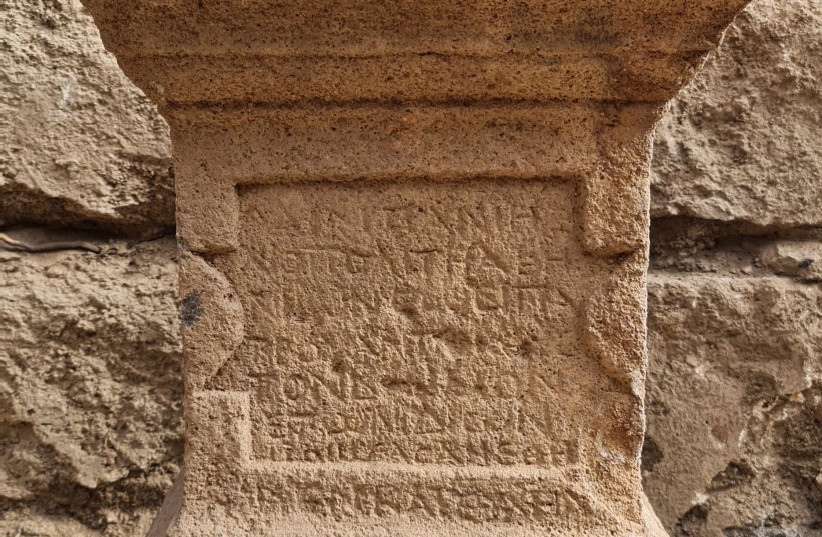
The altar to the Greek god Pan is seen at a Byzantine church in Banyas. / (photo credit: OFER SHINAR)

An Israeli team of researchers excavating a Byzantine church in the Banyas Nature Reserve in Northern Israel believed to be from about 400 CE recently discovered a Roman-era temple to the Greek god, Pan, beneath the church, and made another find that sheds further light on the way that the lives of the later Christians were intertwined with those who worshiped the earlier faiths: a 2nd- or 3rd-century CE altar with a Greek inscription found in the walls of the church.

The church, which is one of the oldest ever found, was important to early Christians, according to Prof. Adi Erlich of the Zinman Institute of Archaeology, University of Haifa, who is leading the excavation of the site with Prof. Ron Lavi. “This site would have had tremendous significance for Christians of the Byzantine era, who believed that this is where Jesus told Peter, ‘I give you the keys to the kingdom of Heaven,’” said Erlich.

This excavation, which is supported and was initiated by the Nature and Parks Authority, is now focusing on figuring out how this pagan altar came to be part of the church wall and what the inscription means. The inscription is being studied by Dr. Avner Ecker of Bar-Ilan University. The inscription, which is in Greek, reads, “Atheneon son of Sosipatros of Antioch is dedicating the altar to the god Pan Heliopolitanus. He built the altar using his own personal money in fulfillment of a vow he made.” Two main things are interesting about this inscription – the combination of Pan with Heliopolitanus, a name normally associated with Zeus, and the origin of the donator from faraway Antioch, some 400 km to the north, located on what is now the on the Turkey-Syria border. “It seems that this cult place was visited by pilgrims coming from afar,” said Erlich.

The Banyas excavation is in a unique location that features a cave, cliff and springs, alongside a terrace formed from the partial collapse of the cliff. The temple was built not long before the beginning of the Christian era.

The discovery of this altar and its inscription raises as many questions for the team researching the site as it answers. The altar was found lying horizontally and it was not until the stone had been thoroughly cleaned that the inscription became visible. Erlich noted that the stone is basalt, and not the local limestone, which is generally found in the area but said that the basalt tends to preserve inscriptions even better than limestone. Why this worshiper chose basalt is one of the many questions the team is investigating in this site that has yielded so many fascinating finds.


Zawartość publikowanych artykułów i materiałów nie reprezentuje poglądów ani opinii Reunion’68,
ani też webmastera Blogu Reunion’68, chyba ze jest to wyraźnie zaznaczone.
Twoje uwagi, linki, własne artykuły lub wiadomości prześlij na adres:
webmaster@reunion68.com


Chanukah Jewish Rock of Ages – Official Hanukkah Song

Jewish Rock of Ages – Official Hanukkah Song

AishCom


The parody of all parodies! “Chanukah: Rock of Ages” is a parody of Jewish holiday parody songs that have become so popular. It tells the Chanukah story in 8 hit songs, capturing the history of contemporary music and dance.

To sign up for more great videos or learn more about Chanukah go to http://aish.com


Zawartość publikowanych artykułów i materiałów nie reprezentuje poglądów ani opinii Reunion’68,
ani też webmastera Blogu Reunion’68, chyba ze jest to wyraźnie zaznaczone.
Twoje uwagi, linki, własne artykuły lub wiadomości prześlij na adres:
webmaster@reunion68.com