Archive | March 2022

A Clear Guide for Combating Campus Antisemitism

A Clear Guide for Combating Campus Antisemitism

Miriam F. Elman and Joshua Suchoff


Burruss Hall at Virginia Tech in Blacksburg, Virginia. Photo Credit: Wikimedia Commons.

On many US college and university campuses, openly Jewish and proudly Zionist students are being demoralized, excluded, and even penalized. Anti-Israel activism has become both more personal and insidious. Gone are the days when Jewish and Zionist students only had to worry about boycott and divestment motions fielded in student governments. Now, more and more of these students are reporting being harassed and ostracized. Scorned for their attachments to Israel, most still don’t live in fear of physical attacks on campus. But a significant number of them say that they have tried to hide their identity just to fit in.

A few months ago, JewBelong put out a call to college students to share their stories about campus antisemitism. The responses revealed a troubling pattern: students forced to confront callous peer-on-peer intimidation, in most cases on their own and bereft of any institutional support.

The anonymous personal accounts in the JewBelong compilation bear a striking resemblance to other recent incidents that have garnered national attention. Take, for example, the depressing case of undergraduate student Rose Ritch, the former vice president of the University of Southern California student government. Ritch was bullied into resigning her leadership position because she identified as a Zionist.

Or consider the sickening uptick in incidents targeting Jewish property on campus — a Hillel entryway sign defaced with curses at the University of Oregon, mezuzahs torn down at Indiana University, and a sukkah vandalized with “Free Palestine” spray-painted on the inside at the University of California. And that’s on top of the now ubiquitous swastikas.

With all this going on, it’s no wonder that Jewish and Zionist students are concealing their identities. On far too many campuses, it has become a necessity for mental health. Cutting edge research recently published by our organization, an educational nonprofit that combats campus antisemitism and works to improve the campus climate for Jewish and all students, finds that American Jews are more likely to be the victims of hate crimes at colleges and universities than all other minority groups.

Alarmingly, this research shows that young Jews are also more likely to suffer bias incidents on campus than at any other location.

And it is not just undergraduate students who are facing these challenges. Jews enrolled in graduate programs are also feeling the pinch. At the University of Chicago, the Students for Justice in Palestine (SJP) chapter launched a campaign to convince peers to boycott “Shi**ty Zionist Classes” — including one taught by a Jewish woman and Ph.D. student.

Recently at NYU’s law school, dozens of graduate students who will soon enter the legal profession or the professoriate, have enthusiastically embraced BDS, choosing to express their solidarity with Palestinians by demonizing Israel and denying the lived experiences of fellow Jewish-Zionist students.

And at Virginia Tech, graduate students recently witnessed their representative body, the Graduate and Professional Student Senate, pass an academic boycott resolution against Israel, while trafficking in incendiary language that equated the complexities of Israel’s majority-minority relations to the history of racial injustices in America.

These cases underscore the heart of BDS activism on campus today — where anything that might normalize the study of Israel is rendered suspect and illegitimate.

But the problem is not simply a matter of students behaving badly. There is also a significant and growing faculty dimension to anti-Israel hostility on campus.

Like students, Jewish and Zionist faculty are contending with vehemently anti-Israel colleagues. In some cases, they may even serve in supervisory roles — such as chairs or deans. Pro-Israel academics, especially junior faculty and those on non-tenure-track and contingent appointments, are particularly vulnerable. These academics are increasingly worried about the potential risks to career advancement that would inevitably come from being branded as racist and anti-progressive — solely due to their support for the only democratic, pluralistic state in the Middle East.

Faculty have long mobilized in support of BDS — by working to shutter study abroad programs to Israel, or refusing to write recommendation letters on behalf of students wanting to study there. But following the May 2021 Israel-Hamas hostilities, this faculty involvement has gone into hyperdrive.

An unprecedented wave of statements condemning Israel issued by dozens of academic departments has now created a formal politicization of academic programs at many schools, basically baking anti-Israel and anti-Zionist group think into both pedagogy and department decision-making. Meanwhile members of the Middle East Studies Association, a prominent society of primarily US-based faculty specializing in the Middle East/North Africa region, are voting over the next few weeks on a resolution to implement an academic boycott against Israel.

Despite all of this, there are ways to walk back the damage — if faculty and university leaders are willing to take on the responsibility for action.

First, faculty need to help students understand how legitimate and warranted criticism of Israel crosses a line when it peddles in tropes and canards about Jews, and presents the Jewish state as the embodiment of evil. Faculty in Jewish and Israel Studies can educate students and even professors about the complexity of Jewish identity and experience, which can lead to a greater sensitivity about anti-Jewish language and motifs. But faculty in other disciplines can also weigh in effectively when criticism of Israel becomes antisemitic. For example, at Yale, a STEM professor’s recent expression of profound disappointment in the Yale College Council’s outrageous demonization of Israel has helped to galvanize his school to confront antisemitism.   

Second, university leaders need to ensure against the abuse of official university channels for the dissemination of anti-Israel propaganda in the name of academic departments, centers, and institutes. To be sure, the bedrock principle of academic freedom gives faculty the right to speak publicly on controversial matters without fear of retribution. But anti-Israel department statements — like those issued by more than 120 Gender Studies programs last spring — suppress the voices of dissenting department members who may believe differently. And it is hard to see how Jewish and Zionist, let alone Israeli, students can feel welcomed and respected in academic units that so thoroughly disregard their values, beliefs, and lived experiences.

Lastly, both faculty and university leaders must serve as a moral compass to set the tone on campus. Administrators should respond forcefully and unequivocally to antisemitism, just as they would to other expressions of hatred and bigotry — and faculty should insist that they do. But university leaders also need to work with their faculty members to move beyond statements, and develop action plans with measurable goals and concrete benchmarks geared toward fostering a welcoming and inclusive learning environment for Jewish and all students. This must be done while also encouraging dialogue and debate on contentious topics. Fortunately, a number of public and private schools are now setting this example and developing models for others to adopt, from the University of Southern California and Colorado State University, to Tufts University, New York University, and San Francisco State University.

Civil rights and educational organizations can also offer resources and guidance regarding best practices for academics and campus administrators. Our organization recently released “Antisemitism, Jewish Identity, and Freedom of Expression on Campus: A Guide and Resource Book for Faculty and University Leaders,” which introduces, contextualizes, and analyzes the pressing concerns and needs of Jewish and Zionist students, faculty, and staff — and offers model ways in which faculty and university leaders can effectively respond to and improve the campus climate for Jewish and all students.

Together, faculty and university leaders must work to ensure that the academy remains a tolerant and supportive space, where reasoned thought and open inquiry thrives, and everyone’s perspectives are valued.

Miriam F. Elman is the Executive Director of the Academic Engagement Network, and an Associate Professor at Syracuse University, where she serves as the inaugural Robert D. McClure Professor of Teaching Excellence. An award-winning teacher and scholar, in 2018 The Algemeiner listed her among the top 100 people worldwide who are positively influencing Jewish life.    

Joshua Suchoff is the Managing Director of the Academic Engagement Network, and a former Wexner Foundation Field Fellow. He has been active in grants management and nonprofit organizational advancement and development for nearly 18 years.

With all this going on, it’s no wonder that Jewish and Zionist students are concealing their identities. On far too many campuses, it has become a necessity for mental health. Cutting edge research recently published by our organization, an educational nonprofit that combats campus antisemitism and works to improve the campus climate for Jewish and all students, finds that American Jews are more likely to be the victims of hate crimes at colleges and universities than all other minority groups.

Alarmingly, this research shows that young Jews are also more likely to suffer bias incidents on campus than at any other location.

And it is not just undergraduate students who are facing these challenges. Jews enrolled in graduate programs are also feeling the pinch. At the University of Chicago, the Students for Justice in Palestine (SJP) chapter launched a campaign to convince peers to boycott “Shi**ty Zionist Classes” — including one taught by a Jewish woman and Ph.D. student.

Recently at NYU’s law school, dozens of graduate students who will soon enter the legal profession or the professoriate, have enthusiastically embraced BDS, choosing to express their solidarity with Palestinians by demonizing Israel and denying the lived experiences of fellow Jewish-Zionist students.

And at Virginia Tech, graduate students recently witnessed their representative body, the Graduate and Professional Student Senate, pass an academic boycott resolution against Israel, while trafficking in incendiary language that equated the complexities of Israel’s majority-minority relations to the history of racial injustices in America.

These cases underscore the heart of BDS activism on campus today — where anything that might normalize the study of Israel is rendered suspect and illegitimate.

But the problem is not simply a matter of students behaving badly. There is also a significant and growing faculty dimension to anti-Israel hostility on campus.

Like students, Jewish and Zionist faculty are contending with vehemently anti-Israel colleagues. In some cases, they may even serve in supervisory roles — such as chairs or deans. Pro-Israel academics, especially junior faculty and those on non-tenure-track and contingent appointments, are particularly vulnerable. These academics are increasingly worried about the potential risks to career advancement that would inevitably come from being branded as racist and anti-progressive — solely due to their support for the only democratic, pluralistic state in the Middle East.

Faculty have long mobilized in support of BDS — by working to shutter study abroad programs to Israel, or refusing to write recommendation letters on behalf of students wanting to study there. But following the May 2021 Israel-Hamas hostilities, this faculty involvement has gone into hyperdrive.

An unprecedented wave of statements condemning Israel issued by dozens of academic departments has now created a formal politicization of academic programs at many schools, basically baking anti-Israel and anti-Zionist group think into both pedagogy and department decision-making. Meanwhile members of the Middle East Studies Association, a prominent society of primarily US-based faculty specializing in the Middle East/North Africa region, are voting over the next few weeks on a resolution to implement an academic boycott against Israel.

Despite all of this, there are ways to walk back the damage — if faculty and university leaders are willing to take on the responsibility for action.

First, faculty need to help students understand how legitimate and warranted criticism of Israel crosses a line when it peddles in tropes and canards about Jews, and presents the Jewish state as the embodiment of evil. Faculty in Jewish and Israel Studies can educate students and even professors about the complexity of Jewish identity and experience, which can lead to a greater sensitivity about anti-Jewish language and motifs. But faculty in other disciplines can also weigh in effectively when criticism of Israel becomes antisemitic. For example, at Yale, a STEM professor’s recent expression of profound disappointment in the Yale College Council’s outrageous demonization of Israel has helped to galvanize his school to confront antisemitism.   

Second, university leaders need to ensure against the abuse of official university channels for the dissemination of anti-Israel propaganda in the name of academic departments, centers, and institutes. To be sure, the bedrock principle of academic freedom gives faculty the right to speak publicly on controversial matters without fear of retribution. But anti-Israel department statements — like those issued by more than 120 Gender Studies programs last spring — suppress the voices of dissenting department members who may believe differently. And it is hard to see how Jewish and Zionist, let alone Israeli, students can feel welcomed and respected in academic units that so thoroughly disregard their values, beliefs, and lived experiences.

Lastly, both faculty and university leaders must serve as a moral compass to set the tone on campus. Administrators should respond forcefully and unequivocally to antisemitism, just as they would to other expressions of hatred and bigotry — and faculty should insist that they do. But university leaders also need to work with their faculty members to move beyond statements, and develop action plans with measurable goals and concrete benchmarks geared toward fostering a welcoming and inclusive learning environment for Jewish and all students. This must be done while also encouraging dialogue and debate on contentious topics. Fortunately, a number of public and private schools are now setting this example and developing models for others to adopt, from the University of Southern California and Colorado State University, to Tufts University, New York University, and San Francisco State University.

Civil rights and educational organizations can also offer resources and guidance regarding best practices for academics and campus administrators. Our organization recently released “Antisemitism, Jewish Identity, and Freedom of Expression on Campus: A Guide and Resource Book for Faculty and University Leaders,” which introduces, contextualizes, and analyzes the pressing concerns and needs of Jewish and Zionist students, faculty, and staff — and offers model ways in which faculty and university leaders can effectively respond to and improve the campus climate for Jewish and all students.

Together, faculty and university leaders must work to ensure that the academy remains a tolerant and supportive space, where reasoned thought and open inquiry thrives, and everyone’s perspectives are valued.


Miriam F. Elman is the Executive Director of the Academic Engagement Network, and an Associate Professor at Syracuse University, where she serves as the inaugural Robert D. McClure Professor of Teaching Excellence. An award-winning teacher and scholar, in 2018 The Algemeiner listed her among the top 100 people worldwide who are positively influencing Jewish life.    

Joshua Suchoff is the Managing Director of the Academic Engagement Network, and a former Wexner Foundation Field Fellow. He has been active in grants management and nonprofit organizational advancement and development for nearly 18 years.


Zawartość publikowanych artykułów i materiałów nie reprezentuje poglądów ani opinii Reunion’68,
ani też webmastera Blogu Reunion’68, chyba ze jest to wyraźnie zaznaczone.
Twoje uwagi, linki, własne artykuły lub wiadomości prześlij na adres:
webmaster@reunion68.com
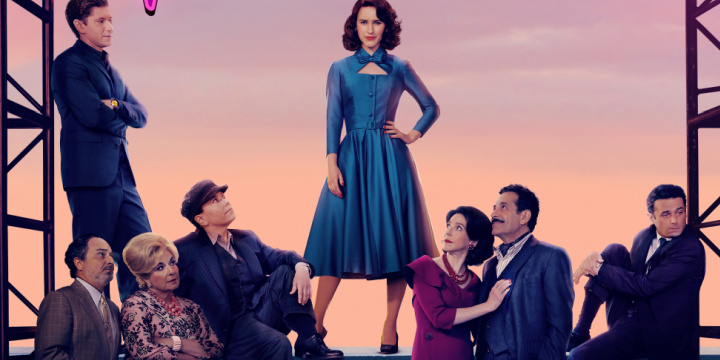


‘Marvelous Mrs. Maisel’ About Jewish Comedian Gets Renewed for Fifth, Final Season

‘Marvelous Mrs. Maisel’ About Jewish Comedian Gets Renewed for Fifth, Final Season

Shiryn Ghermezian


A partial view of the poster for season 4 of “The Marvelous Mrs. Maisel.” Photo: Prime Video.

“The Marvelous Mrs. Maisel” will end its run after its fifth season, which was announced on Thursday.

Prime Video said that its most awarded series about a fictional, Jewish stand-up comedian has been renewed for its fifth and final season. Production is currently underway in New York City for season five of the show, which was written and directed by Amy Sherman-Palladino and her husband, executive producer Daniel Palladino.

“Amy, Dan, and ‘The Marvelous Mrs. Maisel’ have blazed an unparalleled path, elevating the stories we tell about women, challenging the norms in our industry, and forever altering the entertainment landscape with their one-of-a-kind storytelling,” said Jennifer Salke, head of Amazon Studios.

“The dozens of awards cement [the show’s] legacy in many ways, but what’s even more enduring and poignant are the characters Amy created and the joyous, brilliant, singular world she and Dan brought to life,” Salke added. “This series has meant so much to Prime Video and the effects of its success will be felt long after its final season. I can’t wait for fans and our worldwide Prime Video audience to savor each moment as we embark on the culmination of this groundbreaking and unforgettable series.”

“The Marvelous Mrs. Maisel” stars Rachel Brosnahan as Miriam “Midge” Maisel (maidenly Weisman), a Jewish housewife and mother-of-two who pursues a career in stand-up comedy.

The show is set in the late 1950s and early 1960s in New York and has featured numerous scenes highlighting the Jewish identity of the Maisel and Weisman families. The show’s pilot episode opened with scenes from the Maisel’s Jewish wedding and preparations for the post-Yom Kipper meal to break the fast.

The popular series first aired in March 2017, and has since won 20 Emmy Awards and garnered 54 nominations in its first three seasons. Sherman-Palladino is the first person to win Emmys in both comedy writing and comedy directing in the same year. When cast member Alex Borstein won the 2019 Emmy for best supporting actress in a comedy series, she dedicated the victory to her grandmother, who was a Holocaust survivor.

The fourth season of “The Marvelous Mrs. Maisel” premieres on Prime Video on Friday, with two new episodes being releasing every Friday for four weeks. Cast members include Tony Shalhoub, Marin Hinkle, Michael Zegen, Kevin Pollak, Caroline Aaron, and Luke Kirby.The new season will include also guest star appearances from Jane Lynch, Kelly Bishop, Milo Ventimiglia, John Waters and Jason Alexander.

Brosnahan shared her feelings about the final season on Instagram on Thursday.

“A few days ago we started shooting Season 5 (!) of The Marvelous Mrs. Maisel,” she wrote. “It’s bittersweet. The band is back together again and we can’t wait to share season 4 with you starting tomorrow… it’s also going to be our last rodeo. Rest assured our tits are up and it’s going to be a hell of a final chapter. Stay tuned.”


Zawartość publikowanych artykułów i materiałów nie reprezentuje poglądów ani opinii Reunion’68,
ani też webmastera Blogu Reunion’68, chyba ze jest to wyraźnie zaznaczone.
Twoje uwagi, linki, własne artykuły lub wiadomości prześlij na adres:
webmaster@reunion68.com


Doktorze, czy pan jest putinowskim trollem?

August Grabski w 2011 r. podczas debaty w Żydowskim Instytucie Historycznym (Fot. Wojciech Olkuśnik / Agencja Wyborcza.pl)


Doktorze, czy pan jest putinowskim trollem?

Piotr Głuchowski


– To, co napisał dr August Grabski, uważam za przerażające. I wielu moich kolegów, nie tylko historyków, jest podobnego zdania: tej sprawy nie możemy odpuścić – mówi prof. Jerzy Kochanowski, historyk z UW.

.

„Maksymalne straty wśród ludności cywilnej są w politycznym interesie banderowskiej ekipy Zełenskiego i NATO” – napisał na Facebooku, dodając smutną buźkę, dr August Grabski, historyk z Uniwersytetu Warszawskiego.

Grabski, pracownik naukowy Instytutu Historycznego Uniwersytetu Warszawskiego, jest byłym wiceprzewodniczącym rady naukowej Żydowskiego Instytutu Historycznego, ekspertem sejmowej komisji mniejszości narodowych i etnicznych oraz członkiem redakcji pisma „Studia z Geografii Politycznej i Historycznej”. Wydał kilkanaście prac o historii Holokaustu, o syjonizmie, trockizmie i komunizmie. W 2015 r. został odznaczony przez minister Małgorzatę Omilanowską orderem Zasłużony dla Kultury Polskiej.

Kopia jego wpisu krąży pomiędzy warszawskimi historykami. Są oburzeni.

August Grabski - wpis na FacebookuAugust Grabski – wpis na Facebooku 

Prof. Jerzy Kochanowski, historyk z UW, b. naczelny pisma „Mówią Wieki”: – Sprawa jest już głośna w Instytucie Historii i nie tylko. Uważam, że należy ją podnieść na szerszym forum, żeby nie skończyło się jedynie rozmową dyscyplinującą z doktorem Grabskim. Bo to, co napisał, uważam za przerażające. I wielu moich kolegów, nie tylko historyków, jest podobnego zdania: tej sprawy nie możemy odpuścić. Sam się zastanawiam nad zgłoszeniem doktora do Uczelnianej Komisji Dyscyplinarnej.

August Grabski: „Mam odwagę mówić prawdę”

Dzwonię do Grabskiego. Nie wypiera się autorstwa wpisu, nie zmienił również zdania.

– Mam rodzinę w Tarnopolu – zaczyna. Moi przodkowie walczyli o niepodległość Ukrainy, ginęli za nią. I dlatego mi się nie podoba, że tam stoją dosłownie setki pomników masowych morderców Polaków i Żydów. 

– Kogo pan ma na myśli? 

Banderę i Szuchewycza. Był pan w ogóle we Lwowie?

– Byłem. 

To zna pan kościół św. Elżbiety opiewany choćby w „Marszu lwowskich dzieci”. Kilkaset metrów od tego kościoła stoi pomnik Bandery – mordercy polskich dzieci. I to jest, niestety, źródło obecnej ukraińskiej tożsamości narodowej.

– Nie sądzi pan, że dziś nie jest czas na to, aby… 

– Jak chce pan ode mnie coś więcej, poproszę pytania mailem. Aby się potem nie okazało, że jestem jakimś proputinowskim wariatem. 

– A nie jest pan?

– Nie jestem. Po prostu mam odwagę mówić prawdę tam, gdzie inni się boją. Proszę wysłać mail. 

Wysyłam:

  • Dlaczego uznaje pan ekipę prezydenta Zełenskiego za „banderowską”?
  • Czy teza, wedle której „maksymalne straty wśród ludności cywilnej” są korzystne dla obecnych władz Ukrainy, nie jest aby objawem okrutnego cynizmu z Pana strony?
  • Czy nie uważa Pan, że teraz nie czas krytykować Zełenskiego?
  • Czy zgodzi się Pan, że wypowiedzi podobne do pańskiego wpisu są na rękę Moskwie?

Czekając na odpowiedź, odświeżam wiedzę na temat Stepana Bandery i Romana Szuchewycza.

Na ilu cokołach stoją Bandera i Szuchewycz? 

Obaj są świetnie znani. Bandera, przed wojną przewodniczący frakcji Organizacji Ukraińskich Nacjonalistów (OUN-B), organizował w Polsce zamachy terrorystyczne – m.in. na ministra spraw wewnętrznych Bronisława Pierackiego, za co dostał w 1936 r. dożywocie. Wypuszczony we wrześniu 1939 r. wrócił do konspiracji – teraz przeciwko Sowietom.

Szuchewycz również organizował zamachy, m.in. na polskiego kuratora oświaty we Lwowie (1926), sądzony wraz z Banderą i innymi OUN-owcami, odsiedział trzy lata.

Wiosną 1941 r. Niemcy – planujący atak na Związek Sowiecki – powołali do życia dwa ukraińskie bataliony Wehrmachtu – Roland i Nachtigall (Słowik). Bandera zajął się ich organizacją, Szuchewycz został zastępcą niemieckiego dowódcy Słowika. Po wkroczeniu batalionów do Lwowa na przełomie czerwca i lipca 1941 r. Bandera z Szuchewyczem ogłosili niepodległość Ukrainy, ale państwo Niemcy skasowali po 12 dniach istnienia. Oba bataliony rozwiązano. Banderę Niemcy osadzili w Sachsenhausen, Szuchewycz przeszedł do 201. batalionu policyjnego, który walczył z sowiecką partyzantką. W 1943 r. zszedł do podziemia i kontynuował walkę z Sowietami w szeregach UPA. NKWD wytropiło go i zabiło w marcu 1950 r. Banderę zastrzelił w 1959 r. w Monachium zawodowy morderca z KGB. 

Nas interesuje odpowiedzialność obu za rzezie na Wołyniu i w Galicji Wschodniej. Bandera siedział do września 1944 r. w Sachsenhausen, więc jego winę można rozpatrywać jedynie w kategoriach moralnych. Szuchewycz nie ma czystej karty. Zdaniem prof. Grzegorza Motyki zaakceptował post factum decyzję o mordach na Polakach.

Tym niemniej mówiąc o „setkach” pomników Szuchewycza i Bandery w dzisiejszej Ukrainie, dr Grabski przesadza. Jest ich kilkadziesiąt. Szuchewycz ma cztery – m.in. we Lwowie i w podlwowskim Biłhoroszczu, gdzie poległ. W Krakowcu działa szkoła jego imienia. Bandera stoi na ok. 50 cokołach.

Kult Bandery i Szuchewycza nie jest jednak ogólnoukraiński. Nie istnieje na rosyjskojęzycznym wschodzie kraju, gdzie UPA i OUN są raczej potępiane. Koncentruje się na zachodzie, głównie w rejonach, w których działała UPA. Muzea poświęcone Banderze działają w Stryju, Uhrynowie Starym i Dublanach.

Co powinni wiedzieć głosiciele antyputinowskiej krucjaty?

Dr Grabski w mailu pisze tak: 

„W mojej wypowiedzi po prostu ubolewam, że popularność sprawy ukraińskiej rośnie w miarę liczby cywilnych ofiar. Gdyby w tej wojnie zginęło kilku cywili a nie tysiące nie byłaby ona tak ważna w międzynarodowej polityce czy mediach. Stwierdzenie, które tak wielu oburzyło, padło [natomiast] w kontekście dyskusji, czy Kijów potrzebuje teraz obrony na wzór powstania warszawskiego (w którym zginęło raptem 2 tys. Niemców ale być może aż 200 tys. polskiej ludności). Jestem przeciwny hasłom, które sprowadzają się do tego, że Polska, EU czy Zachód miałby walczyć z Rosją do… ostatniego Ukraińca (…) 

Uważam, że im szybciej dojdzie do rozwiązania dyplomatycznego za cenę ukraińskiej neutralności, tym lepiej.

Tymczasem dla wielu gorliwych głosicieli anty-putinowskiej krucjaty sprawa Ukrainy jest ważna, ale dopiero od miesiąca i będzie jeszcze miesiąc. Dla nich to często kwestia nienawiści do Rosji, a dla mnie to sprawa bezpieczeństwa ludzi, w tym mojej rodziny [w Ukrainie]. Niestety nie wiemy, ile zostanie za kilka miesięcy z obecnej nagłej miłości Polaków do Ukraińców. 

(…) Dziś każde krytyczne myślenie, wyłamywanie się z nacjonalistycznego konsensusu, dystans wobec rozwiązań militarnych (…) sprzeciw wobec niszczenia pomników i cmentarzy Armii Czerwonej (gdzie zwykle leży przynajmniej kilkanaście procent Ukraińców) może narazić na zarzut bycia „agentem Putina”. [Tymczasem] każdy, kto był na Ukrainie, widział tam pomniki Bandery, Szuchewycza i dziesiątki upamiętnień pomniejszych ideologów (…) OUN/UPA. Ta tradycja jest silna [i] daje argumenty Kremlowi. Nigdy w polskiej debacie publicznej nie ma dobrego czasu by o tym rozmawiać, bo rzekomo szkodziłoby to stosunkom międzypaństwowym lub służyło Moskwie. (…) Przed wojną nie można było o tym mówić, teraz tym bardziej, po wojnie też nie będzie można”.

Była rozmowa, prośba i wniosek…

Relacjonuję sprawę i opinię dr. Grabskiego profesorowi Łukaszowi Niesiołowskiemu-Spanò, dziekanowi Wydziału Historii UW. Z tonu jego odpowiedzi wnioskuję, że nie darzy szacunkiem dr. Grabskiego, a jego wpis uważa za skandal. Natomiast oficjalnie przekazuje mi jedynie takie stanowisko:

– W związku z internetowym wpisem poprosiłem pana doktora o osobiste złożenie wyjaśnień. Był u mnie dzisiaj ze swą przełożoną. Potwierdził, że inkryminowany wpis to jego dzieło i zapewnił, że wynika z osobiście antywojennego stanowiska.

Poinformowałem go zatem, że szanuję wolność wypowiedzi, ale łączenie prezydenta Zełenskiego z banderyzmem uznaję, delikatnie mówiąc, za niefortunne.

Rozmowa skończyła się z mojej strony prośbą i wnioskiem, by pan doktor powstrzymał się od wygłaszania radykalnych sądów w kontekście Ukrainy.


Zawartość publikowanych artykułów i materiałów nie reprezentuje poglądów ani opinii Reunion’68,
ani też webmastera Blogu Reunion’68, chyba ze jest to wyraźnie zaznaczone.
Twoje uwagi, linki, własne artykuły lub wiadomości prześlij na adres:
webmaster@reunion68.com


Putin’s Fascism

Putin’s Fascism


JASON STANLEY AND ELIYAHU STERN


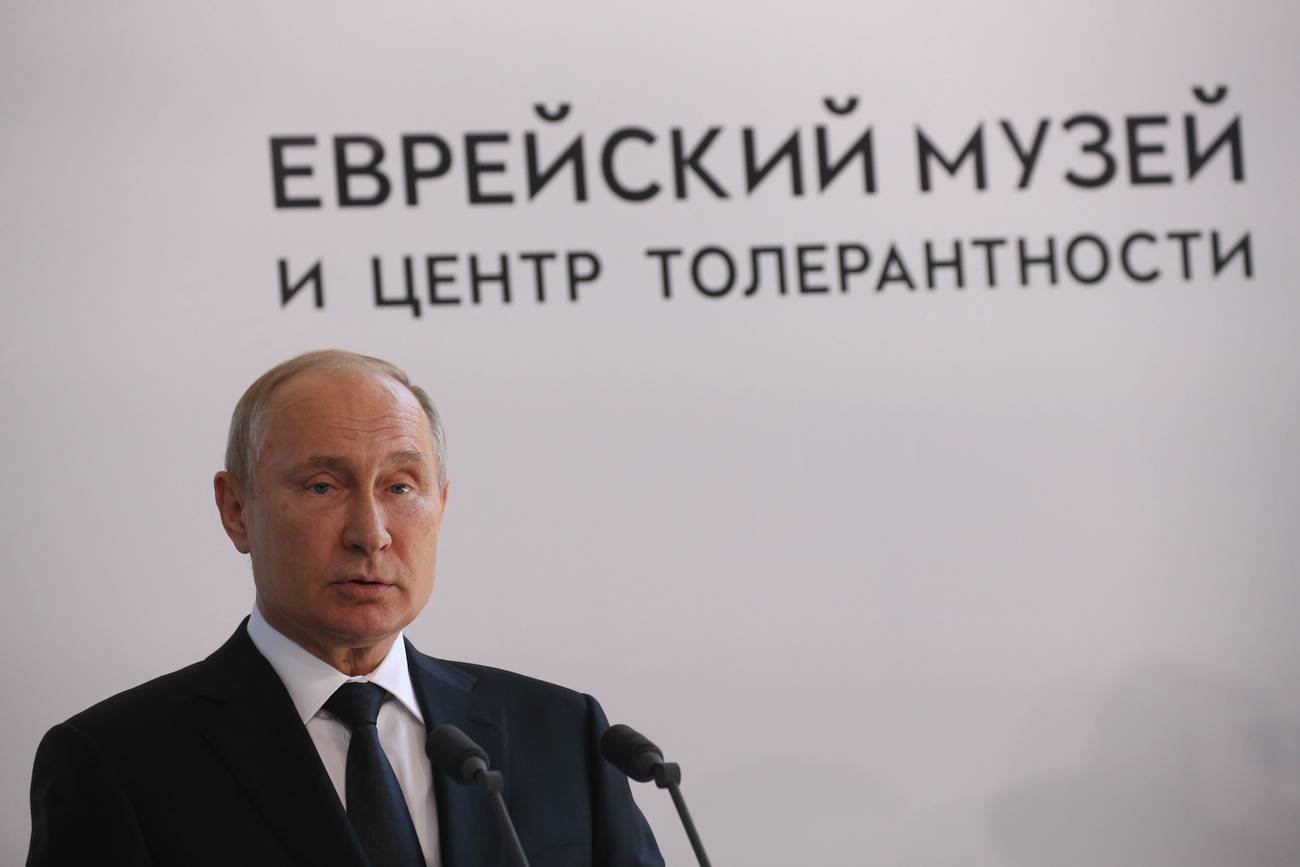
Russian President Vladimir Putin at the Jewish Museum and Tolerance Center in Moscow, 2019MIKHAIL SVETLOV/GETTY IMAGES

The admiration of religious traditionalism and hatred of cosmopolitan liberalism is part of the Kremlin’s fascist ideology

.

On March 2, Yale’s Fortunoff Video Archive for Holocaust Testimonies published a statement on the Russian invasion of Ukraine. It condemns “Vladimir Putin’s deliberate, coldhearted, and Orwellian abuse of the language of the Holocaust.” In Putin’s claim “that Russia must invade Ukraine to “denazify” and end a “genocide,” it finds numerous evils, including “a diversion from his own fascism” and “an expression of antisemitism.”

If Putin’s invasion has been justified in part by employing expressions of antisemitism, how does this square with the fact that Putin has made it a point to disassociate himself from the racist and antisemitic legacy of Nazism? To help decode the Russian leader’s position, it’s instructive to look at the positions espoused by Alexander Dugin, a Russian intellectual who has done much over the years to formulate what appears to now be the Kremlin’s dominant ideology. While often described in Western media as “Putin’s brain,” Dugin’s influence on Russian leaders has waxed and waned over the years. More than political influence, his major contribution has been his ability to make the geopolitical ambitions of Putin’s post-Soviet Russia intelligible.

Dugin began his intellectual career as a critic of the Soviet Union, identifying with underground nationalist and spiritual movements. Some of these groups, such as the ultranationalist Pamyat, promoted antisemitic sentiments. Eventually he disavowed these ties and emerged as a leading spokesperson for Eurasianism, a political movement that sees Russia playing a central role in the geopolitical order bridging the divide between Europe and Asia.

The French scholar Marlene Laruelle has described Dugin’s political philosophy as an attempt “to rehabilitate fascism in Russia” by stressing its nationalist orientation while disowning its associations with Nazism and racism. Tellingly, Putin’s invasion of neighboring Ukraine has exemplified this vision.
Alexander DuginWIKIPEDIA

Fascism embraces a mythic past, where the nation, once great, has experienced humiliation and loss of land, the result of weakness and decadence brought on by liberal democracy. To make up for these losses, real and supposed, fascist leaders encourage violent reassertion of previous greatness, as well as the destruction of liberal democracy in favor of a one-party state or, more typically, a single autocratic ruler who is synonymous with the nation.

In the Russian nationalist version of the mythic past, Ukraine is central. According to this mythology, there are no Ukrainians—just lost Russians living, whether they know it or not, in the heart of historic Russia. Under Putin, Russia has been harshly sexist and homophobic, familiar manifestations of fascist ideology. But Russia’s violent imperial war against a neighboring cosmopolitan democracy that it seeks to absorb is the clearest manifestation yet that its animating ideology is something akin to classical fascism.

Dugin and Putin both claim to be opposed to racism and Nazism. They insist that their primary enemy is not any one people, religion, or race, but rather “confused” cosmopolitans, liberals, and secularists. This 20th-century set of chiefly antisemitic stereotypes is also used to describe liberal democracy.

Putin has enjoyed the support of Russia’s chief rabbi, Berel Lazar, and Dugin counts right-wing Israeli Zionists among his comrades. As Dugin explained in April 2021 in the Israeli journal Dehak:

The Gaon of Vilna said: in the End of Days the main enemy will not be the husk of Ishmael [Islam] or the husk of Rome [Christianity], but rather the husk of Jacob [Jews], those who are designated as the mixed multitude, the assimilated people who, according to the Gaon of Vilna, have underwent modernization and colonization. [In the End of Days], the chief enemy of the Jewish tradition will come from its own house and not from the outside in the form of Christianity and Islam. The chief enemy … is the Jewish People. They are the chief enemy of traditional Judaism … Perhaps this is not well understood, but I think this interpretation is very important. In our own community, in a similar way, the chief enemy of the Russian nation are liberal Russians and not the representatives of other groups. … In my opinion, it follows, we need a deep de-colonization of [the forces of modernization] from Africa, Asia, Latin America, and Israel, in Russia and Europe and in the United States. In the United States this means being made free from the heavy hand of the elite-racist ultra-liberal that seeks to annihilate American values.

Here, Dugin represents himself as the champion of Judaism—or at least his conception of traditional Judaism—against the forces that would destroy it: Jews themselves. Dugin represents “traditional” Jews as those who are attached to the land of Israel. The enemy of Judaism are the assimilated, cosmopolitan Jews, those who are part of “modernization.” More generally, Dugin says that each national community’s existential threat consists of members of that community—the ones who embrace cosmopolitanism, liberalism, tolerance, and democracy. 

Dugin’s appeal here is transnational—it is made to the traditionalists in every group opposed to feminism, secularism, LGBT rights, and liberal tolerance. For Dugin, the enemy of each group is to be found within its midst: those who support multicultural, liberal societies. Traditionalists can and do operate within the parameters of liberal democracy, of course. But in the new Russian fascism, traditionalism is seen as inconsistent with and opposed to liberal democracy.

Increasingly, the global far right denounces racism and antisemitism even while working to extinguish liberalism and multiculturalism. By identifying “real” Jews as the ones connected with the land—specifically Israeli nationalists—the global far right believes it is justified in its repeated use of antisemitic tropes aimed at Jewish targets.

Thus, for many in Putin’s circle, Ukrainian President Volodymyr Zelensky is not really Jewish. Similarly, former New York City Mayor and Donald Trump lawyer Rudolph Giuliani—along with Brexit backers Raheem Kassam and Andy Wigmore—have sought to challenge the Jewish identity of George Soros, in the context of attacking him for his philanthropic and political efforts. Never mind that the rabbis, the State of Israel, and Adolf Hitler would all consider Soros a Jew—“I’m more of a Jew than Soros is,” said Giuliani. That’s because for them, “real” Jews are religiously traditionalist and quintessentially nationalist—and not invested in, say, liberalism or democracy.

According to nationalists and traditionalists, liberals, cosmopolitans, and progressives undermine defined and necessary ethnic and religious identities. It is this set of values that contemporary Russian nationalism associates with democracy. Dugin’s Russian nationalism tries to appeal to what it imagines as traditionalist Jewish allies in an attempt to justify violent opposition to liberal democracy.

The Duginist invocation of traditionalism is clearly meant to appeal to members of minority groups historically targeted by fascism, above and beyond merely using them as tokens for narrow political purposes. But is Russian fascism free from racial, ethnic, gender, and religious hierarchies? Is it free from the antisemitism that is central to so many traditional European versions of fascism? 

When a contemporary society’s institutions were formed under conditions of explicit discrimination, they will continue to contain practices that perpetuate various disparities, even if no one within those structures has an explicitly discriminatory attitude (a key insight of critical race theory). Far-right movements and political parties often campaign on a platform of eliminating attempts to reform or replace these discriminatory practices, as well as introducing new ones, like opposing immigrants, women’s rights, religious and sexual freedoms, and the freedom to teach history.

In a very straightforward sense, this traditionalism is not free from antisemitism. A majority of the world’s Jews still choose to live outside of Israel, and most of them would not meet Dugin’s standards of religious traditionalism. A majority of Jews, then, are Dugin’s—and Putin’s—enemies.

It is one thing to wage cultural battles within the boundaries of liberal democratic politics, which preserve minority rights and allow the regular replacement of political leaders by democratic means. Traditionalists can and often do operate within this sphere.

Fascism breaks these boundaries. In fascist ideology, liberal democracy is itself the existential threat to traditionalism. Putin’s willingness to massacre people he falsely regards as his own points to his real enemy: cosmopolitan liberal democracy.

In Putin’s ideology, it is Ukrainian liberal democratic citizenship that represents the real threat to Russian greatness. Traditionalism demands a “deep decolonization” of these modernizers everywhere, perhaps especially the Jewish ones.


Jason Stanley is professor of philosophy at Yale University, and the author of five books, most recently How Fascism Works: The Politics of Us and Them.

Eliyahu Stern is associate professor of modern Jewish intellectual and cultural history at Yale University and the author of Jewish Materialism: The Intellectual Revolution of the 1870s (Yale University Press, 2018).


Zawartość publikowanych artykułów i materiałów nie reprezentuje poglądów ani opinii Reunion’68,
ani też webmastera Blogu Reunion’68, chyba ze jest to wyraźnie zaznaczone.
Twoje uwagi, linki, własne artykuły lub wiadomości prześlij na adres:
webmaster@reunion68.com

Co warto (bylo) zobaczyć we Lwowie?

Co warto (bylo) zobaczyć we Lwowie?


Travel Tasters


Zapraszamy wraz z nami do zwiedzania Lwowa!

W tym odcinku pokażemy Wam najważniejsze i najsłynniejsze punkty tego miasta, miejsca warte odwiedzenia pod względem kulinarnym, dowiecie się ile kosztuje wynajem mieszkania, a ile jedzenie. Opowiemy trochę o historii i polatamy dronem.
Mamy nadzieję, że dzięki nam poczujecie klimat i smak Ukrainy! 💪🏻💙

We Lwowie byliśmy niedawno ze względu na pokaz mody Walerii, a przy okazji mieliśmy możliwość trochę pozwiedzać to piękne miasto 😊💙 to nie był nasz pierwszy raz we Lwowie, ale pierwszy raz z kamerą!


Zawartość publikowanych artykułów i materiałów nie reprezentuje poglądów ani opinii Reunion’68,
ani też webmastera Blogu Reunion’68, chyba ze jest to wyraźnie zaznaczone.
Twoje uwagi, linki, własne artykuły lub wiadomości prześlij na adres:
webmaster@reunion68.com