Archive | December 2022

The Failed British Double-Cross of Israel

The Failed British Double-Cross of Israel


EDWARD N. LUTTWAK


Heretofore overlooked British General Staff documents demonstrate that the oft-marginalized Lehi leader Avraham ‘Yair’ Stern’s assessment of British intentions toward Mandate Palestine was correct.
.

Avraham Stern in 1942ISRAELI GOVERNMENT PRESS OFFICE

When the warrior poet Avraham “Yair” Stern founder and leader of Lohamei Herut Israel (Lehi, “Fighters for the Freedom of Israel”) who believed that the British had to be forced out with assassinations and bombs and would never leave voluntarily, was killed after being captured and handcuffed by British detectives on Feb. 12, 1942, no Jew could celebrate his death.

But the leaders of the Jews of British Mandatory Palestine, already then led by David Ben-Gurion, viewed Stern’s death as a gain for the national cause rather than a loss—and not only because the poet and his followers were reckless political dilettantes: Some fantasized alliances with Mussolini, even the Nazis, as well as Arab nationalists in a common anti-British cause.

At a time of maximum danger—Rommel seemed to be on the verge of conquering Egypt, with Palestine next—Ben-Gurion and his allies doggedly pursued cooperation with the British in spite of bitter disappointments. Perhaps the worst of these was the May 1939 White Paper which limited the immigration of Jews to 75,000 over five years, sentencing countless European Jews to death at the hands of the Nazis. Yet Ben-Gurion believed, and rightly so, that the British were the least-bad allies the Jews could have.

Nor did Ben-Gurion have much choice. The Americans had refused to enter the war even after the Germans had conquered most of Europe. They still refused to act when the Germans seemed on the verge of defeating Russia, which would soon mean Britain’s defeat, too. On Dec. 2, 1941, German tanks were 14.7 miles from Moscow’s Red Square. America was only at war when Stern died in 1942 because the Japanese had attacked them.

It was unimaginable that the Americans would intervene on behalf of the Jews in the distant Middle East—indeed the U.S. only lifted its total weapons embargo on Israel in August 1962!—to allow the sale of defensive antiaircraft missiles, seven years after the Soviets had agreed to deliver bombers to Nasser’s Egypt (part of a huge Soviet weapons gift package misrepresented as “Czech” at the insistence of the CIA to avert hostility from their own man Nasser: That always-wrong agency was betting on Nasser’s mighty Arab nationalism rather than on seemingly puny Israel).

When Avraham Stern was killed, the communists still gave all their loyalty to Stalin. According to Ben-Gurion and the majority of Jewish leaders in Palestine, Churchill was still the best bet the Jews could have, even after the exposure of his crass duplicity toward the Yishuv. Having vehemently condemned the May 1939 White Paper to please his Jewish benefactors while out of office and short of ready cash, Churchill refused to change the policy once he became prime minister—thus denying escape from death to millions, and incidentally preventing my father, mother, two brothers, and myself from leaving Arad, Romania, to reach safety by a comfortable Orient Express ride to Istanbul and thence Haifa. A 5-inch-by-2-inch Palestine entry slip was enough to obtain Bulgarian and Turkish transit visas, but the British refused to issue them, even in 1944—by which point detailed eyewitness accounts and impeccable documentation of the operation of every part of the Nazi killing machine had reached London and Washington.

In spite of all that, on the evidence available at the time, Ben-Gurion was still mostly right and Avraham Stern was still mostly wrong. The British did eventually, and very reluctantly, agree to the U.N.’s termination of their mandatory rule on May 15, 1948, thus allowing the Jews to fight for their state. The qualifier is necessary because a factor in the British decision was the terrorist attacks inspired by Stern, including the July 22, 1946, bombing of the British headquarters in the King David Hotel whose 91 killed set a deadliest-attack record that lasted for decades.

It is only in more recent years that documents have emerged which prove that the British—meaning the then immensely authoritative Imperial General Staff whose eminence increased even more once Churchill was voted out of office on July 5, 1945—were determined to remain in Palestine, contrary to their representations to the Jewish leaders and the U.N. In fact, they had worked out an operational plan to do exactly that: They would equip the Egyptian army of their obedient liege King Farouk, and the Iraqi army of their obedient liege King Faisal II with field artillery, tanks, and combat aircraft, and they would send armored cars, field artillery, and excellent British officers to command the Arab Legion of their liege King Abdullah of Jordan. The Jews would be allowed no weapons at all—not even revolvers. Faced with the irresistible advance of the Arab armies, they themselves would plead for British protection, thereby ensuring the prolongation of British rule.

The General Staff documents reveal systematic strategic logic at work with no trace of antisemitism. British staff planners accepted that India, Burma, and Ceylon would soon be lost, but asserted that the Persian Gulf had to be kept because its oil revenues were essential to fund Britain’s reconstruction (aside from much housing stock lost to Nazi bombers, the machinery in British factories was worn out by wartime production).

Britain’s postwar recovery, the General Staff planners believed, would require continued control of a chain of air bases from Cyprus and the British-controlled Canal Zone to Iraq and Bahrain via the Negev, the southern desert that constituted the largest part of the U.N.-drawn map of the future Israel. The Jewish state therefore could not be allowed to become independent on May 15, 1948, except for a narrow coastal strip above the Negev, where a few hundred thousand Jews might live under British protection.

The Labour government that followed Churchill’s wartime coalition was fully engaged in building a land fit for heroes and had no time or inclination to interfere with the Imperial General Staff plan—and if they had intervened it would scarcely have changed anything. Labour Prime Minister Clement Attlee (Churchill’s “modest man with a lot to be modest about”), happened to be a very quiet but coldly determined and absolute antisemite as well as an anti-Zionist. This fact was little known at the time partly because of all the attention focused on the Foreign Office, which was led by the ex-trade-unionist Foreign Secretary Ernest Bevin, who was not a serious antisemite at all but only a loudmouth.

Bevin provided cover for both Attlee and the Imperial General Staff planners with his antisemitic outbursts. But the outburst most often cited against Bevin, of June 12, 1946—“There has been agitation in the United States … for 100,000 Jews to be put in Palestine [for] the purest of motives. They did not want too many Jews in New York”—actually originated wih James F. Byrnes, the U.S. secretary of state. Byrnes’ own policy—ferociously and very effectively enforced—was likewise to deny any weapons at all to the Jews, thereby furthering British plans.

Byrnes’ policy persisted unchanged under his certifiably nonantisemitic successor George Marshall (who had pressed for opening the gates to Jewish migrants into the U.S.) even after Israel’s independence on May 15, 1948, regardless of the inherent right of any sovereign state to defend itself. Had weapons not arrived by precarious DC-3 flights from the Czech Republic via Yugoslavia with the consent of Josef Stalin, who was out to embarrass the British Empire, the Jewish state would have been defeated, with the survivors rescued only if British rule persisted.

As it happened, the Jews turned out to be much better fighters than anyone had anticipated, but their 1949 victory on all fronts was only a setback for the Imperial General Staff, whose unquestioned authority did not wane until the 1956 Suez debacle.

Two bundles of heretofore overlooked documents prove that Avraham Stern was right in not trusting British declarations that they would end the Mandate and allow the Jews to establish a state, even within the shrunken borders envisioned by the U.N.

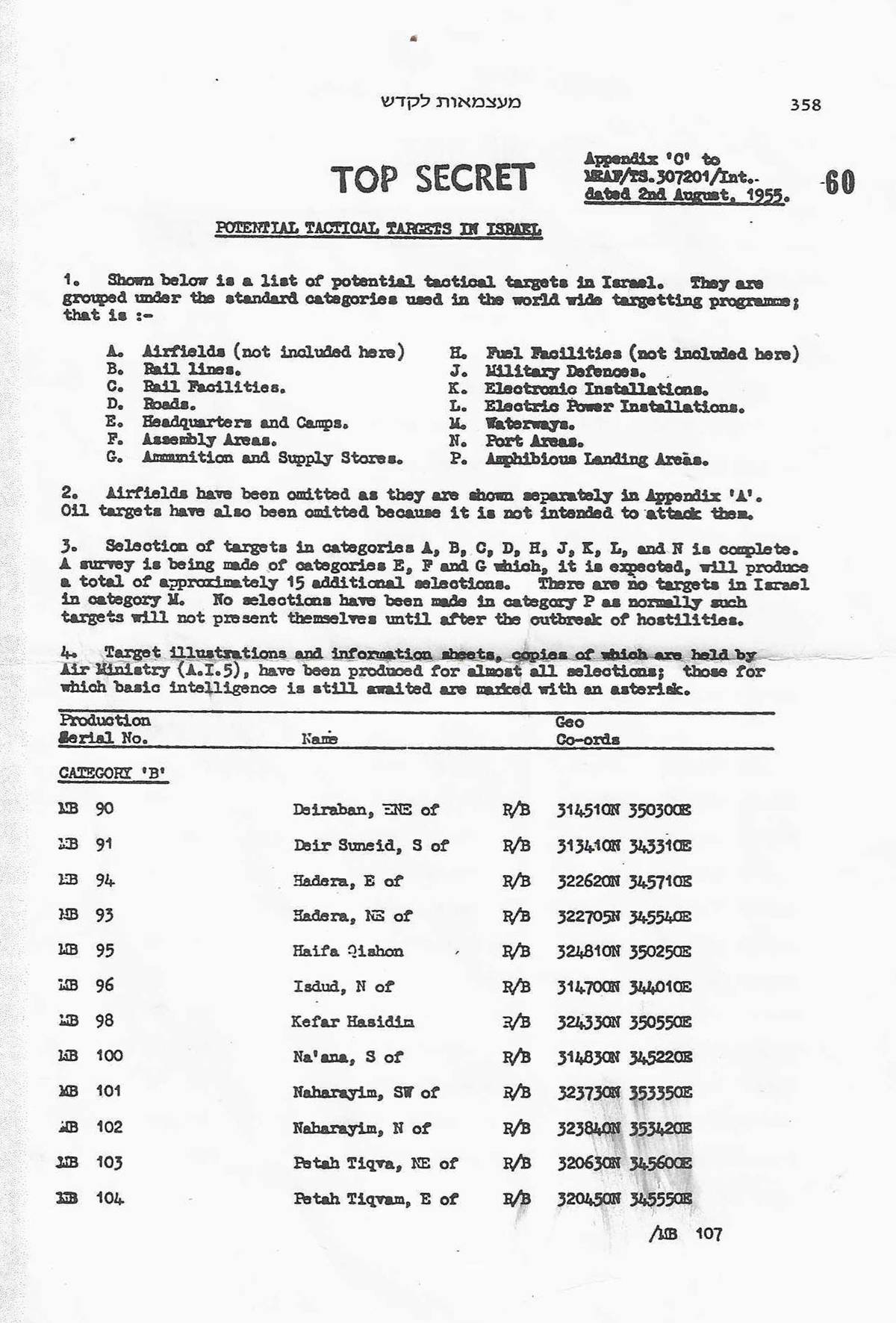
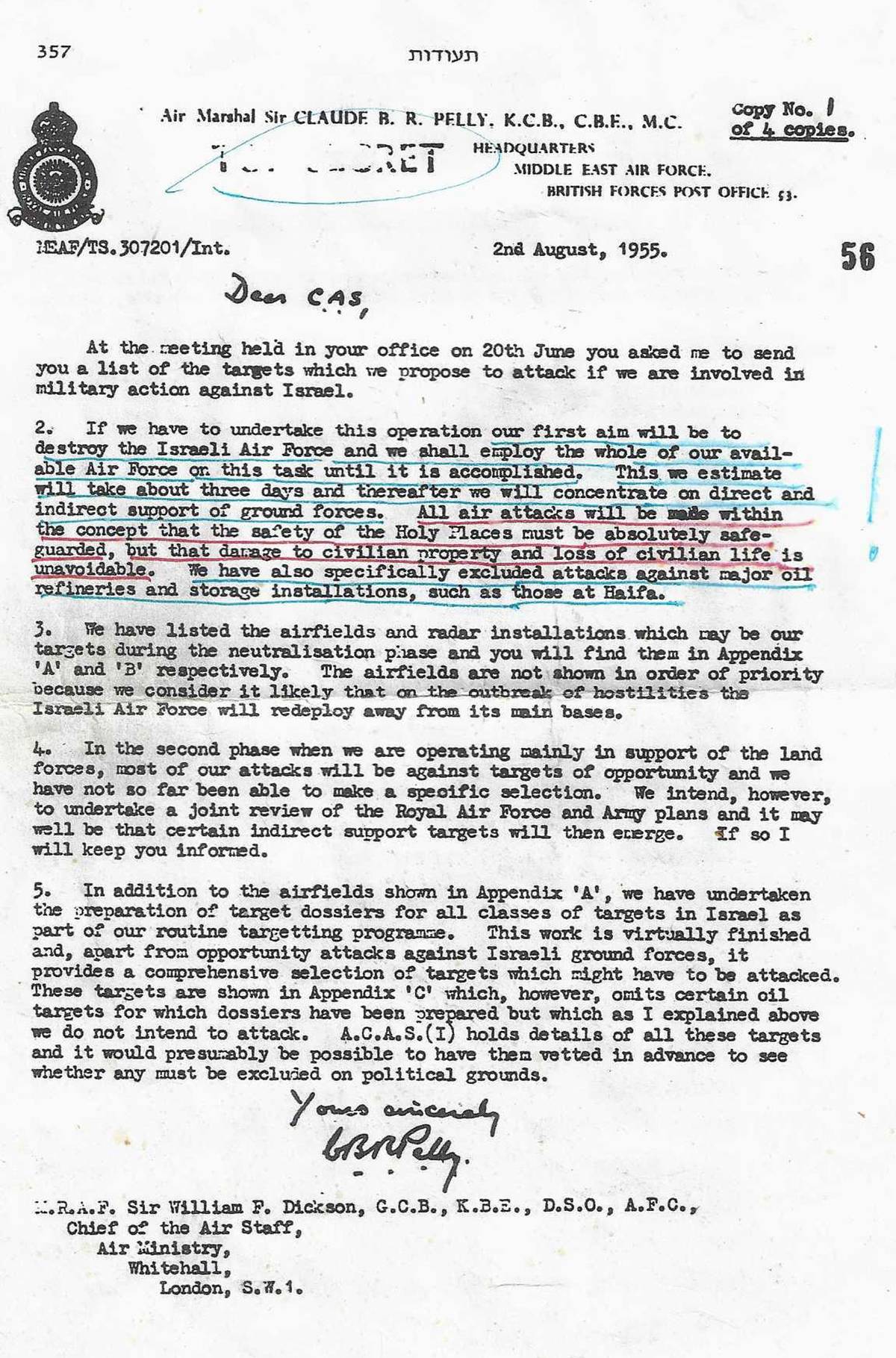
First, there are the “Operation Cordage” documents, which envisaged a terrorist attack on Israel that would provoke Israeli retaliation against the Hashemite Kingdom of Jordan. The Israeli response would allow Britain to activate its commitment to defend the Hashemite Kingdom under the 1946 Treaty of London. This would provide the excuse for the British to launch all-out air attacks by the Royal Air Force from its Cyprus base and by the Fleet Air Arm from carriers, in order to destroy all Israeli air force and army bases, headquarters, and depots. (At the time, the British Air Force could do that and more.) As soon as Cordage was executed, the disarmed Israelis would be forced to beg for British protection, because they would be so weak that even the small Lebanese army could invade, along with the much stronger Syrians, Iraqis, and still then British-officered Jordanians.
The other set of documents describes the U.S.-U.K. Plan Alpha worked out in 1955 by Francis Russell of the U.S. State Department and the leading Arabist of the British Foreign Office, Evelyn Shuckburgh (who would suffer acute stomach pains whenever forced to concede a very rare audience to Israel’s ambassador). Presented by Prime Minister Anthony Eden in his November 1955 Guildhall speech, Alpha would detach the Negev—yes always the Negev—from Israel to give it to Egypt—which was still then, if not for long, “British Egypt,” complete with army and air force Canal-side bases, garrisoned by 70,000 British troops.
It was only Nasser’s betrayal of his CIA would-be handlers to seize control of the Suez Canal, and the subsequent 1956 Suez War—Israel’s Sinai campaign—that turned the tables. The British attacked Egypt instead, resulting in Eden’s resignation, lifelong sorrow for Shuckburgh, and the start of the wars that would lead to the Egypt-Israel peace treaty and present cooperation, thereby realizing Stern’s hope that Arab and Jewish nationalists could be allies.

So who was right?


The Cordage documents attached were provided by the historian and preeminent broadcaster Dr. Isaac Noy, z.l., May 2022. Anat Stern corrected errors in an earlier draft.

Edward N. Luttwak is a contractual strategic consultant for the U.S. government and an author.


Zawartość publikowanych artykułów i materiałów nie reprezentuje poglądów ani opinii Reunion’68,
ani też webmastera Blogu Reunion’68, chyba ze jest to wyraźnie zaznaczone.
Twoje uwagi, linki, własne artykuły lub wiadomości prześlij na adres:
webmaster@reunion68.com


incredible performance at a Jewish wedding in Israel

You have to see this incredible performance at a Jewish wedding in Israel

   Kinderlach Official


What do you get when you cross a famous Italian opera song with a Jewish wedding?

A beautiful, one-of-a-kind performance of course!

Italian songwriters Francesco Sartori and Lucio Quarantotto could not have imagined their song, “Con te partirò”, made famous by singer Andrea Bocelli in the English version, “Time to Say Goodbye”, would one day be used at a Jewish wedding ceremony.

This beautiful melody clearly enhances the ceremony, adding a touch of class.

Looking for that something special at your next event? Try an Italian opera performed by a Jewish boys choir!

לפרטים והזמנות : אף די די פרודקשיין בע”מ
ישראל :036165628
USA : 2126603213
אימייל : david@fdd.co.il
ביצוע מקור: Andrea Bocelli
לחן: Lucio Quarantotto
מילים: מתוך ברכות חופה
מילים במקור Francesco Sartori
עיבוד והפקה מוזיקאלית: אבשלום אריאל
מיקס ומאסטרינג: אלי קליין
צילום ועריכה : אבי סולימן
בימוי : דוד פדידה
Kategori
Musik


twoje uwagi, linki, wlasne artykuly, lub wiadomosci przeslij do: webmaster@reunion68.com


Węzeł gordyjski KUL. Jak zrozumieć degradację uniwersytetu, który mnie ukształtował?

Ks. Alfred Wierzbicki (Fot. Jakub Orzechowski / Agencja Wyborcza.pl)


Węzeł gordyjski KUL. Jak zrozumieć degradację uniwersytetu, który mnie ukształtował?

Ks. Alfred Marek Wierzbicki


Ktoś rozpowiada, że rektor planuje zwolnienia. Atmosfera na KUL-u naprawdę gęstnieje.


Paweł Smoleński artykułem na temat KUL-u włożył kij w mrowisko. Chwalebnej legendzie „wyspy wolności”, „od Berlina do Seulu filozofia tylko na KUL-u”, uczelni, która wydała papieża, przeciwstawiona została ciemna legenda prowincjonalnej, ksenofobicznej, antysemickiej, wstecznej i pazernej szkółki.

Chodzi o to, że obydwie narracje odpowiadają rzeczywistości dopiero wtedy, gdy ukazuje się je razem. Na KUL-u dawniej i całkiem niedawno były obecne i ścierały się różne nurty katolicyzmu, a forsowanie jego endeckiej i integralistycznej postaci – co ma miejsce obecnie – jest wyraźnym zerwaniem z tradycją tego uniwersytetu. Trafnie zwracają na to uwagę Wojciech Samoliński i Paweł Matyaszewski w komentarzach do artykułu Smoleńskiego.

Podtrzymuję moje krytyczne opinie, przytoczone w tym artykule, zabieram głos nie po to, by je korygować, lecz by pogłębić ich kontekst. Bez niego trudno zrozumieć intelektualną i moralną degradację uniwersytetu, który mnie ukształtował, do którego rozwoju na miarę swych możliwości starałem się wnosić otwartość i krytycyzm w ciągu 30 lat pracy. W tekście Smoleńskiego jest kilka nieścisłości, a nawet drobnych błędów, w rzeczy samej nie o szczegóły chodzi, lecz o to, czym naprawdę był KUL, czym się staje, wreszcie, czy jest to proces nieuchronny i nieodwracalny?

Jakaś kolaboracja była konieczna

Razi mnie sam tytuł „Katolicki Uniwersytet Lizusowski”. Gdyby dokonywać bilansu 100-lecia, to w lubelskiej uczelni było więcej twórczości i oporu aniżeli uległości. Zresztą, czy były w PRL instytucje nieuległe? Jakiś stopień kolaboracji z komunistycznym państwem był konieczny, aby KUL mógł przetrwać. Izolacja, ograniczanie działalności, a nawet groźba likwidacji towarzyszyła mu przez cały okres władzy ludowej. Nie o samą uległość chodzi, lecz o jej stopień i granice.

Nie można utożsamiać uległości Mieczysława Krąpca i uległości Mirosława Kalinowskiego. Rektor z lat 70. liczył się z siłą komunistycznego państwa i podejmował z nim „dialog” – chętnie czy niechętnie, to materia dla badań historyków – aby zapewnić warunki do alternatywnej dla komunizmu kultury chrześcijańskiej. Rektor Kalinowski godzi się na uczynienie z KUL-u przez ministra Czarnka poligonu wymiany elit. Jest to działanie bardziej podejrzane i szkodliwe dla przyszłości Polski, a przede wszystkim dla losów Kościoła katolickiego w pluralistycznym, coraz gwałtowniej laicyzującym się społeczeństwie.

Lublin, Katolicki Uniwersytet Lubelski. Rektor KUL ks. prof . Mirosław Kalinowski

Lublin, Katolicki Uniwersytet Lubelski. Rektor KUL ks. prof . Mirosław Kalinowski  Fot. Jakub Orzechowski / Agencja Wyborcza.pl

Katolicyzm otwarty

Na KUL-u spotkałem się z katolicyzmem otwartym, piszę o tym w opublikowanej niedawno częściowo autobiograficznej książce „Między innymi o radości” (Lublin, Gaudium 2022). Studiowałem teologię i filozofię, wiele zawdzięczam również mistrzom humanistyki. Zapytam po Herbertowsku – kim byłbym, gdybym nie spotkał ks. Mieczysława Brzozowskiego, ks. Adama Ludwika Szafrańskiego, Adama Stanowskiego, Jerzego Kłoczowskiego, Ewy i Czesława Deptułów, Ireny Sławińskiej, Czesława Zgorzelskiego, Stefana Sawickiego, Leszka Mądzika, ks. Zdzisława Chlewińskiego, ks. Janusza Mariańskiego, ks. Tadeusza Stycznia, ks. Andrzeja Szostka, Marii i Jerzego Gałkowskich, ks. Andrzeja Bronka, Wojciecha Chudego, Elżbiety Wolickiej-Wolszleger, Romualda Jakuba Wekslera-Waszkinela? Uczyłem się od nich myśleć szeroko, dociekliwie i krytycznie, życzliwie dla każdego poglądu, z bezwzględnym, lecz nie fanatycznym, szacunkiem dla prawdy.

Już w liceum docierała do mnie sława Krąpca, ale zraziłem się do niego po pierwszych wykładach.

Większość filozofów to jełopy, a prawda tylko u św. Tomasza z Akwinu, którego najlepiej miał zrozumieć sam Krąpiec.

Ale nawet z nim można było czasem dyskutować, choć wolał, aby go słuchano. Było wesoło na jego zajęciach, bo opowiadał rubaszne anegdoty i pikantne dowcipy. Koncepcję filozofii miał spójną i jasno artykułowaną. Szkoda, że w późniejszych latach więcej uwagi poświęcał Feliksowi Konecznemu niż św. Tomaszowi. Wtedy stał się ideologiem Radia Maryja.

Lublin, czerwiec 1994 rok. Prof. Stanisław Wielgus, biskup lubelski Bolesław Pylak i były rektor KUL prof. Mieczysław Krąpiec podczas uroczystości 75 lecia Katolickiego Uniwersytetu Lubelskiego.
Lublin, czerwiec 1994 rok. Prof. Stanisław Wielgus, biskup lubelski Bolesław Pylak i były rektor KUL prof. Mieczysław Krąpiec podczas uroczystości 75 lecia Katolickiego Uniwersytetu Lubelskiego.  Fot. Iwona Burdzanowska / Agencja Wyborcza.pl

Choć wykłady Krąpca były obowiązkowe, nikt nie musiał stawać się krąpcystą czy – jak zwykł mówić Stanisław Majdański – „krąpcoidą”. To prawda, że było ich wielu, ale filozofia na KUL-u to nie tylko Krąpiec i jego uczniowie. Prócz tomistycznej metafizyki można było się zetknąć z innymi nurtami filozofii.

Logicy nawiązywali do szkoły lwowsko-warszawskiej, interesowali się współczesną filozofią analityczną. Etycy od Wojtyły rozwijali etykę personalistyczną, rewidującą założenia etyki arystotelesowsko-tomistycznej. Krąpiec oskarżał Tadeusza Stycznia o kantyzm. Ich spór o podstawy etyki angażował całe środowisko, bodaj kilkunastu autorów opublikowało swe głosy w tej dyskusji. Trwała ona dobre dwie dekady.

Filozofia na KUL-u: rzetelność i pasja

Według Smoleńskiego nikt na KUL-u nie słyszał o Ingardenie. Pudło! Akurat myśl Ingardena była u nas kultywowana z wyjątkową intensywnością. W latach 50. i 60 przyjeżdżał wielokrotnie z wykładami gościnnymi. W trakcie studiów chodziłem na wykład Antoniego Stępnia o filozofii Ingardena. Co więcej, wśród obowiązkowych lektur były zawsze książki Ingardena. Było żywe zainteresowanie całym nurtem fenomenologii, odmiennym, lecz bliskim filozofii klasycznej. Powstawały prace magisterskie o Husserlu, Schelerze, von Hildebrandzie i oczywiście o Ingardenie.

Roman IngardenRoman Ingarden  FOT. ARCHIWUM TYGODNIKA POWSZECHNEGO

W moich latach studenckich uderzała rzetelność i pasja, z jaką profesorowie i studenci zajmowali się filozofią. Czytaliśmy chyba więcej niż w innych ośrodkach. Dziś publikacje zagraniczne są łatwo dostępne, ale w latach 60. czy 70. studenci innych uczelni z trudem mogli po nie sięgać w swych uczelnianych bibliotekach. Inaczej było na KUL-u, istniała tu dobrze wyposażona biblioteka. Może także po to Krąpiec musiał się zadawać z komuchami, aby dyrektor biblioteki Andrzej Paluchowski skrzętnie gromadził zagraniczną literaturę fachową oraz polskie piśmiennictwo emigracyjne… 

Andrzej PaluchowskiAndrzej Paluchowski  KUL

Te bardziej trefne książki znajdowały się w prohibitach. Tak było oficjalnie, ale można było z nich korzystać. Nie kto inny, ale właśnie Krąpiec w 1983 roku polecił mi jako studentowi przeczytać „Obecność mitu” Leszka Kołakowskiego i dał upoważnienie dla pracowników biblioteki, aby wypożyczyli mi książkę wydaną przez paryską „Kulturę”. Dyskutowaliśmy o niej na seminarium. Owszem sam profesor zachowywał się jak guru, ustawiał Kołakowskiego jak chłopca do bicia, ale kazał nam go czytać. Na takim seminarium nie dało się nudzić.

Krąpiec rósł w siłę

Według Smoleńskiego Krąpiec miał zatrudniać Stefana Swieżawskiego, było akurat odwrotnie, to Swieżawski w latach 50. ściągnął na KUL Krąpca, a potem Wojtyłę z myślą o tworzeniu szkoły filozoficznej. Byli inni, czerpali z innych źródeł i dlatego mogli się intelektualnie dopełniać. Niestety, potem gdy Krąpiec rósł już w siłę, najpierw jako dziekan, a potem rektor, marginalizował, a czasami eliminował ludzi, którzy nie chcieli uprawiać filozofii na jego modłę.

Mimo wszystko filozofia broniła się przed imperializmem jednej szkoły i do dzisiaj filozoficzne środowisko kulowskie jest pluralistyczne, współpracuje z wieloma ośrodkami w kraju i za granicą. To tylko epigoni Krąpca głoszą, że są oni „lubelską szkołą filozoficzną”, faktycznie rozwinęło się kilka „szkół”. Piszę o filozofii, bo przez lata należałem do tego kręgu, ale podobnie jest na innych kierunkach. Jest to normalne na uniwersytecie, że toczą się dyskusje, podejmuje się problemy, które tylko dzięki badaniom i otwartej debacie można próbować rozwiązywać.

Akces do mediów Tadeusza Rydzyka

Potencjał „katolicyzmu otwartego” próbował rozbudzić na KUL-u abp Józef Życiński, pełniąc funkcję Wielkiego Kanclerza w latach 1997-2011. Nie przywiózł przecież z Krakowa jakiegoś intelektualnego desantu, lecz zastał na KUL-u ludzi, którzy oddziaływali swą myślą już wcześniej na przemiany posoborowego katolicyzmu w Polsce. Spora grupa kulowców już od lat 40. zasilała ideowo „Tygodnik Powszechny”, „Znak” i „Więź”. Wystarczy przejrzeć dawne numery tych pism, aby zauważyć, jak wielu pracowników KUL-u ogłaszało w nich swe artykuły, rozmawiając w ten sposób ze społeczeństwem.

Lublin 2009. Arcybiskup Józef ŻycińskiLublin 2009. Arcybiskup Józef Życiński  IWONA BURDZANOWSKA

Niestety, w latach 90. nastąpił akces znacznej części profesorów z KUL-u do mediów o. Rydzyka. Życiński nie miał wątpliwości, że jest to ze szkodą dla katolicyzmu. O Radiu Maryja miał odwagę powiedzieć, że „katolicki głos w twoim domu ma tyle samo wspólnego z katolicyzmem co »Trybuna Ludu« z ludem”. Życińskiego dziś ledwie się wspomina, jakby był w Lublinie biskupem jakieś 100 lat temu.

Atmosfera na KUL-u gęstnieje

Odszedłem z KUL-u, ponieważ zdałem sobie sprawę, że na uniwersytecie kierowanym przez Kalinowskiego i Sitarza nie ma już wolności akademickiej. Wprawdzie uniewinniono mnie w postępowaniu dyscyplinarnym, ale sam fakt, że wszczęto je ze względu na moją krytykę dokumentu Episkopatu w sprawie LGBT bez jakiejkolwiek dyskusji ze mną, pokazuje, że debatę naukową zastępują represje. Chyba nawet nie chodziło o to, żeby mnie ukarać, lecz przestraszyć. Odszedłem, bo chcę mieć swobodę wypowiedzi, a tej KUL mi już nie zapewnia. 

Fot. Jakub Orzechowski / Agencja Wyborcza.pl

W artykule Smoleńskiego nie znajduję krzty nieprawdy na temat endeckich demonów grasujących dziś na KUL-u. Ma także rację, twierdząc, że zawsze były one obecne, natomiast nie można się zgodzić z tezą, że jest to jedyne oblicze KUL-u. Staram się ten tekst czytać życzliwie, nie jest on żadną napaścią na dobre imię lubelskiej uczelni, powinien zainicjować debatę.

Wydaje się ona na razie niemożliwa. Władze uczelni jej nie chcą, zbyt wiele by je kosztowała. Pracownicy naukowi chyba się boją. Ktoś rozpowiada, że rektor planuje zwolnienia i wykorzysta do tego ewaluację. Atmosfera na KUL-u naprawdę gęstnieje. Rozumiem tych, którzy oburzyli się na artykuł w „Wyborczej”. Mają przecież inne doświadczenie KUL-u, nie muszą mieć zaufania do mediów, a zwłaszcza liberalnych.

Na KUL-u wpajano mi, że należy przyjmować każdą prawdę, niezależnie od tego, kto ją głosi.

Im wcześniej dojdzie do publicznej debaty na temat KUL-u, tym większe szanse na jej efektywność. Niełatwo bowiem rozwiązać węzeł gordyjski trzech kryzysów, które w ostatniej dekadzie trapią KUL. Jest to kryzys uniwersytetu, z którym nie poradziła sobie reforma Gowina, a raczej jeszcze go pogłębiła. Ponadto kryzys polityczny w Polsce promujący autorytaryzm. A do tego kryzys Kościoła zagubionego wobec wyzwań współczesności, co ma istotne znaczenie dla rozumienia zadań uniwersytetu katolickiego.


Ks. prof. Alfred Wierzbicki, teolog, etyk, przez 30 lat związany z Katolickim Uniwersytetem Lubelskim, z którego odszedł w październiku. W tej chwili jest wykładowcą na wydziale Filozofii i Socjologii Uniwersytetu Marii Curie-Skłodowskiej w Lublinie.


Zawartość publikowanych artykułów i materiałów nie reprezentuje poglądów ani opinii Reunion’68,
ani też webmastera Blogu Reunion’68, chyba ze jest to wyraźnie zaznaczone.
Twoje uwagi, linki, własne artykuły lub wiadomości prześlij na adres:
webmaster@reunion68.com


Belgium’s World Cup Football Riots: A Symbol of the Failure of the Migration Policy


Belgium’s World Cup Football Riots: A Symbol of the Failure of the Migration Policy

Alain Destexhe


  • In Brussels, Moroccans outnumber people of Belgian origin in the under-18 age group; many schools are attended exclusively by children of non-European origin. In those public schools where parents have the choice of religion classes, Islam is now followed by a majority of pupils. Whether one describes these changes as “diversity” or as a “great replacement” is of little importance; over a few decades the evolution has been considerable and has modified the social fabric of Belgium’s cities.
  • The hijab (Islamic veil) is increasingly present and is worn by a majority of women in some municipalities. During the month of Ramadan, almost all shops and restaurants are closed during the day in some areas. The number of mosques is exploding and all currents of Islam are represented in Brussels, where tensions between Sunnis and Shiites, or even between Moroccans and Turks, are sometimes high, especially within the Muslim Executive of Belgium, a structure that the federal government set up in order to have a single interlocutor for the Muslim community, but which has been going from crisis to crisis.
  • During trials or elections, it is common to see women arriving with their husbands, and explaining that they cannot be retained as jurors or assessors because they do not speak any of Belgium’s official languages, thus attesting to a completely failed policy of integration. The “vivre ensemble” (“live together”) praised by the Belgian political world is a myth, with communities living side by side but not mixing with each other. Moroccans marry Moroccan women and Turks marry Turkish women…
  • In France, the country’s colonial past is regularly evoked to justify the anger of young North Africans. It is an explanation that does not hold: similar incidents take place in Belgium, a country that has no historical link with North Africa.
  • What is most distressing is the denial and the total absence of debate on the issues of immigration and integration, mainly on the French-speaking side of the country. Neither the media nor the political parties talk about it. Sunday’s riots were attributed by the mayor of Brussels to “thugs and scoundrels”, a discourse that was widely repeated without any precision or analysis.
  • While in France and elsewhere in Europe there is a lively debate around this theme, it is as if Belgium has given up, accepting its destiny as a multicultural country with a Muslim majority in its capital and from time to time a “new normal” made up of urban riots, shootings and terrorist attacks.

Violent clashes took place in Belgium after the Morocco-Belgium football match during the World Cup in Qatar. In Brussels, Moroccans outnumber people of Belgian origin in the under-18 age group. While elsewhere in Europe there is a lively debate around immigration and integration, it is as if Belgium has given up, accepting its destiny as a multicultural country with a Muslim majority in its capital and from time to time a “new normal” made up of urban riots, shootings and terrorist attacks. Pictured: Police work to clear a street amid violent riots on November 27, 2022, in Brussels, Belgium. (Photo by Nicolas Maeterlinck/Belga/AFP via Getty Images)

.
Riots took place in Brussels, Antwerp and Liege, where a police station was attacked by about 50 “youths”, and also in several cities in the Netherlands. Beyond these incidents, the popular jubilation in the predominantly Moroccan neighborhoods of Brussels, especially in Molenbeek, revealed that in these areas, the Moroccan identity has remained much stronger than the Belgian one, even though most of the inhabitants have dual nationality.

One would have to be blind and trying to fit reality into the ideology of “living together at all costs” not to see that the sympathies of Moroccans in Belgium were with the Moroccan team and not with the team of their “second homeland”. Some journalists tried to do so, with headlines like “No matter who wins between Belgium and Morocco, it will be a party”.

The party did take place, in Molenbeek, Anderlecht, Schaerbeek and Brussels, municipalities where Moroccan immigrants and their descendants are more numerous than other people, including the native Belgians. One could see the enthusiasm of these supporters honking their horns and displaying Moroccan flags in the streets of the capital in their cars with Belgian plates.

For many native Belgians, this spectacle broke the myth of integration into the host country, perhaps because the celebrations may have seemed excessive and even indecent for Belgium, which has allowed these Moroccans to live in a prosperous country and to benefit from the advantages of the welfare state.

The television channels did not show images of a man taking down a Belgian flag from a building to the applause of the crowd, nor a striking face-to-face between hundreds of Moroccans dancing and singing just a stone’s throw from the Grand-Place in Brussels, blocked by a cordon of police officers, helmeted and baton-wielding, blocking them from access to the city center.

According to Statbel, the official Belgian statistics office, 46% of the population of Brussels is now of non-European origin (in the sense of the European Union plus the United Kingdom) and only 24% of Belgian origin. Moroccans represent 7% of the population of Belgium, but 12% in the Brussels-Capital Region, most of whom also hold Belgian nationality. The growth in the number of Moroccans in Belgium has been exponential: only 460 in 1961; 39,000 in 1970, and 800,000 forty years later; a large number for a country of only 11 million. As a result of this demographic evolution and the ease of acquiring Belgian nationality (in some instances after three years of residence without any other conditions), the country now has 26 regional or federal deputies of Moroccan origin and several mayors, who often encourage communitarianism, or “belonging to one’s community.”

In Brussels, Moroccans outnumber people of Belgian origin in the under-18 age group; many schools are attended exclusively by children of non-European origin. In those public schools where parents have the choice of religion classes, Islam is now followed by a majority of pupils. Whether one describes these changes as “diversity” or as a “great replacement” is of little importance; over a few decades the evolution has been considerable and has modified the social fabric of Belgium’s cities.

The hijab (Islamic veil) is increasingly present and is worn by a majority of women in some municipalities. During the month of Ramadan, almost all shops and restaurants are closed during the day in some areas. The number of mosques is exploding and all currents of Islam are represented in Brussels, where tensions between Sunnis and Shiites, or even between Moroccans and Turks, are sometimes high, especially within the Muslim Executive of Belgium, a structure that the federal government set up in order to have a single interlocutor for the Muslim community, but which has been going from crisis to crisis.

While the slaughter of animals without first stunning them is forbidden in Flanders and Wallonia, the Muslim lobby in the Brussels Parliament has succeeded in blocking a legislative proposal in that direction. During trials or elections, it is common to see women arriving with their husbands, and explaining that they cannot be retained as jurors or assessors because they do not speak any of Belgium’s official languages, thus attesting to a completely failed policy of integration. The “vivre ensemble” (“live together”) praised by the Belgian political world is a myth, with communities living side by side but not mixing with each other. Moroccans marry Moroccan women and Turks marry Turkish women, whom they often bring over from their native country. Family reunification is now the primary source of immigration in Belgium, as in France.

In France, the country’s colonial past is regularly evoked to justify the anger of young North Africans. It is an explanation that does not hold: similar incidents take place in Belgium, a country that has no historical link with North Africa. It was a 1964 convention that paved the way for economic immigration, the need for which has long since ceased to exist, but which continues indefinitely through family reunification, which the Americans rightly call “chain migration”.

What is most distressing is the denial and the total absence of debate on the issues of immigration and integration, mainly on the French-speaking side of the country. Neither the media nor the political parties talk about it. Sunday’s riots were attributed by the mayor of Brussels to “thugs and scoundrels”, a discourse that was widely repeated without any precision or analysis. The link with excessive immigration, proportionally greater than that of France, is never made again. While in France and elsewhere in Europe there is a lively debate around this theme, it is as if Belgium has given up, accepting its destiny as a multicultural country with a Muslim majority in its capital and from time to time a “new normal” made up of urban riots, shootings and terrorist attacks.


Alain Destexhe, a columnist and political analyst, is an honorary Senator in Belgium and former Secretary General of Médecins Sans Frontières / Doctors Without Borders.


Zawartość publikowanych artykułów i materiałów nie reprezentuje poglądów ani opinii Reunion’68,
ani też webmastera Blogu Reunion’68, chyba ze jest to wyraźnie zaznaczone.
Twoje uwagi, linki, własne artykuły lub wiadomości prześlij na adres:
webmaster@reunion68.com


Regime Change in Iran Is a Distinct Possibility

Regime Change in Iran Is a Distinct Possibility

Joseph Frager / JNS.org


People light a fire during a protest over the death of Mahsa Amini, a woman who died after being arrested by the Islamic republic’s “morality police,” in Tehran, Iran September 21, 2022. Photo: WANA (West Asia News Agency) via REUTERS

My Iranian Jewish friends who live in the United States are telling me that regime change in Iran is a distinct possibility.

Could the Biden administration do more to make this happen? You bet it could. The continued attempts to salvage a nuclear agreement with Iran along the lines of the 2015 JCPOA deal only make regime change less likely. In fact, the talks strengthen the hand of the ayatollahs.

This is precisely the opposite of what should be done, given that the current protests in Iran—which began when 22-year-old Mahsa Amini was killed by “morality police” for not wearing a hijab properly—are larger and more widespread than any since Ayatollah Khomeini overthrew the Shah in 1979.

The Islamic republic’s brutal and repressive tactics are well known. It is certain that 326 protesters, including 40 children, have been killed by regime forces. This is probably a very low estimate. The true number may be in the thousands. Despite the crackdown, however, the protests continue.

On Oct. 3, Iran’s Supreme Leader, Ayatollah Ali Khamenei, accused the US and Israel of fomenting the protests. This is very far from the truth. Israel has been preoccupied with an election and is not involved in the unrest. For its part, the US has done very little to encourage the protests, and as stated above has only strengthened the ayatollahs by seeking a nuclear deal.

No new sanctions have been imposed. Barely a whisper was heard from the administration when it was revealed that Iran is supplying drones to Russia to aid the invasion of Ukraine. The response was muted in order to facilitate the nuclear talks. This remains the administration’s modus operandi.

The US and the West should capitalize on what is the best opportunity for regime change since the 1979 Islamic revolution. If regime change does not happen, it would constitute an enormous policy failure for the Western powers.

One way the West can be of great help to the protesters is in the areas of communication and access to the internet. On Sept. 22, the regime squelched the use of both WhatsApp and Instagram. Working to restore the protesters’ access to them and other messaging and social media platforms should be a major priority.

Regime change is not only desirable for its own sake; it is also good policy. In particular, it is the safest approach to the Iranian regime and its pursuit of nuclear weapons. The only alternative is to bomb Iran’s nuclear facilities. This is feasible and may be necessary but regime change from within is certainly preferable.

The protesters in Iran have been very effective. They recently scored a major symbolic victory when they set fire to Khomeini’s ancestral home. Despite the regime’s barbaric violence, the protests show no sign of slowing down.

The old guard hardliners in Iran are aging and weak. The protesters are young and vibrant. They represent the future of Iran. I am more optimistic today than at any time in 43 years that the ayatollahs can and will be toppled. I hope the Biden administration will finally see things the same way.


Dr. Joseph Frager is a lifelong activist and physician. He is chairman of Israel advocacy for the Rabbinical Alliance of America, chairman of the executive committee of American Friends of Ateret Cohanim and executive vice president of the Israel Heritage Foundation.


Zawartość publikowanych artykułów i materiałów nie reprezentuje poglądów ani opinii Reunion’68,
ani też webmastera Blogu Reunion’68, chyba ze jest to wyraźnie zaznaczone.
Twoje uwagi, linki, własne artykuły lub wiadomości prześlij na adres:
webmaster@reunion68.com