Archive | April 2023

A Celebration of Overlapping Faiths

A Celebration of Overlapping Faiths

ELISABETH BECKER


This year, our family will mark Passover, Easter, and Ramadan at the same time—and honor the three religions that contributed to my children’s heritage.
.

TABLET MAGAZINE

Many people want to know if my two children, born to a Jewish mother and a Muslim father, are Jewish or Muslim. Recently, at a Parisian café on a central boulevard lined with perfect Juliet balconies, a young professor asked me the question that repeats, like a scratched CD, throughout my adult life: “Which one did you choose for your children?” When I answered “both,” that our two children are Jewish and Muslim, she shook her head in disbelief and laughed out loud, asking: “What does that make them—nothing?”

This year, as last year, we will host a Passover Seder in Italy on Easter that is also an iftar (the daily fast break during Ramadan). This is because Ramadan began on March 22 at sundown and continues until April 21, Passover begins on April 5 at sundown and continues until April 13, and Easter falls on April 9. We will celebrate all three holidays together, since all three religions are part of our family’s story.

Last year, my sister and I aligned our five children’s school breaks to meet in Bologna, her middle child an Italian history buff longing to see garden sculptures and frescoes. We only later realized that we would be gathering for Passover, which would also be Ramadan, and coincide with Easter. This is now becoming a kind of unexpected family tradition.

Of course, these holidays rarely align. Next year, they will be dispersed throughout spring. Yet when it happens, the intersection of Abrahamic celebrations seems entirely appropriate for us. We are, after all, the daughters of a Jewish mother and a Christian father. We grew up with a menorah glowing beside a Christmas tree, annual Easter eggs hunts and searches for the afikoman.

Growing up with a Jewish mother on the Upper West Side meant growing up with the belief that—like my parents—half the world was Jewish, too. There, bookstores carried titles about Rosh Hashanah and Hanukkah, delis served pastrami on Jewish rye, and nothing was more beloved to Jews and non-Jews alike than the New York City bagel. Yet it also entailed growing up with a deep awareness of suffering, many of our neighbors having fled Europe during the Nazi era, some having survived concentration camps. Stories of this suffering were told to us by our mother and our grandmother. Images of this suffering marked the books in our school libraries and our neighbors’ skin. And although we had never crossed the Atlantic, Europe remained the terrifying backdrop of this suffering: Germany, in particular, a taboo land that haunted us, as it did our elders, across the wide divide of the seas.

Curiosity about that land led me to study the German language in college, and eventually down a path in which I, a sociologist, rooted my research, my writing, and my own family in Germany. I have lived in Germany on and off for nearly 20 years, as an academic researching Jews and Muslims in post-WWII Europe, exposing the marginality that both groups face, but also their agency in contesting exclusions: their place, our place as not only citizens, but also creators of European societies.

I have not only resettled my life in this once-taboo land, but since found a home in the overlaps of Jewish and Muslim life by both embracing my own Jewish identity and marrying a Turkish German Berliner.

Raising children in a Jewish-Muslim household means that we—my husband of a decade, myself, and our two children—reside in the intersections of our traditions. In spite of the desperate pleas of my mother-in-law that I convert to Islam before we married, and the stern assertion of my own mother that my children are undeniably Jewish by maternal lineage, neither of us relinquished our religions.

Being in Italy with my family for Passover, Ramadan, and Easter is a way to actively celebrate the points of unity, such as the notion of overcoming, in all three of the traditions that have shaped my family’s life. On Passover, we remember those who fled Egypt, overcoming persecution through liberty found across the opened seas. Easter celebrates the resurrection of Jesus, which similarly symbolizes the hope of overcoming great suffering and loss. Ramadan is a period of spiritual rejuvenation through the overcoming of daily desires. The coming together of these Jewish, Christian, and Muslim holidays creates a moment of aligned devotion, and also the hope that in overcoming, we will create a better world.

We all know that such hope matters, not least of all today here in Europe, where war has ravaged Ukraine, with millions of refugees fleeing across the borders to Poland and then Germany. We have seen the images of children buried under rubble, orphans who arrive at our train stations without their parents, without even a language to share their pain with us. We have witnessed this up close, with a Ukrainian boy named Alex among my 8-year-old son Sami’s closest friends. I wonder when he asks me if Alex’s family will die, what else we can give to him other than a shared sense of hope and togetherness, across our languages and our religious traditions. That they, that we may overcome great hardship, as we learned from our Jewish forbears in Egypt, from the Christian story of Jesus’ sacrifice, and from the act of fasting for 30 days on Ramadan.

There is, of course, more to our life than harmonious intersections. But I have also learned from our traditions that overcoming does not entail resolution. It entails a great many questions and creative answers: finding a way forward, beyond the challenges we all encounter on our paths. Since I gave birth to our first child, we have had skirmishes over how to celebrate my father and his Christian traditions (settling on socks filled with candy) on Christmas. We have had a naming ceremony for our children in a synagogue, giving Sami the Jewish name “Noah,” my very favorite name, which I relinquished when my mother-in-law struggled to pronounce it; I similarly refused my husband’s favorite name, Yusuf, from his most beloved Quranic story, for our son.

We are far from the first to walk this path. My own parents had an interreligious marriage. And so, too, did the Prophet Muhammad, who had a Jewish wife.

Still, nothing prepared my husband and me for the questions about who we are and who we, together, could be. What would marrying one another mean for our religious and cultural identities? What would the household of a traditional, practicing Turkish German Muslim man and a liberal Jewish New Yorker look like? What would we lose in gaining one another? And perhaps, most importantly, when we had children, what would we choose for them?

We did not choose for them. Instead we chose them as they are, born pink, plump, and perfect: grown in a household that is very Jewish and very Muslim, very American and very Turkish, somehow, and somewhat German, too.
 

Today, my 8-year-old son Sami takes pride in being American, Turkish, and German. He sees himself as both Muslim and Jewish, and close to Christianity through my late father, whom he never met but knows through my stories as a kind and gentle man. Sami is at home in the synagogue, where he learned to light Shabbat candles and make challah of his own. He is at home in a mosque, where he watches his father pray on turquoise carpets that remind him of the sea. And he is certain that Santa Claus does not discriminate against Jewish and/or Muslim children in his gift-giving (Santa is from Turkey, after all).

Sometimes, at home, Sami asks me to recite a verse from the Torah before he sleeps, as a protective and calming salve that accompanies him from wakefulness to that otherworld of dreams. “Can you tell me the Jewish Quran?” he asks.

Sometimes, when I am asked which religion we have chosen for our children, I describe this request: the understanding, the words, the question that forges new paths. The very existence of our children remakes our world as I imagine God meant for it to be made, where we do not dwell in the places that divide us, but where we overcome them so that we may come to know, may come to love one another as both different and the same.

We have done the best we can to make this world not only bearable, but beautiful for our children, with Jewishness and Muslimness not only familiar, but an unwavering home for them and also, with them, an unwavering home—built by Noah and Yusuf, so many other prophets, so many surviving texts—for ourselves. Their both-ness has given us a shelter from the questions, the audacity of those who call my children, who are my everything, nothing, those small and painful daily storms.
 

And they, our children, have already made me, as a Jew, far more whole: connecting with my traditions, from the baking of hamantaschen to the recitation of Torah, in order to pass them on. They are the reasons that I joined a synagogue for the first time, and why I have crafted a life in Germany centered on the redemption of Jewish life.

On Passover, we conclude with the words “next year, in Jerusalem,” to describe longing for the Jewish homeland. Today’s Jerusalem is a place of conflict, but also one imbued with the cultures, the heritage, and the hopes of all three Abrahamic religions, together and apart. This year in Italy, we will celebrate Passover with an iftar on Easter, with the Four Questions of the youngest child, who will now be Sami, reading the Haggadah for the first time. My husband will break his fast not with bread but with matzo.

This day will be one of the only days on which we are not asked to choose: a day on which I, a Jewish mother, can celebrate with my Muslim husband, while remembering my Christian father. And if I hold this moment close, perhaps it will give me strength, so that the next time someone asks what we have chosen for our children, I can confront their uncertainty with stories of this Passover, this iftar on Easter in Italy. I may tell them that our Jewish-Muslim children are living, breathing proof that we are not all the same, but that we spring from the very same source. But I will also warn them that this does not make them nothing. Nor are we, my family, everything. We are simply at home in the intersections and overlaps of our traditions, not in-between, but knee-deep in the plurality that makes our world beautiful and also whole.

There is so much that we, in this simple togetherness, have and can overcome.


Elisabeth Becker is a sociologist, currently the Freigeist Fellow at Heidelberg University.


Zawartość publikowanych artykułów i materiałów nie reprezentuje poglądów ani opinii Reunion’68,
ani też webmastera Blogu Reunion’68, chyba ze jest to wyraźnie zaznaczone.
Twoje uwagi, linki, własne artykuły lub wiadomości prześlij na adres:
webmaster@reunion68.com


Israel Daily News – 3 April, 2023

Israel Daily News – 3 April, 2023

ILTV Israel News


The Cabinet on Sunday voted in favor of establishing a national guard under Itamar Ben Gvir, and it isn’t going without criticism

Meantime; the Western Wall is undergoing its spring cleaning ahead of Passover

And later, 20 out of 37 2023 Eurovision acts are in Tel Aviv, hosting the traditional ‘Israel calling’ events ahead of Eurovision


Zawartość publikowanych artykułów i materiałów nie reprezentuje poglądów ani opinii Reunion’68,
ani też webmastera Blogu Reunion’68, chyba ze jest to wyraźnie zaznaczone.
Twoje uwagi, linki, własne artykuły lub wiadomości prześlij na adres:
webmaster@reunion68.com


Sefer ha-bahir / Księga światła ukrytego | Jubileuszowe seminarium nt. duchowości żydowskiej


Sefer ha-bahir / Księga światła ukrytego | Jubileuszowe seminarium nt. duchowości żydowskiej

dr hab. Jan Doktór


10 marca odbyło się pierwsze seminarium zorganizowane w Żydowskim Instytucie Historycznym w trybie stacjonarnym po dwuletniej przerwie spowodowanej epidemią, kiedy posiedzenia odbywały się w trybie on-line. Było to zarazem spotkanie jubileuszowe, bowiem seminarium skończyło właśnie 10 lat.

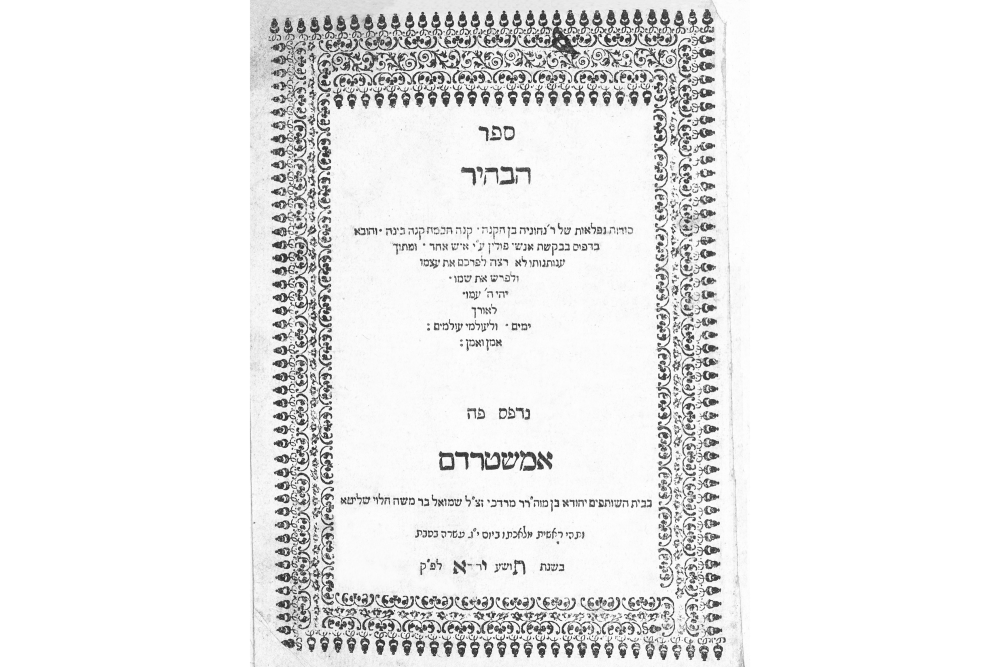
Strona tytułowa Sefer ha-bahir, Amsterdam 1651 (editio princeps), Allard Pierson, University of Amsterdam

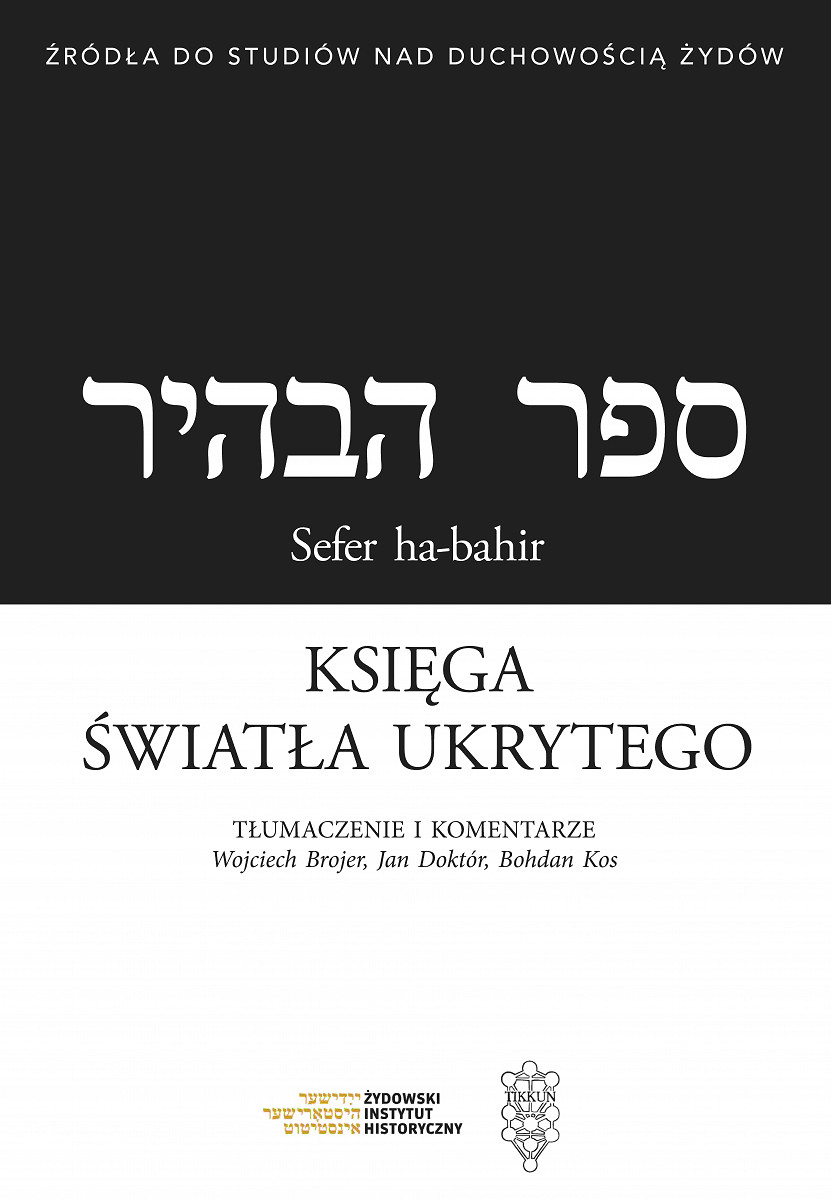
Tematem tego posiedzenia była niedawno wydana przez Żydowski Instytut Historyczny oraz Wydawnictwo „Tikkun” dwujęzyczna edycja Sefer ha-bahirKsięgi światła ukrytego. Tłumacze i autorzy towarzyszących traktatowi monografii: Wojciech Brojer, Jan Doktór i Bohdan Kos z różnych stron omówili traktat uważany za założycielski tekst kabały, okoliczności jego powstania, jego recepcję i znaczenie w życiu polskich żydów. 

Na początku Wojciech Brojer przedstawił ten niewielki, liczący zaledwie 12 tysięcy słów, anonimowy tekst, nad którym trójka badaczy pracowała 26 lat, spotykając się co tydzień. Nadal trwają w środowisku naukowym dyskusje na temat daty i okoliczności jego powstania. Zdaniem tłumaczy powstał on ok. roku 1245 w Langwedocji w środowisku mistyków, uczniów Izaaka Ślepego (zm. ok. 1235). Zachowało się co najmniej 100 rękopisów i licznych egzemplarzach kilkunastu wydań drukowanych. Co zwraca uwagę i skłania do refleksji, to fakt, że wszystkie edycje – począwszy od editio princeps, które ukazało się w 1651 roku w Amsterdamie, aż po wydanie z Wilna z 1913 roku – – wydane zostały przez polskich żydów. Istnieje wiele wersji tekstu, z których za najważniejszą i najstarszą uznaje się wersję z rękopisu monachijskiego powstałego w końcu XIII w. Ta wersja zdecydowanie dominuje w obiegu czytelniczym do XVII wieku. Drugą wersją jest rękopis będący podstawą editio princeps z Amsterdamu z 1651 roku. Od chwili druku wersja ta stała się kanoniczną i na niej opierają się wszystkie kolejne edycje aż do początku XX w. 

Za podstawę swojej edycji trójka tłumaczy przyjęła zgodnie ze starą dyrektywą badawczą lectio difficilior potior – „wersja trudniejsza jest [wersją] właściwszą, pierwotniejszą, bardziej źródłową” – wersję amsterdamską, uznając, że jest bardziej pierwotna i lepiej odpowiada myśli autorów tekstu. Polska edycja jest równoległa, dwujęzyczna z przypisami leksykalnymi i tekstologicznymi.  

Tytuł traktatu ustalony został dopiero na początku XIV w. Wcześniej przywoływano go jako Midrasz szel rabbi Nechunia ben Hakana. Późniejszy i obowiązujący do dzisiaj tytuł Sefer ha-bahir badacze i wydawcy jednoznacznie rozumieją jako „Księga jasności”, „Księga blasku”. Tłumacze polskiej edycji tłumaczą go inaczej, jako „Księga światła ukrytego”. I mają ku temu ważne powody. Słowo bahir’or-bahir pojawia się w Biblii Hebrajskiej raz, w Księdze Hioba i nie ma pewności, co ono w kontekście pierwotnym znaczyło. Już na początku XIV w. pierwszy komentator Bahiru, Meir Sahula – to wyjątek – ’or-bahir tłumaczył jako „światło ukryte”. Jego komentarz nosił tytuł ’Or-ha-ganuz, co jednoznacznie należy tłumaczyć jako „Światło ukryte”. Współczesne językoznawstwo potwierdza, że bahir to przymiotnik oznaczający „mroczny”, „zasłonięty”. Najważniejsze jest jednak to, że tytuł „Księga światła ukrytego” zdecydowanie lepiej odpowiada podstawowej tezie teologicznej traktatu, głoszącej, że Bóg na początku stworzył dwa światła, jedno powszechne, dla „Świata Tego” (ha-‘olam ha-ze) oraz drugie, ukryte, przeznaczone dla sprawiedliwych, dla „Świata Przychodzącego” (ha-‘olam ha-ba’). To ukryte światło (’or-bahir) mistycy winni odsłaniać przez nieustające studiowanie Tory. 

Jan Doktór przedstawił następnie cywilizacyjny kontekst początków kabały: erupcji w trzynastowiecznej Europie – w Nadrenii, Langwedocji, Prowansji i na Półwyspie Iberyjskim – żydowskich tekstów ezoterycznych z Sefer ha-bahir na czele. Spowodowała ją technologia produkcji nowego rewelacyjnego nośnika pisma, czyli papieru, oraz związane z tym pojawienie się Talmudu spisanego na papierze właśnie. Talmud, zredagowany już kilka stuleci wcześniej, był do tego czasu wyłącznym depozytem jesziw babilońskich i nauczany jako ustna Tora wyłącznie w samych jesziwach, a zapisywany fragmentami jedynie w postaci responsów. Jako spisany zasób tradycji opuścił jesziwy dopiero pod koniec X w. a do Europy dotarł z końcem XI w., przedstawiany jako spisana Tora Ustna obowiązująca wszystkich Żydów, wywołując w miejscowych wspólnotach żydowskich prawdziwe trzęsienie ziemi. Równocześnie z Talmudem albo niedługo po nim do dotarły Europy pisma Majmonidesa i innych myślicieli żydowskich ze świata islamskiego, wzbudzając równie wiele zachwytów, jak polemik.  

Te spory o kształt i przesłanie judaizmu, niekiedy gwałtowne i zwieńczone klątwami, stanowiły ideologiczne tło pierwszych pism kabalistycznych. Świat kultury oralnej odchodził zdecydowanie w przeszłość. Atrakcyjność spisywanych tekstów była ogromna. Można je było studiować indywidualnie, wielokrotnie odczytywać, kontemplować, analizować, porównywać a wreszcie komentować. Było oczywiste, że tylko ci, którzy swoje tradycje i idee przedstawią na piśmie, wezmą udział w debacie na temat judaizmu, jaka rozpoczęła się wraz z pojawieniem się Talmudu. Upieranie się przy przekazie ustnym skazywało na nieuchronną marginalizację, a z czasem i zniknięcie. Ich autorzy stanęli przed dramatycznym wyborem, czy utrwalić swoje tradycje na piśmie, czy się poddać. Niektórzy, jak redaktorzy Sefer ha-bahir, zdecydowali się je spisać. 

Jednym z najważniejszych następstw tej rewolucji piśmiennej było odrzucenie ograniczeń ezoterycznych, krępujących dotąd przekaz wiedzy uchodzącej za tajemną. Najpierw w świecie islamskim, gdzie najwcześniej pojawił się papier, stamtąd zaś tajemne albo ściśle reglamentowane dotąd pisma żydowskie zaczęły docierać do Europy.  

Podobna sytuacja panowała na ziemiach polskich na przełomie XV i XVI wieku. Wcześniejsze pięć stuleci państwa polskiego i dziejów żydów polskich było w gruncie rzeczy przedpiśmiennych, a sztuka pisania i dostęp do materiałów piśmiennych zarezerwowane były dla wąskich elit. Społeczność żydowska żyła głównie w świecie przekazu ustnego tradycji, choć oczywiście jakieś elementy kultury pisemnej w postaci zwojów Tory odczytywanych w bożnicach czy pojedynczych ksiąg istniały, podobnie jak niewielka elita osób piśmiennych. Wraz z papierem i drukiem, które pojawiły się tu niemal równocześnie, do wspólnoty żydowskiej napłynęła fala pism z nowymi ideami, z roszczeniowym Talmudem na czele. Temu wszystkiemu próbowały sprostać miejscowe aszkenazyjskie regionalne tradycje. 

Bohdan Kos w swoim wystąpieniu rozwinął niektóre wątki Vademecum Księgi światła ukrytego. Przede wszystkim poszukiwanie śladów Tory Miłości wśród hagadycznych opowieści Tory Surowego Prawa, powołując się na zawarte w Bahirze interpretacje Psalmu 29 i Lamentacji 2. Składają się one na kształt podstawowego modelu stosunków Boga i człowieka. Modelu erotycznej miłości z całą jej złożonością. Pełną żaru i namiętności grę zazdrości, cierpienia i aktów wybaczenia. 

Po wystąpieniach trójki autorów i tłumaczy rozpoczęła się dyskusja.  

Marzena Zawanowska (UW) zapytała o znaczącą pozycję teologiczną święta Sukot w Księdze światła ukrytego

Istotnie, ok. 10% tekstu bezpośrednio dotyczy problematyki Święta Szałasów. Dalsze 20% wyraźnie do niego nawiązuje. Większość przywołań z Pięcioksięgu w traktacie odnosi się do wędrówki żydów pod wodzą Mojżesza do Kaananu, która jest historycznym zapleczem Sukot. Wbrew stworzonej przez Misznę i konsekwentnie podtrzymywanej tradycji skupiania uwagi na symbolice szałasu sukotowego (suka), Bahir koncentruje się wyłącznie na gematrii bukietu sukotowego (lulaw = 36+32) oraz teurgicznej skuteczności i sprawczości sukotowego rytuału. Księga światła ukrytego rozwija charakterystyczną dla formacji sefardyjskiej sukotową teologię zbawienia, w której naród wybrany, Izrael otrzymuje misję poprowadzenia innych narodów ku Bogu w czasie mesjańskim. Sukot jest w traktacie jedynym – z trzech – świąt pielgrzymkowych, podczas gdy w średniowiecznym judaizmie, zwłaszcza aszkenazyjskim, zdecydowanie dominuje liturgia święta Pesach z wizją zbawienia Izraela przez wytracenie Edomu (chrześcijan). Nie potrafimy wyjaśnić, dlaczego polscy żydzi przy dość powszechnej recepcji Sefer ha-bahir całkowicie zignorowali jego bogatą teologię i eschatologię Święta Szałasów. Pomija je również cała dotychczasowa historiografia, począwszy od Gershoma Scholema. 

Barbara Gryczan (UW) poruszyła problem nietypowego języka traktatu w czasach, gdy średniowieczna hebrajszczyzna osiągnęła poziom gramatycznie i stylistycznie dojrzałego języka.  

Wydaje się, że autorzy Księgi światła ukrytego nie mieli problemu z literackim językiem swojej epoki. Znali bez wątpienia twórczość Jehudy Halewiego, Abrahama ibn Ezry, Miszne Tora Majmonidesa oraz filozoficzne tłumaczenia Tibbonów. Świadomie jednak posługiwali się pastiszem „żargonu” talmudycznego, językiem jesziwy, mieszaniną hebrajsko-aramejską, ponieważ – jak wolno się domyślać – swój traktat kierowali polemicznie do tosafistów (zwolenników dominacji Talmudu), jako konkurentów w Torze Ustnej. 

Mateusz Wyrwich pytał o źródła zainteresowania autorów książki Bahirem właśnie, a nie innym tekstem religijnej literatury żydowskiej. 

Powody zainteresowania Księgą światła ukrytego są co najmniej trzy. Po pierwsze, jest to tekst powszechnie uważany za akt założycielski średniowiecznej kabały żydowskiej, powstały jeszcze przed klasycznym, przedzoharycznym etapem jej rozwoju. Zawsze warto przyjrzeć się krytycznie pierwotnym ideom, zwłaszcza że do tej pory badacze analizują ten traktat jedynie w kontekście późniejszych osiągnięć twórców kabały. Wspomniane, konsekwentne unikanie problematyki Sukot jest tu znaczącym przykładem. Po drugie, niezwykłe zainteresowanie Księgą światła ukrytego teologów i pisarzy chrześcijańskich, katolickich i protestanckich XV i XVI w. Między 1486 i 1553 rokiem powstały aż trzy całkowicie niezależne tłumaczenia traktatu na łacinę. Teza o powszechnej fascynacji judaizmem myślicieli europejskich tego okresu wydaje się nie do utrzymania. Raczej szukali oni w tekstach kabalistycznych, zwłaszcza w Bahirze podobieństw do chrześcijaństwa i – przez to – szansy do nawrócenia żydów na prawdziwą wiarę. Po trzecie, trwająca niemal trzy stulecia fascynacja polskich, aszkenazyjskich żydów tekstem wyrosłym z głębi sefardyjskiej teologii zbawienia i radykalnie antygnostyckich inspiracji. 

Bronisław Świątkowski (ASP) spytał, jakie były dla autorów książki największe zaskoczenia w Księdze światła ukrytego.  

Zaskoczeń jest bardzo wiele, choćby wspomniana dominacja teologii Sukot, przy pomijaniu Święta Pesach. Jednak najbardziej niezwykła wydaje się być radykalna reinterpretacja biblijnego opisu wydarzeń w Edenie (Rdz 3) zawarta w końcowym fragmencie wersji monachijskiej traktatu. Langwedoccy mistycy, bez wątpienia inspirowani palestyńskim midraszem Pirqej de-rabi ’Eliezer z IX wieku, posłużyli się gramatyczną grą form przymiotnika ‘arum opartego na rdzeniu ‘ajin-resz-vav-mem‘Arum („mądry”, „sprytny”, „roztropny”) jest wąż, który pojawia się w Ogrodzie (Rdz 3.1). ‘Arum, w formie ‘ejrom, jest również Adam (i Ewa) po zjedzeniu owocu z Drzewa Poznania (Rdz 3. 7; 10-11), co powszechnie tłumaczy się jako „nagi”, „obnażony”. Twórcy traktatu zrywają z tą tradycją, rozumiejąc przymiotnik konsekwentnie jako „mądry”. W ten sposób zmienia się całkowicie sens rajskiego etapu stwarzania pierwszych ludzi. Eden jest miejscem, w którym człowiek uzyskuje ostateczną pełnię swojej natury, fizyczną i duchową: traci podobieństwo do zwierząt (rogową skórę) i osiąga pokrewieństwo Boskie (mądrość). To interpretacja, która – choć znajduje ważkie argumenty w tekście biblijnym – w dotychczasowej egzegetycznej literaturze żydowskiej (i chrześcijańskiej) nie została podjęta i rozważona. 


Sefer ha-bahir / Księga światła ukrytego jest dostępna w stacjonarnej i internetowej Księgarni na Tłomackiem.


Zawartość publikowanych artykułów i materiałów nie reprezentuje poglądów ani opinii Reunion’68,
ani też webmastera Blogu Reunion’68, chyba ze jest to wyraźnie zaznaczone.
Twoje uwagi, linki, własne artykuły lub wiadomości prześlij na adres:
webmaster@reunion68.com


A Guide to Understanding the Hoax of the Century

A Guide to Understanding the Hoax of the Century


JACOB SIEGEL


Thirteen ways of looking at disinformation.
.

ADAM MAIDA

PROLOGUE: THE INFORMATION WAR

In 1950, Sen. Joseph McCarthy claimed that he had proof of a communist spy ring operating inside the government. Overnight, the explosive accusations blew up in the national press, but the details kept changing. Initially, McCarthy said he had a list with the names of 205 communists in the State Department; the next day he revised it to 57. Since he kept the list a secret, the inconsistencies were beside the point. The point was the power of the accusation, which made McCarthy’s name synonymous with the politics of the era.

For more than half a century, McCarthyism stood as a defining chapter in the worldview of American liberals: a warning about the dangerous allure of blacklists, witch hunts, and demagogues.

Until 2017, that is, when another list of alleged Russian agents roiled the American press and political class. A new outfit called Hamilton 68 claimed to have discovered hundreds of Russian-affiliated accounts that had infiltrated Twitter to sow chaos and help Donald Trump win the election. Russia stood accused of hacking the social media platforms, the new centers of power, and using them to covertly direct events inside the United States.

None of it was true. After reviewing Hamilton 68’s secret list, Twitter’s safety officer, Yoel Roth, privately admitted that his company was allowing “real people” to be “unilaterally labeled Russian stooges without evidence or recourse.”

The Hamilton 68 episode played out as a nearly shot-for-shot remake of the McCarthy affair, with one important difference: McCarthy faced some resistance from leading journalists as well as from the U.S. intelligence agencies and his fellow members of Congress. In our time, those same groups lined up to support the new secret lists and attack anyone who questioned them.

When proof emerged earlier this year that Hamilton 68 was a high-level hoax perpetrated against the American people, it was met with a great wall of silence in the national press. The disinterest was so profound, it suggested a matter of principle rather than convenience for the standard-bearers of American liberalism who had lost faith in the promise of freedom and embraced a new ideal.

In his last days in office, President Barack Obama made the decision to set the country on a new course. On Dec. 23, 2016, he signed into law the Countering Foreign Propaganda and Disinformation Act, which used the language of defending the homeland to launch an open-ended, offensive information war.

Something in the looming specter of Donald Trump and the populist movements of 2016 reawakened sleeping monsters in the West. Disinformation, a half-forgotten relic of the Cold War, was newly spoken of as an urgent, existential threat. Russia was said to have exploited the vulnerabilities of the open internet to bypass U.S. strategic defenses by infiltrating private citizens’ phones and laptops. The Kremlin’s endgame was to colonize the minds of its targets, a tactic cyber warfare specialists call “cognitive hacking.”

Defeating this specter was treated as a matter of national survival. “The U.S. Is Losing at Influence Warfare,” warned a December 2016 article in the defense industry journal, Defense One. The article quoted two government insiders arguing that laws written to protect U.S. citizens from state spying were jeopardizing national security. According to Rand Waltzman, a former program manager at the Defense Advanced Research Projects Agency, America’s adversaries enjoyed a “significant advantage” as the result of “legal and organizational constraints that we are subject to and they are not.”

The point was echoed by Michael Lumpkin, who headed the State Department’s Global Engagement Center (GEC), the agency Obama designated to run the U.S. counter-disinformation campaign. Lumpkin singled out the Privacy Act of 1974, a post-Watergate law protecting U.S. citizens from having their data collected by the government, as antiquated. “The 1974 act was created to make sure that we aren’t collecting data on U.S. citizens. Well, … by definition the World Wide Web is worldwide. There is no passport that goes with it. If it’s a Tunisian citizen in the United States or a U.S. citizen in Tunisia, I don’t have the ability to discern that … If I had more ability to work with that [personally identifiable information] and had access … I could do more targeting, more definitively, to make sure I could hit the right message to the right audience at the right time.”

The message from the U.S. defense establishment was clear: To win the information war—an existential conflict taking place in the borderless dimensions of cyberspace—the government needed to dispense with outdated legal distinctions between foreign terrorists and American citizens.

Since 2016, the federal government has spent billions of dollars on turning the counter-disinformation complex into one of the most powerful forces in the modern world: a sprawling leviathan with tentacles reaching into both the public and private sector, which the government uses to direct a “whole of society” effort that aims to seize total control over the internet and achieve nothing less than the eradication of human error.

Step one in the national mobilization to defeat disinfo fused the U.S. national security infrastructure with the social media platforms, where the war was being fought. The government’s lead counter-disinformation agency, the GEC, declared that its mission entailed “seeking out and engaging the best talent within the technology sector.” To that end, the government started deputizing tech executives as de facto wartime information commissars.

At companies like Facebook, Twitter, Google, and Amazon, the upper management levels had always included veterans of the national security establishment. But with the new alliance between U.S. national security and social media, the former spooks and intelligence agency officials grew into a dominant bloc inside those companies; what had been a career ladder by which people stepped up from their government experience to reach private tech-sector jobs turned into an ouroboros that molded the two together. With the D.C.-Silicon Valley fusion, the federal bureaucracies could rely on informal social connections to push their agenda inside the tech companies.

In the fall of 2017, the FBI opened its Foreign Influence Task Force for the express purpose of monitoring social media to flag accounts trying to “discredit U.S. individuals and institutions.” The Department of Homeland Security took on a similar role.

At around the same time, Hamilton 68 blew up. Publicly, Twitter’s algorithms turned the Russian-influence-exposing “dashboard” into a major news story. Behind the scenes, Twitter executives quickly figured out that it was a scam. When Twitter reverse-engineered the secret list, it found, according to the journalist Matt Taibbi, that “instead of tracking how Russia influenced American attitudes, Hamilton 68 simply collected a handful of mostly real, mostly American accounts and described their organic conversations as Russian scheming.” The discovery prompted Twitter’s head of trust and safety, Yoel Roth, to suggest in an October 2017 email that the company take action to expose the hoax and “call this out on the bullshit it is.”

In the end, neither Roth nor anyone else said a word. Instead, they let a purveyor of industrial-grade bullshit—the old-fashioned term for disinformation—continue dumping its contents directly into the news stream.

It was not enough for a few powerful agencies to combat disinformation. The strategy of national mobilization called for “not only the whole-of-government, but also whole-of-society” approach, according to a document released by the GEC in 2018. “To counter propaganda and disinformation,” the agency stated, “will require leveraging expertise from across government, tech and marketing sectors, academia, and NGOs.”

This is how the government-created “war against disinformation” became the great moral crusade of its time. CIA officers at Langley came to share a cause with hip young journalists in Brooklyn, progressive nonprofits in D.C., George Soros-funded think tanks in Prague, racial equity consultants, private equity consultants, tech company staffers in Silicon Valley, Ivy League researchers, and failed British royals. Never Trump Republicans joined forces with the Democratic National Committee, which declared online disinformation “a whole-of-society problem that requires a whole-of-society response.”

Even trenchant critics of the phenomenon—including Taibbi and the Columbia Journalism Review’s Jeff Gerth, who recently published a dissection of the press’s role in promoting false Trump-Russia collusion claims—have focused on the media’s failures, a framing largely shared by conservative publications, which treat disinformation as an issue of partisan censorship bias. But while there’s no question that the media has utterly disgraced itself, it’s also a convenient fall guy—by far the weakest player in the counter-disinformation complex. The American press, once the guardian of democracy, was hollowed out to the point that it could be worn like a hand puppet by the U.S. security agencies and party operatives.

It would be nice to call what has taken place a tragedy, but an audience is meant to learn something from a tragedy. As a nation, America not only has learned nothing, it has been deliberately prevented from learning anything while being made to chase after shadows. This is not because Americans are stupid; it’s because what has taken place is not a tragedy but something closer to a crime. Disinformation is both the name of the crime and the means of covering it up; a weapon that doubles as a disguise.

The crime is the information war itself, which was launched under false pretenses and by its nature destroys the essential boundaries between the public and private and between the foreign and domestic, on which peace and democracy depend. By conflating the anti-establishment politics of domestic populists with acts of war by foreign enemies, it justified turning weapons of war against Americans citizens. It turned the public arenas where social and political life take place into surveillance traps and targets for mass psychological operations. The crime is the routine violation of Americans’ rights by unelected officials who secretly control what individuals can think and say.

What we are seeing now, in the revelations exposing the inner workings of the state-corporate censorship regime, is only the end of the beginning. The United States is still in the earliest stages of a mass mobilization that aims to harness every sector of society under a singular technocratic rule. The mobilization, which began as a response to the supposedly urgent menace of Russian interference, now evolves into a regime of total information control that has arrogated to itself the mission of eradicating abstract dangers such as error, injustice, and harm—a goal worthy only of leaders who believe themselves to be infallible, or comic-book supervillains.

The first phase of the information war was marked by distinctively human displays of incompetence and brute-force intimidation. But the next stage, already underway, is being carried out through both scalable processes of artificial intelligence and algorithmic pre-censorship that are invisibly encoded into the infrastructure of the internet, where they can alter the perceptions of billions of people.

Something monstrous is taking shape in America. Formally, it exhibits the synergy of state and corporate power in service of a tribal zeal that is the hallmark of fascism. Yet anyone who spends time in America and is not a brainwashed zealot can tell that it is not a fascist country. What is coming into being is a new form of government and social organization that is as different from mid-twentieth century liberal democracy as the early American republic was from the British monarchism that it grew out of and eventually supplanted. A state organized on the principle that it exists to protect the sovereign rights of individuals, is being replaced by a digital leviathan that wields power through opaque algorithms and the manipulation of digital swarms. It resembles the Chinese system of social credit and one-party state control, and yet that, too, misses the distinctively American and providential character of the control system. In the time we lose trying to name it, the thing itself may disappear back into the bureaucratic shadows, covering up any trace of it with automated deletions from the top-secret data centers of Amazon Web Services, “the trusted cloud for government.”

When the blackbird flew out of sight,
It marked the edge
Of one of many circles.

In a technical or structural sense, the censorship regime’s aim is not to censor or to oppress, but to rule. That’s why the authorities can never be labeled as guilty of disinformation. Not when they lied about Hunter Biden’s laptops, not when they claimed that the lab leak was a racist conspiracy, not when they said that vaccines stopped transmission of the novel coronavirus. Disinformation, now and for all time, is whatever they say it is. That is not a sign that the concept is being misused or corrupted; it is the precise functioning of a totalitarian system.

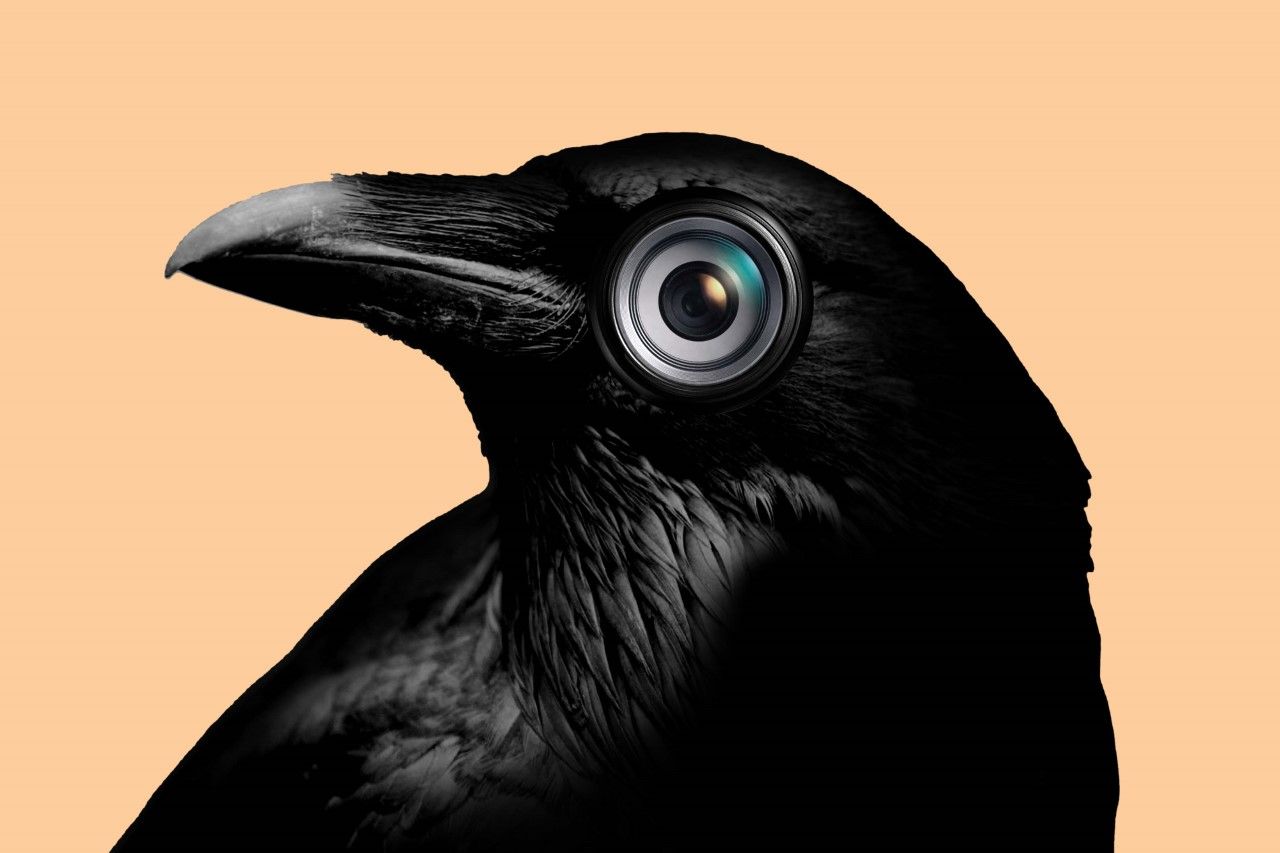
If the underlying philosophy of the war against disinformation can be expressed in a single claim, it is this: You cannot be trusted with your own mind. What follows is an attempt to see how this philosophy has manifested in reality. It approaches the subject of disinformation from 13 angles—like the “Thirteen Ways of Looking at a Blackbird,” Wallace Stevens’ 1917 poem—with the aim that the composite of these partial views will provide a useful impression of disinformation’s true shape and ultimate design.

read more here


Zawartość publikowanych artykułów i materiałów nie reprezentuje poglądów ani opinii Reunion’68,
ani też webmastera Blogu Reunion’68, chyba ze jest to wyraźnie zaznaczone.
Twoje uwagi, linki, własne artykuły lub wiadomości prześlij na adres:
webmaster@reunion68.com


Foreign aircraft enters northern Israel from Syria, is intercepted by IDF

Foreign aircraft enters northern Israel from Syria, is intercepted by IDF

JERUSALEM POST STAFF


IDF helicopters and fighter jets shot down the aircraft, which entered Israel from Syria, according to the Israeli military.
.

The Israeli Air Force works to fight new and developing threats across the region / (photo credit: IDF SPOKESPERSON UNIT)

A foreign aircraft was intercepted by the Israeli military on Sunday evening after invading Israeli airspace from Syria, the IDF said on Sunday night.

IDF helicopters and fighter jets shot down the aircraft, which was being tracked by the Israeli Air Force before being gunned down.

The craft did not pose a threat

Israeli media reported that the craft was shot down in an empty area and that no warnings were activated as per policy, as the situation did not pose a danger at any stage.

The IDF is currently investigating the specifics of the incident.

The Upper Galilee Council was updated on the situation and assured that there are no other abnormalities in Israel’s northern skies.

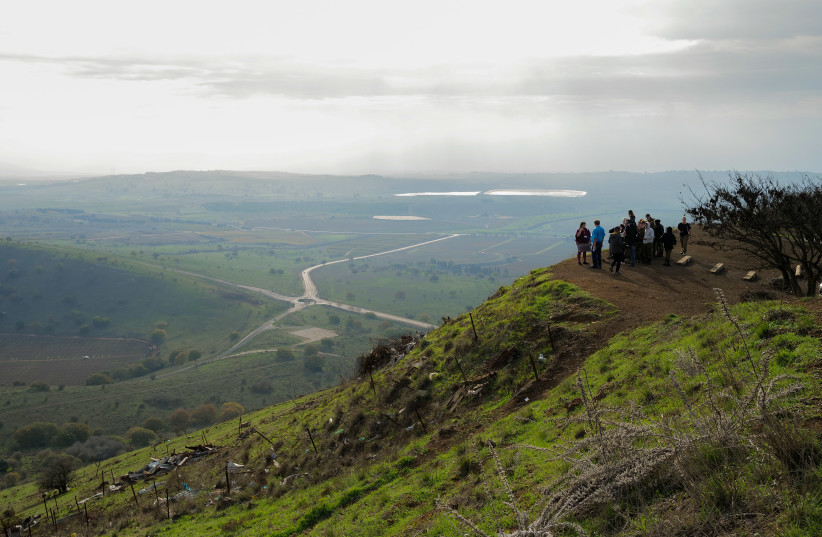
People visit at a lookout point on Mount Bental, overlooking the border with Syria, in the Golan Heights on December 7, 2022. (credit: MICHAEL GILADI/FLASH90)

Explosions heard near Mezzah airport in Syrian capital

A car bomb caused the large blasts heard in the Mezzah suburb area near the Syrian capital Damascus, Syrian state media said.

Police sources quoted by state media said there were no injuries from the improvised explosive device (IED). Residents said the large blasts were heard around the Mezzah military airport.


Zawartość publikowanych artykułów i materiałów nie reprezentuje poglądów ani opinii Reunion’68,
ani też webmastera Blogu Reunion’68, chyba ze jest to wyraźnie zaznaczone.
Twoje uwagi, linki, własne artykuły lub wiadomości prześlij na adres:
webmaster@reunion68.com