Archives

Why Israel will be blamed for the absence of PA elections

Why Israel will be blamed for the absence of PA elections

MAURICE HIRSCH


There are two dominant parties in Palestinian politics: Fatah and Hamas.
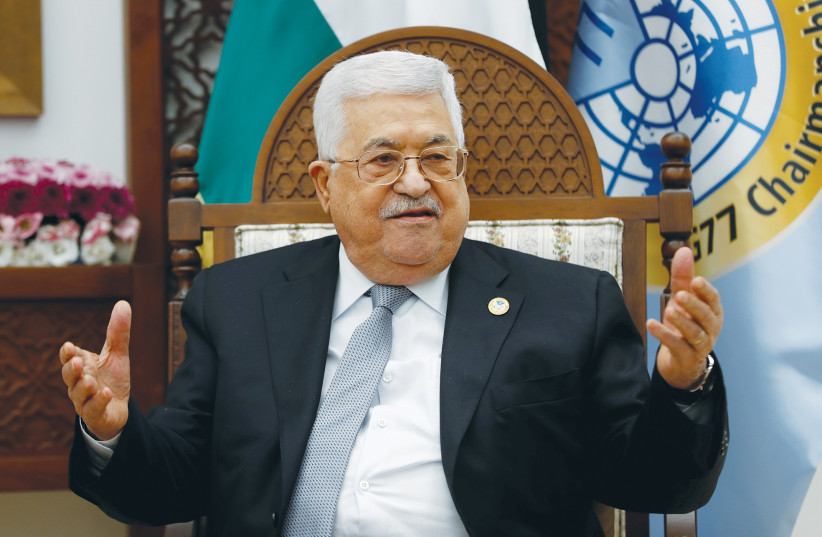
PA PRESIDENT Mahmoud Abbas – ‘He makes threats and engages in fiery rhetoric as part of a strategy to appease the Palestinian public.’(photo credit: REUTERS/MOHAMAD TOROKMAN)

When Palestinian Authority Chairman Mahmoud Abbas and his advisers sit down to plan how to escape the possibility of holding elections for the Palestinian Parliament and the chairmanship of the PA, they will no doubt come up with the ultimate, traditional Palestinian solution: Blame Israel!
There are two dominant parties in Palestinian politics: Fatah and Hamas.

In the formative years of the PA (1994-2005), Fatah, the dominant member of the Palestine Liberation Organization and the party of PA founding father Yasser Arafat, ruled the roost. Fatah’s candidate was elected PA chairman and Fatah ruled the nascent Palestinian Parliament.

Hamas, the internationally designated terrorist organization, spent the formative years of the PA building its power. On the one hand, it carried out hundreds of terrorist attacks. On the other, it created an entire social welfare network as an alternative to the corrupt PA/Fatah rule. Both means served the same goal: to curry favor with the Palestinians in order to pave the way to effectively compete against Fatah.

In the 2005 elections for PA chairman, the time was not yet ripe for Hamas to make a challenge. Accordingly, it boycotted the elections. Only 800,000 of the potential 1,700,000 voters cast their vote. Abbas received only 62% of the votes cast.

The 2006 elections for the PA Parliament were completely different.
Those elections followed Israel’s “disengagement” from Gaza, and the replacement of the comatose Israeli prime minister Ariel Sharon with interim prime minister Ehud Olmert. Both events emboldened Hamas.

Abbas, who had taken different steps to facilitate an additional Fatah victory, and who wanted to legitimize his rule and the rule of the Fatah-led parliament, insisted that Israel allow Hamas to participate in the elections, even in Jerusalem. To his horror, Israel agreed.

In the face of immense international pressure, Olmert capitulated, allowing the Hamas to participate. Running in Gaza, the PA-controlled areas in Judea and Samaria and in Jerusalem under the name “Change and Reform,” Hamas crushed Fatah, even in Judea and Samaria, winning an outright majority in the parliament.

However, the Hamas rule of the entire PA was short-lived. When Israel arrested most of the Hamas ministers (following the kidnapping of IDF soldier Gilad Schalit in June 2006), and the international community expressed reservations about providing aid to a PA government headed by an internationally designated terrorist organization, Abbas seized the opportunity, deposed the Hamas government, and replaced it with a government more to his liking.

Hamas refused to accept this decision, and in the summer of 2007 it violently seized control of the Gaza Strip.

The Fatah-Hamas rift that has continued for the last 13 years has been constantly used as the excuse for the absence of elections.
So when Hamas recently agreed to Fatah’s terms for holding elections – separate elections for the Parliament and the Chairmanship – Abbas needed to move to Plan B: Blame Israel.

Let there be no misgivings. Abbas and his Fatah Party have no desire whatsoever to hold elections for either the Palestinian Parliament or the chairmanship. They know that they are far from being guaranteed to win. Thus, while pretending to want to play the democratic game, from their point of view, elections are to be avoided at all cost.

The spin is simple. First, persuade the international community that true Palestinian elections can only take place if all the so-called “Palestinian factions” are allowed to participate. Then add the demand that the international community force the Israeli government to “comply with the agreed arrangements for Palestinian general elections in east Jerusalem.”
The term “Palestinian factions” is a euphemism for Hamas and others designated by Israel and the international community as terrorist groups. Needless to say, there is no Israeli-Palestinian agreement that requires Israel to allow the PA to hold elections in Jerusalem with the participation of terrorist groups.

In other words, according to Abbas and the PLO, for the Palestinian elections to be held, Israel must allow designated terrorist groups into Jerusalem, the capital of Israel, to campaign and run in the Palestinian elections.

With the political conundrum that has seized Israel for the last year, there would appear to be zero reason to believe that either of the two potential candidates who eventually will become Israel’s prime minister, will suddenly decide to abandon all of his principles and allow Palestinian terrorist groups to campaign and run in Jerusalem.

When Israel refuses this ultimatum, Abbas will declare that the elections must be pushed off, while squarely laying the blame for the delay on Israel.

In this manner, the Palestinian elections will be avoided. Abbas and Fatah will continue to control the areas of Judea and Samaria currently under their control, and Hamas will continue to control Gaza. Israel will, of course, be blamed.


Lt. Col. (res.) Maurice Hirsch, Adv. is the Head of Legal Strategies for Palestinian Media Watch. He served for 19 years in the IDF Military Advocate General Corps. In his last position he served as director of the Military Prosecution in Judea and Samaria. Tweets @mauricehirsch4.


Zawartość publikowanych artykułów i materiałów nie reprezentuje poglądów ani opinii Reunion’68,
ani też webmastera Blogu Reunion’68, chyba ze jest to wyraźnie zaznaczone.
Twoje uwagi, linki, własne artykuły lub wiadomości prześlij na adres:
webmaster@reunion68.com


Why do children with autism struggle to sleep?

Why do children with autism struggle to sleep?

ILANIT CHERNICK


New research study from BGU’s National Autism Research Center of Israel finds brain waves of children with autism are shallower

Illustrative image of an EEG test to measure electrical activity of the brain being performed. / (photo credit: Wikimedia Commons)

Studies have shown that some 48% of children on the autism spectrum have sleep disorders or disturbances.

A new research study from Ben-Gurion University of the Negev’s National Autism Research Center of Israel has found that brain waves of children with autism are shallower, particularly during the first part of the night, which indicates why they have difficulty falling into a deep, rejuvenating sleep.

Not only do they have a hard time falling asleep, but this large percentage also wake up frequently in the middle of the night, and wake up early in the morning.

Previous studies have shown that because of the sleep disturbance, severe challenges are created for the children and their families. Determining the causes that create these sleep disturbances is a first critical step in finding out how to mitigate them.

A team led by Prof. Ilan Dinstein, head of the National Autism Research Center of Israel and a member of BGU’s Department of Psychology, examined the brain activity of 29 children with autism and compared them to 23 children without autism.

The children’s brain activity was recorded as they slept during an entire night in the Sleep Lab at Soroka University Medical Center, managed by Prof. Ariel Tarasiuk.

According to the researchers, normal sleep starts with periods of deep sleep that are characterized by high amplitude slow brain waves.

“The recordings revealed that the brain waves of children with autism are, on average, 25% weaker (shallower) than those of typically developing children, indicating that they have trouble entering deep sleep, which is the most critical aspect of achieving a restful and rejuvenating sleep experience,” the study found.

Speaking to The Jerusalem Post on Wednesday, Dinstein that the importance of this study is that “this EEG [Electroencephalography] measure tells us something about the mechanism of why the children are having trouble sleeping.”

An EEG is an electrophysiological monitoring method to record electrical activity of the brain.

“Finding the solutions that will help these children sleep better will require more research that we are starting to carry out this year,” he explained. “Potential alternatives include increased physical exercise, behavioral interventions that regulate sleep habits, and pharmacological interventions.
“All of these options need to be tested carefully,” Dinstein said.
He highlighted that deep sleep is a complicated state that is governed by a variety of hormones and other factors.

“Imbalances in any of these factors could create a situation where some of the children with autism do not fall into deep sleep,” Dinstein told the Post. “Nevertheless, we do not have a handle or measure for identifying a sub-group of children with a particular type of sleep difficulty. “This is important, because these children will likely need a specific solution – one that we have yet to identify,” he stressed.

Dinstein went on to explain that it appears that children with autism, and especially those whose parents reported serious sleep issues, “do not tire themselves out enough during the day, do not develop enough pressure to sleep, and do not sleep as deeply,” adding that they also found a clear relationship between “the severity of sleep disturbances as reported by the parents and the reduction in sleep depth.

“Children with more serious sleep issues showed brain activity that indicated more shallow and superficial sleep.” he added.

With the team now identifying the potential physiology underlying these sleep difficulties, they are planning several follow-up studies to discover ways to generate deeper sleep and larger brain waves, from increasing physical activities during the day to behavioral therapies, and pharmacological alternatives such as medical cannabis.


The research was supported by the Simmons Foundation Autism Research Initiative and was published recently in Sleep.


Zawartość publikowanych artykułów i materiałów nie reprezentuje poglądów ani opinii Reunion’68,
ani też webmastera Blogu Reunion’68, chyba ze jest to wyraźnie zaznaczone.
Twoje uwagi, linki, własne artykuły lub wiadomości prześlij na adres:
webmaster@reunion68.com


Israeli Actress Gal Gadot Named 1 of 5 Breakout Stars of Decade by Hollywood Reporter

Israeli Actress Gal Gadot Named 1 of 5 Breakout Stars of Decade by Hollywood Reporter

Shiryn Ghermezian


Israeli actress Gal Gadot receives the 2018 #See Her award for her performance in ‘Wonder Woman.’ Photo: Reuters / Mario Anzuoni.

The Hollywood Reporter named Gal Gadot one of its five breakout stars of the 2010s.

The Israeli actress and “Wonder Woman” star shared the news on Instagram on Monday, and said she learned about the recognition from fellow honoree and actress Elizabeth Moss, known for her roles in the television series’ “Mad Men” and “The Handmaid’s Tale.”

Gadot wrote, “Wow! Thank you @hollywoodreporter for the honor of being named 1 of the 5 breakouts of 2010’s. And in such great company. Finding out about it on @elisabethmossofficial post was mind blowing Overwhelmed by all the support you’ve shown throughout the years…! To many more…. 555.”


gal_gadots profilbild   gal_gadot

Wow! Thank you @hollywoodreporter for the honor of being named 1 of the 5 breakouts of the decade, along with such great company. Finding out about it on @elisabethmossofficial post was mind blowing 🙌🏻 Overwhelmed by all the support you’ve shown throughout the years…! To many more…. 555 ♥️

Bilden kan innehålla: en eller flera personer


The other breakout stars of the decade according to Hollywood Reporter included actor Timothée Chalamet, who plays Laurie in “Little Women” and is nominated for an Oscar for his role in “Call Me By Your Name”; Phoebe Waller-Bridge, the star and creator of the Emmy-winning television series “Fleabag”; and Jordan Peele, director of “Get Out” and “Us.”

Gadot’s next film, “Wonder Woman 1984,” will be released in 2020 as a follow-up to her highly successful 2017 film about the Amazonian warrior.

Her other upcoming films include “Red Notice,” with Ryan Reynolds and Dwayne Johnson, and “Death on the Nile.”This year she also founded a production company, called Pilot Wave Motion Pictures, with her husband, Yaron Varsano.

The company already has a number of films in the works, including one about the true story of Irene Sendler, a Polish nurse and social worker who helped care for and save 2,500 Jewish children in the Warsaw Ghetto. Gadot will play the lead character.


Zawartość publikowanych artykułów i materiałów nie reprezentuje poglądów ani opinii Reunion’68,
ani też webmastera Blogu Reunion’68, chyba ze jest to wyraźnie zaznaczone.
Twoje uwagi, linki, własne artykuły lub wiadomości prześlij na adres:
webmaster@reunion68.com


Bennett, Kochavi to meet following confirmed killing of Soleimani

Bennett, Kochavi to meet following confirmed killing of Soleimani

REUTERS, OMRI NAHMIAS


“The American and Israeli enemy is responsible for killing the mujahideen Abu Mahdi al-Muhandis and Qassem Soleimani,” said Iraqi PMF spokesman Ahmed al-Assadi.

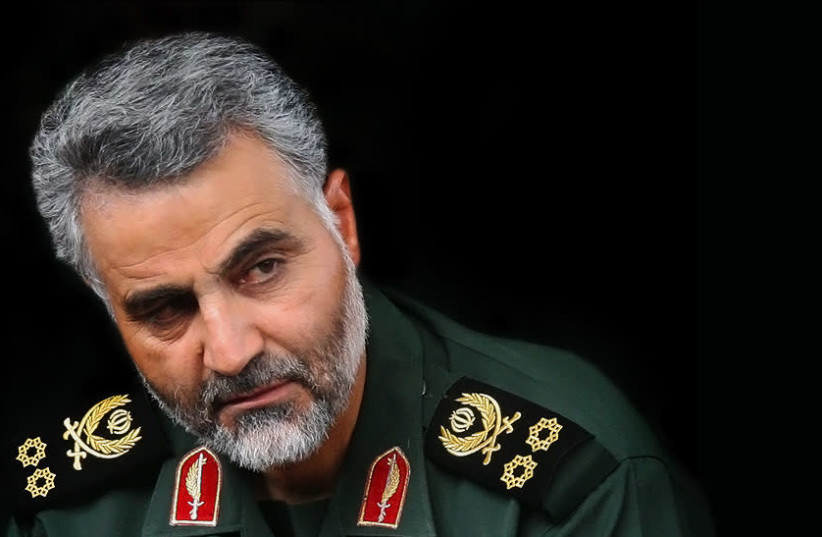
Qasem Soleimani, commander of IRGC Quds Force
(photo credit: SAYYED SHAHAB-O-DIN VAJEDI/WIKIMEDIA COMMONS)

Defense Minister and acting prime minister Naftali Bennett and IDF Chief of Staff Lt.-Gen. Aviv Kochavi, along with security officials, will meet at the Kirya in Tel Aviv on Friday morning to discuss the security situation, following the confirmed killing by US forces of IRGC Quds Force commander Qasem Soleimani.

The Pentagon confirmed Thursday night that the US had killed Soleimani in an airstrike inside Baghdad International Airport, along with Iraqi militia commander Abu Mahdi al-Muhandis. The Iraqi Popular Mobilization Forces spokesperson claimed that Israel and the US are behind the attack.

“At the direction of the President, the US military has taken decisive defensive action to protect US personnel abroad by killing Qasem Soleimani, the head of the Iranian Revolutionary Guard Corps-Quds Force, a US-designated Foreign Terrorist Organization,” the Pentagon’s statement reads.


כאן חדשות

✔@kann_news

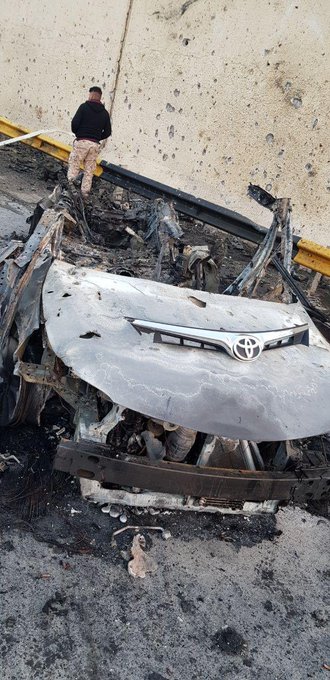
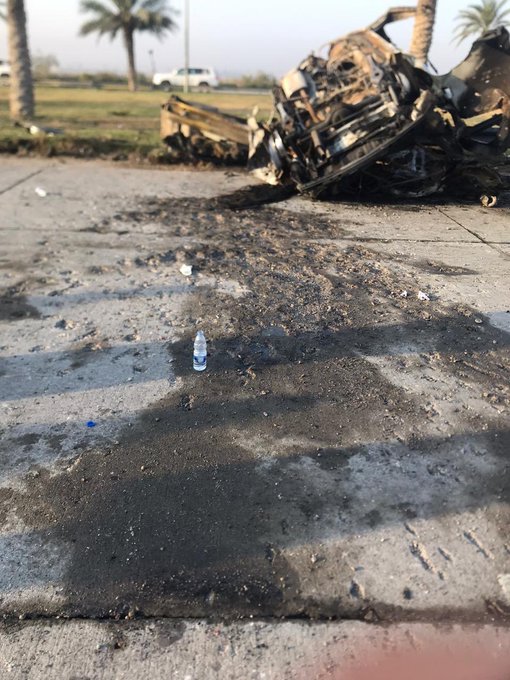
חיסול סולימאני | תמונות רכבו של סולימאני מזירת התקיפה ליד שדה התעופה בבגדאד@MosheBerkovitch

View image on Twitter

“General Soleimani was actively developing plans to attack American diplomats and service members in Iraq and throughout the region,” the statement continues. “General Soleimani and his Quds Force were responsible for the deaths of hundreds of American and coalition service members and the wounding of thousands more.”

According to the statement, Soleimani had orchestrated attacks on coalition bases in Iraq over the last several months – “including the attack on December 27th – culminating in the death and wounding of additional American and Iraqi personnel.”

“General Soleimani also approved the attacks on the US Embassy in Baghdad that took place this week,” the Pentagon added.

“This strike was aimed at deterring future Iranian attack plans. The United States will continue to take all necessary action to protect our people and our interests wherever they are around the world.”

Iraq’s Security Media Cell announced late Thursday night that three katyusha rockets had targeted Baghdad Airport.

The militia members were hosting “important guests” at Baghdad airport who were being driven in two militia vehicles that were struck by two rockets, said the militia sources.

Two militia sources said the two guests were also killed in the attack but declined to identify them. It is assumed that Soleimani was one of them, while Hezbollah deputy leader Naem Qasm was the other. There have been no official confirmations of either report, however.

Police and health sources said that at least five people were killed and nine wounded.

Iraqi state media reported that Soleimani and al-Muhandis, the deputy head of the PMF, were both killed in the attack.

The Iranian Revolutionary Guards Corp (IRGC) later confirmed that Soleimani was killed, saying that “honored supreme commander of Islam Soleimani was martyred.”

Shi’ite PMF said in a post on Facebook that its director of public relations was killed in what it described as “cowardly U.S. bombing.”
Iraqi PMF spokesman Ahmed al-Assadi blamed “Americans and Israelis” for being behind the attack.

“The American and Israeli enemy is responsible for killing the mujahideen Abu Mahdi al-Muhandis and Qassem Soleimani,” said Assadi.

US President Donald Trump tweeted a photo of the American flag with no caption when the report was confirmed of the US airstrike.


Donald J. Trump

✔@realDonaldTrump

View image on Twitter

Former IRGC chief Mohsen Rezaee tweeted in response to the attack that “vigorous revenge against America” will be pursued following the death of Suleimani.

Iran’s Supreme Leader Ayatollah Ali Khamenei warned on Friday that a harsh revenge awaits the “criminals” who killed Soleimani and that the attack will double the motivation of the resistance against the US and Israel.
Khamenei called for three days of mourning in Iran for Soleimani.

Iranian Foreign Minister Mohammad Javad Zarif said on Friday the assassination of Iran Quds Force chief Qassem Soleimani was, “an extremely dangerous and foolish escalation.”

“The U.S. bears responsibility for all consequences of its rogue adventurism,” he said in a post on Twitter.

Zarif later said that the killing of Soleimani will only strengthen the resistance in the region, according to Iranian State TV.

On Friday morning, the IDF announced that Israel’s Mount Hermon ski resort would be closed to tourist after an evaluation of the security situation. Rockets fired from Syria have targeted the site in the past.

Supporters of Iranian-backed Iraqi paramilitary groups stormed the US Embassy in Baghdad on Tuesday following US air raids on Sunday against Kataib Hezbollah militia bases in retaliation for missile attacks that killed a US contractor in northern Iraq last week.

Tension between the United States and Iran has ramped up in the region over US economic sanctions hurting the Iranian economy. The two sides have traded blame over attacks on oil installations, militia arms depots as well as military bases hosting US forces.

Currently pending DNA results have a “high probability” of identifying the two men as the targets, Newsweek reported.

Soleimani, who has led the foreign arm of the Revolutionary Guards and has had a key role in fighting in Syria and Iraq, acquired celebrity status at home and abroad.

He was instrumental in the spread of Iranian influence in the Middle East, which the United States and Tehran’s regional foes Saudi Arabia and Israel have struggled to keep in check.

He survived several assassination attempts against him by Western, Israeli and Arab agencies over the past two decades.

Soleimani’s Quds Force, tasked with carrying out operations beyond Iran’s borders, shored up support for Syrian President Bashar al-Assad when he looked close to defeat in the civil war raging since 2011 and also helped militiamen defeat Islamic State in Iraq.

Soleimani became head of the Quds Force in 1998, a position in which he kept a low profile for years while he strengthened Iran’s ties with Hezbollah in Lebanon, Syrian President Bashar al-Assad’s government and Shi’ite militia groups in Iraq.


Jerusalem Post Staff contributed to this report.


Zawartość publikowanych artykułów i materiałów nie reprezentuje poglądów ani opinii Reunion’68,
ani też webmastera Blogu Reunion’68, chyba ze jest to wyraźnie zaznaczone.
Twoje uwagi, linki, własne artykuły lub wiadomości prześlij na adres:
webmaster@reunion68.com


US Killed Top Iranian Commander Qassem Soleimani

US Says It Killed Top Iranian Commander Qassem Soleimani in Baghdad Air Strike

Reuters and Algemeiner Staff


Iranian Maj. Gen. Qassem Soleimani, the head of the Islamic Revolutionary Guard Corps’ elite Quds Force, and Iraqi militia commander Abu Mahdi al-Muhandis. Photo: Fars News Agency via Wikimedia Commons.

Iranian Maj. Gen. Qassem Soleimani, head of the elite Quds Force, was killed early on Friday in a US air strike on his convoy at Baghdad International Airport, the Pentagon said.

Top Iraqi militia commander Abu Mahdi al-Muhandis was also killed in the attack, a militia spokesman said.

“This strike was aimed at deterring future Iranian attack plans,” the Pentagon said in a statement.

Iran‘s Islamic Revolutionary Guard Corps (IRGC) confirmed in a statement that Soleimani was killed.

Ahmed al-Assadi, a spokesman for Iraq’s Popular Mobilization Forces (PMF), the umbrella grouping of Iran-backed militias, blamed the United States and Israel.

“The American and Israeli enemy is responsible for killing the mujahideen Abu Mahdi al-Muhandis and Qassem Soleimani,” he said.

Strikes had been carried out against two targets linked to Iran in Baghdad on Thursday, US officials earlier told Reuters.

Iraqi paramilitary groups said on Friday that three rockets hit the airport, killing five members of Iraqi paramilitary groups and two “guests.”

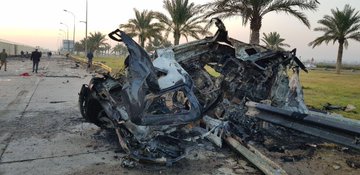
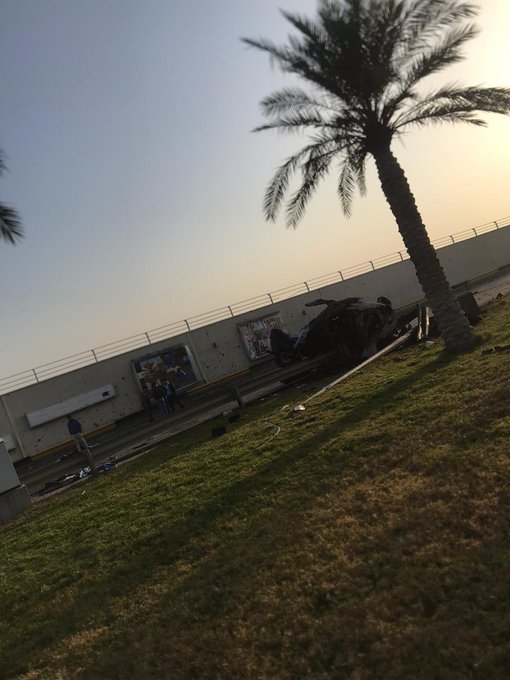
The rockets landed near the air cargo terminal, burning two vehicles, killing and injuring several people.

Local militia commander Abu Muntathar al-Hussaini told Reuters:

“Haj Soleimani and Abu Mahdi al-Muhandis were riding in one vehicle when it was struck by two successive guided missiles launched from an American helicopter while they were on their way from the arrivals hall on the road that leads out of Baghdad Airport.”

He said the second vehicle was carrying bodyguards from the PMF and was hit by one rocket.

“The American criminals had detailed information on the convoy’s movements.”

Oil prices were up $2 on the news.

The high-profile assassinations are seen as a massive blow to Iran, which has been locked in a long conflict with the United States that escalated sharply last week with the storming of the US embassy perimeter in Iraq by pro-Iranian militiamen following an American air raid on an Iraqi Shi’ite militia.

Soleimani, who has led the foreign arm of the Revolutionary Guards and has had a key role in fighting in Syria and Iraq, acquired celebrity status at home and abroad.

He was instrumental in the spread of Iranian influence in the Middle East, which the United States and Tehran’s regional foes Saudi Arabia and Israel have sought to keep in check.

He survived several assassination attempts against him by Western, Israeli and Arab agencies over the past two decades.

Soleimani’s Quds Force, tasked with carrying out operations beyond Iran‘s borders, shored up support for Syrian President Bashar al-Assad when he looked close to defeat in the civil war raging since 2011 and also helped militiamen defeat Islamic State in Iraq.

Soleimani became head of the Quds Force in 1998, a position in which he kept a low profile for years while he strengthened Iran‘s ties with Hezbollah in Lebanon, Syrian President Bashar al-Assad’s government and Shi’ite militia groups in Iraq.


Zawartość publikowanych artykułów i materiałów nie reprezentuje poglądów ani opinii Reunion’68,
ani też webmastera Blogu Reunion’68, chyba ze jest to wyraźnie zaznaczone.
Twoje uwagi, linki, własne artykuły lub wiadomości prześlij na adres:
webmaster@reunion68.com