Archives

Jewish Israelis Find Their Roots in This now-Arab City

Jewish Israelis Find Their Roots in This now-Arab City

Ofer Aderet


About 100 years ago, the last Jew left Shfaram, now a predominantly Muslim city in northern Israel. Last month, its mayor hosted descendants of the Jewish community at an event that was part history, part coexistence

The Jewish tour group enters Shfaram’s 17th-century synagogue, November 21, 2019.rami shllush

When the Samoni family of Tel Aviv embarked on a journey last month to find “a connection with our family history” and to discover its “roots” – they didn’t board a flight to Morocco or Poland. They didn’t go through border control or cross oceans. What separated them from the site of their origins was a distance of a mere 110 kilometers (69 miles).

Of all places, the Samonis’ search took them to Shfaram – an Israeli Arab city with a Muslim majority and Christian and Druze minories, but no Jews. Up until 100 years ago, however, Jews were living in the Galilee locale, 20 kilometers east of Haifa. They were remnants of an ancient community going back to the end of the Second Temple period (between 516 B.C.E. and 70 C.E.).

“We’re the descendants of the Jews who lived in Shfaram for generations,” boasted Eliran Samoni, adding that the last member of his family to leave there was Yitzhak Samoni, whom he described as “somewhere between my great-great-grandfather and a great-great-great grandfather,” who left due to financial problems.

Since his family “consists only of girls today and I’m the only son,” he added with a smile, “in effect, the entire future of the Samonis is me.”

Dozens of Jewish Israelis from around the country – all with roots in Shfaram – joined this unusual journey on November 21. As befits Jews, they argued among themselves as to who was the very last to go and to hand over the keys to his house to his Arab neighbors. According to some accounts, something like that happened in 1919, exactly 100 years ago.

Descendants of Shfaram’s Jewish families tour the city, November 21, 2019.rami shllush

Hosting the group was Shfaram Mayor Ursan Yassin, described on websites of media outlets in the north and in social media as the person who “has invited descendants of the Jewish community that lived in the past in Shfaram to attend a gathering of a rainbow of colors and of brotherhood.”

Agriculture and anecdotes

At a ceremony in the local community center, Yassin excitedly told the participants: “This is your city. Your parents lived here along with our parents as one family. Welcome to your city, Shfaram.”

Listening attentively to the mayor’s remarks – and swapping anecdotes – the group sat around tables and enjoyed eating lamb that had been slaughtered in their honor and generous helpings of knafeh (a traditional Middle Eastern dessert).

“When I was a child, my father told me stories that I haven’t forgotten until this day, when I’m 65,” said Yassin, adding that he remembers descriptions of a shared life “of Jews, Christians, Druze and Muslims, who lived like one family.”

Everyone, he continued, “worked here together, in agriculture. There was no difference between them. After a hard day’s work in the field they sat together on the ground, each one took out the food he had brought from home, and everyone ate some of the other’s food. One told a joke, another told a story, and that’s how they passed time pleasantly. They liked one another, they laughed and cried together.”

Eliran Samoni said that when he first heard about the gathering in Shfaram, he realized that it might be a good opportunity for him to look for forgotten relatives – to help him bear the responsibility for preserving his family’s legacy.

“I want to expand our family tree and to look for other Samoni families who are part of the ‘dynasty,’” he said. “Who needs citizenship in Portugal or Spain?” a reference to a law whereby Jews who can prove they are descendants of Sephardi families forcibly expelled by those countries during the Inquisition, can apply for citizenship. “We have history here, in Shfaram.”

Unfortunately, Samoni didn’t find any long-lost relatives at the event last month, but there is still hope: A WhatsApp group of descendants of the Jews of Shfaram is gaining momentum and members by the day.

The person spearheading the efforts to reconnect descendants of the Jewish community with Shfaram is Danny Levy, an 80-year-old Haifa resident and scion of the Hassan family who lived there; he was also the one who asked Yassin about arranging the gathering. The mayor responded warmly, explaining that it would be an opportunity to help forge closer connections and mutual respect between his city and the Jewish families. Indeed, local residents also took part in the events that day.

Descendants of Shfaram’s Jewish families tour the city, November 21, 2019.rami shllush

Levy, for his part, said that originally, he had “turned to the radio show called the Search Bureau for Missing Relatives, and received a few addresses of descendants. And then one of them posted everything on Facebook and we also published a notice in the Haifa digital newspaper. The result was a flood of phone calls,” he said, adding proudly, “We are an ancient family.”

Along with members of the Hassan and Samoni families, others participating in the November event included descendents of the Cohen, Bonan (Al-Jali), Zeut, Atari and Almani families.

The group also toured the remains of the 17th-century Mahaneh Shekhina synagogue, which some say was built on the ruins of an earlier synagogue. They walked to the site where the Jewish cemetery was once located, but is today empty of any tombstones.

In addition to the family roots aspect of the day, another goal, as mentioned by the mayor, was to bring together Jews and members of the local population. The nadir in those relations came during an incident in 2005 when an Israel Defense Forces deserter named Eden Natan-Zada shot and killed four Arab residents, after which he himself was lynched by a local crowd.

For his part, Mazen Ayoub, an educator who lives in Shfaram, said he preferred to see the silver lining in the fragile relationship, and to cultivate the shared roots “so that new seeds will sprout and new fruit will grow from them,” as he put it. “I’m aiming for a large tree, in whose shade the two of us will sit.”

Ayoub’s remarks were echoed by the chief rabbi of Acre, Yosef Yashar, who was also in attendance.

“How good and how pleasant it is, when brothers live together in unity,” he said from the dais, quoting a verse from Psalms, noting the “unique atmosphere” in which members of different religions have coexisted in Shfaram “like one family,” in “brotherhood,” “peace” and “friendship.”

“We want to demonstrate the possibility of a good connection among the inhabitants of this country, which is dear to all of us,” said Yael Fogelman, a peace activist who helped to arrange the gathering in Shfaram. (A few weeks later, this connection was evident when several local residents were among those who attended the funeral of Fogelman’s father, Israeli intelligence officer Avraham Dar.)

Site of Sanhedrin

According to tradition, following the destruction of the second Temple, during the eras of the Mishna and Talmud, Shfaram was a large Jewish city. In the second century the Sanhedrin (the supreme legislative Jewish body) was transferred there and it was also home to Rabbi Yossi Haglili, a famous sage. During the following generations Christians and Muslims also moved there, and the Jews became a minority.

There is historical evidence that the Jewish community continued to live in Shfaram for many centuries. After the expulsion of the Jews from Spain in 1492, a number of families reached the city, among them some from Oran, Algeria, and others from Tehran. The sources state that in 1525 there were only three Jewish families living in Shfaram, and in 1533, 10 Jewish households.

The community expanded during the rule of Daher al-Omar, the Bedouin governor of the Galilee in the 18th century, who brought in Jews from all over the Ottoman Empire to strengthen the local economy. In 1839, when Sir Moses Montefiore toured Jewish communities in Palestine, there were 197 Jews in Shfaram – all of them Sephardim. In the 1870s a British delegation that conducted research in the country reported that there were 100 Jews residing there; their numbers decreased during World War I and a decade ago, none remained.

A local hero

At the event in November, a number of stories of respected Jewish sons of Shfaram were recounted – among them that of an eye doctor named Zerubbabel Mizrahi, son of the doctor of the Persian sheikh, who immigrated from Tehran and settled in Shfaram in the 19th century. There was also a tale told concerning another local Jew, who was said to have used his bare hands to strangle a tiger that was frightening city residents and devouring their livestock.

“When my husband’s family told me their stories from Shfaram, I thought they were pretty weird,” said Dalia Shahaf of Kiryat Ono, in central Israel, who attended the gathering with her husband Shmulik. “How is it possible that you were never exiled from here?” she asked them in surprise.

Shahaf said local Jewish history has been preserved in anecdotes and memories, but a comprehensive and serious study must be conducted: “This is history that is really worth pursuing – there are many living descendants who know stories from their grandparents’ homes.”

The Shahafs have made several visits to Shfaram, during which they met an 80-year-old cobbler who answers to the name Benjamin. He told them that he reads the Jewish Bible in Arabic translation every day – which, they said, supports their “suspicion” that some locals may have Jewish blood in their veins.

“They say that the Jews disappeared from many places, but they didn’t disappear,” asserted Dalia. “They simply converted to Christianity or Islam.” Her husband said he hoped the renewed interest in the Jewish roots of Shfaram will lead to restoration of the Jewish homes and workshops there, as in Jewish communities abroad.

“There are organizations of people with origins in Lublin and in Warsaw – and now there are also people with origins in Shfaram,” he summed up. “We come from a Jewish community in the State of Israel who are returning to visit it as guests – and that’s lovely.”


Ofer Aderet – Haaretz Correspondent


Zawartość publikowanych artykułów i materiałów nie reprezentuje poglądów ani opinii Reunion’68,
ani też webmastera Blogu Reunion’68, chyba ze jest to wyraźnie zaznaczone.
Twoje uwagi, linki, własne artykuły lub wiadomości prześlij na adres:
webmaster@reunion68.com


The ICC decision on Israel would make Himmler proud

The ICC decision on Israel would make Himmler proud

RICHARD KEMP


The ICC chief prosecutor’s hand is now controlled by organizations linked to the 3rd Reich.

PROSECUTOR FATOU BENSOUDA waits for the start of the trial against former Ivory Coast president Laurent Gbagbo and former youth minister Charles Ble Goude at the International Criminal Court in The Hague last month. / (photo credit: PETER DEJONG/REUTERS)

SS Reichsfuhrer Heinrich Himmler, architect and director of the Holocaust, would be proud of the latest move by Fatou Bensouda, Chief Prosecutor of the International Criminal Court. Intent on the total elimination of the Jewish race, Himmler supported Amin al-Huseini, Grand Mufti of Jerusalem, in his plans to eradicate the Jews in Palestine.

Now Bensouda and the ICC have joined the international campaign aimed at eliminating the Jewish state, led by al-Huseini’s successors. In a grotesque inversion, the ICC, heir to the Nuremberg war crimes tribunal, has become a propaganda weapon of anti-Semitic hate. This represents a shameful betrayal of its honourable anti-Nazi progenitor. Its path more closely resembles that of the Nazis’ notorious People’s Court, the Volksgerichthof, than the Nuremberg trials.

Nuremberg laid low many of the Nazi monsters that perpetrated the Holocaust. The ICC chief prosecutor’s hand is now controlled by organizations linked to the 3rd Reich. The Palestinian Centre for Human Rights, Al-Haq, Addameer and Al-Dameer,

Palestinian NGOs backed by EU and Swiss funds, have been lobbying the ICC to bring prosecutions against Israel for more than a decade according to the Israeli research institute NGO Monitor. All are connected to the Palestinian group PFLP whose founding leaders in the 1970s were trained in terrorism and political warfare by former SS Colonel Otto Skorzeny and Dr Gerhard Hartmut von Schubert, once of Josef Goebbels’s propaganda ministry.

Instigator of the ICC investigation was Palestinian Authority President Mahmud Abbas, a man so immersed in Jew hate he wrote a doctoral thesis denying the Holocaust. He published it as a book in Arabic entitled The Other Side: The Secret Relationship Between Nazism and Zionism, in which he suggested that Jews killed by the Germans were in fact victims of a Nazi-Zionist plot. Today Abbas presides over an administration that incentivises terrorists who kill Jews by paying them salaries as well as openly endorsing their murderous crimes.

Abbas’s book betrays one of the main tactics used in the political warfare campaign against the Jewish state, branding them with the very war crimes that were perpetrated against their people: genocide, mass murder and forcible population transfer.

Joining this campaign, Bensouda says that, after a five-year preliminary examination: “I am satisfied that war crimes have been or are being committed in the West Bank, including East Jerusalem, and the Gaza Strip”. But no objective examination of the facts could have led her to that conclusion. It could only have reached this point after false accusations of war crimes became normalised over many years of political warfare, just as the Nazis normalised warfare against the Jewish people in Germany. As Hitler wrote: “Propaganda tries to force a doctrine on the whole people… Propaganda works on the general public from the standpoint of an idea and makes them ripe for the victory of this idea.”

How has this normalisation come about? By decades of relentless anti-Israel propaganda in universities and schools, the media, political parties, so-called human rights groups and international organizations such as the EU.

 Israel has been long been singled out for special treatment by the UN. According to the NGO UN Watch, in the 2019-2020 session of the UN General Assembly, a total of only 7 resolutions have been adopted against the rest of the world with 18 against Israel alone. In that period only two criticisms have been made against Syria despite hundreds of thousands dead and millions displaced. None have been levelled against some of the world’s worst human rights violators including China, Pakistan, Venezuela and Algeria. Israel is the only country in the world that is the subject of a permanent agenda item at the UN Human Rights Council.

The ICC prosecutor accuses Israel, during Operation Pillar of Defense in 2014, of using disproportionate force in Gaza, willfully killing and causing serious injuries to civilians and intentionally attacking protected individuals and locations. She alleges that the IDF committed war crimes against Gazans violently attempting to breach the border into Israel in 2018 and 2019.

I was present during these conflicts, witnessed and was extensively briefed on IDF operations. I was a member of an investigation into Operation Pillar of Defense by the High Level Military Group, an independent body of retired generals from Western armed forces and human rights experts. The group unanimously concluded that: “The IDF not only met its obligations under the Law of Armed Conflict, but often exceeded these on the battlefield.”

General Martin Dempsey, at the time Chairman of the US Joint Chiefs of Staff, commented: “Israel went to extraordinary lengths to limit collateral damage and civilian casualties.” My first-hand observations during the Hamas-instigated Gaza border violence in 2018-19 echo these assessments.

If Bensouda’s accusations are demonstrably false, her third allegation, that Israel has committed war crimes under Article 8 of the Rome Statute by transferring parts of its civilian population into occupied territory, can only be described as outrageous.

The West Bank, east Jerusalem and the Gaza Strip are not “occupied territories”. They are disputed territories but are not and have never been the territory of any sovereign state other than Israel. The suggestion that willing tenancy on this land by Jews is intrinsically illegal sees the ICC prosecutor adopting the Nazi concept of Judenrein, cleansing an area of Jews. Despite situations where such crimes have actually occurred, including Northern Cyprus and Crimea, no prosecutions for war crimes in this category have ever been brought against anyone. Special treatment is again reserved for the Jewish state.

Not only have Bensouda’s accusations been enabled by normalisation of anti-Israel hate, but she is intent on illegally contorting the ICC’s mandate to force the Jewish state into the dock. Jurisdiction only applies where alleged war crimes have been committed by a state which lacks the capability and political will to investigate and take action itself. The opposite is true of Israel, which has an internationally respected judicial system and a track record of prosecuting battlefield crimes.

The ICC’s jurisdiction is also limited to accusations made by sovereign states. The Palestinian Authority is not by any definition a sovereign state. The prosecutor believes otherwise and has requested the ICC’s pretrial chamber to rule.

The US and Australia have both condemned Bensouda’s decision to proceed with her investigation, an unprecedented step. Britain, itself under improper ICC preliminary examination for alleged war crimes in Iraq, should take up the cudgel. If the pretrial chamber decides the ICC has jurisdiction, as a party to the Rome Statute, the UK should appeal its judgement and enlist the support of Australia and Canada, also state parties.

Bensouda’s announcement has already been seized upon by Israel’s enemies. If her investigation goes ahead, whatever the outcome, that alone will be enough to incite and encourage violence against Israelis and Jews everywhere. If her decision was based upon an objective legal assessment that price would have to be paid. But this is a politically-motivated move, intended by those behind it to redouble the anti-Israel propaganda campaign. If it does proceed Bensouda and her fellow ICC officials, as well as those who support or fail to fight her actions, will have blood on their hands.


The author is a former British Army commander.


Zawartość publikowanych artykułów i materiałów nie reprezentuje poglądów ani opinii Reunion’68,
ani też webmastera Blogu Reunion’68, chyba ze jest to wyraźnie zaznaczone.
Twoje uwagi, linki, własne artykuły lub wiadomości prześlij na adres:
webmaster@reunion68.com


Your News From Israel – Dec. 26, 2019

Your News From Israel – Dec. 26, 2019

   ILTV Israel News


srael fires back at the Gaza Strip after the Israeli Prime Minister is forced to take cover in a rocket attack…we’ll reveal which Israeli start-ups made the most money in 2019…and get ready to smile…because we have the run-down on the top 5 most exciting things that happened in the holy land this year.


Zawartość publikowanych artykułów i materiałów nie reprezentuje poglądów ani opinii Reunion’68,
ani też webmastera Blogu Reunion’68, chyba ze jest to wyraźnie zaznaczone.
Twoje uwagi, linki, własne artykuły lub wiadomości prześlij na adres:
webmaster@reunion68.com


Israeli scientific study shows electrons flow like water

Israeli scientific study shows electrons flow like water

AARON REICH


The implications of the study have the potential to be groundbreaking in the field of electronics, as it can create ways of lowering electrical resistance.

Concept image of an atom and electrons / (photo credit: INGIMAGE)

A longstanding scientific theory was proven recently when scientists from the Weizmann Institute of Science were able to visualize the hydrodynamic flow of electrons for the first time.

Electrons are often spoken of as if they were flowing; a liquid flow of sorts had long been hypothesized. However, they actually move more like gasses than liquids – meaning they don’t collide with one another like liquid particles do.

In order to get electrons to flow like liquid, a special kind of conductor was needed. That conductor was graphene, a sheet of carbon with the thickness of a single atom.

With the right conductor, the team then needed to properly see the expected flow – something strong enough to look inside the material but with enough gentleness that it wouldn’t interfere with the flow.
“Theories suggest that liquid electrons can perform cool feats that their non-liquid counterparts cannot,” said Prof. Shahal Ilani, head of the team in the Institute’s Department of Condensed Matter Physics. “But to get a clear-cut proof that electrons can, indeed, form a liquid state, we wanted to directly visualize their flow.”

In a study published in the journal Nature Nanotechnology, the team described their methodology. Utilizing a nanoscale detector built from a carbon nanotube transistor, it’s possible to visualize the flowing electrons without disrupting the flow.

“Our technique is at least a thousand times more sensitive than alternative methods; this enables us to image phenomena that previously could only be studied indirectly,” said Weizmann team member Dr. Joseph Sulpizio.

The team followed this up with another study, this time published in the journal Nature. In this study, they used their technique with specialized graphene devices produced by the University of Manchester, England’s Sir Andre Geim. With these devices, which were designed to help guide the flow, the team were able to observe it with unprecedented clarity – the electrons flowed faster in the center but were slowed down by the walls, exactly like water in a pipe.

According to team member Dr. Lior Ella, the implications of the study have the potential to be groundbreaking in the field of electronics, as it can create ways of lowering electrical resistance.

“Computing centers and consumer electronics are devouring an ever-increasing amount of energy, and it’s imperative to find ways to make electrons flow with less resistance,” Ella explained.


Zawartość publikowanych artykułów i materiałów nie reprezentuje poglądów ani opinii Reunion’68,
ani też webmastera Blogu Reunion’68, chyba ze jest to wyraźnie zaznaczone.
Twoje uwagi, linki, własne artykuły lub wiadomości prześlij na adres:
webmaster@reunion68.com


Not enough

Not enough

JPOST EDITORIAL


Almost daily we hear reports of murders and assassinations in Arab cities, towns and villages.

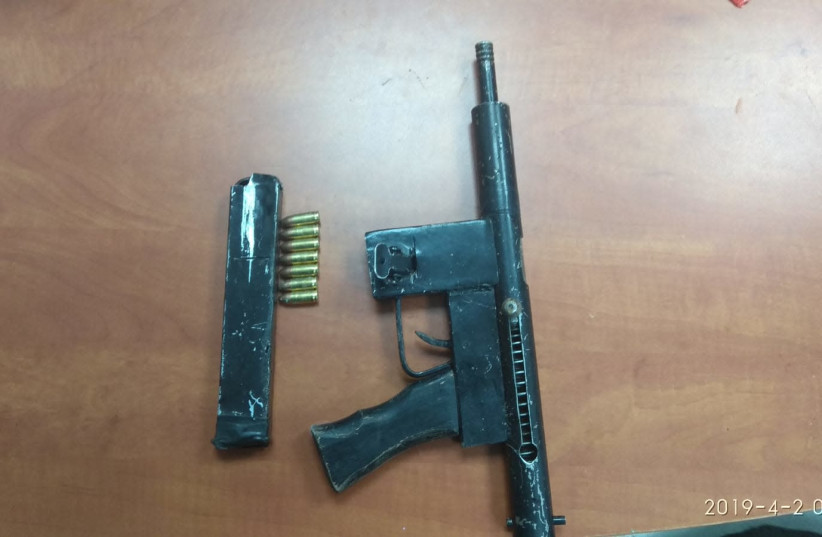
The homemade Carlo-style gun discovered by IDF forces on April 2 / (photo credit: IDF SPOKESMAN’S UNIT)

The violence on the country’s Arab streets is still raging, and no solution is on the horizon.

Almost daily we hear reports of murders and assassinations in Arab cities, towns and villages.

This phenomenon has long gotten out of hand, and no one is stopping it.

On Saturday, Dr. Safwat Abu Ria, the mayor of the city of Sakhnin, was the target. A car outside of his house was set on fire, and gunshots were fired. Luckily, no one was injured.

Abu Ria is one of eight Arab mayors targeted in the past three months.

Also on Saturday, 27-year-old Johar Abu Jaber from Kfar Qassem was shot dead. Abu Jaber is the fourth member of his family killed since the beginning of the year, and the 91st within the Arab sector.

What are Israel Police doing to stop this deadly plague? In mid-November, it announced  – yet again – that it was launching a campaign to get the Arab public to voluntarily return illegal weapons to police stations.

The police promised the public that people who return their weapons would not suffer from criminal sanctions.

However, even as the campaign was launched, people were skeptical it would succeed. Israel Hayom reported that 12 Arab municipalities refused to cooperate with the campaign. Public Security Minister Gilad Erdan said that it is “sad and shocking to see municipalities that are refusing to take part in an operation that intends to save lives.

“An Arab leader who does not call on the public to surrender their weapons is losing legitimacy to criticize the law enforcement organizations,” he said.

MK Aida Toma Suleiman (the Joint List), explained why some Arab leaders refuse to participate. “In the weapon collection operation in 2017, only three weapons were returned. We all know what a person who repeats the same action and expects a different outcome is called,” she said. “I support doing everything possible to remove weapons from our streets. But this voluntary operation is a joke.”

Suleiman is correct. The operation was tried before and failed, so why would it work this time?

The police promised the public that people who return their weapons would not suffer from criminal sanctions.

However, even as the campaign was launched, people were skeptical it would succeed. Israel Hayom reported that 12 Arab municipalities refused to cooperate with the campaign. Public Security Minister Gilad Erdan said that it is “sad and shocking to see municipalities that are refusing to take part in an operation that intends to save lives.

“An Arab leader who does not call on the public to surrender their weapons is losing legitimacy to criticize the law enforcement organizations,” he said.

MK Aida Toma Suleiman (the Joint List), explained why some Arab leaders refuse to participate. “In the weapon collection operation in 2017, only three weapons were returned. We all know what a person who repeats the same action and expects a different outcome is called,” she said. “I support doing everything possible to remove weapons from our streets. But this voluntary operation is a joke.”

Suleiman is correct. The operation was tried before and failed, so why would it work this time?


Zawartość publikowanych artykułów i materiałów nie reprezentuje poglądów ani opinii Reunion’68,
ani też webmastera Blogu Reunion’68, chyba ze jest to wyraźnie zaznaczone.
Twoje uwagi, linki, własne artykuły lub wiadomości prześlij na adres:
webmaster@reunion68.com