Archives

Daniel Blatman’s anti-Semitic Attack

Daniel Blatman’s anti-Semitic Attack

Yehuda Bauer


The charge that International Holocaust Remembrance Alliance is a tool of the Israeli government can only be described as anti-Semitic

An al-Quds Day demonstration in Berlin, June 2019. The poster reads, “I boycott Israel, but not the Jews.” Fabrizio Bensch / Reuters

In his piece “Maybe No ‘Different Germany’ Exist,” Prof. Daniel Blatman sharply attacks the International Holocaust Remembrance Alliance for being a tool of the Israeli government in general, and specifically for establishing a definition of anti-Semitism that ostensibly serves the political interests of the Israeli government. (That definition, incidentally, is a pretty exact repetition of a similar definition accepted in the past by organs of the European Union.)

Blatman describes the IHRA as “unnecessary” and “destructive,” as if we were talking about a superpower with aircraft carriers and not a voluntary organization, comprising 33 member governments (not 27, as he wrote), that serves as a political umbrella for the educational, memorial and research efforts regarding the Holocaust being made by some 250 educators, academics and directors of memorial sites, most of whom are volunteers.

The IHRA makes decisions by consensus, and every member state has veto rights, including Germany, Hungary and nationalist Poland, which is an enthusiastic supporter of approaches amounting to distortions of the history of the Holocaust.

The Israeli government is one of 33 members, and to say that it controls IHRA is another anti-Semitic canard.

Full disclosure: Not only was I a central figure in setting up the IHRA (as Blatman notes) and the writer of its founding document (the “Stockholm Declaration” of 2000), but I continue to serve as the group’s active honorary chairman, and am a senior partner in its decision making. I do not represent Israel, or even Yad Vashem. IHRA’s definition of anti-Semitism, from 2016, was accepted by all the member states, including Poland.
In the examples appended to the definition, which were also accepted unanimously, it says specifically that, “criticism of Israel similar to that leveled against any other country cannot be regarded as anti-Semitic.” One of the examples of something that does constitute anti-Semitism is an anti-Israel approach when Israel is perceived as a Jewish entity and is attacked as such.

The document was written by two experts on the subject, one Jewish and the other non-Jewish, with the help of others. IHRA isn’t a Jewish organization. Other than the Israeli representatives, there is currently only one other government representative who is Jewish. Except for the one Israeli who chaired the organization when it was Israel’s turn to do so, the group has never had a Jewish chairman.

The idea that IHRA is an aggressive Jewish organization that dictates the policy of the German Bundestag, as Blatman’s article implies, is a clear and extreme anti-Semitic canard. Can a Holocaust researcher with much to his credit, like the author of the article in question, support blatant anti-Semitism? Apparently, yes.

Is the boycott, divestment and sanctions movement anti-Semitic, as the Bundestag has determined? Anyone who supports only those clauses in the movement’s platform that call for the end of the Israeli occupation of the territories or true equality for Israel’s Arab-Palestinian minority is certainly not an anti-Semite; otherwise a significant minority of Israeli Jews would be anti-Semitic.

The (much-vilified) Zionism expresses the right of the Jewish people to self-determination, and the fathers of Zionism envisioned full equality for the minorities living in a future Jewish political entity; many Israeli Jews vigorously demand this equality for minorities and the end of the discrimination against them. There is no anti-Semitism in this.

But the meaning of the clause in the BDS platform that calls for the Palestinian “right of return,” which if realized would put an end to the existence of the State of Israel as the state of the Jewish people, is very clear. Such an objective can be achieved only by war, since the vast majority of Israeli Jews – and not just them – will fight for their homes, and only their annihilation will accomplish a “right of return.” Supporting the right of return clause is therefore a clear case of anti-Semitism; moreover, it is anti-Semitism that could lead to the genocide of Jews.

IHRA had nothing to do with the Bundestag’s decision to define the BDS movement as anti-Semitic; it couldn’t have, because IHRA’s charter requires the agreement of all the member governments for any kind of political action, which in this case would be practically impossible. I don’t know exactly who initiated the German decision, though it is reasonable to assume that the Israeli government played a role, in the background.

But the party representatives in the Bundestag are not puppets, and whoever says that Germany’s small Jewish minority, in cooperation with Jerusalem, cooked up this porridge is reviving the anti-Semitic ideology that claims an international Jewish conspiracy that subjugates the nations of the world, in this case Germany.

Before the Bundestag’s decision, the German public didn’t seem particularly interested in BDS, which has by all accounts been an overall failure. There are some pop stars and academics who have avoided ties with Israel, the movement has some supporters in a number of universities in English-speaking countries and Frau Mueller in Hanover might refrain from buying Israeli avocados when she shops. Big deal. Investment in Israel is flourishing and its economic ties with the entire world are strong.

After the decision, however, Germans began asking: What exactly is BDS? The Bundestag decision proved to be an impressive and unexpected success for the movement in Germany. There couldn’t be a better advertisement for it, and the Israeli government, if it indeed was a partner to the decision, managed – once again – to shoot itself in the foot.

En route, it also succeeded in neutering the Jewish Museum in Berlin, through the forced resignation of its director, one of the great Jewish studies researchers, a non-Jew who loves Jews, because he believed in conducting a public dialogue with promoters of BDS.

IHRA indeed copes with the distortion of Holocaust memory and anti-Semitism, in Poland, for example. Blatman, in his essay, is critical of extreme nationalism in Hungary and Israel, but not in Poland – after all, he has been named the chief historian of a new museum being supported by the nationalist Polish regime, apparently intended to serve as its Jewish-Israeli fig leaf.

It is certainly true that he will not encounter any censorship, since his approach is similar if not identical to the Polish government’s approach.
IHRA, Blatman writes, hasn’t succeeded much in its missions of education, memory and Holocaust research. One can argue with this.

IHRA has made a serious contribution to opening archives in Europe, including, for example, the archives in Bad Arolsen, Germany, of the displaced persons camps and concentration camps in Germany; it has focused, inter alia, on working to preserve the memory of the genocide of the Roma; it has developed guidelines for teaching the Holocaust in high schools and has held and continues to hold workshops on various aspects of the Holocaust; it supports research work on the Shoah suggested to it by educational organizations and memorial sites; it has held and continues to hold academic conferences; it has contributed to the preservation of memorial sites and the uncovering of sites where Jews were killed; it arranges cooperative projects with international agencies that battle genocide and more.

It’s not enough, to be sure, and Blatman could presumably do a lot better. Let him try.

I never imagined that an anti-Semitic attack and venomous criticism of a positive project that promotes Holocaust remembrance would emerge from the Hebrew University of Jerusalem on Mount Scopus, and from the person who fills the same position – head of the Institute for Contemporary Jewry – that I held there for decades. But one learns, even at my advanced age.


Yehuda Bauer is a professor emeritus at the Avraham Harman Institute of Contemporary Jewry at Hebrew University



Zawartość publikowanych artykułów i materiałów nie reprezentuje poglądów ani opinii Reunion’68,
ani też webmastera Blogu Reunion’68, chyba ze jest to wyraźnie zaznaczone.
Twoje uwagi, linki, własne artykuły lub wiadomości prześlij na adres:
webmaster@reunion68.com


UK: DIRTY MONEY TRAIL

UK: DIRTY MONEY TRAIL

LETTERS TO THE EDITOR


Readers of the Jerusalem Post have their say.

Letters. (photo credit: REUTERS)

UK: Dirty money trail

Every government in the world knows that PA funds a Pay-to-Slay policy using about 8% of its annual budget, yet only the US government under President Donald Trump is withholding aid to avoid funding terrorism.
It is ironic that in its eagerness not to confront Abbas’s funding of terrorism (“UK office must disclose audits: Did PA use money to pay terrorists?” July 30), the UK government has to lie in Parliament that its aid money is not being used to pay murderers when it constructs a funding route through the World Bank and then cannot even produce audit reports or terms of reference for those audits.

It claims to be a friend and ally of Israel, but leaves Israel to confront the terrorism that the money is paying for! 

Moreover, despite Trump’s rejection of the JCPOA purporting to stop Iran from developing nuclear weapons, the very same UK government with its EU partners clings to this agreement, fully aware that 1) the JCPOA has been breached by Iran; 2) it is the victim of Iran’s naval aggression in the Straits of Hormuz; and 3) the JCPOA never stopped Iran from developing nuclear weapons.

Little wonder that the UK Embassy in Israel never responded to Maayan Hoffman’s report.

PETER SIMPSON 
Jerusalem

J Street: The wrong road

Regarding “J Street’s Israel trip wasn’t alternative Birthright. It was better” (July 30) – what a scurrilous piece of propaganda!
J Street is radically left-wing – anti-American, anti-white and anti-Semitic. Its aim is to drive a wedge between the US and Israel and to deliver Israel into the hands of its enemies.

The majority of American Jews consider themselves to be progressives. Their attachment to Israel is minimal. They tend to be less religious and will likely merge into the mainstream, leaving Judaism behind, much as Western European Jews did in the 19th and 20th centuries.
Israeli Jews, by contrast, are mostly supportive of the miracle they’ve created and are proud to share it.

J Street does not expose their students to reality. They skew truth to their own aim. Even their base-line “occupation” is biased.

In the West Bank town of Har Gilo, were the students told that Israel supplies the Arabs with twice the water agreed to at Oslo? At Hebron, were they told of the 1929 massacre of the Jews before the British forced the survivors to flee to Jerusalem? Did they tell them that the PA is responsible for the day-to-day lives of the Palestinians, not Israel?

In Ramallah, did they visit the luxurious neighborhood where Mahmoud

Abbas has his $30 million home?

Did the Peace Now leader tell the students that from 1967 to 2000, Muslims, Christians and Jews traveled freely back and forth to work, shop and play until Yasser Arafat unleashed his suicide bombers against Israeli civilians? Did she explain that that’s why there is a security barrier and checkpoints?
At Susya, did the B’Tselem “activist” admit that they turn Arabs who sell land to Jews over to the PA to be tortured and possibly killed?
American Jewish families who support Israel will continue to send their children to learn about Israel and its surroundings in a positive environment. Progressives will send their children to “Let Our People Know” to further justify their hostility toward Israel.

LEN BENNETT
Ottawa, Ontario

J Streeters should remember that the present situation results from the 1948 war that the Arab states initiated to eliminate the Jews and Israel. We need neither apologize nor justify. Birthright is a program designed to combat assimilation.

ROSALIND FENSTER
Petah Tikva

I was shocked to see an unpaid advertisement for J Street in The Jerusalem Post. The Post publishes articles by Gershon Baskin, which I read with a semi-smile on my face because of his naivety; articles by Jeff Barak make my blood pressure rise; and I do not agree with the pieces by the “Women of the Wall.” All of these reside in Israel and are entitled to their opinion and will have to live with any consequences that arise from what they write.

However, J Street is an American organization whose raison d’etre is to hate Israel and besmirch its name. It supports Iran, which says that it wants to destroy the State of Israel, and brainwashes American Jewish students to oppose and defame the State of Israel. J Street is an anti-Israel organization whose articles should have no place in a newspaper which considers itself Zionist .

Media written on paper worldwide are having a hard time keeping their heads above financial waters and I suggest that if the Post gives anti-Israel organizations a voice in its pages, it will rapidly lose the readers that it has, given the wealth of news available for free on the Internet.

CYRIL ATKINS
Bet Shemesh

In its drive for “balance,” The Jerusalem Post has been feting us to articles about “concerned” American millennials and their need to pursue justice for the “oppressed, occupied Palestinians” at the expense of their actual – not imagined – brothers and sisters, for whom no tears are ever shed.
In “Millennials on a Mission” (July 26) we learned of the desire of these earnest young people to help us benighted local yokels to see the error of our ways, in reference to our lack of enthusiasm for a two-state solution, the much-touted but unsubstantiated threats to our democracy, and other ills. Next we have another glowing account from yet another concerned American millennial about the wonderfulness of the new J Street “better” Birthright, again outlining the original sin of the “occupation.”

In both of these accounts and all others like them, the relentless brainwashing of the “Palestinians” to hate, loathe and despise Jews and Israel is conveniently overlooked.

The fact that any contact whatsoever on any level with the hated Israeli/Jewish “oppressors” is condemned by one and all and those who dare to do so put their lives at risk is also somehow not raised. The ironic joke is that the “Palestinians” that meet these groups have absolutely no support in their wider community, and, in fact, are seen as collaborators by their fellow citizens.

How about this, committed American millennials: thanks for coming here and spending your money, but really, we don’t need it or you. We have enough enemies without adding Jews to them. Stay in America, marry non-Jews and raise non-Jewish children. I am sure you will be happy fighting American exceptionalism back in what you think is your home. We here, who are truly home, still think we are exceptional. 
I’ll take an Evangelical Christian any day over these Jews.

YISRAEL GUTTMAN
Jerusalem

Aiya Napa indiscretion

Regarding “Israeli youth gone wild?” (July 26), okay, so now we know there was no rape in Cyprus. But a dozen young men were allegedly in a hotel room observing and filming several friends having sex with a British tourist. I watched on television their return to Israel, singing and dancing and praising God. These were religious young men! So there wasn’t a crime. But was it proper behavior? It was a sin. Their religious parents are happy? Are their rabbis happy? It disgusts me.

LAURIE BENTNER
Tel Aviv

Wadi Hummus fiasco

It shames me to say so, but I probably agree with Gershon Baskin’s comments in “Have we no shame?” (July 25).
The reason I say “probably” is that I’m writing this without actually having read the article because I don’t want to read that writer’s biased Palestinian propaganda.

If, as I suspect, he is referring to the demolitions in Wadi Hummus, then yes, this was a stupid thing for Israel to do. Israeli often claims that “the Palestinians never miss an opportunity to miss an opportunity;” unfortunately, Israel also never misses opportunity – to shoot itself in the foot!

If there is to be any chance for peace, then Israel must win the hearts and minds of the Arab population, and it shows a lack of common sense to destroy hope by knocking down some unfinished buildings while leaving older adjacent ones intact. OK, so they were building in breach of some obscure planning permission rules, but I can’t help thinking of Douglas Adams’s The Hitchhikers Guide to the Galaxy, where the Vogon Destructor fleet destroys the Earth, because the earthlings were too lazy to visit the local planning department on Alpha Centauri, which is only four light years away! The person that ordered the Wadi Hummus destruction has the same mentality, but unfortunately for Israel, the rest of the world does not, and this action only reinforces the “aggressive Israelis” stereotype that the antisemitic media portrays. So, Israeli innovation: 10/10, Israeli emotional intelligence: 0/10.

BOB KNIGHT
Modi’in

Post-horror horror

The horror of the massacre of Ukrainian Jews in the days after the liberation by the Soviet army in 1944 (Memorial unveiled for Ukrainian Jews massacred in Holocaust,” July 29) brings to mind the little-publicized fact that in 1946, the year after WWII ended, over 1,000 Jews were murdered in Poland by Polish people.

On one day alone, July 4, 1946, 42 Jews who had been liberated and returned to Kielce, were brutally killed by the townspeople because a teenage boy had accused them of kidnapping him to use his blood for Jewish rituals.

The use of the medieval blood libel, mere months after the horrific murder of the six million Jews was revealed to the world, is a chilling reminder of the tenacity of antisemitism in Europe. 

It is something that cannot be ignored 70 years later and needs to be part of the diplomatic conversation between nations and individuals. If “never again” is humanity’s goal, then “never forget” must accompany it.

MARION REISS
Beit Shemesh

Planting an idea

As president emeritus of Jewish Veg and the author of three editions of Judaism and Vegetarianism, I was pleased to see “Plant-based diets tied to lower risk of type 2 diabetes,” (July 28) However, based on my research, there are other important factors related to adopting such diets.

• Not only can type 2 diabetes often be prevented via plant-based diets, it can also be reversed in many cases.
• Plant-based diets also reduce risks for heart disease, several types of cancer, and other life threatening diseases.
• Such diets are not only very important for human health, but they also reduce climate change and other environmental threats to humanity, the current widespread abuse of farmed animals, and the wasteful use of land, water, energy, and other resources.

In view of the above and more, I ask some of society’s most respected and dedicated people: 

• Why aren’t doctors generally not urging their patients to shift to healthy, well-balanced plant-based diets?
• Why aren’t rabbis addressing the fact that animal-based diets violate Jewish teachings on preserving human health, treating animals with compassion, protecting the environment, and conserving natural resources?
• Why aren’t environmentalists doing more to stress that shifts to plant-based diets are essential to efforts avert a climate catastrophe and other environmental disasters?

RICHARD H. SCHWARTZ, PhD
Professor Emeritus, College of Staten Island

Meat during the Nine Days

Regarding “Fish sales expected to jump as no-meat ‘Nine Days’ approach” (July 26), this year, in the first nine days of Av, there are two Shabbattot when meat is permitted according to Jewish Law. On Shabbat, there is no sadness or mourning restriction for the destruction of the two Temples of Jerusalem. Thus, August 2-3 (the 2nd of Av) and also August 9-10 (Tisha Be’av) are celebrated with the richness of Oneg Shabbat, in line with the words of Isaiah: “You shall call the Day [of Shabbat] a delight” with consumption of chicken, meat (for non-vegetarians) and wine, accompanied with songs of Shabbat joy. 

The Fast of Tisha Be’av (the Ninth of Av) is pushed off to the 10th of Av, starting Saturday, August 10 at sunset, because no mourning enters into the holiest day of the Jewish calendar: Shabbat Kodesh. 

May we merit to see the rebuilding of the Third Holy Temple, which will come only with shalom and the acknowledgment/acquiescence of the entire human race. I can be reached at sagrafstein@gmail.com if you have questions. 

SHELDON ALLAN GRAFSTEIN
Toronto, Ontario


Zawartość publikowanych artykułów i materiałów nie reprezentuje poglądów ani opinii Reunion’68,
ani też webmastera Blogu Reunion’68, chyba ze jest to wyraźnie zaznaczone.
Twoje uwagi, linki, własne artykuły lub wiadomości prześlij na adres:
webmaster@reunion68.com


MIDDLE ISRAEL: BRITAIN’S NEXT FINEST HOUR

MIDDLE ISRAEL: BRITAIN’S NEXT FINEST HOUR

AMOTZ ASA-EL


Johnson has earned honestly the common revulsion with his impulsiveness, oafishness and buffoonery, and the analogies to Donald Trump that they inspired.

BRITAIN’S PRIME Minister Boris Johnson – he might ignite a post-Brexit Britain prosperity and instill in Britain a new spirit of confidence.. (photo credit: HANNAH MCKAY/ REUTERS)

Having collected the tales that would become The Wit and Wisdom of Boris Johnson (2013), author Harry Mount called one of Johnson’s classics tutors at Oxford and asked him what he thought of his former student’s prime ministerial prospects.

“He was up to the job of emperor until he became emperor,” quipped the instructor, quoting Roman historian Tacitus’s take on Emperor Galba’s short-lived reign (seven months).

It was the kind of tone with which Johnson’s emergence as Britain’s 77th premier would be greeted universally, with fastidious remarks ranging from “How far can Britain fall?” (Irish Times editorial) and “Boris Johnson is how Britain ends” (James Butler, New York Times) to “The clown is crowned while the country burns in hell” (Hannah Jane Parkinson, The Guardian).

Johnson has earned honestly the common revulsion with his impulsiveness, oafishness and buffoonery, and the analogies to Donald Trump that they inspired.

Yes, the two indeed are part of one epoch, but Johnson carries assets that Trump will never possess, and which might finally produce something good from an era of growing chaos, insecurity and despair.

JOHNSON DOES, no doubt, remind one of Trump in several ways: the breezy flock of yellowish hair; the willingness to nonchalantly lie; and of course the unique love life which just landed in 10 Downing Street a tenant whose girlfriend is awaiting her boyfriend’s divorce of his second wife, unlike a comparatively nerdy Trump’s arrival in the White House with a fully official first lady and third wife.

The similarities, however, end there

Unlike Trump, whose first hour in the White House was also his first in public office – Johnson has been foreign secretary for two years, mayor of London for eight years, and a lawmaker for 11 years that began 18 years ago. In short, he has been around and understands government.

In terms of education, Johnson is the opposite of the ignoramus that Trump’s tweets routinely unveil. A classics graduate of Oxford’s Balliol College, he speaks fluently French and Italian and has working knowledge of German and Spanish, in addition to having foundations in Latin and Greek.

Having published a biography of Churchill and presented one TV series on the history of Rome and another on early Islam, Johnson is broad-minded and eloquent. There is reason to believe that the new British prime minister’s light-headedness is actually an act, behind which hides a thinking man.

These differences of experience and baggage between Johnson and Trump are, of course, besides their inverted relationships with the media. Johnson can’t attack the press, because he has been part of it; and he can’t decry fake news, because he has been part of that, too, and in fact was once fired for inventing a quote.

Still, when Johnson invented a story about Italy asking the EU to change its condom standards so as to accommodate smaller penises, he put off many people (and at the same time made even them laugh), but his point – that Brussels had become a monstrosity of regulation – was very valid.

In fact, the eulogies – of Britain, Europe and Western civilization – that animated Johnson’s appointment say less about him and more about the eulogizers, who prefer to change the subject rather than discuss what his success is really about – namely, the collapse of Europeanism as both an idea and a plan.

THE HARSH fact is that most Brits have grown fearful, scornful and resentful of an increasingly overbearing European Union’s intrusions.

The harsh fact is also that Boris Johnson is charismatic, articulate and focused, and might indeed extract the Brits from the association which they joined reluctantly in the first place, and then watched helplessly as it unleashed financial mayhem, constitutional usurpation and migratory catastrophe.

Worse, from his detractors’ viewpoint, Johnson might not only pull Britain away from the EU politically; economically, he might ignite a post-Brexit British prosperity, and emotionally he might instill in Britain a new spirit of confidence.

Worst of all, ideationally, the leader of such a newly resilient Britain might use his erudition, eloquence and disparagement of conventional wisdom in order to tell all Europeans the heresy that the bishops of Europeanism suppress – namely, that nationalism is not bad, but good; that it is not passé, but very relevant; and that it is not part of the problem, but part of the solution.

What has unsettled Europe in recent years is the delusion that a supranational state can be artificially cobbled, in disregard of national history, geography and natural instinct. The Greek currency crisis exposed the truth, which is that international solidarity exists mainly in the minds of Brussels’ bureaucrats, but not in the hearts of the average German, Brit or Pole.

This is besides the absurdity of the European implication that nationalism is fascism’s parent.

Nationalism is what defeated fascism. Nationalism is what drove the British pilots who fought the Luftwaffe; nationalism is what drove the French, Norwegian, and Polish undergrounds; and nationalism is what the Soviets turned to, in the face of fascism’s invasion, when they replaced “The Internationale” with a patriotic anthem.

In peacetime, nationalism is a better driver of social solidarity, equality and compassion than any international structure will ever be, least of all one run by unelected mandarins.

Intellectually, recent decades’ conventional wisdom that nationalism is a modern invention has been challenged by Tel Aviv University historian Azar Gat in his internationally acclaimed Nations: The Long History and Deep Roots of Political Ethnicity and Nationalism (Cambridge, 2013), where he argued that nationalism is a deeply rooted element in human history, whose origins can be traced back to antiquity.

Boris Johnson’s premiership may provide the sequel to this thesis, demonstrating that nationalism has not only a long past, but also a promising future.


The writer’s best-selling Mitz’ad Ha’ivelet Hayehudi (The Jewish March of Folly, Yediot Sfarim, 2019), is an interpretation of the Jewish people’s political history.


Zawartość publikowanych artykułów i materiałów nie reprezentuje poglądów ani opinii Reunion’68,
ani też webmastera Blogu Reunion’68, chyba ze jest to wyraźnie zaznaczone.
Twoje uwagi, linki, własne artykuły lub wiadomości prześlij na adres:
webmaster@reunion68.com


Leading Berlin Rabbi – ‘We Will Not Hide,

‘We Will Not Hide,’ Leading Berlin Rabbi Pledges After Enduring Antisemitic Assault on Walk Home from Synagogue

Algemeiner Staff


Rabbi Yehuda Teichtal giving a media interview in Berlin. Photo: Screenshot.

German police launched an investigation on Wednesday following an incident last week in which one of Berlin’s most prominent rabbis was insulted and spat on.

Returning home with one of his children from Shabbat services last Friday night, Rabbi Yehuda Teichtal was set upon by two men, who insulted him in Arabic and then spat at him. The attack was another reminder of the dangers facing visibly identifiable Jews in the German capital, where well over 1,000 antisemitic incidents — several of them involving violence — were recorded in 2018.

In a statement reflecting on his experience, Teichtal asserted that “the aggression against Jews has developed a life of its own, both in the schoolyards and on the streets of Berlin.” He added that he remained “convinced that most people in Berlin do not want to accept this aggression against Jews as a sad part of everyday Jewish life,” promising that “we will not hide now, but rather continue to build on love, tolerance, dialogue and education.”

Several Berlin politicians expressed solidarity with Teichtal — a well-known Chabad movement rabbi who serves as the chairman of the Jewish Educational Center in Berlin, where he has been based for over 20 years.

Berlin Senator Dirk Behrendt tweeted that the attack was “shameful — we will not cease to fight antisemitism in all its manifestations,” while Raed Saleh, leader of the left-wing SPD Party in Berlin, declared that “the attack on my friend Rabbi Teichtal is an attack on all of us.”

The head of the Berlin Jewish community demanded that the police provide an escort to rabbis traveling to synagogue in a separate statement. Such a measure was necessary in order for them “to make their way to the synagogue and back undisturbed,” Dr. Gideon Joffe said on Wednesday.

Asked to respond to Joffe’s proposal by the Tagesspiegel news outlet, a spokesperson for the Berlin Interior Administration said that “protection of the Jewish community and its members is our top priority.” However, the spokesperson declined to give concrete details of additional security measures being taken, saying only that the Berlin police were monitoring the situation “continuously.”


Zawartość publikowanych artykułów i materiałów nie reprezentuje poglądów ani opinii Reunion’68,
ani też webmastera Blogu Reunion’68, chyba ze jest to wyraźnie zaznaczone.
Twoje uwagi, linki, własne artykuły lub wiadomości prześlij na adres:
webmaster@reunion68.com

IDF OFFICER, TWO SOLDIERS INJURED IN EXCHANGE OF FIRE AT THE GAZA BORDER

IDF OFFICER, TWO SOLDIERS INJURED IN EXCHANGE OF FIRE AT THE GAZA BORDER

ANNA AHRONHEIM, ROSSELLA TERCATIN


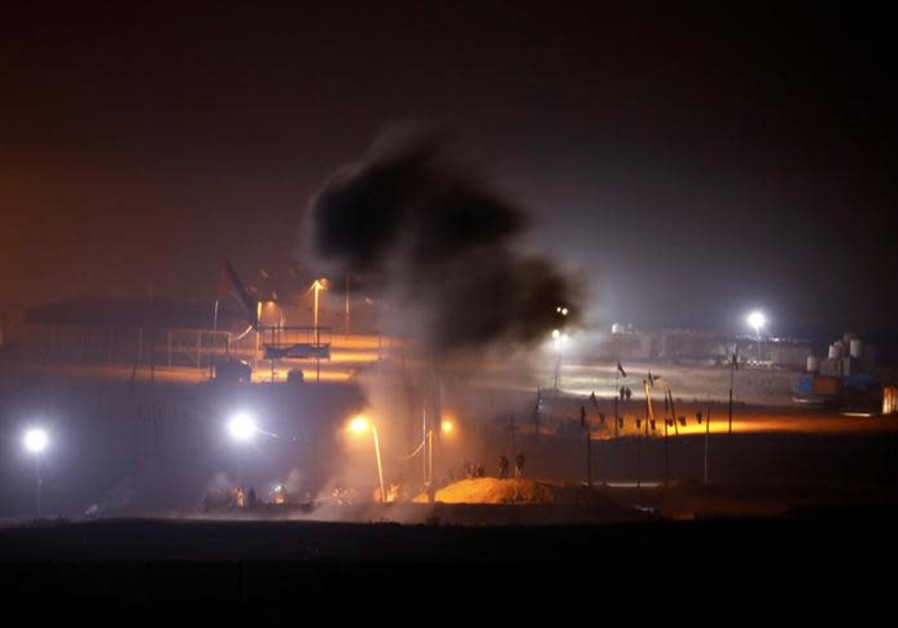
Smoke rises after an explosion as Palestinians take part in a night protest held along the Gaza side of the border with Israel. (photo credit: REUTERS/AMIR COHEN)

An IDF officer and two soldiers were injured and a Hamas militant killed in an exchange of fire at the border with the Gaza Strip on early Thursday morning, the IDF confirmed. 

According to IDF Spokesperson Brig.-Gen. Ronen Manelis, the initial investigation into the incident has found that the Palestinan was identified by troops at 2am approaching the border fence in the area of Kissufim in southern Israel.

“Normal course of action was taken by troops after an infiltration is detected, an action that occurs a lot,” Manelis said adding “but it is still unclear whether the force that arrived at the scene realized that the suspect was armed.”

The suspect, who was wearing a uniform and was armed with grenades and a Kalashnikov, infiltrated into Israeli territory from the southern edge of the Hamas-run enclave and opened fire towards Golani troops who were deployed to the area moderately injuring an officer. 

According to Manelis the suspect threw at least one grenade towards the force.

Two other soldiers were lightly injured, one by shrapnel and one in his eardrum from his own firing, the IDF spokesperson said. They were evacuated to Soroka hospital in Beer Sheva for medical treatment and their families have been notified.

Shortly after the incident began, additional Golani troops were deployed to the scene and opened fire on the suspect, killing him.

During the incident, the army closed roads near the border and additional forces were sent to protect nearby border communities. An IDF tank also attacked a Hamas position.

“This is a very serious incident,” Manelis told reporters stressing nevertheless that it is believed that the suspect acted alone, independently from Hamas.

The flare-up of violence broke several weeks of relative calm along the normally restive border.

On Wednesday the military completed the largest drill since the last conflict in the coastal enclave,  Operation Protective Edge in 2014, which saw the participation of eight brigade commanders, hundreds of reservists and the participation of air and naval forces.  

During the four-day long drill, key scenarios which the IDF expects to encounter in any future war were practiced including maritime attacks by terror groups in the Strip, evacuation of wounded soldiers, IDF incursions into northern Gaza as well as  attacks on civilian communities and the evacuation of communities along the border.


Zawartość publikowanych artykułów i materiałów nie reprezentuje poglądów ani opinii Reunion’68,
ani też webmastera Blogu Reunion’68, chyba ze jest to wyraźnie zaznaczone.
Twoje uwagi, linki, własne artykuły lub wiadomości prześlij na adres:
webmaster@reunion68.com