Archives

13 of the best auto-tech startups at Israel’s Ecomotion conference

13 of the best auto-tech startups at Israel’s Ecomotion conference

Brian Blum


Autonomous-driving, parking, ride-sharing – Israel’s innovative auto-tech startups are thrilling the world.

The 7th annual Ecomotion conference and exhibition in Tel Aviv, June 2019. Photo: courtesy

More than 130 startups packed the Tel Aviv Exhibition center on June 11 for the main event of the seventh annual Ecomotion four-day conference. The vast majority of exhibitors are part of Israel’s burgeoning auto-tech industry, which is especially remarkable given that cars are not manufactured in Israel.

That didn’t stop Bill Ford, executive chairman of the company his great-grandfather Henry Ford started over 100 years ago, from praising Israeli ingenuity. The 62-year-old Ford was making his first visit to Israel.

“The lack of hierarchy here, I love that,” Ford said during his keynote speech. “It sparks innovation.” The automotive ecosystem in Israel, he added, is “amazing.”

Nearly 5,000 visitors from Israel and abroad attended this year’s Ecomotion.

You didn’t need to hear Ford to understand that Israel has become a world leader in everything from the sensors and cameras that power self-driving cars to the software that will find an open parking spot in a lot or on the street (no small feat in a perennially parked-up city like Tel Aviv).

Orlie Sol Dahan, executive director of Ecomotion 2019, addressing the conference. Photo: courtesy

Here are a few of the startups that impressed ISRAEL21c during a visit to Ecomotion this week.

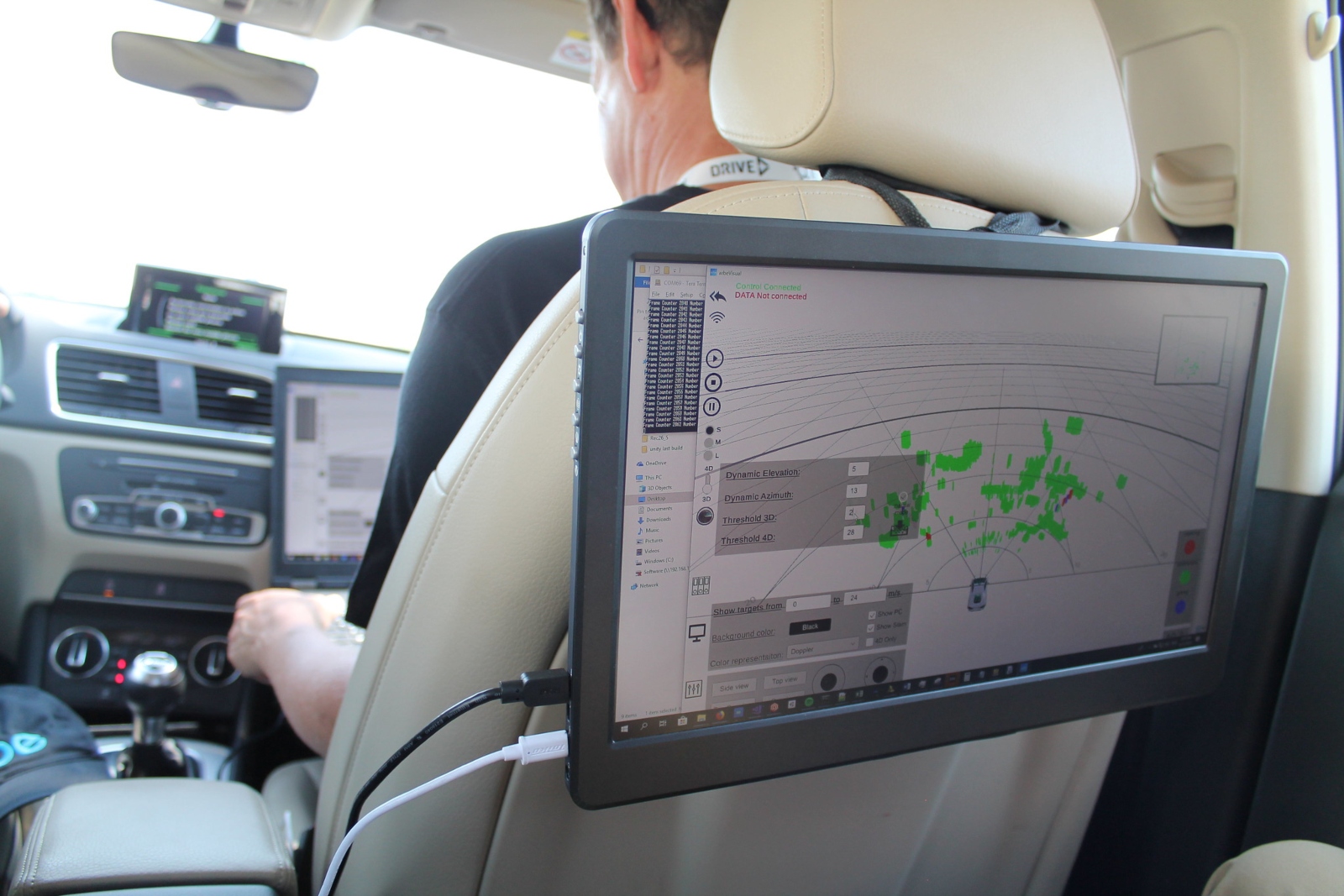
Tel Aviv-based startup Arbe Robotics gave ISRAEL21c a test drive to show how its 4D radar will allow a self-driving car to navigate safely. Arbe’s system highlights stationary and moving objects in real time.

Arbe Robotics’ 4D radar system highlights stationary and moving objects in real time. Photo by Anna Wachspress

read more: 13 of the best auto-tech startups at Israel’s Ecomotion conference


Zawartość publikowanych artykułów i materiałów nie reprezentuje poglądów ani opinii Reunion’68,
ani też webmastera Blogu Reunion’68, chyba ze jest to wyraźnie zaznaczone.
Twoje uwagi, linki, własne artykuły lub wiadomości prześlij na adres:
webmaster@reunion68.com


Barak said pushing to form center-left bloc that would include Blue and White

Barak said pushing to form center-left bloc that would include Blue and White

TOI STAFF


Israeli TV reports Blue and White wary of potential alliance with ex-PM’s new party, Labor and Meretz over concerns it could hurt its prospects among right-wing voters
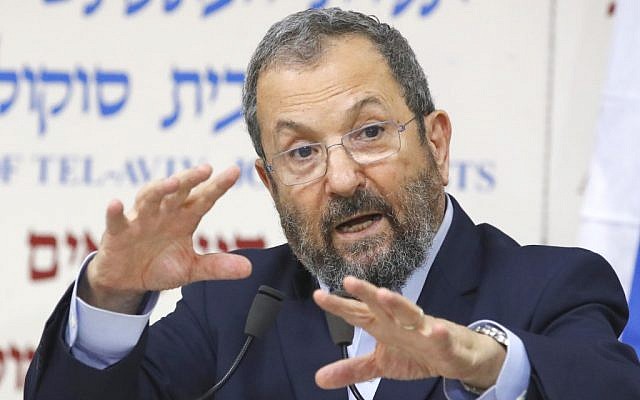
Former prime minister Ehud Barak speaks at a press conference announcing his return to politics ahead of national elections in September, Tel Aviv, June 26, 2019. (Jack Guez/AFP)

After announcing his return to politics, former prime minister Ehud Barak is pushing for an alliance of center-left factions that would also include the Blue and White party, according to Israeli television reports Friday.

Barak’s envisioned tie-up, which was reported by Channel 12 and the Kan public broadcaster, would include his still unnamed party, Labor, Meretz and Blue and White.

Blue and White, however, is reportedly wary of the proposal, fearing it could hurt it ability to pick up right-wing voters.

“This is a blow to our right flank. We need to bring votes from the right, this is the only way to expand the bloc,” Kan quoted the party saying.

According to Channel 12, Blue and White looked into possibly teaming up with Barak before April’s elections, but determined allying with the former Labor leader would not help it at the polls.
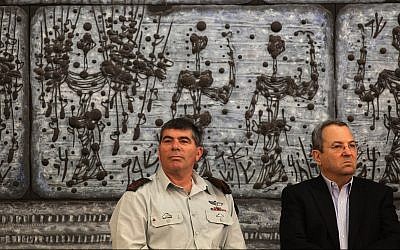
Then defense minister Ehud Barak (R) and then IDF chief of staff Gabi Ashkenazi at a ceremony at the President’s Residence in Jerusalem, May 16, 2010. (Kobi Gideon/Flash90)

Further complicating a potential joint run is the bad blood between Barak and Gabi Ashkenazi, who served as IDF chief when Barak was defense minister and is now No. 4 on the Blue and White list.

Barak would likely accuse any parties that didn’t join him of splintering support for a center-left coalition and hampering the bloc’s chances of forming a government, the reports said.

The left-wing Meretz party’s selection of former MK Nitzan Horowitz as its leader on Thursday was seen as boosting the chances of Barak’s proposed alliance, which Labor leadership candidate MK Itzik Shmuli is also reportedly open to joining.

MK Amir Peretz, another contender to be Labor chief, is said to be opposed to joining up with Barak, who defeated him in the center-left party’s leadership primaries in 2007.

Channel 12 news reported Wednesday night that Barak and Blue and White leader Gantz had discussed cooperating ahead of the previous elections in April, but Gantz eventually cut off talks.
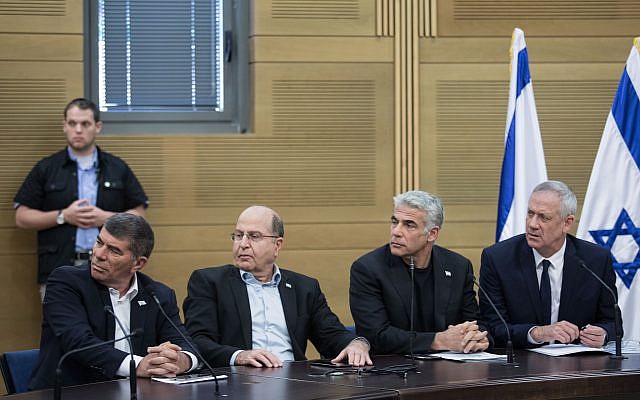
Blue and White party leaders (R-L) Benny Gantz, Yair Lapid, Moshe Ya’alon, and Gabi Ashkenazi, during a faction meeting at the Knesset on May 20, 2019. (Hadas Parush /Flash90)

Barak said Wednesday that Blue and White lacked the “passion” necessary to convince voters and claimed its leaders weren’t willing to fight hard enough to defeat Prime Minister Benjamin Netanyahu. He said that in the coming two or three weeks, his party would introduce a more detailed agenda and list of candidates.

He also said “it is not the size of the party that matters, it is the size of the blocs,” noting Likud and Blue and White each received 35 seats, but Netanyahu easily managed to be tasked with forming the coalition instead of Gantz.

Declaring Netanyahu’s political career to be over, Barak on Wednesday announced the establishment of his new political party that will compete in the September 17 elections. Barak appeared at a press conference in Tel Aviv with his new political partners: former IDF deputy chief of staff Yair Golan, law professor Yifat Biton and entrepreneur Kobi Richter.

“We have come here today to announce the establishment of a new party that will work to reform the country and society… This is not the time to remain sitting on the sidelines,” Barak said.
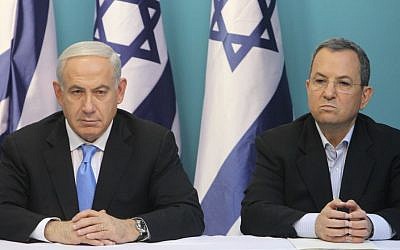
Prime Minister Benjamin Netanyahu and then-defense minister Ehud Barak attend a press conference at the PM’s office in Jerusalem, November 21, 2012. (Miriam Alster/Flash90)

“Bibi, this is your last chance to go home on your own,” he continued, imploring the prime minister — who is facing pending charges in three corruption cases — not to plunge the country into “chaos” in order to “save yourself from prison.”

Just hours after Barak announced his political comeback, a television poll said his new party would win six seats if national elections were held today.

Barak, 77, was the IDF’s longest-serving chief of staff and the country’s most decorated soldier before defeating Netanyahu in 1999 to become prime minister.

Following his defeat in 2001 by the late Ariel Sharon, Barak temporarily retired from politics, but returned to lead the Labor Party in 2005. From 2007 to 2013, he served as defense minister, including four years in Netanyahu’s cabinet.

In 2011, he split with Labor, forming the short-lived Atzmaut party so that he could remain in Netanyahu’s coalition despite the objection of most of Labor. Atzmaut was effectively disbanded upon Barak’s second retirement from politics in 2013.


Zawartość publikowanych artykułów i materiałów nie reprezentuje poglądów ani opinii Reunion’68,
ani też webmastera Blogu Reunion’68, chyba ze jest to wyraźnie zaznaczone.
Twoje uwagi, linki, własne artykuły lub wiadomości prześlij na adres:
webmaster@reunion68.com

HEALING ETHIOPIAN ANGER

HEALING ETHIOPIAN ANGER

JPOST EDITORIAL


Israeli leaders and society in general understand that there are problems of racism that we must address, and also help heal the anger among victims in the Ethiopian-Israeli community.

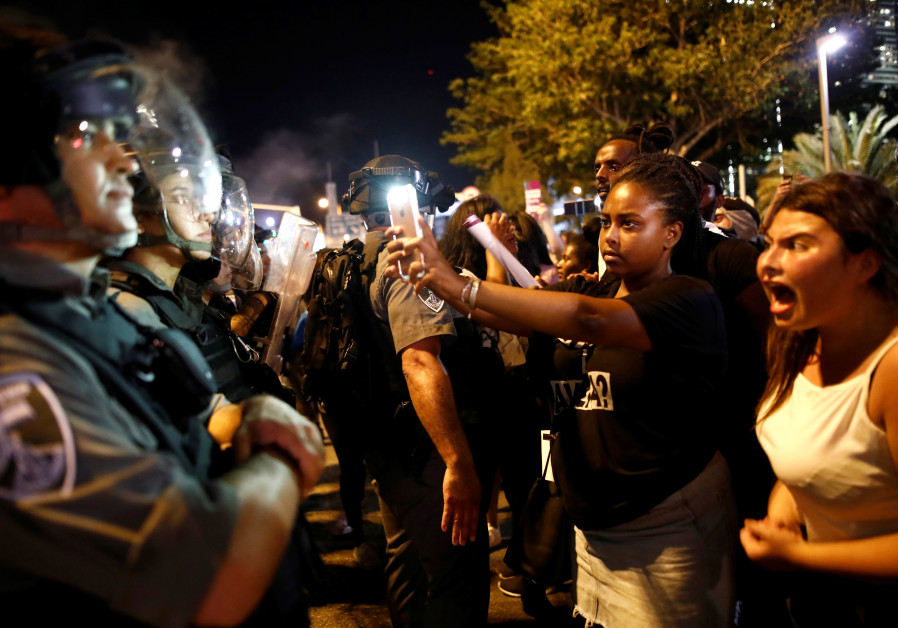
Protesters stand opposite police during a protest for the death of 18-year old Solomon Tekah of Ethiopian descent, after he was shot by police, in Tel Aviv, Israel July 2, 2019. (photo credit: CORINNA KERN/REUTERS)

Protests erupted across Israel this week by Israelis from the Ethiopian community. Demonstrators blocked intersections. Some of the protests descended into tragic clashes with police in which more than 60 protesters were arrested and 47 officers injured. There are fears the protests will continue. Now is the time to reach out and heal the wounds and embrace each other.

These are not the scenes anyone in Israel wants to see, either members of the Ethiopian-Israeli community who have suffered racism in the past, or police and others caught in the traffic jams that surrounded the protests. The protests were triggered by the shooting of 19-year old Solomon Tekah in a suburb of Haifa. He was killed after an altercation with an off-duty policeman, the circumstances of which are under investigation.

The wider context, and the reason that people poured into the streets in anger, is that four years after similar nation-wide anti-racism protests in April 2015, there is a feeling among many Ethiopian-Israelis that the systemic issues youth face are still not being addressed. In April 2015, an Israeli soldier named Damas Pakedeh was stopped by police while riding his bicycle. An altercation ensued. At the time, the highest levels of government, from the president to the prime minister, sought to reach out to Pakedeh and the community and assure them that the incident was not consistent with the values of the Israel Police, and that they wanted a society in which people are not accosted for the color of their skin. 

In the wake of the 2015 protests, the government sought wide-ranging changes to how addresses issues of racism and integration of Ethiopian-Israelis. This involved discussions about juvenile incarceration, meetings with the police, providing tools for people to report racism, and making local authorities more responsive. For instance, studies found that Ethiopian-Israeli youth offenders were three times more likely to receive prison time. 

It also sought to address issues that Israelis of Ethiopian descent face in their army service. Even though Ethiopian Jews have among the highest levels of service in the army, one in four didn’t complete their conscription due mostly to social or integration issues. In 2011, 48% of male Ethiopian Jews ended up sentenced to military prison, often for minor infractions, during their service, compared to only 23% in the larger IDF population. One in five of the inmates in the army’s prisons were from Ethiopia. Almost 10 years later, the IDF has brought these numbers down, although a new study of how that was accomplished and whether the results will continue must be done.

Israeli leaders and society in general understand that there are problems of racism that we must address, and also help heal the anger among victims in the Ethiopian-Israeli community. President Reuven Rivlin said we must stop and think how to continue. “Let us sit together in peace.” Articles in the media said it is important that the government addresses anger over discrimination by police. An officer should think twice before pulling his or her weapon. 

The tragedy of the violence in Tuesday’s protests and the protests that began again on Wednesday, is that there is a risk of a rift in Israeli society. While there is sympathy for Ethiopian Jews, no one wants to see violence. This isn’t the first time we have seen violence from different sectors of society, whether they were clashes with some extremists on the far right, or with ultra-Orthodox protesters. In general, Israeli society is more cohesive today than in the past. But there is much work still to be done.

With every clash between protesters and police, the divide will widen between young Ethiopian-Israelis, who feel harassed and profiled by the authorities, and the police who interact with black youth. This creates a toxic mix that is the opposite of what must happen. Ethiopian-Israelis are a shining example of the wonderful diversity and beauty of Israeli society. 

Many serve with distinction in the IDF and throughout society, including recent appointments of the first Ethiopian-Israeli judges, and success in the diplomatic corps, arts and academia. That is what Israel is all about. If we forget that on the streets of our cities, then we truly fail.


Zawartość publikowanych artykułów i materiałów nie reprezentuje poglądów ani opinii Reunion’68,
ani też webmastera Blogu Reunion’68, chyba ze jest to wyraźnie zaznaczone.
Twoje uwagi, linki, własne artykuły lub wiadomości prześlij na adres:
webmaster@reunion68.com


PALESTINIANS ON PILGRIMAGE ROAD INAUGURATION: ‘ISRAEL FALSIFYING HISTORY’

PALESTINIANS ON PILGRIMAGE ROAD INAUGURATION: ‘ISRAEL FALSIFYING HISTORY’

KHALED ABU TOAMEH


Jordan also condemns opening of ‘Pilgrimage Road.’

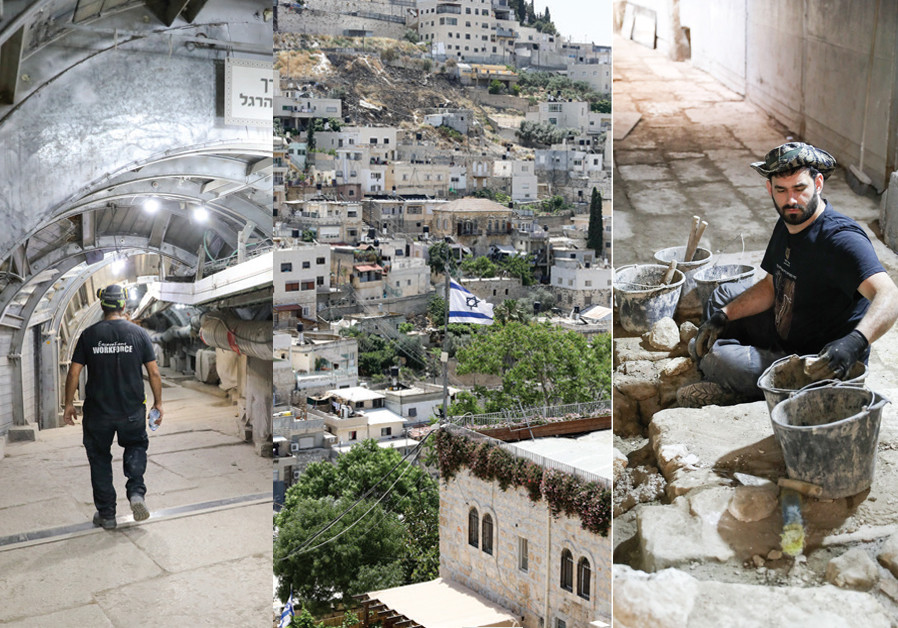
‘I FOUND myself on an exclusive tour of an ancient road dug out from beneath the village of Silwan and the now well-known water channel.’. (photo credit: MARC ISRAEL SELLEM)

US Ambassador David Friedman and US Middle East Special Envoy Jason Greenblatt attended the inauguration of Pilgrimage Road in the City of David on Sunday, triggering angry denunciations from Palestinian and left-wing circles for taking part in a “settler project.”

Ministers Rafi Peretz and Uri Ariel, US Senator Lindsey Graham, Ambassador to the UN Danny Danon, Israel Antiquities Authority director Israel Hasson, and US billionaire Sheldon Adelson and his wife, Miriam, were also among those present at the event.

Friedman wielded a sledgehammer and broke through a wall, ceremoniously opening the tunnel. “The City of David brings biblical Jerusalem back to life,” Friedman said. “It enables every one of us to stroll the corridors where the ancient prophets of Israel gave voice to revolutionary ideals of freedom, liberty and human dignity.

“It is our unique privilege as Americans to walk together with our Israeli counterparts on the just unveiled Pilgrimage Road, where our shared ancestors ascended the flagstone steps in prayer and blessing,” he said.

Palestinians and Jordan strongly condemned the inauguration of Pilgrimage Road, calling it a “falsification of history” and “reversal of the facts.”

They also denounced the participation of Friedman and Greenblatt in the ceremony. Palestinian Authority “governor” of Jerusalem Adnan Gheith said that the participation of the US officials in the ceremony reflects the US administration’s “hostility” against the Palestinians and “denial of Palestinians’ national rights.”

He also accused the US administration of supporting the “colonial settler project spearheaded by the extremist Right in the state of occupation.”

Gheith claimed that the Israeli archaeological excavations pose a “direct threat to al-Aqsa Mosque and its surroundings,” and warned that the excavations could lead to the collapse of parts of the mosque.

The PA Foreign Ministry in Ramallah denounced Friedman and Greenblatt as “false witnesses,” and said they “volunteered to support the falsification of history and the Judaization of Jerusalem.”

The ministry accused Israel of working to change the identity of Jerusalem and its historical and legal reality.”

Fakhri Abu Diab, an east Jerusalem activist from Silwan, called on the international community to “preserve the Palestinian heritage.” He was quoted by the PA’s official news agency Wafa as saying that US President Donald Trump’s plan for peace in the Middle East, also known as the “Deal of the Century,” “was being implemented underground.”

Abu Diab said the archaeological excavations have already caused damage to several houses and a mosque in Silwan.

The agency quoted Palestinian engineer and academic Jamal Amro as saying that the inauguration ceremony was a “new crime” against the Palestinians because it “consolidates the concept that Israeli sovereignty over Jerusalem is entirely above the ground and under it.”

According to Amro, the opening of Pilgrimage Road is an attempt to “impose the Israeli narrative, falsify history and impose its sovereignty on the ground by force.”

Jordan also condemned the opening of Pilgrimage Road, and warned that “such illegal and irresponsible actions increase tension” in the region.

The Jordanian Foreign Ministry said that the kingdom rejects “all Israeli attempts to change the identity and character of the Old City of Jerusalem, especially the Noble Sanctuary [Temple Mount] and adjacent sites.”

The ministry said, “These Israeli practices constitute a flagrant violation of international law and UN resolutions calling for a cessation of all illegal Israeli excavations in the Old City of Jerusalem.”

Earlier, Friedman and Greenblatt slammed the activists who had protested their cooperation in the event, with Friedman saying the discovery “brings truth and science to a debate that has been marred too long by myths.”

He argued that this discovery, among others, will “bring an end to the baseless efforts to deny the historical fact of Jerusalem’s ancient connection to the Jewish people.”

The event was also hotly contested by activists from the NGO Emek Shaveh, who argued that due to its location in east Jerusalem, the decision to excavate the find was motivated by politics rather than searching for historical truth.

Greenblatt said that Emek Shaveh activists “misunderstand the meaning of archaeology,” and said “Peace can only be built on truth.”

Pilgrimage Road was discovered in 2004 when a sewage pipe burst and workers found long and wide stairs near to the water pool Jewish pilgrims used to purify themselves before ascending to the Temple.

The road now offers visitors the chance to walk the ancient path of Jewish pilgrims from the ritual pool, the Shiloah, to the Western Wall.


Hagay Hacohen and Herb Keinon contributed to this report.


Zawartość publikowanych artykułów i materiałów nie reprezentuje poglądów ani opinii Reunion’68,
ani też webmastera Blogu Reunion’68, chyba ze jest to wyraźnie zaznaczone.
Twoje uwagi, linki, własne artykuły lub wiadomości prześlij na adres:
webmaster@reunion68.com


Postcard from Israel – Uncovering Israel

Postcard from Israel – Uncovering Israel

  21see


Zawartość publikowanych artykułów i materiałów nie reprezentuje poglądów ani opinii Reunion’68,
ani też webmastera Blogu Reunion’68, chyba ze jest to wyraźnie zaznaczone.
Twoje uwagi, linki, własne artykuły lub wiadomości prześlij na adres:
webmaster@reunion68.com