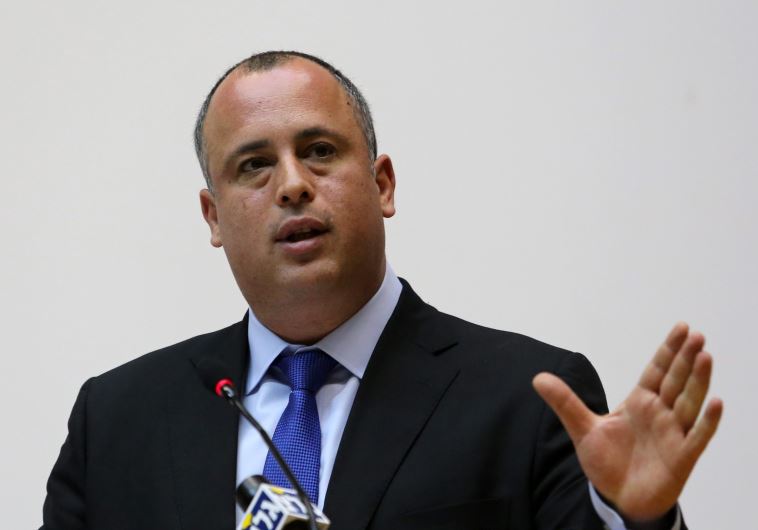
Hilik Bar Photo By: MARC ISRAEL SELLEM
Hilik Bar said he met people in Skulsk who remembered his great grandfather fondly.
For hundreds of years, Skulsk, Poland, had a thriving Jewish community. Before the Holocaust, it was headed by Yitzhak Kotowski and his family, but during the war, he and most of the family were murdered. For 70 years, there was no sign left of the Jews who once lived in Skulsk.
That changed this week, however, when the town received with great fanfare Kotowski’s great-grandson, MK Hilik Bar (Zionist Union).
Ironically Bar, who is deputy Knesset speaker and the head of the Israel-Poland Friendship parliamentary caucus, was received at a municipality building on land his family had owned; it was built over their home, which had been destroyed.
“For me, it was closing a circle, because my great-grandfather was the head of the Jewish community and got killed and I came back as head of the Polish-Israel parliament group in a Jewish state,” he said upon his return to Jerusalem Tuesday. “It’s a huge victory over the Nazis that I came back 70 years later with these titles and the power to push for commemorating the large Jewish community that lived in Skulsk.”
Bar joined forces with From the Depths, an organization that works to discover old Jewish cemeteries and bones and ensure that they are treated with respect. With the help of a sophisticated DNA scanning machine from Poland’s Pomeranian Medical University of Szczecin, Bar and From the Depths director Jonny Daniels were able to find the cemetery where the MK’s relatives were buried before the war.
They dedicated a plaque at the cemetery, as well as a larger monument that is currently at the cemetery but will be moved to the center of town in a September ceremony attended by dozens of Polish politicians and all of Bar’s family.
“In memory of the Jewish community of Skulsk, who lived here and contributed to the culture, arts, commerce and trade until it was almost completely annihilated in the Holocaust by the Nazis,” the monument reads. “This memorial stone was dedicated in the presence of Deputy Knesset Speaker Hilik Bar, great grandson of the late Gitel and Yitzhak Kotowski, the leader of Skulsk’s Jewish community.”
Bar said he had met people in the city who remembered his great-grandfather fondly. He said they had shown him dozens of documents signed by his great-grandfather, who was deputy mayor of the city, and a piece of wood from the family house.
“It’s an amazing thing to find a Jewish community that was ignored, with no sign of their former existence after they were nearly half the population of the city,” Bar said. “I wanted to go there all my life after hearing as a kid that my mother’s family came from there. I told them I don’t want our land back, just to remember the family and that a Jewish community lived there for hundreds of years.”
Daniels said the first time he’d visited the town, he had been told there were no Jewish gravestones left there. He found one that had been used as a grinding stone in a local workshop.
“In a city with hundreds of years of Jewish history, we can’t let them forget it,” Daniels said. “Having the deputy speaker on our team helped us push this further. But we want any Jew around the world looking for his roots to be able to do the same. This is what we’re here for.”
Daniels intends to use the same georadar DNA scanner he used in Skulsk, which can identify Jewish genes, to scan the surface of mass graves and ensure that Jewish bones will be moved to Jewish graves and buried in accordance with Halacha. It is already in use at sites where Polish soldiers are in the process of being reburied.
“Seeing this happen is remarkable, and we’re thankful for the opportunity to do what we do,” he said. “Understanding where we come from highlights the importance of having Israel, a home of our own, where if we are buried, we know it’s forever.”
 Biography
Hilik Bar was born in Safed. Bar was a camper and camp counsellor at “HaNoar HaOved VeHeLomed” (The Federation of Working and Studying Youth) in Safed, and was an active leader in Labor Youth.
Bar studied at Bezek College at Givat Mordechai in Jerusalem. He served in the Israeli Defense Force as an officer in Adjutant Corps and reached the rank of captain in the reserves, later studying at the Hebrew University in Jerusalem. From 1998 he served as chairman of the student organization (“Ofek”) of the Labor Party at Hebrew University, chairman of the national student organization of the Labor Party, and Chairman of the World Youth of the World Labour Zionist Movement.
Bar served as an Advisor to Minister Dalia Itzik in the Environment Ministry and the Ministry of Industry and Trade; an adviser to Acting Mayor of the Jerusalem Municipality, Professor Shimon Sheetrit; Director of Development Economics and Higher Education in the Jerusalem Municipality; Project Manager for the Jerusalem Conference with the Zionist Council for Israel; and adviser to National Infrastructure Minister Binyamin Ben-Eliezer in Ariel Sharon’s second administration and Ehud Olmert’s government. It was during this time that he also served as advisor to Ben-Eliezer while the latter served as Minister of Industry.
During his public service he completed his BA in political science and international relations and MA in international relations at the Hebrew University. In 2008 he was accepted to the master’s program at the Kennedy School of Government at Harvard University, but passed on the opportunity in order to continue his public service.
Since 2002, Bar has been a delegate at the World Zionist Congress and the World Zionist Council. He is actively involved in pro-Israel advocacy and has taken part in advocacy and coexistence missions around the world, in the course of which he met with US President George W. Bush and other senior officials in both the Arab world and the West. In 2003, he was involved in the establishment of the “Young Israeli Forum for Cooperation” (YIFC), an organization whose activity was awarded a special prize by the EU’s Minister of Education.
In August 2008, he was elected as Chairman (Secretary) of the Labour Party in Jerusalem.
On 11 November 2008 he was elected to the Jerusalem City Council on Nir Barkat’s Jerusalem Will Succeed list, and, up until his election to the Knesset, served as a Council member and executive board member, and held the portfolios of Tourism and Foreign Relations for the municipality.
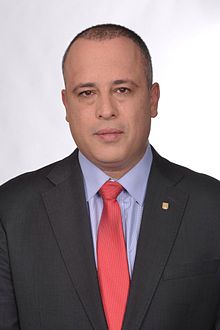 In 2010, Bar was elected Secretary General of the Labour Party, the youngest person ever to serve in that capacity, and the first to be elected to the post before serving as a Member of Knesset. Following Ehud Barak’s retirement as Labor Party chairman in order to establish his Independence Party, the party unanimously re-elected Bar as Secretary General at a conference held on 27 March 2011. After Barak’s departure, Bar played a crucial role in leading the rehabilitation of the Labor Party during the transitional period together with temporary chairman Micha Harish, up until the election of Shelly Yachimovich to the party leadership.
In the party primaries prior to the 2013 Knesset elections, Bar won seventh place on the Labor Party’s list (in his capacity as Secretary General of the party). As a result of Defense Minister Amir Peretz’s resignation (to join Tzipi Livni’s Hatnua party), Bar moved up to sixth place on the list. He was elected in January 2013 to serve in Israel’s Nineteenth Knesset.
Bar lives in Jerusalem. He is married to Edit and has a son named Harel.
 Israel against using term ‘Polish death camps’
 In 2010, Bar was elected Secretary General of the Labour Party, the youngest person ever to serve in that capacity, and the first to be elected to the post before serving as a Member of Knesset. Following Ehud Barak’s retirement as Labor Party chairman in order to establish his Independence Party, the party unanimously re-elected Bar as Secretary General at a conference held on 27 March 2011. After Barak’s departure, Bar played a crucial role in leading the rehabilitation of the Labor Party during the transitional period together with temporary chairman Micha Harish, up until the election of Shelly Yachimovich to the party leadership.
