Archives

Rising above judgment

IsraelNationalNews.comRising above judgment

Rod Bryant


The connection between Noah’s flood narrative and the end of days judgment of the nations.

Noah's Ark (illustration)Noah’s Ark (illustration)

Today we will discover a connection between Noah’s flood narrative and the end of days judgment of the nations (Gog and Magog).

Humanity can rise above this judgment by building a vessel of repentance and rise above judgment. Just as Noah built an ark of salvation so can we.

It is a process of toil and struggle. The results will elevate us all in these troubling times. Have you even wondered why God give Noah the responsibility to build the ark? Of course, we can say he was the only one righteous enough to hear from G-D.
But why did HaShem not just save the righteous? Why must humanity participate in building this vessel of salvation?

Almost every end-time teaching today has Gog/Magog invading Israel before the coming of Messiah. All the Biblical nations mentioned in this invasion have been matched up with today’s countries and are being carefully monitored.

With Russia’s sudden reentry into the Middle East allied with Syria and Iran many are asking nervously, “is this Gog’s Axis of Evil?”

But could all our concern about Gog’s army be completely misplaced? The Bible only mentions Gog and Magog in two places: Ezekiel 38:1- 39:16 and Revelation 20:7-11. Ezekiel’s prophecy doesn’t give us a precise timing for Gog’s attack other than he will be summoned “in the latter years.” But John’s revelation is very specific. He places Gog’s invasion at the end of the 1000-year reign of Messiah.

So why are so many biblical prognosticators certain Gog will attack before Yeshua even gets here? Especially when the conditions needed to provoke his attack in Ezekiel’s prophecy depict the supernatural peace of the Messianic Age? Ezekiel’s prophecy describes an Israel – “restored from the sword, whose inhabitants are …all living securely, all of them…and without walls and having no bars or gates.” But how can that type of peace and security exist prior toYeshua coming and destroying Antichrist and the evil world system? (Rev. 19:11-21)

I know many believe Antichrist will trick Israel into accepting a false peace plan. But in today’s world, does anyone seriously think Israel would dismantle its nuclear deterrent, Iron Dome defense and world-class army and air force, and just kick back and raise sheep? I don’t care how beguiling Antichrist’s peace plan might be, Israel has learned its lesson about trusting any Gentile power with its security. Their slogan is, “Never again!”

Ibelieve it’s time to reconsider some things. When we look at the preceding chapters in Ezekiel we see a succession of prophecies that must be fulfilled for this unprecedented peace and security to be present in Israel before the Gog/Magog invasion.

Starting in chapter 28: 24,25 we read the security starts after scattered Israel comes into the land, and all her enemies “who scorned them round about” are no more. God’s holiness will then be manifested in them “in the sight of all the nations.” Neither is the case today.

In chapter 34, we learn the scattered ‘sheep’ of BOTH Israel’s two kingdoms must be regathered, not just the descendants of Judah, and all living under one shepherd, Messiah. “And I will make a covenant of peace with them…and they will live securely and no one will make them afraid” (v. 25). Even harmful animals will be eliminated so the people “…may sleep in the woods.”

In chapter 37 we have the famous two-stick prophecy that graphically symbolizes the reunion of Judah and Israel under “My servant David.” And it states, “I will make a covenant of peace with them” – which results in Israel entering her Millennium rest with “…My sanctuary in their midst forever.”

That brings us to chapter 38 where we find this amazing peace now in place and Gog being summoned “after many days” to attack “the land restored from the sword” and those “who are at rest.” Surely this describes the millennial reign of Messiah when “the wolf will live with the lamb” (Isa. 11:6). And “nation will not lift up sword against nation, and never again learn war” (Isaiah 2:4) – that is, until Satan is let loose one more time!
f so, whatever Russia’s presence might mean today, we know Gog won’t show up for at least another thousand years!

Maybe we should be focusing on what’s needed to bring about this awesome end-time peace and security – namely, the reunion of Judah and Israel. And if this growing fellowship of Zionist Christians and Jews today isn’t the start of that reunion, I don’t know what is.


twoje uwagi, linki, wlasne artykuly, lub wiadomosci przeslij do: webmaster@reunion68.com


Converting Waste Water into Electricity

Converting Waste Water intoElectricity

Israel   Israel


Israel company EMEFCY has developed a revolutionary, innovative and environmentally sound process to convert waste water into electricy, while purifying the water. This process convert waste water treatment plants from energy consumers into energy producers.


twoje uwagi, linki, wlasne artykuly, lub wiadomosci przeslij do: webmaster@reunion68.com


German guesthouse turns away Israelis: ‘Our apartments are not for them’

The Jerusalem Post - Israel NewsGerman guesthouse turns away Israelis: ‘Our apartments are not for them’

JPOST.COM STAFF


Group of Israeli travelers told to cancel reservation at lodging in Baden-Württemberg.

Black Forest GermanyPastoral view of the Black Forest in Germany [File] Photo By: WIKIMEDIA COMMONS/ADRIAN THOMALE

A group of Israeli tourists looking for board while planning a trip to Germany next summer were shocked after a guesthouse in the southwestern region of Baden-Württemberg last week urged them to cancel their reservation due to their nationality.
While planning a vacation for next August, the four Israeli families reserved lodging at the Mattenhof guesthouse in the Black Forest town of Zell am Harmersbach, explained one of the party’s members, Igor Tsehansky.

owever, shortly after confirming the reservation, the administrators of the guesthouse contacted the Israelis with a slew of messages and notified them that they should cancel the booking.

Tsehansky said that he and his friends received the German-language notice less than week after making the arrangements.

“We don’t Want have Guests from Israel, because our apartments are Not for them [sic]. Please cancel the Booking,” read a Google translated message that Tsehansky posted to Facebook.

In light of the matter, the disgruntled Israeli traveler contacted the Booking.com platform that had facilitated the reservation to complain and request alternative accommodations.

“It took us weeks to find the hotel and we even ordered it a year in advance,” he told Jpost.com on Sunday.

Despite various attempts by the online accommodation booking website to make other accommodations or financial compensation for the Israeli group, the future tourists remained disconcerted by the ordeal.

“Nothing has been resolved,” he said, adding that he plans to file a complaint against the booking company.

According to Tsehansky, Booking.com said it had lowered the guesthouse’s review score in light of the incident, although Jpost.com could not confirm the action.

While Tsehansky noted that he had successfully booked a separate hotel for another leg of the Germany trip, the issue with the Black Forest lodging represented a “specific incident.”

As of Sunday evening, Booking.com had not responded to a request for comment by Jpost.com.


twoje uwagi, linki, wlasne artykuly, lub wiadomosci przeslij do: webmaster@reunion68.com


Column One: Checkmating Obama

The Jerusalem Post - Israel NewsColumn One: Checkmating Obama

CAROLINE B. GLICK


Obama has waited eight years to exact his revenge on Israel for not supporting his hostile, strategically irrational policies. And he has no interest in letting bygones be bygones.
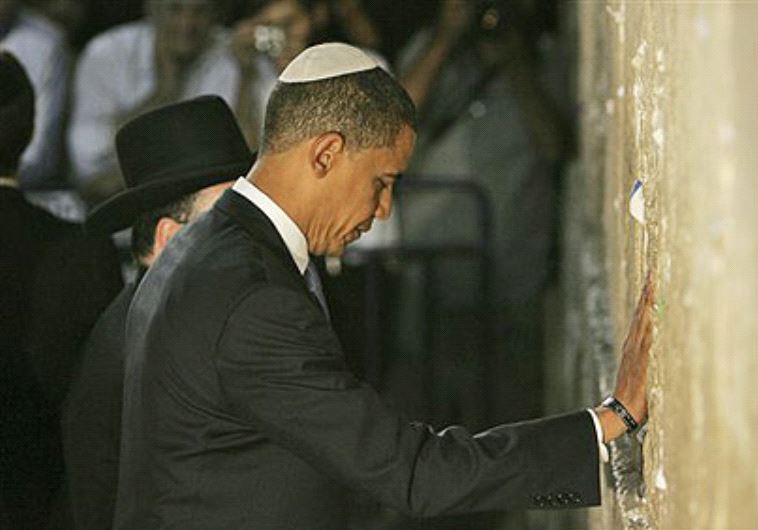
Obama at the Western WallObama at the Western Wall Photo By: AFP PHOTO

In one of the immortal lines of Godfather 2, mafia boss Michael Corleone discusses the fate of his brother, who betrayed him, with his enforcer.
“I don’t want anything to happen to him while my mother is alive,” Corleone said.

Message received.

The brother was murdered after their mother’s funeral.

Last week it was reported that the Obama administration has delivered a message to the Palestinian Authority. The administration has warned the PA that the US will veto any anti-Israel resolution brought before the UN Security Council before the US presidential elections on November 8.

Message received.

Open season on Israel at the Security Council will commence November 9. The Palestinians are planning appropriately.

Israel needs to plan, too. Israel’s most urgent diplomatic mission today is to develop and implement a strategy that will outflank President Barack Obama in his final eight weeks in power.

Lobbying the administration is pointless. Obama has waited eight years to exact his revenge on Israel for not supporting his hostile, strategically irrational policies. And he has no interest in letting bygones be bygones.

Before turning to what Israel must do, first we need to understand what Israel can do.

A good place to begin is by considering what just transpired at UNESCO, where twice in a week, UNESCO bodies resolved to erase 3,000 years of Jewish history in Jerusalem and the Temple Mount.

The fight that Israel waged at UNESCO is not the fight it needs to wage at the Security Council. The stakes at the Security Council are far higher.

Like the UN General Assembly, UNESCO’s decisions are non-binding declarations that have no legal or operational significance. As such, there is no reason to expend great resources to fight them. For Israel, the goal of the fight at UNESCO is not to defeat anti-Israel initiatives. That is impossible given the Palestinians’ automatic majority.

The purpose of the fight at UNESCO is to humiliate European governments that side with antisemitic initiatives, and to weaken the congenitally anti-Israel body itself.

The government achieved both of these objectives. Italian Prime Minister Matteo Renzi’s disavowal of his own government’s abstention from the vote on the first resolution – like the similar position taken after the fact by the Mexican government – was a diplomatic victory for Israel.

So too, the fact that UNESCO’s own Secretary-General Irina Bukova felt compelled to disavow her own agency’s actions by rejecting the resolution’s denial of the Jewish people’s ties to Jerusalem was a significant victory for Israel. Her statement was deeply damaging for UNESCO and its reputation.

Finally, the fact that Tanzania and the Philippines voted against the resolution was a testament to Israel’s capacity to convince other governments to abandon their traditional pro-Palestinian voting pattern.

The Palestinians won the vote at UNESCO because they are more powerful diplomatically than Israel. They have an automatic anti-Israel majority. But they weren’t empowered by their victory. To the contrary. They were bloodied by it.

In a sign of their weakening hold on member nations, the Palestinians and Jordanians felt compelled to send a threatening letter to the members of UNESCO’s World Heritage Committee lest they dare to vote against the resolution. Powerful players don’t make threats. They don’t need to.

Israel’s experience at UNESCO teaches us that there are governments that are open to counteroffers. Israel doesn’t need to hide in America’s shadow. It is capable of working on its own to blunt the impact of the Palestinians’ automatic majority. And it will need to use all of its resources to fend off a US-backed assault at the Security Council.

Unlike UNESCO, the Security Council can pass legally binding resolutions. Israel needs to be prepared to bring all of its resources to bear to prevent such a resolution from being adopted against it. Obama’s intention to abandon Israel at the Security Council means that Israel comes to this battle severely hobbled.

But there is one advantage to the US’s betrayal.

Over the years, Israel’s ability to trust the US to veto anti-Israel resolutions at the Security Council was been a mixed blessing. On the one hand, the US has secured Israel from diplomatic assaults. But on the other hand, our ability to trust Washington has made us diplomatically lazy and ineffective.

Safe in Washington’s shadow, we have behaved as through all diplomacy is public diplomacy. That is, we have pretended that statecraft begins and ends with making the moral or strategic case for our side against the other guys.

But public diplomacy is just one diplomatic tool.

The Syrian regime, for instance, has no moral case for securing international support. Bashar Assad didn’t convince Russian President Vladimir Putin to support him by arguing that he is better than alternative regimes. He bought Putin’s support by offering him permanent air and naval bases in Syria.

Then there is Morocco, another weak state with no public diplomacy case to make. Last March, UN Secretary-General Ban Ki-moon outraged Rabat when he acknowledged the plain fact that Western Sahara, which Morocco occupies, is “occupied territory.”

Morocco quickly secured the support of Spain and France and launched an all-out onslaught against Ban. How did Morocco manage?

Morocco’s most powerful diplomatic resource is its control over migration flows from North Africa to Europe. Anytime it wishes, Rabat can open the migratory floodgates just as easily as it can keep them shut. And the French and Spanish know it.

In less than a month, Ban issued repeated abject apologies.

Game. Set. Match. Morocco.

From reports to date, it appears that shortly after the US elections on November 8, the Malaysians or Egyptians will submit a Palestinian-backed resolution that defines Israeli communities in united Jerusalem, Judea and Samaria as illegal. If the resolution is brought to a vote, the US will fail to veto it.

Such a resolution, or a resolution obligating Israel to withdraw to the 1949 armistice lines, would cause Israel grave harm.

So what resources does Israel have to prevent this from happening?

Of course, we have public diplomacy. And that might work with some friendly nations. But it won’t get us over the top. We need to learn from the Syrian and Moroccan examples and consider what we have to offer Security Council members in exchange for their support in scuttling the approaching onslaught against us.

One such resource is the US Congress. Israel’s allies in Congress are sickened by the Obama administration’s devastating Middle East policies. A solid majority of lawmakers can be trusted to support actions that will reinforce Israel’s position.

Israel has other resources as well that we can trade on. We have natural gas. And we have technologies that the governments of the world require to surmount the challenges of the 21 century. There is no reason to give these resources away when we can trade them for diplomatic support.

As for the Palestinians, as the UNESCO vote showed, they are less popular now than at any time in the past 40 years. All they have to offer is threats and antisemitism. Both are powerful weapons.

But they are no longer invincible.

Israel’s goal must be to use our resources at the Security Council in a manner that will make it impossible for Obama to enable an anti-Israel resolution to pass.

A method for achieving this goal has two components. The first component is to convince a friendly country on the Security Council to propose a balanced resolution that would counter the Palestinian-backed Israel-bashing one.

Such a resolution could include four points. First, it could deplore efforts to deny Jewish history in Jerusalem and the Temple Mount.

Second, it can condemn the PA/PLO for their continued unlawful funding of terrorists.

Third, it can urge Israel to restrain settlement construction in areas that in previous negotiations have been identified as likely territory for a future Palestinian state.

Fourth, it can call on Israel and the PA to reinstate negotiations immediately without preconditions.

Israel has friendly ties with a few Security Council members, among them Uruguay and New Zealand. In the final weeks of the Obama era, it is possible that Israel will be able to convince one of them to submit a balanced resolution along these lines.

Obama would be hard-pressed to oppose such a resolution in favor of one that singles Israel out for rebuke.

But that still is insufficient. Obama can make Uruguay and New Zealand a better offer if he wishes.

And so we move to the second aspect of the plan.

If we learn nothing else from the Obama era, we must recognize that the time has come for Israel to stop sufficing with just one Security Council veto. Most states have several. And we need a few more.

Russia today is the best place to start our search for a second veto.

Putin is a dealmaker. As his agreement with Assad showed, he is willing to consider attractive offers. Obviously, Israel won’t offer Russia bases. But we do have other things to offer Putin in exchange for a veto.

For instance, in exchange for a Russian veto at the Security Council, Israel can offer Putin to lobby the US Congress to cancel US sanctions against Russia over Russia’s annexation of Crimea.

Israel has no dog in that fight. And the sanctions are not getting the US anywhere.

Putin might go for the deal for two reasons. First, by stepping into the breach and defending Israel against Obama, he will humiliate Obama.

Second, if Israel succeeds with the Congress, he will reap economic rewards.

For his part, Putin wouldn’t even have to openly side with Israel. All he would have to do is announce that in the interests of regional stability, Russia will not support an unbalanced resolution on Israel and the Palestinians.

If Putin supports a balanced resolution, Obama will be checkmated. His plan to take revenge on Israel for not following him off the strategic cliff will be foiled. Israel will have survived his presidency.

None of this will be easy. And success is far from assured. There are many more ways for Israel to fail than succeed. Our diplomatic weakness remains a millstone around our neck. But as the UNESCO resolutions showed, attacking Israel is no longer cost free. We are not powerless in the grip of circumstances. We have cards to play.

And now is the time to play them for all they are worth.


twoje uwagi, linki, wlasne artykuly, lub wiadomosci przeslij do: webmaster@reunion68.com


Fishing zone expanded by 50% for Gaza’s 4,000 fishermen

The Jerusalem Post - Israel NewsFishing zone expanded by 50% for Gaza’s 4,000 fishermen

ADAM RASGON


The decision will increase the coastal enclave’s fishing zone from six to nine nautical miles and will go into effect on November 1.

Palestinian fishermen in the waters off of the Gaza StripPalestinian fishermen in the waters off of the Gaza Strip Photo By: REUTERS

The IDF decided on Wednesday to expand the designated fishing zone off the coast of Gaza for the upcoming fishing season.

“COGAT decided to approve the expansion of the fishing zone along the Gaza Strip,” read a statement from the Coordinator of Government Activities in the Territories, a branch of the Defense Ministry.

The decision will increase the coastal enclave’s fishing zone from six to nine nautical miles and will go into effect on November 1 and expire approximately two months later.

COGAT said that it made the decision “to facilitate increased activity in Gaza Strip’s fishing sector, which is an [important] source of income.”

A similar measure to expand the fishing zone between April and June 2016 resulted in a 15% increase in the total output of fish, compared to the same period in 2015, according to COGAT.

The total output of the fish market in Gaza stands at NIS 6 million annually.

Amjad al-Shrafi, the secretary- general of the Gaza fisherman’s union, told The Jerusalem Post that he welcomes the expansion, but expressed his frustration that it will only last for two months. “We consider the expansion of the fishing zone an achievement of our rights as fishermen, but why will it only last for two months?” he said. “We believe the Israeli authorities should make this change permanent.”

Ibrahim Bakr, a Gazan fisherman, said that he is happy about the decision, but also is concerned it will not be fully implemented. “We support any decision to expand the fishing zone, but the Israeli authorities must allow us to take advantage of all nine miles,” he said. “When Israel expanded the zone to nine miles in April, it frequently barred us from going beyond 7.5 miles.

“On many occasions, I would go out beyond seven and eight miles and then the Israelis would yell to retreat and shoot warning shots.”

COGAT also said that it hopes to keep the zone open for the fishing season, but warned fishermen against taking advantage of the expansion.

“We emphasize that the expansion of the [fishing zone] is conditioned on the fishermen respecting the agreement [of nine nautical miles] and not exploiting it to smuggle or penetrate Israel’s territory,” the statement added.

Shrafi said the fishermen solely want to catch fish and provide for their families. “We have no interest in conflict with the Israeli authorities.

All we want is to catch fish and take care of our families,” he said.

There are approximately 4000 fishermen in Gaza today.

After the Gaza war in 2014, Israel extended the fishing zone from three to six nautical miles, a substantial increase, but far less than the 12 nautical miles from before the second intifada and 20 nautical miles stated in the Oslo Accords.


twoje uwagi, linki, wlasne artykuly, lub wiadomosci przeslij do: webmaster@reunion68.com