Archives

Raid on the Reactor !

Raid on the Reactor !

Operation Opera (Hebrew: אופרה‎),[1] also known as Operation Babylon,[2] was a surprise Israeli air strike carried out on 7 June 1981, that destroyed a nuclear reactor under construction 17 kilometers (10.5 miles) southeast of Baghdad, Iraq.[3][4][5] This operation was after Iran’s Operation Scorch Sword that damaged this nuclear facility months before.

In 1976, Iraq purchased an “Osiris”-class nuclear reactor from France.[6][7] While Iraq and France maintained that the reactor, named Osirak by the French, was intended for peaceful scientific research,[8] the Israelis viewed the reactor with suspicion, and said that it was designed to make nuclear weapons.[3] On 7 June 1981, a flight of Israeli Air Force F-16A fighter aircraft, with an escort of F-15As, bombed and heavily damaged the Osirak reactor.[9] Israel claimed it acted in self-defense, and that the reactor had “less than a month to go” before “it might have become critical.”[10] Ten Iraqi soldiers and one French civilian were killed.[11] The attack took place about three weeks before the elections for the Knesset.[12]

The attack was strongly criticized around the world and Israel was rebuked by the United Nations Security Council and General Assembly in two separate resolutions.[13][14] The destruction of Osirak has been cited as an example of a preventive strike in contemporary scholarship on international law.


twoje uwagi, linki, wlasne artykuly, lub wiadomosci przeslij do: webmaster@reunion68.com


German, Austrian Jews worried about anti-Semitism.

German, Austrian Jews worried about anti-Semitism and extreme ideologies from refugees

Benjamin Weinthal


Germany will also likely absorb a number of Palestinians as part of its relaxed immigration policies.

Angela Merkel

Migrants from Syria and Iraq take selfies with German Chancellor Angela Merkel outside a refugee camp near the Federal Office for Migration and Refugees after their registration at Berlin’s Spandau district, Germany, September 10, 2015 Photo By: REUTERS


The growing influx into central Europe of refugees from Muslim-majority countries with a deeply rooted culture of lethal anti-Semitism has started to jolt Jewish leaders and journalists into an examination of dangers inherent in the mass migration.

Oskar Deutsch, head of Austria’s Jewish community, issued a warning in a column last week in the daily Kurier, “The hundreds of thousands of refugees from Syria or Afghanistan who are coming to Europe were exposed while growing up to decades of anti-Semitism. Jew-hatred was learned and promoted in schools, newspapers and social networks. Terrorism against Israeli was celebrated – such as Islamic attacks on Jewish schools, synagogues and Jewish museums in the West.”

Deutsch further warned of Islamic State fighters disguised as refugees. His concern is grounded in European reality; Islamic State and Jihadi-affiliated combatants have attacked and murdered several European Jews since 2014. For example, the French-Algerian Mehdi Nemmouche, who murdered three people at the Brussels Jewish museum, was a trained Islamic State terrorist.

“Latent anti-Semitism among the approximate 20 million Muslims can transform into violence, as we have unfortunately experienced too often in the past years,” said Deutsch.

In a column last week entitled: “How much anti-Semitism are we actually importing?” Christian Ortner, a popular Vienna columnist, praised Deutsch for his intellectual honesty, and warned that refugees are streaming into the heart of Europe with “a highly likely hefty dose of anti-Semitism, hatred of gays and misogyny.”

“We have pasted over the ‘Je suis Charlie’-posters against the anti-Semitic terrorism in the Jewish Parisian supermarket with ‘Welcome refugee’ signs,” he added.

Israel is acutely aware of the anti-Semitic and anti-Western orientation of many of the refugees. One senior diplomat told The Jerusalem Post that the medical care provided to Syrians in northern Israel might help to decontaminate the “poisonous” anti-Israel climate conditioned by the regimes of Syrian dictator Bashar al-Assad and his father.

In the Rosh Hashana issue of the German Jewish newspaper Jüdische Allgemeine, Juri Goldstein, the deputy chairman of the state of Thuringia’s Jewish community, said, “Many [community members] look with fear at developments in France and themselves remember attacks on Jewish institutions in Europe. But all of them hope, of course, that it will not come to Germany.”

Contrary to the wishes of Goldstein’s community, German Muslim migrants have launched ferocious attacks on German soil. For example, three Palestinian Germans attempted to torch the Wuppertal synagogue in 2014. A court panel gave the three men only suspended sentences, dismissing the attack as a political protest that sought to draw “attention to the Gaza conflict” with Israel.

Germany will likely absorb a number of Palestinians as part of its relaxed immigration policies.

In a Washington Post article, Hisham Fares, an interpreter of Libyan origin, said of the refugees in Vienna: “I’ve met Palestinians who live in camps in Lebanon and now claim they were from Yarmouk camp in Syria. Many of them said they have family in Germany and just use this situation to finally get asylum.

Most of these people say they’ve lost their passports.

The sad thing is that those Syrians who really are fleeing war will be the ones paying the price.”

New York Yankees catcher Yogi Berra, who passed away last week, famously remarked— ‘It’s tough to make predictions, especially about the future.’ Sadly, one prediction is not tough to make: things are likely to get progressively worse for European Jews in the coming years.

Benjamin Weinthal is a fellow at the Foundation for Defense of Democracies.


twoje uwagi, linki, wlasne artykuly, lub wiadomosci przeslij do: webmaster@reunion68.com


The 69 “Hammers” Squadron & Kidon (documentary)

The 69 “Hammers” Squadron & Kidon (documentary)

The 69 “Hammers” Squadron is an Israeli Air Force squadron operating the F-15I Thunder out of Hatzerim. It was formed in July 1948 to operate three B-17 Flying Fortresses which the fledgling Israeli Air Force had acquired in the United States. The squadron flew the Flying Fortress, a type credited with propelling the IAF into the realm of modern aerial warfare, during both the 1948 Arab-Israeli War and 1956 Suez Crisis. Disbanded in early 1957, 69 Squadron reformed in 1969 to fly the F-4 Phantom II. 69 Squadron operated the Kurnass (Sledgehammer), as the Phantom was known in Israel, for 25 years and its Phantoms saw extensive action during the War of Attrition, Yom Kippur War, First Lebanon War and numerous engagements in between. The squadron often played a central role in IAF suppression of enemy air defences (SEAD) efforts and took part in repeated battles against Egyptian and Syrian air defence arrays.

Kidon (Hebrew: כידון‎, bayonet or “tip of the spear”) is the name of a department within Israel’s Mossad that is allegedly responsible for the execution of opponents. Kidon is suspected of being behind a number of successful assassination campaigns, such as the Operation Wrath of God campaign. Given the secret nature of the unit, there is almost no reliable information available.


twoje uwagi, linki, wlasne artykuly, lub wiadomosci przeslij do: webmaster@reunion68.com


Supreme Moslem Council in 1925: Jerusalem’s Temple Mount is Jewish

LogoSupreme Moslem Council in 1925: Jerusalem’s Temple Mount is Jewish

org. Arutz Sheva


The widely-disseminated Arab Moslem position that the Temple Mount is not Jewish has been debunked – by the Supreme Moslem Council (Waqf) of Jerusalem, in a Temple Mount guide published in 1925.

Guidebook Puts the Lie to Current Arab Campaign
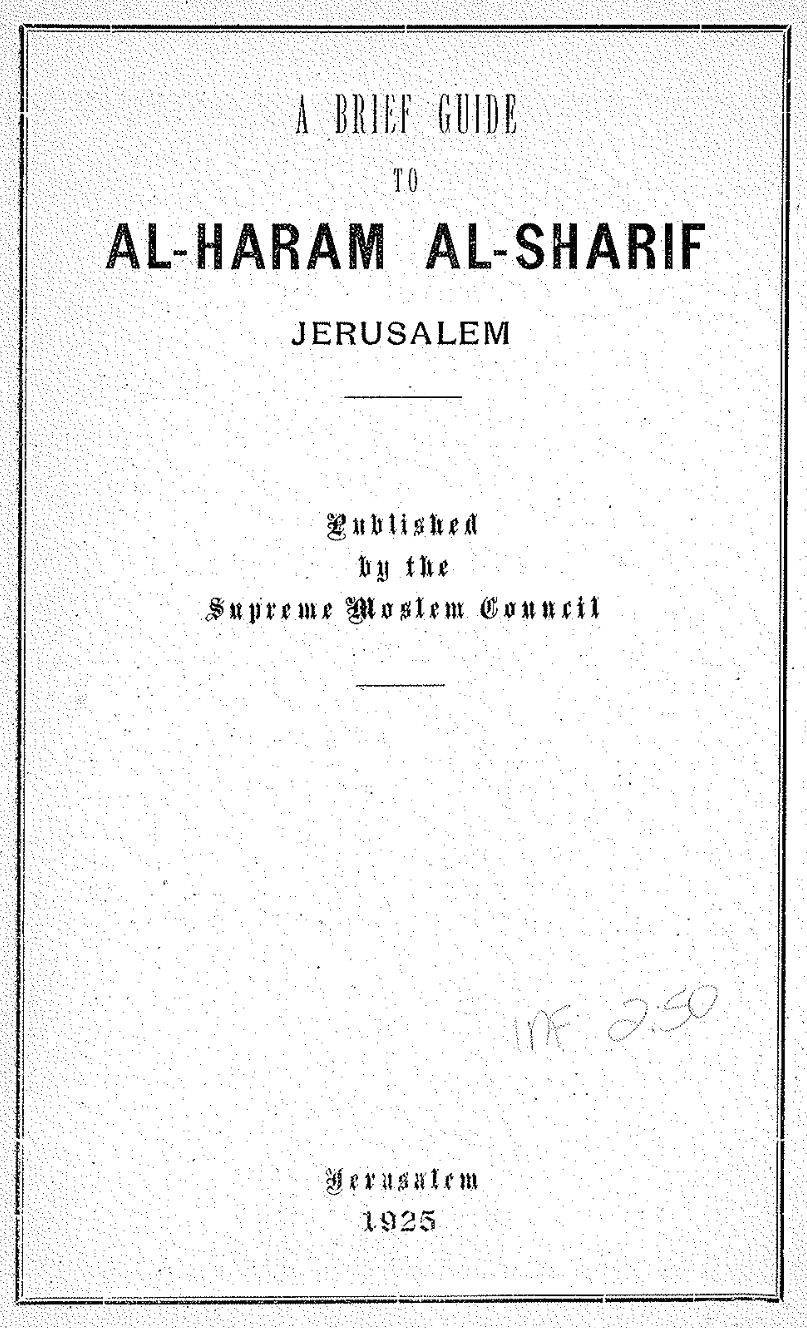
Wakf guidebook, 1925, cover - The Temple Institute

In 1997, the chief Moslem cleric of the Palestinian Authority, Mufti Ikrama Sabri, stated, “The claim of the Jews to the right over [Jerusalem] is false, and we recognize nothing but an entirely Islamic Jerusalem under Islamic supervision…”

Thus began a campaign to convince the world that the millennia-old natural association between Jerusalem and Jews was untrue. As Islamic Movement chief Raed Salah stated in 2006, “We remind, for the 1,000th time, that the entire Al-Aqsa mosque [on the Temple Mount], including all of its area and alleys above the ground and under it, is exclusive and absolute Moslem property, and no one else has any rights to even one grain of earth in it.”

However, it is now known that this “absolute” Moslem claim is actually not as absolute as claimed. In fact, back in 1925, the Supreme Moslem Council – also known as the Waqf, which has overseen Temple Mount activities on behalf of the Moslem religion for hundreds of years – boasted proudly that the site was none other than that of Solomon’s Temple.

The Jerusalem-based Temple Institute

(http://www.templeinstitute.org) reports that it has acquired a copy of the official 1925 Supreme Moslem Council Guide Book to Al-Haram Al-Sharif (the Moslem name for the Temple Mount). On page 4, the Waqf states, “Its identity with the site of Solomon’s Temple is beyond dispute. This, too, is the spot, according to universal belief, on which ‘David built there an altar unto the L-rd,” citing the source in 2 Samuel XXIV,25.

To download a facsimile of the entire sixteen page guidebook, please click here.(pdf file)

In addition, on page 16, the pamphlet makes reference to the underground area in the south-east corner of the Mount, which is refers to as Solomon’s Stables. “Little is known for certain of the history of the chamber itself,” the guide reads. “It dates probably as far back as the construction of Solomon’s Temple. According to Josephus, it was in existence and was used as a place of refuge by the Jews at the time of the conquest of Jerusalem by Titus in the year 70 A.D.”The Temple Mount in Jerusalem was in fact the site of the two Jewish Holy Temples which stood for nearly 1,000 years (see below).
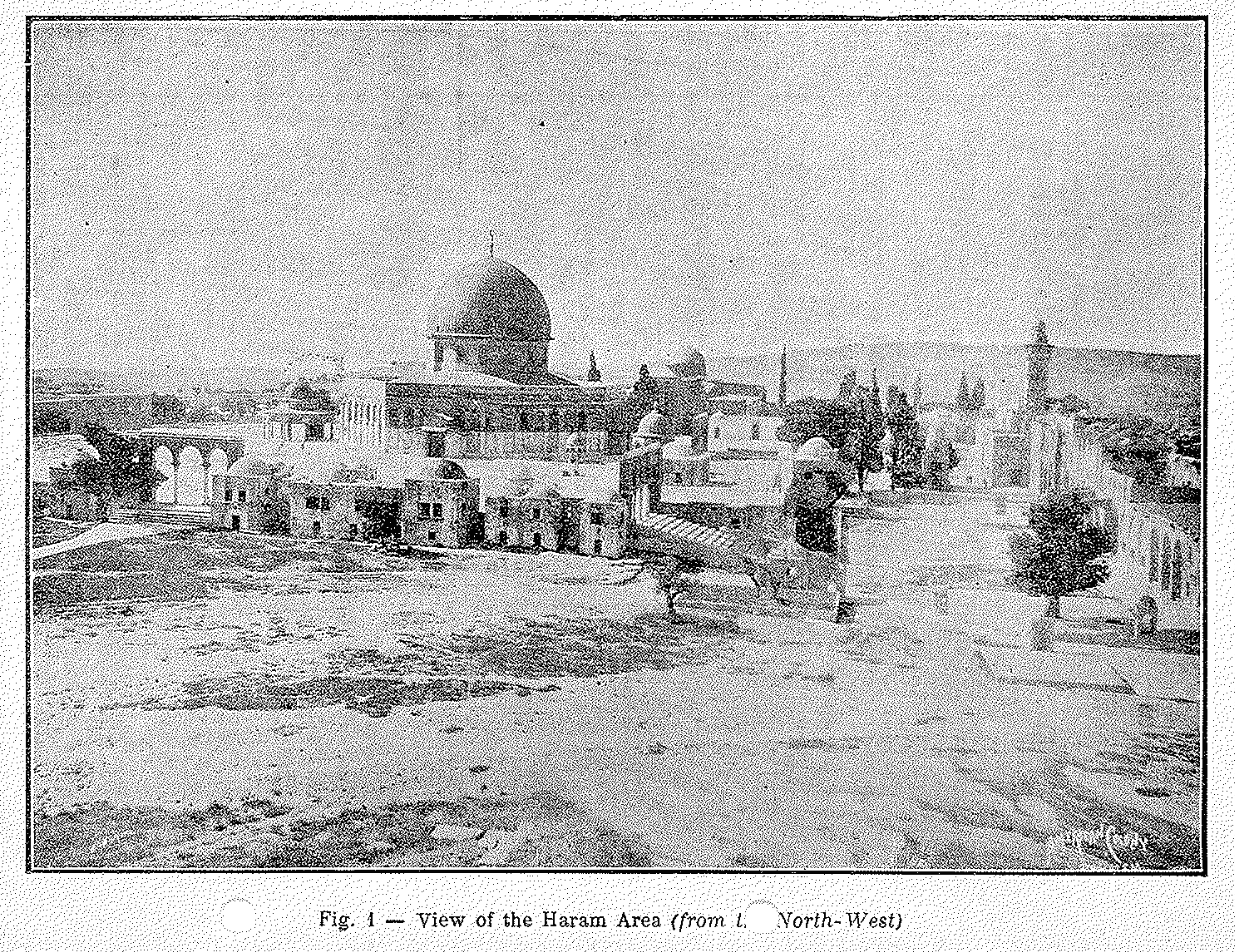
Wakf guidebook, 1925, page 2 - The Temple Institute

Proof of Moslem Anti-Jewish Revisionism

The Temple Institute’s Rabbi Chaim Richman writes that the pamphlet provides proof that the Waqf’s current position is a departure from traditional Muslim belief. “In recent years,” he writes, “the Moslem Waqf has come to deny the historic existence of the Holy Temple, claiming that the Temple Mount belongs solely to the Moslem nation, and that there exists no connection between the Jewish nation and the Temple Mount. It is clear from this pamphlet that the revised Waqf position strays from traditional Moslem acknowledgment of the Mount’s Jewish antecedents.””The current denial of historical reality is merely one tool in the war being waged by Moslems against the G-d of Israel and the entire ‘infidel’ world,” Richman declares.Examples of the new Palestinian/Arab position on Jerusalem:
PA Mufti Sabri was quoted in the Palestinian daily Al-Ayyam on November 22, 1997 as saying, “The ‘Al-Buraq’ Wall [the Western Wall] is a part of the Al-Aqsa Mosque. The Jews have no relation to it.”

The same newspaper, on July 18, 1997, reported that Hamad Yusef, head of The Institution for the Rejuvenation of the Palestinian Heritage, referred to the “false historical claim of the Jews in the holy city, a claim which they were unable to prove in all of the excavations conducted by foreign groups for the past hundred years.” The paper also stated that Hamad “accused the Israelis of unprecedented historical forgeries, emphasizing the Palestinian, the Arab and the Islamic nature of the holy city for the past 6,000 years. Israel fails in her attempt to find a historical connection to Jerusalem.” (courtesy of Jewish Virtual Library)

Jewish History on the Mount

The Temple Mount in Jerusalem was the site of the two Jewish Holy Temples, the first of which was built by King Solomon in the year 832 BCE, close to 1,500 years before Islam was founded. It stood for over 400 years, and after the 70-year Babylonian Exile, a Second Temple was built on the same site. Thus, for nearly 1,000 years, Holy Temples stood on the site, until the Romans conquered the entire land and destroyed the Second Temple. Though the area came under the control of the RomansByzantines, Moslems, Christians, Turks, British and others over the intervening centuries, Jerusalem and the Temple Mount were always the focus of Jewish religious and national yearnings, and continued to be the Jews’ “capital” even while in exile. In the Six Day War of 1967, the modern State of Israel liberated the Temple Mount area and all of Jerusalem, placing it under Jewish control once again after a hiatus of 1,900 years.

Israel, however, never actualized its sovereignty over the holy Temple Mount site, but rather granted the Waqf nearly total control. Jews, in fact, have not been allowed to pray there ever since then-Chief IDF Rabbi Shlomo Goren led a prayer service there on the first Tisha B’Av after the liberation. Jews’ visiting hours are also restricted.


View original Arutz Sheva publication at:http://www.israelnationalnews.com/News/News.aspx/127428#.Vf2G2rShCFK


twoje uwagi, linki, wlasne artykuly, lub wiadomosci przeslij do: webmaster@reunion68.com


If a German Writer Wrote Like Etgar Keret, He’d Be Booted Out of Town

If a German Writer Wrote Like Etgar Keret, He’d Be Booted Out of Town

Benny ZifferBenny Ziffer


But when the writer comes from outside, from the realms of the Third World, the lay reader in Europe thinks to himself: What fun! Why don’t our fossilized old authors write with in that kind of fun style?

At a certain point in the career of successful writers, they take one small step too many toward the edge of the cliff they’re standing on. They trip and – oh! Maybe a sprained ankle. They bend down to find out what’s causing the sharp pain, giving those behind them an opportunity to give them a light kick in the posterior. And the slide down the slippery slope begins. Slowly. At first it’s not even felt. They hold on tight with the fingernails. But for how long?

That’s when I heard (no one tells me anything in this house) that writer Etgar Keret is extraordinarily admired in Poland and that a house – a museum, actually – was established in his name in the heart of Warsaw, on the site of the former Jewish ghetto there. Here is the very embodiment of the era of globalization and postmodernism. The writer is no longer the “landscape of his homeland,” as poet Shaul Tchernichovsky once wrote, but the landscape of the image of a mischievous fellow – or the mischievous, nonbinding composite of images he creates for himself. In this specific case: the image of the urban Ashkenazi Israeli of Polish-Holocaust origin, who has returned home to that place, as it were, but who also remains in Israel, as it were, and who is ostensibly hesitant about what and who he is, but can also be decisive when the need arises.

I – like Thomas Mann (no comparison intended), who when asked if he’d already read Hemingway, replied, “I am still on Tacitus” – am not into fashion trends. I am still on Francois Mauriac and Andre Gide, and it will take me some time yet to be impressed by the play-dumb childish style of Etgar Keret.

Already a decade ago, a witty Berlin friend summed up the Etgar Keret phenomenon for me like this: If a German or European writer were to write like Keret, he’d be booted out of town and told that the writing was utter kitsch. But when the writer comes from outside, from the realms of the Third World, the lay reader in Europe thinks to himself: Wallah! What fun! Why don’t our fossilized old authors write with in that kind of fun style?

That’s the advantage of belonging to a culturally virginal place like Israel: You build a stylistic start-up by degrees. Let’s call it “Tel Aviv Seinfeld” style. First you try it out on the natives, then you sell it to the world, and you’re set for life. Hundreds of natives try to imitate your style, but they don’t achieve the same level of precision in mixing Seinfeldian New York with Tel Aviv.
Not long ago, at a dinner of intellectuals in Paris with French Academy member Angelo Rinaldi, who is considered the pope of literary criticism there, Etgar Keret came up in conversation. The PR woman of a certain publishing house related that a writer had complained to her that the publisher wasn’t promoting his books properly in France and that he was considering a move to a competitor. The elderly Rinaldi asked: Who was it? “Keret, Keret,” the PR woman told him. Rinaldi had never heard the name before, and went back to talking about how angry he had been at Francois Mauriac for not having had the courage to come out of the closet.

(..)
We also think that we have successfully upgraded the image of Tel Aviv and branded it such that despite its ugliness, nothingness and filth, it’s considered something more than what it really is. One of those responsible for the imaginary upgrade of Tel Aviv to a sort of mischievous New York is Etgar Keret and his Cameri Quintet television skits, and the young and supposedly biting “Tel Aviv style” he’s created. From this point of view, he’s an asset to the city’s landlords. Thanks to this style, which is hovering in the air, they can demand thousands of shekels rent for fleabags in which herds of naïve young people, misled into believing in false images, hope to live in the style of a character from an Etgar Keret story or skit or screenplay.

Last week I was sitting with a young German writer who is in love with Tel Aviv, at a hummus place on the Nahalat Binyamin pedestrian mall. He too admitted that he is slowly discovering how neglected and dirty and expensive Tel Aviv is, and how far it is from the image to which it pretends. He told me he has discovered Warsaw. It’s the new, big thing. I told him next time he’s there he should visit the house – museum – of Etgar Keret.


twoje uwagi, linki, wlasne artykuly, lub wiadomosci przeslij do: webmaster@reunion68.com