Archive | October 2019

Tragic shooting attack outside a Jewish synagogue in Germany on Yom Kippur.

Tragic shooting attack outside a Jewish synagogue in Germany on Yom Kippur.

  ILTV ISRAEL DAILY


SHOCKING: 2 have been killed after a tragic shooting attack outside a Jewish synagogue in Germany on Yom Kippur- the holiest day in Judaism. Earlier today, two gunmen attempted to enter a Jewish temple in the Germany city of Halle that was filled with around 70 to 80 worshippers, but the holy space’s tight security measures helped keep the gunmen out. Instead, the shooters opened fire on the street- killing one woman near the synagogue, and one man in a nearby Turkish kebab shop. Several others were injured in attack and as of now, two remain hospitalized in serious condition. Police say that one of the two shooters have been arrested, but that there is a manhunt taking place in search for other perpetrators.


Zawartość publikowanych artykułów i materiałów nie reprezentuje poglądów ani opinii Reunion’68,
ani też webmastera Blogu Reunion’68, chyba ze jest to wyraźnie zaznaczone.
Twoje uwagi, linki, własne artykuły lub wiadomości prześlij na adres:
webmaster@reunion68.com


Rashida Tlaib Endorses Prominent Antisemite — and No One Cares

Rashida Tlaib Endorses Prominent Antisemite — and No One Cares

Petra Marquardt-Bigman


US Congresswoman Rashia Tlaib of Michigan. Photo: Reuters/Rebecca Cook.

It is rather shocking to contemplate the implications of US Rep. Rashida Tlaib (D-MI)’s recent decision to declare her unequivocal support for Zahra Billoo.

When the Democratic Congresswoman took to Twitter on Friday evening, she must have been fully aware of the countless examples for Zahra Billoo’s extremist views that prompted the national Women’s March to quickly rescind Billoo’s recent appointment as a board member.

For the past decade, Billoo has served as Executive Director of the Council on American-Islamic Relations (CAIR) branch in San Francisco, and she has produced an unending stream of hate-filled social media posts during that time.

In 2010, Billoo equated Israelis with Nazis, and declared: “No need for a holocaust museum, seeing as Israel has taken it upon itself to recreate it. #Israel #Nazis.” In 2014, she made a similar statement, asserting that “Israel ‘defending’ itself from Palestinians is analogous to Nazi Germany defending itself from Jewish uprising.” Billoo also indicated support for Hamas, declaring, “Blaming Hamas for firing rockets at [Apartheid] Israel is like blaming a woman for punching her rapist.”

Almost exactly a year ago, Billoo opined that “the Israeli Defense Forces, or the IDF, are no better than ISIS. They are both genocidal terrorist organizations.” Her social media posts include numerous similar statements, and like many radical anti-Israel activists, Billoo also frequently denounces the US. Last year, Billoo described the White House as “a war mongers’ shelter” and a “Zionists’ shelter.”

Not even President Obama was good enough for Billoo, who told her followers in 2012 that she was “troubled by the fact that many of the people who condemn the Taliban for their crimes cheer on Pres. Obama despite his comparable crimes.”

Billoo’s public extremism and the fact that the Women’s March quickly distanced itself from Billoo should make it inconceivable that any politician would publicly embrace her. But Rashida Tlaib was undeterred, and posted [archived link] a remarkable declaration of solidarity with Billoo:

#FreePalestine always sis! They won’t silence us for speaking out against human rights violations. They will lie, smear our names and call us anti this and that, but we always be pro- humanity & we have the truth on our side. Stay strong @ZahraBilloo.

It’s noteworthy that Tlaib’s tweet linked to Billoo’s thread complaining about her dismissal from the Women’s March board. Without acknowledging any wrongdoing, Billoo blamed “an Islamophobic smear campaign led by the usual antagonists.”

While Billoo felt it might have been advisable to express herself less “passionately,” she made clear that she had no other regrets by declaring: “I stand by my words.”

Rashida Tlaib endorsed Billoo’s sentiments without any reservations, echoing her preposterous claims that she was the victim of “lies” and “smears,” while ridiculing concerns about antisemitism as unwarranted accusations of “anti this and that.” Tlaib also echoed Billoo’s vilification of her critics as bigoted liars by claiming the moral high ground: “we always be pro- humanity & we have the truth on our side.”

But the truth is that it is shocking and alarming that a member of Congress would be so eager to lend unqualified support to an unrepentant extremist like Billoo.

By enthusiastically embracing Billoo as her “sis,” Tlaib signals that support for a #FreePalestine agenda justifies even the most unhinged bigotry. But Tlaib might ask herself why Billoo, whose family is from Pakistan, takes such an intense interest in the Palestinians that she feels only loathing for the Jewish state while remaining apparently unmoved by the dire plight of the Baloch who have long fought Pakistan’s oppressive rule.

Most importantly, however, Tlaib’s enthusiastic embrace of Billoo elevates a radical fringe voice that is not representative of mainstream American Muslims. Pew surveys show that American Muslims are “largely assimilated, happy with their lives, and moderate with respect to many of the issues that have divided Muslims and Westerners around the world.” Pew found that two-thirds of American Muslims acknowledge “that the quality of life for Muslims in the US is better than in most Muslim countries.”

And nearly half (48 percent) of American Muslims say that Muslim leaders in the United States “have not done enough to speak out against Islamic extremists.”

Billoo, by contrast, has always been very proud of her extremist brother.

In 2007, Billoo happily announced on her blog: “my lil’ brother was quoted in the Jewish Journal.” But Billoo had no reason to be proud of her brother Ahmed, who told The Jewish Journal that “the righteousness of suicide bombers needs to be evaluated on a ‘case-by-case basis.’” Ahmed Billoo was clearly reluctant to condemn suicide bombings and explained that he believed they were “something that Islam justifies,” claiming that it was “very rare that I meet someone who says suicide bombings in Palestine are not justified.”

Fast forward to July 2019, and Zahra Billoo’s brother Ahmed is a cleric, also known as Ahmed Ibn Aslam Billoo, who leads a trip to Jerusalem for his employer, the “Institute of Knowledge” in California. When departing from BenGurion Airport, Ahmed Billoo reportedly posted a no longer publicly accessible — but archived — Facebook update that he was “feeling annoyed,” adding an invocation in Arabic that reads in translation: “Oh God, reduce their numbers, exterminate them, and don’t leave a single one alive.” The hashtag “Zionists” in English clarified whom Ahmed Billoo wanted exterminated.

Upon his arrival in the US, Ahmed Billoo apparently complained about harassment by US Customs and Border Protection (CBP) officials, and his sister Zahra eagerly seized the opportunity to emphasize: “My brother @AhmedIbnAslam makes me proud often but there’s a special appreciation I have here – putting his privilege to good use, asserting his rights, speaking out against @CBP harassment, and thereby making it somewhat easier for those who are unable.”

Rashida Tlaib legitimizes Zahra Billoo’s unhinged views, and Zahra Billoo legitimizes her brother’s extremism, all for the sake of a supposedly “progressive” #FreePalestine agenda that seems motivated primarily by a bigoted and even murderous hate for the world’s only Jewish state.


Petra Marquardt-Bigman is a German-Israeli researcher and writer with a PhD in contemporary history. Her recent work has focused on antisemitism and anti-Israel activism


Zawartość publikowanych artykułów i materiałów nie reprezentuje poglądów ani opinii Reunion’68,
ani też webmastera Blogu Reunion’68, chyba ze jest to wyraźnie zaznaczone.
Twoje uwagi, linki, własne artykuły lub wiadomości prześlij na adres:
webmaster@reunion68.com


British Teenager Goes Public About Months of Antisemitic Abuse

British Teenager Goes Public About Months of Antisemitic Abuse

Algemeiner Staff


British teenager Charlotte Nathan, who recently went public about her experience of antisemitic abuse. Photo: Facebook screenshot.

A British teenager has gone public about a torrent of antisemitic invective she has faced in recent months, including taunts about the Holocaust.

Charlotte Nathan, 17, who attends school in Northwich, England, was moved to speak about her experiences after she received a derogatory message on her Snapchat account that said, “I wanna fart in your face to remind you of how your grandparents died.”

The Manchester-based Jewish Telegraph quoted her as saying, “Casual racism is a common feature of daily life, especially among the millennial generation, who perceive racism as a form of humor and so-called ‘banter.’”

“Catalysts, such as memes used on social media, seem to justify and sugarcoat the underlying racial tensions that as a society we fail to address,” she stated. “This can be exemplified through the lack of education supplied about different cultural groups to schools and other communities, exacerbating ignorance.”

“I am no stranger to antisemitic abuse,” she added, “and for the last six years, being in secular education and interacting with other cultures, I have encountered a fair share of comments and remarks.”

“This is evidence of inherited, underlying racism we see daily,” she said.

“The antisemitism I have encountered has been from someone with so-called ‘white privilege’ — a member of our white British middle-class,” Nathan explained. “But I am not insinuating that racial ignorance is a feature in all of our white middle-class.”

“The most worrying thing about casual racism is that these so-called jokes are based around horrifying historical occurrences,” she said. “Jokes are being made with an understanding and education of events.”

“People will joke about the Holocaust with reference to the murder of six million Jewish people, and they will joke about concepts such as slavery, with no restrictions on using the N- word,” she continued. “This is the unfortunate world we live in.”


Zawartość publikowanych artykułów i materiałów nie reprezentuje poglądów ani opinii Reunion’68,
ani też webmastera Blogu Reunion’68, chyba ze jest to wyraźnie zaznaczone.
Twoje uwagi, linki, własne artykuły lub wiadomości prześlij na adres:
webmaster@reunion68.com


75 lat temu zbuntowali się więźniowie Sonderkommanda w Birkenau

75 lat temu zbuntowali się więźniowie Sonderkommanda w Birkenau

Marek Szafrański


Palenie zwłok Żydów w KL Auschwitz-Birkenau – fotografia wykonana potajemnie przez jednego z członków żydowskiego Sonderkommando w 1944 r. Źródło: IPN

75 lat temu w Auschwitz II-Birkenau zbuntowali się więźniowie Sonderkommanda. Byli to głównie Żydzi, których Niemcy wykorzystywali do usuwania ciał zgładzonych w komorach gazowych. Wydarzenia z 7 października 1944 r. to największy bunt w historii obozu.

Pod koniec lata 1944 r., gdy malała liczba transportów z Żydami przeznaczonymi na zagładę, Niemcy zaczęli sukcesywnie likwidować więźniów Sonderkommanda. We wrześniu zgładzili ok. 200 osób. Pozostali zdali sobie sprawę z zagrożenia i zaplanowali bunt. W przygotowaniach Żydom pomagali jeńcy sowieccy, również wcieleni do Sonderkommanda.

Załmen Gradowski, polski Żyd, jeden z organizatorów buntu, w relacji, którą zakopał koło krematorium, opisał najważniejsze wydarzenia, jakich był świadkiem. Jedno ze zdań odnalezionej po wojnie relacji brzmiało: „Mamy straszne przeczucie, gdyż wiemy”.

Plan buntu zakładał wysadzenie krematoriów, podpalenie baraków, przecięcie drutów i masową ucieczkę. Więźniowie dysponowali prymitywnymi granatami, wykonanych z materiału wybuchowego zdobytego od więźniarek pracujących przy demontażu starych samolotów.

7 października 1944 r. rano obozowy ruch oporu zawiadomił buntowników, że SS zamierza zgładzić 300 członków Sonderkommanda. Żydzi postanowili walczyć. Organizatorami buntu, oprócz Gradowskiego, byli polscy Żydzi: Jankiel Handelsman, Josef Deresiński, Josef Darębus. Sygnałem do walki miało być podpalenie krematorium.

Shlomo Venezia, zmarły w 2012 r. członek Sonderkommanda, wspominał, że najważniejsza część buntu miała się rozegrać w krematorium II. Więźniowie planowali, że zaatakują wartowników SS, którzy każdego dnia o godz. 18.00 przechodzili w pobliżu bramy idąc do wieżyczek, zabiją ich i zdobędą broń. To miał być sygnał do walki.

Esesmani przyszli jednak po godz. 13., by zabrać więźniów z krematorium IV. Zostali zaatakowani. Więźniowie byli uzbrojeni w kamienie, młotki i siekiery. Podpalili krematorium. Akcję podjęli także osadzeni w krematorium II. Zgładzili m.in. kapo. „Ocaleni opowiedzieli nam, co zrobili z Karlem, niemieckim kapo, tym pospolitym kryminalistą, który najprawdopodobniej doniósł o planowanym buncie. Ogłuszyli go i tak jak stał, w ubraniu wrzucili do pieca” – relacjonował Venezia. Następnie przecięli druty obozowe i zaczęli uciekać w stronę wsi Rajsko. Tam zabarykadowali się w stodole. Niemcy obrzucili ją granatami wzniecając pożar. Wielu Żydów zabili seriami z karabinów maszynowych.

W walce zginęło ok. 250 więźniów. Byli wśród nich organizatorzy buntu. Ok. 200 zatrzymanych rozstrzelano wkrótce potem. „Zebrano nas przy krematorium. Przemawiał komendant. Pytał, czy zdajemy sobie sprawę z tego, co zrobiliśmy? Powiedział, że poniesiemy konsekwencje. Kazano nam położyć się twarzą do ziemi, ręce do tyłu i rozstrzeliwano co trzeciego” – wspominał więzień Sonderkommando Henryk Mandelbaum.

Liczba osób w Sonderkommando zmniejszyła się po buncie z 663 do 212. Pozostałych przy życiu Niemcy umieścili w krematorium III.

Po buncie Niemcy wszczęli dochodzenie, skąd więźniowie mieli proch. Ustalili, że dostarczały go żydowskie dziewczęta zatrudnione w fabryce: Roza Robota, Ala Gaertner, Regina Safirsztain i Estera Wajcblum. Zostały powieszone trzy tygodnie przed wyzwoleniem obozu.

Pierwsze Sonderkommando powstało, by obsługiwać krematorium I w obozie macierzystym Auschwitz, w którym już latem 1941 r. palono ciała ofiar gazowania Cyklonem B. Adolf Eichmann, organizator masowej zagłady Żydów, zalecał, by członków Sonderkommando likwidować po każdej większej akcji palenia zwłok. W praktyce czyniono to co kilka miesięcy, pozostawiając przy życiu palaczy, mechaników i funkcyjnych.

Jedno z pierwszych Sonderkommand liczyło 80 więźniów. Zgładzono ich latem 1942 r. Na początku lata 1944 r., gdy do Birkenau docierały transporty z Żydami węgierskimi, liczyło ono ok. 900 osób. Więźniowie ci zawsze byli odizolowani. Obóz przeżyło kilkudziesięciu z nich.

Henryk Mandelbaum o Sonderkommandzie mówił: „Kiedy trafiłem do niego, było tak, jakbym do piekła trafił. Ja to palenie, wyrywanie zębów mam codziennie przed sobą. Chodzę z tymi obrazami, jem, śpię, tańczę, śpiewam. Tego się nie da wymazać. Mam to we krwi, w całym ciele” – wspominał. (PAP)


Zawartość publikowanych artykułów i materiałów nie reprezentuje poglądów ani opinii Reunion’68,
ani też webmastera Blogu Reunion’68, chyba ze jest to wyraźnie zaznaczone.
Twoje uwagi, linki, własne artykuły lub wiadomości prześlij na adres:
webmaster@reunion68.com


When Was the “Palestinian People” Created? Google Has the Answer.

When Was the “Palestinian People” Created? Google Has the Answer.

Jean Patrick Grumberg


  • All people born in British Mandatory Palestine between 1923-1948 (today’s Israel) had “Palestine” stamped on their passports at the time. But when they were called Palestinians, the Arabs were offended. They complained: “We are not Palestinians, we are Arabs. The Palestinians are the Jews”.
  • After invading Arab armies were routed and the Arabs who had fled the war wanted to return, they were considered a fifth column and not invited back. The Arabs who had loyally remained in Israel during the war, however, and their descendants, are still there and make up one fifth of the population. They are known as Israeli Arabs; they have the same rights as Christians and Jews, except they are not required to serve in the army unless they wish to.
  • “The Palestinian people does not exist. The creation of a Palestinian state is only a means for continuing our struggle against the state of Israel for our Arab unity. In reality, today there is no difference between Jordanians, Palestinians, Syrians and Lebanese.” – PLO leader Zuheir Mohsen, interview in the Dutch newspaper Trouw, March 1977.

In an op-ed in the Guardian on November 1, 2017, ahead of the 100th anniversary of the Balfour Declaration, Palestinian Authority (PA) President Mahmoud Abbas called on the UK to “atone” for the century of “suffering” that the document allegedly wrought on the “Palestinian people.” Abbas reiterated the claims he has been making since 2016, to justify a surreal lawsuit he has threatened to bring against Britain for supporting the “creation of a homeland for one people [Jews], which, he asserted, “resulted in the dispossession and continuing persecution of another.”

“Palestinians” were the Jews who lived, along with Muslims and Christians on land called Palestine, which was under British administration from 1917 to 1948.

All people born there during the time of the British Mandate had “Palestine” stamped on their passports. But the Arabs were offended when they were called Palestinians. They complained: “We are not Palestinians, we are Arabs. The Palestinians are the Jews”.

Bernard Lewis explains:

“With the rise and spread of pan-Arab ideologies it was as Arabs, not as south Syrians, that the Palestinians began to assert themselves. For the rest of the period of the British Mandate, and for many years after that, their organizations described themselves as Arab and expressed their national identity in Arab rather than in Palestinian or even in Syrian terms.”

When Israel declared independence on May 14, 1948, five Arab armies joined up to try to kill the infant nation in its crib. After they were routed, some of the local Arabs who had fled the war wanted to return, but they were considered a fifth column and most were not allowed back. The Arabs who had loyally remained in Israel during the war, however, and their descendants, are still there and make up one-fifth of Israel’s population today. They are known as Israeli Arabs; they have the same rights as Jews, except they are not legally required to serve in the army. They may volunteer if they wish to.

Israeli Arabs have their own political parties. They serve as members of Knesset and are employed in all professions. The moral is, or should be: Do not start a war unless you are prepared to lose it — as the Arabs in and around Israel have done repeatedly, in 1947-48, 1967 and 1973.

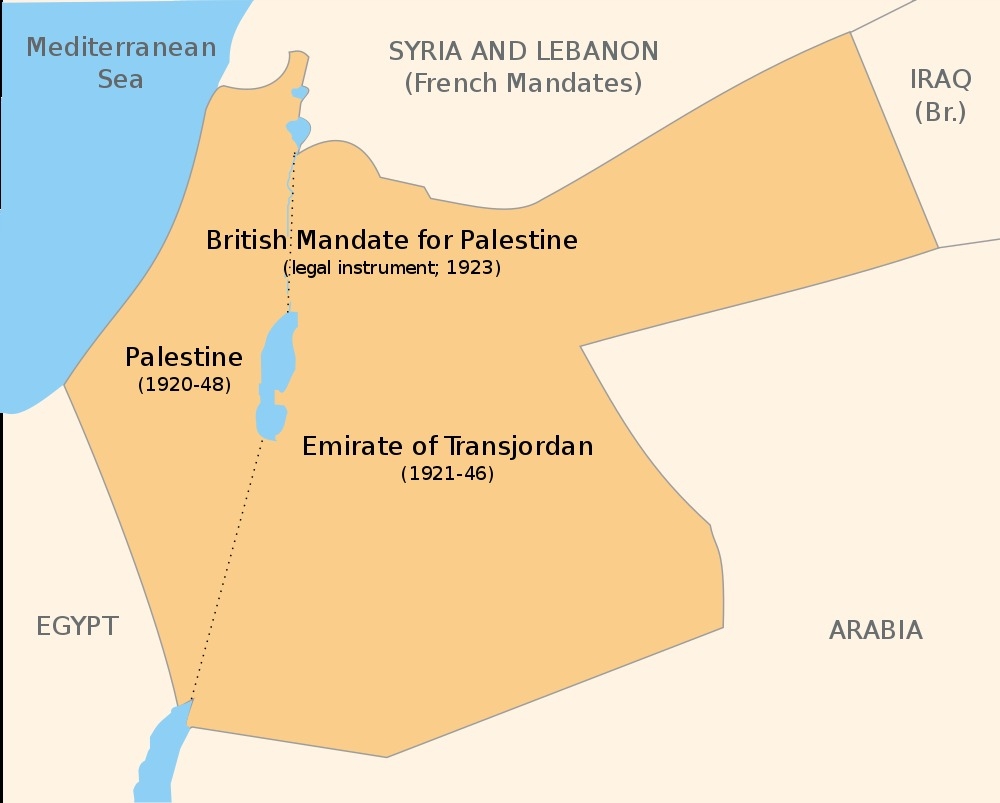
Incidentally, the land that was being held in trust for the Jews in the British Mandate for Palestine initially included all of what is now the Kingdom of Jordan, which was granted its independence in 1946 as the Kingdom of Transjordan.

(Image source: Wikimedia Commons)

Less than a week after the article in the GuardianOmar Barghouti, the instigator of today’s attempts to destroy Israel by suffocating it economically, echoed Abbas in a Newsweek piece, calling the Balfour Declaration “a tragedy for the Palestinian people.”

The same sentiment was expressed at the end of September in a lecture delivered by Rashid Khalidi — the Edward Said Professor of Modern Arab Studies at Columbia University — at the Hagop Kevorkian Center for Near Eastern Studies in New York City: that the Balfour Declaration “launched a century-long assault on the Palestinians aimed at implanting and fostering this national homeland, later the state of Israel, at their expense…”

Khalidi’s claims, like those of Abbas and Barghouti, are false. Prior to the establishment of the state of Israel in 1948, there were no “Palestinians.” As the prominent Lebanese-American historian and Mideast expert Philip Hitti stated in his testimony before the 1946 Anglo-American Committee of Inquiry: “There is no such thing as Palestine in history, absolutely not.”

Authors Guy Millière and David Horowitz elaborate on this in their 2015 book, Comment le peuple palestinien fut inventé (“How the Palestinian People Were Invented”), illustrating that the purpose of the fabrication was “to transform a population into a weapon of mass destruction against Israel and the Jewish people, to demonize Israel, and to give totalitarianism and anti-Semitism renewed means of action.”

The ploy for a while worked beyond expectations. The term “Palestinians” was used across the world — including in Israel — to define the Arabs living in the West Bank and Gaza; it is often employed also to describe Arabs with Israeli citizenship. The narrative that the Jews displaced them by establishing a state completely contradicts the facts.

What are these facts? When was the “Palestinian people” actually created? Simply using the Google Ngram Viewer provides the answer.

Ngram is a database that charts the frequency that a given phrase appears in books published between the years 1500 to 2008. When a user enters the word phrases “Palestinian people” and “Palestinian state” into the Ngram search bar, he discovers that they began appearing only in 1960.

In his November 2, 1917 letter to Walter Rothschild, the leader of Britain’s Jewish community, Foreign Secretary Lord Balfour wrote:

“His Majesty’s government view with favor the establishment in Palestine of a national home for the Jewish people, and will use their best endeavors to facilitate the achievement of this object, it being clearly understood that nothing shall be done which may prejudice the civil and religious rights of existing non-Jewish communities in Palestine [emphasis added], or the rights and political status enjoyed by Jews in any other country.”

Finally, apart from Ngram, there are the words of the PLO leader Zuheir Mohsen, who, in a March 1977 interview with the Dutch newspaper Trouwstated:

“The Palestinian people does not exist. The creation of a Palestinian state is only a means for continuing our struggle against the state of Israel for our Arab unity. In reality, today there is no difference between Jordanians, Palestinians, Syrians and Lebanese. Only for political and tactical reasons do we speak today about the existence of a Palestinian people, since Arab national interests demand that we posit the existence of a distinct Palestinian people to oppose Zionism.”For tactical reasons, Jordan, which is a sovereign state with defined borders, cannot raise claims to Haifa and Jaffa, while as a Palestinian, I can undoubtedly demand Haifa, Jaffa, Beer-Sheva and Jerusalem. However, the moment we reclaim our right to all of Palestine, we will not wait even a minute to unite Palestine and Jordan.”


Jean Patrick Grumberg is a journalist for the French-language news site Dreuz.


Zawartość publikowanych artykułów i materiałów nie reprezentuje poglądów ani opinii Reunion’68,
ani też webmastera Blogu Reunion’68, chyba ze jest to wyraźnie zaznaczone.
Twoje uwagi, linki, własne artykuły lub wiadomości prześlij na adres:
webmaster@reunion68.com