Archive | December 2020

France Is Still Under Attack

France Is Still Under Attack

Guy Millière


  • “If nothing changes, in a few decades, France will have submitted to Islam, and Islamic violence will probably be even greater than today. It is already almost impossible for the country’s leaders to react. They are hostages of a Muslim population that is less and less integrated and whose anger they do not want to arouse. They are under the gaze of groups that immediately denounce any criticism of Islam and under pressure from many countries in the Muslim world that France does not want to offend”. — Alan Wagner, “L’Europe face à l’islam”, interview on Tepa, August 2, 2020.
  • “For Muslims, Islamic law has God as its author. Any other legislator is illegitimate.” — Mohammed Hocine Benkheira, historian, Le Point, March 21, 2016.
  • “Macron… is still not able to pinpoint the real problem because it would be politically incorrect for him to do so… This is the problem with someone like Macron and what he’s saying… they can never acknowledge that what’s happening is integral or a part of authentic Islam….” — Raymond Ibrahim, “Islamic Terror in France”, SkyWatch TV, October 30, 2020.
  • “France still does not understand the reality it is facing. It believes that it has been struck by terrorists… but it is suffering a guerrilla war that is gradually gaining momentum…” — Algerian writer Boualem Sansal, lexpress.fr, October 18, 2020.

According Algerian writer Boualem Sansal, “France still does not understand the reality it is facing. It believes that it has been struck by terrorists… but it is suffering a guerrilla war that is gradually gaining momentum…” (Photo by Farouk Batiche/AFP via Getty Images)

October 29. Nice, the main city on the French Riviera. A man in the Basilica of Notre-Dame-de-l’Assomption decapitates a woman and murders two other people while shouting “Allahu Akbar!” [“Allah is the greatest!”]

This is the second beheading in France by an extremist Muslim in less than a month. Two weeks earlier, on October 16, a middle school teacher, Samuel Paty, was beheaded in the suburbs of Paris after showing his students some Mohammad cartoons during a discussion on freedom of speech.

Paty’s beheading came after many other recent, seemingly jihadist-inspired murders in France. They include the protracted torture and murder of Ilan Halimi in 2006; the slaughter of a Jewish teacher and three children in Toulouse in 2012; the massacre of the staff of the satirical magazine Charlie Hebdo in 2015 and the murder on the same day of four Jews at a kosher supermarket; the beheading of an entrepreneur, Herve Cornara, in his car in the suburbs of Lyon in 2015; a truck-ramming that killed 86 and wounded 458 people leaving a Bastille Day fireworks celebration in Nice on July 14, 2016; the murder a few days later, on July 26, of Father Jacques Hamel while he was conducting mass, and the murders of two elderly Jews, Sarah Halimi and Dr. Mireille Knoll, in 2017.

It is also the third extremist attack in France in less than two months. On September 26, shortly before Paty was killed, a Pakistani, Zaheer Hassan Mahmoud, assaulted and seriously injured two people in front of the former offices of Charlie Hebdo.

Countless attacks by young Muslims, often resulting in serious injuries, are committed daily throughout France — according to police figures, approximately 120 times a day.

France seems to be the Western European country most affected by Islamic violence. Although the deadliest terrorist attacks have disappeared since the destruction of the Islamic State and the far-away bases from which they could easily be organized, they still occur, just on a smaller scale. They never stop.

The attitude of successive French governments every time a serious attack is carried out — the less serious ones go unnoticed — has been the same. The president and his ministers give speeches denouncing the danger and promising firmness; then nothing happens. On February 16, 2015, Prime Minister Manuel Valls actually instructed his countrymen that “the French should get used to living with the terrorist threat”.

A few months after that, on November 14, 2015, an extremist massacre at the Bataclan Theater took place, in which 130 people were murdered and more than 360 wounded. A state of emergency was declared. For two years, soldiers were seen on the streets of France, but when the state of emergency did not prevent several more attacks from being committed — including the assassination of Father Hamel, and the deadly July 14 truck-ramming in Nice — the state of emergency, in view of its uselessness, was lifted two years after it was proclaimed.

President Emmanuel Macron, shortly after he was elected in May 2017, promised to do better than his predecessors and to act decisively. Three and a half years later, he seems largely to have failed.

Macron can see that French hostility towards Islam is growing. A poll conducted in October 2019 revealed that 61% of French people think “Islam is incompatible with the values of French society”. He can also see also that an outspoken opponent of radicalism, Marine Le Pen, president of the National Rally party, is considered by many French people as more credible than he to ensure the security of the country and that she could possibly defeat him in the 2022 presidential election. He has apparently decided, therefore, to try to do more.

On October 2, he delivered a solemn speech denouncing what he calls “Islamic separatism” and promising to propose a law to fight against “Islamism”. He was careful to insist that he was blaming Islamism — which he defined as an “ideology”, as distinct from Islam, which he referred to as “a religion in crisis.”

The next day, the leading French Muslim associations published a statement presenting their constituents as the victims. “Muslims in France,” they said, “are increasingly the target of the worst stigmatization and invective from political figures who make Islamophobia a business”.

Anti-racist associations supported their statement. Dominique Sopo, president of SOS Racisme, said that Macron was sinking into “a political obsession with Islam”. Malik Salemkour, president of the League for Human Rights, accused Macron of taking up “the speeches of the extreme right and pointing the finger at innocent culprits, fundamentalist Muslims”.

The leaders of several Muslim countries called for a boycott of French products. Turkish President Recep Tayyip Erdogan questioned Macron’s “mental health”. The Organisation of Islamic Cooperation did not name Macron, but “deplored the remarks of some French officials that could harm Franco-Muslim relations”.

To calm the situation, Macron sent French Foreign Minister Jean-Yves Le Drian to Egypt to meet with Ahmed al-Tayeb, the Grand Imam of Al-Azhar University, Egypt’s highest Muslim authority, After their discussion on November 9, Le Drian announced, “I have emphasized, and emphasize here, the deep respect we have for Islam.”

Macron, responding to an article in the Financial Times accusing him of “dividing France further,” wrote that he did not in any way want to “stigmatize Muslims,” and that he had spoken of “Islamist separatism,” not of “Islamic separatism”. He stated that that France was “confronted by hundreds of radicalized individuals, who we fear may, at any moment, take a knife and kill people…. This,” he noted, “is what France is fighting against — designs of hatred and death that threaten its children — never against Islam”.

Since then, Macron has been even more cautious.

On the evening of Paty’s beheading on October 16, Macron said that the murder had been an “Islamist terrorist attack” and denounced “obscurantism and violence”. He later said that the murderer seemed to have been driven by “the fatal conspiracy of stupidity, lies, amalgamation, hatred of the other”.

Just two weeks later, however, after the knife murder of three people in Nice on October 28, Macron simply asked “people of all religions to unite and not give in to the spirit of division”.

The notion of Islamist separatism used by Macron does not really make a lot of sense. He criticized what he calls Islamist separatism for “claiming that its own laws are superior to those of the Republic”. As the historian Mohammed Hocine Benkheira puts it, explains:

“For Muslims, Islamic law has God as its author. Any other legislator is illegitimate. When people live under laws other than this one, not only do they sin if they accept this state of affairs, but they also live under the reign of injustice and oppression. It is therefore that Islam itself that places its laws above the laws of any government.”

“Islam,” the author Celine Pina pointed out, “does not ask Muslims to separate, but to conquer”.

“If neighborhoods have become Muslim neighborhoods, it is not because the Muslims who live there have decided to separate, but because the non-Muslims have fled from them”, noted Christophe Guilluy, another author. Most non-Muslims, it seems, do not want to live in areas where the law of Islam reigns and where unveiled women are sometimes harassed or assaulted.

The idea that Islamism is an ideology distinct from Islam is, unfortunately, totally meaningless. As Erdogan, regarding the term “moderate Islam,” noted in August 2007, “These descriptions are very ugly. It is offensive and an insult to our religion. There is no moderate or immoderate Islam. Islam is Islam and that’s it.” Such false distinctions, according to the British author Douglas Murray in his book , Islamophilia, are usually “used by political leaders who fear offending Muslim populations”.

For Islamic organizations, anti-racist organizations, and various countries of the Muslim world, however, speaking of “Islamist separatism” or “Islamism” in France, or promising to fight against “Islamism”, or saying that Islam is in crisis, is evidently a bridge too far.

The law Macron promised has been presented to the French National Assembly and is to be voted on this month. The text shows that Macron’s law will not, after all, be against “Islamic separatism”, but only a “law upholding republican principles”. The main aim of the law, it seems, is to “combat online hate” — which is not defined in the text. The law will not, therefore, allow anyone to “combat” anything that judges or associations might define as hate.

The new law seems aligned with another, defined as a “law to fight against hateful content on the Internet”. Passed on June 24, it, too, fails to define “hateful content on the Internet.”

The new law will, however, ban home schooling. As Muslim parents are not the only ones who practice it in France, the ruling will consequently affect thousands of non-Muslim families as well.

In a message Macron addressed to the CFCM, Conseil Français du Culte Musulman (French Council of Muslim Worship), an organization created in 2003 to represent the various French Muslim associations, Macron asked its President, Mohamed Moussaoui, and the various Muslim associations belonging to the CFCM, to sign a “charter of republican values”. These defined Islam in France as “a religion and not a political movement,” and prohibited “foreign interference” in French Islam. Although Moussaoui and the Muslim associations belonging to the CFCM immediately signed the proposal, no one is expecting their consent to mean that they are planning to change their practices. Islam has always and everywhere, for fourteen centuries, been more than a religion; it is an entire spiritual, political and legal system, and will continue to be what it is — “Islam is Islam” — and the French President will not be able to change that either. Islam knows no borders and no differences between countries. Muslims belong to the ummah [nation of believers] and that is a situation the French President will not be able to change, either.

The man who stabbed three people to death in Nice on October 29; the murderer of Samuel Paty; the knife-wielding assailant of two people in front of the former offices of the satirical magazine Charlie Hebdo on September 25 and other assailants, all benefited from refugee status. Macron, however, does not seem interested in considering any legislative decisions aimed at examining the files of persons benefiting from that status in France.

For now, France continues to receive approximately 400,000 immigrants a year, most of whom come from the Muslim world. Macron also does not seem interested in considering any measures that might limit immigration to France.

Meanwhile, the proportion of Muslims in the French population continues to grow. Today, Muslims represent 10% of the population; estimates indicate that this figure will double by 2050. At the same time, the number of Muslims living in France who place Shari’ah above the laws of the republic also continues to grow. Currently, 57% of Muslims under the age of 25 say they would prefer to obey Shari’ah rather than the laws of the French republic should they contradict Shari’ah. Previously, in 2016, people holding those views made up only 47%.

Referring to the Mohammed cartoons reprinted by Charlie Hebdo, Macron said that France will not change the laws that guarantee freedom of expression and that he is in a “fight for our freedoms”. Even so, he overlooked that in France, freedom of expression is already extremely restricted, especially when it comes to Islam; the cartoons published by Charlie Hebdo were an exception. A law passed in 1972 long ago condemned “incitement to discrimination, hatred, or violence against a person or group of persons on account of their origin or their belonging to a particular ethnic group, nation, race, or religion”. This law is still increasingly used to condemn speech regarded by some as “Islamophobic”.

The journalist Éric Zemmour has been condemned several times for having made politically incorrect remarks about Muslim immigration and for pointing out that Islam has a history of bloodshed and war. Zemmour was also recently fined 10,000 euros for “incitement to hatred” after a speech he gave on September 28, 2019. What he had said was that Muslims living in France are becoming less and less integrated, that entire neighborhoods are becoming “budding Islamic republics” and that France is undergoing a process of Islamic “colonization”.

The association Riposte Laïque (Secular Response), created to combat the Islamization of France, is constantly under attack in court. Its president, Pierre Cassen, has been condemned again and again for stating, accurately, that all the terrorist attacks that have marked France in the last two decades were committed by Muslims, and that Islam, throughout its history, has fundamentally been violent and bloody. In 2018, Cassen was sentenced to a three-month suspended sentence; if he is sentenced again, for “Islamophobic” speech, even if what he says is factually correct, he will spend at least a month in prison. Criticizing uncontrolled immigration to France and its consequences could be enough to earn him jail time.

Renaud Camus, the author of the book Le grand remplacement (“The Great Replacement”) — which describes the slow replacement of the French population by a Muslim population — was sentenced in January 2020 to a two-month suspended sentence for having said that “immigration has become invasion”.

At a ceremony in honor of Paty, Macron paid tribute to teachers. He noted that they bring knowledge, and promised that he would give back “to them the power of the place and the authority that belongs to them. We will consider them as they should be, we will support them, we will protect them as much as necessary”.

The reality is that most teachers in France can no longer bring real knowledge to anyone. They would find themselves in danger or out of work. Twenty teachers recently published an article in which they spoke of “students running in the corridors of schools screaming Allahu akbar”, “students who threaten teachers [and] humiliate them in front of their class” and who state that “there are no measures to effectively ensure the safety of teachers.”

As far back as 2002, the historian Georges Bensoussan noted in the book Les territoires perdus de la République (“The Lost Territories of the Republic”) that it had become impossible in the high schools of France’s Muslim neighborhoods to talk about the Holocaust and certain other subjects. He added that teachers had to censor themselves or risk their lives. Fifteen years later, in the book Une France soumise (“A Submissive France”), he reported that the situation had worsened considerably. By 2017, the self-censorship that teachers had to impose on themselves was present throughout the country. The horrendous fate of Paty shows what can happen to a teacher who decides not to self-censor.

The extremist Muslim attack on a Jewish school in Toulouse in 2012 cost the life of a teacher, Jonathan Sandler, and three children — Sandler’s two sons and Myriam Monsonego — who perhaps had been inadequately protected. Although it was the first time that a teacher and children were murdered in a school in France, it was, not the first time here that Jews have been victims of Islamic anti-Semitism. The French government continues to remain disingenuously blind to Islamic anti-Semitism.

“There are strong tendencies at work in France,” Alain Wagner, an expert on Islam, remarked.

“If nothing changes, in a few decades, France will have submitted to Islam, and Islamic violence will probably be even greater than today. It is already almost impossible for the country’s leaders to react. They are hostages of a Muslim population that is less and less integrated and whose anger they do not want to arouse. They are under the gaze of groups that immediately denounce any criticism of Islam and under pressure from many countries in the Muslim world that France does not want to offend”.

“Macron”, noted the American writer Raymond Ibrahim in October, “is still not able to pinpoint the real problem because it would be politically incorrect for him to do so… This is the problem with someone like Macron and what he’s saying… they can never acknowledge that what’s happening is integral or a part of authentic Islam….”

“France still does not understand the reality it is facing,” said the Algerian writer Boualem Sansal. “It believes that it has been struck by terrorists… but it is suffering a guerrilla war that is gradually gaining momentum…”


Dr. Guy Millière, a professor at the University of Paris, is the author of 27 books on France and Europe.


Zawartość publikowanych artykułów i materiałów nie reprezentuje poglądów ani opinii Reunion’68,
ani też webmastera Blogu Reunion’68, chyba ze jest to wyraźnie zaznaczone.
Twoje uwagi, linki, własne artykuły lub wiadomości prześlij na adres:
webmaster@reunion68.com


Beitar Jerusalem, the unlikely symbol of Israeli-Arab unity

Beitar Jerusalem, the unlikely symbol of Israeli-Arab unity

JPOST EDITORIAL


Perhaps now, Beitar can shed its racist image and become a sporting model of Jewish-Muslim teamsmanship.

BEITAR JERUSALEM looks like a whole new team – both on and off the pitch – after a number of personnel changes, from the club’s owner to executives to players, and improved results are bound to follow. / (photo credit: DANNY MARON)

We welcome the news that Sheikh Hamad Bin Khalifa Al Nahyan, a member of the United Arab Emirates’ royal family, has purchased a 50 percent stake in the Beitar Jerusalem soccer club, and congratulate him with the Arabic term, “Mabruk!”

“A historic and exciting day for Beitar Jerusalem,” the capital’s Premier League team tweeted to its followers, noting that the deal had been signed by the Israeli co-owner, Moshe Hogeg, and Sheikh Hamad on Monday – three months after Israel and the UAE established diplomatic ties as part of the US-led Abraham Accords.

Perhaps now, Beitar – which is infamous for its refusal to sign an Arab player and the anti-Arab chants of some of its hardcore fans, known as “La Familia” – can shed its racist image and become a sporting model of Jewish-Muslim teamsmanship.

Beitar’s announcement quoted Sheikh Hamad as saying: “I am thrilled to be a partner in such a glorious club that I have heard so much about and in such a great city, the capital of Israel and one of the holiest cities in the world.”

Pledging to invest NIS 300 million in the team over the next decade, he said this represented “the fruits of peace and brotherhood between the nations” and would “bring people together through sport.”

Saying he would strive to put together the best team possible, he concluded with the fans’ famous chant, “Yalla, Beitar!”

Hogeg said, “On the eve of Hanukkah, Beitar’s menorah is lit in a new and exciting light. Together, we all march the club to new days of coexistence, achievements and brotherhood for the sake of our club, community and Israeli sports.”

Beitar has sought to change its ugly image in recent years and received an award from President Reuven Rivlin in 2017 for its efforts to tackle racism and reduce the number of racist chants at its games. Hogeg, a cryptocurrency entrepreneur, said after buying the team in 2018 that he planned to put it on a “new path.”

The sheikh’s son, Mohammed bin Hamad bin Khalifa, will in effect control the club from the UAE and become a member of its new board of directors. The funds invested by his father will be used, inter alia, to buy some star players.

Foreign ownership of football clubs in England has proved to be enormously successful. A staggering 15 clubs in the English Premier League are owned or part-owned by overseas investors.

Since the West London club, Chelsea, was bought by Russian-Israeli billionaire Roman Abramovich in 2003, it has won 16 major trophies – the UEFA Champions League, the UEFA Europa League twice, the Premier League five times, the FA Cup five times and the League Cup three times.

We can only hope that Beitar, which has been struggling financially and on the field in recent years, can return to its glory days and flourish after being injected with much-needed funding from the UAE. Beitar has won the Israeli Premier League six times, as well as seven Israeli Cups and two Israeli Supercups – in 1976 and 1986.

The club was founded in 1936 by Shmuel Kirschstein and David Horn, who chaired the so-called Beitar branch in Jerusalem, and several players were also members of the banned Irgun and Lehi groups associated with the Revisionist Zionism movement trying to oust the British Mandate.

The club has traditionally worn yellow and black and plays its home matches at Teddy Stadium (named after legendary Jerusalem mayor, Teddy Kollek).

Some fans have protested against the UAE purchase. Others, however, welcomed the move and the promised funding as providing a new start.

We understand that some fans may be upset by a quintessentially Israeli team being sold to a foreign investor, but it is time to put an end to unbridled hatred that shames not only the club but the whole of Israel.
Just as FIFA has effectively conducted a “#Say No To Racism” campaign and Chelsea has successfully promoted its “#Say No To Antisemitism” campaign, so too should the new Beitar launch a new campaign against hatred.

From now on, “Yalla, Beitar!” should be a chant associated with sportsmanship and coexistence – and the team should become a proud mascot of the Abraham Accords.


Zawartość publikowanych artykułów i materiałów nie reprezentuje poglądów ani opinii Reunion’68,
ani też webmastera Blogu Reunion’68, chyba ze jest to wyraźnie zaznaczone.
Twoje uwagi, linki, własne artykuły lub wiadomości prześlij na adres:
webmaster@reunion68.com

Dlaczego Bractwo Muzułmańskie wylazło z nory

Komunikat, jaki Arabowie wysyłają nowej administracji USA: nie powtarzajcie błędów byłego prezydenta, Baracka Obamy, którego administracja stanęła po stronie egipskiego prezydenta, Mohammeda Morsiego, członka Bractwa Muzułmańskiego. Na zdjęciu: Ówczesny sekretarz stanu USA, John Kerry (po lewej) spotyka się z Morsim w Kairze 3 marca 2013 roku. (Zdjęcie: Khaled Desouki/AFP via Getty Images)


Dlaczego Bractwo Muzułmańskie wylazło z nory

Khaled Abu Toameh


Tłumaczenie: Małgorzata Koraszewska


Czy nowa administracja USA, prawdopodobnie pod przywództwem Joe Bidena, pomoże ożywić Bractwo Muzułmańskie, które jest uważane za organizację terrorystyczną przez Egipt, Arabie Saudyjską, Zjednoczone Emiraty Arabskie, Bahrajn i Syrię? Dlaczego Bractwo Muzułmańskie nie posiada się z radości z powodu “zwycięstwa” Bidena?

Niektórzy Arabowie mówią, że niepokoją się, kiedy widzą Bractwo Muzułmańskie świętujące wynik wyborów prezydenckich w USA. Ci Arabowie obawiają się, że Bractwo Muzułmańskie, wspierane przez Katar i Turcję, przygotowuje powrót w czasach (potencjalnej) administracji Bidena.

Komunikat, jaki Arabowie wysyłają nowej administracji USA: nie powtarzajcie błędów byłego prezydenta, Baracka Obamy, którego administracja stanęła po stronie egipskiego prezydenta, Mohammeda Morsiego, członka Bractwa Muzułmańskiego. Arabowie chcą także przypomnieć potencjalnie nowej administracji USA, że islamiści i ich zwolennicy są notorycznymi kłamcami, którzy dbają tylko o własne interesy.

“Aktywiści i media Bractwa Muzułmańskiego wydają się bardzo entuzjastyczni wobec postępów demokratycznego kandydata, Joe Bidena w wynikach wyborów w USA” – pisze wychodzące w Londynie pismo “The Arab Weekly“.

“Analitycy przypisywali ten entuzjazm ich [Bractwa Muzułmańskiego] pragnieniu powtórki ich doświadczeń z epoki poprzedniego prezydenta, Baracka Obamy, podczas której grali niezwykłą rolę, jadąc na fali powstania ‘Wiosny Arabskiej’…

Popierający Bractwo Muzułmańskie aktywiści i osobistości medialne w Egipcie, Tunezji i państwach Zatoki, nie ukrywali modlitw o zwycięstwo Bidena…

Od początku Bractwo Muzułmańskie nie ukrywało swego poparcia dla Bidena. Przedstawiali go jako zwolennika islamu i muzułmanów, podkreślając fakt, że cytuje hadisy Proroka [Mahometa]…”

W zeszłym tygodniu Bractwo Muzułmańskie opublikowało oświadczenie na swojej oficjalnej witrynie internetowej, w którym napisano, że Bractwo “docenia amerykański proces wyborczy, który dał panu Joemu Bidenowi zwycięstwo w walce o stanowisko nowego prezydenta Stanów Zjednoczonych, zwycięstwo, które dowodzi, że naród amerykański nadal jest w stanie narzucić swoją wolę”.

Oznakowana jako terrorystyczna organizacja oznajmiła z śmiertelną powagą, że “życzy panu Bidenowi, amerykańskiemu narodowi i narodom całego świata dalszego życia w godności z zasadami wolności, sprawiedliwości, demokracji i respektowania praw człowieka”.

Bractwo Muzułmańskie wezwało Bidena “do zrewidowania polityki poparcia dla [arabskich] dyktatur i zbrodni oraz pogwałceń popełnianych przez tyrańskie reżimy na całym świecie”.

To oświadczenie zdumiało niewielu Arabów, wielu szydziło ze słów Bractwa Muzułmańskiego o “wolności, sprawiedliwości, demokracji i respekcie dla praw człowieka”. Saudyjski autor, Tarik Al-Homajed napisał:

“Jak oczekiwano, organizacja Bractwa Muzułmańskiego wylazła z nory i wydała oświadczenie gratulujące Joemu Bidenowi oraz proszące go, by działał przeciwko tym, których nazywają dyktatorami… Powiedzieliśmy, oczekiwano, ponieważ Bractwo Muzułmańskie, które potępiało swoich krytyków jako agentów Zachodu i syjonistów, ujawniło swoje oblicze i wzywa Amerykę do interwencji przeciwko naszym krajom, [robiąc to] obecnie pod pretekstem demokracji”.

Al-Homajed zastanawiał się, czy dyktatury, o których mówi Bractwo Muzułmańskie, obejmują Iran, Turcję i Katar. “Czy dyktaturami są ci, którzy chcą chronić kraje arabskie przed złem Bractwa Muzułmańskiego, przed ich kłamstwami i ich terrorem?” – Al-Homajed podkreślił, że Bractwo Muzułmańskie opłakiwało Kasema Solejmaniego, dowódcę Siły Kuds Iranu “który walczył z Irakijczykami, Syryjczykami i Libańczykami, i był architektem dewastacji regionu”.

Solejmaniego zabito w precyzyjnym uderzeniu dronu USA 3 stycznia 2020 w Bagdadzie. ONZ oraz Unia Europejska miały nałożone na niego osobiste sankcje i od 2005 roku był na liście terrorystów w USA.

Egipski politolog, Israa Ahmed Fuad, reagując na wypowiedzi Bractwa Muzułmańskiego, powiedział, że ta organizacja terrorystyczna “na różne sposoby stara się wykorzystać międzynarodowe okoliczności, by odnowić się i wyjść do pierwszego szeregu po tym jak jej sabotażowy projekt zawiódł wraz z upadkiem ich reżimu w Egipcie w 2013 roku” – chodziło o upadek reżimu prezydenta Mohammeda Morsiego.

“Było wiele doniesień, które potwierdzają poparcie Bractwa Muzułmańskiego dla Bidena, żeby organizacja mogła uniknąć restrykcji nałożonych na islamskie ruchy polityczne – dodał Fuad. – Epoka Obamy była dla nich idealnym okresem. Obecnie mają nadzieję, że USA zdejmą ich z listy organizacji terrorystycznych”.

Marokański badacz, Amin Al-Alawi powiedział, że “świętowanie [przez Bractwo Muzułmańskie] wygranej Bidena odzwierciedla nostalgię za epoką rewolucji i poparcia Demokratów dla Wiosny Arabskiej”. Oskarżył Bractwo Muzułmańskie o to, że “są partnerami administracji Demokratów w rujnowaniu regionu i wspieraniu ekstremizmu. Bractwo Muzułmańskie wierzy, że Biden sprowadzi ich z powrotem do władzy [w Egipcie], szczególnie po tym, jak czteroletnia obecność [prezydenta Donalda] Trumpa przerwała spełnianie ich ambicji”.

Chaled Salah, redaktor naczelny egipskiej gazety “Al-Youm Al-Sabi'”, szydził z gratulacji Bractwa Muzułmańskiego dla Bidena. Salah powiedział, że Bractwo Muzułmańskie ma nadzieję, że Biden będzie naciskał na Egipt, by wypuścił z więzienia wysokich rangą członków tej organizacji terrorystycznej. “Ignorancka grupa [Bractwo Muzułmańskie] tańczy z radości z powodu zwycięstwa Bidena, jak gdyby przygotowywali się do powrotu do władzy na rozkaz z Białego Domu” – skomentował.

Nabil Na’im, były członek egipskiej Organizacji Islamskiego Dżihadu, powiedział, że on także wierzy, iż Bractwo Muzułmańskie stara się “otworzyć nową kartę” z administracją USA. Przez gratulowanie Bidenowi, twierdził Na’im, Bractwo Muzułmańskie oczekuje, że Partia Demokratyczna adoptuje ich, będzie bronić ich istnienia i utoruje im drogę do powrotu na arenę polityczną.

Żadna administracja USA nie może pozwolić sobie na zlekceważenie dzwonów alarmowych, w jakie biją Arabowie po próbach Bractwa Muzułmańskiego przedstawienia siebie jako pokojowej grupy, która chce przynieść wolność i demokrację do świata arabskiego.

Islamiści desperacko pragną powrócić do władzy w Egipcie i dla osiągnięcia tego celu są nawet gotowi umizgiwać się do amerykańskiego “szatana”. To są ci sami islamiści, którzy potępiali Arabów mających jakiekolwiek kontakty z Amerykanami. W obliczu możliwej zmiany administracji w Ameryce Arabowie, którzy nie popierają Bractwa Muzułmańskiego – szczególnie ci, którzy żyją w Egipcie i w państwach Zatoki – mają gorącą nadzieję, że Biden i jego grupa usłyszą głośno i wyraźnie ich dzwony alarmowe.


Zawartość publikowanych artykułów i materiałów nie reprezentuje poglądów ani opinii Reunion’68,
ani też webmastera Blogu Reunion’68, chyba ze jest to wyraźnie zaznaczone.
Twoje uwagi, linki, własne artykuły lub wiadomości prześlij na adres:
webmaster@reunion68.com

2,000-year-old gem seal depicting Greek god Apollo found under City of David

2,000-year-old gem seal depicting Greek god Apollo found under City of David

HANNAH BROWN


Although Apollo is an Olympian deity of the Greek and Roman cultures, it is highly probable that the person wearing the ring with Apollo’s portrait was a Jew.

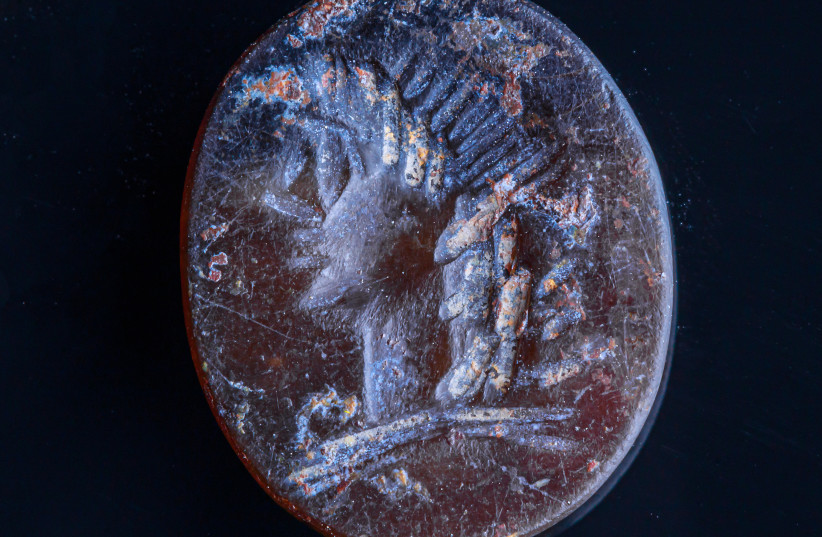
Seal with the image of Apollo. / (photo credit: ELIYAHU YANAI/CITY OF DAVID)

Researchers discovered a gem seal featuring a portrait of Apollo in the drainage channel of the City of David late last month. It was found in archaeological soil that was removed from the foundations of the Western Wall during work on the Archaeological Sifting Project in Tzurim Valley National Park.

The excavations were carried out under the auspices of the City of David and the Israel Nature and Parks Authority.
The gem features an engraved portrait of the god Apollo. According to researchers, this surprising and rare find is only the third secured gem sealing (intaglio) from the Second Temple period to have been discovered in Jerusalem.

The gem is cut from dark brown jasper and has remnants of light yellow, brown and white layers. In antiquity, jasper was considered a precious stone. The gem sealing was embedded in a ring, and it dates from the first century CE (Second Temple period).

The oval-shaped gem is 13 mm. long, 11 mm. wide and 3 mm. thick. Because it is an intaglio – having a design carved into the upper side of the stone – its main function was a seal to be stamped on soft material, usually beeswax, for use as a personal sign ature on contracts, letters, wills, goods and bundles of money.

The intaglio features an engraving of Apollo’s head in profile to the left, with long hair flowing over a wide, pillar-like neck, large nose, thick lips and small, prominent chin. The hair is styled in a series of parallel lines directed to the apex and surrounded by a braid above the forehead. One line of hair marks a strand that covers the ear; long curls flow over part of the neck, reaching the left shoulder. Thin diagonal lines at the base of the head mark the upper end of the garment and the body.

Although Apollo is an Olympian deity of the Greek and Roman cultures, it is highly probable that the person wearing the ring with Apollo’s portrait was a Jew, according to the researchers, archaeologist Eli Shukron, Prof. Shua Amorai-Stark and senior archaeologist Malka Hershkovitz.

SHUKRON, who conducted the excavation in which the gem was found, said in a press release: “It is rare to find seal remains bearing the image of the god Apollo at sites identified with the Jewish population. To this day, two such gems [seals] have been found at Masada, another in Jerusalem inside an ossuary [burial box] in a Jewish tomb on Mount Scopus and the current gem that was discovered in close proximity to the Temple Mount.

“When we found the gem, we asked ourselves: ‘What is Apollo doing in Jerusalem? And why would a Jew wear a ring with the portrait of a foreign god?’ The answer to this, in our opinion, lies in the fact that the owner of the ring did so not as a ritual act that expresses religious belief, but as a means of making use of the impact that Apollo’s figure represents: light, purity, health and success.”

Amorai-Stark, a researcher of engraved gems, added: “At the end of the Second Temple period, the sun god Apollo was one of the most popular and revered deities in Eastern Mediterranean regions. Apollo was a god of manifold functions, meanings and epithets. Among Apollo’s spheres of responsibility, it is likely that association with sun and light – as well as with logic, reason, prophecy and healing – that fascinated some Jews, given that the element of light versus darkness was prominently present in the Jewish worldview in those days.”

“The fact that the craftsman of this gem left the yellow-golden and light brown layers on the god’s hair probably indicates a desire to emphasize the aspect of light in the god’s persona, as well as in the aura that surrounded his head,” he said. “The choice of a dark stone with yellow coloring of hair suggests that the creator or owner of this intaglio sought to emphasize the dichotomous aspect of light and darkness and/or their connectedness.”

The Archaeological Sifting Project at Tzurim Valley National Park, sponsored by the City of David and the Nature and National Parks Authority, is a large-scale archaeological project that offers the public an opportunity to experience and appreciate archaeological activity without the need for advanced training or specialized knowledge.

The sifting has been supervised closely by archaeologists. It allows participants to become “archaeologists for a day” as they process archaeological material unearthed in City of David excavations, where they often find ancient treasures. The findings discovered thus far in the project include an imprint of King Hezekiah, coins from different periods, arrowheads and jewelry.

Due to the current nationwide closure of tourist sites, the site is closed. But it will be reopened to the public as soon as conditions permit.


Zawartość publikowanych artykułów i materiałów nie reprezentuje poglądów ani opinii Reunion’68,
ani też webmastera Blogu Reunion’68, chyba ze jest to wyraźnie zaznaczone.
Twoje uwagi, linki, własne artykuły lub wiadomości prześlij na adres:
webmaster@reunion68.com


Israeli Athlete Makes History After Winning Two Medals in Europe

Israeli Athlete Makes History After Winning Two Medals in Europe

JNS.org


Israeli gymnast Artem Dolgopyat at the European Championships on Dec. 13, 2020. Photo: YouTube/Screenshot.

Israeli gymnast Artem Dolgopyat made history on Sunday, after winning the gold medal for the floor exercise at the European Championships, in addition to a bronze medal for vault with a score of 14.766.

Prime Minister Benjamin Netanyahu congratulated Dolgopyat on Twitter, saying “all citizens of Israel are proud of you.”

Israeli gymnast Alexander Myakinin later won the bronze medal on the high bar event, getting a score of 14.200.

The win puts the two athletes on a promising path for the Tokyo 2021 Olympic Games, adding to various other fields that Israel has made strides in, including judo and baseball.


Zawartość publikowanych artykułów i materiałów nie reprezentuje poglądów ani opinii Reunion’68,
ani też webmastera Blogu Reunion’68, chyba ze jest to wyraźnie zaznaczone.
Twoje uwagi, linki, własne artykuły lub wiadomości prześlij na adres:
webmaster@reunion68.com